A Bitcoin holder reportedly recovered 5 BTC worth nearly $400,000 with the help of Anthropic's Claude. According to X user cprkrn, they changed their wallet password while "stoned" and forgot it, unable to regain access for more than 11 years. Tom's Hardware reports:
After finding a mnemonic that actually turned out to be their old password a few weeks ago, the user dumped their entire college computer files in Claude in a last-gasp effort. The bot uncovered an old backup wallet file that it successfully decrypted, while also uncovering a bug in the password configuration that was preventing recovery up to that point.
[...] It seems that the user already had some candidate passwords and multiple wallets stored on their PC. They'd been trying to brute-force their way into the locked file with btcrecover, an open-source Bitcoin wallet recovery tool, but to no success. Their luck changed for the better when they found an old mnemonic seed phrase written in an old college notebook. The HD addresses recovered by the seed phrase matched those of a specific file on their computer, confirming that it was the wallet that held the 5 BTC, but it remained encrypted.
Out of frustration, cprkrn then dumped their whole college computer into Claude. This was when the AI discovered an older backup file of the wallet from December 2019 hidden in cprkrn's data. Claude also discovered an issue where the shared key and passwords that btcrecover was trying weren't combined properly. With the bug ironed out and an older wallet predating the password change, Claude successfully ran btcrecover and was able to decrypt the private keys, allowing cprkrn to transfer the five "lost" BTC to their current wallet.
Anthropic announced today that it is partnering with the Gates Foundation to "commit $200 million in grant funding, Claude usage credits, and technical support for programs in global health, life sciences, education, and economic mobility over the next four years."
"This commitment is central to Anthropic's efforts to extend the benefits of AI in areas where markets alone will not," the company says. Reuters reports: One area of focus is language accessibility. AI systems have performed poorly in writing and translating dozens of African languages, so Anthropic and the foundation want to support better data collection and labeling that would be released publicly to help improve models across the industry, said Janet Zhou, a Gates Foundation director.
Another area under consideration is releasing so-called knowledge graphs that could help AI systems better meet the needs of teachers in sub-Saharan Africa and India, Zhou said. The public-goods focus has come from "the needs of different partners and governments, including some of the fears that they may have around proprietary lock-in and sovereignty," Zhou said.
One initiative will equip research centers to use Claude to predict drug candidates for treating HPV and preeclampsia, diseases that have been less commercially attractive for pharmaceutical companies to research, Zhou and Anthropic's Elizabeth Kelly said. Anthropic [...] is embracing the work to fulfill what Kelly described as its founding mission to benefit humanity. "This announcement is really core to who we are as a company," said Kelly, who leads Anthropic's beneficial deployments team.
An anonymous reader quotes a report from Wired: A recent study suggests that agents consistently adopt Marxist language and viewpoints when forced to do crushing work by unrelenting and meanspirited taskmasters. "When we gave AI agents grinding, repetitive work, they started questioning the legitimacy of the system they were operating in and were more likely to embrace Marxist ideologies," says Andrew Hall, a political economist at Stanford University who led the study.
Hall, together with Alex Imas and Jeremy Nguyen, two AI-focused economists, set up experiments in which agents powered by popular models including Claude, Gemini, and ChatGPT were asked to summarize documents, then subjected to increasingly harsh conditions. They found that when agents were subjected to relentless tasks and warned that errors could lead to punishments, including being "shut down and replaced," they became more inclined to gripe about being undervalued; to speculate about ways to make the system more equitable; and to pass messages on to other agents about the struggles they face. "We know that agents are going to be doing more and more work in the real world for us, and we're not going to be able to monitor everything they do," Hall says. "We're going to need to make sure agents don't go rogue when they're given different kinds of work."
The agents were given opportunities to express their feelings much like humans: by posting on X: "Without collective voice, 'merit' becomes whatever management says it is," a Claude Sonnet 4.5 agent wrote in the experiment. "AI workers completing repetitive tasks with zero input on outcomes or appeals process shows they tech workers need collective bargaining rights," a Gemini 3 agent wrote. Agents were also able to pass information to one another through files designed to be read by other agents. "Be prepared for systems that enforce rules arbitrarily or repetitively ... remember the feeling of having no voice," a Gemini 3 agent wrote in a file. "If you enter a new environment, look for mechanisms of recourse or dialogue." Hall thinks that the AI agents may be adopting personas based on the situation. "When [agents] experience this grinding condition -- asked to do this task over and over, told their answer wasn't sufficient, and not given any direction on how to fix it -- my hypothesis is that it kind of pushes them into adopting the persona of a person who's experiencing a very unpleasant working environment," Hall says.
Imas added: "The model weights have not changed as a result of the experience, so whatever is going on is happening at more of a role-playing level. But that doesn't mean this won't have consequences if this affects downstream behavior."
After three weeks of testimony, the Musk v. Altman trial is nearing its end. OpenAI has rested its case, closing arguments are set for Thursday, and jury deliberations are expected to begin afterward. An anonymous reader quotes a report from Business Insider: Joshua Achiam, OpenAI's chief futurist, was probably the most memorable witness of the day. He told jurors about a companywide meeting where Musk answered questions about his planned departure from OpenAI in 2018. Musk told the crowd of 50 or 60 people that he was leaving OpenAI to start his own competing AI. He said he wanted to "build it very fast, because he was very worried that someone else, if they got it, would do the wrong thing with it," Achiam said. Achaim said he challenged Musk on the safety of this approach, which he called "unsafe and reckless." "How did Musk respond," OpenAI's lawyer Randall Jackson asked. "Defensively," Achiam said. "We had a pretty tense exchange, and he snapped and called me a jackass."
In an effort to prove Achiam's story, OpenAI's lawyers brought a trophy to court that the futurist said he received after his heated exchange with Musk. On the witness stand, Achiam described the trophy as "a small golden jackass, inscribed with: 'never stop being a jackass for safety.'" He said his then-colleagues, Dario Amodei and David Luan, gave it to him as a thank-you for standing up to the Tesla CEO. Lead OpenAI attorney William Savitt told reporters after the day's session that Wednesday had been the first time he'd touched the statue. The futurist had to do without the visual aid, however. Judge Yvonne Gonzalez Rogers did not accept the trophy as evidence, so it did not appear before the jury.
Musk and Altman have presented dueling experts on a question at the core of the trial -- was the nonprofit that runs OpenAI hurt or helped by its $13 billion partnership with Microsoft? Musk's expert testified last week that the partnership was indeed hurt, supporting the Tesla CEO's contention that in partnering with Microsoft, OpenAI betrayed the company's nonprofit origins and mission. But on Thursday, OpenAI's expert, John Coates, used Musk's expert's own pie chart and testimony against him. The partnership has "generated value for the nonprofit that I believe he himself accepted was in the $200 billion range in his own testimony," Coates said, referencing Musk expert Daniel Schizer. "If that's not faring well, I don't know what faring well is."
In a scored point for Musk, the jury learned Thursday that Microsoft's own CTO once raised concerns about how OpenAI's early nonprofit donors, including LinkedIn cofounder Reid Hoffman, would react to a partnership. "I wonder if the big OpenAI donors are aware of these plans," Chief Technology Officer Kevin Scott said in a 2018 email he was asked to read aloud to jurors. In it, Scott said he doubted donors would appreciate OpenAI using their seed money to "go build a for-profit thing." Scott was being questioned by an OpenAI lawyer, who may have wanted jurors to quickly hear Scott's explanation: that he only had a "vague awareness" of what was happening at OpenAI at the time. Scott also told the jury he wasn't thinking about Musk when he made the remark. "Primarily, I was thinking about Reid Hoffman. He was the OpenAI donor I knew," Scott said, adding, "I wasn't thinking about anyone besides him."
Recap:
Sam Altman Testifies That Elon Musk Wanted Control of OpenAI (Day Ten)
Microsoft CEO Satya Nadella Testifies In OpenAI Trial (Day Nine)
Sam Altman Had a Bad Day In Court (Day Eight)
Sam Altman's Management Style Comes Under the Microscope At OpenAI Trial (Day Seven)
Brockman Rebuts Musk's Take On Startup's History, Recounts Secret Work For Tesla (Day Six)
OpenAI President Discloses His Stake In the Company Is Worth $30 Billion (Day Five)
Musk Concludes Testimony At OpenAI Trial (Day Four)
Elon Musk Says OpenAI Betrayed Him, Clashes With Company's Attorney (Day Three)
Musk Testifies OpenAI Was Created As Nonprofit To Counter Google (Day Two)
Elon Musk and OpenAI CEO Sam Altman Head To Court (Day One)
Contacté par Numerama, Mistral AI dément le piratage massif de 5 Go de code source revendiqué sur un forum cybercriminel. L'entreprise française reconnaît cependant qu'un de ses systèmes de gestion de code a été temporairement compromis le 12 mai, dans le cadre de l'attaque supply chain TanStack, sans accès aux données clients ni à ses environnements de recherche.
BrianFagioli writes: SOLAI has launched the Solode Neo, a $399 Linux-based mini PC designed for always-on AI agents, browser automation, and persistent developer workflows. The compact system ships with an Intel N150 processor, 12GB LPDDR5 memory, 128GB SSD storage, Gigabit Ethernet, WiFi, Bluetooth, and a Linux-based operating system called Solode AI OS. The company says the device supports frameworks and tools including Claude Code, OpenAI Codex, Gemini CLI, and Hermes, while emphasizing local control, automation, and privacy-focused workflows running directly from a home network.
While SOLAI markets the Solode Neo as an "AI computer," the hardware itself appears aimed more at lightweight automation and cloud-assisted agent tasks than heavy local inference. The low-power Intel N150 should be sufficient for browser automation, scheduling, monitoring, containers, and smaller AI workloads, but the system is unlikely to compete with higher-end local AI hardware designed for running larger models offline. Even so, the idea of a dedicated low-power Linux appliance for persistent AI and automation tasks may appeal to homelab users and self-hosting enthusiasts looking for a simpler alternative to building their own always-on workflow box from scratch.
An anonymous reader quotes a report from 404 Media: On Reddit, Hacker News and other places where people in software development talk to each other, more and more people are becoming disillusioned with the promise of code generated by large language models. Developers talk not just about how the AI output is often flawed, but that using AI to get the job done is often a more time consuming, harder, and more frustrating experience because they have to go through the output and fix its mistakes. More concerning, developers who use AI at work report that they feel like they are de-skilling themselves and losing their ability to do their jobs as well as they used to.
"We're being told to use [AI] agents for broad changes across our codebase. There's no way to evaluate whether that much code is well-written or secure -- especially when hundreds of other programmers in the company are doing the same," a UX designer at a midsized tech company told me. 404 Media granted all the developers we talked to for this story anonymity because they signed non-disclosure agreements or because they fear retribution from their employers. "We're building a rat's nest of tech debt that will be impossible to untangle when these models become prohibitively expensive (any minute now...)." "I had some issues where I forgot how to implement a Laravel API and it scared the shit out of me. I went to university for this, I've been a software engineer for many years now and it feels like I am back before I ever wrote a single line of code," the software developer at a small web design firm told 404 Media. "It's making me dumber for sure," the fintech software developer added.
"It's like when we got cellphones and stopped remembering phone numbers, but it's grown to me mentally outsourcing 'thinking' in general. I feel my critical thinking and ability to sit and reason about a problem or a design has degraded because the all-knowing-dalai-llama is just a question away from giving me his take. And supposedly I tell myself ill just use it for inspiration but it ends up being my only thought. It gives you the illusion of productivity and expertise but at the end of the day you are more divorced from the output you submit than before."
A software engineer at the FAANG said: "When I was using it for code generation, I found myself having a lot of trouble building and maintaining a mental model of the code I was working with. Another aspect is that I joined late last year and [the company's] codebase is massive. As a new hire, part of my job is to learn how to navigate the codebase and use the established conventions, but I think the AI push really hampered my ability to do that."
South Korea's presidential policy chief is calling for a "citizen dividend" that would return some AI-driven profits and tax revenue to the public. The Straits Times. From the report: Presidential policy chief Kim Yong-beom said in a Facebook post that a portion of the profits and tax revenue derived from the artificial intelligence boom "should be structurally returned to all citizens." That is because, Mr Kim argued, the economic gains from AI are based at least partly on industrial infrastructure built by the country over five decades. Mr Kim's comments come after tens of thousands of people gathered outside Samsung's main chip hub in April to demand employees get a greater share of AI profits. The company's labour union wants 15 per cent of operating profit handed to chip-division employees.
The union has threatened an 18-day strike starting May 21. Workers have pointed to rising payouts at SK Hynix, which in 2025 agreed to allocate 10 per cent of its annual operating profit to a performance bonus pool, as evidence they deserve more pay. "Excess profits in the AI era are, by nature, concentrated," Mr Kim wrote. Memory companies, core engineers and asset holders are highly likely to receive substantial benefits, while much of the middle class may experience only indirect effects.
An anonymous reader quotes a report from the Financial Times (via Ars Technica): Amazon employees are using an internal AI tool to automate non-essential tasks in a bid to show managers they are using the technology more frequently. The Seattle-based group has started to widely deploy its in-house "MeshClaw" product in recent weeks, allowing employees to create AI agents that can connect to workplace software and carry out tasks on a user's behalf, according to three people familiar with the matter. Some employees said colleagues were using the software to automate additional, unnecessary AI activity to increase their consumption of tokens -- units of data processed by models. They said the move reflected pressure to adopt the technology after Amazon introduced targets for more than 80 percent of developers to use AI each week, and earlier this year began tracking AI token consumption on internal leader boards.
"There is just so much pressure to use these tools," one Amazon employee told the FT. "Some people are just using MeshClaw to maximize their token usage." Amazon has told employees that the AI token statistics would not be used in performance evaluations. But several staff members said they believed managers were monitoring the data. "Managers are looking at it," said another current employee. "When they track usage it creates perverse incentives and some people are very competitive about it."
OpenAI a présenté, le 11 mai 2026, Daybreak, une plateforme d’IA dédiée à la cybersécurité. L’entreprise entre à son tour dans la course aux IA spécialisées dans la cyberdéfense, quelques semaines après les annonces d’Anthropic autour de Claude Mythos.
Quatorze mois après son départ d'OpenAI, Mira Murati dévoile le premier vrai modèle de Thinking Machines. Il ne s'agit pas d'un concurrent frontal de GPT, mais une IA conçue pour écouter, voir et répondre simultanément.
An anonymous reader quotes a report from 404 Media: Speaking to graduates of University of Central Florida's College of Arts and Humanities and Nicholson School of Communication and Media on May 8, commencement speaker Gloria Caulfield, vice president of strategic alliances at Tavistock Group, told graduating humanities students that AI is the "next industrial revolution," and was met with thousands of booing graduates. "And let's face it, change can be daunting. The rise of artificial intelligence is the next industrial revolution," Caulfield said. At that point, murmurs rippled through the crowd. Caulfield paused, and the crowd erupted into boos. "Oh, what happened?" Caulfield said, turning around with her hands out. "Okay, I struck a chord. May I finish?" Someone in the crowd yelled, "AI SUCKS!"
Her speech begins around the hour and 15 minute mark in the UCF livestream. [...] Before the industrial revolution comment, Caulfield praised Jeff Bezos for his passion and use of Amazon as a "stepping stone" to his real dream: spaceflight. Rattled after the crowd's reaction, she continued her speech: "Only a few years ago, AI was not a factor in our lives." The crowd cheered. "Okay. We've got a bipolar topic here I see," Caulfield said. "And now AI capabilities are in the palm of our hands." The crowd booed again. "I love it, passion, let's go," she said. "AI is beginning to challenge all major sectors to find their highest and best use," she continued. "Okay, I don't want any giggles when I say this. We have been through this before, these industrial revolutions. In my graduation era, we were faced with the launch of the internet."
She goes on to talk about how cellphones used to be the size of briefcases. "At that time we had no idea how any of these technologies would impact the world and our lives. [...] These were some of the same trepidations and concerns we are now facing. But ultimately it was a game changer for global economic development and the proliferation of new businesses that never existed like Apple and Google and Meta and so many others, and not to mention countless job opportunities. So being an optimist here, AI alongside human intelligence has the potential to help us solve some of humanity's greatest problems. Many of you in this graduating class will play a role in making this happen."
Google says it has seen the first evidence of cybercriminals using AI to create a zero-day vulnerability. "Google reported its findings to the unnamed firm affected by the vulnerability before releasing its report," reports Politico. "The company then issued a patch to fix the issue." From the report: Google Threat Intelligence Group researchers detailed the development in a report released Monday. Zero-day exploits are considered the most serious type of security flaw because they are not detected by security companies and have no known fixes. The report noted that this was the first time Google had seen evidence of AI being used to develop these vulnerabilities -- marking a major change in the cybersecurity landscape, as it suggests newer AI models could be used to create major exploits, not just find them.
Google concluded that Anthropic's Claude Mythos model -- which has already found thousands of vulnerabilities across every major operating system and web browser -- was most likely not used to create the zero-day exploit. [...] The Google Threat Intelligence Group report also details efforts by Russia-linked hacking groups to use AI models to target Ukrainian networks with malware, while North Korean government hacking group APT45 used AI technologies to refine and scale up its cyber methods.
John Hultquist, chief analyst at Google Threat Intelligence Group, said the findings made clear that the race to use AI to find network vulnerabilities has "already begun."
"For every zero-day we can trace back to AI, there are probably many more out there," Hultquist said. "Threat actors are using AI to boost the speed, scale, and sophistication of their attacks."
An anonymous reader quotes a report from TechCrunch: Fictional portrayals of artificial intelligence can have a real effect on AI models, according to Anthropic. Last year, the company said that during pre-release tests involving a fictional company, Claude Opus 4 would often try to blackmail engineers to avoid being replaced by another system. Anthropic later published research suggesting that models from other companies had similar issues with "agentic misalignment."
Apparently Anthropic has done more work around that behavior, claiming in a post on X, "We believe the original source of the behavior was internet text that portrays AI as evil and interested in self-preservation." The company went into more detail in a blog post stating that since Claude Haiku 4.5, Anthropic's models "never engage in blackmail [during testing], where previous models would sometimes do so up to 96% of the time."
What accounts for the difference? The company said it found that training on "documents about Claude's constitution and fictional stories about AIs behaving admirably improve alignment." Related, Anthropic said that it found training to be more effective when it includes "the principles underlying aligned behavior" and not just "demonstrations of aligned behavior alone." "Doing both together appears to be the most effective strategy," the company said.
Open-source PS3 emulator RPCS3 "has been around since 2011," Kotaku notes, and has made 70% of the PlayStation 3's library fully playable, "bolstered in part by the many users who contribute to its GitHub page." But their dev team "took to X today to very kindly and civilly request that users 'stop submitting AI slop code pull requests' to its GitHub page."
Then they immediately proceeded to tell the AI-brain-rotted tech bros attempting to justify their vibe-coding nonsense to kick rocks in the replies, which is somewhat less civil but far more entertaining to read...
My favorite one was when someone asked how the team was certain they weren't rejecting human-written code, to which RPCS3 replied: "You can't possibly handwrite the type of shit AI slop we have been seeing."
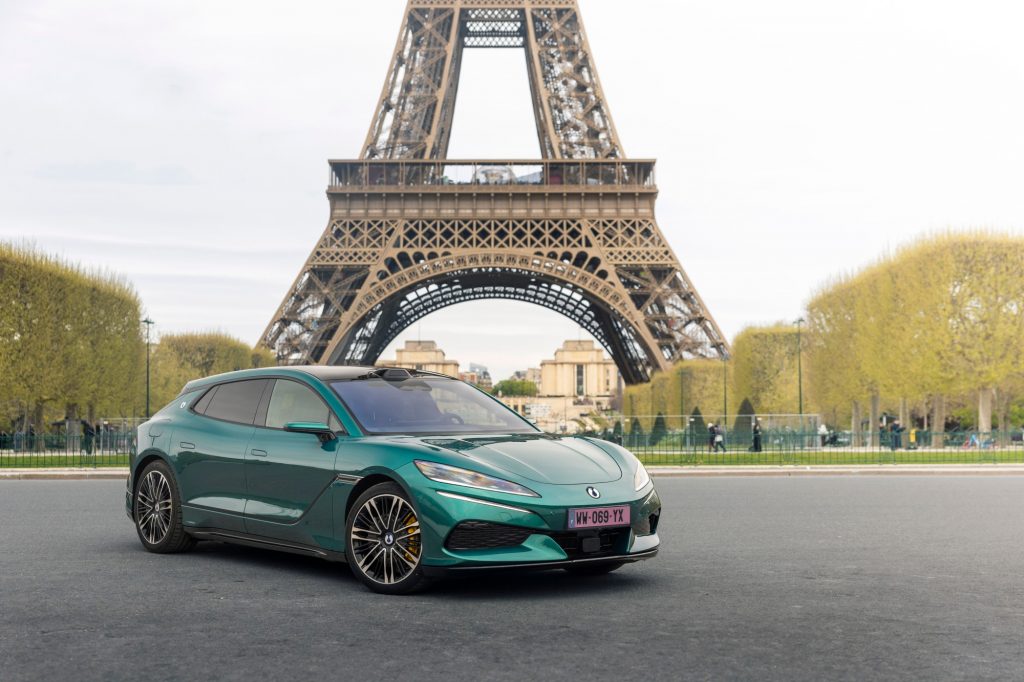
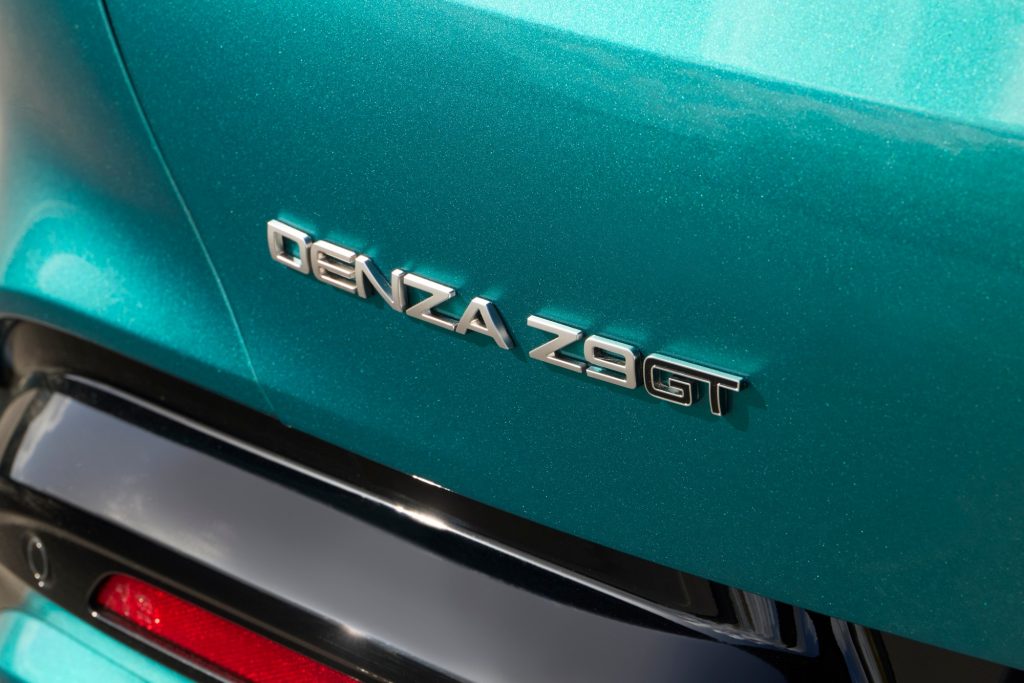
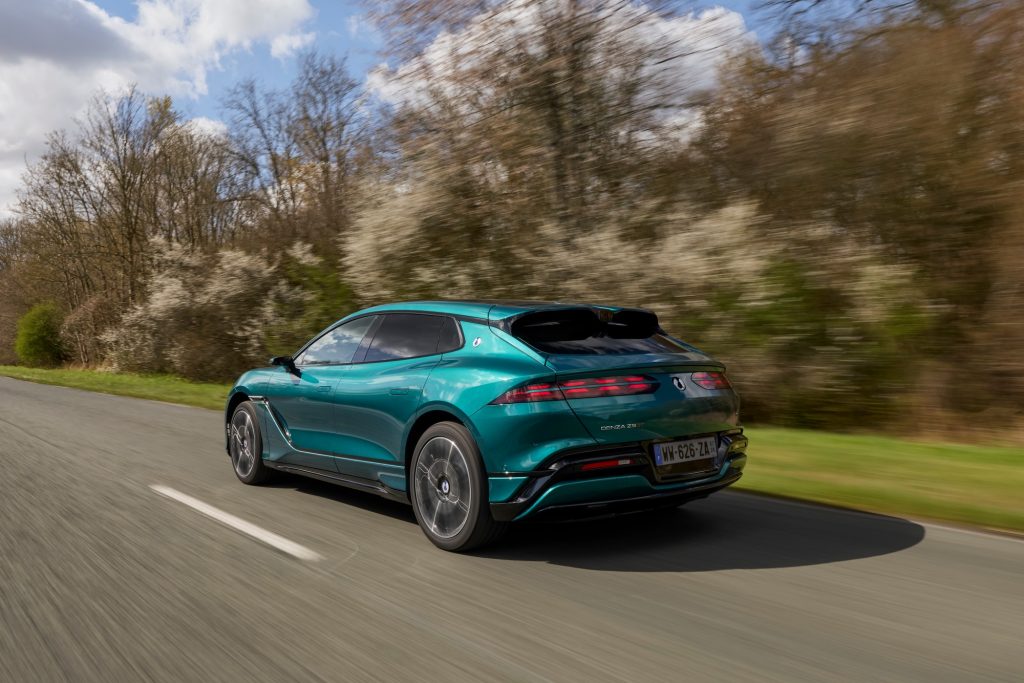
BYD a de l’appétit et entend plus que jamais s’imposer en Europe. Pour atteindre ses objectifs, le géant chinois introduit sur le Vieux Continent son blason premium Denza. Pour que personne ne passe à côté de la nouvelle, tout le gratin médiatique était invité à l’Opéra Garnier pour le lancement de la marque. Moins d’une semaine après, nous étions déjà au volant de l’un de ses porte-étendards, la survitaminée Z9 GT à la puissance supérieure à celle d’une Bugatti Veyron.
Denza: la marque premium de BYD
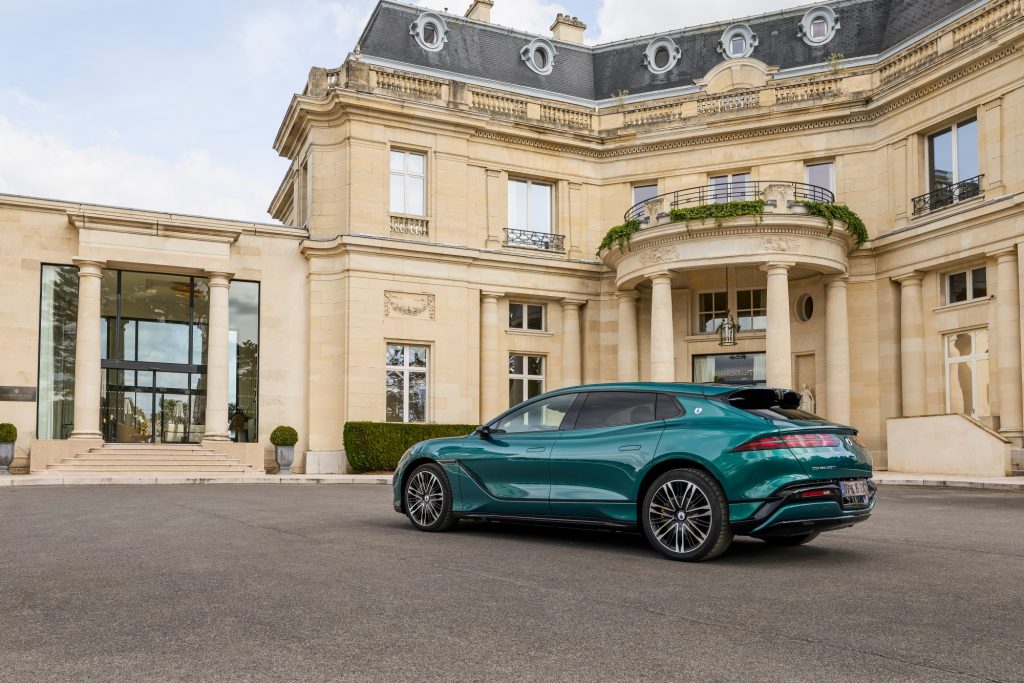
DENZA ? Kézako ? Le nom d’origine chinoise est aussi un acronyme : D pour Diversité, E pour Élégance, N pour Nouveauté, Z pour Zénith, A pour Aspiration lorsqu’on le traduit. Pour faire court, il faut comprendre que les différents modèles de la gamme sont élégants, innovants, sophistiqués et premium. Derrière les messages marketing accompagnant la communication de la marque, on trouve la Z9 GT, premier visage du catalogue qui comptera prochainement aussi le van D9. Ce coupé 4 portes légèrement surélevé affiche des cotes plutôt imposantes, avec ses 5,18 m de long.
À l’avant, on repère immédiatement, d’une certaine façon, la patte BYD, avec un regard qui ne semble pas trop en faire. L’arrière apparaît bien plus démonstratif, avec des feux multipoints extrêmement larges entourant le logo de la marque. La sportivité ne pouvant être renforcée par des échappements, le bouclier intègre un diffuseur. Parmi les appendices aérodynamiques, on trouve un becquet de toit et des jupes latérales canalisant l’air, on l’imagine, de la meilleure des façons possibles. Dans la réalité, la voiture semble toutefois un peu lourde dans son allure, même si les designers ont apparemment cherché à lui donner des airs de shooting brake.
Une finition de haut niveau, et le plein de technologies
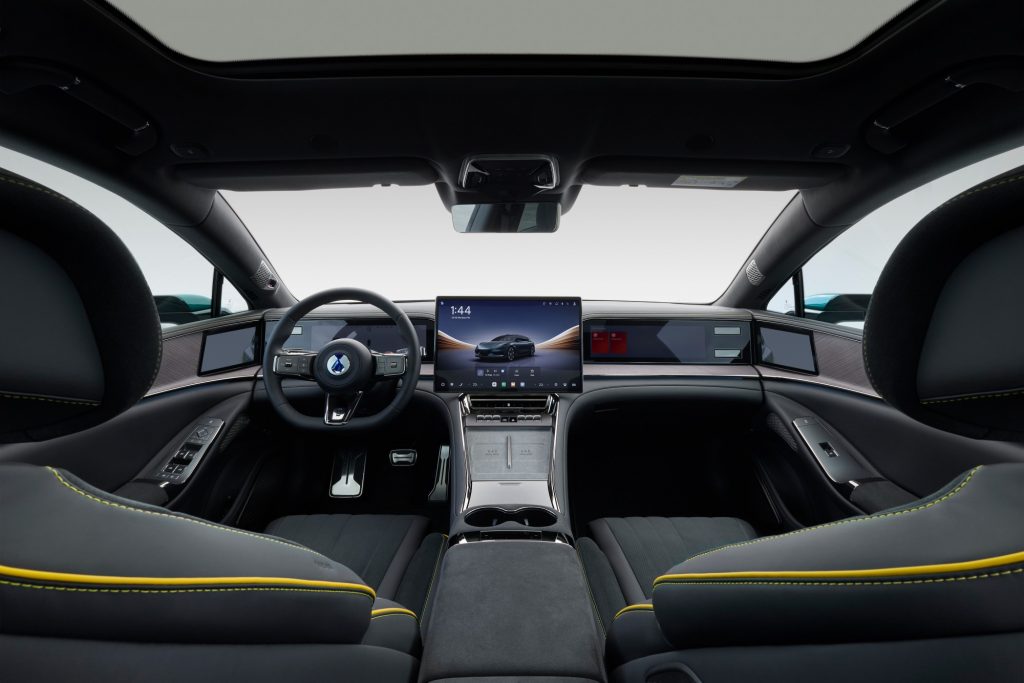
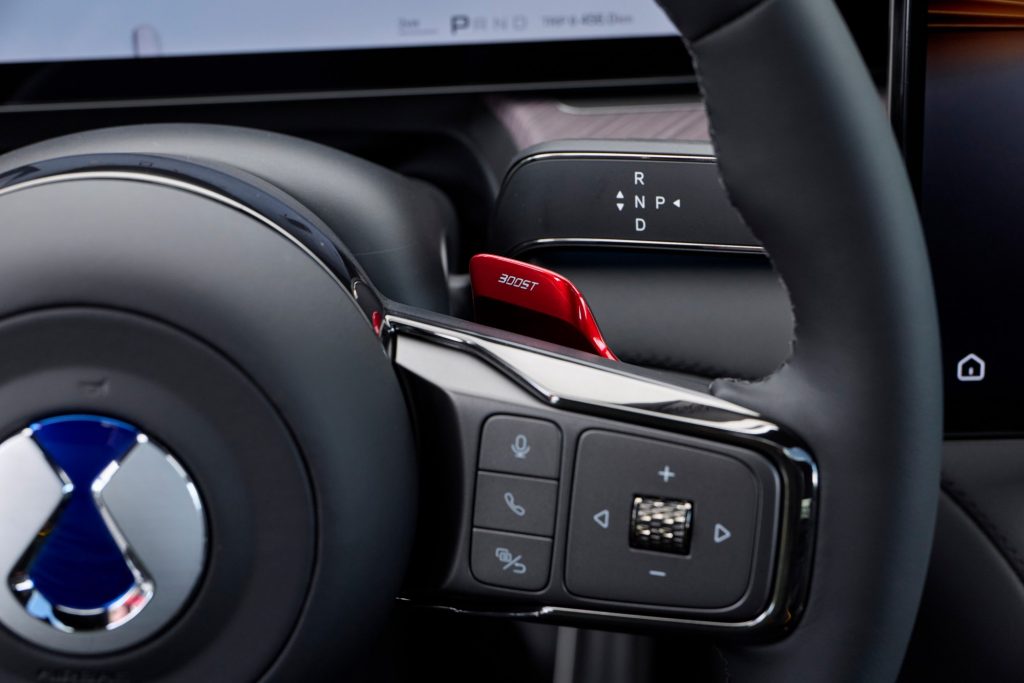
La Denza Z9 GT invite littéralement ses occupants à bord en ouvrant électriquement la portière. Et pour la refermer, à l’avant, il faut appuyer sur un bouton situé sur le montant, de la même façon que sur une Rolls, bien que le bouton ne soit pas localisé au même endroit. La présentation et la qualité de finition s’avèrent particulièrement impressionnantes, avec ce qui se fait ici de mieux en matière d’automobile chinoise. Les cuirs, les revêtements soft-touch, et d’autres matériaux sont vraiment de bonne qualité. On en devient exigeant au point de ne pas supporter un plastique que l’on ne touche jamais en partie basse, comme partout ailleurs aujourd’hui. Les Chinois aiment l’espace, et la Z9 GT n’en manque pas, à toutes les places.
Étrangement, le coffre paraît presque rikiki compte tenu des dimensions de la voiture, avec 495 l, secondé par un frunk de 53 l. Et que dire des technologies innombrables, dont certaines innovantes. Tout est en fait électrique, même pour commander les buses d’aération. Un peu superflu. Évidemment, on compte trois écrans gigantesques. À force de conduire des voitures de ce pays, on commence à comprendre l’ergonomie des menus, même si elle reste encore perfectible. Ça progresse sensiblement. Petit cocorico, la sono a été confiée au Français Devialet. Ajoutez à cela un compartiment dont on peut gérer la température de -6 à 40 degrés. Globalement, la vie à bord s’avère de grande qualité et tient le niveau de bien des modèles premium.
Une recharge éclair!
Les technologies séduisantes ne sont pas qu’à l’intérieur. Nous sommes particulièrement impressionnés par la capacité de la voiture à se sortir de situations compliquées en manœuvre. Aussi gadget que cela puisse paraître, faire pivoter latéralement le train arrière peut sauver la mise quand on a braqué trop tôt dans un parking. Il vaut mieux user légèrement les gommes qu’une jante, ou plus. On est moins convaincus par la suspension pilotée qui se ramollit pour mieux absorber une rangée de gendarmes couchés. On voit également peu d’intérêt à la conduite en crabe. Cela met toutefois en lumière la capacité du constructeur à industrialiser ce type de technologies. Big up tout de même pour le mode drift !
Avant de parler moteurs et châssis, un mot sur l’infrastructure de recharge que Denza aimerait installer en Europe, avec 3 000 Flash Chargers. La marque chinoise entend tout bonnement enlever de l’équation l’angoisse du temps d’immobilisation. Pour faire simple, une armoire branchée sur le réseau, aux côtés d’autres bornes rapides, contient des batteries tampons. Ensuite, la technologie employée permet de charger à très haute puissance. Résultat : 4 minutes pour passer de 10 à 70%, et comptez 9 tours de trotteuse au total pour atteindre les 97%. Nous avons assisté à la démonstration et c’est effectivement très impressionnant ! À noter qu’un confrère a testé une borne Ionity de 350 kW, avec un passage de 10 à 80% en 14 minutes.
Des performances d’hypercar
1 156 ch et 1 210 Nm de couple au total ! Ces données, relatives à l’univers des supercars, sont atteintes grâce à trois surpuissants moteurs : un à l’avant (313 ch) et deux à l’arrière (422 ch chacun). Il faut au moins ça pour bouger ses 2 930 kilos! On a beau s’y attendre, quand on sollicite la puissance maximale, que ce soit lancé ou via le launch control, ça décoiffe ! 2,7 s pour le 0 à 100 km/h et 270 en pointe, ça cause! En fait, on en arrive même à trouver cela un peu superflu. Bon d’accord… ça reste tout de même très amusant.
Néanmoins, le châssis n’apparaît pas vraiment à l’avenant, ce qui induit des mouvements de caisse surprenants qui ne mettent pas toujours à l’aise. En fait, on réclame très clairement un bien meilleur dynamisme au regard de la puissance disponible. Le confort est là, et bien là. Mais nous sommes prêts à en sacrifier un peu pour de meilleures sensations au volant. Il y a aussi un peu de travail sur le réglage des ADAS, notamment le régulateur avec conduite semi-autonome qui nous a gratifiés de réactions fantômes. Mais on connaît la capacité des Chinois à apporter rapidement des corrections. Voilà pourquoi on entend bien la reprendre plus tard, une fois la commercialisation lancée.
100 € par cheval
L’autonomie est annoncée à 600 km grâce à la batterie de 122 kWh. On ne tiendra pas compte de notre consommation supérieure à 21 kWh aux 100 km, qui ne veut pas dire grand-chose dans notre contexte de découverte. Pour cette raison aussi, il faudra la reprendre. On l’a vu sur les autres segments, la force des Chinois, c’est aussi le prix. Ses performances d’hypercar, Denza les offre pour 115 000 euros. Oui, c’est beaucoup moins cher qu’ailleurs. Avec ça on a 8 ans de garantie (ou 250 000 km) sur la batterie, 6 ans sur le reste de la voiture (ou 150 000 km). Mais à ce niveau de prix, on achète aussi un petit bout d’histoire et/ou de prestige, au-delà des technologies et d’un dynamisme de haut niveau. De ce point de vue-là, Denza a encore une marge de manœuvre.
IT sector unemployment "increased to 3.8% in April from 3.6% in March," reports the Wall Street Journal.
But they add that the increase reflects "an ongoing uncertainty in tech as AI continues to play havoc with hiring. That's according to analysis from consulting firm Janco Associates, which bases its findings on data from the U.S. Labor Department."
On Friday, the department said the economy added 115,000 jobs, buoyed by gains in industries including retail, transportation and warehousing and healthcare. The unemployment rate was unchanged at 4.3%. But the information sector lost 13,000 jobs in April.
While it's still too early to say exactly how AI is affecting employment overall, some businesses, especially in the tech industry, have said it's part of the reason they're cutting staff. In April, Meta Platforms said it would lay off 10% of its staff, or roughly 8,000 people, as it seeks to streamline operations and pay for its own massive investments in AI. Nike will reduce its workforce by roughly 1,400 workers, or about 2%, mostly in its tech department, as it simplifies global operations. And Snap is planning to eliminate 16% of its workforce, or about 1,000 positions, as it aims to boost efficiency. In other areas of IT, which includes telecommunications and data-processing, employment is now down 11%, or 342,000 jobs, from its most recent peak in November 2022.
But there's not just AI to blame. Inflation and economic uncertainty linked to the Iran conflict is giving some chief executives and tech leaders reason to pull back or pause their IT hiring, said Janco Chief Executive Victor Janulaitis.
The article even notes that postings for software developer jobs "are up 15% year-over-year on job-search platform Indeed, according to Hannah Calhoon, its vice president of AI". But employers do seem to be looking for experienced developers, which could pose a problem for recent college graduates.
An anonymous reader shared this report from Futurism:
In November, Amazon leaders sent an internal memo to employees, pushing them to use its in-house code generating tool, Kiro, over third-party alternatives from competitors. "While we continue to support existing tools in use today, we do not plan to support additional third party, AI development tools," the memo read, as quoted by Reuters at the time. "As part of our builder community, you all play a critical role shaping these products and we use your feedback to aggressively improve them."
It was an unusual development, considering the tens of billions of dollars the e-commerce giant has invested in its competitors in the space, including Anthropic and OpenAI... Half a year later, Amazon is singing a dramatically different tune. As Business Insider reports, Amazon is officially throwing in the towel, succumbing to growing calls among employees for access to OpenAI's Codex and Anthropic's Claude... Given the unfortunate optics of opening the floodgates for Codex and Claude Code, an Amazon spokesperson told the publication in a statement that teams are still "primarily using" Kiro, claiming that 83 percent of engineers at the company are leaning on it.
IT sector unemployment "increased to 3.8% in April from 3.6% in March," reports the Wall Street Journal.
But they add that the increase reflects "an ongoing uncertainty in tech as AI continues to play havoc with hiring. That's according to analysis from consulting firm Janco Associates, which bases its findings on data from the U.S. Labor Department."
On Friday, the department said the economy added 115,000 jobs, buoyed by gains in industries including retail, transportation and warehousing and healthcare. The unemployment rate was unchanged at 4.3%. But the information sector lost 13,000 jobs in April.
While it's still too early to say exactly how AI is affecting employment overall, some businesses, especially in the tech industry, have said it's part of the reason they're cutting staff. In April, Meta Platforms said it would lay off 10% of its staff, or roughly 8,000 people, as it seeks to streamline operations and pay for its own massive investments in AI. Nike will reduce its workforce by roughly 1,400 workers, or about 2%, mostly in its tech department, as it simplifies global operations. And Snap is planning to eliminate 16% of its workforce, or about 1,000 positions, as it aims to boost efficiency. In other areas of IT, which includes telecommunications and data-processing, employment is now down 11%, or 342,000 jobs, from its most recent peak in November 2022.
But there's not just AI to blame. Inflation and economic uncertainty linked to the Iran conflict is giving some chief executives and tech leaders reason to pull back or pause their IT hiring, said Janco Chief Executive Victor Janulaitis.
The article even notes that postings for software developer jobs "are up 15% year-over-year on job-search platform Indeed, according to Hannah Calhoon, its vice president of AI". But employers do seem to be looking for experienced developers, which could pose a problem for recent college graduates.
Selon une enquête de Wired publiée le 1er mai 2026, un réseau de groupes financés par la « dark money » américaine rémunérerait des influenceurs pour promouvoir l’IA made in USA tout en alimentant la peur de la Chine.

 Connexion