The Trump administration is reportedly considering an executive order to create a working group that could review advanced AI models before public release. The shift follows concerns over Anthropic's powerful Mythos model and its cyber capabilities, with officials weighing whether the government should get early access to frontier models without necessarily blocking their release. The New York Times reports: In meetings last week, White House officials told executives from Anthropic, Google and OpenAI about some of those plans, people briefed on the conversations said. The working group is likely to consider a number of oversight approaches, officials said. But a review process could be similar to one being developed in Britain, which has assigned several government bodies to ensure that A.I. models meet certain safety standards, people in the tech industry and the administration said.
The discussions signal a stark reversal in the Trump administration's approach to A.I. Since returning to office last year, Mr. Trump has been a major booster of the technology, which he has said is vital to winning the geopolitical contest against China. Among other moves, he swiftly rolled back a Biden administration regulatory process that asked A.I. developers to perform safety evaluations and report on A.I. models with potential military applications. "We're going to make this industry absolutely the top, because right now it's a beautiful baby that's born," Mr. Trump said of A.I. at an event in July. "We have to grow that baby and let that baby thrive. We can't stop it. We can't stop it with politics. We can't stop it with foolish rules and even stupid rules." Mr. Trump left room for some rules, but he added that "they have to be more brilliant than even the technology itself."
The White House wants to avoid any political repercussions if a devastating A.I.-enabled cyberattack were to occur, people in the tech industry and the administration said. The administration is also evaluating whether new A.I. models could yield cyber-capabilities that could be useful to the Pentagon and U.S. intelligence agencies, they said. To get ahead of models like Mythos, some officials are pushing for a review system that would give the government first access to A.I. models, but that would not block their release, people briefed on the talks said.
An anonymous reader quotes a report from 404 Media: A new, bipartisan bill introduced (PDF) by Democratic Senator of California Adam Schiff and endorsed by the biggest AI developers in the world -- including OpenAI, Google, and Microsoft -- would change the K-12 curriculum to shoehorn in "AI literacy," something that young people and teachers alike already hate in schools. The Literacy in Future Technologies Artificial Intelligence, or LIFT AI Act, would empower the new director of the National Science Foundation (NSF) to make grant awards "on a merit-reviewed, competitive basis to institutions of higher education or nonprofit organizations (or a consortium thereof) to support research activities to develop educational curricula, instructional material, teacher professional development, and evaluation methods for AI literacy at the K-12 level," the bill says.
It defines AI literacy as using AI; specifically, "having the age-appropriate knowledge and ability to use artificial intelligence effectively, to critically interpret outputs, to solve problems in an AI-enabled world, and to mitigate potential risks." The bill is endorsed by the American Federation of Teachers, Google, OpenAI, Information Technology Industry Council, Software & Information Industry Association, Microsoft, and HP Inc. [...] The grant would support "AI literacy evaluation tools and resources for educators assessing proficiency in AI literacy," according to the bill. It would also fund "professional development courses and experiences in AI literacy," and the development of "hands-on learning tools to assist in developing and improving AI literacy." Most importantly for real-world implications, it would fund changing the existing curriculum "to incorporate AI literacy where appropriate, including responsible use of AI in learning."
An anonymous reader quotes a report from Bloomberg's Ashley Carman: Welcome to the modern era of podcasting in which thousands of new shows are released into the world every day with a sizable portion likely being AI-generated. Figuring out exactly which ones fall into that growing category is becoming more difficult just as the industry is starting to take this issue seriously. In only the past month or so, Amazon launched a feature that explains a product by generating a quasi-podcast, complete with co-hosts talking to each other and taking questions from users. Shout out to Business Insider reporter Katie Notopoulos for spotting this (and, naturally, demoing it with an adult diaper rash-cream). Not long ago, Nicholas Thompson, chief executive officer of the Atlantic, noted "podslop" dominated his Spotify search results when he typed in the word "Sora." This was around the time that OpenAI shut down its user-generated, AI-content-only app.
[...] All of which raises some big, difficult questions. For one, what should the listening platforms do about this incursion? As of right now, Apple Podcasts requires creators who generated a "material portion" of their show using AI to disclose it. The platform also bans misleading or deceptive content. Spotify hasn't published any specific guidelines around AI, though it maintains general rules around dangerous and misleading content. Where this conversation gets even trickier is when it comes to money. Many of these podcasts are hosted on at least one free service that allows programs to opt into their ad marketplace with zero barrier to entry, meaning these shows (and the hosting service) profit off every listen or download. Spreaker, a company owned by iHeartMedia, is the primary one to watch here. Though it tells users to disclose when they rely on AI, it still allows those shows to opt into its programmatic ad marketplace, which pays creators 60% of the revenue generated by the ads placed in their shows. It stands to reason that most of these thousands of shows don't reach many people. But in the aggregate, the ears and dollars could add up. Are the advertisers on board with being next to AI-generated content, some of which might be deemed "slop?" There's also the question of how to define "slop." Jackson of the Podcast Index and his co-host Adam Curry treat it as something listeners simply know when they hear it, while Alberto Betella, co-founder of RSS.com, defines it as "fully automated content with no human review."
Jeanine Wright, co-founder of Inception Point, rejects the debate altogether: "The people still talking about slop are still making 6-7 jokes," she said. "It's still yesterday's conversation."
Le procès entre Elon Musk et Sam Altman, qui pourrait bouleverser l'avenir d'OpenAI, va être diffusé en direct à partir de sa seconde semaine. Problème : le tribunal n'autorise qu'un flux audio. Il sera impossible de le regarder en vidéo.
A Wall Street Journal opinion piece warns of "a troubling trend" in AI's growth. "Rather than selling software, some AI companies are paying their partners to use it."
It cites OpenAI's $1.5 billion joint venture with private-equity firms, Anthropic's $200 million contribution to a private-equity firm joint venture, and Google's $750 million subsidization of Gemini's adoption by consulting firms. "These agreements muddy the distinction between a company's sound growth trajectory and artificial financial engineering."
[T]he scale and structure of the recent AI deals go beyond standard incentive mechanisms... When a seller pays customers to buy its products, it is unclear if its revenue growth reflects vibrant demand or a willingness to accept subsidies.
Slashdot reader destinyland writes:
This warning comes from a prominent figure in the investing community. For six years Robert Pozen was chairman of America's oldest mutual fund company, after five years at Fidelity. An advocate for corporate governance, he's currently a lecturer at MIT's business school (and the author of the book Remote Inc.: How to Thrive at Work...Wherever You Are). "As AI companies prepare initial public offerings, investors should scrutinize their numbers closely," Pozner writes, warning about "time-limited financial support".
"In evaluating AI sales figures, analysts should consider the distorted incentives that the recent financing deals create," writes Pozner:
Private-equity firms, enticed by promised returns, might demand rapid rollouts of AI products, rather than ensuring their orderly and safe development. Portfolio companies of private-equity firms may embrace AI tools not because they are needed but because adoption is mandated by their owners. Consultants may favor one set of AI models based on the subsidy instead of the merits.
If guarantees and subsidies are major factors in the rapid adoption of AI tools, investors should be skeptical of AI companies' revenue projections. Many of their customers enticed by consultants will stop paying full price when the financial incentives are gone. Many of the portfolio companies of private-equity firms could back away from selected AI tools once these joint ventures expire. The challenge with evaluating these AI financing deals is the lack of transparency. At present, AI vendors don't separate revenue driven by subsidies or joint ventures from standard sales.
The lesson from the telecom debacle is that financial engineering can obscure, for years, the difference between real customer demand and demand driven by incentives. When AI companies begin to finance their own product distribution, guaranteeing returns to investors and subsidizing sales, it's a signal for investors to dig deeper.
Investing in an AI company? Ask what percentage of enterprise revenue is coming from subsidized channels or joint ventures, Pozner suggests. And the renewal/retention rate for customers not supported by subsidies or joint ventures...
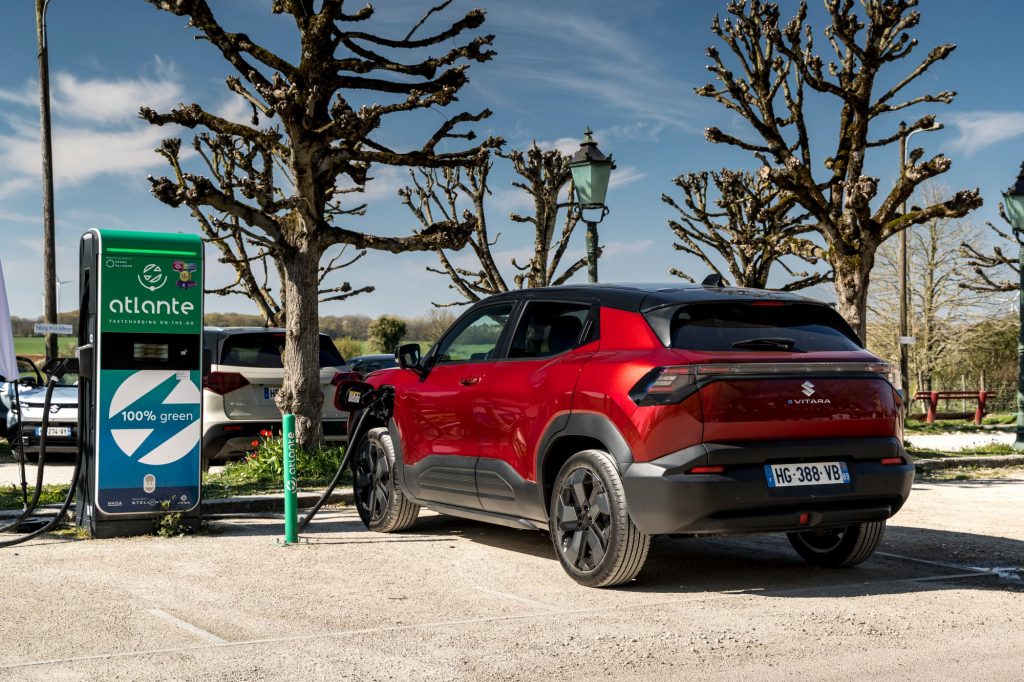
Elle s’est fait attendre, mais la voici maintenant disponible sur le marché français. Suzuki présente sa première voiture 100% électrique. Après une précédente rencontre dans un environnement contrôlé, nous l’avons conduite sur les jolies routes de la campagne bourguignonne, idéales pour se faire une bonne idée de ce que vaut l’e-Vitara.
Comme le concept-car
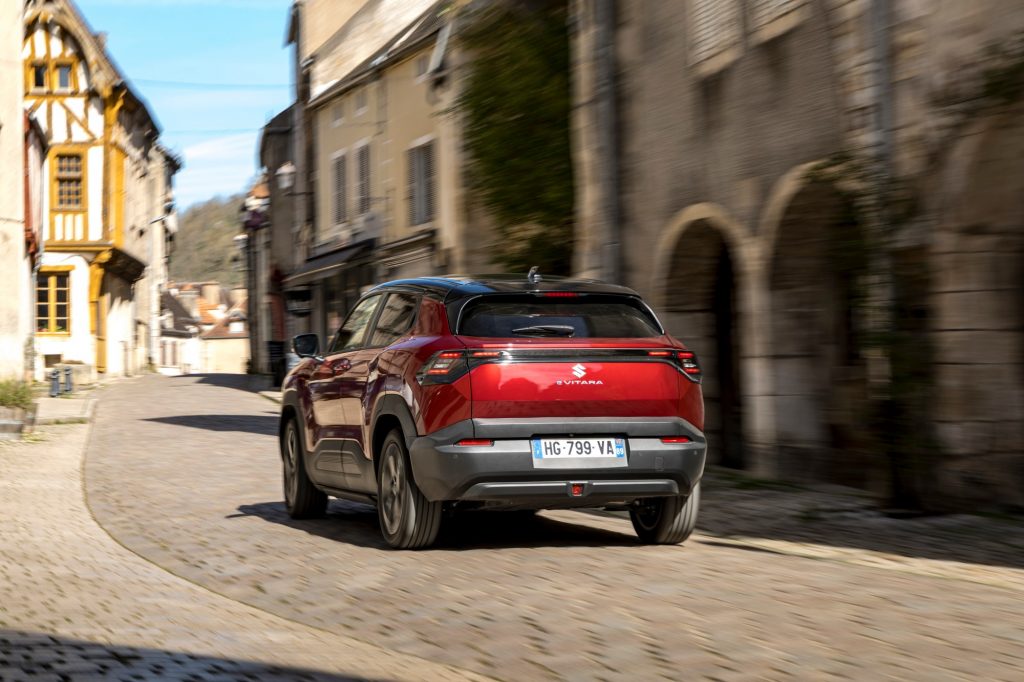
On a déjà à peu près tout dit sur le physique de la toute nouvelle Suzuki e-Vitara. Son design devait être en partie compatible avec celui de son cousin, l’Urban Cruiser. Pour faciliter son intégration dans le catalogue, le constructeur japonais s’est appuyé sur son best-seller, le Vitara, qui continue d’exister à ses côtés pour le moment. Il ressemble quasiment trait pour trait au concept-car qui l’a précédé. Il paraît à la fois robuste et plutôt moderne. Avec ses épaulements, il semble vouloir bousculer les autres sur la route.
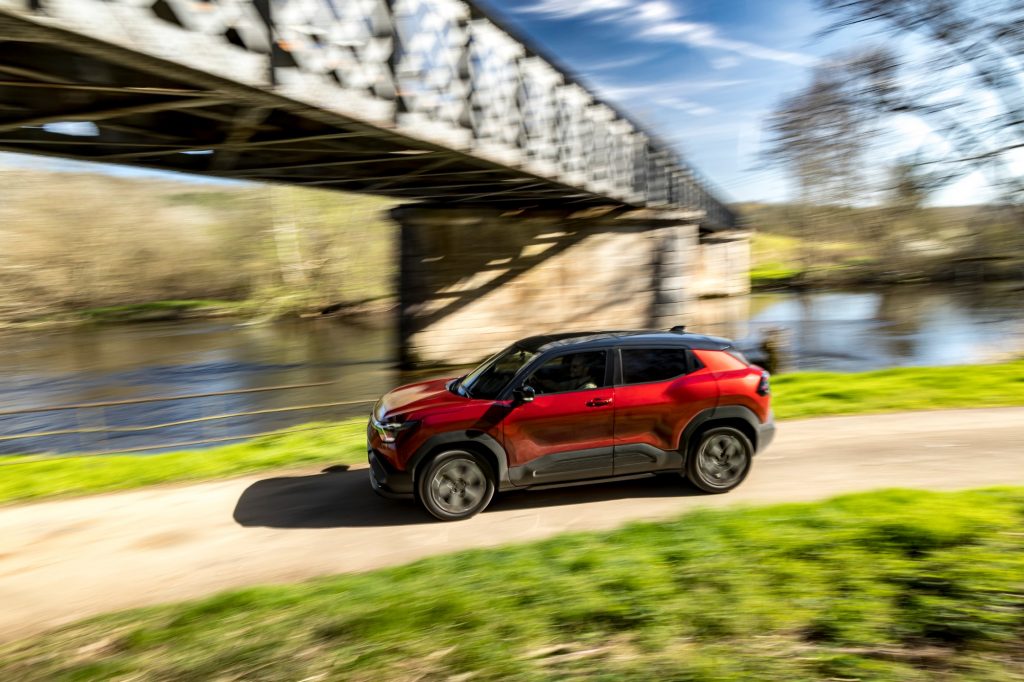
Ce SUV a une garde au sol relativement élevée, qui lui permet non seulement de franchir les trottoirs, mais aussi de s’aventurer parfois sur des chemins. Car, tout Suzuki qu’il est, il a droit aussi à une version à transmission intégrale, avec un moteur sur le train arrière sur la version AllGrip. Il a son petit look et, il faut bien l’avouer, il donne un sacré coup de vieux à son frère thermique, qui commence véritablement à accuser le poids des ans. La génération de ce dernier existe depuis 2015 et s’est, au passage, écoulée à plus de 54 000 exemplaires. On ne sait pas si c’est l’objectif que se fixe la marque pour l’e-Vitara.
Un intérieur de voiture, pas de vaisseau spatial
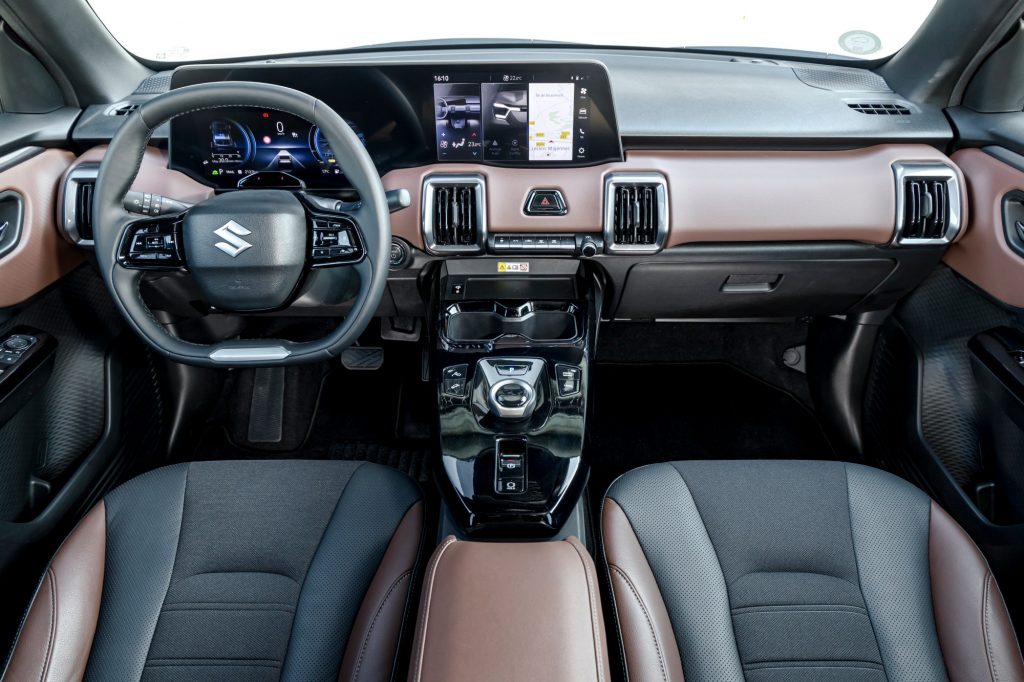
À bord, on retrouve cet intérieur que nous avions découvert l’an passé. Oui, Suzuki a pris son temps pour ajuster sa production dans son usine indienne. D’ailleurs, il précise que la pleine cadence n’interviendra pas avant juin. En tout cas, on évolue dans un environnement qui, ici aussi, marque l’écart avec l’autre Vitara. L’atmosphère s’avère plutôt moderne, avec une instrumentation 100% numérique. Quelques revêtements moussés rendent l’ambiance un peu plus chaleureuse. Pas d’écran XXL (Apple CarPlay/Android Auto embarqués), mais disons qu’il est à la bonne taille pour ne pas avoir à faire de grands gestes au moment de le manipuler. Un chargeur à induction, une prise USB-C et USB-A sont présents à l’avant.
Aussi bête que cela puisse paraître, Suzuki a agencé la plupart des commandes comme auparavant dans la plupart des voitures, avec des boutons physiques pour la gestion de la climatisation en premier lieu, et une molette rotative pour le son. Basique ? Loin s’en faut dans l’industrie automobile actuelle. On comprend assez rapidement où se trouvent la plupart des fonctions. On se sent bien à l’avant, et pas trop mal à l’arrière en ce qui concerne l’espace aux jambes. Méfiance tout de même, pour les grands gabarits, au niveau de la garde au toit. Le coffre dépasse à peine 300 litres, mais offre un plancher plat. On peut ajuster sa contenance grâce aux sièges coulissants sur 16 cm.
Temps de recharge long en DC
Après nos premiers tours de roues, on constate une régénération manifestement réglée sur un niveau intermédiaire. On cherche alors à la modifier. On se rappelle alors, lors d’une prise de contact avec un prototype l’an passé, avoir recommandé aux ingénieurs japonais un accès rapide à ce réglage. Malheureusement, ce n’est pas le cas : il faut passer par plusieurs étapes sur l’écran, et surtout être à l’arrêt pour choisir l’un des trois niveaux. Dommage ! Pour le reste, on profite, sur notre version deux roues motrices, d’un moteur de 128 kW (174 ch) couplé à une batterie de 61 kWh (LFP). La voiture ne manque pas d’entrain ; globalement, elle se comporte bien dans toutes les situations de conduite, que ce soit en ville ou sur route.
Néanmoins, on remarque assez rapidement que l’on doit utiliser le mode ECO et fluidifier sa conduite si l’on veut maintenir une consommation raisonnable. Cela se fait sans grande difficulté, mais on voit nettement la différence si on la mène tambour battant. Le chiffre WLTP dépassant les 400 km nous paraît plutôt optimiste. Cependant, il est probable qu’en faisant attention, elle s’approche des 300 km. Avec son chargeur embarqué de 11 kW, on peut espérer une recharge complète en un peu plus de 5 heures. Suzuki refuse de communiquer sur la puissance en courant continu, mais le constructeur annonce un temps de 45 minutes pour passer de 10 à 80%. Il va clairement falloir que cette donnée s’améliore par la suite.
Bon comportement routier
Même si la puissance paraît faible, notez que l’on peut préconditionner manuellement la batterie. Nul besoin, comme chez certains concurrents, de devoir obligatoirement entrer une destination dans le GPS. En tout cas, on ne passe pas un mauvais moment à son volant. La voiture se montre plutôt bien amortie, ce qui sert assez bien le confort. Son couple confortable lui assure notamment des reprises de bon aloi. On doit aussi son bon comportement routier à ses suspensions arrière multibras. Soyons clairs : elle n’a pas pour autant des accents de compacte sportive.
En se perdant sur quelques chemins ici et là, on apprécie la garde au sol de 18 cm. On se sentirait encore un peu plus à l’aise avec l’e-axle associé à la version AllGrip. Mais honnêtement, par temps sec, cela ne nous manque pas outre mesure. L’insonorisation à haute vitesse aurait mérité un peu plus de soin. Même si cela ne s’avère pas trop gênant, on l’a tout de même remarqué. On oublie aussi son poids, proche des deux tonnes, qui ne se fait pas trop ressentir. Il se rappelle parfois à nous lorsque l’on rebondit sur une imperfection du bitume que l’on n’aurait pas anticipée.
Un rare SUV compact électrique 4X4
D’entrée de jeu, se sachant désavantagé en Europe à cause de son assemblage en Inde, l’e-Vitara bénéficie d’une ristourne maison de 4 000 € à son lancement. Ses tarifs vont de 32 500 à 40 800 € hors réduction constructeur. La version AllGrip à transmission intégrale se distingue comme l’une des rares 4×4 sur le segment. Au-delà de la garantie classique de 3 ans, elle peut grimper jusqu’à 10 ans si l’entretien est réalisé dans le réseau selon les préconisations. D’ailleurs, n’importe quelle Suzuki déjà vendue est éligible à cette garantie étendue, après un diagnostic de la marque. L’e-Vitara a mis du temps à arriver avec certaines qualités, mais il faudra progresser, notamment sur la recharge.
"Vibe coding just got a whole lot more adorable," writes Engadget:
OpenAI introduced AI-generated pets to the Codex app, its agentic tool that helps with coding. These "optional animated companions" don't do any coding themselves, but serve as a floating overlay that can tell you what Codex is working on, notify you when Codex completes a task or whether it needs your input on something. The new feature lets developers see Codex's active thread, without having to switch away from your current open app.
"The feature ships with eight built-in variations — including a cat and dog," reports Mashable. "But the more interesting play is the custom pet creator."
Users can prompt Codex directly to generate their own companion, then share it online. A quick scroll through the homepage reveals the community has already gotten to work. Current creations include Goku, Patrick Star, Microsoft's long-retired Clippy, OpenAI CEO Sam Altman, Anthropic CEO Dario Amodei, and — naturally — a goblin.
There's also Grogu, Dobby, a tiny Bob Rossi, and a "Doge-style Shiba Inu dog"...
The Associated Press reports:
On a March afternoon, artificial intelligence detected something resembling smoke on a camera feed from Arizona's Coconino National Forest. Human analysts verified it wasn't a cloud or dust, then alerted the state's forest service and largest electric utility. One of dozens of AI cameras installed for the utility Arizona Public Service had spotted early signs of what came to be known as the Diamond Fire. Firefighters raced to the scene and contained the blaze before it grew past 7 acres (2.8 hectares).
As record-breaking heat and an abysmal snowpack raise concerns about severe wildfires, states across the fire-prone West are adding AI to their wildfire detection toolbox, banking on the technology to help save lives and property. Arizona Public Service has nearly 40 active AI smoke-detection cameras and plans to have 71 by summer's end, and the state's fire agency has deployed seven of its own. Another utility, Xcel Energy in Colorado, has installed 126 and aims to have cameras in seven of the eight states it serves by year's end... ALERTCalifornia is a network of some 1,240 AI-enabled cameras across the Golden State that work similar to the system in Arizona....
Pano AI, whose technology combines high-definition camera feeds, satellite data and AI monitoring, has seen a growing interest in its cameras since launching in 2020. They've been deployed in Australia, Canada and 17 U.S. states, including Oregon, Washington and Texas... Last year, its technology detected 725 wildfires in the U.S., the company said... Cindy Kobold, an Arizona Public Service meteorologist, said the technology notifies them about 45 minutes faster on average than the first 911 call.

 Connexion