When you use DPReview links to buy products, the site may earn a commission.
Bull elk take shelter in a morning fog while grazing the Grass Flat Tank meadow.
Nikon Z9 + Nikon Z 800mm F6.3 VR S | F6.3 | 1/25 sec | ISO 12800 Photo: Bill Ferris
Editor's note: This article launches a new series highlighting DPReview community members, their photography, and the gear they depend on. If you'd like to be featured in a future installment, please use the submission link at the bottom of this page.
DPReview community member and volunteer moderator Bill Ferris loves wildlife and the outdoors. A lot. By his own estimate, he spends about 150 days each year in the field, trading the comforts of home for pre-dawn conditions in the Arizona high country. The result of his dedication is a portfolio of spectacular images born of persistence and patience.
We asked Bill to take us into his world, including his beginnings in photography, his photographic process, and what gear he relies on to get the job done.
Getting started
Like many of us, Bill's obsession with photography was sparked by family members and the work of other photographers.
"My father used to present slide shows from his backpacking trips. His photos took me to places and revealed experiences I dreamed of. He passed away too early in 1981."
"I recall the day I saw "Afghan Girl" on the cover of National Geographic magazine. I looked at and studied that face for hours. Those eyes."
Three bald eagles enjoy the sunrise while perched near northern Arizona's Lower Lake Mary.
Nikon D500 + Nikon 200-500mm F5.6E VR | F8 | 1/2000 sec | ISO 640 Photo: Bill Ferris
"My interest in photography took a back seat to college and work until 1993. That was when I bought my first camera, a used Nikon F3 film body. I remember how it felt in my hands in the camera store. It had brassing, nicks and scratches. She was rough around the edges, but perfect. I imagined the F3 had been used by a photojournalist to cover wars. I used that camera and a small collection of lenses to do photography on vacations and a little night sky photography."
Shooting in the Arizona high country
Based in Flagstaff, Arizona, Bill has turned the surrounding high country into his personal studio, focusing on wildlife, including large mammals and raptors.
"I spend a lot of time driving Lake Mary Rd. It's a two-lane asphalt that cuts a path through the Coconino National Forest, heading southeast from Flagstaff past Lower and Upper Lake Mary to Mormon Lake and beyond."
Bill's photography has made waves in his home state of Arizona, where the Arizona Game and Fish Department produced this video about his work.
Video: Arizona Game and Fish Department
"My subjects include elk, pronghorn, mule deer, coyotes and other mammals. When it comes to birds, my favorite subjects are raptors. Mormon Lake overlook is home to a wide variety of species: bald and golden eagles, red-tailed hawks, northern harriers, ferruginous and rough-legged hawks, peregrine and prairie falcons, American kestrels, and turkey vultures."
Photographing these subjects requires more than just a long lens. It means getting up early and being familiar with his subjects.
"Photographing these subjects requires more than just a long lens. It means getting up early and being familiar with his subjects."
"Lower Lake Mary is usually a dry lakebed and a favorite grazing spot for the area elk and pronghorn. From May through September, I'll leave the house a couple of hours before sunrise, drive to a gravel pullout along Lake Mary Rd, park and walk in darkness across the lakebed to set up at the edge of the forest. Often, I'll sit with my back against a juniper tree, concealed beneath a LensCoat fabric photo hide with my camera on a gimbal head tripod."
A Red-tailed hawk soars past Bill's lens.
Nikon D610 + Nikon 200-500mm F5.6E VR | F5.6 | 1/2000 sec | ISO 1100 Photo: Bill Ferris
"Whether photographing wildlife or birds, I prefer locations where the Sun will be at my back and with water nearby. Food and water meet the animals' needs. Open fields address my preference for clean surroundings and backgrounds."
Beyond camera skills, Bill attributes his success to a keen understanding of his subjects' behavior, gained through years of observation.
"Beyond camera skills, Bill attributes his success to a keen understanding of his subjects' behavior, gained through years of observation."
"I've learned over the last decade that raptors like to ride the prevailing winds out of the west and southwest, soaring along the rim to hunt the dry lakebed below. While red-tailed and most other hawk species like to survey their hunting grounds from high above, northern harriers like to fly just above the tall grass of a field, looking and listening for the sounds of their prey."
"Harriers are a special favorite. They're wary of humans and, if you can get close, have such beautiful plumage and expressive faces."
What's in your bag?
Bill's photography kit is surprisingly lean, optimized for reach, mobility and blending in so as not to spook his subjects.
"From 2018 to 2024, my main wildlife and bird kit was a Nikon D500 paired with a Nikkor 200-500mm F5.6E VR. In May 2024, I treated myself to a retirement gift: an upgrade to a Nikon Z9 paired with a Nikkor 800mm F6.3 VR S prime lens."
Bill's camera bag is is the padded bag Nikon provided with his Nikkor 800mm F6.3 VR S prime lens. Other essential items in his kit include tripod, camp chair, blind and toiletry supplies for when nature calls.
Photo: Bill Ferris
"I chose this mirrorless system for a few reasons. Over the years, I've come to appreciate that photography is all about the glass. It's the lens that forms the image captured by the camera. The Nikkor 800mm PF is a unicorn. It's a long focal length prime lens that's handholdable and great in low light."
"When deciding what to upgrade to, I reviewed the best photos I'd made with the D500 and 200-500mm lens and found that 85% were made with the zoom at 450mm or greater focal length. Given that I routinely crop my photos, I concluded that 90% or more of my favorite images were made using a 750mm full-frame equivalent angle of view."
In addition to camera and lens, Bill carries a few key accessories, but keeps his kit mobile.
"I bring a Benro TMA38CL Mach3 carbon fiber tripod with a GH2 aluminum gimbal head for camera/lens support. That's in the left hand. In the right, I carry a Tragopan V6 photo blind. Atop that bag is a Coleman folding camp chair. I pack a LensCoat fabric photo hide inside the hide bag."
A mountain lion leaps over deadfall while evading a curious photographer in the Coconino National Forest. Bill captured this photo when the cougar suddenly emerged from the forest righ in front of him, raising his camera and firing off 15 exposures in two seconds. He admits it's not the greatest photo, but says it means a lot to him as it documents a close encounter with an apex predator.
Nikon D500 + Nikon 200-500mm F5.6E VR | F8 | 1/2000 sec | ISO 2000 Photo: Bill Ferris
"I keep camera accessories to a minimum. I stow a spare battery, Peak Design Slide camera strap, body and lens rear cap in the side pockets. I rarely use any of it, but it's nice to have just in case."
Bill also reminds us that sometimes the most critical piece of gear isn't a camera or a lens.
"Bill also reminds us that sometimes the most critical piece of gear isn't a camera or a lens."
"The most useful and essential accessory I bring – and I'll admit, we're entering the too much information zone with this one – is a quart ziplock bag containing four snack-size ziplocks. The snack-size ziplocks each contain four sheets of facial tissue," he tells us. "I'm often out from an hour or two before sunrise until 10 or 11 am. Nature is going to call, and one must be prepared. I bury the solid waste and pack home any used tissues for proper disposal."
Finally, Bill proves that sometimes, the best bag for carrying your camera is the one in the box.
A pronghorn and two fawns.
Nikon Z9 + Nikon Z 800mm F6.3 VR S | F6.3 | 1/200 sec | ISO 3200 Photo: Bill Ferris
"I use the padded nylon bag Nikon shipped with the 800mm F6.3 VR S as my camera bag. The Z9 with 800 PF attached fits in the bag. The strap slings over my head and across the opposite shoulder. I like it because it's the smallest, lightest option I have for carrying this gear, and it was free... with the $6K lens."
Bill's advice for other photographers
"Get out with your camera as often as possible. You'll never make a great photo unless you're out trying to make a great photo."
Would you like to be featured in a future installment of 'What's in your bag?' Tell us a bit about yourself and your photography by filling out this form. If you're selected for a feature, we'll be in touch with next steps.
In last week's Question of the week, our community eagerly awaited the arrival of 2026 with a healthy list of New Year's resolutions, ranging from committing to a better understanding of current gear to rethinking old habits. Many of you also said, "I need to slow down!" when preparing for that perfect shot. While a great opportunity doesn't always wait for us, it was clear from your resolutions that you felt it would help to take more time setting up the shot when possible.
Sharing your resolutions
For the resolutions quoted below, we aimed to showcase a variety of experiences and interesting stories. I was especially impressed with SJSNIKON's commitment to their photo collection of 60,000 images dedicated to Dutch cultural heritage. Nice work! And great job faunagraphy for capturing a great shot of that tiger without it capturing you first :-).
For the photos shared, we were able to include nearly all of the submissions. Thank you for including a photo with your responses when possible. It makes it a lot more fun when we can share them with your comments.
Read on for a spotlight selection of contributions, and then join our forum community to share your great photos and the stories they tell.
DaveZSmitty: I recently bought a refurbished D7500, and I'm getting used to using the back LCD to make my changes, unlike my D7000, which had a top screen behind the shutter button. So, I'm training my muscle memory for the new camera in 2026.
Minibike: I'm a primes guy, but I'm going to do the opposite and use zooms as my main lenses, with the goal of getting better at seeing compositions within a bigger scene and zooming in to isolate them. Also, be aggressive in deleting pointless photos. I think it was HCB who said something like, There is no salvage, there is only yes or no. If I stick to that philosophy, I'll have about five keepers in 2026 :).
Hike Pics: To sell/donate a LOT of my cameras, at least half of them. They are taking up way too much space in my studio. Funny thing is, I said the same exact thing early this year!
A wild opportunity to capture a great photo with a tiger.
Photo: Community member faunagraphy
faunagraphy: My New Year's resolution is to try to be less of a technical perfectionist. This goes against my nature - often, I am out in nature experiencing things that would be the envy of many people, and yet, I return home unhappy because my photos fall short of my idea of perfection. They could always be more detailed or sharper; perhaps the shutter speed was too low or too high, or perhaps my compositions should have been wider or tighter. If a photo is slightly out of focus, or slightly blurry, or without the max possible amount of detail, it's a "lost opportunity" - no matter how compelling a story it tells.
Satyaa: Figure out how to get good value from using my gear, without buying more gear that I "want" (not need).
RJSNIKON: Happy New Year, everybody! My New Year's resolution in the photographic field is to prepare my 60,000+ photo collection on Dutch cultural heritage for transfer into the collection of the cultural heritage organization where I work when I retire (in a few years).
Keith Cooper: Two related things - print more and print bigger, and produce at least one large print that stops people, makes them look, and prompts them to wonder how I did it. By large, I mean needing at least 64" roll paper.
A lonely tree on a grassy hill-top with the sun shining through.
Photo: Community member DuckShots
DuckShots: Funny you should ask, because I had just made a list. Tired of my wall hangings, which need a bit of freshening up with recent photos. I need to be more disciplined in shooting and filing self-portraits, something I do to maintain my skills in light of the absence of people who will sit for a portrait. I shoot every day, a practice I will maintain, but these shoots should include more exploration. No more books. I need to go back and review what I have.
dollarslice: Think about what else I can do with existing photography versus constantly feeling the need to go shoot more. Last year I put together a small book of black and white photos I've made, next I want to make one of my color work. I also desperately need to back up and organize all my files.
AfzalKhanVisuals: From 2026, I am planning to change a few things in my photography. These ideas are not entirely new, but they feel necessary. One thing is to push photography further into storytelling, not just images, but the art of stories. Stories of human behavior, fleeting moments, nature, and the quiet truth of being human.
Sam Bennett: I want to leave a more substantial "paper trail." So much of what I do is for social media - whether it's for myself or the venues that I work for. That's all well and good, but as I get older, I want to ensure that what I do is available in a tangible form. So I've started printing more - even if it's these tiny Instax prints. When I photograph bands, I typically finish processing the "quick picks" for the marketing team, so it's easy to print these out and hand them to the band.
Taken as a whole, these resolutions show that you are thinking strategically about what you want from your photography this year. There’s less emphasis on chasing perfection or new gear, and more on printing work, telling better stories, editing with purpose, and creating something that we can all admire.
Keep watch for the next Question of the week every other Wednesday to participate in this series. New questions are posted here on the homepage and in the forums. We can't wait to read and share your stories!
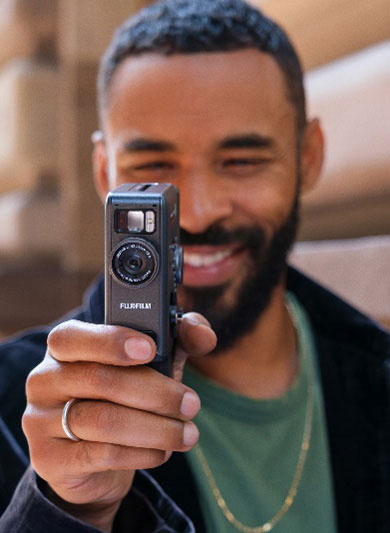
Fujifilm has announced a surprising addition to its popular Instax camera line: the Instax Mini Evo Cinema. The camera builds on Fujifilm's existing Evo lineup, which focuses on a hybrid of digital and instant film, adding the ability to record video. It offers a handful of unexpected features, including an "Eras Dial."
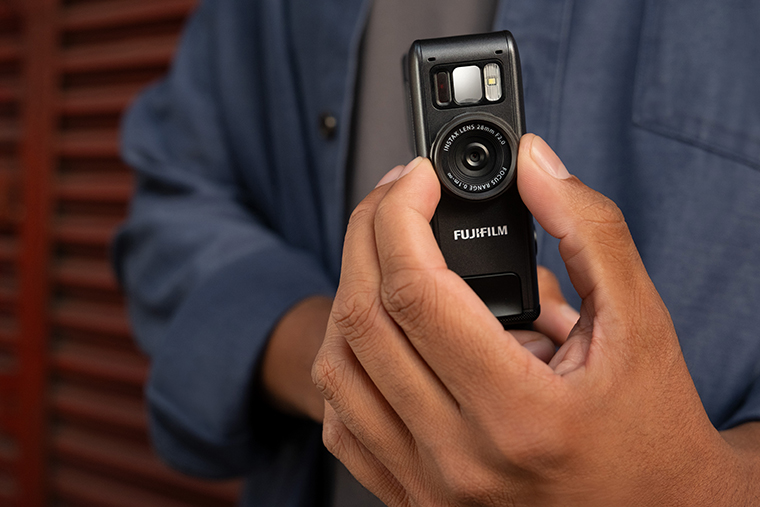
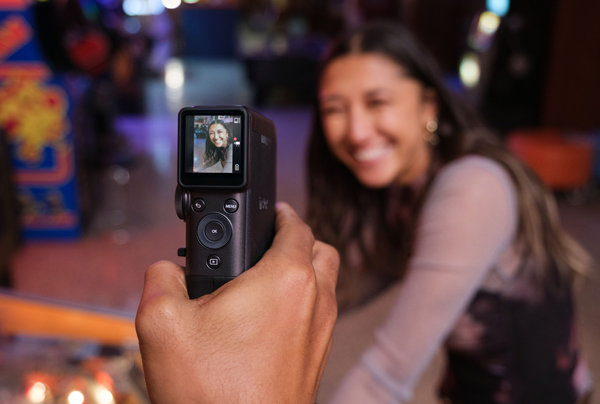
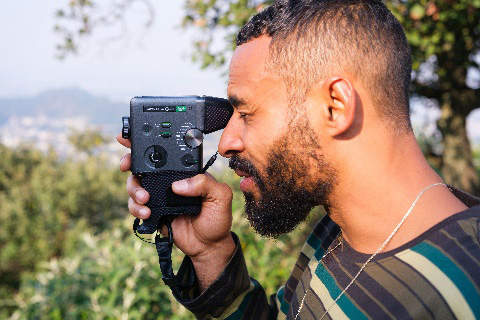
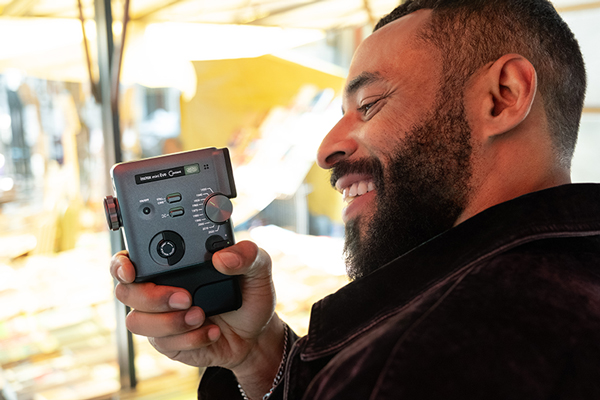
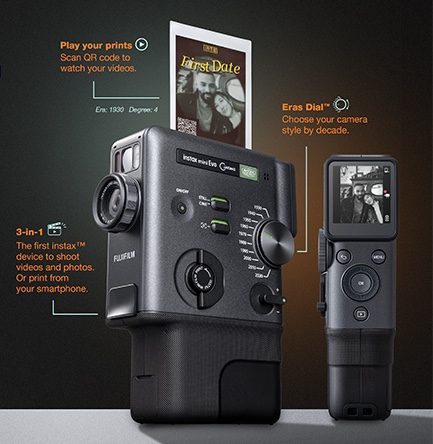
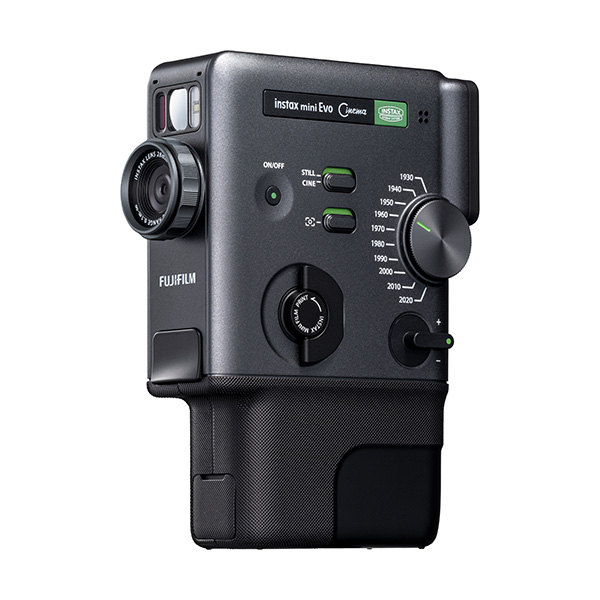
The Mini Evo Cinema features a design vaguely reminiscent of the Fujica Single-8 camcorder from the 1960s. It shares the vertical orientation and a trigger for recording video. You won't be recording feature-length films with it, though, as it's only capable of 15-second clips. You can view videos instantly on the small rear display, and then choose individual scenes to print to Instax film. The Instax prints also feature a QR code that allows you to play the video, though Fujifilm notes that it will only store videos on its servers for two years, so you'll want to be sure to download them before that time runs out.
When you print a still from a video, a QR code is added. Image: Fujifilm
Should you want to make the camera look even more retro, there's an optional viewfinder attachment that converts the small screen into an electronic viewfinder. There's also an attachment to make the grip more prominent, and a dedicated case.
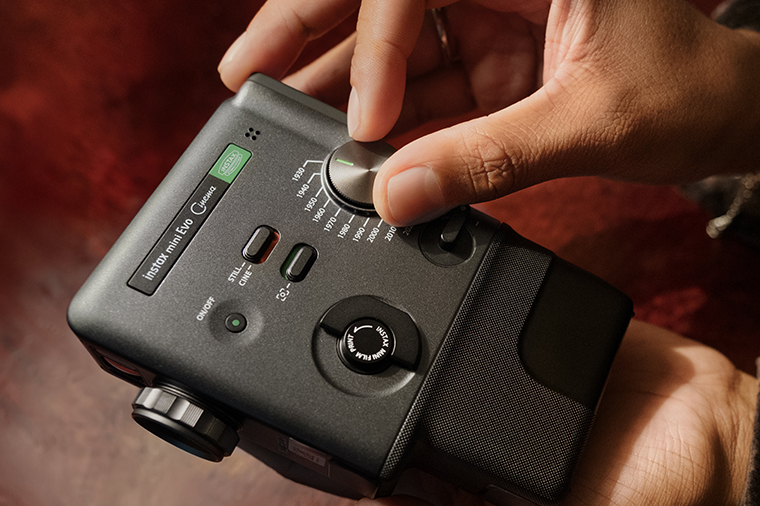
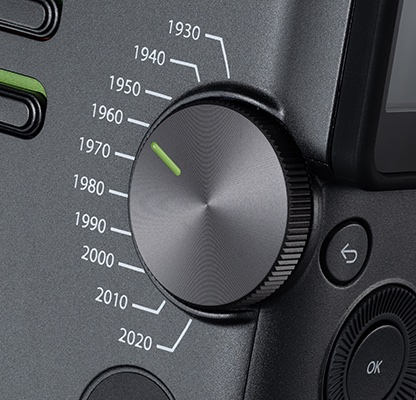
The camera also features an "Eras Dial" that would make Taylor Swift proud. It offers 10 different settings that change the look of the footage to recreate the feel of each era, spanning from 1930 to 2020. It also adds sounds, such as the whir of film reels, for a more complete experience. Each effect provides 10 levels of adjustment to fine-tune the result.
The "Eras Dial" allows you to change the look and sound of your videos. Image: Fujifilm
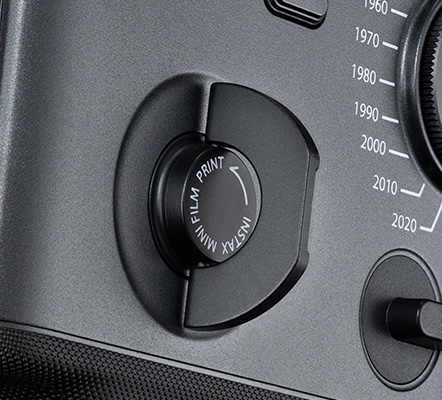
On the stills side of things, you trigger a print by using a lever that Fujifilm says is designed to evoke the feel of winding film. Like the other Evo cameras, you can print images you take with the camera like a traditional instant camera, or print photos from your smartphone.
There's a small display on the back of the camera. Image: Fujifilm
The camera is equipped with Wi-Fi and Bluetooth, and connects to the Instax app, which allows you to view photos and videos captured with the device. You can also combine video clips to create videos up to 30 seconds long with cinematic opening and ending templates. There are also poster templates for you to create movie posters by adding text.
The camera is only available in Japan, and is slated to go on sale January 30th. Fujifilm hasn't shared full specs – such as what size or resolution sensor the camera is using or battery life – or a price as of yet. For now, we'll have to wait on details, and to find out if it will be available elsewhere.
Press release:
Fujifilm Launches Hybrid Instant Camera "instax mini Evo Cinema™"
An instax™ that can capture videos and "hand them over" in instax™ print!
Enjoy a time-travel experience with "Eras Dial™" effects inspired by various eras!
TOKYO, January 7, 2026 - FUJIFILM Corporation announces the launch of the "instax mini Evo Cinema™" (mini Evo Cinema), a new model in the instax™ hybrid instant camera "Evo series". It will be available in Japan on January 30, 2026.
The "Evo Series" is a hybrid instant camera that allows users to take pictures with viewing the LCD monitor on the back of the camera and select their favorite shots to print, and enjoy an immersive photography experience with a variety of creative effects.
The mini Evo Cinema can capture both still images and videos. It converts captured video data into a QR code*1 and creates an instax™ print together with a still image cut out from the video, allowing users to "hand over a video". By turning videos into instax™ prints, users can not only preserve memorable moments spent with loved ones in tangible form, but also easily revisit the video anytime via the QR code.
As a new feature, the camera is equipped with the "Eras Dial™", which lets users experience effects inspired by different eras.10 "Eras Dial™" effects are available, including "1960" inspired by 8mm film cameras. Each effect has 10 adjustable levels, offering a total of 100 possible expressions. These effects capture the unique flavor of each era, letting users shoot extraordinary, special videos and still images with a sense of time travel.
The camera features a vertical grip design inspired by Fujifilm’s "FUJICA Single-8", an 8mm camera introduced in 1965. Its meticulously crafted design and analog operation enhance the enjoyment of shooting and printing.
The dedicated app*2 allows users to edit videos by combining clips and adding cinematic opening and ending templates, making it possible to create them more special. Furthermore, it features a "Direct Print Function" that lets users turn smartphone images into instax™ prints.
The mini Evo Cinema is a 3-in-1 camera that not only captures videos and still images but also functions as a smartphone printer.
Fujifilm will continue to expand the world of the instax™ instant photo system that allows people to enjoy on-the-spot photo printing.
Main Features of the "instax mini Evo Cinema™"
(1) Capture videos and hand them over as instax™ prints with QR codes
Capture videos up to 15 seconds long with simple controls—press and hold the shutter button to record, release to pause, and shoot multiple cuts with ease. Recorded videos can be reviewed instantly on the rear monitor, and users can select their favorite scenes to print as instax™ prints with a QR code for immediate sharing. By scanning the QR code with a smartphone, the video can be replayed with an instax™ frame or downloaded for easy posting on social media and sharing with friends.
(2) Features various "Eras Dial™" effects inspired by different eras
Featuring 10 "Eras Dial™" effects, such as "1960" inspired by 8mm film cameras of the 1960s and "1970", evoking the texture of color CRT televisions from the 1970s. In addition to visual textures, each effect incorporates subtle details such as noise and tape flutter to recreate the feel of the era. Each effect offers 10 adjustable degree levels, enabling a total of 100 unique expressions. Audio is also processed with "Eras Dial™" effects, adding distinctive sound characteristics, while certain effects even play nostalgic sounds—such as the whir of film reels—during shooting, creating an immersive experience that feels like stepping back in time.
(3) Design that enhances the shooting experience with a vertical Grip and analog feel
The camera body features a classic, premium design in black and gray, adopting a vertical grip style reminiscent of Fujifilm’s "FUJICA Single-8", the groundbreaking 8mm home movie system launched in 1965 that made everyday video recording accessible to everyone. Details such as the tactile "Eras Dial™", which delivers a satisfying click with every turn, and the "Print Lever," designed to evoke the feel of winding film by hand, add to the analog charm and expand the joy of shooting and printing.
Users can easily shoot while checking the rear monitor or enjoy an immersive experience by attaching the included viewfinder accessory. The grip attachment further improves handling, ensuring stable operation and allowing users to focus on capturing the perfect shot.
(4) Dedicated app for viewing and editing captured videos
The dedicated app allows users to view videos captured with mini Evo Cinema on their smartphones and combine multiple clips to create truly special content. In addition to Bluetooth, Wi-Fi connectivity is supported for faster transfers and the ability to preview and select videos or still images before sending.
In the gallery, users can browse and edit transferred videos and still images. Multiple clips can be combined into a single video of up to 30 seconds, with cinematic opening and ending templates available for added impact.
A "Poster Template" feature lets users design instax prints™ with a movie-poster look by adding titles and text for a personalized touch.
The "Direct Print" function enables printing of photos and favorite images stored on a smartphone directly with mini Evo Cinema. By linking with the dedicated app, mini Evo Cinema serves as a 3-in-1 device—capturing videos and still images while also functioning as a smartphone printer.
*1 QR Code is a registered trademark of Denso Wave Incorporated. After printing a instax™ print with a QR code, it is necessary to upload the video data to the server via the "instax mini Evo™" app. The download period for video data is two years from the time they are uploaded to the server via the dedicated smartphone app along with the captured images.
*2 A free app for Android and iOS devices. It is available for download from Google Play for Android devices and from App Store for iOS devices. Android and Google Play are trademarks or registered trademarks of Google Inc. iPhone and App Store are trademarks of Apple Inc. The iPhone trademark is used in Japan under license from Aiphone Co., Ltd. The iOS trademark is used under license from Cisco in the United States and other countries.
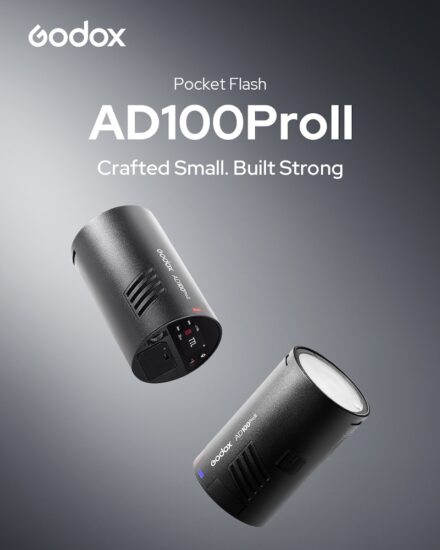
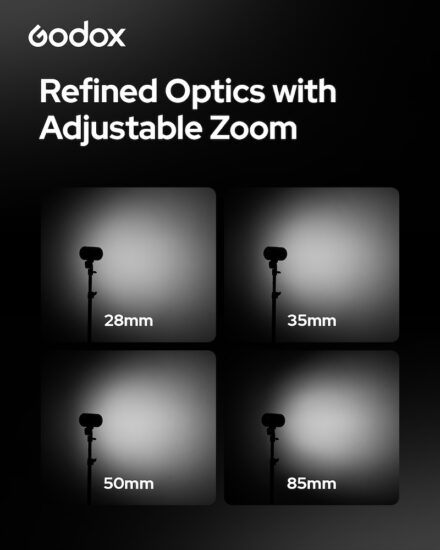
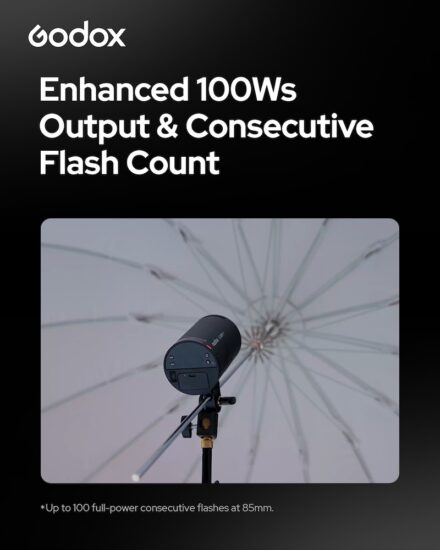
Godox has announced an update to its popular portable strobe, the AD100Pro II. The new model retains many of the well-regarded features of the original, while introducing worthy refinements such as an improved cooling system and updated wireless control.
Like the first iteration, the AD100Pro II delivers 100Ws of power, which can be adjusted in nine steps. However, Godox upgraded the cooling architecture of the flash, and it's now capable of 60 to 100 consecutive full-power flashes without overheating. It also features a higher-capacity 3300mAh battery (up from 2600mAh in the original), rated for up to 490 full-power flashes, and rechargeable via USB-C.
Godox added a group indicator light on the body of the flash, which uses 16 color options to indicate different groups during multi-light setups. The color-coded lights make it much easier to see which group a specific unit is assigned to at a glance, allowing for faster adjustments. A new full-color display on the back makes it easy to see and adjust settings. While the flash still uses the Godox 2.4GHz X wireless system, it now also supports 433 MHz connectivity. Godox also added compatibility with its new X3-series triggers, with quick-sync pairing with the X3 and X3Pro for faster setup time.
Despite the new features and larger battery, it's still very lightweight, coming in at 564g (1.2lbs). It's also still very compact, measuring 122.2 x 76.0 x 76.0mm (4.81 x 2.99 x 2.99"), making it easy to toss in a bag for shoots out of the studio.
Image: Godox
Otherwise, the AD100Pro II offers familiar features. It offers a recycle time that ranges from 0.01-1.5 seconds, depending on flash power. It supports TTL compatibility for automatic exposure, and with high-speed sync, you can shoot at shutter speeds as fast as 1/8000s. It also supports front and rear curtain sync. A built-in magnetic mount enables compatibility with Godox's round-head accessories, allowing for fast and versatile light modification. It offers a transmission range of 100m (328') and a 5W modeling lamp with 10 brightness levels.
The new Godox AD100Pro II is available for preorder now for $299 with an expected shipping date of January 27.
Fujifilm announces a new Instax Mini Evo cinema camera that also shoots video in Japan (check for availability at B&H Photo). Here are the main features of the Instax Mini Evo cinema camera:
Capture videos and hand them over as instax prints with QR codes
Features various “Eras Dial” effects inspired by different eras
Design that enhances the shooting experience with a vertical Grip and analog feel
Dedicated app for viewing and editing captured videos
Will be available in Japan on January 30, 2026.
Additional information:
The “Evo Series” is a hybrid instant camera that allows users to take pictures with viewing the LCD monitor on the back of the camera and select their favorite shots to print, and enjoy an immersive photography experience with a variety of creative effects.
The mini Evo Cinema can capture both still images and videos. It converts captured video data into a QR code*1 and creates an instax print together with a still image cut out from the video, allowing users to “hand over a video”. By turning videos into instax prints, users can not only preserve memorable moments spent with loved ones in tangible form, but also easily revisit the video anytime via the QR code.
As a new feature, the camera is equipped with the “Eras Dial”, which lets users experience effects inspired by different eras.10 “Eras Dial” effects are available, including “1960” inspired by 8mm film cameras. Each effect has 10 adjustable levels, offering a total of 100 possible expressions. These effects capture the unique flavor of each era, letting users shoot extraordinary, special videos and still images with a sense of time travel.
The camera features a vertical grip design inspired by Fujifilm’s “FUJICA Single-8”, an 8mm camera introduced in 1965. Its meticulously crafted design and analog operation enhance the enjoyment of shooting and printing. The dedicated app*2 allows users to edit videos by combining clips and adding cinematic opening and ending templates, making it possible to create them more special. Furthermore, it features a “Direct Print Function” that lets users turn smartphone images into instax prints. The mini Evo Cinema is a 3-in-1 camera that not only captures videos and still images but also functions as a smartphone printer.
When you use DPReview links to buy products, the site may earn a commission.
Photo: Mitchell Clark
Before the holidays, we put the Sony a7 V in front of our studio test scene to see for ourselves how good its dynamic range performance is. Now that we're fully into the swing of 2026, it's time to take a look at what our studio scene reveals about its image quality.
Our test scene is designed to simulate a variety of textures, colors, and detail types you'll encounter in the real world. It also has two illumination modes, full even light and low directional light, to see the effect of different lighting conditions.
Image Comparison
This widget is not optimized for RSS feed readers. Click here to open it in a new browser window / tab.
Comparing processed Raws at base ISO, the a7 V's 33MP sensor provides a similar level of detail to cameras with similar resolutions, such as its predecessor and Canon's EOS R6 III, while offering a bump up from its 24MP competitors. It does appear that Sony has slightly tweaked the formula for the camera's color response compared to the a7 IV, and we've found the JPEGs it puts out to be pleasing.
At high ISOs, the a7 V's Raws show a touch more noise than those of its competition, a trend that continues as you push your ISO higher, but its JPEG engine does a decent job of reducing noise while still retaining details. Its ISO range extends a stop higher than the Canon EOS R6 III's, but in most circumstances, this simply means you have a wider range of settings that provide an unusable image.
Overall, the a7 V's images are very similar to the a7 IV's, but its partially stacked sensor brings better low-ISO dynamic range and burst rates without any noticeable impact on image quality.
When you use DPReview links to buy products, the site may earn a commission.
Image: Nikon
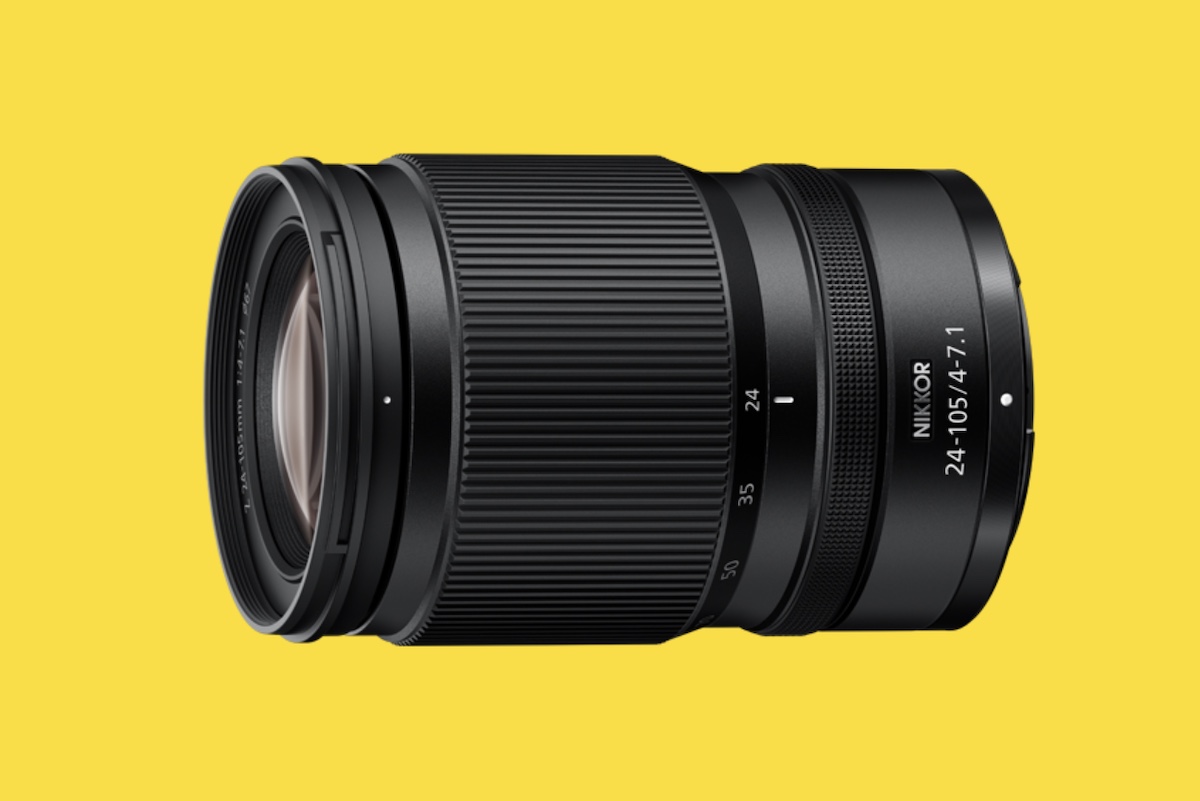
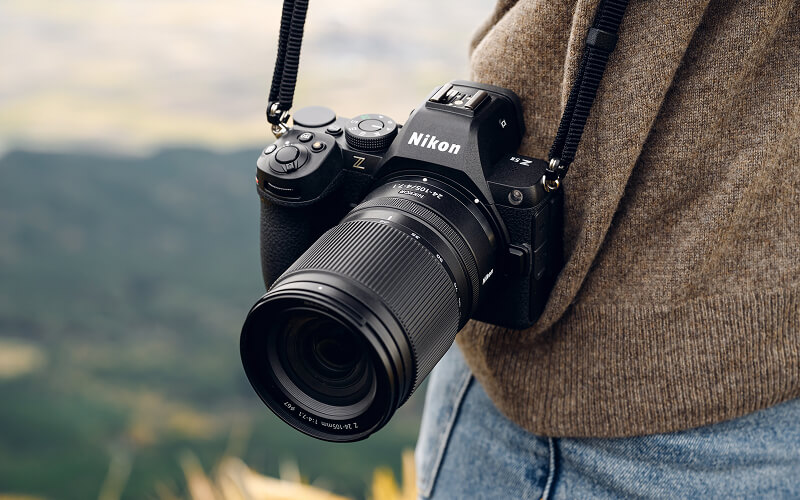
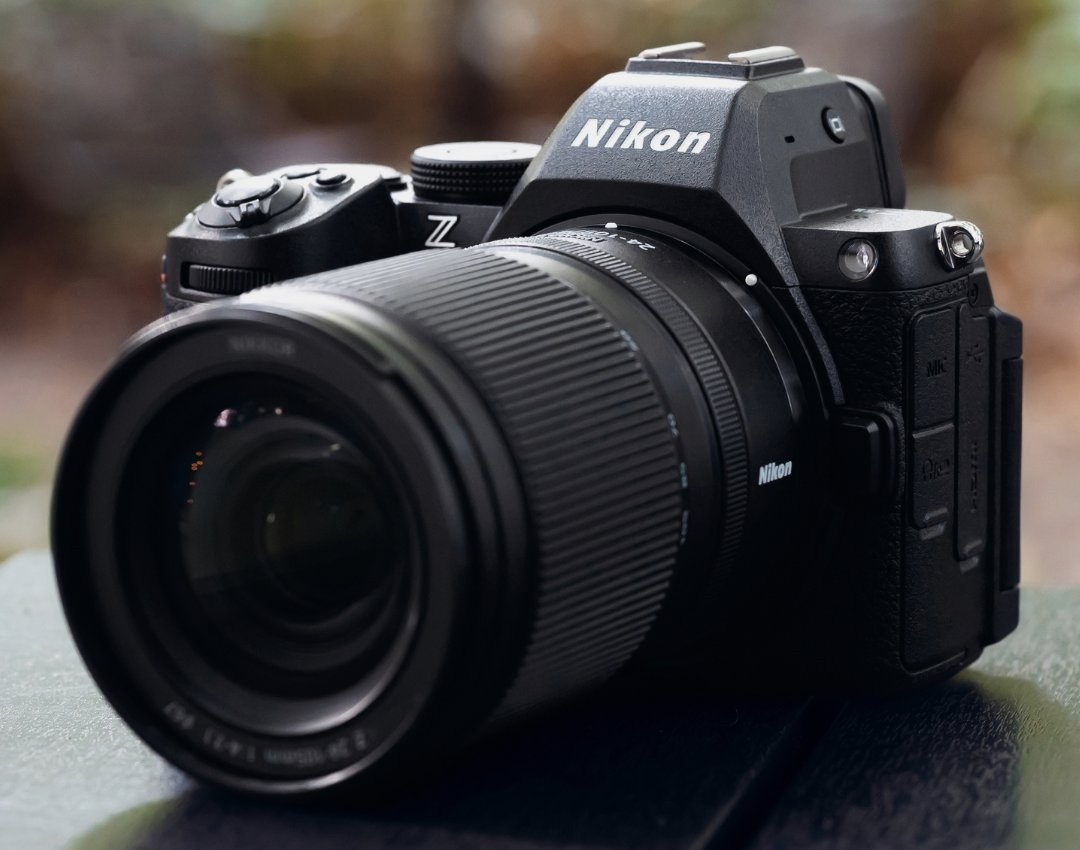
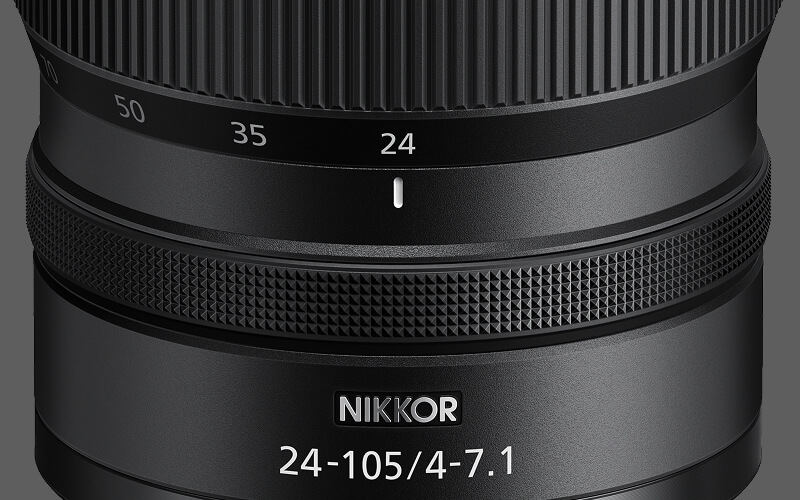
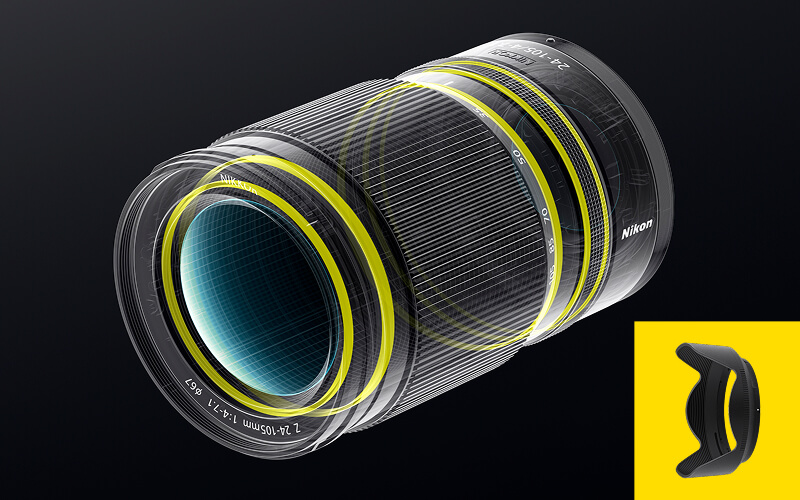
Nikon has announced the Nikkor Z 24-105mm F4-7.1, a budget zoom lens for its full frame cameras. It's designed to be lightweight and relatively compact, despite its relatively versatile focal range.
The lens is made up of 12 elements in 10 groups, with one ED element and two aspherical lenses. It has a minimum focusing distance of 0.2m (7.9") on the wide end, which increases to 0.28m 11") on the long end, which lets you obtain 0.5x reproduction from 70 to 105mm.
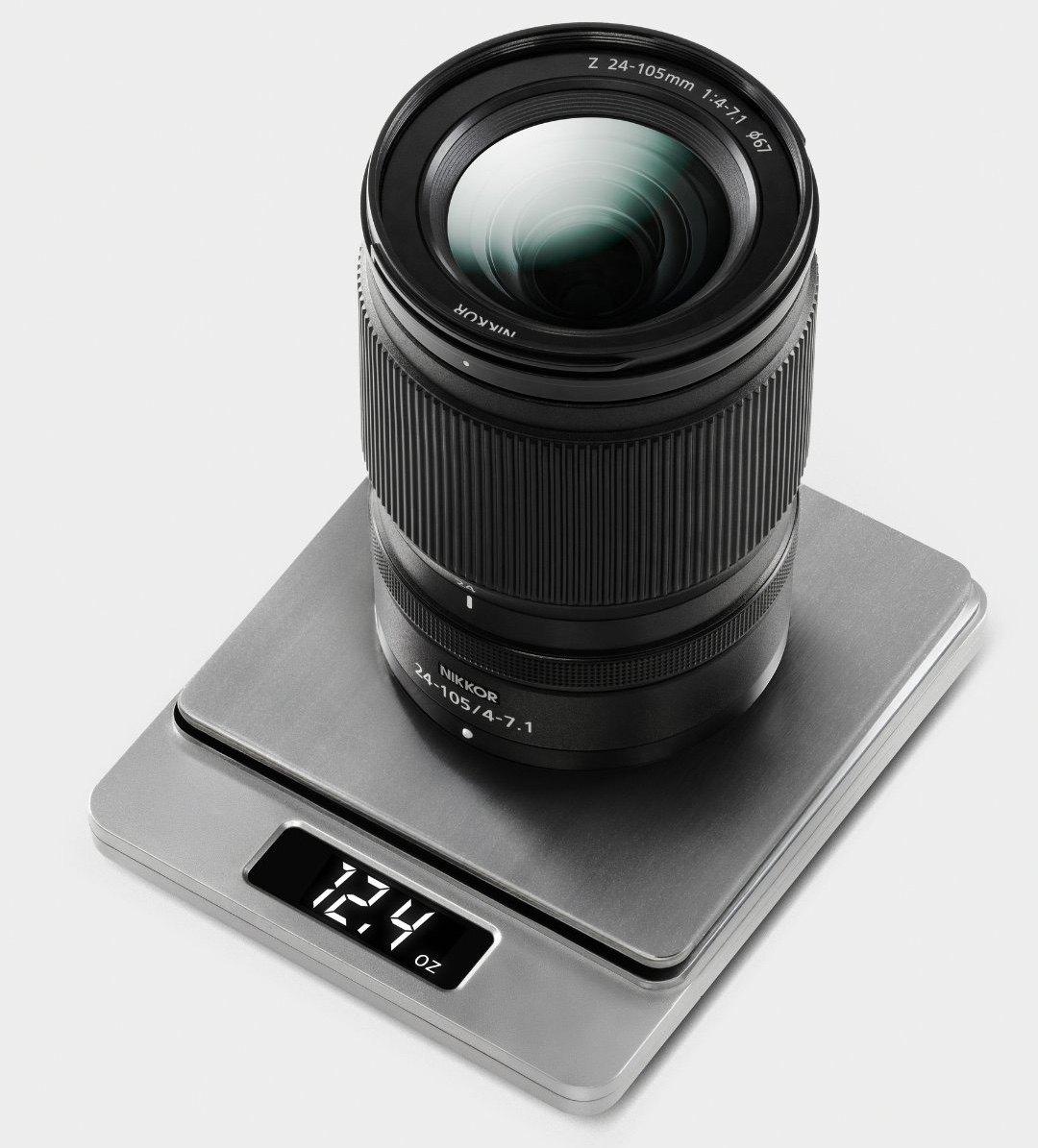
It's a relatively light lens at 350g (12.4oz), and is only 107mm (4.2") long when retracted, so it won't be too hard to carry around with you. It has a 67mm thread for filters. While the company says it's "designed with consideration for dust and drip-resistance," we wouldn't expect it to have the level of weather sealing as the company's more premium lenses.
As most modern budget lenses do, the 24-105mm F4-7.1 uses a stepper motor for autofocusing, which Nikon says will provide "fast and quiet autofocusing" for stills and video shooting. The lens also has a customizable ring, which you can set to control a variety of settings like focus, aperture, exposure compensation or ISO.
It's an interesting addition to Nikon's lineup, especially considering its availability as a kit option for the company's budget full frame entry, the Z5II. The company's 24-120mm F4 S has been widely lauded and offers slightly more reach, but is more expensive and heavier. The same is true of the 24-200mm F4-6.3, another Z5II kit option that offers even more reach.
The Nikon 24-105mm F4-7.1 will be available starting in "mid January" at a suggested retail price of $550. It'll also be available in a kit with the Z5II for $2200, around $350 more than the camera's standalone retail price.
This widget is not optimized for RSS feed readers. Click here to open it in a new browser window / tab.
Photos provided by Nikon
Press release:
NIKON RELEASES THE NIKKOR Z 24-105MM F/4-7.1: A VERSATILE AND LIGHTWEIGHT 4.4X ZOOM LENS THAT ELEVATES EVERYDAY CAPTURE
An Affordable Zoom Lens for Everyday Photo and Video
MELVILLE, NY (January 6, 2026) - Nikon Inc. has announced the versatile NIKKOR Z 24-105mm f/4-7.1 standard zoom lens for Nikon FX-format /full-frame mirrorless cameras. This new lens features a broad 24-105mm wide-angle to medium-telephoto focal range, making it easy to capture all types of scenes and subjects, from expansive landscapes, distant landmarks, food, friends, street snapshots, travel and more.
This highly versatile and compact lens is easy to carry all day for any excursion, with a weight of only 12.4 oz / 350 g. It features a minimum focus distance of just 7.9 in. / 0.2 m at the wide-angle end and 11 in. / 0.28 m at the telephoto end, allowing users to achieve attractively blurred backgrounds with close-up shooting for impressive rendering that highlights the primary subject.
The new NIKKOR Z 24-105mm f/4-7.1 zoom lens pairs perfectly with Nikon’s full-frame Z5II mirrorless camera and will be available as a kit lens option starting this winter. This convenient kit gives Z5II users an all-in-one package to explore creative boundaries and capture every memory or moment.
Key Features of the NIKKOR Z 24-105mm f/4-7.1
The versatile wide-angle 24mm to medium telephoto 105mm range of focal lengths is optimal for a wide range of scenes and subjects.
A lightweight design of only 12.4 oz / 350 g that is comfortable to use all day.
The short minimum focus distances of 7.9 in. / 0.2 m at the wide-angle end and 11 in. / 0.28 m at the telephoto end, combined with a maximum reproduction ratio of 0.5× (at focal lengths of 70mm to 105mm), facilitate close-up shooting.
Use of a stepping motor (STM) ensures fast and quiet autofocusing for smooth video recording
Zoom capability can be expanded to the equivalent of a maximum 210mm range of focal lengths, without sacrificing resolution, using the Hi-Res Zoom1 feature of select Nikon cameras2.
Equipped with a customizable control ring to which focus (M/A), aperture, exposure compensation, or ISO sensitivity can be assigned.
Designed with consideration for dust and drip-resistance3.
Price and Availability
The NIKKOR Z 24-105mm f/4-7.1 lens will be available in mid January 2026 for a suggested retail price (SRP) of $549.95*. The new lens will also be available as part of a kit with the Nikon Z5II for $2,199.95 SRP*.
For more information about the latest Nikon products, including the vast collection of NIKKOR Z lenses and the entire line of Z series cameras, please visit nikonusa.com.
1. Some features may not be accessible or may have limited functionality when using High-Res Zoom.
2. When used with the Z9, Z8, Z6III, Z5II, Zf, Z50II, or ZR. The angle of view is equivalent to that of the 36-315mm lens in FX/35mm [135] format when used with the Z50II (as of January 7, 2026).
3 Thorough dust and drip resistance is not guaranteed under all conditions or in all situations.
Specifications, equipment, and release dates are subject to change without any notice or obligation on the part of the manufacturer.
*SRP (Suggested Retail Price) listed only as a suggestion. Actual prices are set by dealers and are subject to change at any time.
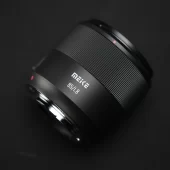
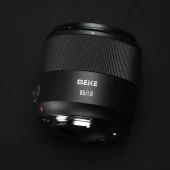
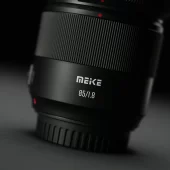
2026 is kicking off with quite the selection of fast prime lenses for APS-C cameras. First, 7Artisans unveiled a trio of F1.8 lenses. Now, Meike has released the AF 23mm F1.4 lens (35mm equiv.), which is available for Sony E and Nikon Z mounts.
Meike's latest lens features autofocus powered by an STM motor, which Meike claims is quiet and responsive. It's compatible with face and eye detection, including during video recording. Meike also says there's minimal distortion and focus breathing. It can focus as close as 0.25m (9.8").
Image: Meike
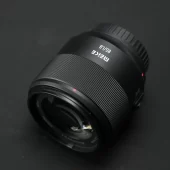
The optical design comprises 13 elements in 11 groups, and it features a 9-blade aperture. It offers a 58mm filter thread. It's relatively compact and lightweight to feel at home on smaller APS-C bodies, measuring 66.5mm x 81mm (2.6 x 3.2") and weighing 298g (10.5oz) for the E mount model, and 302g (10.6oz) for the Z mount version.
Unlike many budget lenses, the Meike 23mm F1.4 offers some on-lens controls. That includes an aperture ring and an AF/MF switch. It also features a water and oil-repellent coating on the front element and offers a USB-C port for firmware updates. The lens also supports EXIF data.
The Meike AF 23mm F1.4 is available for purchase as of today for E and Z mounts through Meike's website for $290. The product page also has references to an X mount version that doesn't seem to be available yet, but hopefully Fujifilm users don't have to wait long for that addition.
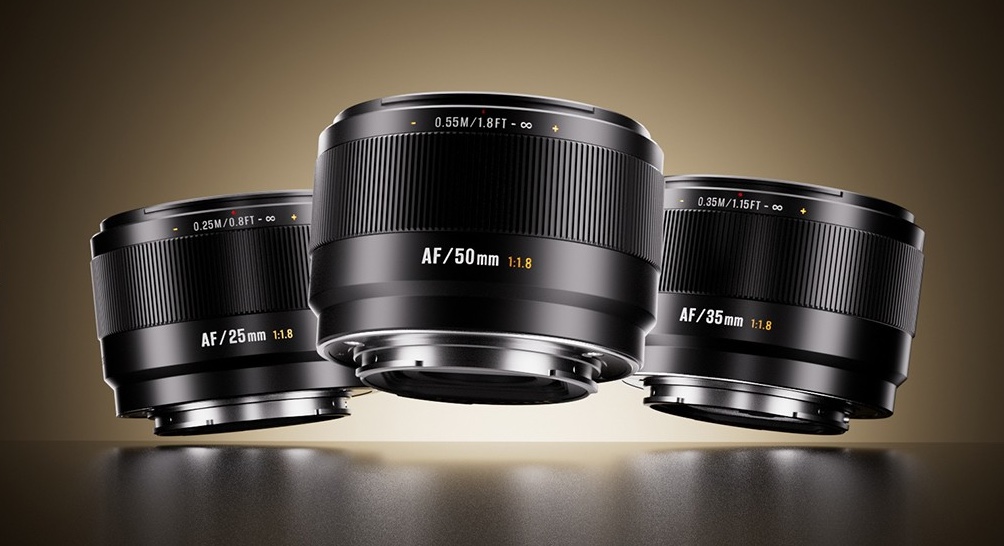
7Artisans has launched a new series of autofocus lenses for APS-C cameras. The 'Lite' lineup, which is currently only listed on the company's Chinese-language website, consists of 25mm F1.8, 35mm F1.8 and 50mm F1.8 lenses made for Sony E mount and Fujifilm X mount.
The new Lite series, as the name suggests, focuses on compact size and low weight. All three lenses weigh between 178g (6.3oz) and 183g (6.5oz). They share the same dimensions, measuring 67mm by 51mm (2.6 x 2"), and all use a 58mm filter thread. That means users don't need to buy separate filters for each lens, and it makes the trio easier to use with a gimbal as well.
A sample image listed on the 7Artisans website for the new series. Image: 7Artisans
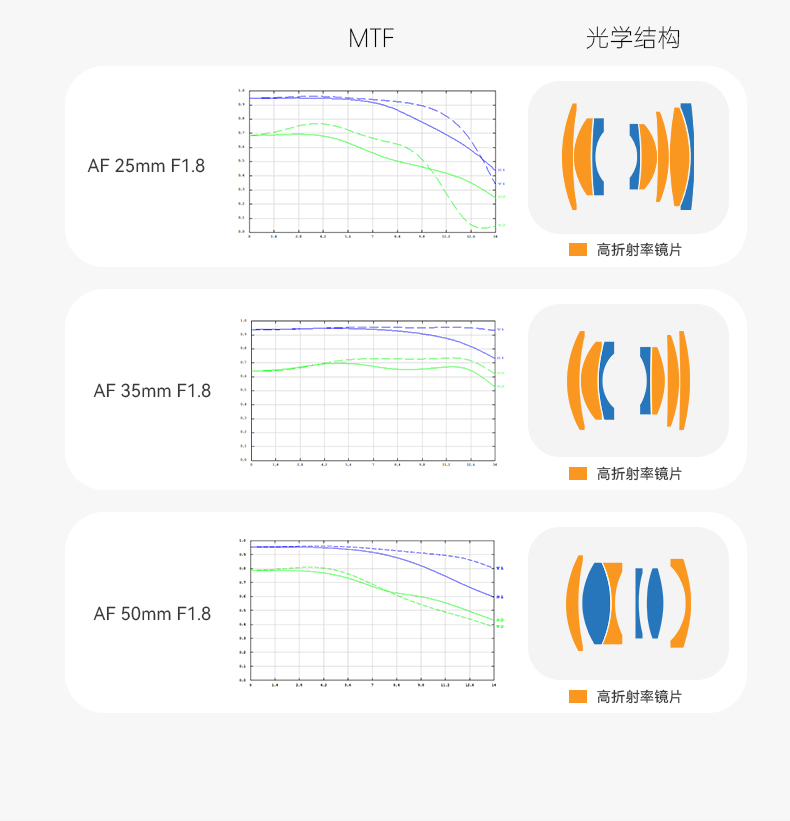
The 25mm lens (37mm equiv.) features an optical design comprised of eight elements in five groups. The 35mm (52mm equiv.) utilizes seven elements in six groups, and the 50mm (75mm equiv.) of six elements in five groups. 7Artisans says that all three lenses use high-refractive-index glass to reduce aberrations while keeping weight minimal. All three lenses feature a nine-blade aperture and an aperture range of F1.8 to F16.
The Lite lineup's autofocus is powered by STM motors, with support for eye detection and tracking. The 25mm lens can focus as close as 0.25m (9.8"), the 35mm at 0.35m (13.8") and the 50mm at 0.55m (21.6"). Aside from a focusing ring and a USB-C port for firmware updates, the lenses lack any additional controls, which isn't surprising given their budget price.
The three lenses aren't yet listed on the 7Artisan's English website. Interestingly, they were initially available for preorder through B&H, but those listings have since been removed. When the pages were up, they were listed at $125 each with an expected shipping date of May 04, 2026.
Canon EOS-1 Series cameras have long set the benchmark for professional sports photography. Now, as Canon’s first flagship professional mirrorless camera, the EOS R1 carries that legacy into a new era – combining revolutionary autofocus, breakthrough speed and seamless connectivity. Here are five ways the EOS R1 keeps you ahead on every assignment.
Photo: Canon
1. Game-changing autofocus
The EOS R1 elevates subject detection and tracking with its next-generation Dual Pixel Intelligent AF. Its deep learning system delivers subject-aware tracking that feels more responsive, agile and reassuringly ‘sticky’ when the action turns unpredictable. The Accelerated Capture system maintains accuracy even when subjects slip briefly out of view, and the latest firmware introduces support for tracking cleanly through goal netting. Powerful Eye Control AF shifts focus at a glance, while cross-type AF points enhance precision down to -7.5EV – ideal for indoor arenas and nighttime matches. With the EOS R1 managing tracking so reliably, you can focus on composition and timing.
Photo: Canon
2. Made for defining events in sport
The EOS R1 redefines Canon’s flagship camera performance. Its configurable silent continuous shooting of up to 40 fps allows you to fine-tune settings for any event and capture split-second drama with remarkable clarity. Pre-continuous shooting buffers up to 20 frames before you release the shutter, helping you capture the decisive moment – even if you’re a heartbeat late. Thanks to EVF Viewfinder Priority, a built-in face sensor wakes the viewfinder before it reaches your eye, ensuring it’s ready to shoot the instant the action unfolds.
Photo: Canon
3. Seamless workflow – from arena to office
For pro sports photographers, the real race begins after the shot. Getting images to editors and clients first is critical – and the EOS R1 keeps you ahead. Multiple MIMO antennas, Wi-Fi 6E and 2.5G BASE-T ethernet enable stable, ultra-fast transfers when every second counts. Direct FTP upload and in-camera voice memo tagging streamline delivery, so files reach press or socials faster. Designed for modern workflows, the EOS R1 lets you stay immersed in the action while ensuring every image arrives without delay.
Photo: Canon
4. Smart assistive features
Canon’s most advanced assist functions give photographers the freedom to focus on the moment, not the controls. Action Priority tracks players based on their movement near the ball, while Register People Priority locks onto the most important person in crowded scenes. Deep learning isn’t just for autofocus performance: it also powers in-camera upscaling, allowing you to crop into the action and still deliver images at up to 4x their original resolution.
Photo: Canon
5. Durable design, built to perform under pressure
A weather-sealed, heat-dissipating body, clad in a newly designed textured rubber grip, provides assured handling in all conditions – from rain-lashed sidelines to wind-chilled ski slopes. Even the large, high-resolution EVF features an anti-fog design for a clear view in the cold. For peace of mind, Pro CPS (Canon Professional Services) membership provides direct access to a pro rep, on-site support and service centers across Europe for fast, factory-quality repairs and maintenance.
Sign up to get the latest on Canon’s EOS R1 and what it can do for you.
Leica is reportedly developing a proprietary sensor with an advanced design, according to Dr. Andreas Kaufmann, Chairman of the Supervisory Board of Leica Camera AG. Speaking as a guest on the Leica Enthusiast podcast, which was reported by Leica Rumors and PetaPixel, he shared a very brief (and vague) glimpse into the company's ambitions.
The Leica Enthusiast podcast is in German, so we relied on machine learning translations. While the episode touches on a variety of topics, the most noteworthy part is that, partway through, Dr. Kaufmann unveils, "We are also developing our own sensor again." When asked about the development time, he simply said "five years." It isn't clear whether that's how long Leica has been working on the project or if it's the expected timetable for a finished product, but to us it seems likely that it's the former.
Dr. Kaufmann then briefly went into some of the history of the sensor in the M series to provide some context. He explained that the M10 utilized a sensor that was entirely developed in Europe. Development was conducted by AMS in Graz, Austria, with design work handled by AMS’s Dutch development office, and fabrication taking place at a French foundry in Grenoble. With the M11, though, Leica switched to using Sony sensors.
"Work began on developing a proprietary sensor again, with a more advanced design."
That appears to be changing, however. When discussing the switch to Sony sensors in the M11, Dr. Kaufmann added that "at the same time, work began on developing a proprietary sensor again, with a more advanced design. And I think we have made considerable progress there." Unfortunately, that brief comment is all the information that's currently available. "At the moment, we cannot say more," he said.
There's a broad range of things that "developing a proprietary sensor" could mean. It could involve anything from building its own sensor from the ground up (which would be a massive undertaking, especially for a company of Leica's size) to customizing an existing design from another manufacturer. For now, as per usual, we'll just have to wait and see what Leica is actually up to.
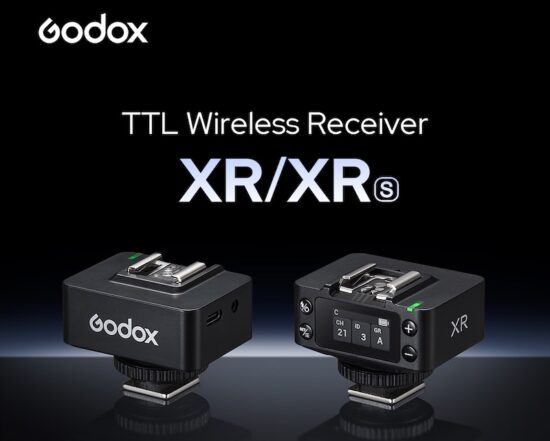
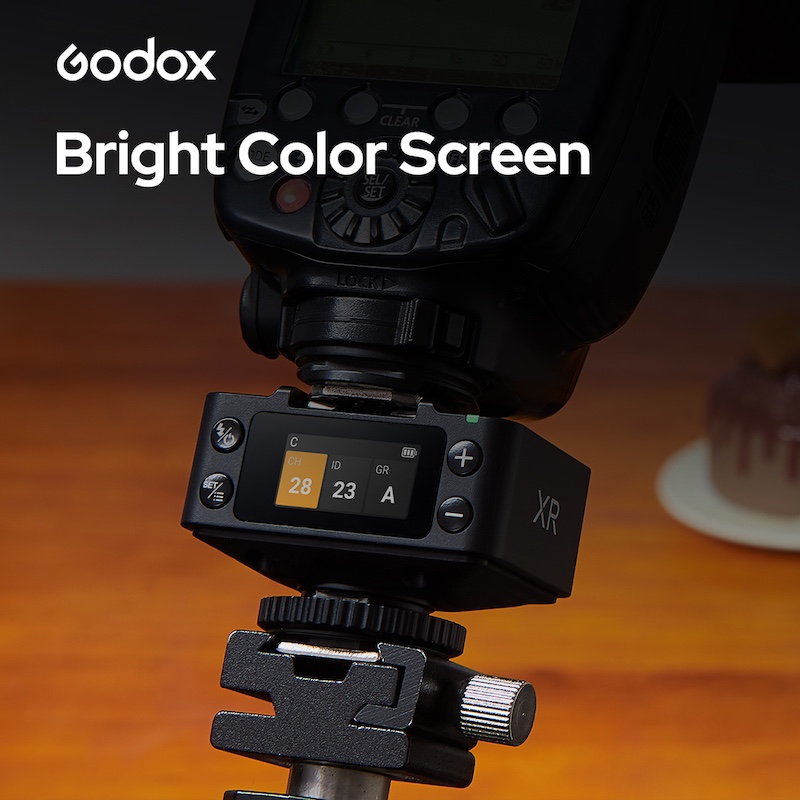
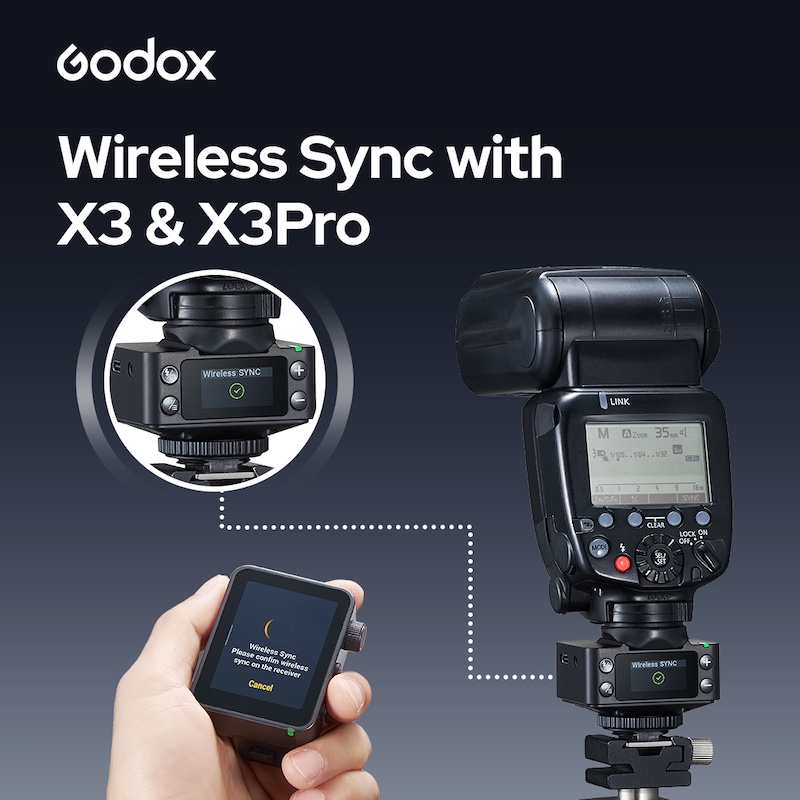
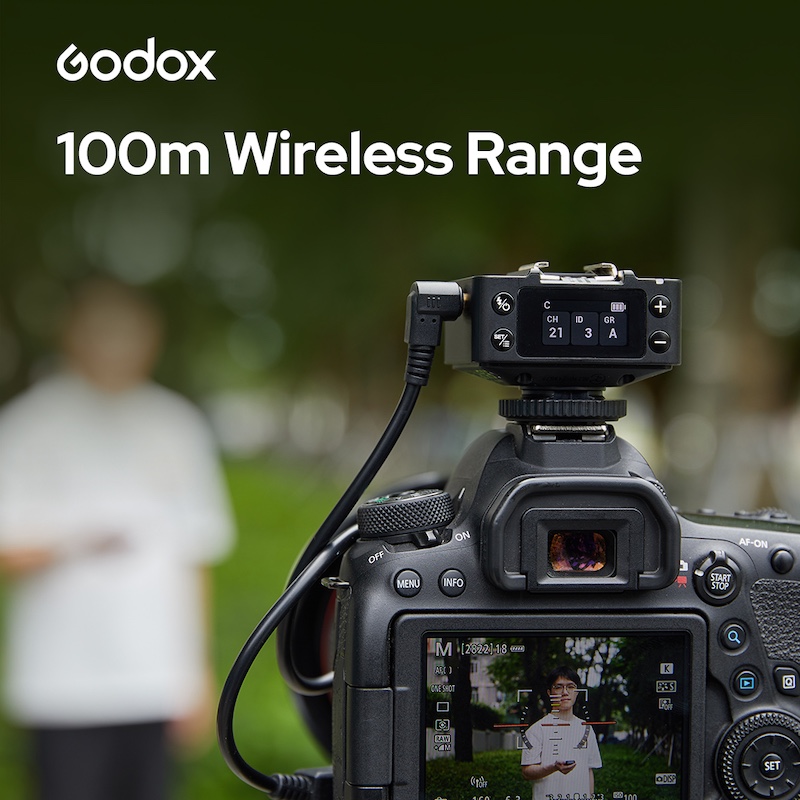
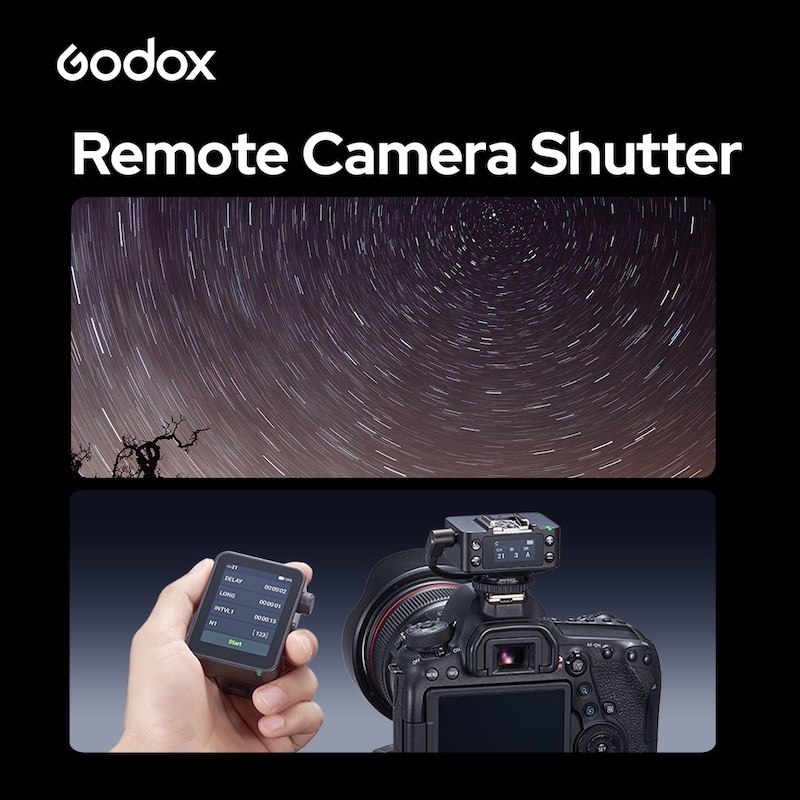
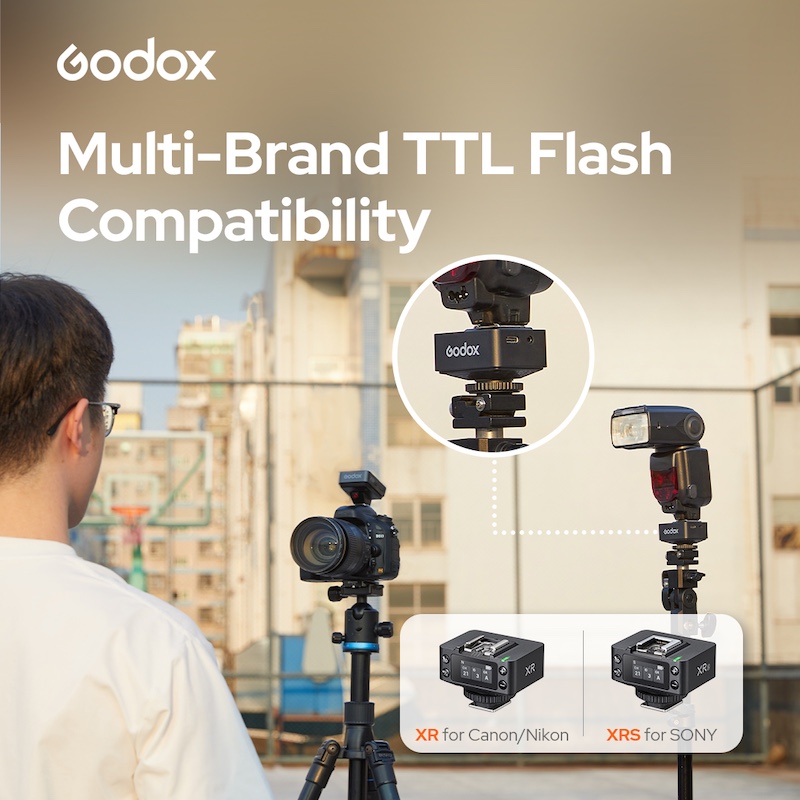
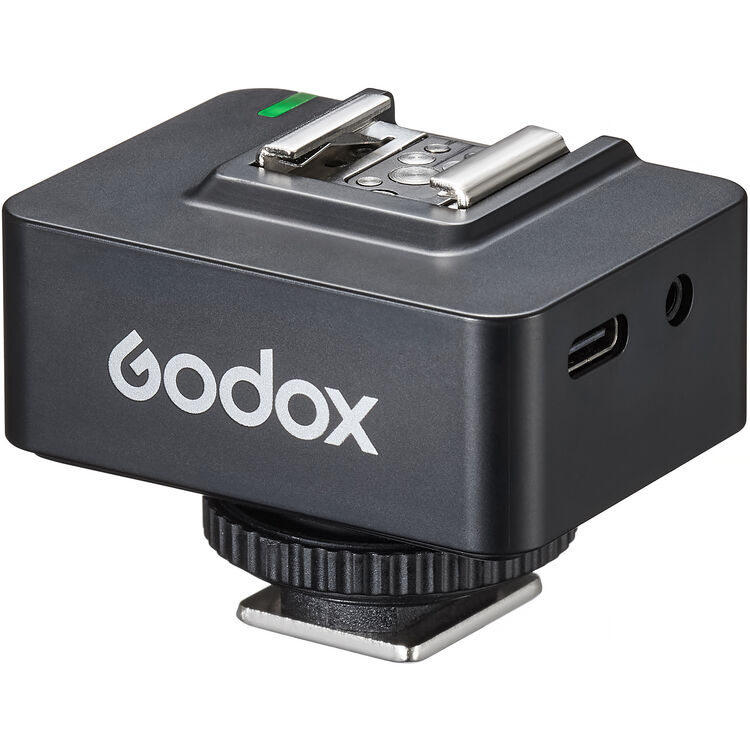
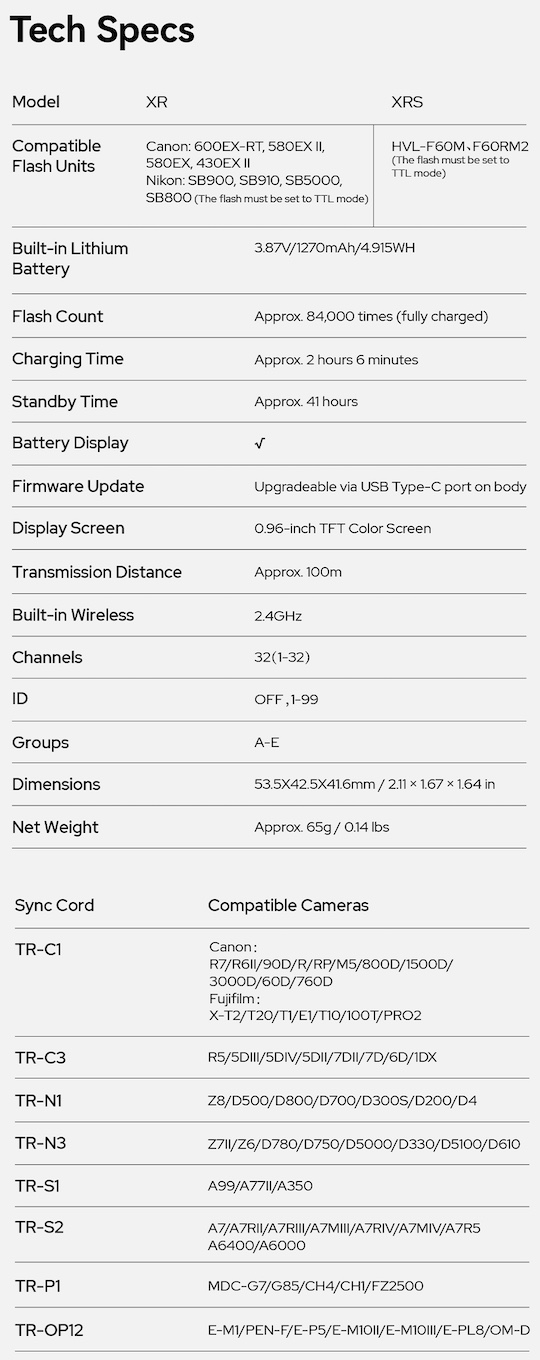
A few weeks ago, Godox released a new XR TTL 2.4GHz wireless receiver for Canon, Nikon, and Sony speedlights – I did not find any coverage online, so here are the details:
As 2025 drew to a close, we invited DPReview readers to share their best photos from the past year in our "Best photo of 2025" challenge. The response was fantastic, with submissions ranging from breathtaking vistas to stunning macro photos. Thanks to everyone who participated in this challenge!
As always, we received many more great photos than we can feature here. Our favorites, showcasing a diverse range of vision and talent, are presented in random order.
To view all the submissions and discover which photos resonated most with your fellow readers, please visit the challenge page.
Photographer's statement: A crystal clear night at the Church of St John. I love something that gives scale to the image. This church is surrounded by a jagged range of mountains; the lone figure (me) with a bright hand torch gives a small bit of scale in the scene.
Photographer's statement: A male Budgerigar feeding his female mate while she is in her nesting hollow. While I was there, he was most attentive and came back numerous times.
Equipment: Nikon Z8 + Nikon Nikkor Z 600mm F4 TC VR S
Photographer's statement: It hasn't been that long since we graduated, but we still party like we're in college. Taken during the annual Halloween party with my friends, all 200 of us stuck in a Brooklyn backyard. It was packed, it was uncomfortable, and it was fun as hell.
Photographer's statement: This is the Heart Nebula (IC 1805), a colossal emission nebula located about 7,500 light-years away in the constellation Cassiopeia. This stellar nursery is quite a hotbed of activity, centered around a young open star cluster called Melotte 15. The energetic winds and radiation from these massive, newborn stars are the reason the nebula's gases are lit up so brightly, essentially acting as the power source for this entire cosmic light show.
This image was created using the Hubble Palette, a clever technique that maps the light from ionized sulfur, hydrogen, and oxygen gases into different color channels to create this vivid and detailed portrait. Shot over three nights in late October, this is a stack of 161 images broken into 5-minute exposures.
Equipment: ZWO ASI2600MC + Williams Optics Red Cat 51 V2
Photographer's statement: I visited a falconer to practice capturing birds in flight. The falconer is well known for flying his birds in the most natural way, and I was right on the water's edge on my belly on a cold November morning. I captured this shot in full flight with the wings touching the water.
Equipment: Canon EOS 5D Mark IV + Canon EF 500mm F/4 L USM
Photographer's statement: Patience paid off while seated in my home garden observing wisteria blooms after noticing the Gulf Fritillary butterflies fluttering to the colorful purple colored petals. Handholding my Olympus camera with a long lens, I got a shot of two visitors.
Equipment: Olympus OM-D E-M1 Mark II + Olympus Zuiko Digital ED 50-200mm 1:2.8-3.5 SWD
Photographer's statement: I was driving with a friend to watch the sunrise over the Pacific Ocean, but we realized we were running late. The fog was so thick along the way that I almost lost hope of catching the sunrise at all. Then, before we could even make it to the ocean, the sun began to rise while we were still on the road. That's when we stumbled upon two male elk grazing in front of the glowing horizon. We stopped the car, and I quickly grabbed my camera, running around to line up the elk with the rising sun. This photo is a reminder of that moment, as if the elk and I were both quietly watching the world awaken beneath the rising sun.
Photographer's statement: As the working day ends, London slows but never stops. People spill into the streets, the red bus gliding through the junction as the city shifts from work to life.
Photographer's statement: This photo was taken in February 2025, in Serengeti National Park, Tanzania. This is the period between the two rainy seasons, when the grass has grown, and nature is lush and green. The sunset on that day bathed everything in incredible light. Zebras and various species of antelope were grazing everywhere as far as the eye could see, undisturbed by predators.
Equipment: Fujifilm X-S20 + Sigma 100-400mm F5-6.3 DG DN OS
Photographer's statement: Out on a boat during a fog-filled November morning, this Texas bayou was transformed into a dreamlike landscape, as backlit Spanish moss draped from grand cypress trees emerged from the mist and autumn colors slowly strengthened with the rising sun.
Photographing from a slowly drifting boat in low light, using a zoom lens and requiring as much depth of field as possible, presented a significant challenge. Pushing the ISO was necessary to get this all to work.
Equipment: Nikon Z8 + Nikon Nikkor Z 70-200mm F2.8 VR S
Photographer's statement: While hiking in the woods, I came across a pair of Pileated Woodpeckers excavating a cavity in an old madrone tree. This shot shows the male spitting out the wood chips. Unfortunately, this is near a popular hiking path, so the nest was eventually abandoned.
Equipment: Nikon Z8 + Nikon Nikkor Z 400mm F4.5 VR S
Photographer's statement: University of Nottingham Jubilee Campus: I was drawn to the stark, futuristic form of the building and chose a low viewpoint, a wide-angle lens and the rails on a bench to provide dramatic leading lines
Equipment: Panasonic Lumix DMC-G1 + Panasonic Lumix G Vario 7-14mm F4 ASPH
Photographer's statement: The sculpture "Man Meets the Sea" was created to mark the Danish municipality of Esbjerg's 100th anniversary in 1995. It is very impressive, but it is best appreciated with people nearby to give a sense of its size. Traveling alone, I had no one to "put in place," so I just had to wait. I didn't know what exactly I was waiting for until, all of a sudden, having waited for more than an hour in windy conditions, there it was... that magic moment when four people were right where I wanted them to be, with each individual taking a different position relative to their man. It really made my day, and a great shot.
Equipment: Nikon Z6III + Nikon Nikkor Z 24-120mm F4 S
Photographer's statement: Tiny yet mighty, I was fortunate to find this little owl and spent the day watching this little creature hunt prey that was similar to her size. One of the most amazing owls to photograph this year.
Equipment: Sony a1 + Sony FE 200-600mm F5.6-6.3 G OSS
Photographer's statement: The Pantanal of Brazil offers a rare opportunity to see Jaguars in their natural habitat. It was near dusk when I saw these eyes staring at me, and I was lucky enough to get the shot.
Equipment: Sony a1 II + Sigma 500mm F5.6 DG DN OS Sports
Photographer's statement: Having only been in Switzerland for two days and with great weather, I decided to take a 3-hour train ride to reach my personal highlight of this two-week backpacking trip. Arriving in Zermatt, the view was better than I could have ever imagined. After hiking for the entire day on just one bottle of water and two croissants from the train station, I was on my way back down to Zermatt. Coming down and seeing the light fading, I was frantically searching for a location to set up my tripod. Then, behind some snow-covered bushes, I spotted an opening with this exact view. What a Day
Equipment: Panasonic Lumix DC-S5 + Panasonic Lumix S 20-60mm F3.5-5.6
Photographer's statement: This photo was taken at a local wildflower and native plant garden. The conditions were near ideal with a shaded location and this beautiful Skipper sitting high upon the plants.
Stack of 40 images, stacked in HeliconFocus.
Equipment: Nikon Z8 + Sigma APO Macro 180mm F2.8 EX DG OS HSM
Photographer's statement: It was a late summer day, and my wife and I went for a hike in the Columbia River Gorge (on the Washington side). I had not researched the hike very much, but had been in the area many years ago. We had done most of the hike, and it was rather uneventful photographically. But alas, at the end of the hike was this waterfall. And as I started to head back, I felt thankful to have found it.
Taken with a full-spectrum camera using an IRChrome filter.
Equipment: Nikon D810 + Tamron 17-35mm F2.8-4 Di OSD
Photographer's statement: My friend Chip Cruz and I were collaborating on a video shoot for his website. He is a guitarist. He asked me to do some drone stuff for him, so we went out onto frozen Lake Mendota in Madison, Wisconsin, and got some really cool stuff on the lake. It was something like 8ºF (-13ºC) out that morning, so he suffered a bit to get this shot.
Photographer's statement: Landscape photography in Tuscany. This was one of the last photos taken that morning, as the ground fog began to rise and shortly afterwards enveloped everything in its soft blanket.
Equipment: OM System OM-1 Mark II + Olympus M.Zuiko Digital ED 12-100mm F4.0 IS Pro

 Connexion












 prints with QR codes