Connexion
2025: Our year in stories, reviews and more
 |
| This year saw the release of several extremely competent full frame hybrid cameras such as the Panasonic S1II, Canon EOS R6 III and Sony a7 V, show above. Photo: Mitchell Clark |
As we come to the end of the year, it can be fun to take a trip down memory lane and look back at the year that will soon be in the rearview. What were the releases that we could've sworn happened forever ago? What were the stories that are still having an impact today? And what series are we looking forward to continuing into the new year?
January
 |
| Photo: Richard Butler |
2025 started off with a bang, with the release of the Leica SL3-S – a full frame camera focused on speed, rather than resolution – and our review of the Nikon Z50II, an entry level APS-C camera designed for photo and video creators.
The former release inspired Richard Butler to write about what counts as a "real" Leica, and how branding works in general. We also got an interesting and in-depth look at the history of sensor development, from the people who were there.
February
 |
| Photo: Mitchell Clark |
February was when things really picked up, and not just because that's when the camera industry gets together to hold the CP+ trade show.
OM System kicked things off with its announcement of the OM-3, a retro-styled mirrorless with a stacked Four Thirds sensor, which we were able to review by launch day. It also updated three lenses for its system. Panasonic also had a new camera; the high resolution, full frame S1RII, which aimed to be a solid offering for both stills and video shooters.
Not to be left out, Nikon launched its 35mm F1.2 S lens, its first video-focused full frame power zoom lens and releasing Z-mount versions of Red's most powerful cinema cameras.
Meanwhile, we were busy with reviews, finishing our testing of the Panasonic GH7 and the Leica D-Lux 8... just in time for Canon to surprise announce another compact camera, the PowerShot V1, which we were the first to get our hands on. We also got to test out Zeiss' 50mm F1.4 'Otus' lens – its first major release in six years – and interview the company's Senior Manager of Creative Arts.
Speaking of lenses, Sony had some new ones, too: a 16mm F1.8 full frame prime, and a 400-800 super telephoto. We also got to see over a dozen new lenses from third-party manufacturers like Viltrox, Laowa, and TTArtisan at CP+.
 |
| The Sigma BF is unlike any camera we've seen recently. It's also only one of the several things the company announced in February. Photo: Richard Butler |
Realistically, though, the month belonged to Sigma, who managed to overshadow everyone at the last minute with its announcement of the super-minimalist BF, a full frame camera stripped down to the bare essentials. If that wasn't enough, it also updated its logo, announced a stabilized 16-300mm (24-450mm equiv.*) F3.5-6.7 lens for APS-C systems and a full frame 300-600mm F4 lens for sports shooters and, on top of all that, refreshed its entire lineup of I-series primes.
Phew!
* - 26-480mm equiv. on Canon
March
 |
| Photo: Richard Butler |
Things didn't slow down much in March, which kicked off with a ton of phone news coming out of the Mobile World Congress show. There were budget offerings from Nothing and Google, exciting concepts from RealMe and Xiaomi, and the continuation of a Leica partnership from the latter.
We also started releasing our interviews from the major manufacturers we got to talk to during CP+; OM System, Ricoh, and Fujifilm (which came in two parts).
Speaking of Fujifilm, we were able to travel to Prague to cover the announcement of the GFX100RF, a fixed lens camera with a 100MP medium format sensor. We also had the chance to sit down with their executives again to talk about the launch.
Rounding out the month was a slate of announcements from Canon. The PowerShot V1 finally got a price and availability outside of Japan, and the company released three new products: a 20mm F1.4 prime in its full frame VCM series, the EOS R50 V, an APS-C vlogging camera, and a new wide-angle power zoom lens to act as its kit.
April
 |
| Photo: Mitchell Clark |
Things calmed down a bit in April, with there being only one major camera release: Nikon's budget full frame offering, the Z5II. Which isn't necessarily a bad thing, as its price to performance ratio would end up earning it our Product of the Year award (but we're getting ahead of ourselves).
The bad news for value-oriented cameras, at least in America, was April's other big story: the US' launch of tariffs on imports from other countries. While things have (mostly) shaken out, the US government's ever-changing and arbitrary approach meant manufacturers and the market struggled to figure out how to price things for a few months, a story we tracked closely.
April also saw the release of Sony's 50-150mm F2 lens, a fast, full frame zoom offering. We also continued to cover the Sigma BF, through interviews with Sigma CEO Kazuto Yamaki, a deep dive on its UI and the potential implications for the industry, and Richard Butler's personal challenge to use it every day while on vacation holiday in the UK.
May
 |
| The Panasonic S1II may look like the rest of the company's second-gen S1 cameras, but its partially stacked sensor and the capabilities it brings make it one of the most well-rounded options out there for stills and video shooters. Photo: Richard Butler |
After resting a bit in April, we and the camera industry were back in full swing in May. We finished our reviews of the Canon EOS R50 V, screen-less Camp Snap camera and the Sigma BF, with the latter including a deep-dive into its innovative (and completely unadvertised) implementation of the UltraHDR JPEG spec. We also published our final interview from CP+ 2025, where we met up with executives from Canon.
May also marked the beginning of us publishing regular educational articles, aimed towards beginners who are still figuring out the ins and outs of digital photography. We also launched a few new series:
- A YouTube show where the team discusses camera and photography news
- Articles highlighting photographers using interesting techniques to take amazing pictures
- Article on the history of the camera industry and the business shenanigans and zombie brands therein
Of course, there were several launches in May, too. Panasonic came out with the S1II, a full frame hybrid camera designed to excel at both stills and video, and the S1IIE, which used the same body, but paired with a standard BSI sensor, rather than a partially stacked one. The company also released a 24-60mm F2.8 lens, to act as a budget (and back)-friendly alternative to the standard 24-70mm F2.8 zoom.
 |
| The X half remains a strange release, but it's hard to knock a company for trying something new. Photo: Richard Butler |
On the other side of the photography spectrum, Fujifilm announced the X half, a compact camera with a Type 1 sensor and tons of quirky, fun features aimed at making photography fun for beginners. Ricoh also announced it was working on the GR IV, releasing a few tantalizing details for fans of its stalwart enthusiast APS-C compact.
Finally, DJI announced the fourth iteration of its Mavic Pro drone, though availability in the US was spotty, to say the least, as it wasn't supposed to officially launch in the country (a trend that would continue for the rest of the embattled company's products throughout the year).
June
 |
| The X-E5 ups the ante on the Film Simulation dial by letting you assign recipes to it, and brings the rangefinder-styled camera back upmarket with more programable command dials and milled aluminum top and bottom plates. Photo: Richard Butler |
Summer is typically a relatively quiet time for the camera industry, but 2025's was arguably an exception. We saw two camera launches in June: Fujifilm's rangefinder-style X-E5, which came complete with the film simulation dial that's been making its way onto several of the company's products, and OM System's OM-5 II, a light refresh that brought updated menus and a USB-C port.
There were also a few interesting lenses released in June. Sigma released its super-fast APS-C standard zoom, the 17-40mm (26-60mm equiv.*) F1.8 DC Art, and Fujifilm released the XF 23mm F2.8 R WR, a 35mm equiv. pancake lens that emulates the one found on its still quite hard to find X100 series cameras.
Beyond covering all of that, we also published our review of the GFX100RF, and went hands-on with Peak Design's new Pro tripods.
* - 27-64mm equiv. on Canon
July
 |
|
The RX1R III was a bolt out of the blue. |
July only saw one blockbuster release, but it was a big one: the Sony RX1R III, the company's full frame compact camera with a fixed 35mm F2 lens. It was released pretty much out of the blue, with very few rumors or teasers leading up to the launch.
Tamron also had an announcement in July, releasing its updated 16-30mm F2.8 wide-angle zoom lens.
As for reviews, we published our experiences with the Fujifilm X-E5, PowerShot V1, from both a photography and videography standpoint, and the Fujifilm X half, which Richard Butler says was one of the most difficult-to-review cameras he's ever written about. We also interviewed Leica for its 100th anniversary, and took a look at how the Kodak brand name was making a comeback in some surprising places unrelated to photography.
August
 |
| The X2D II not only shoots HDR output files by default, but lets you preview them on a bright rear display. Photo: Richard Butler |
We were hard at work on reviews in August, publishing them for the Sony RX1R III, Panasonic S1RII, and Nikon Z5II. We also covered the launches of the Ricoh GR IV, which was fully unveiled after being teased in the spring, and the Hasselblad X2D II, a medium format camera that goes all-in on HDR.
There was a lot of lens news in August, too. Sigma announced a 12mm (18mm equiv.*) F1.4 prime for APS-C cameras, as well as a 200mm F2 prime for full frame systems. Alongside the X2D II, Hasselblad released a fast, standard zoom for medium format, and Nikon updated its own full frame standard zoom, creating the first internally zooming 24-70mm F2.8 for full frame systems.
 |
| Our new community coordinator, Mathew Anderson, is here to act as a bridge between us at DPReview and our community. |
We also made a big investment in our community, bringing on Mathew Anderson to act as our full time community manager. If you've spent any time in our forums at all, you'll almost certainly be familiar with him, as he's been working to make sure we keep in touch with what our readers and members need most.
* - 19mm equiv. on Canon
September
 |
| The Nikon ZR is an interesting release, but September belonged to the lenses. Photo: Mitchell Clark |
Things ramped back up in September, with a slew of lens news. Canon introduced an 85mm F1.4 to its VCM lineup, and OM System released its long-awaited 50-200mm (100-400mm equiv.) F2.8 IS Pro for Micro Four Thirds. Sigma was back at it again with three full frame lenses: an updated 35mm F1.2 which was lighter and smaller than its predecessor, a 135mm F1.4 made to be a portrait powerhouse, and a 20-200mm F3.5-6.3 designed to be small enough to travel anywhere with. Panasonic and Sony also got in on the action, releasing the 100-500mm F5-7.1 OIS and 100mm F2.8 Macro GM, for their respective full frame systems.
Nikon also announced a new camera, the video and vlogging-focused ZR, which takes the partially stacked sensor from the Z6III and puts it in a small body with a big screen and Red logo. We also posted our final reviews of the Hasselblad X2D II and Ricoh GR IV, and dug into some of the marketing behind the new iPhone and its lenses.
October
 |
| A visit to Canon's lens factory in Utsunomiya, Japan, was a highlight of the month. Photo: Richard Butler |
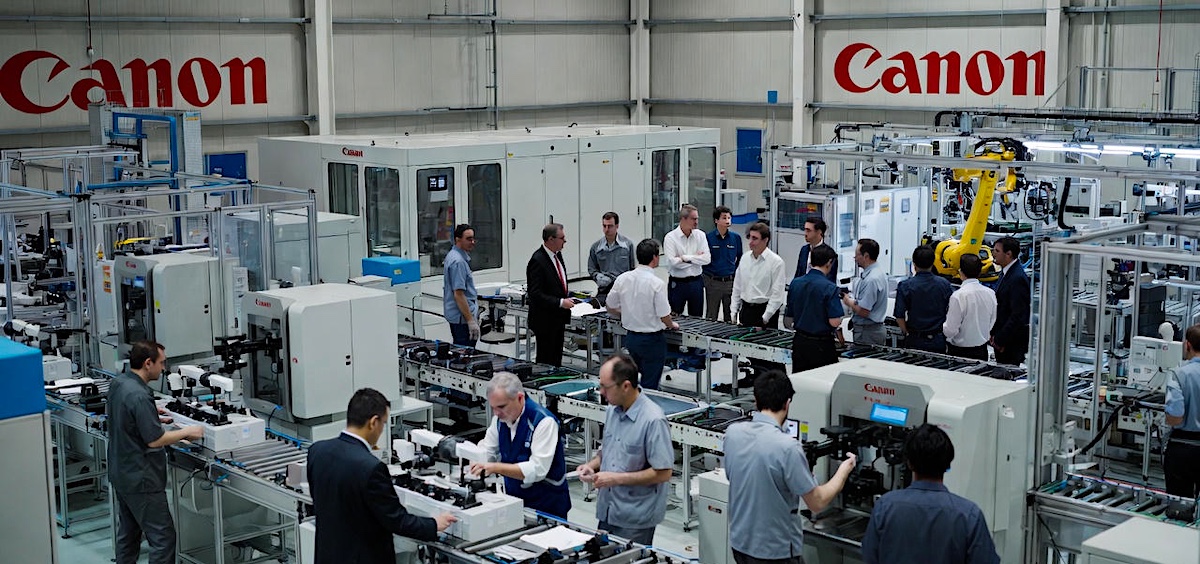
We opened October with a visit to Canon, where we got to interview executives about the company's culture and take a tour of the company's lens production facility. We also traveled to Adobe's Max conference to hear about the future of Photoshop and Lightroom, which, unsurprisingly, involved a lot of AI.
Some of the most interesting releases this month were lenses. Nikon introduced a fast standard zoom for APS-C with the 16-50mm (24-75 equiv.) F2.8 VR, alongside a 35mm (53mm equiv.) F1.7 'Micro' branded lens for capturing close-up objects. Tamron also brought out its 25-200mm F2.8-5.6 to compete with Sigma's 20-200mm, and Fujifilm released a collapsing 13-33mm (20-50mm) F3.5-6.3 stabilized lens.
 |
| An M series without a rangefinder? Is this blasphemy? Photo: Richard Butler |
That lens, however, is initially only available kitted with the X-T30 III it was announced alongside, an entry-level mirrorless camera with an EVF and a film simulation dial. Leica also released a new camera: the M EV1, a camera that eschews the company's classic rangefinder mechanism for an electronic viewfinder. This prompted an excellent op-ed from Richard Butler on jargon and the semantics of "mirrorless," which we promise is more interesting than those descriptors may make it sound (or, to a certain type of person, is exactly as interesting as those descriptors promise).
As for reviews, we published our final thoughts on the OM System OM-5 II. That may make it seem like it was a quite month, but that's because we were gearing up for...
November
 |
|
The EOS R6 III is a strong new entry in the very competitive midrange enthusiast marketplace. |
... the Canon EOS R6 III, which was November's first big release, alongside the company's $470 43mm F1.2 lens (no, the price isn't a typo). Leica was also back this month, with the Q3 Monochrome, a – you guessed it – black and white version of its full frame compact with a 28mm F1.7 lens.
We also published our review of the Panasonic S1II, following a firmware update that brought dramatic improvements to its autofocus performance and cooling performance for video.
DPReview also got a big update in November, as we officially moved our forums onto a modern, sustainable platform. Come say hi!
December
 |
| The a7 V's faster, partially stacked sensor, brings a much-needed speed boost to Sony's mainline full frame entry. Photo: Mitchell Clark |
This brings us to this month. While releases have finally slowed down, with the massive exception of Sony's enthusiast-tier a7 V, we've still been busy. We published our review of the Canon EOS R6 III, in-depth looks at Nikon's 24-70mm F2.8 S II and the a7 V's impressive dynamic range performance, and have started on our end-of-year content. That includes our annual awards, our Gear and Photos of the Year series, and this very article. (And there's still more to come!)
While it's been a year full of news, reviews and buying guides, we've also been working on increasing our engagement with the community, featuring your work and thoughts on our homepage. We've done so through the monthly editors' photo challenges, and our question of the week series, as well as with events like our AMA. Look forward to even more of that coming in the new year!
While the EOS R6 III was our last review of the year, we already have our work cut out for us going into next year, with the reviews of the Sony a7 V and the Fujifilm X-T30 III. Stay tuned for those, as well as our coverage of the CP+ show in February and anything else that happens in the upcoming year.
We appreciate you reading our work in 2025, and look forward to bringing you even better coverage in 2026.