❌

Vue lecture

iPhone Duo vs. Galaxy Z Fold 8 Ultra vs. Pixel 11 Pro Fold: which foldable is the best?

Apple is fashionably late to the folding phone market. How does its first foray compare to phones several generations in?

The iPhone Duo, proped up and automatically taking pictures.Apple

This week, Apple announced its first foldable: the iPhone Duo. It’s launching into a mature market with lots of competition, though it adopts the still relatively rare passport form factor. This means it’s designed to be short and wide, rather than tall and thin, a decision with relatively fundamental implications on the aspect ratio of its interior screen.

iPhone DuoGoogle Pixel 11 Pro FoldSamsung Galaxy Z Fold 8Samsung Galaxy Z Fold 8 UltraiPhone 18 Pro
Price / starting storage$2000 / 256GB$1900 / 256GB$1900 / 256GB$2100 / 256GB$1200 / 256GB
Outer screen size / aspect ratio5.4″ 1:1.46.5″ 19.5:95.5″ 16:106.5″ 7:36.3″ 21:9
Inner screen size / aspect ratio7.6″ 1:1.48″ 0.96:17.6″ 3:48″ 1:1.11N/A

While there are plenty of options to compare it with, we’re choosing some of the more established competitors: the Samsung Galaxy Z Fold 8 series (both the passport style phone and the boxier Ultra variant) and the Google Pixel 11 Pro Fold. However, we will bring up some of the other foldables on the market at points where they’re relevant.

Cameras

One of the areas folding phones differ the most is in their camera layouts. Some opt for a three camera array, while others opt for two (usually, it’s the telephoto option that gets the axe). But different phones will make different compromises, so it’s up to you to decide what parts of the camera experience you value.

iPhone DuoGoogle Pixel 11 Pro FoldSamsung Galaxy Z Fold 8Samsung Galaxy Z Fold 8 UltraiPhone 18 Pro
Main camera26mm F6.8 equiv.
48MP
Type 1/1.56 (48mm²)
Stabilized sensor
24mm F7.2 equiv.
48MP
Type 1/1.56 (48mm²)
Stabilized lens
23mm F7.6 equiv.
50MP
Type 1/1.57 (50mm²)
Stabilized lens
24mm F6 equiv.
200MP
Type 1/1.3 (72mm²)
Stabilized lens
24mm F5.1 to F13.7 equiv.
48MP
Type 1/1.3 (72mm²)
Stabilized sensor
Ultrawide camera13mm F13.5 equiv.
48MP
Type 1/2.55
(23.5mm²)
9mm F18.9 equiv.
10.5MP
Type 1/3.4 (13mm²)
12mm F11.5 equiv.
50MP
Type 1/2.5 (25mm²)
12mm F11.5 equiv.
50MP
Type 1/2.5 (25mm²)
13mm F13.5 equiv.
48MP
Type 1/2.55
(23.5mm²)
Telephoto cameraNone110mm F23.6 equiv.
10.8MP
Type 1/3.2 (15.5mm²)
Stabilized lens
None67mm F22.7 equiv.
10MP
Type 1/3.94 (10mm²)
Stabilized lens
100mm F17.7 equiv.
48MP
Type 1/2.55 (23.5mm²)
Stabilized sensor / lens

Comparing the options across the foldables from Apple, Samsung and Google to a standard slab phone – in this case the iPhone 18 Pro – a few things become clear. Both Apple and Samsung decided that there just wasn’t room in a passport-style phone for a three camera array (though, notably, Xiaomi managed it).

However, while the larger foldables offer telephoto cameras, they’re usually very compromised compared to what you’d typically get on a standard phone. Samsung’s “Ultra” foldable, the most expensive in this roundup, is also the only one that has what we’d consider to be a flagship-class main camera, though Motorola’s new Razr Fold has a comprable camera layout, albeit with an slightly worse ultrawide and substantially nicer telephoto.

The rear camera bump on a Samsung Galaxy Z Fold 8 Ultra, showing its three cameras.
The Galaxy Z Fold 8 Ultra still asks you to make a few camera compromises – it doesn’t have the longer telephoto included on its non-folding counterpart – but not as many as the rest of its peers.
Samsung

As for how the iPhone Duo compares: it’s very similar to the Z Fold 8, and Apple has made a different trade-off than Google, opting for a better ultra-wide with no telephoto rather than relatively poor versions of both. But like the rest of the phones, it’s pretty much no contest between it and the Z Fold 8 Ultra, or the iPhone 18 Pro it launched alongside.

Screens

Foldable smartphone with a large screen, shown in two hands, displaying app icons, a weather widget, a photo widget featuring a person, and a map on a light gray background.Apple

Of course, the main reason to get a folding phone is that they come close to the pocketability of a standard phone, will unfurling to give you a large display that lets you run multiple apps at once, or view videos and photos on a much larger canvas. (But while the iPhone Fold is IMAX-shaped, we suspect Christopher Nolan still wouldn’t approve of watching movies on one.)

Your choice of form factor will largely dictate what kind of screen you get, with the passport-style phones offering slightly smaller displays with aspect ratios more suited to viewing content, but not quite as ideal for running apps side-by-side (though both the iPhone Duo and Galaxy Z Fold 8 can). Meanwhile, the more traditional folding phones offer nearly square screens, which offer a multitasking experience that’s almost like having two standard phones next to each other.

Two hands holding two folding phones. On the left is a tall, thin one, and on the right is a wider, shorter one.Samsung

While you may need to compromise on cameras to get a folding phone, you’re not compromising on screen specs. All the phones in our roundup have incredibly bright displays – Apple and Samsung* offer 3000 nits peak brightness on bother inner and outer screens, while Google ratchets that up to 3600 – with variable refresh rates that go from 1 to 120Hz.

The one place Apple has thought different is in the finish of its inner display; it has a matte “nano-texture” coating, where its competitors have glossy displays. Apple says this does a better job of hiding the crease in the middle – though it’s barely noticeable on the Samsungs either, according to most reviewers – and makes it less prone to scratches. We’ll see what happens when JerryRigEverything does his durability tests on it, though.

Size and Weight

There’s no getting around it: the iPhone Duo is hefty, especially given its size. Despite Apple’s use of titanium in its construction – typically a material that offers incredible strength for its size – it winds up being substantially heavier than even the larger Galaxy Z Fold 8 Ultra and Google Pixel 11 Pro Fold.

iPhone DuoGoogle Pixel 11 Pro FoldSamsung Galaxy Z Fold 8Samsung Galaxy Z Fold 8 UltraiPhone 18 Pro
Weight254g (9.0oz)238g (8.4oz)201g (7.1oz)215g (7.6oz)211g (7.4oz)
Dimensions, folded (H x W x D)118 x 84 x 11.3mm
(4.6 x 3.3 x 0.4″)
155 x 76 x 10.1mm
(6.1 x 3.0 x 0.4″)
124 x 82 x 9.7mm
(4.9 x 3.2 x 0.4″)
158 x 73 x 8.9mm
(6.2 x 2.9 x 0.3″)
150 x 72 x 8.8mm
(5.9 x 2.8 x 0.3″)
Dimensions, unfolded118 x 165 x 5.2mm
(4.6 x 6.5 x 0.2″)
155 x 150 x 5mm
(6.1 x 5.9 x 0.2″)
124 x 161 x 4.5mm
(4.9 x 6.3 x 0.2″)
158 x 143 x 4.1mm
(6.2 x 5.6 x 0.2″)
N/A

To us, this comparison illustrates Samsung’s experience as the company that’s been making foldables the longest. Its models are substantially thinner and lighter than their Apple and Google counterparts, while having roughly similar battery capacities. Of course, Apple is known to let its devices be a bit heavier to give them a premium feel, but it’s up to you whether the feel in your hand is worth the heft in the pocket.

The rest of the experience

Each brand, will, of course, have its own take on what the foldable experience should be like. These range from macro-level decisions, like how the transition from folded to unfolded should work and how multitasking is handled, to smaller quality-of-life features like Google and Apple’s inclusion of camera features made to make kids smile as you’re taking their picture, and automatically capture group photos when you have your phone set up on a flat surface.

A Pixel fold in the laptop position to take pictures.
For years, the Pixel Fold has used its form factor to augment the photography experience.
Google

While we won’t know the full scope of those usability differences until all the phones are available, there are a few things we can glean from what we know so far. While all the phones can be stood up on a table in the a-frame-like tent mode for watching video, the Galaxy Z Fold 8’s hinge design means it can’t be used half-unfolded (in a way that makes the phone sort of like a laptop). This is an ability the Ultra version, as well as the Pixel and iPhone, have.

While none of the selfie cameras on the inner screens will be great – they’re designed mostly for video calls – Apple goes the extra step of hiding its one under the display when it’s not in use, so you can get a truly full-screen experience when watching video, without the hole-punch you’ll get in the Galaxies and Pixel. Ironically, this was something Samsung used to do with its foldables, but has dropped in recent years.

The iPhone Duo and Google Pixel 11 Pro Fold both offer dust and water ingress protection that’s equivalent to a standard cell phone (which is important given their oh-so-complex hinges and display mechanisms), with an IP68 rating. The Samsung models fall a bit short on the dust protection, only boasting IP48.

If you want to see how the iPhone 18 Pro compares to its traditional smartphone competitors, check out our story below.

* – It’s also no secret that Samsung, innovator in the foldable space, provides the panel for Apple’s foldable; no wonder it has similar performance.

About the Author: Mitchell started taking pictures at 10 and hasn’t stopped since. It’s been a wide-ranging adventure, spanning a wide variety of genres and locales, and occasionally dipping into fascinations with video and filmmaking. They honed their technical knowledge doing documentation, programing and QA, writing for The Verge, and just generally messing around on the computer to see what breaks.

Want to stay up to date on the latest product news and releases? Add DPReview as a preferred source to ensure our independent journalism makes it to the top of your Google search results.

  •  

Responding to your takes on the OM System PEN, iPhone 18 Pro, and more

The DPReview crew discusses a very busy week in camera news.

Image showing the four colors of the iPhone 18 Pro: black, silver, light blue, and burgundy.Apple

It’s been a week packed full of launches and announcements, so we thought: what better time to bring back our DPReview Discussions podcast series, where we get the editors together to discuss the latest cameras, lenses and more? This episode is a bit wider-ranging than usual. Of course, we cover the new OM System PEN and iPhones 18 Pro and Duo, as well as our audiences’s reactions to them, but we also touch on the new Sigma lenses and the news that Ricoh has discontinued the remaining K-mount Pentax DSLRs.

We hope to make these discussions a more regular thing going forward, so let us know what you think. Do you prefer the longerform conversations, where we cover most of our thoughts in full, or do you prefer tighter episodes focused on just a single topic or two? Sound off in the comments below. 

About the Author: Mitchell started taking pictures at 10 and hasn’t stopped since. It’s been a wide-ranging adventure, spanning a wide variety of genres and locales, and occasionally dipping into fascinations with video and filmmaking. They honed their technical knowledge doing documentation, programing and QA, writing for The Verge, and just generally messing around on the computer to see what breaks.

Want to stay up to date on the latest product news and releases? Add DPReview as a preferred source to ensure our independent journalism makes it to the top of your Google search results.

  •  

Far and wide: how the Sigma 20-60mm F2.8-4 works as a travel lens

We took Sigma’s latest small, full-frame zoom lens to the UK

St George's church, Beckenham, surrounded by trees with a cloudy sky behind it.Richard Butler

Earlier this week, Sigma announced the 20-60mm F2.8-4 DG Contemporary, a surprisingly small full-frame lens that offers better range and a faster aperture than most full-frame kit lenses, in a package that’s smaller than any of its immediate rivals.

It arrived just before a planned trip to the UK, so I got to test my theory that it’d be an excellent replacement for most kit zooms, with the size and flexibility that would work well for travel.

This is my initial response, as I unboxed it:

And below are the samples Mitchell and I shot in both Seattle and London.

Sample gallery

Please do not reproduce any of these images on a website or any newsletter/magazine without prior permission (see our copyright page). We make the originals available for private users to download to their own machines for personal examination or printing; we do so in good faith, so please don’t abuse it. 

Loading gallery…

Thanks to Panasonic for the loan of an S1RII to shoot this gallery. All images were processed using our standard lens workflow in Capture One, with the manufacturer’s distortion correction applied but no correction of vignetting. The profile corrects a large amount of barrel distortion at the wide end and a minor amount of pincushion distortion at the long end. We’d consider it an essential part of the lens’ optical design.

About the Author: Richard graduated as a scientist but had a lot more fun writing and shooting for his university magazine. A number of years spent variously as a reporter, writer and editor on science and engineering titles combined his knowledge of science with his interest in images and words. But it was spotting the connections between emission spectra, white balance and all the nonsense he’d taught himself playing around in Photoshop that helped kindle an interest in digital photography. Searching for a camera led to him discovering DPReview and Richard was recruited by Phil Askey in 2007. He’s been combining his love of photography, communication and attention to detail (pedantry?) ever since. He has unusually strong opinions about lenses for the APS-C format.

Want to stay up to date on the latest product news and releases? Add DPReview as a preferred source to ensure our independent journalism makes it to the top of your Google search results.

  •  

New on Kickstarter: 3 Legged Thing modular, tactical tripod system


3 Legged Thing launched a new modular, tactical tripod system on Kickstarter. The project has already raised $63,256 of a $13,499 goal with 27 more days to go.

Additional information on the new 3 Legged Thing tripod system:

  • Ultimate Modularity: Almost every component is interchangeable. You can swap out the legs, canopies, flat plates, rings, heads, and feet to build a custom setup for your specific shoot, eliminating the need to own separate tabletop, travel, or studio tripods.
  • Two Core Canopies:
    • James: Built for portability with a slim profile that fits easily into a camera bag’s water bottle pocket.
    • Jason: Designed for maximum strength, stability, and additional mounting features.
  • High Payload Capacity: Despite their portability, both base canopies can handle heavy camera rigs up to 30 kg (66 lbs).
  • Three Carbon Fiber Leg Options:
    • 5-Section: The most compact for travel, folding down to 16.7 inches.
    • 4-Section: A happy medium balancing folded length and overall height.
    • 3-Section: The sturdiest option, prioritizing maximum height (up to 60.6 inches) and stability.
  • Multi-use Legs: Individual legs can be detached from the canopy to function as standard monopods or lightweight boom poles for lighting and audio.
  • Glove-Friendly Adjustments: Features a new trigger-pull latch design that makes it easy to adjust the leg angles for a wider stance or low-angle shots, even if you are wearing thick gloves.
  • Airhed Orbit Ball Head: Debuts a newly designed ball-style head that uses just one main control knob to intuitively level, adjust, and lock the camera into place.
  • Tabletop Conversion: By removing the primary legs, you can attach the interchangeable feet directly to the canopy to create an ultra-sturdy, low-profile tabletop mini tripod.
  • Easy Maintenance: Because the system is entirely modular and breaks down into separate pieces, it is exceptionally easy to clean out dirt, sand, and grit after shooting in harsh environments.

Also now on Kickstarter  – the new Brightin Star APO M 35mm f/1.7 ASPH lens (more info):

The new Brightin Star APO M 35mm f/1.7 ASPH lens for Leica M-mount is now available for purchase (early bird specials available)

The post New on Kickstarter: 3 Legged Thing modular, tactical tripod system appeared first on Photo Rumors.

  •  

25 years after 9/11: The flag photos that gave me my voice as a photographer

Twenty-five years ago, I spent several days photographing American flags in New York. It might be some of the most important work I’ve done.

Lit candles held by people at an outdoor evening vigil; one individual wears a jacket with a US flag design. Buildings and a sign reading "WASHINGTON SQUARE" are seen in the background under a blue sky, with the crowd gathered quietly.Copyright Dale Baskin

It’s difficult to believe that 9/11 happened 25 years ago this week. It’s equally difficult to think that day helped shape the photographer I became. Both are true, and as the anniversary news coverage unfolds while I write this, I’ve found myself reflecting on those 25 years.

This article isn’t about what happened that day – there’s nothing I can tell you that you don’t already know – but suffice it to say that it was a tough day to be an American, and an even tougher day to be a New Yorker.

When you’re in the middle of an event like that, it’s easy to feel helpless, and it doesn’t take long for that to evolve into a need to do something, to regain some control over the situation in whatever way you can. I think that’s part of why first responders drove fire trucks from across the US and Canada to help; New York needed them, but I believe it also answered a need to do something.

Large American flag serves as a backdrop for a table displaying assorted food items, drinks, condiments, and a cardboard sign marked "EMS," all under red and blue lighting.
First responders came to New York from all over the US and Canada. This flag was draped behind one of the many tables that littered southern Manhattan, many set up by small businesses in front of their storefronts, offering free food, drink and other supplies to emergency workers.
Copyright Dale Baskin

For me, that something was photography.

I wasn’t a working photographer then. I had never even sold a photo. I was just the guy who always carried a camera. I’d always aspired to do something meaningful with photography, but hadn’t figured out how. Sure, I could take good photos, but that was about the extent of it.

In the days that followed, we were exposed to a lot of photos. It was overwhelming. But it didn’t take long to realize I wasn’t overwhelmed by photos; I was overwhelmed by photos of destruction. I needed to find something else.

And so I set off into the streets of New York with my camera and several rolls of film in search of something hopeful, and it didn’t take long to find it. Everywhere I looked, I saw American flags. And wherever I saw a flag, I saw people expressing hope.

Group stands beside open vehicle trunk filled with folded American flags; a flag is being handed to two others on a city sidewalk.
Flags were in such high demand that entrepreneurs began printing them by the thousands, sometimes selling them out of the back of a van before the ink was even dry.
Copyright Dale Baskin

We Americans have a complicated relationship with our flag, but in September of 2001, it was the one thing none of us needed to argue about. It was a symbol that we were in this together, and that we’d dig our way out together.

I latched onto that, and for the next several days I made it my mission to photograph flags in New York City. In the process, I found my voice as a photographer, though I wouldn’t realize it until later.

What I took from that experience is that photography isn’t just about taking pictures, it’s about telling a story. And at times, not the obvious one. I was surrounded by people using cameras to document devastation; I wanted to document for history that there was another story to be told.

I’m not naive enough to think I was the only person in New York who figured this out. But it was a lightbulb moment for me. The kind of thing you can read in a book or hear from a more experienced photographer, but still not understand until you’ve lived it.

Lit candles held by people at an outdoor evening vigil; one individual wears a jacket with a US flag design. Buildings and a sign reading "WASHINGTON SQUARE" are seen in the background under a blue sky, with the crowd gathered quietly.
New Yorkers gather for an evening vigil at Union Square Park following the attacks on the World Trade Center.
Copyright Dale Baskin

Fast forward a few years, after I’d relocated to the West Coast. I happened to mention this collection of photos to an acquaintance, along with the fact that no one but me had ever seen them. Intrigued, he invited me to share my story and my photos with a local civic group.

The next thing I knew, I was getting invited to speak to all kinds of groups. It was the story of an event still visceral in people’s memories – but not the story they were used to hearing. I distinctly remember one man who had been living in New York at the time telling me that while he recognized many of the places in my photos, my photos told a story he’d never seen before.

Talks became exhibits, and exhibits became a book, coauthored by someone I met at one of those talks. Flags Across America grew well beyond our original vision and includes works from many other people, but it still has a section dedicated to my flag photos from New York.

Candles arranged on the ground form an American flag pattern, with a group of people gathered around and lighting the candles during a tribute.
Memorials sprang up in parks all over New York City, including flags made from candles.
Copyright Dale Baskin

What started as a project to cope with feeling helpless eventually reached more people than I can count, and taught me to appreciate the power of storytelling through photos.

To this day, I have hundreds of photos from that project, shot on slide film, that I’ve never taken the time to scan. I don’t even remember what’s in most of them. But I know I should do something with them, because history matters.

A few years ago, I wrote an article called “What is your digital shoebox?” and asked readers what would happen to their photos when they were gone. I’ve thought about that a lot in the past couple of days, and about the fact that photos taken contemporaneously with important historical events often have real value to future historians. My collection needs to find a home. If you have suggestions, let me know.

25 years is a significant slice of a life, and this anniversary makes me feel a little older today than I did yesterday. But I’d like to think I learned something important from the experience, and that I’ve touched a few people positively along the way with my photography.

About the Author: Dale Baskin is a professional photographer, writer, and filmmaker based in the Pacific Northwest. He is the Managing Editor of DPReview.com.

Want to stay up to date on the latest product news and releases? Add DPReview as a preferred source to ensure our independent journalism makes it to the top of your Google search results.

  •  

The king of slow-motion has done a deep dives on shutters, flashes and more

If you’ve ever wanted to see how a camera works in more detail than your eye could possibly manage, here’s your chance.

Image of a leaf shutter in a Hasselblad lens closing.The Slow Mo Guys

Gavin Free, one half of the YouTube duo The Slow Mo Guys, is a camera nerd through and through. His 2015 video “Inside a Camera at 10,000fps” was one of the catalysts for me deciding to actually learn about the technical side of photography, rather than treating my camera as a sort of magic box that takes photos. But slow-motion videography and cameras have changed a lot since then, which is why it’s so exciting that he’s taken another run at the subject. 

The video he released today covers way more than the mirror and shutter mechanism of DSLRs, though he goes into that a bit too. It also shows the exact way that electronic first curtain (or, really, mechanical second curtain) shutters work, how they synchronize with a lens’s aperture mechanism and captures a leaf shutter in action. The video also covers various flash sync modes, showing how a camera manages to capture the light from a strobe, and explaining the things that can go wrong in that process (especially when using High-Speed Sync). 

If you’ve never dug into how a camera shutter works, this video is an excellent primer. Sure, you can figure it out by reading metaphors and explainers and looking at diagrams and animations (and those help you go deeper on a subject), but watching extremely slow-motion footage gives you a very visceral understanding of what’s happening. And if you are familiar with a camera’s mechanisms, it’s still fun to see them in action, in both high definition and slow motion. One thing I learned from the video is just how much the blades of a leaf shutter jiggle when it closes; it’s the kind of thing that really makes you appreciate just what a marvel of precision engineering and manufacturing cameras are.

About the Author: Mitchell started taking pictures at 10 and hasn’t stopped since. It’s been a wide-ranging adventure, spanning a wide variety of genres and locales, and occasionally dipping into fascinations with video and filmmaking. They honed their technical knowledge doing documentation, programing and QA, writing for The Verge, and just generally messing around on the computer to see what breaks.

Want to stay up to date on the latest product news and releases? Add DPReview as a preferred source to ensure our independent journalism makes it to the top of your Google search results.

  •  

This week in photo gear: The launches you may have missed

A rangefinder-style Micro Four Thirds body, Apple’s first moving-aperture phone camera and many new lenses all landed this week. Get caught up on everything we saw released.

Silver Olympus OM System digital camera with extended zoom lens held in a hand, viewed from above on a plain gray background.Richard Butler

This year started out quite quiet for new cameras and almost as quiet for photography-related gear in general. We saw some lenses and a few cameras trickled out in the first half of the year, each of which told us something interesting about the market, but there have been fewer releases than in past years. Thankfully, this week marked a bit of a shift, and we suddenly had some actually new products to share. In case you missed some of it, here’s all we saw over the last seven days. 

OM System PEN

Front view of OM System PENRichard Butler

Perhaps the standout launch this week was the OM System PEN, a compact, Micro Four Thirds camera built around a 20MP sensor that marks the first time in a decade that a Pen camera has been sold in North America. The camera is aimed at travel and everyday use, offering a compact build with retro styling at a very reasonable price.

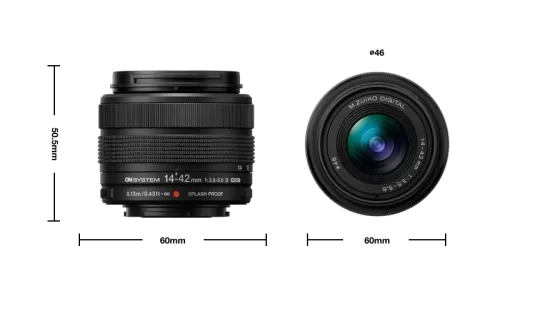
OM System M.Zuiko Digital 14-42mm F3.5-5.6 III

A person holding the OM System PEN with a 14-42mm lens attached and extended.OM System

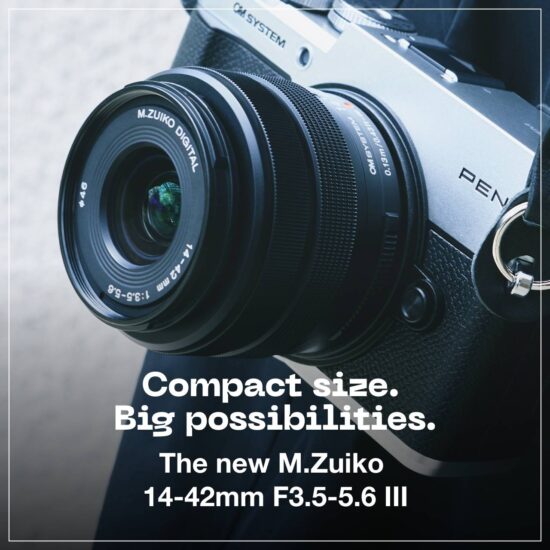
Released alongside the PEN was an updated model of OM System’s standard zoom, the M.Zuiko Digital 14-42mm F3.5-5.6 III (28-84mm equiv.). The new version is a small upgrade, but it finally offers weather sealing and lets you focus more closely. It is slightly larger than its predecessor, but it’s still quite small for what it is, fitting nicely on cameras like the new PEN. 

Laowa 180mm F4.5 1.5x Ultra Macro APO for X and F-mount

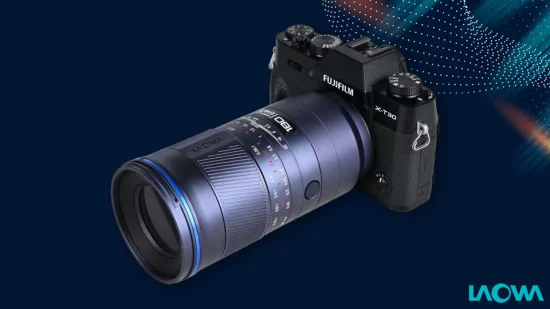
A Nikon F-mount manual-focus version launches alongside it, but the Fujifilm variant is the headline story as it ends a long wait for AF Laowa glass on the X-system.Laowa

While not a new lens, Laowa announced this week that the previously released 180mm F4.5 1.5x Ultra Macro APO is now available for Fujifilm X-mount and Nikon F-mount. It is the first autofocus Laowa lens available for X-mount, and offers a 270mm equiv. field of view on Fujifilm’s APS-C cameras. The price is also a pleasant feature: it costs just $499. 

Sony FE 8-14mm F3.5 Fisheye G

The Sony FE 8-14mm F3.5 G Fisheye lens with focus and aperture markings, held in a hand against a gray shirt background.
The Sony FE 8-14mm F3.5 G Fisheye lens.
Dale Baskin

Sony released a lens this week that is a first in its lens lineup. The FE 8-14mm F3.5 Fisheye G is the company’s first standalone fisheye lens for E-mount, and it says it’s the most compact lens of this type. At 8mm, the lens provides a circular fisheye image, which will be very familiar to anyone who watched 90’s skateboarding or music videos, while zooming to 14mm results in an image that fills the frame. 

Sigma 20-60mm F2.8-4 DG Contemporary

A person holds a Sony camera up to their eye with the Sigma 20-60mm F2.8-4 attached.Sigma / Jack Redgate

Sigma announced two lenses this week, one of which was the 20-60mm F2.8-4 DG Contemporary, a kit lens upgrade for E and L-mounts that is remarkably compact. It weighs 385g (13.6oz), and is 88mm (3.5″) long at its shortest (it extends as you zoom). It is limited in on-lens controls, but Sigma says it’s dust and splash-resistant, and at $849, it’s relatively affordable, too. 

Sigma 85mm F1.2 DG Art

A pair of hands holding the Sigma 85mm F1.2 Art attached to a Sony body.Sigma

For those looking for a more portrait-focused lens, the new Sigma 85mm F1.2 DG Art may be of interest. Like the above lens, it is available for E and L-mounts and is the company’s third F1.2 prime lens, joining 35mm and 50mm options. A lens of this type will have some bulk, but Sigma says it is the “smallest and lightest in its class,” and it weighs just 905g (31.9oz). It’s also significantly more affordable than the Canon and Nikon 85mm F1.2 lenses, coming in at $1599. You can see sample images from the lens here. 

Nine Nikon cinema lenses

A Nikon-branded 50mm T1.9 cinema lens with gold accents.Nikon

Not to be left out of the slew of announcements this week, Nikon announced it will be releasing a series of nine T1.9 cinema lenses. Details are still sparse on most of them, including availability, pricing and focal lengths, but it did say one of the nine lenses will be a 50mm. We’ll have to wait for more details, but it does appear Nikon is busy at least.

Fujifilm XF 400mm F4.5 R LM OIS WR

Professional digital camera with a large telephoto lens on a wooden surface; sunlight casts shadows across the scene.Abby Ferguson

Fujifilm released the XF 400mm F4.5 R LM OIS WR at the end of last week, but for the sake of thoroughness, we’re including it here. The $3200 super-telephoto prime lens rounds out its trio of such lenses, joining the XF 500mm F5.6 R LM OIS WR and XF 200mm F2 R LM OIS WR. It provides a 609mm equivalent focal length on X-mount cameras, and is relatively compact and lightweight for what it is. 

Apple iPhone 18 Pro, iPhone 18 Pro Max and iPhone Duo

Image showing the four colors of the iPhone 18 Pro: black, silver, light blue, and burgundy.Apple

Shifting gears away from lenses, this week marked the release of Apple’s latest iPhone lineup, which includes the iPhone 18 Pro, 18 Pro Max and Duo. The most notable update from a camera perspective is the variable aperture found on the main camera of the 18 Pro and Pro Max, which ranges from F1.48 to F4. It also finally unlocks manual control over some settings within the native camera app.  

The Duo is Apple’s long-awaited entry into the folding phone market, and while it doesn’t feature very advanced cameras, it does offer some camera tricks. 

Insta360 Luna Pro

Black handheld camera gimbal in a hand outdoors, with green plants and purple flowers in the background.Mykim Dang

Lastly, Insta360 announced the global release of its Luna Pro, a single-lens gimbal camera aimed at creators who want a portable, stabilized camera for social-ready video. It keeps the specs of the main camera found on the Luna Ultra, and comes in at $600, $170 less than its dual-lens sibling. You can see our hands-on footage here. 

About the Author: Abby Ferguson holds an MFA in photography and blends a fine-art background with extensive editorial and commercial experience. She built and led an in-house imaging program for a large vacation rental company and has served as an associate editor at Popular Photography. She also teaches at a local community college and serves on its Photographic Technology Program Advisory Board, sharing her knowledge and enthusiasm for the medium.

Want to stay up to date on the latest product news and releases? Add DPReview as a preferred source to ensure our independent journalism makes it to the top of your Google search results.

  •  

This 24-inch camera was built to spy from 80,000 feet

The San Diego Air & Space Museum unpacked an unused reconnaissance camera associated with the Lockheed A-12, showing off the camera that produced six-foot-long negatives.

Large, green, circular optical device with a glass lens and multiple bolts held in a hand; shown indoors near machinery and office chairs.All Day Aviation

Photographers usually discuss focal length in millimeters. But the San Diego Air & Space Museum’s newly unpacked reconnaissance camera is identified in inches: 24 of them, or roughly 610mm. According to the museum, an even longer 48-inch version followed. 

The camera was part of a cache of unused 1960s-era equipment supplied with the museum’s Lockheed A-12, the CIA’s Mach 3 reconnaissance aircraft and the predecessor to the SR-71 Blackbird. The video is nearly 20 minutes long and begins with substantial background on the A-12 (it is an aviation channel, after all) so photographers may want to jump to the 11:47 mark, where the museum gets into the cameras and how they were used. 

In the video, host Gordon Permann walks through some of the challenges of making a sharp photograph from about 80,000 feet while traveling at roughly 2500 mph. The ground would move hundreds of feet beneath the aircraft during an exposure, resulting in a blurred image. Making matters worse, neither the aircraft nor the terrain would necessarily be level. The solution was motion compensation: the camera itself would “skew,” or make a small movement as its aperture opened, counteracting image smear.

Another fascinating feature is simply how much film these systems used. Permann first shows the standard film canister used in reconnaissance aircraft from the 1950s through the 1990s, which he says held roughly 1200 feet of film. But the A-12 and SR-71 Blackbird needed still more film, so a larger canister was made. The museum has one of those, too, which Permann lifts in the video. He explains that the larger camera used a five-inch-wide film strip, with around 4.5 inches of usable image area. Each individual frame measured about six feet long.

Permann says the system could image more than 100,000 square miles in a single hour, capturing huge swathes of land or sea at once. He also recounts a Blackbird making a turn with its camera running and pointed out to sea. When the film was developed, analysts reportedly spotted a U.S. destroyer on the horizon, 94 miles away, and were able to identify the ship’s type despite the distance.

A separate, still-factory-wrapped camera in another crate is the real mystery: its 1953 date predates the A-12 project by six years, so it couldn’t have come from a Blackbird-family aircraft. The museum is seeking the public’s help to identify what airplane it may have been used on, so anyone with a theory can head to the video and share it in the comments.

About the Author: Abby Ferguson holds an MFA in photography and blends a fine-art background with extensive editorial and commercial experience. She built and led an in-house imaging program for a large vacation rental company and has served as an associate editor at Popular Photography. She also teaches at a local community college and serves on its Photographic Technology Program Advisory Board, sharing her knowledge and enthusiasm for the medium.

Want to stay up to date on the latest product news and releases? Add DPReview as a preferred source to ensure our independent journalism makes it to the top of your Google search results.

  •  

Is the Sigma 85mm F1.2 Art the new portrait champion for E and L mount?

Check out our sample gallery with portraits, portraits and more portraits.

Photo of a young man with balls of light behind him.Mitchell Clark

Earlier this week, Sigma fully unveiled the 85mm F1.2 Art, a lens it announced would be coming earlier this year. We had the chance to shoot with it, and mainly focused on testing out its capabilities for portraiture, as that’s the traditional use for fast 85mm primes.

You can check out the sample gallery below to judge its performance for yourself. 

We found that shooting with it was the characteristically refined experience that we’ve come to expect from Sigma’s Art-series lenses. While a quality F1.2 lens will never be the smallest or lightest option, we appreciated that this particular lens is light for what it is; Sigma actually claims it’s the smallest and lightest full-frame 85mm F1.2 with autofocus for mirrorless cameras. It feels like something you could conceivably carry around all day without having to worry about waking up the next morning to an unusably sore arm (though I had it paired with an original Panasonic S1R, so it still made for a relatively hefty setup). 

The controls on the lens are also well-judged. I always appreciate a clicked aperture ring, though Sigma also lets you de-click it if you prefer. It’s also nice that you can lock it either into or out of the ‘A’ mode that hands over control of the aperture to the camera body.

While we haven’t put the lens through a full battery of tests to determine every aspect of its image quality, it’s hard to find much fault with the samples we’ve taken. It’s quite sharp across the frame, even at F1.2 (though obviously you’ll be working with razor-thin depth of field), though there’s definitely some chromatic aberration present. There’s also relatively strong vignetting at F1.2, which isn’t necessarily a surprise given the lens’s size, though it largely clears up by F2.8.

Whether you think the trade-offs of an F1.2 lens are worth it over an F1.4 or F1.8 will largely depend on your thirst for light and background blur. But before now, your options for this kind of lens on E and L-mount were limited to non-existent, so it’s nice that we’re getting a genuinely good option, especially one that comes in at just over half of what Nikon and Canon will charge you for a similarly-speced lens.

Loading gallery…

About the Author: Mitchell started taking pictures at 10 and hasn’t stopped since. It’s been a wide-ranging adventure, spanning a wide variety of genres and locales, and occasionally dipping into fascinations with video and filmmaking. They honed their technical knowledge doing documentation, programing and QA, writing for The Verge, and just generally messing around on the computer to see what breaks.

Want to stay up to date on the latest product news and releases? Add DPReview as a preferred source to ensure our independent journalism makes it to the top of your Google search results.

  •  

Battle of the Pros: how the new iPhone 18 Pro stacks up to its predecessors

Is an adjustable aperture Apple’s only new camera trick?

A burgundy iPhone mobile phone against a dark background.Apple

This week, Apple announced the iPhone 18 Pro, the latest entry in its lineup of high-end smartphones. As we’ve come to expect, the update includes several new camera features, and even some new hardware. So how does it stack up against the last few years of Pro phones from Apple?

Before we get to what’s changed, let’s quickly cover what stayed the same: the 48MP ultra-wide camera, which provides a 13mm equiv. field of view and uses a 1/2.55 (23.5mm²) sensor, is the same model on the iPhones 16, 17 and 18 Pro. Likewise, Apple hasn’t updated the selfie or telephoto cameras on the 18 Pro either; they’re the same ones from the iPhone 17 Pro (though they were upgrades from those of the 16 Pro).

iPhone 18 ProiPhone 17 ProiPhone 16 Pro
Main camera24mm equiv.
F1.48 – 4
48MP
Type 1/1.28 (71.5mm²)
24mm equiv.
F1.78
48MP
Type 1/1.28 (71.5mm²)
Ultrawide13mm equiv.
F2.2
48MP
Type 1/2.55 (23.5mm²)
Telephoto100mm equiv.
48MP
Type 1/2.55 (23.5mm²)
120mm equiv.
12MP
Type 1/3.2 (15.3mm²)

It’s also worth stating up front that the camera layouts on the 18 Pro are the same whether you go with the standard or Max versions, leaving you free to decide whether you want a 6.3″ or 6.9″ display, without having to worry that you’re compromising your phone’s photographic abilities.

The main camera

Illustration of the iPhone 18 Pro's aperture blades.
An illustration of the iPhone 18 Pro’s aperture blades.
Apple

So what has changed then? The major hardware change Apple made to the iPhone 18 Pro is the addition of an adjustable aperture to the main 24mm equiv. camera. Unlike the fixed aperture lenses that all previous iPhones have used, this allows you or the phone’s software to choose whether it wants to cut down on the amount of light hitting the sensor, or make adjustments to the depth of field without resorting to software tricks. And if you stop it down all the way, you can even get some sun stars.

The six-bladed aperture has four settings: F1.48, F1.8, F2.8 and F4. Notably, the brightest aperture is faster than the lenses used on the iPhone 17 and 16 Pro, which were fixed at F1.78. While I’m on record saying that an adjustable aperture probably won’t be a ground-breaking change (something I still generally believe), I caveated that statement with the assumption that the phone’s maximum aperture wouldn’t change. At the time, I thought the feature would make for a lens that goes from F1.78 to F4, or F6.1 to F13.7 equiv., letting you switch from a setting with enough depth of field to more than enough. But the difference should be a bit more noticeable now that you’re starting at F5.1 equiv.

A hand holding an iPhone 18 Pro with the camera open, showing the aperture picker UI.Tucker Bowe

While Apple says the sensor behind the lens is new, details are light on what’s changed. It’s still the same size – Type 1/1.28 (71.5mm²) with 1.22µm pixels – as the one used by the 17 and 16 Pro, so it won’t gather any more light; the 50% improvement that Apple references in its presentation is entirely accounted for by the fact that the lens’s maximum aperture is half a stop faster.

Software

Screenshot showing Apple's
Apple is finally giving you some of the manual control that you’ve previously had to use third-party camera apps to get. (Thankfully, Apple says it’ll provide API access to the variable aperture, so apps like Halide and Adobe Project Indigo will be able to make use of it.)
Apple

The rest of the camera improvements on the iPhone 18 Pro come from software, and many of the features are only available when using that upgraded main camera. The biggest finally comes from the the “Pro controls” mode, which lets you manually set parameters like white balance, aperture, shutter speed, and view a histogram. (Disappointingly, there’s no mention of manual focus control, for when the AF system doesn’t get things right. While this is theoretically something Apple could port to its older Pro phones, minus the aperture control, of course, its comparison page indicates that it has no intention of doing so.

Apple has also introduced a new “Reference” mode for the main camera, which it says bakes authenticity data into photos taken with the phone into the image on a pixel level. This appears to be an answer to Google Pixel’s inclusion of C2PA Content Credentials in its camera app, though its inclusion as a separate mode means you have to actively decide to use it.

Photographic Styles 3 is a minor change

The iPhone 18 Pro introduces Photographic Styles 3, an update to the system that gives you more control over what your phone’s photos look like, letting you adjust things like contrast and color at the point of capture. The system was majorly overhauled with the iPhone 16 Pro, giving you a lot more control and letting you change the style after-the-fact, rather than permanently baking it into the image. The version on the 18 Pro is a much more minor change, adding the ability to “customize texture and grain to soften skin details or achieve an artful film look.”

Finally, Apple is adding a “Smart focus tracking” mode, which will attempt to recognize and stick to a subject after you’ve tapped on it to focus. Again, this feels like something that could come to previous models, but Apple’s comparison tool says it won’t.

Video

Many of the iPhone 18 Pro’s video upgrades are the same as they are for stills: you get the benefits of the variable aperture, and the ability to manually control it and other parameters, along with the tracking autofocus.

iPhone 18 ProiPhone 17 ProiPhone 16 Pro
Max res. / frame rate4K/120 main camera
4K/60 ultrawide/tele
“Cinematic” video4K/604K/30
Dual capture from front and rear cameras✅✅❌
ProRes Raw recording✅✅❌
Log recordingApple Log 2Apple Log
GenLock✅✅❌

Otherwise, the changes are relatively minor: you can now record at up to 4K/60 in the “Cinematic” video mode that adds simulated background blur, where the iPhone 17 and 16 Pro max out at 4K/30. More importantly, though, is that you no longer have to make the on whether to apply the effect or not when recording; you can apply it after the fact. The timelapse video feature is also upgraded to 4K, and Apple appears to have improved its noise reduction as it claims the 18 Pro has better low light video across the board, including on the selfie camera.

The rest

Screen showing several feature of the iPhone 18 ProApple

Of course, a phone isn’t just a camera, and Apple’s made some big changes under the hood that make the iPhone 18 Pro enticing even if you’re happy with your phone’s photos. You can read our launch coverage for the full story, but the top-level summary is that the chip is now substantially faster (especially when it comes to AI tasks, with twice the number of neural cores), and is kept cool thanks to a more advanced vapor chamber design, and some clever engineering choices. The battery life has also gotten a relatively impressive bump, and you can new refill it faster with 60W wired charging, where the 17 Pro topped out at 40W.

You will, however, pay for all these upgrades, in more ways than one. The iPhone 18 Pro and Pro Max start at $100 more than their predecessors for the same spec, and, while they keep roughly the same dimensions as past Pros, are the heaviest ones yet, despite their aluminum, rather than stainless steel, frames. That metal is, however, once again in four colors: black, burgundy, silver and a light blue.

About the Author: Mitchell started taking pictures at 10 and hasn’t stopped since. It’s been a wide-ranging adventure, spanning a wide variety of genres and locales, and occasionally dipping into fascinations with video and filmmaking. They honed their technical knowledge doing documentation, programing and QA, writing for The Verge, and just generally messing around on the computer to see what breaks.

Want to stay up to date on the latest product news and releases? Add DPReview as a preferred source to ensure our independent journalism makes it to the top of your Google search results.

  •  

Icelandair’s worst photographer is back. Here are her Iceland photos

$50,000 and 10 days later, the verdict is in: Iceland is still difficult to photograph badly. Though not for lack of trying.

Mossy rocks in a natural landscape with scattered clouds in a blue sky and distant mountains; two fingers partially obscure the top of the view.Blanche Mortemard

Earlier this year, we reported on a novel photography contest sponsored by Icelandair: a competition to identify the worst photographer it could find, offering a free trip to Iceland and $50,000 cash. The premise was that Iceland is so beautiful that even a terrible photographer could capture its stunning landscapes, and Icelandair wanted to prove it. 

It turns out the airline got a much bigger response than it anticipated, receiving 127,642 entries from 178 countries. That’s a lot of bad photographers, and to find the winner, the judges spent more than 2,000 hours screening what were, by all accounts, terrible photos. You can’t make this stuff up.

Fast forward to June, when we reported on the winner, 28-year-old Blanche Mortemard of Paris, France, who wowed the judges with her inept technical ability and lack of compositional skill.

Wide waterfall cascading down mossy cliffs into a rocky riverbed, with several people standing nearby. A red finger partially covers the top right corner. Overcast sky in the background.
Blanche captured the famous Skógafoss waterfall in southern Iceland – along with her finger.
Blanche Mortemard

But the story didn’t end there. Shortly thereafter, Blanche jetted off to Iceland, presumably on Icelandair, to put her – ahem – skills to the test, spending 10 days touring the island and shooting its landscapes with no filters, no retouching and no AI.

The results are in, and while Blanche isn’t likely to be named photographer of the year by any other organization on the planet, she got some nice shots – along with less-than-perfect photos. As for Iceland? It understood the assignment and came through, looking beautiful, even if obscured by body parts. 

Atlantic puffin standing on a grassy cliff edge above the ocean with waves crashing in the background.
Although some of Blanche’s photos are less than perfect, we quite like this shot of an Atlantic puffin.
Blanche Mortemard

Reflecting on her experience, it seems that even Blanche thinks Icelandair’s marketing department was onto something. “Iceland makes it almost impossible to take a bad photo, despite my total inability to straighten the camera or take one without my thumb in shot,” she said.

And with that, the saga of one of the most interesting photo contests to cross our desks in quite some time comes to a close. Well, almost.

A tall column of water and steam erupts from a geyser under a bright blue sky, with wet, rocky ground in the foreground.Blanche Mortemard
Waves crashing against blue ice chunks floating in a gray, stormy sea, with cloudy skies overhead and additional pieces of ice scattered in the cold water near the shore.Blanche Mortemard
Wide waterfall flowing between green cliffs beneath a bright blue sky with scattered clouds; wildflowers and grass cover the rocky foreground.Blanche Mortemard
Mossy rocks in a natural landscape with scattered clouds in a blue sky and distant mountains; two fingers partially obscure the top of the view.Blanche Mortemard

If you find yourself inspired by Blanche’s photography – and we’re not making any judgments – and are near London, you can attend the Iceland by the World’s Worst Photographer exhibition in person at White Rabbit Studios in Shoreditch on September 11 (2 – 8pm) and 12 (1 – 9pm). What’s more, you can attend a moderated talk by the “artist” (and we think even Blanche would use that term loosely) on Saturday, September 12 at 5pm. Admission is, mercifully, free, but needs to be booked. And if London isn’t on your itinerary, Icelandair says it plans to take the exhibition to a handful of other cities in North America and Europe. Because why not?

And let’s admit it – we probably all wish it could have been us on that trip.

About the Author: Dale Baskin is a professional photographer, writer, and filmmaker based in the Pacific Northwest. He is the Managing Editor of DPReview.com.

Want to stay up to date on the latest product news and releases? Add DPReview as a preferred source to ensure our independent journalism makes it to the top of your Google search results.

  •  

Viltrox unveiled new lenses at IBC 2026


Viltrox officially unveiled several new lenses at the 2026 IBC show (previously reported here)

  • New Full-frame L-Mount lenses: AF 14mm F4.0, AF 20mm F2.8, AF 40mm F2.5, and AF 50mm F2.0
  • New Full-frame Pro Series Lens: Viltrox AF 35mm F1.4 Pro
  • New APS-C lenses: Viltrox 18mm F1.2 Pro and Viltrox 40mm F1.2 Pro
  • New high-power flash
  • New Viltrox DC-X4 camera monitor

Viltrox 10% off code: NIKONRUMORS

Additional information:

New Full-Frame Lenses on Show

At IBC2026, Viltrox will showcase new Air Series and Pro Series lenses, expanding its full-frame portfolio. These include the Viltrox AF 14mm F4.0 L, Viltrox AF 20mm F2.8 L, Viltrox AF 40mm F2.5 L, and Viltrox AF 50mm F2.0 L, adding four new focal lengths to the L-Mount system to give creators the opportunity to experience the series on their preferred camera system. From expansive scenes and architectural spaces to travel, vlogging, everyday shooting, and portraits, the four focal lengths offer versatile options for a wide range of visual storytelling.

In addition, the Viltrox 35mm F1.4 Pro is a highly anticipated addition to the Viltrox Pro Series, combining high-level image quality, meticulous craftsmanship, and a bright F1.4 aperture in one highly versatile focal length.

Two New APS-C Pro Series Lenses Deliver New Creative Potential

Viltrox will also introduce the new Viltrox 18mm F1.2 Pro and Viltrox 40mm F1.2 Pro to its Pro Series of APS-C lenses.

The Viltrox 18mm F1.2 Pro provides a broad perspective while maintaining the creative possibilities of a bright F1.2 aperture, while the Viltrox 40mm F1.2 Pro takes a more focused approach, combining a versatile perspective with an ultra-bright F1.2 aperture. Together, they allow creators to explore subject isolation, depth, and a more intimate relationship between the subject and the frame.

Beyond the Lens: New Tools that Support the Creative Process

Beyond optics, Viltrox is introducing new tools designed to support other essential stages of the creative process. This includes a new high-power flash that expands Viltrox’s imaging portfolio, giving creators greater lighting capability and flexibility, and providing another tool to help transform an initial idea into a finished image.

For modern video-production workflows, the new Viltrox DC-X4 camera monitor will also debut. Its larger, more practical production view provides greater control over composition, focus, exposure, and the overall image.

Viltrox roadmap: four new lenses for L-mount and more

Several new lenses from Chinese brands will be announced next week

The post Viltrox unveiled new lenses at IBC 2026 appeared first on Photo Rumors.

  •  

Laowa 180mm f/4.5 1.5x ultra macro lens released for Fuji X and Nikon F mounts


Venus Optics released new Fuji X and Nikon F versions of the Laowa 180mm f/4.5 1.5x ultra-macro lens:

Key Features

  • Laowa’s first autofocus lens for the Fujifilm X-mount system.
  • Compact and lightweight design for macro, telephoto, portrait, wildlife, and travel photography.
  • 180mm focal length, providing a 270mm full-frame-equivalent field of view on Fujifilm APS-C cameras.
  • 1.5× ultra-macro magnification for highly detailed close-up images.
  • Minimum focusing distance of 30cm (11.8 in.) and a minimum working distance of 14.7cm (5.8 in.).
  • Autofocus from 1.5m to infinity, with limited autofocus assistance for macro stacking.
  • APO optical design with 12 elements in 9 groups for high sharpness and reduced chromatic aberration.

Specification

Name 180mm f/4.5 1.5X Ultra-Macro APO
Format Full Frame
Focal Length 180mm
Aperture Range AF: F4.5 – 22
MF: F4.5 – 32
Angle of View 13.7°
Lens Structure 12 elements in 9 groups
Aperture Blades 9
Min. Focusing Distance 300mm
Min. Working Distance 147.6mm
Max. Magnification 1.5X
Focusing System AF* & MF
Filter Thread Ø62mm
Front Diameter Ø67.6mm
Dimensions Canon EF: Ø67.6mm×88.4mm
Sony E: Ø67.6mm×134.4mm
Fuji X: Ø67.6mm×134.7mm
Weight Canon EF: 484g (1.07 lb)
Sony E: 521.6g (1.15 lb)
Fujifilm X: 526.2g (1.16 lb)
Mounts AF*: Sony E / Nikon Z / Canon EF / Fuji X
MF: Canon RF / L-Mount / Nikon F
Price USD 499

Announced: Venus Optics Laowa AF FF 180mm f/4.5 CA-Dreamer Macro 1.5X lens (E/Z/EF/RF/L)

Additional information on the upcoming Venus Optics Laowa AF FF 180mm f/4.5 CA-Dreamer Macro 1.5X lens

The post Laowa 180mm f/4.5 1.5x ultra macro lens released for Fuji X and Nikon F mounts appeared first on Photo Rumors.

  •  

With the PEN camera, OM System also released a new M.Zuiko Digital 14-42mm f/3.5-5.6 III lens


With the PEN camera, OM System also released a new M.Zuiko Digital 14-42mm f/3.5-5.6 III lens:

  • Pre-orders: B&H Photo | Amazon | WEX Photo | Foto Erhardt
  • Supports Focus Stacking
  • 28-84mm 35mm Equivalent Focal Length
  • IPX1 Rated Weathersealing
  • 0.53x 35mm Equivalent Image Magnification
  • Minimum Focus Distance 5.12 inches
  • Compact Lightweight Design
  • F3.5 Maximum Aperture
  • Weather-sealed: IPX1 Splash-proof Performance and Dust-proof Design
  • 0.53x Magnification: Close Focusing Capabilities and Focus Stacking Support


Additional information on the new PEN can be found here and here:

The post With the PEN camera, OM System also released a new M.Zuiko Digital 14-42mm f/3.5-5.6 III lens appeared first on Photo Rumors.

  •  

We went hands on with the small, travel-ready OM System PEN. Here are our thoughts.

A first look at one of the smallest mirrorless cameras on the market.

A person holds up the OM System PEN to the cameraMitchel Clark

The OM System PEN brings a lot of camera (interchangeable lenses, twin command dials, an EVF, in-body stabilization and a rated degree of weather sealing) to not a lot of camera (it’s usefully small).

Here’s our hands-on overview of a camera that brings together familiar components in a form that we haven’t seen (at least in North America) for some time.

It’s more an E-P7 with a viewfinder than a direct PEN-F successor, but that delivers an interesting, relatively affordable option for everyday and travel photography.

If you want to read about the PEN in more depth and see more sample images, check out our written review.

About the Author: Richard graduated as a scientist but had a lot more fun writing and shooting for his university magazine. A number of years spent variously as a reporter, writer and editor on science and engineering titles combined his knowledge of science with his interest in images and words. But it was spotting the connections between emission spectra, white balance and all the nonsense he’d taught himself playing around in Photoshop that helped kindle an interest in digital photography. Searching for a camera led to him discovering DPReview and Richard was recruited by Phil Askey in 2007. He’s been combining his love of photography, communication and attention to detail (pedantry?) ever since. He has unusually strong opinions about lenses for the APS-C format.

Want to stay up to date on the latest product news and releases? Add DPReview as a preferred source to ensure our independent journalism makes it to the top of your Google search results.

  •  

Laowa is releasing its first autofocus lens for Fujifilm X-Mount: a macro monster

A Nikon F-mount manual-focus version launches alongside it, but the Fujifilm variant is the headline story as it ends a long wait for AF Laowa glass on the X-system.

A Nikon F-mount manual-focus version launches alongside it, but the Fujifilm variant is the headline story as it ends a long wait for AF Laowa glass on the X-system.Laowa

When you use DPReview links to buy products, the site may earn a commission.

Laowa has announced that it is bringing its 180mm F4.5 1.5x Ultra Macro APO lens to Fujifilm X-mount and Nikon F-mount. The lens was originally released almost exactly one year ago for Sony E, Nikon Z, Canon EF, Canon RF, and L-mounts, and the new additions mean that most photographers, no matter their system, have access to an affordable macro lens, though not every mount offers autofocus. 

A Nikon F-mount manual-focus version launches alongside it, but the Fujifilm variant is the headline story as it ends a long wait for AF Laowa glass on the X-system.Laowa

The Fujifilm X-mount version, like the E, Z, and EF-mount iterations, is an autofocus lens and marks the first autofocus Laowa lens for X-mount cameras. The Canon RF, L-mount and Nikon F versions, though, are manual focus only. Complicating matters further, the autofocus versions of the lenses only have their full abilities from 1.5m (4.9′) to infinity. For subjects between 1.5m and the lens’ minimum focusing distance, 30cm (11.8″), you only get “limited autofocus assistance for focus stacking.”

On Fujifilm X-mount cameras, the lens offers a 270mm equivalent field of view. Optically, all mounts are the same, with an apochromatic design and 12 elements in 9 groups, which Laowa says results in excellent sharpness and reduced chromatic aberration. It features a nine-blade aperture diaphragm. 

A Nikon F-mount manual-focus version launches alongside it, but the Fujifilm variant is the headline story as it ends a long wait for AF Laowa glass on the X-system.Laowa

The exact weight depends on the mount, but the Fujifilm X version is the heaviest of the bunch, weighing 526.2g (1.2 lbs). All iterations are compatible with 62mm filters. 

Laowa’s 180mm F4.5 1.5x Ultra Macro APO for X and F-mounts is available for purchase today for $499. 

About the Author: Abby Ferguson holds an MFA in photography and blends a fine-art background with extensive editorial and commercial experience. She built and led an in-house imaging program for a large vacation rental company and has served as an associate editor at Popular Photography. She also teaches at a local community college and serves on its Photographic Technology Program Advisory Board, sharing her knowledge and enthusiasm for the medium.

Want to stay up to date on the latest product news and releases? Add DPReview as a preferred source to ensure our independent journalism makes it to the top of your Google search results.

  •  

Viltrox teases several new lenses, including four L-mount options

The company is bringing several Air lenses to a new mount, and introducing two fast APS-C models.

Image showing five silhouetted lenses with the Viltrox and IBC logos underneath themViltrox

It looks like Viltrox is gearing up to release a lot of lenses, including bringing several of its existing full-frame designs to L-mount. The news comes from the company’s press release about its attendance of the International Broadcasting Convention, or IBC, this week. While the show is typically focused on video, the company says it’ll be showing off several photographic tools there, too.

First are its L-mount lenses. Viltrox is bringing its autofocusing 14mm F4, 20mm F2.8, 40mm F2.5 and 50mm F2 lenses to the mount, which are all part of its “Air” series of relatively lightweight options that were originally launched for Sony E and Nikon Z mounts. Given that the company has only released two autofocusing lenses for the mount since it joined the L-mount Alliance in 2025, this looks like a relatively dramatic expansion of its offerings. What stands out more, though, is that these lenses aren’t all standard fare; sure a 50mm F2 isn’t that exotic, but there aren’t exactly a ton of affordable ultrawide autofocus lenses already on the market for those with L-mount cameras.

The company also says it’ll be introducing two new APS-C lenses, the 18mm (27mm equiv.) F1.2 Pro and 40mm (60mm equiv.) F1.2 Pro. These are also exciting options, as I wasn’t able to find any other lenses like them currently available for sale (assuming they’ll have autofocus). Of course, they’ll probably be quite large and heavy, but for those who want fast glass to pair with an APS-C camera, these could be options to watch out for. 

The company also promises to expand its flash lineup

The company also promises to expand its flash lineup – which has, until now, consisted mainly of small, on-camera models – with a “new high-power” option. Whether that means a particularly bright version of what it’s made before, or a speedlight or standalone strobe to compete with companies like Godox, we’ll have to wait and see.

While Viltrox will be showing these lenses off at IBC, this doesn’t quite seem to be an official announcement yet. We don’t have release dates for the L-mount lenses, nor do we know if they’ll be the same price as the Sony and Nikon versions. Nor do we have much info on the APS-C lenses. But it’s clear that we should keep a close eye on Viltrox in the coming weeks.

About the Author: Mitchell started taking pictures at 10 and hasn’t stopped since. It’s been a wide-ranging adventure, spanning a wide variety of genres and locales, and occasionally dipping into fascinations with video and filmmaking. They honed their technical knowledge doing documentation, programing and QA, writing for The Verge, and just generally messing around on the computer to see what breaks.

Want to stay up to date on the latest product news and releases? Add DPReview as a preferred source to ensure our independent journalism makes it to the top of your Google search results.

  •  

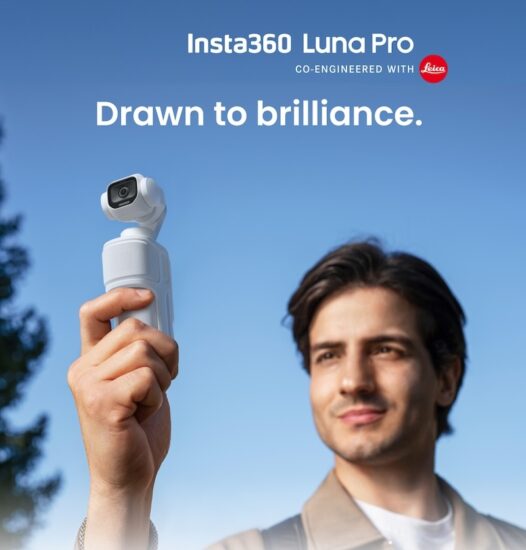
Insta360 launches Luna Pro gimbal camera co-engineered with Leica


Insta360 today announced the previously reported Luna Pro gimbal camera – its newest addition to the Luna series, co-engineered with Leica:

Insta360 Launches Luna Pro: Leica Co-Engineered Gimbal Camera for Everyday Vlogging

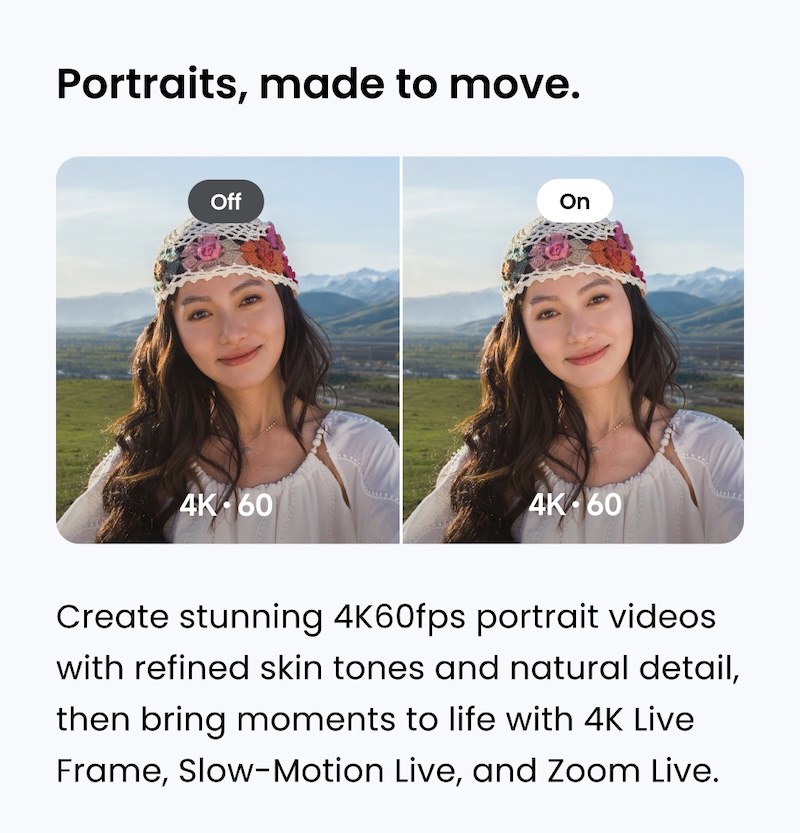
Designed around the needs of today’s lifestyle creators, Luna Pro combines high-end imaging with a fast, flexible approach to content creation. Native 4K Vertical Video makes it easy to capture high-quality content for short-form platforms, while AI-powered tracking, intuitive controls, and streamlined editing help creators work quickly when shooting solo or on the move.

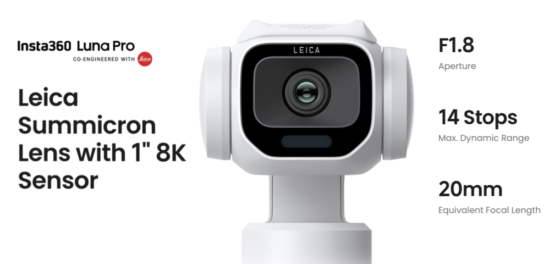
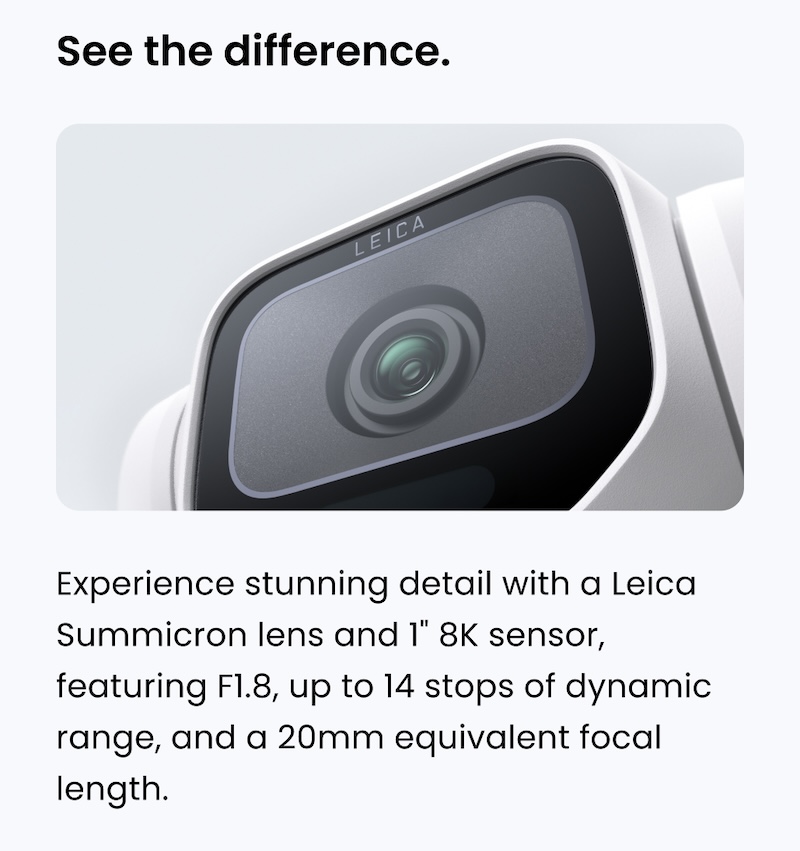
A Leica Summicron lens, 1-inch 8K sensor, 8K Dolby Vision video, 10-bit I-Log, and built-in timecode give Luna Pro the imaging quality and workflow tools to take on more demanding creative projects as well.

Luna Pro is available starting September 10 via the Insta360 Store, Amazon, and select retailers worldwide. Pricing for the Standard Bundle starts at US$599.99.

Professional Imaging

  • Luna Pro pairs a Leica Summicron lens with a 1-inch 8K sensor for exceptional detail and strong low-light performance.
  • Its Dual AI Chip architecture combines a dedicated imaging chip with a 4nm flagship chip, providing the processing power needed for advanced imaging and intelligent shooting features.
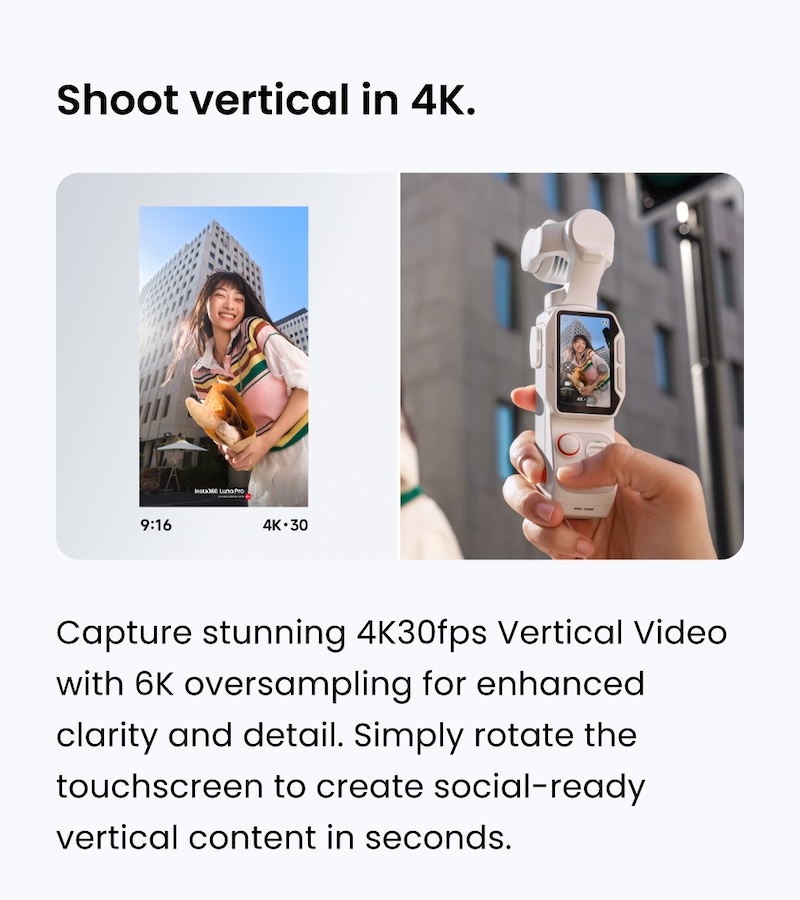
  • For creators producing short-form content, Luna Pro supports native 4K30fps Vertical Video with 6K oversampling for greater clarity and detail. Rotate the touchscreen to switch orientation and start shooting vertical content in 4K.
  • Luna Pro also records 8K Dolby Vision video for rich detail, color, and dynamic range. For slow motion capture, it supports 4K120fps and 1080p240fps recording.
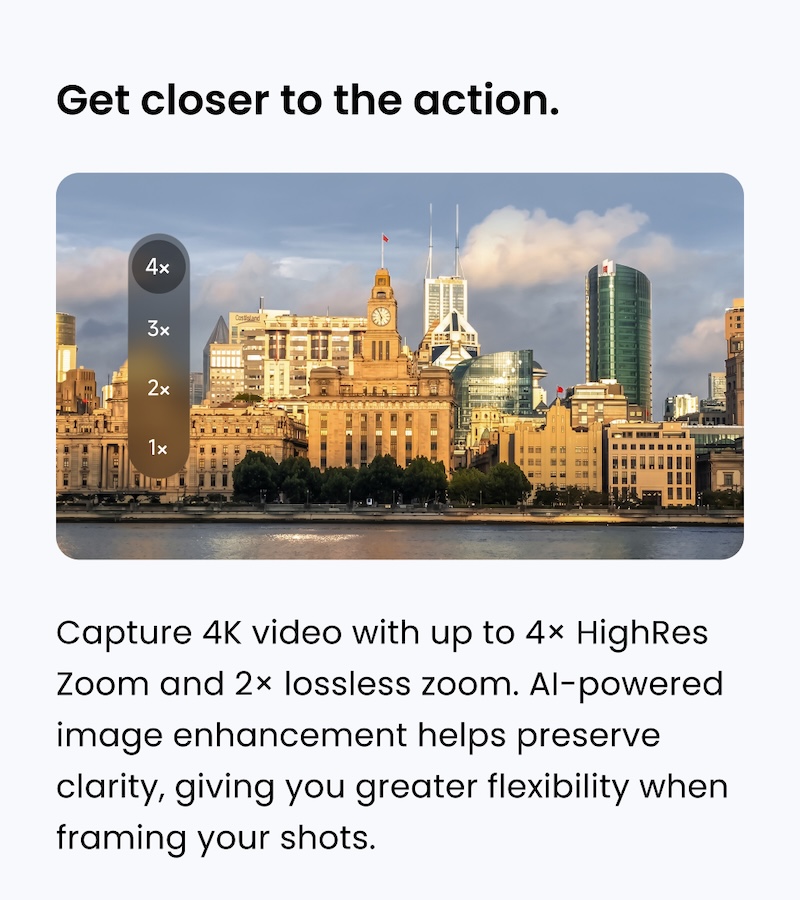
  • Up to 2× lossless zoom and 4× HighRes Zoom give creators more freedom to reframe or get closer to distant subjects, with AI-powered enhancement helping preserve image clarity at higher zoom levels.

Smooth, Flexible Shooting

  • Luna Pro’s 3-axis stabilization keeps footage smooth and steady, while AI-powered Deep Track and Rapid Focus help keep moving subjects sharp and in frame.
  • The detachable 2-inch OLED touchscreen makes it easier to compose and monitor shots from different angles. Slide-to-start recording and twist-to-shoot controls also reduce the time between picking up the camera and getting the shot.
  • With up to 4 hours of battery life and 47GB of built-in storage, Luna Pro is equipped for longer shooting sessions without frequent charging or storage changes. It also connects directly to the Insta360 Mic Series for high-quality wireless audio capture.

More Ways to Create

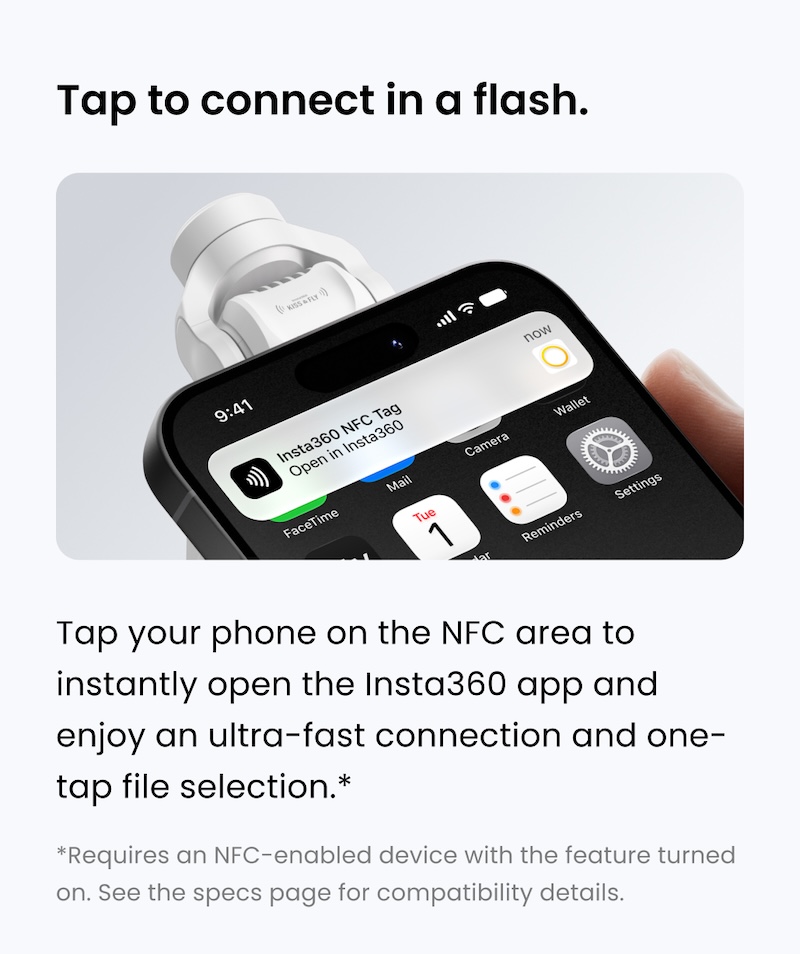
  • The POV Head Tracker opens up new possibilities for immersive first-person content, while NFC lets compatible phones connect to the Insta360 app with a simple tap for faster access to files and editing.
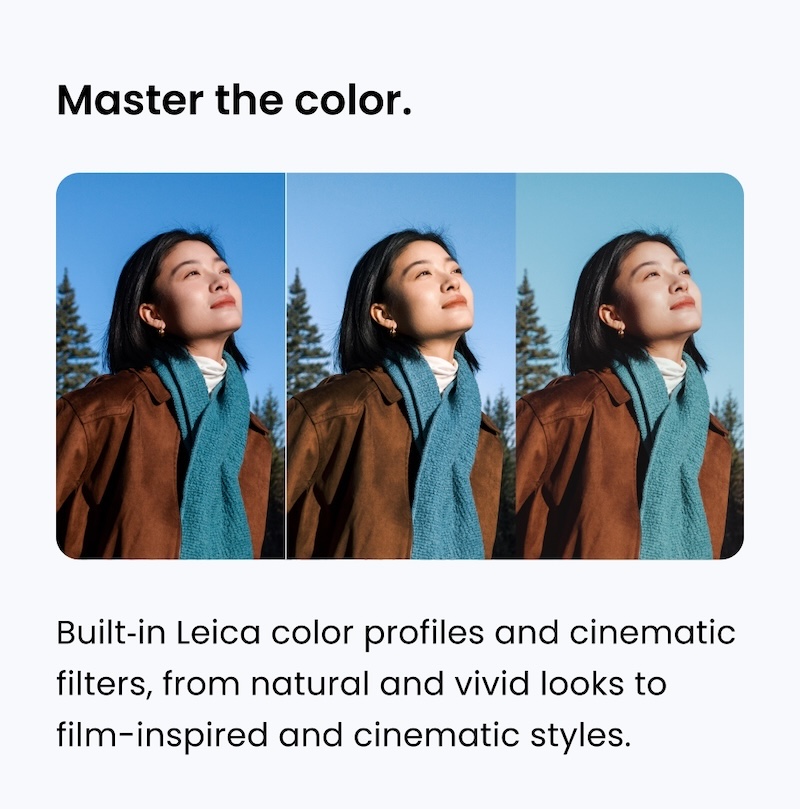
  • Luna Pro also offers Leica color profiles including Leica Natural, Leica Vivid, and Leica Chrome, alongside a range of cinematic filters for distinctive looks straight out of the camera.
  • For creators who want more control in post-production, 10-bit I-Log preserves more color information and highlight and shadow detail, with support for ACES workflows for professional color grading.
  • Built-in timecode simplifies synchronization in multi-camera productions and integrates into workflows using Final Cut Pro and Adobe Premiere Pro. AI-powered editing tools in the Insta360 app can also turn footage into polished content, particularly when speed matters.


The post Insta360 launches Luna Pro gimbal camera co-engineered with Leica appeared first on Photo Rumors.

  •  
❌