Vue lecture

DJI Osmo 360 II camera officially announced
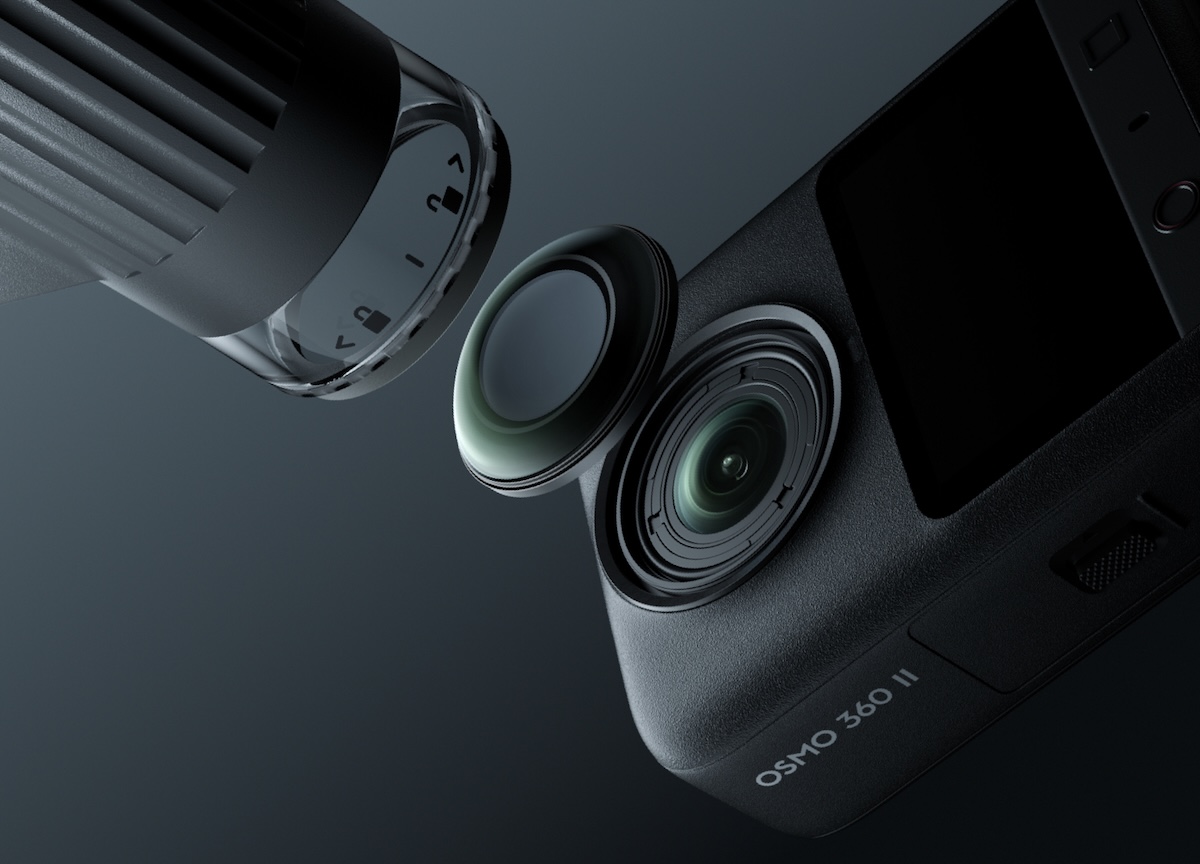

The previously rumored DJI Osmo 360 II camera has now been officially announced. You can already order one from AliExpress. Additional information is available here:

Imaging

  • Dual 1/1.1-inch square CMOS sensors (designed for 360° capture; equivalent imaging area to a traditional 1-inch sensor with ~25% higher utilization)
  • 2.4 μm pixels
  • f/1.9 aperture
  • ISO 100–51,200
  • Up to 14.5 stops dynamic range (lab measurement; 13.5 stops in D-Log M)
  • Independent exposure on front and rear lenses
  • AI SuperNight 2.0 noise reduction

Photos

  • 120 MP panoramic stills (15,520 × 7,760, 2:1) with HDR support
  • 30.72 MP single-lens stills (6,400 × 4,800, 4:3)
  • JPEG + RAW

Video

  • Native 8K panoramic: 7680 × 3840 @ 24/25/30/48/50/60 fps (up from 50 fps)
  • 6K panoramic: 6000 × 3000 @ up to 60 fps
  • Single-lens / flat: 4K (4:3 and 16:9) up to 60 fps; Boost / ultra-wide up to 4K/120 fps
  • Panoramic slow-mo: up to 4K/240 fps (up from 4K/100 fps)
  • 16K panoramic time-lapse
  • 8K/120 fps time-freeze mode (with optional Vortex rotating handle)
  • 10-bit color + D-Log M
  • Max bitrate ~220 Mbps (up to 600 Mbps for 16K time-lapse)

Other key specs

  • Stabilization: RockSteady / HorizonSteady (export options in DJI Mimo)
  • New: Spotlight Follow subject tracking (up to 4K/30 fps panoramic)
  • NFC tap-to-connect
  • User-replaceable lenses with ultra-hard ion-sputtered coating
  • IP68; 10 m waterproof without a case
  • 105 GB usable internal storage (128 GB total) + microSD up to 1 TB
  • Size: 61 × 36.3 × 81 mm
  • Weight: 183 g
  • Battery: 2,150 mAh (~8.3 Wh) — up to 100 min continuous 8K/30 fps; 80% charge in ~22 min with 30W+ PD charger; magnetic battery extension rod adds up to ~180 min
  • Operating temperature: −20°C to 45°C
  • Connectivity: Wi-Fi 6, Bluetooth, USB-C; compatible with Osmo Action magnetic mounts and DJI Mic

Pricing (launch)

  • China: from 3,299 yuan (~$460–490) standard combo
  • Japan: ~93,610 yen standard / ~110,990 yen Adventure combo
  • Europe listings around €480 starting

DJI Osmo 360 II camera to be announced next week

The post DJI Osmo 360 II camera officially announced appeared first on Photo Rumors.
  •  

The View-Master was built for photographers, not children, and nobody told us

It was sold beside postcards, and by 1952, you could buy the camera and make your own reels. I just didn’t know any of that when I was a kid.

White and red vintage View-Master toy with two eyepieces, a top slot for reels, and a blue side lever, shown against a dark gradient background.Dale Baskin

Despite what many people believe today, the View-Master wasn’t a toy. It was a photographic instrument, sold for decades alongside disks of stereoscopic photo pairs that took you a world away. And that’s where my story with the View-Master – and even my interest in photography – begins.

But my part of the story comes later. The View-Master’s story starts at the mouth of a cave in southern Oregon in 1938.

According to the Oregon Historical Society, Harold Graves, the president of Sawyer’s, a photo-finishing company in Portland, was vacationing there when he met a photographer named William Gruber, who was carrying a homemade stereo photography rig.

Sawyer’s had become the nation’s largest producer of scenic postcards. Gruber had figured out how to mount tiny chips of the then-new Kodachrome film into a paper reel that could be viewed through a small handheld stereoscope. Graves, Gruber and Sawyer’s co-owner Edwin Mayer, sensing an opportunity, struck up a partnership and developed the View-Master, which made its debut at the 1939 New York World’s Fair.

It’s worth thinking about what Sawyer’s thought it was selling. The View-Master was pitched as an alternative to the scenic postcard, targeting the same channels postcards did: gift shops at scenic locations, stationery stores and even photography shops. Notably, not toy stores.

View-Master reel with paper sleeve labeled "7 More Wonders of the World" and "3-Dimensional Pictures in Full-Color Kodachrome"; the reel displays location names including Mount Rainier and Jasper National Park.
Originally, View-Master’s reels mirrored postcard content: National Parks, famous landmarks and scenic destinations around the world.
Dale Baskin

Even the US military took notice; it ordered 100,000 of the viewers to use for training during World War II.

The View-Master wasn’t the first device for viewing stereo images, a technology that predated practical photography; Charles Wheatstone, a member of the Royal Society, described his stereoscope, which used drawings, in 1838, a year before the daguerreotype was announced to the world. But photography made stereo viewing far more compelling than drawings ever could, and “stereographs” became a popular form of visual entertainment in the latter half of the 19th and earlier 20th centuries.

What the View-Master managed to do was productize stereo photo viewing in a dummy-proof device… in beautiful Kodachrome color.

What the View-Master managed to do was productize stereo photo viewing in a dummy-proof device that was easy to use, in beautiful Kodachrome color. The earliest reels featured the same things as postcards, including National Parks, famous landmarks, and scenic travel destinations.

The View-Master-as-toy came later. In 1951, Sawyer’s bought Tru-Vue, its main competitor, which had a license with Walt Disney Studios, and Disney reels and other entertainment brands like Looney Tunes and The Muppets followed. So, the View-Master was eventually sold as a toy. It just didn’t start as one.

Vintage View-Master reel labeled "Banff National Park" featuring small scenic images from Lake Louise Region, Alberta, Canada, displayed on a gray surface.
Gruber’s key innovation was fitting Kodachrome film chips into a paper reel – giving the View-Master its signature full-color stereo look.
Dale Baskin

As a child, I loved the View-Master. Whenever we got a new set of picture disks, it gave me a new world to explore. During our family’s summer road trips, I could spend hours in the back of our banana-yellow station wagon, looking at photos through my View-Master.

That’s pretty remarkable when you think about the fact that each disk contained just seven pairs of images. In an age where the phones in our pockets put limitless media at our disposal, that seems like a staggeringly small set of photos, but somehow I just kept looking at them. Over and over again. I probably looked at some of those photos thousands of times, and I never got tired of it.

Back then, View-Master disks could be found at tourist locations. Every National Park gift shop had them. Sure, you could buy a postcard, but the View-Master disk of the park was way better. (Unless, of course, you actually wanted to send someone a postcard.) You could relive the experience of that National Park for hours during the drive to the next National Park, where you could acquire a new set of View-Master reels. In contrast, you had to wait until you got home to see the photos your parents took.

In 1952, in a further nod to photographers, Sawyer’s launched the View-Master Personal Stereo Camera

In 1952, in a further nod to photographers, Sawyer’s launched the View-Master Personal Stereo Camera, which allowed you to capture 69 pairs of photos on a 36-exposure roll of film. The company offered a mail-order mounting service, or users could mount their own photos on View-Master reels. You still had to wait until you got home to process your images, but you could have View-Master reels of your trip. It’s amazing to think you could buy an entire camera system built around this.

Vintage brown View-Master Personal Stereo Camera with two lens openings on the front, labeled "Personal" and "Stereo Camera," featuring ridged horizontal lines across the body.
The View-Master Personal Stereo Camera was designed to let photographers create their own View-Master reels. It allowed photographers to capture 69 pairs of photos on a standard 36-exposure roll of 35mm film.
John Alan Elson

While visiting my parents recently, I found a box with my childhood View-Master inside. Nostalgia is a strong thing, so I immediately took it off the shelf, inserted one of the reels and found myself staring at Yosemite National Park, displayed in rich colors and deep shadows. It had the unmistakable look of Kodachrome and reminded me of the slides my father shot on family vacations.

My father was always taking pictures. No vacation was complete without a camera coming along. Back home, we’d gather in the living room for slideshow nights, kind of like movie nights today, where he would load one box of 36 slides at a time into the stack loader on our Kodak projector, allowing us to relive whatever slice of our lives had passed during that roll of film. Those slides were usually Kodachrome, too.

The images on those old View-Master disks had that same look, but with a couple of important differences. First, they were stereo pairs, and the depth made them less like pictures and more like places.

The second one mattered more. Most were of incredible landscapes I had never seen, or people from different cultures and faraway lands. It was like browsing through the photos in a National Geographic magazine (something else I did a lot as a kid; I wasn’t as good about reading the articles back then), except better. My father’s slides showed me where we had been. The View-Master showed me where I hadn’t been yet, and I wanted to go to those places and take pictures of them.

White and red vintage View-Master toy with two eyepieces, a top slot for reels, and a blue side lever, shown against a dark gradient background.
For years after its 1939 launch, the View-Master was sold as a photographic and travel product, not a toy — it didn’t reach toy stores until after Sawyer’s bought Tru-Vue in 1951.
Dale Baskin

In retrospect, I think the View-Master was a proxy for the camera I didn’t own yet. Today, I realize that it wasn’t just looking at the pictures that I enjoyed, but the act of holding the device up to my eyes, of looking through the viewfinder up close, and having the all-immersive experience of seeing that and nothing else.

We live in a time when taking photos often involves holding a screen in front of our faces. I still don’t get the same satisfaction from that experience as bringing the viewfinder to my eye, focusing on the image and letting the rest of the world fade away. And I suspect that’s one thing that draws a lot of new photographers to a dedicated camera. Once you know that feeling, it’s addictive.

As a kid, I wanted to take photos like my Dad. I wanted to take photos like the ones in National Geographic. And I wanted to take photos like the ones I saw in the View-Master.

And when I finally bought my first roll of film with my own money, it was Kodachrome.

About the Author: Dale Baskin is a professional photographer, writer, and filmmaker based in the Pacific Northwest. He is the Managing Editor of DPReview.com.

Want to stay up to date on the latest product news and releases? Add DPReview as a preferred source to ensure our independent journalism makes it to the top of your Google search results.

add as a preferred source on google

  •  

2025 mirrorless camera production volume ranking (without fixed-lens compact and instant cameras)


I already reported on the 2025 digital camera shipment market share from the latest Nikkei Industry Report– Fujifilm’s surge is widely attributed to strong compact demand (X100VI, X-half, and Instax models, which appear to be counted in this series):

2025 digital camera shipment market share

We now have a better breakdown of the actual 2025 Mirrorless Camera Production Volume Ranking (without fixed-lens compact and instant cameras) from the latest edition of the Japan Company Handbook Industry Map 2027 Edition (the report excludes non-Japanese players such as Leica):


2025 Mirrorless Camera Production Volume Ranking

  1. Canon: 2.3 million units sold 
  2. Sony: 1.8 million units sold 
  3. Nikon: 860,000 units 
  4. Fujifilm: 750,000 units sold 
  5. Panasonic: 270,000 units 
  6. OM Digital: 120,000 units 

2025 DSLR Camera Shipment Ranking

  1. Canon: 580,000 units
  2. Nikon: 60,000 units
  3. Pentax: 10,000 units

CIPA’s official 2025 total (all participating Japanese makers) was 9.44 million units, up 11.2% from 8.49 million in 2024. Compact/fixed-lens cameras grew much faster than interchangeable-lens bodies and were a major driver of the volume rebound.

See previous reports here:

Canon celebrates 23rd consecutive year of #1 share of global interchangeable-lens digital camera market

DJI currently holds a whopping 72.5% of the video camera market in Japan

2026 BCN awards

Here are the top 10 best-selling compact digital cameras for the first half of 2026 in Japan


Source: dclife, via NikonRumors

The post 2025 mirrorless camera production volume ranking (without fixed-lens compact and instant cameras) appeared first on Photo Rumors.

  •  

A Kathmandu, Nepal photographer’s quiet search for the stories others overlook

Afzal Khan first turned to photography for a sense of calm amid a demanding advertising career, and it has since become a personal connection to his hometown of Kathmandu, Nepal.

Those Labradorite Eyes V1.Afzal Khan

Meet Afzal Khan

Home base: Kathmandu, Nepal

I’m always interested in the way photographers describe their relationship with their camera, and Afzal Khan’s story is a particularly thoughtful example. What began with film rolls and childhood self-portraits evolved into a nearly 16-year photographic journey, influenced by a search for calm amid a demanding advertising career.

From Kathmandu, Nepal, Afzal now uses photography to take it slower and notice the people around him, finding deep stories in their solemn faces, old homes and the majestic landscapes of Nepal. In this edition of ‘What’s in your bag?’, he also talks about his move from a Sony A7R IV to the Hasselblad X1D II.

“Photography has been close to me since childhood. During the film era, I used to buy film rolls and take photographs of myself, usually with the help of friends. It was just something I enjoyed, without really thinking that photography would become such an important part of my life. What started as something I enjoyed as a child has now been with me for nearly 16 years, and I am still continuing the journey.”

Our ‘What’s in your bag?’ community spotlight series features readers sharing their favorite gear and photography, including from past DPReview collaborators. See below for what Lester has to share.

How did you get started as a photographer?

The Night of Shivaratri: A Divine Celebration | A Glimpse of Shivaratri Night in Kathmandu.
“The Night of Shivaratri: A Divine Celebration | A Glimpse of Shivaratri Night in Kathmandu.”

Sony α7R IV | Sony FE 55mm F1.8 ZA @ 55mm | F1.8 | 1/60 sec | ISO 1250
Afzal Khan

“When I started working in advertising in 2004 as a creative, I slowly found myself getting involved with photography from the other side of the camera. As a creative director, I worked with many reputed photographers in Nepal and spent a lot of time observing how they worked and how they saw things through the lens.

Around 2009, I carried a friend’s camera on a trekking trip, and that was probably when I started to feel I might have an eye for photography. Then, around 2010–11, I bought my first camera, a Sony A230, and started taking photography more seriously.

At that time, my advertising career was at its peak, and the work was quite hectic. I needed a break, some peace and a little calmness in my life. Photography gave me exactly that. It became almost like a medicine for me. I could step away from the pressure of work, go somewhere, observe things and just spend time with the camera.”

What’s in Afzal’s bag

Afzal Khan's camera bag
Afzal Khan’s camera bag
Afzal Khan

Favorite cameras(s): Hasselblad X1D II and Sony A7R IV

Favorite lens(s): Sony Zeiss 55mm FE ZA, Sony Zeiss 135mm F1.8 and a Lensbaby Sol 45.

“Just a few months ago, I switched brands. I am currently shooting with a Hasselblad X1D II and Hasselblad XCD 65mm lens. It is a new chapter for me, and I am enjoying the change.”

Must-have accessories: “One accessory I really like is the Peak Design Capture Clip, especially the limited edition made with Carryology. I also like the Peak Design backpack from the Coyote series. Apart from that, I prefer not to carry too many things. For me, the simpler the setup, the easier it is to concentrate on what I am seeing and photographing.

I love writing and reading, too, so my camera bag usually has one or two books in it. I also carry a wired earphone, a pen and a small box of natural solid perfume. They are not really photography essentials, but they are things I like having. My camera bag is not just a camera bag; it carries a few things that are part of my everyday life, too.

I am also looking forward to getting the Chinotech waist-level viewfinder, which is currently on my wishlist.”

What do you like to shoot?

Their shared ground: old age and old home.
“Their shared ground: old age and an old home.”

Sony α7R IV | Sony 135mm F1.8 ZA @ 135mm | F1.8 | 1/2000 sec | ISO 100
Afzal Khan

“I never really believed in dividing photography into genres. A camera doesn’t say, “I only capture landscapes” or “I only capture wildlife.” For me, a camera is simply a tool that allows me to capture what I love to see. I am usually more attracted to things that people tend to ignore, forgotten places, ordinary people and small moments of life that may look insignificant but actually have many stories hidden inside them. There are so many moments happening around us that we hardly notice, and I think I am always looking for those moments.

There are so many moments happening around us that we hardly notice, and I think I am always looking for those moments.

If I had to describe myself as a photographer, I would probably say I am a storyteller. I am always hunting for a story, whether it is in a person’s face, a place, a small detail or a particular moment. I enjoy many kinds of photography, but if I had to pick my favorites, portraits, macro, and more artistic and experimental work are what attract me most. They give me the freedom to look at things a little differently and tell a story in my own way.”

What’s changed since the beginning?

A Quiet Sadness II.
“A Quiet Sadness II.”
Afzal Khan

“I have gone deeper into searching for stories and understanding life and nature. I think most of my improvement came from regular practice. I never really made photography my profession, and I was never behind followers or trying to become popular. I simply kept doing it because I love photography.

That regular practice not only refined my skills of capturing things, but also improved my observation. I became more curious and more of an observer. I started noticing things, moments and stories that I might have ignored before. I think photography has not only made me a better photographer, but it has also made me a better observer and, in some ways, a better human being.”

What places have helped you to better understand your photography?

Colors of Devotion IV | In Hindu and Buddhist worship, ritual powders such as Sindoor, Turmeric, Abir, Gulal, Saffron, Sandalwood paste, and Sacred Ash are repeatedly applied to deities and sacred spaces. Over time, these pigments accumulate, transforming temples and stupas into vibrant, unintentional abstractions. These layered colors stand as quiet traces of devotion, faith, and time.
“Colors of Devotion IV | In Hindu and Buddhist worship, ritual powders such as Sindoor, Turmeric, Abir, Gulal, Saffron, Sandalwood paste, and Sacred Ash are repeatedly applied to deities and sacred spaces. Over time, these pigments accumulate, transforming temples and stupas into vibrant, unintentional abstractions. These layered colors stand as quiet traces of devotion, faith, and time.”
Afzal Khan

“I believe I can find stories in almost every corner, though I am not really a crowded-place or festival-kind-of photographer. I need some breathing space to observe things, understand the surroundings and create or capture some stories. I usually feel more connected to quieter places, where I can slow down and look around.

In recent years, two places that really stayed with me are Lumbini, the birthplace of Buddha, and the Forbidden Kingdom of Mustang. Both places helped me understand my subjects in a different way.

In Mustang, I started to feel stories even in the landscapes. The sand, land and mountains create a kind of magic that makes you look at the landscape differently. Lumbini gave me something completely different. Its spirituality and calm made me look at human life in a quieter way, and that was reflected in the pictures I took there. Both places were not just trips for me; they changed the way I saw and photographed the subjects around me.”

What would you say to other photographers about their work mattering?

Boudhanath Codex VI | “With our thoughts, we make the world.” –Buddha

Sony α7R IV | 1/2500 sec | ISO 100
Afzal Khan

“I feel many photographers today are trying to capture photographs with their brain, thinking they can make everything later on a computer or through an app. But for me, the photograph is actually created at the time of the shoot. So I would say, shoot with your heart, not just with your brain. Cameras already have enough brains these days.

What we need is the heart to understand and feel the subject, to observe before pressing the shutter, to feel the moment, and to hunt for your own kind of light. Getting good light and capturing a photograph is not enough. Look for ‘your’ kind of light, the light that is pleasant to your eye and makes the subject feel more like yours. That, for me, is where photography becomes personal.

What we need is the heart to understand and feel the subject, to observe before pressing the shutter, to feel the moment, and to hunt for your own kind of light.

It may sound a little weird, but I actually talk to my camera sometimes. I might say, “It’s good, let’s capture,” or after taking a photograph, “That’s great, well done.” I think this little friendship between my camera and me actually makes a difference.

Afzal really enjoyed participating in this spotlight article and would love to hear what you think of his photography and to answer any of your questions in the comments below.

You can check out Afzal’s other work at behance.net/afzalkhanvisuals.


Editor’s note: This article continues a series, ‘What’s in your bag?’, highlighting DPReview community members, their photography and the gear they depend on. Would you like your photography to be featured in a future installment? Tell us a bit about yourself by filling out this form.

About the Author: Mathew Anderson is a proud Community Manager for the technology industry and a past visitor to DPReview.com for all his camera needs. He is currently the lead of DPReview’s community and primary communication link between the community and DPReview’s team.

Want to stay up to date on the latest product news and releases? Add DPReview as a preferred source to ensure our independent journalism makes it to the top of your Google search results.

add as a preferred source on google

  •  

Leica’s new Summicron 66mm F2 is a tribute to a military lens M shooters have never been able to buy

There will only be 660 of them made, which still makes it far less rare than the original.

Close up of the 66mm designation on the Leica Summicron-M 66 F2's front ring.Leica

When you use DPReview links to buy products, the site may earn a commission.

Leica has announced the Summicron-M 66 F2, which it says is a “reinterpretation” of one of the rarest M-mount lenses ever made: the Elcan 66mm F2, which was specially designed for the US Navy’s use in “covert reconnaissance photography.”

According to Leica’s press release, there were only around 200 copies of the original lens, designed by Dr Walter Mandler of Ernst Leitz Canada in the late 1960s, ever made. Its spy-centered origins also explain the odd focal length; it was designed to balance providing maximum resolution and contrast, without being too big. It’s not hard to imagine why the US Navy and its allies would want that in the midst of the Cold War.

A person holding an M-series camera with the Summicron-M 66mm F2 attached.Leica

The new lens contains several references to its lineage. Leica says the aperture ring turns in the opposite direction from a typical M-lens – you twist it left to stop down, instead of right – and the distance scale is military-spec. It will also be a limited edition; the company is producing 660 of them, which will have their serial number engraved on the front ring. The first lens, 001, will be auctioned.

Optically, the lens has 6 elements in 5 groups, and can focus on subjects as close as 1m (3′ 3″) away. It has a 9-bladed aperture. Leica says that, at F2, it will have “distinctive rendering” with “soft bokeh and high contrast,” while providing “maximum resolution” when stopped down. You can see some samples taken by Mike Chudley and provided by Leica below, though it’s hard to critically examine a lens’s performance based on JPEGs that have gone through an unknown editing process. Thankfully, Leica has also provided MTF charts.

The MTF charts for the Leica Summicron-M 66mm F2 at F2, F2.8 and F5.6
Talking about the Hugo 66mm T2.1, Leitz Cine says of the original Elcan 66mm: “While considered extremely sharp for its time, the images match remarkably well with the strong character of the modern day HUGO lenses.” Strong character indeed.
Leica

The lens weights 456g (16.1oz), and is around 60mm (2.4″) long. It has a 49mm filter thread and, unlike some other premium Leica lenses, has a screw-on hood, rather than an integrated one.

This isn’t the first reinterpretation of the lens that we’ve seen. Leica’s movie-focused sister company, Leitz Cine, sells the Hugo 66mm T2.1, which is also based on the Elcan. However, that lens is designed for PL and L mount, is much larger and has geared focus and aperture rings designed to make life easier on a movie set.

Leica says the Summicron-M 66 F2 will be available starting September 3 for $10,900. While that’s a hefty sum for an F2 lens, even by Leica standards, it’s a pittance for what you’d pay for one of the originals, assuming you were even able to find one (which is apparently no small task). One went up for auction in 2020, with a starting price of €40,000, though it ended up going unsold. Similarly, every listing of the cine version of the lens that I found had a “Contact Us” button instead of a price, essentially saying that if you have to ask, you can’t afford it. 

Manufacturer Samples

Loading gallery…

Three quarters image of the Summicron-M 66mm F2Leica

Leica Summicron-M 66 F2

Specifications

Quick Specs

Lens Type
Prime lens
Zoom range
N/A
Fisheye
N/A
Perspective control
N/A
Macro
N/A
Mirror
N/A
Max format size
35mm FF
Minimum Focal length (W)
66 mm
Maximum Focal length (T)
66 mm
Max aperture (W)
F2
Min aperture (W)
16
Aperture ring
Yes
No. of diaphragm blades
9
Aperture actuation
Mechanical
No. of elements
6
About the Author: Mitchell started taking pictures at 10 and hasn’t stopped since. It’s been a wide-ranging adventure, spanning a wide variety of genres and locales, and occasionally dipping into fascinations with video and filmmaking. They honed their technical knowledge doing documentation, programing and QA, writing for The Verge, and just generally messing around on the computer to see what breaks.

Want to stay up to date on the latest product news and releases? Add DPReview as a preferred source to ensure our independent journalism makes it to the top of your Google search results.

add as a preferred source on google

  •  

DJI’s new Osmo 360 II is a small step forward for video, and a big one for repairability

DJI will lead with native 8K at 60fps, but the ability to replace a scratched lens without retiring the whole camera is the real star of the show.

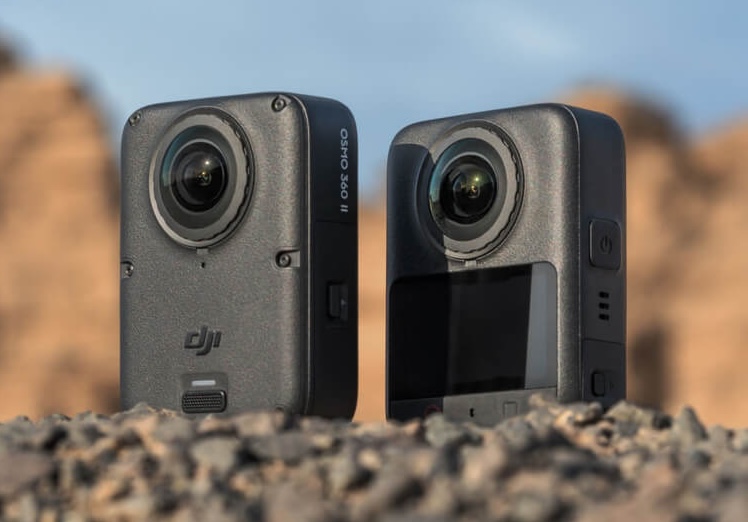
Two black DJI action cameras with wide fisheye lenses positioned upright on rocky outdoor ground, with blurred brown rock formations and blue sky in the background.DJI

When you use DPReview links to buy products, the site may earn a commission.

DJI has announced the Osmo 360 II, its second-generation 360-degree action camera. The latest version is an iterative successor rather than a redesign, building on the original model’s dual square-sensor design and 8K panoramic capture, without substantially changing the camera’s core hardware or shooting concept.

M-PI-dji-osmi-360-lens-kit
The Osmo 360 II now features interchangeable lenses, so they can be replaced if damaged.
DJI

One of the most consequential changes is the move to swappable lenses, rather than the fixed ones used by the original Osmo 360. Following in the footsteps of Insta360, DJI now sells a replacement kit for $30, which is substantially more affordable than having to replace the entire camera if you accidentally scratch or crack a protruding lens.

The camera uses two Type 1/1.1 square sensors (one for each lens) with 2.4 μm pixels, matching the sensor specifications of the original Osmo 360. The company says each of its sensors features “an imaging area equivalent to that of a 1-inch CMOS sensor with a 4:3 aspect ratio,” or 123mm² each.

DJI claims 14.5 stops of dynamic range from the camera, which is one additional stop compared to the previous model. As with most dynamic range claims, though, we’d take that number with a grain of salt, and DJI hasn’t specified where that extra stop is coming from. There’s every chance it’s mainly due to noise reduction, although DJI did somewhat quietly switch to a LOFIC sensor in its Osmo Pocket 4P to improve dynamic range.

M-PI-dji-osmi-360-ice-climbing
The Osmo 360 II shoots 8K video at up to 60fps, a step up from the original model’s 8K/50 cap.
DJI

The camera is capable of up to 8K/60 video, up from the original version’s 8K/50. Slow motion video also gets an increase, with up to 4K/240 possible, compared to a max of 4K/100 previously. Panoramic photo resolution remains at 120MP, though it gets the benefit of HDR this time around. DJI also added a ‘Spotlight Follow’ mode that promises to track your subject, keeping them in the center of the frame, with footage up to 4K/30 possible in this mode. 

DJI has also updated how users connect the camera to its Mimo app. It now supports the ability to tap to connect using NFC. The Osmo 360 II keeps the same 105GB of onboard storage and is waterproof to 10m (33′) without a case.

The DJI Osmo 360 II will be available for purchase outside of Asia starting on September 15. As expected, it will not be officially available in the US. In most EU countries, the new camera will cost 589 EUR.

Close-up of a black action camera with a front display screen showing footage of a motorcyclist on a scenic road bordered by orange rock formations and a low sun.DJI

DJI Osmo 360 II

About the Author: Abby Ferguson holds an MFA in photography and blends a fine-art background with extensive editorial and commercial experience. She built and led an in-house imaging program for a large vacation rental company and has served as an associate editor at Popular Photography. She also teaches at a local community college and serves on its Photographic Technology Program Advisory Board, sharing her knowledge and enthusiasm for the medium.

Want to stay up to date on the latest product news and releases? Add DPReview as a preferred source to ensure our independent journalism makes it to the top of your Google search results.

add as a preferred source on google

  •  
❌