❌

Vue lecture

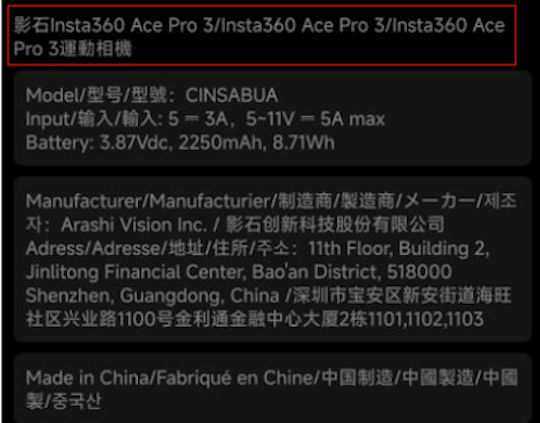
The next Insta360 Ace Pro 3 camera lands at the FCC

The new Insta360 Ace Pro 3 camera is being tested at the FCC

The upcoming/rumored Insta360 Ace Pro 3 camera is already registered for testing with the FCC:



The confidentiality request was filed on September 9th, 2026, and it is for 180 days; that means the official announcement is expected in the next 5 months:

Insta360 Ace Pro 3 camera rumors

Here are the rumored Insta360 Ace Pro 3 camera specifications:

  • Sensor: 1-inch 50MP CMOS sensor, co-engineered and tuned by Leica.
  • Video Capabilities: 8K video at 30fps (with some leaks suggesting up to 50fps or 60fps), 10-bit 4K at up to 120fps, and 1080p at 240fps.
  • Shutter: Potential support for a global shutter.
  • Color & Processing: 14-bit RAW photos with Leica color profiles, HDR, and 10-bit log profile support. Processing is expected to be handled by a Dual 5nm AI Image Processing Chip for enhanced “PureVideo 2.0” low-light performance.
  • Lens Options: A standard version with an aperture around f/2.8, alongside rumors of a potential dual-lens “Ultra” version featuring an additional, brighter f/1.8 lens for low light.
  • Stabilization: FlowState 2.0 with AI-assisted 360° horizon lock.
  • Design: A modular, rugged body weighing approximately 185g, featuring an upgraded dual-hinge flip touchscreen.
  • Battery & Power: An FCC-confirmed 2250 mAh battery—a noticeable increase from the Ace Pro 2—rumored to support up to 200 minutes of continuous 4K recording along with faster charging capabilities.
  • Durability: Native waterproofing up to 16 meters (52 feet) without a housing, and up to 60 meters (197 feet) with a dive case.
  • Audio: Upgraded directional microphones paired with improved AI wind noise cancellation.
  • Expected Price: Estimated to retail between $499 and $599.

Imsta360 will also announce a new mic tomorrow (use code INRPWDO for a discount):

You don’t have to be a paying member to get discounts from those brands

The post The next Insta360 Ace Pro 3 camera lands at the FCC appeared first on Photo Rumors.
  •  

The iPhone Duo reviews are in: here’s what photographers need to know

The videos and articles that tell the story of Apple’s first foldable.

A white foldable smartphone shown from both the open inner display side and the rear camera side.

The iPhone Duo, Apple’s first folding phone, is set to come out in just a few days, but the reviews are out now. In aggregate, they paint a picture of a complicated phone that feels highly refined in some ways, and first-gen janky in others, especially when it comes to third-party apps.

While it may be a bit too late to get a pre-order in (at least, if you want the phone in a timely manner; at time of writing delivery dates are already pushed to next year), the reviews we’ve listed below tell the story of the Duo both for those curious about it as a tech object, and for anyone actually considering buying it.

The photographer’s perspective

Tyler Stalman does a great job of reviewing phones from the perspective of a working photographer and content creator, so his take on the Duo is one of the ones we were most anticipating.

Overall, his takeaway about the phone is that it’s better at productivity and media consumption than creation, though he does a good job of comparing it to the iPhone 18 Pro across a variety of scenarios, and at breaking down the roles of each of the phone’s four cameras. One of the most interesting takeaways from this review, at least for me, is that the Duo doesn’t make as good a teleprompter/camera combo as I thought it might, thanks to where the cameras are in relation to the front screen.

Hear from the tech enthusiasts

Marques Brownlee, or MKBHD, has long been one of YouTube’s premier tech reviewers, and for good reason. His review of the Duo is both a visual treat and an in-depth look at Apple’s philosophy behind its foldable, how well it executes those ideas, and whether they’re good ideas in the first place.

Tech review veteran iJustine has also taken a look at the Duo, which does a good job of illustrating what it’s actually like to live with the phone.

What about a foldable fanatic?

There are few as dedicated to the foldable cause as Michael Fisher aka Mr. Mobile. His experience with testing basically every phone in this form factor means he’s well-equipped to discuss how it stacks up to the competition, and he does so in his trademark poetic style.

For what it’s worth, he calls the iPhone Duo’s cameras the best you can get in a foldable in the US. That’s despite the Z Fold 8 Ultra having unambiguously superior hardware, though, given his comparison between the Z Fold 8 and the Duo, he hasn’t had a great experience with Samsung’s processing.

The in-depth look

While The Verge has produced one of its trademark cinematic reviews for YouTube, anyone actually considering buying a Duo should read its written review, which goes in depth in a way that is really difficult in a video. We know our audience appreciates a thorough examination of a new device, and Nilay Patel and Allison Johnson deliver.

Full disclosure: I was predisposed to like this one: Allison is a DPReview alum, and I also worked with her during my two-year stint at The Verge, an outlet I still deeply respect for its commitment to examining the big picture beyond the specifics of any particular gadget.

The wrap-up

The impression I got from the countless reviews I’ve watched about the Duo is that it’s both exactly what we expected and a bit of a surprising release from Apple. The company is known for releasing products polished to a mirror finish, and while it seems the hardware and Apple app experience has received that treatment, there are still a lot of rough edges.

A lot of that comes down to software. Apple was very late in getting developers the tools they need to make their apps work for the Duo, so anyone buying one needs to be ready for what feels like a very beta user experience. There will probably be a lot of people who end up disappointed that their $2000-and-up displays their favorite apps as a small, floating rectangle in a sea of black on the inner display.

I suspect many major apps will be updated relatively quickly (though there will be stragglers), and the bugs with the OS will be ironed out. Once that’s happened, users will be left with the phone that the iPhone Duo appeared to be when it was announced: a first-generation foldable that, yes, has a lot of polish, but that’s still a fair bit heavier than the competition, and which asks you to give up quite a bit to be among the first iPhone users to adopt a new form factor.

That includes compromises to the cameras: the reviews mostly settled on them being fine, for a foldable, and many reviewers missed a telephoto option, though the experience of being able to easily use the phone’s main camera for selfies was near-universally lauded.

We’re hoping to get our hands on an iPhone Duo so we can bring you our own thoughts, but until then you can read some of our existing coverage below.

About the Author: Mitchell started taking pictures at 10 and hasn’t stopped since. It’s been a wide-ranging adventure, spanning a wide variety of genres and locales, and occasionally dipping into fascinations with video and filmmaking. They honed their technical knowledge doing documentation, programing and QA, writing for The Verge, and just generally messing around on the computer to see what breaks.

Want to stay up to date on the latest product news and releases? Add DPReview as a preferred source to ensure our independent journalism makes it to the top of your Google search results.

  •  

What’s the most memorable costume or festival you’ve photographed?

Some occasions leave you with a full memory card and one photo you keep coming back to. This week, we’re asking DPReview readers to share their most memorable shot of a costume, festival or celebration – and the story behind getting it.

Person in a silver helmet and ornate blue costume holding a turquoise staff, seated against a wooden fence.Getty Images

With festive, costume-filled events like Halloween approaching in various parts of the world, we’re opening this week’s question to celebrations of all kinds, wherever you live.

Your photo and story might feature a carnival procession, a cultural festival, a traditional family gathering, or even a portrait of a solitary individual in an extravagant costume (or perhaps a striking wearable showpiece). The more local and distinctive the scene, the better.

So, with that said…

What’s the most memorable costume, festival or celebration you’ve ever photographed?

This question is part of our Question of the week series, where every other week we ask our community what they think about a topic related to cameras and photography.

Drop a reply in the comments section below to share your story for this week’s topic. If you’ve got a photo to include with a great story, it may be selected for next week’s article showcasing the community’s submissions.

And stay tuned this Friday for a related mini-challenge kickoff!

About the Author: Mathew Anderson is a proud Community Manager for the technology industry and a past visitor to DPReview.com for all his camera needs. He is currently the lead of DPReview’s community and primary communication link between the community and DPReview’s team.

Want to stay up to date on the latest product news and releases? Add DPReview as a preferred source to ensure our independent journalism makes it to the top of your Google search results.

  •  

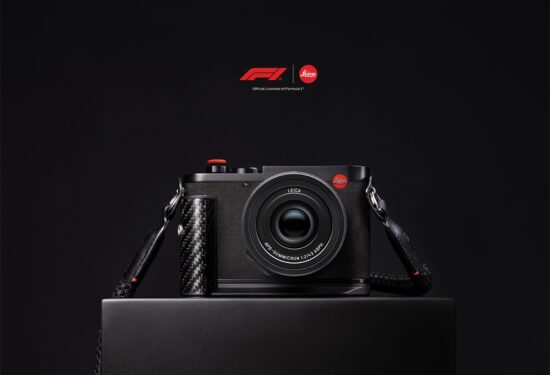
Leica’s F1 edition Q3 43 comes with carbon fiber, red accents and a race-inspired color mode

Leica’s Q3 43 F1 Edition drops the starting flag on a licensing partnership with the race series.

Leica Q3 43 F1 edition camera with large lens, carbon-fiber grip, and red shutter button on a white background.Leica

Leica has announced a Formula One-branded special edition of the Q3 43. The special edition marks the start of a licensing partnership between the two brands. One that they say embodies their “shared values: precision, teamwork and
craftsmanship.”

The $9950 Q3 43 F1 edition will come with a carbon fiber version of the Q3-series wireless charging accessory grip, along with a soft release with carbon weave and a carbon fibre thumb rest, clipped into the hotshoe. The body features a “Microvelour” coating, to evoke the steering wheel of a Formula 1 car. The camera’s top plate and lens cap feature the current F1 logo.

Leica Q3 43 F1 edition camera with carbon-fiber accents, red controls, and a large lens on a white background.Leica

The soft-touch shutter button and some of the camera’s shutter buttons have red accents to mimic the buttons on a modern F1 car’s steering wheel. The camera also comes with a rope-style camera strap with F1 branding.

In most other regards, the camera will behave like a standard Q3 43 (to which we gave our Gold award, when we reviewed it), but with the addition of an exclusive “Formula One” color mode. Leica says the F1 Look provides: “a rendering that complements the world of motorsport. Higher contrast and richer saturation capture the atmosphere of the racetrack and paddock in the final image.”

Leica Q3 43 F1 edition camera with attached lens, top view, featuring red accents and carbon-fiber control details on a white background.Leica

There are some cynics who might say that Formula One isn’t what it once was. And that, for all its shows of impressive engineering, has become an exclusive pursuit, entirely disconnected from the rest of automotive, and from its origins in which the skill of talented individuals overcame everything, delivering memorable moments seen the world over. But, if nothing else, it knows the power of branding.

Leica’s press release doesn’t reveal how many Q3 43 F1 Edition models will be made but, as ever with special editions, we look forward to seeing them come up for auction, above their original list prices, in a few years’ time.

About the Author: Richard graduated as a scientist but had a lot more fun writing and shooting for his university magazine. A number of years spent variously as a reporter, writer and editor on science and engineering titles combined his knowledge of science with his interest in images and words. But it was spotting the connections between emission spectra, white balance and all the nonsense he’d taught himself playing around in Photoshop that helped kindle an interest in digital photography. Searching for a camera led to him discovering DPReview and Richard was recruited by Phil Askey in 2007. He’s been combining his love of photography, communication and attention to detail (pedantry?) ever since. He has unusually strong opinions about lenses for the APS-C format.

Want to stay up to date on the latest product news and releases? Add DPReview as a preferred source to ensure our independent journalism makes it to the top of your Google search results.

  •  

New aerial category produces top winner at 2026 Epson Pano Awards

Spain’s Daniel Viñé Garcia took Open Photographer of the Year and the debut Open Aerial category, as entries rose almost 20% to 4,084 from 93 countries.

An individual stands on a reflective surface before a snow-capped mountain under an aurora borealis spanning a starry night sky.Wutimet Bunyasirisith

Epson has announced the winners of its 17th Epson International Pano Awards, with two photographers from Spain taking its top awards. The 2026 competition drew 4,084 entries from 93 countries, an almost 20% increase over 2025. Of those entries, 2,122 competed in the Open division and 1,962 in the Amateur division.

The competition included award categories across both divisions; the Open division included Built Environment, Nature/Landscape and the new Aerial category, while the Amateur division included Nature/Landscape and Aerial. In addition to these categories, the competition presented awards in several specialty categories. The overall Open Photographer of the Year and Amateur Photographer of the Year titles went to the highest-scoring entrants in their respective divisions.

The new Aerial categories attracted 680 entries in their first year, a number that contest founder David Evans says reflects years of requests from the community. “In the 17-year history of The Epson Pano Awards, never has a request from entrants been stronger than the addition of a dedicated Aerial category,” Evans said.

Open Photographer of the Year

Photographer’s name: Daniel Viñé Garcia (Spain)
Awards: Open Photographer of the Year, Category Winner: Open Aerial, The RAW Planet Award

The Sleeping Giant

Panoramic aerial view of a snow-capped volcanic mountain range above a vast, dark landscape of interconnected lakes and wetlands at sunset.Daniel Viñé Garcia

Parinacota Volcano was one of the main photographic goals of my trip to Chile. Rising to more than 6,300 meters, its distinctive snow-covered cone has an almost perfect symmetry that immediately reminded me of volcanoes such as Mount Fuji. Beside it stands Pomerape, another giant reaching more than 6,200 meters, together forming one of the most impressive landscapes I encountered during the journey.

After allowing time for proper acclimatisation, I spent three days and three nights at around 4,500 metres above sea level, giving myself the best possible chance of photographing the area under ideal conditions.

This image was captured during the final moments of sunset. After one last burst of light, the landscape gradually took on magenta tones, wrapping the volcanoes and the high-altitude lakes in a particularly special atmosphere.

The original capture was a 360-degree aerial panorama made from 33 individual exposures. I later refined the framing from the full panorama to concentrate the final composition on the volcanoes, the light, and the shapes of the landscape.

Cathedral of Starlight

Panoramic view of white rock formations in a desert landscape under a vibrant Milky Way arch and green airglow.Daniel Viñé Garcia

After several days travelling along dirt roads through the Argentine Puna, we reached this remote part of the Andean Altiplano: a vast landscape of white pumice formations sculpted by the wind. The area is so immense, uniform and isolated that it is surprisingly easy to lose your sense of direction while exploring it.

While walking through the area, I found this particular spot, where the pumice formations and pale ground perfectly reflected the almost surreal character of the landscape. As I worked on the composition, I also noticed a shape in the terrain that reminded me of a large prehistoric bird, adding even more to the otherworldly feeling of the scene.

At around 3,100 metres above sea level, beneath a sky almost completely free from light pollution, the night sky was spectacular. I waited until late into the night, when the Galactic Centre had climbed higher above the horizon and the Milky Way formed a huge arc across the landscape.

When we finally started driving back to our accommodation in El Peñón, we came across the police: they were looking for us. The owner of our accommodation had become worried when we had not returned and thought we might have got lost or become stuck somewhere with the 4×4. We had told her we would be back late… although I suppose she had not imagined quite how late.

My Perfect Night

The Milky Way arcs across a night sky above a rocky landscape featuring small, turquoise thermal pools.Daniel Viñé Garcia

During our expedition through the Argentine Puna, after several days travelling deeper into this remote part of the Andean Altiplano, we reached a salt flat in the province of Catamarca, more than 3,300 meters above sea level. Its small, colourful pools broke up the vast white expanse and gave the landscape an almost otherworldly appearance.

The nearest settlement, Antofalla, is a tiny community of only a few dozen people, located several hours from any other populated area. Electricity is supplied by a generator that is switched off during the night, leaving this part of the Puna in almost complete darkness.

The southern sky offered a particularly striking composition: at one end of the Milky Way arc was the bright Galactic Centre, while at the opposite end stretched the enormous Gum Nebula, one of the great structures of the southern sky. It is a view of the Milky Way very different from the one we are used to seeing from the Northern Hemisphere.

Amateur Photographer of the Year

Photographer’s name: Tomás Sánchez Ruiz (Spain)
Awards: Amateur Photographer of the Year, Category Winner: Amateur Nature/Landscape

Double Arch over Stokksnes

Vibrant green aurora borealis arching across the night sky above snow-covered dunes and a jagged mountain range.Tomás Sánchez Ruiz

On the night I took this photograph, the aurora forecast was not particularly promising. The skies were clear, but the chances of seeing the Northern Lights were low.

However, when I pulled back the curtain of our hotel room and saw a green glow in the sky, I knew this could be the night we had been waiting for. We quickly left the room and headed to Stokksnes.

When I arrived, I found a landscape I had never encountered on my previous visits: the black sand was completely covered in freshly fallen, untouched snow. I grabbed my camera and tripod and walked out into the snow, looking for a composition that would frame Vestrahorn beneath the spectacular aurora already dancing above its peaks.

And there I was, finally taking the photograph I had been waiting for, with a smile on my face. A smile that still appears whenever I remember that night.

Wonderful Reflections

Green aurora borealis lights over a snow-covered landscape and jagged mountain range at night.Tomás Sánchez Ruiz

During my first trip to Iceland in 2015, I had the opportunity to visit the famous Vestrahorn mountains in the southeast of the island. Although I had already seen them in photographs, seeing them in person for the first time left a deep impression on me.

Over the past ten years, I have returned to Iceland several times, and I have visited Stokksnes and Vestrahorn on almost every trip. I have photographed them at sunrise, at sunset and, of course, at night, hoping to see the Northern Lights dancing above their peaks. I had never been lucky enough to see them there, at least not in the way I had dreamed of.

Until that January night. For more than two hours, the aurora danced above Vestrahorn. After so many years of waiting, this time I was there.

Westminster Abbey

Low-angle view looking up at the intricate fan-vaulted stone ceiling of Kings College Chapel, with colorful heraldic banners hanging from the walls above stained-glass windows.Tomás Sánchez Ruiz

In December 2023, during a several-day trip to London, I had the opportunity to visit Westminster Abbey. Although I had visited the city before, I had never made what I considered an almost obligatory visit. I knew its interior would be impressive and that I would thoroughly enjoy it, but I had no idea that this architectural masterpiece contained another hidden gem: the Henry VII Chapel, also known as the Lady Chapel.

As soon as I entered the chapel and saw its enormous stained-glass windows, the spectacular ribs of the vaulted ceiling and the flags lining both sides of the room, I knew I had to get my camera out. I positioned myself as centrally as possible and began taking a series of overlapping photographs, covering the vaulted ceiling from one end to the other, with the intention of later stitching them together into a single panorama that would capture the grandeur of the entire space.

Curator’s Award

Photographer’s name: Max Terwindt (The Netherlands)
Award: Curator’s Award
Location: Antarctic Peninsula

Panoramic Antarctic landscape featuring a sprawling, deeply crevassed glacier overlooking a calm bay filled with small icebergs under a sunset sky.Max Terwindt

Last January, on an evening down south at the Antarctic Peninsula, I was with a group of photographers divided over two sailing ships exploring the southern continent. It was my first time there and the whole experience was truly magical. We had a special license to fly our drones and this gave me the chance to capture unique shots of the best landscapes that Antarctica has to offer.

On this particular night the light was really amazing with some low clouds and vibrant golden light. The glaciers in Antarctica often have rectangular shaped structures as seen on my panorama. If you look well you can also spot our two sailing ships with the red sails up in the distance. As it never becomes dark in the Antarctic summer this whole night was such a spectacle.

The sunset slowly faded into the sunrise, so it went from golden hour to blue hour to golden hour again. Our ships were also surrounded by humpback whales and penguins which made this moment truly breathtaking. I remember I only slept for like an hour, but the lack of sleep was definitely worth it.

Category Winner: Open Nature/Landscape

Photographer’s name: Mikel Iraeta (Spain)
Award: Category Winner: Open Nature/Landscape
Location: Milford Sound, New Zealand

A figure standing on a rocky shore facing a mountain range under a panoramic night sky filled with stars, nebulae, and the Milky Way galaxy.Mikel Iraeta

This is what I consider an almost impossible photo because you need some very specific conditions to pull it out. Milford Sound is a place where it rains (on average) 300 days a year. In fact, the day before I visited, the access road was closed due to snow avalanche danger. I ventured there without any expectations, with the sole intention of enjoying the place, aware of the improbability of the task. It is very difficult to have an entire clear night with no rain, no clouds, no moon, and for all of this to coincide at the end of September when it is possible to capture the double arc of the Milky Way. But I thought what if…

I don’t think I can put into words the luck and chain of coincidences that had to come together to capture this photo. I still remember feeling excited under the stars, aware of what I was witnessing. It is a unique photo, one that I have not seen anywhere else and that I think would be very difficult for anyone else to replicate.

It is also a very complex photo that requires a lot of work, both in terms of capturing and editing. The sky is composed of two separate tracked panoramas, each comprising eight panels, with each panel in turn consisting of a stack of four 45-second exposures. The first panorama is taken after sunset to capture the spiral arm containing the galactic core. The second contains both Magellanic Clouds, Gum, and the Orion Nebula, captured between 2 and 4 am. It is important to time the shots so that both panoramas are at approximately the same height above the horizon. Finally, the ground needs to be captured, for which the moving tides need to be considered. For this foreground I used a 14-panel 360º panorama, where each panel is created from a bracketing of three photographs, plus an additional photograph to include myself. The final image is therefore the result of combining 107 different photographs.

The final results is what I consider to be a pretty unique image that shows the dream team of the wide angle astrophotography. Everything you want to see on an astrolandscape night sky shot is there, so I hope you enjoy it as much as I do.

Category Winner: Open Built Environment

Photographer’s name: Xuecheng Liu (USA)
Award: Category Winner: Open Built Environment
Location: Times Square, New York, USA

Black and white aerial view of a dense city grid at night, featuring a central corridor of bright street lights framed by tall skyscrapers.Xuecheng Liu

Times Square is one of the most photographed places in the world, so my challenge was to find a perspective that could make such a familiar place feel unfamiliar again. From above, the dense architecture, streets, and illuminated billboards seem to radiate around the square.

I stitched together 25 frames to create an ultra-wide aerial panorama, revealing the scale and density of the skyscrapers surrounding Times Square. I wanted the panorama to immerse the viewer in the vast expanse of the city, with countless points of light resembling stars surrounding the centre of a galaxy.

Southeast Asia Open Photographer of the Year

Photographer’s name: Wutimet Bunyasirisith (Thailand)
Award: Southeast Asia Open Photographer of the Year
Location: Skagsanden Beach, Norway

An individual stands on a reflective surface before a snow-capped mountain under an aurora borealis spanning a starry night sky.Wutimet Bunyasirisith

This photograph came to life as the Northern Lights flared up and curved perfectly around the mountain. The display was so vastly immense that even my 12mm ultra-wide lens couldn’t capture the entire scene in a single frame. My only choice was to shoot a panorama. It wasn’t until I stitched the frames together that I realized the aurora had formed a flawless, complete arch framing the peak. Standing on the wet beach, the calm shore provided a mirror-like reflection of the entire celestial phenomenon.

The conditions that night were brutal—freezing cold, biting winds, and I had to wade into the icy seawater to get the shot. Given all the challenges faced in those harsh elements, bringing this vision to reality is something I am truly proud of.

Epson Digital Art Prize 2026

Photographer’s name: Preeti & Prashant Chacko (India)
Award: Epson Digital Art Prize 2026
Location: Solio Game Reserve, Kenya

Four rhinoceroses walking across a grassy field with two egrets flying nearby under a cloudy sky.Preeti & Prashant Chacko

Southern white rhinos are, in their normal state, surprisingly unthreatening – calm grazers who move around at a leisurely pace. One morning at Solio Game Reserve in Kenya we were photographing a group of eight rhinos with a few cattle egrets walking among them, a rare sighting in most other national parks. Something suddenly shifted and five of the rhinos broke into a run. We understood in that instant why a group of rhinos is called a crash.

Neither of us has ever played rugby, but from the point of view of the egrets this is how we imagine a forward pack must look, heads down and all that weight already committed. Thankfully the egrets took to the air and got out of the way with barely a moment to spare. Seeing these many rhinos together is already rare and seeing them run together at another species is rarer still. At Solio Game Reserve, where Kenya’s rhino population has been painstakingly rebuilt without any de-horning even an accidental moment of chaos feels like a miracle.

VR/360 Photographer of the Year

Photographer’s name: Marcio Esteves Cabral (Brazil)
Award: VR/360 Photographer of the Year
Location: Cenote El Edén, Quintana Roo, Mexico

Scuba diver swimming through an underwater limestone cave illuminated by a beam of sunlight.Marcio Cabral

Cenote El Edén is known for its natural curtains of light. Deep inside the cavern lies a narrow chamber where sunlight cuts through the water, framing the scene.

Capturing this 360° panorama took a great deal of care. In such a tight space with clear water and a delicate clay floor, the greatest challenge was maneuvering and rotating the camera without letting the gear or fins brush against the rocks, which would instantly stir up sediment and ruin the shot. Positioning the flashes was key to revealing the cave’s textures and properly lighting the diver, avoiding a dark silhouette against the light. The model made all the difference by staying steady and motionless just inches above the bottom, without disturbing the silt.

Category Winner: Amateur Aerial

Photographer’s name: Xuejun Long (China)
Award: Category Winner: Amateur Aerial
Location: Lake Magadi, Kenya

A small flock of pink flamingos flying in a line over dark water and a swirling, multicolored slick.Xuejun Long

In March 2024, I returned to Lake Magadi in Kenya, just in time for the quick transition from the rainy season to the dry season. As the freshwater evaporated, the proportion of the lake water increased, and chemical deposits on the lakebed were exposed, forming lots of interconnected patterns. These patterns usually only last a few days. With the arrival of the dry season, vast areas of the lake, only a few dozen centimeters deep, turned into dry riverbeds. I was lucky to catch this moment, and a flock of flamingos flew in, adding life and bringing a dreamy, magical scene from the sky.

Category Winner: Amateur Built Environment

Photographer’s name: Sebastián Cantos Navalon (Spain)
Award: Category Winner: Amateur Built Environment
Location: Valencia, Spain

Concrete spiral staircase with curved walls, viewed from above.Sebastián Cantos Navalon

This photograph was taken in 2026 at the Reina Sofía Palace of the Arts, in the City of Arts and Sciences in Valencia. It’s a moment I’ll always remember, as it was the first time l’d ever been inside. Once inside the building, I found myself faced with a vast expanse of concrete, textures and lines, and was confronted with the challenge of creating what, for me, is an optical illusion. To achieve this, I used a wide-angle lens and created a composite image from eight shots, aiming for the curved lines of the staircase to guide the eye from the ground towards the sky.

The result is a double ‘S’-shaped spiral which, in my opinion, lends dynamism and depth to the image and creates a different perspective on this space. I believe the Reina Sofía Palace of the Arts is a magnificent place to practise and enjoy architectural photography; it offers endless possibilities for experimenting with composition and perspective.

About the Author: Dale Baskin is a professional photographer, writer, and filmmaker based in the Pacific Northwest. He is the Managing Editor of DPReview.com.

Want to stay up to date on the latest product news and releases? Add DPReview as a preferred source to ensure our independent journalism makes it to the top of your Google search results.

  •  
❌