Vue lecture

'The Oral Tradition That Built Software May Not Survive AI'

A historian-turned-software engineer warns that "so little is ever written down" by professional programmers in a new article for Fast Company: Perhaps there's an early design doc, but then it turns out that everything was substantially revised before work began. Maybe there are a few wiki pages explaining known issues, some of which were solved a long time ago and others that have been left to molder in the codebase. Somebody might have left a comment in the code itself, but typically it's a warning not to change something or else something else will break... Software engineering has an ambivalent relationship with documentation. Everyone agrees documentation matters in theory, but in practice it's inconsistent, outdated, or missing entirely. Part of that is simple inertia. Writing documentation is usually less interesting than writing the code itself. But it's also ideological. The Agile movement emerged in part as a reaction against the heavily documented Waterfall methodology, and one of Agile's core values explicitly prioritizes "working software over comprehensive documentation." In escaping bureaucratic overdocumentation, the industry also normalized underdocumentation. High turnover at software jobs always brings "a constant drain of domain knowledge." And he's he's skeptical that generative AI will be able to fill in those gaps: [H]aving it generate documentation on the codebase itself might sound like a solution to the absence of other written information. LLMs can certainly summarize code back to you. But hold up with that idea. Beyond hallucinations, there's a deeper problem: Writing documentation is itself part of the thinking process. Whether I'm writing history or software, putting an approach into words helps refine it before I sink hours into implementation. Documentation also captures intent. An LLM may be able to summarize what a codebase does, but it cannot reliably explain why a developer chose one approach over another, or what trade-offs shaped that decision... An LLM can read code that I've written. It might even scan a large codebase and accurately summarize what it's doing. But it can't assess authorial intent. Thanks to long-time Slashdot reader smooth wombat for sharing the article.

Read more of this story at Slashdot.

  •  

US Teachers' Union Urges Schools To Curb AI Chatbots and Screen Time

Axios reports: The American Federation of Teachers, the second-largest teachers' union in the U.S., released a 10-point plan to introduce AI and screen-time guardrails in classrooms. The plan would limit AI use and ban screens for students in prekindergarten through second grade "unless there is a compelling reason," such as supporting students with special needs. The teacher union's president Randi Weingarten warned that young students "are drowning in tech," according to the New York Times, which reports the union president also "called on schools on Wednesday to stop giving digital devices like iPads to children in prekindergarten through second grade." In a speech at the National Press Club in Washington, Weingarten also urged elementary schools to avoid using artificial intelligence tools like OpenAI's ChatGPT, Google's Gemini and Khan Academy's Khanmigo with children [and] called for new national privacy and safety standards for A.I. tools in all schools... "The work of teaching and learning in the earliest grades should be done without A.I." The union's effort reflects a backlash among parents and educators against heavy use of school-issued laptops and apps. Some parents and nonprofit children's groups are also pushing back against campaigns by tech giants like Google and OpenAI to spread their A.I. products in schools... Weingarten said that the union was negotiating safety and privacy standards for A.I. use in schools with "our partners in the A.I. academy," and that Microsoft, OpenAI and Anthropic had agreed in principle to those standards. Weingarten "laid out a plan for reorienting public schooling toward human abilities and student well-being," according to the article, calling it "a devices down, eyes up, hands-on strategy." And meanwhile school cellphone bans are expanding into broader efforts to establish guardrails around AI in education and limit screen use, reports Axios. "At least 16 states — both red and blue — have introduced bills to limit classroom technology." Schools Beyond Screens formed with fewer than a dozen parents in Los Angeles Unified School District last year, but the nonprofit has grown to include thousands of parents and educators nationwide, SBS policy director Kate Brody tells Axios... McPherson Middle School principal Inge Esping told Axios that the suspension rate at her Kansas school fell 70% after cellphones were banned in 2022. Students also started speaking more with one another and with teachers. Thanks to long-time Slashdot reader theodp for sharing the article.

Read more of this story at Slashdot.

  •  

New Star Wars Movie Falls to #3 Behind Two Movies Directed By YouTube Stars

Disney's Star Wars: The Mandalorian and Grogu "suffered a catastrophic 70% drop in its second weekend," reports Variety, suggesting the movie isn't finding audiences "beyond an aging group of core fans." "Despite playing on far more screens, The Mandalorian and Grogu landed in third place on weekend charts behind Backrooms and Obsession." (described as "two buzzy horror films.") Suprisingly, both movies were directed by 20-something YouTube stars, "and cost nearly nothing to produce." Analyst Jeff Bock of Exhibitor Relations tells Variety, "We knew indie horror was hot, but we didn't know how hot. It's actually competing with the big summer blockbuster." Directed by 20-year-old Kane Parsons, "Backrooms" has earned $118 million globally so far... With a production budget of roughly $10 million, it's already one of the most profitable movies of the year. Though a sequel hasn't been announced, Parsons has already started toying with the idea of turning "Backrooms" into a film franchise... [The "Backrooms" premise seems to have originated on 4chan, then expanded in a YouTube video Parsons filmed when he was 16.] "Backrooms" also ranked as the biggest debut in history for original horror, as well as the best start for a first-time filmmaker on a non-franchise film. Parsons is the youngest director, by far, to have the No. 1 film at the box office. Based on Parsons' hit web series, "Backrooms" follows a furniture store owner (Chiwetel Ejiofor) who finds a secret doorway that leads him to a seemingly endless stretch of nondescript rooms. When he disappears, his therapist (Renate Reinsve) ventures into the unknown to rescue him. Nearly 85% of audiences were under the age of 35, and more than 50% were 25 or younger, according to PostTrak data. Parsons and [26-year-old Obsession director/writer Curry] Barker are part of a wave of YouTubers who have turned their talents to the big screen — and brought their enormous, youthful fanbases along with them. Earlier this year, YouTube creator Mark Fischback directed, self-financed and distributed the horror film "Iron Lung," which earned a stellar $50 million against a $3 million budget. What's all the more impressive is that "Backrooms" and "Obsession" aren't cannibalizing each other at the box office. In fact, "Obsession" rose 10% from the prior weekend, which was already up a stunning 39% from its solid $17 million debut. It's defying box office norms as the first film since "E.T. The Extraterrestrial" in 1982 to see ticket sales increase in its second and third weekends outside of the holiday season, according to Focus. After three weekends of release, "Obsession" has grossed $106 million domestically and $148 million worldwide against a mere $1 million production budget. The first-weekend box office for The Mandalorian and Grogu was the worst since 2002's Attack of the Clones, but then it's second-weekend drop in sales was also the largest ever, reports ScreenRant. The next-worst drop in sales (for a second weekend) was 2017's The Last Jedi, they point out, but The Last Jedi was dropping from a 2.5x larger debut. Their article suggests The Mandalorian/Grogu box office "may not ever hit a total large enough for the titular duo to return to the big screen," although it could eventually show a profit. "While it likely won't break even in theaters, it will earn additional revenue from merchandising on top of its impending streaming, video on demand, and physical media releases." Variety adds that Disney "is hoping that next summer's Star Wars: Starfighter, an original adventure directed by Shawn Levy and starring Ryan Gosling, serves as a fresh start for the franchise."

Read more of this story at Slashdot.

  •  

G.SKILL lance un kit DDR5 à 9200 MT/s

G.SKILL profite du Computex pour annoncer son propre kit DDR5 à 9200 MT/s. Le Trident Z5 CK CU-DIMM 32 Go (2x16 Go) tourne à DDR5-9200 CL74-74-74-148, validé sur carte mère MSI MEG Z890 GODLIKE et processeur Intel Core Ultra 7 270K Plus. Bonus non négligeable : il le fait sous 1,1V, soit la tension standard JEDEC, là où les kits hautes fréquences nécessitent habituellement une tension plus élevée pour rester stables. Moins de voltage, c'est aussi moins de chaleur et moins de consommation. En contrepartie, les latences restent élevées avec ce CL74, ce qui est le compromis habituel quand on vise des fréquences aussi extrêmes : on gagne en bande passante brute mais on perd sur le temps d'accès. […]

Lire la suite
  •  

Renewable Energy is Surging in Africa

Almost a fifth of the earth's population lives in Africa. And Africa's next generation of power projects "is increasingly being built around solar and wind power and battery storage," reports the Associated Press, "as governments and investors shift away from coal and large hydropower dams in search of cheaper, faster and more reliable electricity." The shift is visible in a $1.5 billion energy agreement between China and Zambia announced in early May that includes three separate 300-megawatt projects spanning solar, wind and coal-fired power. While the inclusion of coal underscores the continent's continuing need for stable baseload electricity, African countries facing rising fuel import bills as a result of the Iran war, unreliable grids and growing industrial demand are increasingly turning to renewable energy projects that can be deployed faster and more cheaply than traditional plants. Of the 322 energy projects announced across Africa in 2025, 173 were solar projects, followed by hydropower at 46, wind at 34, gas at 22 and hybrid energy projects at 14, according to the energy research firm Electron Intelligence... Utility-scale solar power costs have dropped by nearly 90% globally since 2010, while onshore wind costs have fallen around 70%, making renewables the cheapest source of new electricity generation in many African markets... Much of the growth is through distributed solar and battery systems installed directly in mines, factories, telecom towers and homes. "Most official statistics still measure the energy transition the old way, by counting megawatts connected to national grids," [said Matt Tilleard, CEO of CrossBoundary Energy, which invests in renewable energy in Africa]. "But solar and batteries don't need central utilities." Data from the Africa Solar Industry Association shows 23.4 gigawatts of operational solar projects had been tracked across Africa by the end of 2025. But Chinese export figures indicate 58.1 gigawatts of solar panels have been shipped to African countries since 2017, suggesting solar adoption may be growing far faster than official figures capture. Investor Tilleard says "Renewable energy is now unequivocally the fastest, cheapest, and most bankable way to connect people, companies and economies to the megawatts they need to grow." And the article also includes this quote from Mugwe Manga, climate finance lead at FSD Kenya. "Africa is not on the periphery of the global energy transition, it is sitting at its center. The continent holds the world's best renewable resources, and the economics have now decisively turned in favor of clean energy."

Read more of this story at Slashdot.

  •  

AI Agents Get Their Own Directory Built Atop DNS

"In the future, AI agents will be able to find one another using the Domain Name System (DNS), instead of crawling about and probing ports or checking configured resources," writes The Register. InfoWorld writes that "numerous proprietary agent registries are on the market, but the Linux Foundation suggests we simply extend the distributed, open Domain Name System (DNS) infrastructure we already have." The foundation is now inviting contributions to the DNS-AID project, a standard way for AI agents to discover, verify, and communicate with one another over DNS that requires no new infrastructure. It enables agents and Model Context Protocol (MCP) servers to use DNS as a global, vendor-neutral directory. While many details remain to be worked out, the proposal suggests domain owners create a new well-known address that can provide a starting point for agents looking for one another: _index._agents.{domain}. This approach ensures that agent discovery remains scalable, secure, and compatible with the protocols that underly the internet, the Linux Foundation said. The Linux Foundation descrbes DNS-AID as enabling a standard way for AI agents to discover and communicate with one another. "By leveraging the internet's existing Domain Name System (DNS) infrastructure, DNS-AID provides a robust, decentralized alternative to the centralized registries and hardcoded URLs currently limiting AI interoperability." The standard was originally developed by Infoblox, their announcement notes, but "Because the protocol is implementation-agnostic, it functions across any DNS provider, ensuring that organizations maintain control over their agent infrastructure without relying on proprietary, centralized services."

Read more of this story at Slashdot.

  •  

Podcasts musique française 2026 : notre sélection du dimanche soir

Entre deux matchs et une soirée ciné, le dimanche offre le meilleur cadre pour découvrir les podcasts musique française du moment. Rap, électro, chanson nouvelle génération, coulisses des labels : la création sonore française vit une période riche et les émissions pour en parler n’ont jamais été aussi nombreuses. Voici notre sélection, en français d’abord, […]

L'article Podcasts musique française 2026 : notre sélection du dimanche soir a été publié en premier sur Bbox-Mag

  •  

'Virtual OS Museum' Lets You Try 570 Extinct Operating Systems

You can try 570 extinct operating systems at a new "virtual museum," according to a new article by ZDNet. Their reporter downloaded the ancient OS NeXTSTEP, and was "shocked" by how easy it was to run it, "and by the sheer number of operating systems to choose from." Essentially, what you do is download a zipped file, unzip it, change into the newly created directory, and run the executable. VirtualBox then opens to a Debian Linux instance, where you can select from a very long list of operating systems to run... You can run operating systems like Amiga, Apple I/II/III, Atari, Avigo, Commodore 64, Cray, DEC Alpha, Einstein, Game Boy Advance, GE 200, HP 3000, IBM 1130, iPod touch, Jupiter Ace, Lisa, Macintosh, MIPS-based SBCs, Neo, Newton, NeXT, NORC, Palm, and so many more. You can test the earliest mainframes, later mainframes and minicomputers, workstations and Unix variants, home computers, personal computer operating systems, mobile and embedded adOSes, and research-based and obscure systems. As far as Linux is concerned, you can run early Debian and its derivatives, Red Hat and its derivatives, early Slackware, and more... There are two editions of the Virtual OS Museum: full and lite. The full edition is currently 174GB and includes everything you need to run these old-school operating systems. The full version does not require a network connection to run. The Lite version is only 14GB and requires an internet connection because it downloads the full OS image you want to use. Gizmodo notes "this project is all the more remarkable for being the work of one man: Andrew Wartenkin, who has been collecting OS images for over two decades." Of course, Wartenkin didn't write all the emulation software himself, and he maintains a list of credits to give credit where it's due... The Museum itself runs in a virtual machine, which seems kinda fitting — it opens in a virtualized Linux installation and presents you with the full list of available operating systems. Did you know someone has written a GUI for the Commodore 64? Neither did I! There are simulations of ancient mainframes, like the IBM 1130 (yours for the low, low price of $32,280 — or $41,230 with a disk drive — back in 1965). There's also a YouTube channel. Thanks to long-time Slashdot reader Z00L00Kfor sharing the news.

Read more of this story at Slashdot.

  •  

COMPUTEX 2026 : des écrans de poche pour tout faire chez Acer, et des surprises !

Les écrans qu'on peut transporter plus ou moins facilement ont la côte, et Acer entend bien y participer avec des fonctionnalités originales. Par exemple, ajouter un clavier avec une fixation magnétique et liaison avec des broches Pogo. PM161QJB Prenons donc l'écran PM161QJB. Avec son clavier, il ressemble presque à un ordinateur portable de type convertible. Mais non, il s'agit bien d'un écran de 15.6" en Full HD avec une double connexion HDMI et USB Type-C, et c'est celle-ci qui se montre la plus intéressante puisqu'elle permet, si l'appareil est compatible, d'utiliser le clavier. Avec un téléphone portable, disons un Samsung, on profite de l'environnement Dex qui propose un bureau complet utilisable avec le clavier et le touchpad. Plus léger qu'un ordinateur portable, l'écran peut être très pratique pour de nombreuses tâches si le téléphone suit ! Et à 200 U+20AC l'ensemble, c'est plutôt pas mal. […]

Lire la suite
  •  

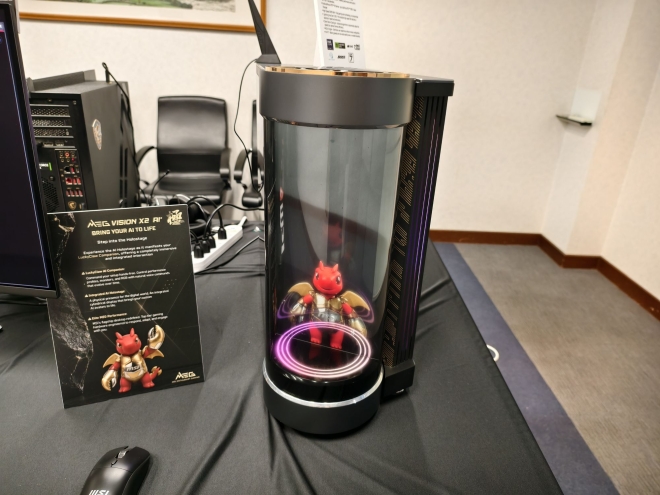
COMPUTEX 2026 : MSI dévoile le MEG Vision X2 AI+, le premier PC gaming avec compagnon IA holographique

Au Computex 2026, MSI ne se contente pas de présenter de nouveaux composants ou de nouveaux écrans. La marque taïwanaise a également dévoilé le très original MEG Vision X2 AI+, une machine ultra haut de gamme qui entend redéfinir l'interaction entre l'utilisateur et son PC grâce à l'intelligence artificielle. La principale nouveauté de ce modèle repose sur l'intégration de LuckyClaw, un assistant IA local développé par MSI fonctionnant sous OpenClaw. Fonctionnant grâce à des commandes vocales naturelles, ce dernier permet de piloter différents aspects du système sans avoir à toucher au clavier ou à la souris. Changement de mode de performances, réglages des écrans MSI, gestion de l'éclairage RGB ou encore accès à diverses fonctions du système, LuckyClaw se veut être un véritable compagnon numérique capable d'évoluer au fil du temps grâce à l'ajout de nouvelles compétences. […]

Lire la suite
  •  

Ohio Suspends Data Center Tax Break as Opposition Grows

The state of Ohio — one of America's hot regions for data center construction — "is suspending a tax break that has been critical to its competition with other states," reports the Associated Press. The move "comes as tax breaks for energy-hungry AI data centers are increasingly playing a role in state budgets," the article points out. But they also note the expanding data center industry "is under pressure to pay the full costs" The size of Ohio's tax break skyrocketed, dwarfing previous projections, as opposition to data centers is sweeping through cities, suburbs and towns there and prompting lawmakers to form a committee to study the impact. In the meantime, residents are trying to bypass the GOP-controlled Legislature and get a referendum on November's midterm election ballot that's designed to permanently ban hyperscale data centers, likely the strictest such statewide ban under consideration in the U.S... The state, in 2024, had used previous history in projecting that the exemption would total $136 million in fiscal 2025 and $142 million in fiscal 2026. It was $554 million in 2024 and nearly $1.6 billion in 2025, the state reported... State tax breaks for the massive data center industry are facing growing criticism by governors and lawmakers... Thirty-eight states have some form of a sales tax break for data centers, according to the National Conference of State Legislatures... [Though many were passed before 2022, when data centers were smaller.] Ohio's exemption is fairly broad, applying not only to construction materials, but to the expensive equipment — such as server racks and cooling systems — used in data centers. Operators might buy new server racks every couple of years as the technology improves.

Read more of this story at Slashdot.

  •  

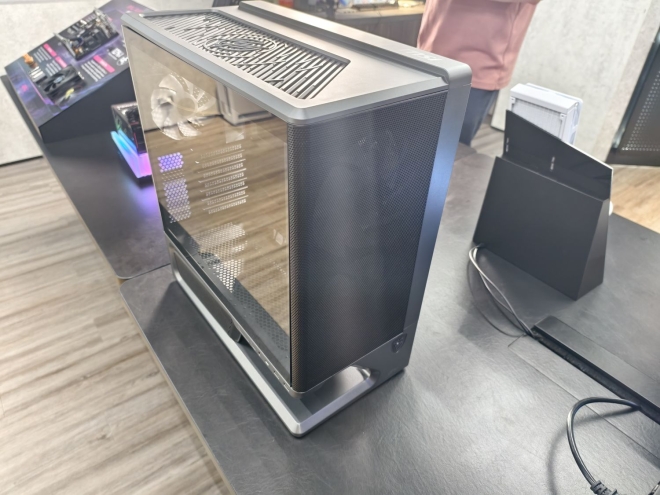
COMPUTEX 2026 : MSI VIXTA 300R, un boitier panoramique PZ au look soigné

Chez MSI, nous avons également découvert un nouveau boitier, le VIXTA 300R. Ce modèle moyen tour ATX au format panoramique sera proposé en deux déclinaisons : une version avec façade et panneau panoramique en verre trempé, et une version plus orientée refroidissement avec une façade en mesh afin d'améliorer le flux d'air. Un style particulièrement travaillé On peut le dire, ce boitier affiche un design très travaillé, avec une approche résolument moderne et même futuriste, surtout dans cette superbe finition Gun Metal. La version verre trempé profite d'un unique panneau panoramique doté d'une élégante courbure à 90°, offrant une vue totalement dégagée sur la configuration. La version Airflow remplace quant à elle la partie avant par du mesh et permet l'installation de deux ventilateurs supplémentaires de 140 mm afin de maximiser les performances de refroidissement. De base, le VIXTA 300R est livré avec deux ventilateurs de 140 mm installés sur le côté ainsi qu'un modèle de 120 mm à l'arrière. Mais au-delà de ses capacités de ventilation, c'est surtout son travail esthétique qui retient l'attention. On apprécie notamment l'ouverture présente dans la partie basse du châssis, qui apporte une impression de légèreté et un petit côté aérien à l'ensemble. MSI a également ajouté des habillages en plastique sur toutes les zones potentiellement saillantes, ce qui adoucit les lignes du boitier et renforce cette sensation de fluidité visuelle. Un design original qui ne manque clairement pas de personnalité. […]

Lire la suite
  •  

Streaming en famille : notre sélection du dimanche 31 mai 2026

Ce dimanche 31 mai, entre Roland-Garros en journée et les films du soir, l’après-midi laisse place au streaming famille 31 mai. Netflix, Disney+, Prime Video et Apple TV+ proposent chacun des contenus adaptés à tous les âges. Voici notre sélection pour un dimanche en famille, organisée par plateforme et par tranche d’âge, accessible depuis votre […]

L'article Streaming en famille : notre sélection du dimanche 31 mai 2026 a été publié en premier sur Bbox-Mag

  •  

Zig Bans AI Code Contributions Because They're 'Invariably Garbage'

The Zig programming language wants to be a modern alternative to C (including better memory safety features). It's maintained by as an open-source project by a 501(c)(3) nonprofit and a network of contributors. But Business Insider notes that Zig bans the submission of AI-assisted code: On the JetBrains podcast, Zig President Andrew Kelley called AI-assisted contributions "invariably garbage." "People are sending us contributions that have no value whatsoever," Kelley said. "They have negative value, because they take review time away from the team...." There are more pull requests than reviewers. At the time of the recording, Kelley said that Zig had 200 open pull requests. Those AI-generated "slop contributions" slow the whole team down even more, Kelley said. "We've wasted everybody's time...." Big Tech companies have projected lofty goals for the percentage of code that should be — and already is — written with AI. Zig doesn't have a mandate to be maximally efficient like these public companies. Instead, "mentorship" is part of its core mission, Kelley said, making AI contributions counterproductive. "We're all trying to get better at programming," Kelley said. "People who are sending AI pull requests, those people are not helping this goal."

Read more of this story at Slashdot.

  •  

Servo 0.2 Released With Revamped Android Browser UI

For ending out the month of May is a new monthly release of Servo, the open-source, Rust-based browser engine being developed by Linux Foundation Europe stakeholders and the open-source community. There are many nice enhancements on the desktop side with Servo 0.2 while also improving the Android browser UI experience with Servo too...
  •  
❌