
Vue lecture

California's 'Truth in Recycling' Law Blocked by Judge

An anonymous reader shared this report from the Los Angeles Times: A federal judge has halted California's groundbreaking "Truth in Recycling" law, which aims to reduce consumer confusion about which packaging can be recycled. [Originally planned to take effect October 4th], California's recyclable packaging law prohibits manufacturers from using a "chasing arrows" recycling symbol on products or materials unless they are actually being recycled in a meaningful way, which the law quantifies... A coalition of farming, forestry, restaurant and packaging organizations sued the state in March, arguing the law violates their right to free speech. They argued that Senate Bill 343 operates as "government-imposed censorship." Judge William Hayes agreed that their challenge has merit, and on Tuesday ordered California Atty. Gen. Rob Bonta, the defendant in the case, to pause enforcement of the law "until further order of the Court...." Advocates of reducing plastic use disagreed. "The court got it wrong, and I'm confident that the state will ultimately prevail," said Nick Lapis, director of advocacy for Californians Against Waste. "S.B. 343 does not violate the 1st Amendment; it requires companies to tell the truth when they make recyclability claims. Suggesting that the 1st Amendment protects misleading environmental marketing is inconsistent with the basic principles of consumer protection that states like California have implemented for decades." In January, CalRecycle, the state's waste agency, reported that less than 10% of most single-use plastic materials in the state were being recycled. Even yogurt containers and margarine tubs — made of ubiquitous polypropylene, or No. 5 plastic — are being recycled at a rate of only 2% in the state, the report said. Only 5% of colored shampoo and detergent bottles, made from polyethylene, or No. 1 plastic, are getting recycled... Plastic materials that can't be recycled are typically sent to landfills or sometimes illegally shipped overseas, where they are burned or end up in landfills, rivers and waterways. The bill's author told the Los Angeles Times "All you have to do is look at the numbers. These products are not getting recycled, despite what the industry is claiming. They are just confusing consumers, clogging the waste stream, polluting the environment, leading to higher and higher prices for local governments and ratepayers." He argues the symbols shouldn't be used to "confuse people who see the symbols [on products] and assume they can be recycled." The article also quotes Judith Enck, former Environmental Protection Agency regional administrator and president of the nonprofit Beyond Plastics. "Given the long history of the plastics industry deceiving the public about plastics recycling, this is an especially bad outcome. It is a reminder that the plastics industry has enough money to fight even the most modest policy designed to protect people and the planet."

Read more of this story at Slashdot.

  •  

James Webb Space Telescope Discovers How Black Holes Feed Themselves

"Thanks to the James Webb Space Telescope, astronomers have been given a glimpse of the mechanisms that supermassive black holes use to feed themselves," reports Space.com: The powerful cosmic titans get really puzzling when astronomers using the JWST spot them before the universe was even 1 billion years old. That's because the mechanisms by which black holes devour matter to grow and then merge to create even more massive black holes should take at least 1 billion years to achieve supermassive status. This is even more confusing because theories also say the most ravenously feeding black holes (and thus the fastest growing) should also push the matter they use for this growth away, in effect putting themselves on a diet. So, with all this in mind, how did supermassive black holes grow so rapidly in the early universe? One explanation suggests supermassive black holes push away gas, starving themselves as predicted, but also that this matter eventually cools and falls back to the black hole. That would allow for another period of feeding and thus growth. This explanation further suggests that as this gas cools down, it forms "streamers," or filaments, of gas just a few hundred light-years wide but which stretch thousands of light-years long. These would fall back to the center of the galaxy and form a swirling disk around its incumbent black hole, once again feeding it and triggering a new period of growth. This would then restart the jets from the black hole, which would again cut off the cosmic titan's food supply, allowing the whole process to begin once more. The process would in essence be a self-regulating cycle of feasting followed by fasting. However, the connection between these filaments and supermassive black holes has been elusive, meaning this mechanism has resisted confirmation. To solve the mystery of feasting black holes, the JWST turned its attention to a relatively close AGN situated at the heart of the central galaxy of the Centaurus Cluster, NGC 4696, located just 145 million light-years from Earth. The Hubble Space Telescope previously studied this galaxy, uncovering a strange, hook-shaped swirl of gas near the central supermassive black hole of NGC 4696. The JWST followed up this discovery by producing a detailed map of gas flowing at the heart of the galaxy. This revealed the hook-shaped feature is around 800 light-years wide and is composed of gas moving at incredible speeds of around 1.3 million miles per hour (600 kilometers per second). More excitingly, the swirl of gas appears to be connected to a vast filament of material falling in toward the central supermassive black hole. The team tested the JWST observations against a computer simulation, finding gas in the infalling filament scenario would indeed take a shape similar to that seen in NGC 4696. "JWST is now showing us the final link of this closed loop," team member Helen Russell of the School of Physics and Astronomy at the University of Nottingham in the U.K. said in the statement. "The vast filamentary network of gas flows ultimately funnels gas down to a disk that fuels the black hole." The team's research was published on Wednesday (July 16) in the Astrophysical Journal Letters. "We are finally seeing this self-sustaining cycle in action," team leader Julie Hlavacek-Larrondo of the Université de Montréal said in a statement.

Read more of this story at Slashdot.

  •  

Robot 'Decapitated' in World's First-Ever Humanoid UFC Fight

"A humanoid robot lost its head," reports Newsweek, "during the world's first free-combat tournament for full-sized humanoid robots." The Ultimate Robot Knock-out Legend competition began Thursday in Shenzhen, China, according to the article, with local robotics company EngineAI providing $40,000 of their "T800" robots (yes, named after The Terminator) to 32 participating teams from around the world: A video shared of the combat on YouTube by local news outlet Shenzhen Story, showed that even after one of the robots had its head practically knocked off its shoulders, it continued to fight, throwing punches at its opponent and kicking into the air... [White humanoid robot "White Eagle"] landed a high kick to the head of its black opponent, "Matador," which made the robot's head rock precariously in its socket before rolling completely out of place. The two continued to spar as Matador's head was swinging from its socket until eventually the robot fell, crushing its head underneath its body. Matador tried to scramble back to its feet, but its head flew off and the robot then collapsed back down. The White Eagle did a celebratory dance for the crowd as the fight concluded, and did a move that mimicked that of someone flexing their biceps. The White Eagle waited in the ring, fists still up, as Matador was carried away, occasionally doing a few more dance moves... Per a report by Global Times, the winning team will be awarded a gold championship belt worth $1.44 million (10 million yuan) by the event organizer. It's a strange fight. The robots sometimes seem unaware of where their opponent is, facing the wrong direction or throwing kicks and punches in the air. In the first round White Eagle just knocks over Matador, who then isn't able to stand back up. (And White Eagle again appears to do a victorious dance.) EngineAI's site says they aim to "promote the development of robot combat events toward greater professionalism, scale, and industrialization," while fostering innovation and global collaboration. Thanks to Slashdot reader pbahra for sharing the news.

Read more of this story at Slashdot.

  •  

Aptera Announces US-Wide Repair Network for Its Upcoming Solar Electric Car

Solar car maker Aptera has "officially announced a repair network partnership which will give owners of its upcoming solar electric car access to thousands of repair shops nationwide," reports Electrek: We recently got a chance to drive the Aptera solar EV and tour the company's factory, and came away both impressed at the progress that has been made, but cognizant of the long road ahead for the company. One question that often gets raised in reference to EV startups is how owners get service on their vehicles, especially those from a small company... So to waylay those fears, Aptera announced a partnership today that unlocks access to 4,300 service shops across the US, through a company called RepairPal. Aptera had been working on this partnership when we saw them at our factory tour, but today they're ready to officially announce it. RepairPal doesn't own its own shops, but instead certifies local shops to work on particular models of car... All shops will get access to Aptera-specific service procedures.

Read more of this story at Slashdot.

  •  

Windows 10 Still Being Used, Often Unpatched and Insecure

Windows 10 still runs on 16.9% of the Windows devices monitored by asset-tracking service Lansweeper. That's more than one in six, The Register points out. A year ago, the operating system accounted for about half of the machines in its dataset, falling to the low-to-mid 40% range by the time Microsoft ended standard support. The decline continued after that, reaching 18.6% in June, but Lansweeper says migration has now slowed to a crawl... Small and medium-sized businesses are particularly exposed. Lansweeper reckons that 21.4% of machines at small and medium-sized business still run Windows 10, with cost usually being the constraint that keeps the legacy operating system running. The exposure is greater in some sectors, with 23% of healthcare and pharmaceutical systems sticking with Windows 10, while consumer and retail devices hover at 22.7%. According to Lansweeper's data, "a Windows 10 device carries an average of 1,903 active CVEs against 652 on Windows 11. That's a 2.9x gap." Esben Dochy, principal technical evangelist at the company, told The Register that "the Windows 10 average also includes devices that have Extended Security Update patches applied." [According to Lansweeper's figures, 14% of Windows 10 assets have applied Extended Security Update patches.] Part of the problem, according to Lansweeper, is "patch diffing," in which Windows 11 fixes can be reverse-engineered to find flaws in Windows 10. "The supported OS effectively hands attackers a map into the unsupported one," Lansweeper said... Looking at other market share measures such as Statcounter, there was little change in the share of Windows 10 and its successor over the last few months after a surge following the end of support. As Lansweeper noted: "The easy migrations are done. What's left is the hard core: devices that haven't moved because they can't or won't." Lansweeper's evangelist noted that in some cases there is no Windows 11-certified version yet for many medical devices and industrial or retail systems.

Read more of this story at Slashdot.

  •  

Aptera Announces Nationwide Repair Network For Its Upcoming Solar Electric Car

Solar car maker Aptera has "officially announced a repair network partnership which will give owners of its upcoming solar electric car access to thousands of repair shops nationwide," reports Electrek: We recently got a chance to drive the Aptera solar EV and tour the company's factory, and came away both impressed at the progress that has been made, but cognizant of the long road ahead for the company. One question that often gets raised in reference to EV startups is how owners get service on their vehicles, especially those from a small company... So to waylay those fears, Aptera announced a partnership today that unlocks access to 4,300 service shops across the US, through a company called RepairPal. Aptera had been working on this partnership when we saw them at our factory tour, but today they're ready to officially announce it. RepairPal doesn't own its own shops, but instead certifies local shops to work on particular models of car... All shops will get access to Aptera-specific service procedures.

Read more of this story at Slashdot.

  •  

Une semaine se termine, un récap' commence

Cette semaine, AMD était à l'honneur. Avec le dernier processeur Ryzen 7 7700X3D bien évidemment, même si les avis sont plutôt partagés à cause d'un tarif plutôt difficile, même face à l'offre AMD actuelle, mais aussi via d'autres articles : une carte mère ASUS avec les dernières technologies embarquées, des cartes graphiques d'ancienne génération qui découvrent le FSR 4.1, de la mémoire compatible EXPO 1.2, il y a de tout pour les rouges ! Plus d'autres choses, bien entendu : alimentation, dossier sur le choix d'un écran, et encore une carte mère, mais pour Intel. […]

Lire la suite
  •  

Former Richard Stallman Colleague Now Argues for Open AI Models Too

Long-time Slashdot reader theodp writes: Recalling his initial resistance to free and open software, billionaire computer scientist David Siegel argues vigorously in FORTUNE that the stakes are too high to let AI become increasingly closed. "In the 1980s, I had the chance to spend several years arguing about free and open software, what we now call open source, with the founder of the movement, Richard Stallman. My office at the MIT AI Lab was next door to his. Stallman's position was that the source code to software should be free for everyone to use, learn from, and improve. Software encapsulates knowledge, he argued, and no one should lock something so fundamental away. To hide software inside a company was to hide knowledge itself... What I missed was that software was not just a commercial asset; it was a body of knowledge, and bodies of knowledge grow stronger when they are shared. After about two years of on-and-off debate, Stallman convinced me I was wrong." "Now the AI fight is the same — only bigger," advises Siegel. "AI is software, and AI is increasingly closed. The frontier models — the most advanced, cutting-edge AI systems — are closed completely and the trend is accelerating. Viable open alternatives are few and far between." So, what to do...? "Yes, frontier models keep getting bigger and more expensive — that arms race may well stay with the giants. But open source AI does not have to match their scale to be useful. Much of what the world needs probably does not require the absolute frontier. And where keeping a credible open option does demand serious compute, that is precisely the kind of public good worth paying for. "What's missing is not a path but will. The government, the private sector, and nonprofits should invest heavily in free and open source AI — the way they once invested in open software: public compute grants for open research, corporate and philanthropic support for universities and nonprofits doing the work, and a simple rule that AI built with public money is open by default. "We have run this experiment before. We know how it turns out. Let's not unlearn it."

Read more of this story at Slashdot.

  •  

Are There Cybersecurity Risks in Over-the-Air Tech Used in Autos?

CNBC reports: The automotive industry's increasing use of over-the-air technology to update vehicle systems makes it more susceptible to cyberattacks, analysts say, urging more intervention in the sector... Its use represents "a unique national security concern," Gabriel Lim, senior analyst at the S. Rajaratnam School of International Studies in Singapore, told CNBC. "Aside from data privacy concerns, the potential of a foreign actor sabotaging the controls of a moving vehicle is a possibility that countries like Norway, Denmark, and Britain have expressed concerns about," Lim added. In May, the American Enterprise Institute warned that safeguarding the automotive sector was crucial to limit foreign governments' espionage capabilities. "To protect against foreign espionage threats, the US should consider additional security reviews, implement restrictions on certain foreign-made hardware and software in vehicles, and mandate increased data-collection disclosures," the report said. The concerns come as real-life tests reveal vulnerabilities. Late last year, Norwegian bus company Ruter conducted tests on two buses and found that one had potential risks linked to OTA technology. "There is access to the control system for battery and power supply via mobile network through a Romanian SIM card. In theory, therefore, this bus can be stopped or rendered inoperable by the manufacturer," the company said. The investigation by Ruter then sparked the U.K. and Denmark to conduct their own investigations... While these investigations were conducted on buses made by Chinese firm Yutong, [Siraj Ahmed Shaikh, systems security professor at the UK's Swansea University] said the issue goes beyond one manufacturer or country, as the technology becomes more pervasive. "Other sectors adopting OTA include other transport modes [such as] maritime and rail, aerospace (particularly drones), industrial machinery and robotics," he said.

Read more of this story at Slashdot.

  •  

Logitech K400 Plus : Le clavier sans fil avec touchpad à 29.99€ ?

Mise à jour : On me demande encore et toujours quel clavier choisir pour un MiniPC « canapé » et la recette n’a pas bougé depuis 2019 : Le Logitech K400 Plus reste une valeur sûre. Il est à 29.99€ aujourd’hui sur Amazon.

Billet original : Nouveau design, boutons différents mais même principe de base. La nouvelle version propose toujours une partie clavier compacte sur la gauche et un pavé tactile sur la droite. Un dispositif qui a fait ses preuves et qui permet de suivre les nouveaux usages lié à des minimachines de plus en plus présentes sous les téléviseurs.

Logitech K400 Plus

Logitech K400 Plus

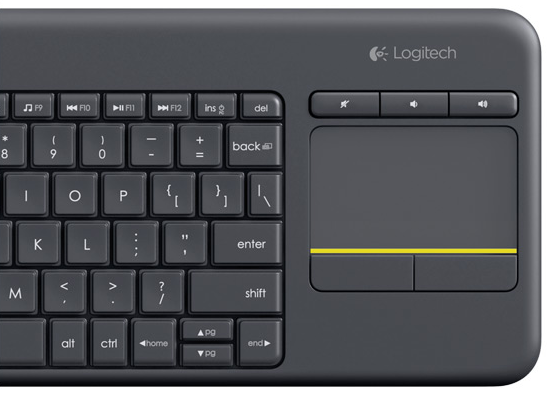
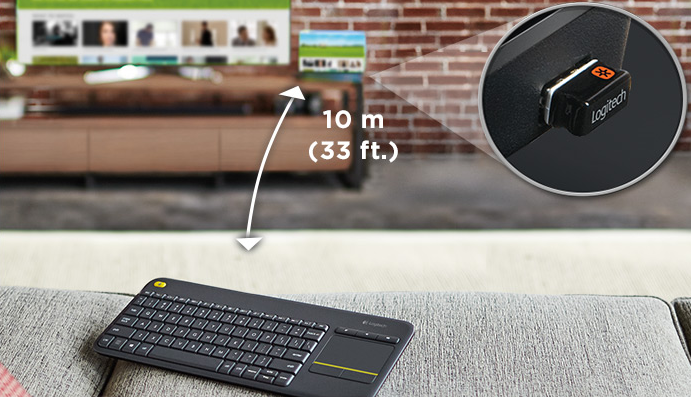
Le Logitech K400 Plus ne révolutionne donc rien tout en améliorant le concept de base de cette proposition assez ancienne. On reste sur un dispositif relativement classique, avec une belle portée d’une dizaine de mètres et compatible à la fois avec Windows, Android, Linux et ChromeOS. Des boutons Microsoft et Android sont d’ailleurs visibles sur la partie clavier.
Minimachines.net 2015-06-10 12_31_44

Logitech fait appel à sa technologie Unifying et ses micro-dongles USB pour relier l’appareil à votre machine. L’alimentation se fait par piles et la marque a, semble-t-il, poussé le travail sur l’économie d’énergie puisqu’une paire de batteries AA semble suffisante pour faire tenir l’engin 18 mois d’affilée. Les batteries rechargeables sont également très efficaces avec ce modèle.
Minimachines.net 2015-06-10 12_31_51

L’objet mesure 35.5 cm de marge pour 14 cm de profondeur et 2.35 cm d’épaisseur au point le plus volumineux et pèse 380 g. La zone tactile mesure 4.7 cm de profondeur pour 7.6 cm de large. Il sera décliné en noir et jaune ou en blanc et bleu avec, à chaque fois, des rappels colorés assez discrets. Comme le clic gauche qui est désormais excentré en haut à gauche du dispositif pour être manipulé de la main gauche sans lâcher le dispositif.

Par contre, les touches multimédia sont encore et toujours intégrées au reste des autres fonctions et dans les touches F1 à F12.

Attention cependant, les touches fléchées de l’appareil sont à présent très différentes de l’ancien modèle K400. Très compactes, les touches haut et bas ne sont plus que l’ombre d’une touche normale. Un défaut pour un objet qui servira à piloter une interface de type mediacenter à distance, et où on navigue parfois plus facilement avec les flèches qu’avec un pointeur.

Pour utiliser ce type de clavier depuis des années, j’en suis toujours ravi. Léger, robuste, efficace, c’est l’allié parfait d’un MiniPC dédié à un usage multimédia. Il peut remplacer une télécommande et permet plein de choses pratiques. Renommer des fichiers, faire des recherches, jouer et piloter finement toutes les interfaces. Si vous utilisez un logiciel de lecture avancé comme VLC avec beaucoup de raccourcis clavier, c’est également un atout très précieux.

Le K400 Plus pour de multiples usages

Il est disponible toute l’année sur Amazon en ce moment à 29.99€. Cela reste un excellent clavier pour un usage déporté d’un MiniPC sous un téléviseur. C’est surtout un des rares modèles en AZERTY fiable du marché. C’est également une solution assez pratique pour piloter un MiniPC serveur caché dans un coin de bureau si vous n’utilisez pas de KVM matériel. Enfin, je l’ai découvert au fil des ans, c’est un excellent clavier de « substitution » pour les plus petits. Si vous avez un enfant qui veut utiliser votre ordinateur classique ou votre portable et que vous ne voulez pas qu’il le manipule de trop près pour éviter toute situation problématique (ergonomie, prise de goûter au-dessus des touches et autres), éloigner le clavier d’origine pour un K400 Plus est une excellente alternative. Plus compact, facile à lire et à manipuler, cela permet de ne pas laisser son ordinateur portable sous les mains – parfois collantes – d’un bambin parfaitement adorable au demeurant.

Voir l’offre sur Amazon

Logitech K400 Plus : Le clavier sans fil avec touchpad à 29.99€ 🍮 © MiniMachines.net. 2026

  •  

Home Assistant 2026.7 : les nouveautés à connaître

Home Assistant 2026.7 vient de sortir, et il s’accompagne d’un changement plus large encore engagé depuis fin juin : un nouveau serveur Matter entièrement reconstruit. Ensemble, ces deux mises à jour touchent la stabilité du réseau, les automatisations et l’interface. Voici ce qui change concrètement pour votre installation. Nouveau serveur Matter Automatisations 2026.7 Activité et […]

L'article Home Assistant 2026.7 : les nouveautés à connaître a été publié en premier sur Bbox-Mag

  •  

Les prix des processeurs semaine 28-2026 : le Ryzen 7 7800X3D s'effondre, Intel remonte

Comme chaque week-end, nous faisons le point sur l'évolution des prix des processeurs Intel et AMD. Cette semaine est marquée par une très belle baisse du Ryzen 7 7800X3D, qui retrouve un tarif particulièrement agressif, tandis que plusieurs processeurs Intel voient leur prix repartir à la hausse. Chez AMD, les évolutions sont plus contrastées avec quelques baisses intéressantes, mais aussi plusieurs augmentations sur les modèles Zen 5. AMD : le Ryzen 7 7800X3D redevient une excellente affaire La vedette de la semaine est sans aucun doute le Ryzen 7 7800X3D. Son tarif passe de 329,90 U+20AC à seulement 289,90 U+20AC, soit une baisse de 40 U+20AC. À ce prix, il redevient l'un des meilleurs choix pour les joueurs recherchant un processeur performant sans basculer sur les dernières générations. D'ailleurs, il est même possible de le trouver à ce tarif chez 1FODiscount. Le Ryzen 5 7600X baisse également de 177,90 U+20AC à 169,90 U+20AC, tandis que le Ryzen 7 9700X passe de 269,90 U+20AC à 265,90 U+20AC et le Ryzen 9 7900X recule légèrement à 302,90 U+20AC. À l'inverse, plusieurs modèles Zen 5 augmentent. Le Ryzen 5 9600X grimpe de 179,90 U+20AC à 203,90 U+20AC, le Ryzen 9 9900X passe de 338,90 U+20AC à 366,90 U+20AC, le Ryzen 9 9950X progresse de 503,90 U+20AC à 525,90 U+20AC et le Ryzen 7 9800X3D atteint désormais 429,90 U+20AC. Les Ryzen 9 7950X et Ryzen 9 7950X3D restent quant à eux parfaitement stables, tout comme le Ryzen 9 9950X3D. […]

Lire la suite
  •  

Mod du dimanche : 500 heures d'impression 3D pour donner vie au Skullcrusher de DOOM !

Chaque dimanche, nous mettons à l'honneur les réalisations les plus impressionnantes de la scène modding. Et cette semaine, le moins que l'on puisse dire, c'est que le projet sort complètement de l'ordinaire. Le moddeur polonais CzugA s'est attaqué à l'une des armes les plus emblématiques de DOOM: The Dark Ages, le Skullcrusher, en la transformant en véritable PC Gaming entièrement fonctionnel. Le projet est né d'une collaboration avec NVIDIA GeForce et Bethesda, qui ont laissé carte blanche au créateur. Il aura fallu près de 90 jours de travail, plus de 500 heures d'impression 3D et environ 14 kg de filament pour donner vie à cette machine hors norme. Une fois terminée, elle dépasse les 22 kg sur la balance, preuve que l'on est ici bien plus proche d'une sculpture technique que d'un simple boîtier PC. […]

Lire la suite
  •  

New Study Links Teen Boys' ADHD Symptoms To Addictive Social Media Use

A new study by researchers at the University of California at San Francisco "adds to growing research linking increased social media use to detrimental effects on attention, memory and cognition," reports the Washington Post: The study followed more than 11,000 U.S. adolescents over a period of five years, with participants first asked about their own social media use at the average age of 12, and surveyed annually through the average age of 16. Researchers found that increases in addictive social media use were followed by rising ADHD one year later — particularly among boys who reported rising addictive social media use at ages 14 and 15. This association was not found consistently in reverse, meaning that ADHD symptoms did not appear to precede higher levels of addictive social media use... "When an individual adolescent's addictive social media use score increased from one year to the next, that same adolescent tended to show an increase in ADHD symptoms in the following year...." [said Jason Nagata, lead author of the study and an associate professor of pediatrics at the University of California at San Francisco]. He urged parents to consider: "Can their kids stop if they want to? Is social media interfering with their schoolwork? Is it impairing their social relationships? Are there addiction-like symptoms, like withdrawal and relapse?" Approximately 7 million American children between the ages of 3 and 17 have received an ADHD diagnosis, according to the Centers for Disease Control and Prevention, and boys are diagnosed with ADHD at about twice the rate of girls. The study did not find a clear link between addictive social media use and ADHD among girls, Nagata said. "Some studies do suggest that teenage boys in particular may be more sensitive to immediate reward and sensation-seeking in adolescence," he said. And social media platforms are designed to provide exactly that: "It encourages frequent task-switching, and there's this constant stream of stimulation that might make it harder for adolescents to maintain and sustain attention that is needed for schoolwork and daily life," he said. "The design features of social media offer the constant reinforcement of impulsivity — it offers immediate gratification and novelty and it encourages multitasking, which can then override working memory and executive control." Experts have long noted that this kind of digital exposure is particularly significant during critical stages of mental, social-emotional and cognitive development... [I]t's especially important for parents themselves to demonstrate a healthier relationship with screens and social media. "One of our previous findings was that parental screen use is a very strong predictor of kids' screen use," Nagata said.

Read more of this story at Slashdot.

  •  

Xiaomi 17T Bouygues Telecom : prix, avis et fiche technique

Xiaomi 17T Bouygues Telecom : les deux nouveaux smartphones de la série T rejoignent le catalogue de l’opérateur. Ainsi le 17T et le 17T Pro partagent un même téléobjectif Leica x5, mais se distinguent nettement sur l’écran, la puce et la batterie. Voici donc les prix chez Bouygues Telecom, la fiche technique complète et ce […]

L'article Xiaomi 17T Bouygues Telecom : prix, avis et fiche technique a été publié en premier sur Bbox-Mag

  •  
❌