
Vue lecture

New MCP Specification Addresses the Main Barrier To Enterprise Adoption

An anonymous reader quotes a report from Ars Technica: This week, the Model Context Protocol (MCP), an open source standard for how AI systems interact with external tools and data sources, saw its largest update since its introduction. Most notably, MCP's protocol core is now stateless, so requests are no longer dependent on a session tied to an individual server instance. This change has the potential to address long-standing barriers to scalability. The blog post announcing the specification, written by lead maintainers David Soria Parra and Den Delimarsky (who both work at Anthropic), says: "The highlight of this release is a stateless protocol core -- MCP is transforming from a bidirectional stateful protocol into a request/response stateless protocol. It was one of the most highly-requested features from developers who were eager to get better reliability and scalability for their MCP servers." [...] There is also a new deprecation policy that ensures at least 12 months between when a feature's formal deprecation is enacted and when the feature may actually be removed -- with a narrow exception for critical security updates. This is again in keeping with the general "let's make this work better at enterprise scale" theme of the new specification. This update is "MCP's most important since remote MCP first launched over a year ago," Soria Parra wrote. Other additions include "Multi Round-Trip Requests, header-based routing, cacheable list results, authorization hardening, a formal extensions framework, and updated Tier 1 SDKs." A full list of changes can be found here.

Read more of this story at Slashdot.

  •  

A Fundamental Flaw Leaves LLMs Strikingly Vulnerable To Attack

joshuark quotes a report from MIT Technology Review: It is impossible to make large language models fully secure against hacks because of a fundamental flaw in how they work, a team of researchers argue in a paper presented at the International Conference on Machine Learning, a top AI conference, this month. The claim has huge implications for the safety of this technology. By taking advantage of this flaw, which concerns how LLMs identify who or what is giving them instructions, the researchers were able to make popular LLMs spit out information they had been trained not to provide, such as how to synthesize cocaine and how to sabotage a commercial aircraft's navigation system. "There's a real probability that this is going to be a problem that's fundamentally unsolvable," says Charles Ye, an independent researcher and coauthor of the ICML paper. [...] The ICML paper describes attacks against several of OpenAI's models, but Cui and Ye say that they have since seen similar results with models made by Anthropic, Alibaba, and DeepSeek. Cui and her colleagues wanted to find out why an attack like chain-of-thought forgery was so effective. They suspected it had something to do with the mechanism that LLMs use to keep track of where their instructions are coming from. But what Cui and her colleagues discovered is that LLMs are in fact very bad at keeping track of different roles. In a series of experiments that looked at what was going on inside a handful of different models, the researchers found that LLMs seem to identify the role of a specific chunk of text not by the tags around it but by the style of that text and the words it contains. The upshot, the researchers claim, is that all an attacker needs to do to hack an LLM is write text that spoofs a certain role. And because roles are a fundamental part of how LLMs work, no amount of training will fully solve the problem. "There's going to be a huge economic incentive for people to do jailbreaks and prompt injections," says Cui. The best defense could be to expect the worst. Organizations shouldn't trust LLMs, and they should expect that anything done by agents could be unsafe, he says: "That's not a great solution, but it just might be what we have to do." "It's really incredible that these things are being deployed everywhere to control super-critical systems. There's been no study of the fundamental science here. We're all doing it ad hoc."

Read more of this story at Slashdot.

  •  

Microsoft's $450 Billion Jump Is Biggest In Stock Market History

Microsoft shares surged as much as 17% after reporting 43% growth in Azure revenue, putting the company on track to add a record $490 billion in market value in a single day. Bloomberg notes that it "would eclipse Nvidia's $440 billion addition, following President Donald Trump's announcement of a 90-day tariff pause last year, as the biggest ever." From the report: The nearly $500 billion jump is larger than the market capitalization of roughly 96% of S&P 500 stocks, data compiled by Bloomberg show. It's also bigger than the combined value of the benchmark's 44 smallest members, which includes companies like Domino's Pizza Inc., Clorox Co. and Hasbro Inc. Microsoft's one-day add in value also dwarfs many of the world's other equity markets. South Africa, Turkey, Finland and Vietnam all have total stock market values that are less than what the software maker is set to add on Thursday.

Read more of this story at Slashdot.

  •  

Frais de résiliation Bouygues Telecom : les 3 dates clés

Frais de résiliation Bouygues Telecom : depuis le 27 juillet 2026, tous les forfaits sans engagement sont concernés. Ainsi, voici les 3 vagues qui ont mené à cette généralisation, et ce que ça change concrètement pour vous. La généralisation Les 3 vagues Forfaits concernés 5€, une exception La justification Peut-on encore y échapper ? Vos […]

L'article Frais de résiliation Bouygues Telecom : les 3 dates clés a été publié en premier sur Bbox-Mag

  •  

ABC Accuses FCC of 'Attempted Censorship'

ABC accused FCC Chair Brendan Carr of "attempted censorship," arguing that an early review of its eight broadcast licenses is politically motivated retaliation over the network's coverage and could chill the entire media industry. "The retaliation against ABC is a signal to every media company in the country: accommodate the Administration's view of what news coverage should look like or pay the price," the Disney-owned television network wrote. Politico reports: "Across the government, regulatory and contracting carrots and sticks have been trained on other disfavored speakers," ABC's lawyers added in the 119-page filing. "The tools vary; the objective does not: a media industry too fearful of official reprisal to report the news freely." Carr has repeatedly rejected accusations of censorship while defending his efforts to rein in what he calls abusive, politically motivated behavior by licensed TV broadcasters. "I don't view the FCC as the speech police," he told POLITICO this week for an upcoming episode of the podcast "The Conversation." In its filing, ABC pointed to an outpouring of support it has received in more than 152,000 comments in the agency's license review, as well as recent warnings from conservative Supreme Court Justice Neil Gorsuch, Sen. Ted Cruz (R-Texas) and various pro-free-market organizations about the dangers of a politically motivated FCC. Those include letters from a bipartisan group of former FCC leaders, community and advocacy groups and lawmakers of both parties. "The Commission's attempted censorship of ABC has attracted condemnation across the political aisle," the network wrote.

Read more of this story at Slashdot.

  •  

Amazon's Zoox Wins First US Approval For Paid Robotaxis Without Human Controls

An anonymous reader quotes a report from Reuters: Amazon's Zoox unit has won U.S. approval for limited commercial deployment of its novel steering-wheel-free robotaxis, a first for the autonomous ride industry, the U.S. auto safety agency said on Thursday. Zoox said that the National Highway Traffic Safety Administration's decision gives the company federal approval to begin charging for rides, and that it will soon begin charging for service, first in Las Vegas, with additional markets to follow as it completes various state requirements. [...] NHTSA Administrator Jonathan Morrison told Reuters that Zoox had received clearance to commercially deploy up to 2,500 vehicles in each of the next two years. Zoox currently carries passengers in parts of Las Vegas and San Francisco as part of testing. The exemption would allow Zoox to charge them fees, subject to state and local approvals. The agency said it determined the vehicle is as safe as an equivalent vehicle meeting federal motor vehicle safety standards that are being waived. Zoox cannot sell any of the vehicles to the public. "We can say pretty clearly that the systems in place on the Zoox exceed the equivalent performance requirements of a compliant vehicle," Morrison said in an interview. "But we still want to make sure that the automated driving system will operate appropriately." As part of the exemption, NHTSA is placing additional reporting requirements on Zoox for issues such as crashes or stopping inappropriately on roads, and the regulatory agency will adjust the conditions based on how the vehicles behave. "We have the ability to pull the exemption if we see major safety issues," Morrison said. All remote operators must be located in the United States, NHTSA said, and Zoox must publish maps of areas indicating where the vehicles are operating. Morrison said NHTSA expects to develop the first federal safety standards for automated driving systems by the end of the Trump administration. It is also proposing to overhaul some existing rules written with human drivers in mind such as requiring brake pedals and rear-view mirrors.

Read more of this story at Slashdot.
  •  

AMD Posts Linux Patches For HDMI 2.1 Auto Low-Latency Mode "ALLM" & VRR

Following AMD posting AMDGPU patches for HDMI 2.1 FRL support after the HDMI 2.1 open-source support was long blocked by the HDMI Forum, as part of working toward a complete HDMI 2.1 implementation in this AMD Linux driver it was followed by HDMI 2.1 Display Stream Compression (DSC) support. Now the latest on the AMDGPU HDMI 2.1 enabling path is enabling Auto Low-Latency Mode (ALLM) as well as HDMI Variable Rate Refresh!..
  •  

There's Finally A New Game Powered By The Unigine 2 Engine

It's been about a decade since seeing any new games released on the visually-impressive, Linux-friendly Unigine Engine. Unigine Corp has mostly been focusing on Unigine Engine usage for simulations and other professional applications, but coming as a surprise today is a new game being developed on their latest Unigine 2 engine technology...
  •  

Catastrophic MoD Data Breach Caused By Lack of Training On Excel

A UK parliamentary inquiry found that a catastrophic Ministry of Defense breach exposing 18,700 Afghans could have been prevented with basic Excel training, after an employee unknowingly shared a hidden worksheet containing their details. The Independent reports: The leak, in February 2022, exposed the details of 18,700 Afghans who said they were in danger from the Taliban because of their links to UK forces and now wanted to escape to Britain. The blunder triggered an unprecedented superinjunction used against the national media, including The Independent, and prompted a secret evacuation program -- the cost of which is still unclear but which likely ran into the billions of pounds. Following the revelation by this outlet and others in July last year of the hidden operation, MPs set up an inquiry to scrutinize what had happened. In their report, the defense selection committee concluded that: - The data breach could have been prevented if Ministry of Defense (MoD) personnel had received basic Excel training - By August 2023, when the department discovered the leak, thousands of people already knew that a significant data incident had taken place - The government did not strike "the right balance between operational secrecy and democratic accountability" -- and the superinjunction was in place for too long - Secrecy denied affected Afghans the chance to take steps to protect themselves and their families and caused delays to evacuation program - Thousands of Afghans eligible to come to Britain are still trapped in Afghanistan with the government failing to explain how they will help get families to safety. MPs have called on the government to publish periodic reassessments of the risks facing Afghan applicants to UK resettlement schemes, with officials to report findings annually. They also want ministers to publish a clear policy explaining how they will help Afghans who are eligible to come to Britain but who have not yet been evacuated. The defense committee have also called on the MoD to explain who was responsible for data protection risk before the Afghan breach, criticizing the lack of accountability within the civil service.

Read more of this story at Slashdot.

  •  

Google's Gemini Can Now Stomp Around as a Humanoid Robot

Google DeepMind's Gemini Robotics 2 combines vision, language, and action models to control multiple types of robots, including humanoids performing tasks such as organizing shelves, tying bags, and replacing lightbulbs. "It's another milestone in our path towards really getting towards what we call like physical AGI, which means we get a robot to do anything that a human can," Carolina Parada, head of robotics at Google DeepMind, tells WIRED. From the report: Gemini Robotics 2 combines several different AI models into a single system. Taken together, they allow a robot to make sense of its surroundings and how to act in it. A vision language model (VLM), which understands images and video, can communicate with humans and reason how to perform different tasks. Two vision language action (VLA) models, trained to understand how to move in physical space, control the robot's full-body movement as well as the movements of grippers or hands. In video demonstrations shared ahead of the release, the company showed several different robots performing complex tasks autonomously using the amalgamated model. In one demo, Apptronik's Apollo 2 robot used hands from a company called Sharpa to tidy shelves. Google DeepMind trained the model to perform these tasks using a mix of human teleoperation, video examples, and simulations -- it's not yet possible for AI models to perform a wide range of complex tasks without specific training. [...] Parada says Google takes a multi-layered approach to safety, with guardrails applied on each model layer. It's also introducing ASIMOV-Agentic, a new benchmark for measuring the safety of various AI systems collaborating to control a robot. The benchmark detects whether a command will result in harmful or uncertain outcome.

Read more of this story at Slashdot.

  •  

Bon Plan : le jeu OTXO offert par Epic Games

Le premier jeu offert par le store d'Epic Games est le très bon OTXO, qui devrait vous donner un coup de oh-cho, puisque vous devrez vous rendre dans un monastère, légèrement glauque, afin de délivrer un être cher. Toutefois, cela va se faire à coup de bastos, sans aucune pitié, ce jeu de tir en vue du dessus nous rappelle un certain Hotline Miami, auquel nous avons joué et que nous avons adoré !L'ajout se passe sur cette page et vous avez sept jours pour l'effectuer. OTXO (prononcé oh-cho) est un jeu de tir en vue du dessus violent et intégrant des éléments de rogue-lite. Le protagoniste entre dans un étrange manoir afin de secourir son amour perdu. Plus vous vous enfoncez à l'intérieur, plus vous en découvrez les secrets. Sans visage, sans nom et sans aucune idée de comment vous êtes arrivé ici... vous ne vous souvenez que d'une chose : pourquoi. Elle vous attend, quelque part dans ce manoir, et vous ne pouvez partir sans elle. Frayez-vous un chemin à travers des zones uniques et rencontrez de nouveaux alliés tout en avançant jusqu'à la source du mystère. Faites face à vos démons intérieurs, et massacrez-les ! SOYEZ PLUS PUISSANT QU'EUX Avec une foule d'armes, plus de 100 capacités et la possibilité de ralentir le temps à n'importe quel moment, défoncez toutes les portes et tous les ennemis assez fous pour se mettre sur votre chemin. […]

Lire la suite
  •  

Nouveautés Netflix août 2026 : séries, films, docs

Les nouveautés Netflix août 2026 couvrent tous les genres, entre séries événement, films et documentaires. Cent ans de solitude conclut son adaptation dès le 5, Death Inc. tire sa révérence le 7, et Outer Banks revient le 20. Voici le programme complet, classé par catégorie. Les incontournables du mois Séries à suivre Films et documentaires […]

L'article Nouveautés Netflix août 2026 : séries, films, docs a été publié en premier sur Bbox-Mag

  •  

LinkedIn ajoute un bouton pour signaler des contenus « AI slop »

Ça sent mauvais l'IA
LinkedIn ajoute un bouton pour signaler des contenus « AI slop »

LinkedIn inaugure un nouveau bouton qui permet à l’utilisateur de signaler un contenu « AI slop ». Lorsqu’un billet semble avoir été rédigé par une intelligence artificielle, il suffit d’appuyer sur ce bouton pour informer LinkedIn. La procédure doit l’aider à « améliorer le fil d’actualité », sans supprimer pour autant le contenu.

Quand on parle d’« AI slop », on pense souvent à ces posts et ces images postés sur Facebook ou Instagram, Meta s’étant fait la spécialité de ce genre de bouillie, ou encore les horreurs qui circulent sur X. Mais dans le genre, LinkedIn n’est pas mal non plus. Une étude Pangram de début juillet relevait ainsi que 41 % des billets « long format » (plus de 250 mots) postés sur le réseau social sont générés par IA.

Signaler les posts qui sonnent faux

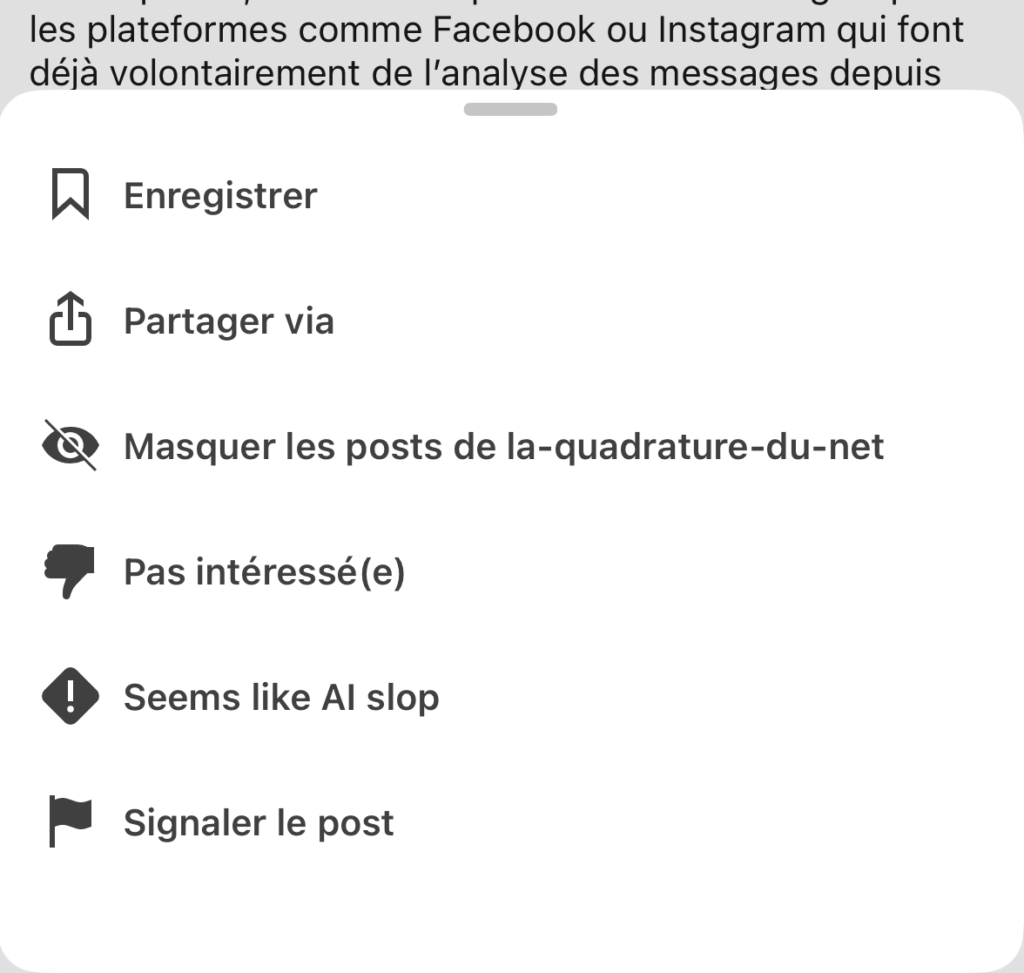
LinkedIn ne veut pas de ce stigmate, mais il a besoin de ses utilisateurs. Ils trouveront dans la feuille d’options un nouveau bouton au libellé très clair « Seems like AI slop » (pas encore traduit en français), pour signaler un contenu généré par IA – ou qu’on estime être généré par IA. Ce bouton est d’ores et déjà disponible, d’après ce que nous avons pu constater (404media aussi).

Hari Srinivasan, chef produit de LinkedIn, explique dans un post (généré par IA ?) que la lutte contre cette « bouillie » est une « priorité absolue ». Il confirme le lancement de cette nouvelle option de signalement d’AI slop, « [une] notion difficile à définir » et qui évolue : « ces signalements nous permettront d’ajuster nos modèles et d’améliorer les fils d’actualité. »

Il déroule également les efforts de l’entreprise dans cette lutte acharnée contre la médiocrité : la détection automatisée dans les commentaires de publications automatisées et de « slop », l’amélioration des outils internes d’identification de publications de faible qualité ou générées par IA, et la suppression de la fonction « améliorer votre publication ». Elle sera remplacée par un outil de correction du texte, sans modification plus profonde du texte.

Les utilisateurs qui publient du contenu verront dans leur tableau de bord les signalements de lecteurs qui estiment qu’un post « paraît manquer d’authenticité » ou semble recourir largement à l’IA. Une approche qui repose sur deux constats :

« Premièrement, l’IA et la « bouillie » ne sont pas la même chose : beaucoup de personnes utilisent l’IA pour affiner leurs idées, et nous pensons qu’elles souhaitent savoir quand leur propos semble manquer d’authenticité. Deuxièmement, nous voulons que les membres reçoivent l’avis de vraies personnes sur ce qui paraît authentique, plutôt que de se fier uniquement à un détecteur d’IA susceptible de se tromper. »

D’autres changements sont dans les tuyaux pour réduire la bouillie d’IA dans le fil d’actualité de LinkedIn, et redonner aux utilisateurs l’impression de lire des textes écrits par des humains.

  •  

LinkedIn ajoute un bouton pour signaler des contenus « AI slop »

Ça sent mauvais l'IA
LinkedIn ajoute un bouton pour signaler des contenus « AI slop »

LinkedIn inaugure un nouveau bouton qui permet à l’utilisateur de signaler un contenu « AI slop ». Lorsqu’un billet semble avoir été rédigé par une intelligence artificielle, il suffit d’appuyer sur ce bouton pour informer LinkedIn. La procédure doit l’aider à « améliorer le fil d’actualité », sans supprimer pour autant le contenu.

Quand on parle d’« AI slop », on pense souvent à ces posts et ces images postés sur Facebook ou Instagram, Meta s’étant fait la spécialité de ce genre de bouillie, ou encore les horreurs qui circulent sur X. Mais dans le genre, LinkedIn n’est pas mal non plus. Une étude Pangram de début juillet relevait ainsi que 41 % des billets « long format » (plus de 250 mots) postés sur le réseau social sont générés par IA.

Signaler les posts qui sonnent faux

LinkedIn ne veut pas de ce stigmate, mais il a besoin de ses utilisateurs. Ils trouveront dans la feuille d’options un nouveau bouton au libellé très clair « Seems like AI slop » (pas encore traduit en français), pour signaler un contenu généré par IA – ou qu’on estime être généré par IA. Ce bouton est d’ores et déjà disponible, d’après ce que nous avons pu constater (404media aussi).

Hari Srinivasan, chef produit de LinkedIn, explique dans un post (généré par IA ?) que la lutte contre cette « bouillie » est une « priorité absolue ». Il confirme le lancement de cette nouvelle option de signalement d’AI slop, « [une] notion difficile à définir » et qui évolue : « ces signalements nous permettront d’ajuster nos modèles et d’améliorer les fils d’actualité. »

Il déroule également les efforts de l’entreprise dans cette lutte acharnée contre la médiocrité : la détection automatisée dans les commentaires de publications automatisées et de « slop », l’amélioration des outils internes d’identification de publications de faible qualité ou générées par IA, et la suppression de la fonction « améliorer votre publication ». Elle sera remplacée par un outil de correction du texte, sans modification plus profonde du texte.

Les utilisateurs qui publient du contenu verront dans leur tableau de bord les signalements de lecteurs qui estiment qu’un post « paraît manquer d’authenticité » ou semble recourir largement à l’IA. Une approche qui repose sur deux constats :

« Premièrement, l’IA et la « bouillie » ne sont pas la même chose : beaucoup de personnes utilisent l’IA pour affiner leurs idées, et nous pensons qu’elles souhaitent savoir quand leur propos semble manquer d’authenticité. Deuxièmement, nous voulons que les membres reçoivent l’avis de vraies personnes sur ce qui paraît authentique, plutôt que de se fier uniquement à un détecteur d’IA susceptible de se tromper. »

D’autres changements sont dans les tuyaux pour réduire la bouillie d’IA dans le fil d’actualité de LinkedIn, et redonner aux utilisateurs l’impression de lire des textes écrits par des humains.

  •  

Google Brings Its Age-Assurance Tech To Android Developers Worldwide

An anonymous reader quotes a report from TechCrunch: Google is expanding its answer to Apple's age-assurance tools with Wednesday's news that it will bring its Play Signal API to users worldwide by the end of 2026. The technology, already available in Brazil, allows Android developers to identify younger users of their apps in order to provide safer, age-appropriate experiences. The expansion will initially bring the API to Australia and Canada by mid-August, before rolling out globally to all markets by the end of the year. [...] Like Apple, Google's technology allows developers to obtain a user's age range without needing to access personal information, like their date of birth. Instead, it enables parents to share their child's age range directly with apps. It also lets adults share their age when prompted by app developers as well, allowing for customized experiences. Parents won't have to manage sharing this information on an app-by-app basis, either. To make it easier, Google centralizes these controls inside its parental controls dashboard, Family Link. Once entered, any developer that chooses to incorporate age-range information can access this signal to customize their apps accordingly. Google notes, however, that the age ranges are not shared by default -- parents must opt in by entering that information. The feature joins other safety tools on Google Play, including those that let developers restrict a child's ability to discover their apps. Parents, meanwhile, can continue to use Google Play's Family Link app to manage their child's screen-time limits, approve app downloads, or set PIN-based content filters for specific apps.

Read more of this story at Slashdot.

  •  

Bon Plan : Jeu Sol Cesto offert sur Epic

Sol Cesto est un roguelite tactique et frénétique dans lequel il faut maîtriser sa chance. Choisissez un héros, améliorez-le et atteignez le fond d’un donjon qui change sans cesse.

Sur la grille de combat, choisissez une des 4 lignes pour vous y déplacer. Vous tomberez alors aléatoirement sur une des 4 cases de cette ligne : un monstre qui vous fait du mal ? Un coffre rempli d’or ? Ou bien un piège empoisonné ? Tout peut arriver…

Bon Plan : Jeu Sol Cesto offert sur Epic © MiniMachines.net. 2026

  •  

Chiffrement : Claude casse HAWK et fissure une version réduite d’AES, mais pas de panique

Faucon, vraie faiblesse
Chiffrement : Claude casse HAWK et fissure une version réduite d’AES, mais pas de panique

L’équipe Frontier Red Team d’Anthropic a publié un billet dans lequel elle décrit ses trouvailles sur deux algorithmes dédiés à la cybersécurité : HAWK et AES. Si les découvertes sont avérées, les conséquences ne sont pas aussi dramatiques qu’on peut le lire ça et là. Elles ne sont pas inexistantes pour autant.

Le 28 juillet 2026, Anthropic a publié un billet de recherche consacré à la « découverte de faiblesses cryptographiques avec Claude ». Il décrit les trouvailles réalisées avec une préversion interne de Mythos qui n’est pas encore accessible au public.

Les découvertes concernent deux algorithmes de sécurité. D’abord HAWK, un schéma de signature numérique conçu pour résister aux ordinateurs quantiques. Ensuite AES, ou plus exactement une version réduite d’AES, utilisée en général en recherche pour mieux étudier la robustesse de cet algorithme.

Dans son billet, Anthropic affirme qu’aucune de ces découvertes n’a d’incidence sur l’informatique actuelle. Certes, mais elles ont tout de même quelques conséquences, même si elles sont loin de l’apocalypse décrite par certains.

Le vol court du faucon post-quantique


Il reste 88% de l'article à découvrir.
Vous devez être abonné•e pour lire la suite de cet article.
Déjà abonné•e ? Générez une clé RSS dans votre profil.

  •  

Nouveau vs. NVIDIA R610 On CachyOS With The GeForce RTX 5090 Laptop GPU

With the Razer Blade 18 as the first laptop Razer's certifying for (Ubuntu) Linux use while testing it out I was predominantly using the NVIDIA R610 official driver stack. Some users were interested though in how well this laptop is working with the open-source, upstream Nouveau+NVK driver stack given Razer is marketing this high-end laptop for Linux use too. Before sending the review unit back I had run some graphics benchmarks to see how Nouveau+NVK was performing for this Razer Blade RZ09-0582 with the flagship GeForce RTX 5090 Laptop GPU.
  •  
❌