Dans le milieu du refroidissement, Noctua est un peu l’excentrique de la bande. Non contente de proposer des produits peinturlurés en marron et beige reconnaissables entre tous, la marque autrichienne publie aussi des guides dans lesquels elle enjoint ses clients à disposer des ventilateurs partout dans leur logis... [Tout lire]
Le Minisforum NAB9S n’aura pas demandé à la marque de se gratter énormément le crâne. L’engin est, à une lettre près, un clone du modèle lancé en 2024 sous Core i9-12900HK. On change de puce pour un processeur Intel de treizième génération et l’emballage bénéficie également de belles évolutions, notamment en matière de refroidissement.
La famille NABx propose un assez bel arbre généalogique. Il y a eu le NAB6 en Core i7-12650H, puis le NAB7 en Core i7-12700H, le NAB9 sous I9-12900HK et désormais le NAB9S qui passe enfin la treizième. Comme d’habitude avec ces machines, la marque a recours à des puces légèrement passées de mode avec quelques générations de retard pour baisser la note du système. Le Core employé ici est un Raptor Lake sous gravure Intel 7 lancé au début 2023 par Intel. Une puce performante reposant sur une architecture solide. On retrouve 6 cœurs P et 8 cœurs E pour un total de 20 Threads dans des fréquences de 4.1 à 5.4 GHz. La puce embarque 24 Mo de mémoire cache et un circuit graphique Intel Iris Xe avec 96 Unités d’exécution à 1.5 GHz. C’est un processeur mobile que l’on a retrouvé dans des portables de jeu ou des stations de travail où il excellait dans la majorité des tâches.
Son « petit » défaut est son TDP assez élevé. 45 watts en fonctionnement normal, un Turbo à 115 watts et une puissance minimale assurée de 35 watts, c’est souvent le signe d’un modèle qui nécessitera une ventilation soutenue. Chose que le Minisforum NAB9S assurera sans trop de soucis puisque les anciennes puces des précédents modèles étaient taillées dans le même silicium.
Pour parvenir à encaisser le dégagement de chaleur de la puce, Minisforum emploie un système désormais classique mélangeant cuivre, aluminium, caloducs, ailettes et ventilation active. Rien de bien extravagant et un système qui fonctionne bien depuis des années sur ces modèles mais que la marque a mis à jour. En usage standard, la machine ne fera pas spécialement de bruit, mais en général il vaudra mieux anticiper une montée dans les tours en usage plus intensif. Pour le jeu ou les travaux gourmands, ce type de configuration se fait entendre.
Un déploiement sous un bureau, loin de vos oreilles, peut tout à fait avoir son intérêt. D’ailleurs les portables équipés de ce type de puce avaient également tendance à se faire entendre en usage « lourd ». Il ne faut donc pas trop considérer ce type de machine pour un usage familial avec un déploiement dans le salon, mais plutôt en faire une machine de bureau plus personnelle.
Le dispositif de refroidissement est assez complet avec un recours à deux séries d’ailettes disposées sur l’arrière et le côté de l’engin. Le ventilateur proposera un flux d’air frais aspiré par le dessous et les côtés de la machine pour les traverser. Un second petit ventilateur vient se positionner au niveau du SSD M.2 2280 pour refroidir un dissipateur en aluminium fourni avec la machine.
L’accès aux composants est facile, le Minisforum NAB9S reprend le design très classique qui a fait connaitre la marque. On pousse sur la partie supérieure du châssis et on dégage le capot qui révèle à la fois l’accès à la mémoire vive et au stockage. L’engin propose deux emplacements SODIMM de DDR4, un port M.2 2280 NVMe PCIe 4.0 x4 et, surprise, un emplacement 2,5″ SATA. Une bonne idée de la part du constructeur qui va permettre de recycler des stockages qui traînent dans de vieilles machines. Le module M.2 2230 qui embarquera un Wi-Fi6E et Bluetooth 5.2 sera également accessible de cette manière.
La connectique n’a pas beaucoup bougé depuis la première version de ce châssis. L’aluminium est percé sur la face avant pour laisser passer un petit microphone, un USB 3.2 Type-C avec DisplayPort et Power Delivery 3.0, deux USB 3.2 Gen2 Type-A, un jack audio combo 3.5 mm, un bouton de démarrage avec LED et un bouton Reset.
A l’arrière, au-dessus de la première grille de ventilation, on note la présence de deux USB 3.2 Gen2 Type-A, deux sorties HDMI 2.1, un USB 3.2 Gen2 Type-C avec DisplayPort et un USB 3.2 Gen2 Type-C supplémentaire. Un duo de ports Ethernet 2.5 Gigabit est présent ainsi qu’un Antivol type Kensington Lock. La totalité de la coque est en métal sauf la découpe arrière en ABS pour les connecteurs. La partie supérieure est également en matière plastique et laissera ainsi passer les signaux sans fil. En tout, la machine peut piloter quatre affichages différents. On regrettera tout de même l’absence de Thunderbolt…
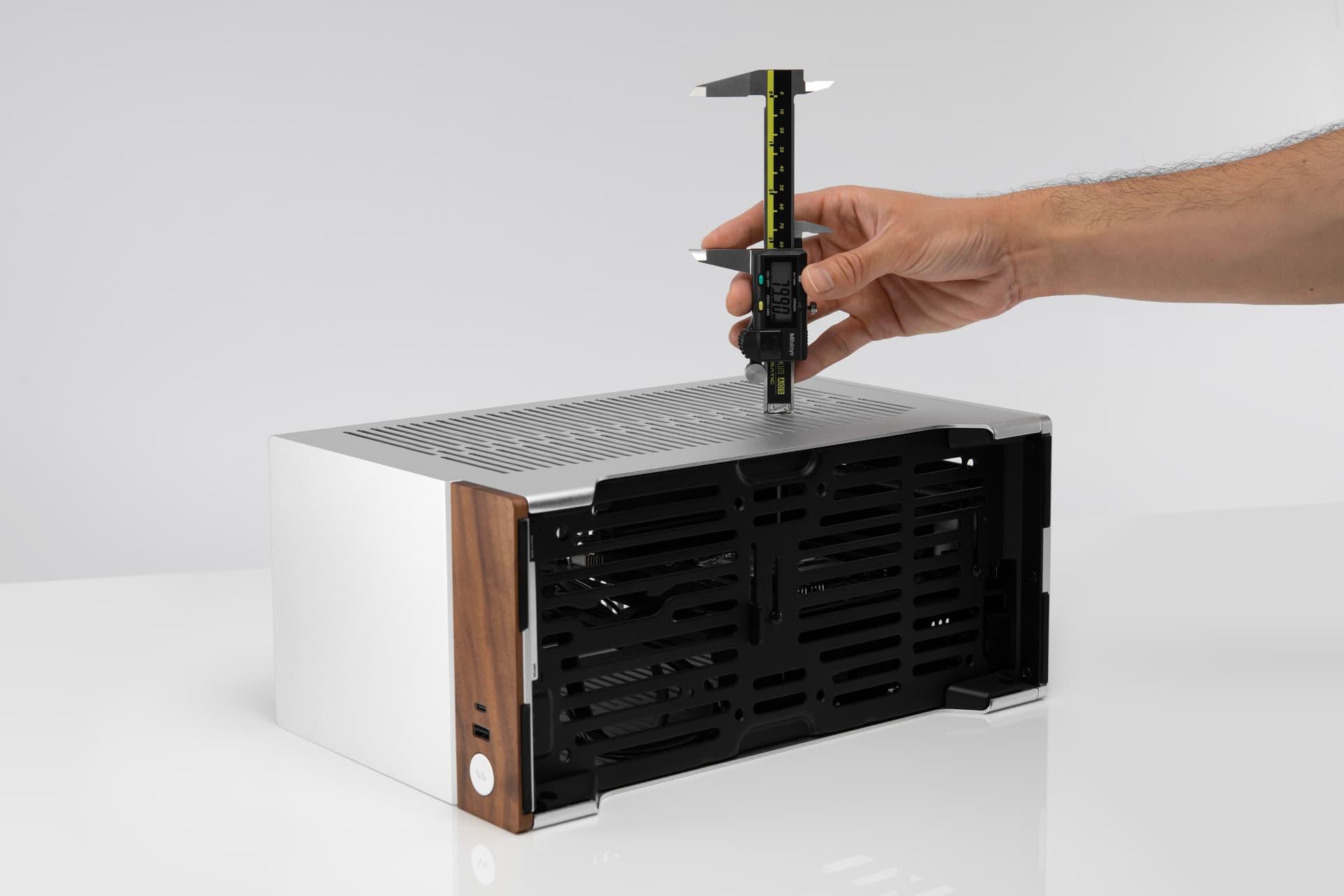
Livré avec un adaptateur VESA et un petit câble HDMI, le NAB9S pourra se fixer facilement contre un caisson de bureau ou derrière un écran. L’engin est compact avec 12.7 cm de large et de profondeur et une épaisseur de 5.47 cm pour un poids de 570 grammes.
Le NAB9S parfait pour recycler des composants de portable
La série NAB9S, livrée avec un équipement solide et efficace, sera parfaite pour deux types de scénarios et dans des usages variés. Le Core i9 que la minimachine embarque est performant. C’est un excellent processeur pour tout type d’usage malgré ses trois ans d’âge. Pour des calculs lourds, de la 3D, du travail d’image comme de la vidéo, pour peu qu’il soit accompagné d’un montant de mémoire vive correct, ce sera une très bonne base de travail. Si vous cherchez un engin tout neuf pour ces usages, ce sera idéal. En jeu, même sur des titres assez récents, la puce d’Intel se débrouille très bien. Les jeux les plus classiques et grand public comme Counter Strike, Fortnite, Valorant et autres DOTA sont parfaitement pris en compte. Les titres plus récents demanderont des ajustements de détails ou de définition.
Mais c’est aussi parce qu’avec sa gestion de la DDR4 et son emplacement 2,5″, cela en fait un excellent candidat à une greffe de mémoire vive et de stockage dans sa version barebone. Pour peu que vous ayez un vieux coucou un peu dépassé ou un portable qui a quelques heures de vol avec une batterie un peu juste, le transfert de la mémoire vive et du stockage 2.5″ vers ce nouveau MiniPC sera un bon moyen de faire une mise à jour technique. Bien moins cher qu’un achat « neuf » en ce moment.
À 429€ en version barebone cela donne un engin capable de venir à bout de nombreuses tâches pour longtemps. Les versions mieux équipées, en 32Go / 1 To sont malheureusement beaucoup plus chères à 839€. Les versions Barebones sont livrées sans système ni licence.
La QIDI Plus5 est la réponse du constructeur aux évolutions les plus récentes du monde de l’impression 3D. Plus grande en capacités et en volume, plus précise et plus fine, complète et capable d’exploiter divers matériaux sans problèmes. Simple d’emploi et ergonomiquement très travaillée, elle est dotée de fonctions avancées et propose plusieurs innovations intéressantes. Elle vise des utilisateurs expérimentés à la recherche d’un modèle fermé, fiable et sérieux.
J’ai reçu la QIDI Plus5 en test il y a quelques jours. Suffisamment pour découvrir la machine, mais pas assez longtemps pour en faire un test vraiment complet. Je vous propose donc un tour technique du propriétaire en attendant un test exhaustif d’ici la rentrée. À noter que la machine m’a été envoyée gratuitement par QIDI et que la marque a décidé de sponsoriser le blog pour quelques mois. Les deux éléments sont dissociés, je ne fais jamais de tests sponsorisés et mon avis sur l’engin sera totalement impartial. Qidi a déjà été sponsor du blog à la même période en 2025 sans me demander de tester quoi que ce soit.
QIDI Plus5
Je n’ai aucune idée de ce qu’il se passe dans la tête d’un ingénieur quand il a pour mission de réinventer encore et toujours le même objet. Entendons-nous bien, je ne parle pas ici de l’habituelle métaphore du type qui cherche à réinventer la roue. Non, plus sérieusement, du défi qui consiste à trouver la nouvelle manière de faire évoluer son sujet dans un domaine aussi précis que celui de l’automobile, du smartphone ou, c’est le cas qui nous préoccupe ici, de l’impression 3D.
Il y a toujours plusieurs acteurs sur ces terrains. Des fabricants qui innovent, d’autres qui suivent, d’autres encore qui essaient de tracer leur propre voie. C’est encore plus vrai dans le monde de l’impression 3D puisque le cœur de cette invention est né d’une idée logicielle commune et libre. Une industrie qui s’est basée sur la technologie de filament fondu après la fin du brevet qui la protégeait. Chaque industriel trouve sa place dans cet écosystème avec des arguments différents. Les « suiveurs » sont souvent en retard, c’est logique, mais ils sont moins chers. Les plus innovants proposent des nouveautés intéressantes qu’on ne trouvera chez les autres que bien plus tard. Ces derniers font souvent payer leurs idées fort cher, ce qui est tout aussi logique.
Tout cela se combine allégrement dans un énorme bouillon de culture porté par des dizaines de marques. De telle sorte que tout un panel de propositions est disponible sur le marché. Évidemment, il est plus simple et confortable pour un fabricant de suivre les autres que de défricher de nouvelles idées. Mais cela ne permet pas souvent d’être très visible ni de dégager de belles marges. Il est plus avantageux de lancer des machines avec de nouvelles fonctionnalités qui vont faire leur marketing toutes seules et dégager plus de bénéfices, mais des marques qui lancent des produits aux fonctionnalités parfois encore balbutiantes. Entre ces deux extrêmes, il y a une galaxie de marques qui se positionnent un peu en retrait. Ne cherchant pas forcément à jouer sur les tableaux classiques mais en traçant leur propre voie. Souvent un bon moyen de séduire les plus frileux, les entreprises et ceux à la recherche de fonctions précises et maitrisées. Qidi fait partie de cette troisième catégorie.
Qidi Plus5 Combo
La QIDI Plus5 est une évolution du modèle précédent, la QIDI Plus4. Une évolution technique qui ressemble à une réponse aux retours des utilisateurs, je vous disais que je n’avais aucune idée du mode de fonctionnement d’un ingénieur face à la tâche consistant à faire évoluer sa propre création technique. Mais écouter les remontées de ses clients semble être un bon point de départ pour réfléchir au futur de ses produits. C’est sans doute la meilleure méthode de travail pour commencer.
La QIDI Plus5 offre 18% de volume en plus
La QIDI Plus5 est une imprimante CoreXY à dépôt de filament. Si vous n’avez jamais eu d’imprimante 3D en main, cela peut paraître assez intimidant, mais en réalité le processus est assez simple. Une tête d’impression chauffe et fait fondre un filament de matière plastique en suivant des mouvements précis. Au fur et à mesure que le filament fond, le plateau qui réceptionne le filament descend sur un axe. Tant et si bien que la tête d’impression propose petit à petit une forme imprimée couche par couche. De cette simple opération, on peut déduire l’essentiel des éléments indispensables à une bonne imprimante. De la stabilité, de la précision et une régularité à toute épreuve. Tout l’enjeu pour un constructeur est donc d’améliorer ces éléments tout en les rendant toujours plus simples à exploiter. Tout en apportant diverses évolutions.
Sur la QIDI Plus5 on commence par découvrir une surface d’impression plus grande. La QIDI Plus4 imprime en 305 x 305 mm de côté sur 300 mm de haut. La 5 optimise l’espace pour proposer 320 x 320 de côté toujours sur 300 mm de haut. C’est 18% de volume en plus au total. De quoi imprimer, très facilement, un ballon de basket pour adulte (un ballon de basket taille 7 mesure 250 mm de diamètre environ). Cette évolution technique qui intéressera les utilisateurs voulant profiter d’une grande capacité de production.
Point assez important de l’équation proposée ici, l’imprimante propose cette évolution en taille comme une énorme optimisation de l’espace d’impression interne. Il est bien entendu très simple de proposer un plus grand volume en augmentant simplement les dimensions de l’imprimante. Pour comprendre le travail mené par les équipes de la marque, il faut mettre en perspective les chiffres de l’encombrement des deux machines.
Imprimante
Volume d’impression
Encombrement global
QIDI Plus5
320 x 320 x 300 mm
500 x 488 x 558 mm
QIDI Plus4
305 x 305 x 300 mm
505 × 487 × 550 mm
L’utilisateur gagne donc 15 cm de côté pour 8 mm de plus en hauteur, 5 mm de moins en largeur et 1 mm de moins en profondeur. Si la Qidi Plus5 est plus lourde avec 29 Kg au lieu de 27 Kg, la place occupée dans un atelier ou un bureau est quasi identique tout en imprimant des volumes plus conséquents.
Une gestion impressionnante des températures
Deuxième élément important, les températures proposées par l’imprimante. La QIDI Plus5 propose une tête d’impression capable de monter à 370°C. Un chiffre très élevé pour un modèle de ce type qui va permettre d’exploiter de nombreux types de filaments et parmi les plus difficiles à imprimer1 tout en offrant des débits d’impression rapides. Sur des PLA+, généralement les plus simples à imprimer rapidement, on arrive à des débits de 4 cm³ par seconde. C’est l’équivalent de quatre petits dés de 1 cm3 expulsés de la buse d’impression chaque seconde pour être déposés sur le plateau.
Pour les plus hautes températures et les matériaux les plus contraignants, le constructeur propose en option une « climatisation » intégrée. Un circuit externe dédié qui va aspirer de l’air ambiant depuis l’extérieur et le diriger vers la tête d’impression afin qu’elle puisse offrir une température interne élevée sans surchauffe. Des détails qui assurent des impressions longues possibles même avec les matériaux les plus difficiles à imprimer. Cela servira sûrement beaucoup plus aux utilisateurs professionnels sortant en boucle de grandes pièces dans les matériaux les plus complexes. Il n’était pas justifié de le proposer par défaut pour tout le monde, d’autant qu’il augmente la note de 150€ en option.
Ces fonctions se conjuguent avec un ensemble d’autres éléments techniquement indispensables pour assurer une impression correcte. Le plateau propose une très forte densité de résistances pour couvrir une surface très homogène tout en chauffant rapidement. Cela permet non seulement de lancer très vite chaque impression s mais également d’éviter tout décollement des formes les plus imposantes.
Les objets les plus imposants ou avec une base très large ont naturellement tendance à se rétracter et à se relever si les bords du plateau ne sont pas homogènes en température sur la périphérie. Avec un maximum de 120°C, ce plateau peut servir de lit aux éléments les plus difficiles à imprimer. Il assurera une bonne liaison sur l’ensemble de la surface disponible.
Enfin, l’enceinte fermée de la QIDI Plus5 est également chauffée de manière à pouvoir conserver un bon débit et la viscosité nécessaire à la bonne impression de certains matériaux. Cette fonction débrayable sera gourmande en énergie mais indispensable au maintien de la chambre à sa température maximale. L’intérieur de la machine pourra ainsi être maintenu jusqu’à 65°C tout en consommant 500 watts. Évidemment, l’impression classique sera moins gourmande. La marque indique qu’une impression en PLA qui ne nécessite pas de chauffage de la chambre ne dépensera que 190 watts, un objet en ABS demandera jusqu’à 500 watts.
Cette fonctionnalité ne sera donc pas utile pour des impressions 3D en PLA par exemple. Mais pour les composants les plus exigeants, la montée en température assurera une gestion fluide du travail.
L’ensemble de ces postes assurera non seulement une capacité de traitement des matériaux complète, mais également la possibilité d’une grande répétabilité technique de vos impressions. Une fois un filament testé et identifié, la machine pourra le gérer sans problèmes dans cet environnement fermé. Ce qui assure une excellente productivité. Il est souvent plus rentable de découvrir le filament qui correspond à ses besoins et de lui faire confiance plutôt que d’investir dans différentes marques suivant les baisses de tarifs du moment. Si vous identifiez un matériau fiable, restez-y fidèle pour éviter de jeter quelques mètres de matière pour régler votre imprimante.
Ces températures nécessitent également plus de précautions ! Si vous achetez une imprimante de ce type pour un usage personnel, il faudra obligatoirement veiller à ce qu’un enfant ne puisse pas s’approcher de l’engin, ouvrir la porte et toucher les éléments. Cela semble une évidence, mais entre le plateau et la tête d’impression, il y a de quoi se faire de jolis bobos.
QIDI a construit l’engin dans une enveloppe de matériaux ignifugés : métal et verre trempé. Si par malheur un feu se déclarait dans la Plus5 – un oubli de post-it sur le plateau ou de la poussière accumulée sur le filtre, par exemple, un départ de feu ne quitterait pas l’enceinte. Dernier point, avec toutes ces fonctions de chauffe, l’imprimante propose de sécher vos filaments trop humides. Un programme pour lancer ce type d’opération est directement disponible dans ses menus.
Enfin, détail non négligeable avec une machine de ce type, l’impression de certains filaments à haute température provoquant des fumées. L’air éjecté de la QIDI Plus5 est filtré par un dispositif complet sur trois niveaux qui va retenir 99.5% des poussières et des particules. Je ne conseille pas d’embarquer ce type d’imprimante dans un bureau ou une chambre, mais plutôt de l’intégrer à un atelier, un garage ou une pièce largement ventilée. Ce modèle a au moins le mérite de ne pas relâcher de particules autour d’elle. Il sera ainsi possible de diriger le flux d’air de l’imprimante vers l’extérieur avec une simple gaine. Quitte à aider ce flux à circuler avec un petit ventilateur en extraction. Si vous comptez imprimer beaucoup en ABS par exemple, ce type de filtre est indispensable. Ici QIDI a d’ailleurs pensé à une manipulation simple pour le changer facilement.
Une plus grande fiabilité technique
Autre point indispensable de l’offre actuelle, la fiabilité et la simplicité des impressions. Je sais que beaucoup d’utilisateurs sont encore frileux à l’idée de se frotter à l’univers de l’impression 3D. Autour de moi, énormément de monde a simplement peur de se jeter dans le grand bain. La raison est assez simple, depuis des années et des années les utilisateurs qui ont franchi le pas ressemblent souvent à des expérimentateurs un peu fous. Le nombre de personnes ayant enchaîné les galères avec leurs imprimantes 3D au fil du temps, la quantité d’utilisateurs ayant simplement transformé des tonnes de filament en espèces de blobs fondus… Tout cela a taillé à cette technologie une réputation sulfureuse, et méritée. Un loisir étrangement chronophage et peu gratifiant. C’est fort compréhensible.
Une première couche parfaite, c’est le nouveau credo des constructeurs d’imprimantes 3D
Mais depuis quelques années, la donne a changé. Les machines se sont améliorées, devenant toujours plus efficaces, plus simples et moins gourmandes en entretien. Je n’irais pas jusqu’à dire qu’on imprime aussi facilement en 3D que sur papier, mais l’écart s’est largement amoindri. Les machines arrivent désormais prêtes à l’emploi, prémontées en usine et testées avant d’être commercialisées. Les capteurs de défaillance sont désormais plus nombreux et les réglages de la majorité des imprimantes se font de manière totalement automatique. Les matériaux les plus classiques sont pris en charge sans aucune difficulté et les logiciels sont beaucoup plus précis et souples dans leur approche. De loisir de savant fou, l’impression 3D est devenu un vrai outil de production au quotidien.
Sur la QIDI Plus5 par exemple, c’est la tête d’impression elle-même qui va aller sonder la hauteur de l’ensemble du plateau avec de multiples points de contrôle. La tête vient toucher la surface où elle déposera la première couche de filament. Sans aucun intermédiaire ni opération au doigt mouillé pour deviner le bon espacement. Tout est automatisé par la machine. Cela permet de proposer une première couche parfaite, base de toute la structure qui reposera dessus et accroche indispensable de vos projets.
Le recours à des rails linéaires pour gérer les mouvements les plus réguliers possibles ainsi qu’un jeu de courroies 1.5GT permet également d’assurer un travail très rapide et régulier. Les rails linéaires empêchent toute dérive de la tête par rapport au plateau. Les courroies de 9 mm de haut avec des crans de 1.5 mm, plus précises que les modèles 2 mm classiques, offrent mécaniquement plus de finesse dans les mouvements. L’ensemble est plus fluide, plus réactif et plus apte à gérer une grande vitesse d’impression et les vibrations qui en découlent.
En pratique, ces éléments se traduisent par une plus grande fiabilité technique. Ce n’est pas anodin car cela suggère plus de temps de production que de réglages. Soit l’exact inverse des imprimantes d’il y a quelques années. Une fois votre base stabilisée et calibrée, l’impression ne sera pas plus compliquée que l’appui sur le bouton du logiciel d’impression. Il restera toujours des étapes techniques indispensables comme le changement de filament, mais là aussi des constructeurs comme QIDI ont largement amélioré les processus pour les rendre plus simples.
QIDI Plus5 Combo
La QIDI Plus5 Combo propose une gestion multifilaments
Si le modèle de base de l’imprimante est monofilament, il est possible de lui adjoindre des modules complémentaires pour pouvoir piloter jusqu’à 16 filaments. Par défaut le modèle « combo » est livré avec un caisson qui alimentera la machine avec 4 bobines de matériaux. Si cela n’est pas indispensable, cette option aura plein d’avantages. Le premier étant bien sûr d’imprimer des objets en mélangeant les filaments pour profiter de couleurs variées ou de composants aux propriétés différentes. Mixer un filament souple avec un filament solide, intégrer un filament soluble au cœur d’un objet technique pour s’en débarrasser une fois imprimé en le plongeant dans l’eau. Créer des supports avec un PLA peu cher et imprimer l’objet avec un autre matériau plus onéreux.
On pourra également prototyper des objets avec un PLA entrée de gamme, vérifier leurs dimensions et leur fonctionnement puis les réimprimer avec des filaments très haut de gamme plus coûteux et longs a imprimer. Autre avantage, la possibilité de positionner plusieurs bobines du même filament pour pouvoir lancer un objet de grande taille sans risquer de voir le travail s’arrêter au milieu, dans l’attente qu’on recharge la machine.
Le second gros point fort de ces modèles « Combo » étant évidemment de mélanger les matériaux pour créer des objets colorés dans la masse. Cela améliore évidemment leurs qualités esthétiques et permet de sortir des objets durablement colorés. Des objets très proches du rendu d’un produit commercial.
Cela n’est pas sans contrepartie et sur ce type d’imprimante, cela suppose un changement de filament par couche de chaque couleur. Cela produit des déchets de purge et fait littéralement exploser les temps d’impression, mais le résultat est souvent surprenant de qualité. Cela ouvre dans tous les cas de grandes possibilités d’explorations techniques.
Une surveillance complète de vos impressions.
La QIDI Plus5 propose un panneau avant en verre qui va permettre de voir l’impression se dérouler facilement. Deux petites fenêtres sont également disponibles sur le haut de l’imprimante pour pouvoir y jeter un coup d’œil rapide. Sur un modèle CoreXY, le plateau est en haut de l’imprimante au début de l’impression et descend ensuite couche par couche. Tant et si bien que la toute première phase d’impression, qui peut être délicate, sera visible par ces petites ouvertures.
La partie haute sera également transparente mais, si vous choisissez un modèle « combo », elle sera bouchée par la partie prenant en charge les bobines de filament.
Tout le reste de l’impression sera visible par les mêmes ouvertures et la QIDI propose en plus une surveillance par webcam FullHD. Celle-ci se trouve enfermée dans la chambre d’impression et propose non seulement un flux vidéo en direct pour suivre vos travaux mais également des outils de contrôle. Le flux sera pratique si vous changez de pièce ou que votre impression dure longtemps. Il permettra également de réaliser les fameux Timelapses de construction en accéléré des objets.
La caméra propose également des fonctions de contrôles automatisés. D’abord une surveillance du plateau qui va détecter la présence d’objets qui n’ont pas à y être et vous prévenir le cas échéant. Une autre fonction intéressante consistera à ignorer un objet ayant un défaut. Imaginez un plateau de plusieurs éléments dont un serait problématique. Pour une raison ou une autre, un d’entre eux s’imprime mal. Au lieu de laisser l’impression de cet objet se poursuivre, la caméra va détecter le problème et décider de ne plus l’imprimer.
La prochaine fois que l’imprimante sera censée déposer du filament dans sa zone, elle passera directement à la zone d’après. Cela évite d’extruder des matériaux qui pourraient altérer le reste de l’impression. Outre le temps gagné, cela va éviter de transformer un plateau avec une grande majorité d’objets parfaitement imprimés en un gros gâchis. Les fonctions classiques de détection d’objets mal imprimés sont toujours là. Les fameux filaments qui se transforment en « spaghettis » ou les bases qui se décollent du plateau généreront quant à eux des alertes.
La QIDI Plus5 intègre également une nouveauté intéressante avec la présence d’un grand bandeau LED RGB sous le plateau d’impression. Celui-ci permet de voir d’un seul coup d’œil, à distance, l’état de l’imprimante. Si elle est en mode veille, si elle est en préchauffage ou si une impression est en cours. Cela n’a l’air de rien mais c’est une excellente idée puisque si vous enfermez votre appareil dans un atelier ou un garage et que vous voulez voir où cela en est sans passer par une application, il suffira de lever les yeux vers la machine pour être renseigné sur son activité en corus.
Une architecture solide
Le reste de la machine propose une approche assez classique avec un ensemble de fonctionnalités sans grandes surprises. La QIDI Plus5 propose un écran de 4 pouces de diagonale en 800 x 480 pixels tactile. Un petit affichage orientable et lisible qui permettra de piloter en direct la machine comme de suivre l’avancement des travaux. On pourra appeler depuis celui-ci un fichier stocké sur une clé USB ou vérifier combien de temps il reste avant la fin d’une impression. À noter que le port USB est situé sur la partie haute, à gauche de la face avant. Cela parait être un détail, mais le nombre d’imprimantes qui proposent un port USB sur l’arrière ou les côtés dans des endroits tarabiscotés est incroyable. Comme si les personnes qui les conçoivent ne les utilisaient jamais réellement.
La vérité est plus simple, ce n’est pas économique de faire ce genre d’ajustement. Il faut transporter le signal USB jusqu’à un endroit éloigné de la carte mère, qui est souvent positionnée à l’arrière de l’engin. C’est un coût matériel et du temps de montage supplémentaire pour un élément rarement mis en avant. Cela explique pourquoi les ports USB se retrouvent souvent coincés à l’arrière des machines… Ici la clé USB sur la même face que l’écran qui permettra de la contrôler et cela évitera pas mal de contorsions.
Un positionnement pas idéal… Entre la table légère peu stable et la pièce à vivre, ce n’est franchement pas un palcement conseillé…
L’ensemble de la machine est construit avec une structure de métal pour proposer une fondation solide. Avec des vitesses d’impression élevées, les vibrations causées par l’engin nécessitent un cadre de ce type. La tête d’impression peut se déplacer à 600 mm/s et propose des accélérations à 20 000 mm/s. Cela reste évidemment de la théorie puisque tout dépend du matériau employé et de sa fluidité lors de la phase de chauffe. Les impressions plus rapides provoquent des vibrations qui sont compensées directement par l’engin. Le plateau magnétique souple livré propose deux faces aux textures différentes. Cela permet de décoller facilement les objets sans avoir à recourir à une spatule. Les fonctions classiques de reprise en cas de coupure de courant ou de détection de fin de filament sont évidemment disponibles.
Enfin, la buse d’impression pourra être changée. Livrée en 0.4 mm elle pourra être remplacée par des solutions 0.2, 0.6 et 0.8 mm. Cette opération nécessitera un tournevis classique. De nombreux fabricants proposent aujourd’hui des changements sans outil, la marque n’a pas jugé utile de travailler ce poste. Probablement qu’il ne s’agissait pas d’une demande spécifique des utilisateurs.
La QIDI Plus5 propose une double connexion réseau pour un pilotage distant et la récupération des signaux vidéo. On découvre un Wi-Fi que l’on pourra piloter directement depuis l’écran de contrôle ainsi qu’un port Ethernet. L’imprimante est évidemment compatible avec la suite logicielle QIDI Studio mais elle supportera aussi des logiciels tiers comme Cura ou Orca.
Des tests complets sont en cours
L’imprimante est imposante et a demandé des ajustements pour pouvoir être véritablement testée. Il a fallu procéder à quelques déménagements pour la glisser dans mon atelier. C’est d’ailleurs un élément à prévoir si la machine vous intéresse. La marque prévient qu’il faut de l’espace autour de l’objet pour le manipuler, changer de filaments et laisser la chaleur se dissiper. La machine propose un volume de 620 x 630 x 700 mm et il vaut mieux prévoir un peu d’espace en plus pour être à l’aise dans sa manipulation.
Je vous ferai un retour plus complet d’ici la fin du mois. Le temps de tester différents matériaux à différentes vitesses et de voir ce que l’ensemble a vraiment dans le ventre ainsi que sa facilité de prise en main. L’installation et la mise en place n’ont demandé aucune compétence particulière à part de pouvoir déplacer 29 kilos à bout de bras. Après un branchement sur le port Ethernet situé à l’arrière, la détection réseau et le préréglage de l’imprimante se sont faits sans aucun souci. J’ai également pu approcher les pages de QIDI Maker, le nouveau site proposant des objets à imprimer de la marque. Une première mise à jour de firmware a été installée très facilement. Elle proposait des informations précises sur ses améliorations et son déploiement. Pour le moment la gestion par le site du constructeur comme le déploiement de la machine sont exemplaires. L’emballage est parfait et le kit livré avec outils, accessoires, documentation et pièces est parfait. Avec tout ce qu’il faut pour piloter la machine directement fourni par la marque.
Dernier point, le tarif. La QIDI Plus5 n’est pas une imprimante entrée de gamme, vous l’aurez compris, il s’agit d’un engin à mi-chemin entre l’imprimante grand public et le matériel pro. D’abord parce qu’elle demande de l’espace et reste pensée pour imprimer beaucoup de matériaux sérieux. À 749€ par défaut, c’est un bel investissement à consentir et demande donc d’y réfléchie à deux fois. Pour le lancement de la machine QIDI propose une remise de 50€ si vous leur laissez votre email. Cela fait tomber l’imprimante à 699€ et QIDI la livrera avec 1 Kg de filament.
Si vous avez des questions techniques, des demandes particulières ou autre sur l’imprimante que je pourrais adresser dans mon test, n’hésitez pas à les indiquer en commentaires.
Si vous voulez voir l’imprimante en action, certains vidéastes spécialisés ont proposé des tests complets de la machine. Parmi les plus intéressants, je vous conseille celui-ci de la chaineAnglophone 3DPrinterMike :
La chaîne francophone TechNapa a également pris en main la machine :

 Connexion
 Dans le milieu du refroidissement, Noctua est un peu l’excentrique de la bande. Non contente de proposer des produits peinturlurés en marron et beige reconnaissables entre tous, la marque autrichienne publie aussi des guides dans lesquels elle enjoint ses clients à disposer des ventilateurs partout dans leur logis... [Tout lire]


