Vue lecture

Township Fights Nuclear Weapons Data Center By Passing a Moratorium on Electrical Infrastructure

Ypsilanti Township, Michigan, has imposed a six-month moratorium on "major electric utility infrastructure" in its latest attempt to delay a proposed $1.2 billion University of Michigan-Los Alamos data center that would support nuclear-weapons research. Township leaders, who have already paused water service for data centers, say the project has moved forward without adequate consultation and want more time to study noise, grid impacts, and other effects on residents. 404 Media reports: Last year, the university announced it was partnering with LANL on the construction of a massive 220,000 square foot hyperscale data center in Ypsilanti Township and residents have been fighting it ever since. During a meeting of the Township Board on August 18, the council unanimously passed a resolution that will delay the construction of new electrical infrastructure for 180 days. Data centers need a lot of energy, and Michigan's power authority will have to build new substations in the Township to power the proposed facility. The moratorium asked the local power authorities to use the six month delay to study noise pollution and how the new infrastructure would affect existing customers. The moratorium is narrowly focused on "the nature and scale of electrical infrastructure necessary to serve new high-energy-demand land uses [...] including infrastructure associated, but not limited to hyper-scale data centers, mid-sized data centers, artificial intelligence computing facilities, and high-performance computational centers, industrial facilities, and other intensive electrical users." Earlier this month, the University of Michigan announced it had settled on a specific plot of land in Ypsilanti Township -- a 144-acre plot on Textile Road. In a press release about the decision, the University said the data center would have the "capacity to change the world" and insisted it would not be a "high value target risk" in a war, that it would not store any hazardous nuclear material, and was not a weapons production facility. LANL previously confirmed that the data center will be used for nuclear weapons research. Ypsilanti Township Supervisor Brenda Stumbo told WEMU news that the selection of the site was a "travesty of justice" because it ignores constituents' concerns about environmental impact. During the August 18 moratorium vote, the Board projected a large stock photograph of an electric substation behind its members. The photo was meant to remind people of the size of the incoming infrastructure and the lack of communication from the university about it. "This picture's really important to think about because U of M has been so crystal clear that they've been communicating to us abundantly -- which is not true," Township clerk Debbie Swanson said during the meeting. "That speaks to the lack of respect."

Read more of this story at Slashdot.

  •  

Apple Cuts Jobs In Siri, Vision Pro Immersive Video and Gaming Teams

Apple is cutting more than 200 jobs as it shifts resources toward a rebuilt, AI-powered Siri and other future products. Roughly 100 positions are being eliminated from the Vision Pro organization, including much of its gaming team and some immersive-video staff. Another 100 cuts are hitting the Siri and software teams. Bloomberg reports: In a statement, Apple acknowledged that it was realigning some teams "to evolve our business to deliver the best experiences for our users." "While we will create new roles as part of this change, it will also impact a limited number of existing roles," the company said. "We are grateful to these team members for their contributions, and we are committed to supporting them throughout their transition, including opportunities to apply for other roles at Apple." The Siri reshuffling is tied to an upcoming AI-infused version of the assistant, which is built on a new technical architecture. That shift requires a change in the necessary expertise, prompting the company to eliminate a small number of existing roles, reallocate resources and create new positions supporting the updated Siri. The changes to the Intelligent Systems Experience team reflect an effort to reorganize work on AI-powered capabilities. As more groups bring AI functions to apps, features and services, Apple is realigning teams to match priorities and accelerate development. The restructuring will eliminate some existing positions while creating new roles.

Read more of this story at Slashdot.

  •  

American Who Wiped His Phone With 'Duress' Password During Border Search Gets Felony Charges

Federal prosecutors have charged activist Samuel Tunick with obstruction after he gave Customs and Border Protection officers a duress passcode that wiped his GrapheneOS-powered Pixel during a border search. "His prosecution is one of the earliest known instances of the federal authorities charging a person with destroying evidence using a program designed to wipe a device clean after a specific code is entered," reports The New York Times. From the report: "Obstructing federal law enforcement is a serious matter that has serious repercussions," Theodore Hertzberg, the U.S. attorney for the Northern District of Georgia, said in a statement. "Individuals who destroy or attempt to destroy property, including data, to prevent lawful search and seizure should expect to face prosecution and punishment for their actions." A spokeswoman for U.S. Customs and Border Protection said in a statement that the agency had the authority to search the electronic devices of anyone entering or leaving the United States, regardless of citizenship, to enforce laws addressing terrorism, child exploitation, drug- and human-smuggling, visa fraud and national security threats. "The border search will only include an examination of information that is present on the device at the time it is presented for inspection," the spokeswoman said, adding that it searched the electronic devices of fewer than 0.01 percent of all arriving international travelers in the last fiscal year. "Just the knowledge that the government is peering into your private life in this way, trying to dig up dirt on you, even though it's unsuccessful, is creepy," Tunick said, in response to a question about how the charges have affected him. His message: "The government doesn't own our communications, our relationships, as hard as they might try to. We have to defend our fundamental right to privacy; otherwise we can't say that we really live in a democracy."

Read more of this story at Slashdot.

  •  

AI Boosted Homework Scores, Then Exam Scores Dropped

An anonymous reader quotes a report from The Economist: Students and school children are increasingly using artificial intelligence. A survey last year by Chegg, an ed-tech firm, found that 80% of rich-world undergraduates used it in their studies. More recent polls put the figure at 94% in Britain and 93% in Germany. Such widespread adoption has fueled concerns about the impact the technology might be having on learning. Teachers report marking identikit essays that they suspect are churned out by ChatGPT. Yet firm evidence on AI's educational effects has been lacking. David Stromberg of Stockholm University and Victor Lei and Wu Yanhui of the University of Hong Kong set out to fill the gap. They tracked 27,000 pupils aged 12-18 in China, where AI adoption has been fast. Around 80% reported using models such as Doubao and DeepSeek; the other 20% formed the control group. The results are eye-opening. After six months, pupils using AI saw their average homework score rise by 18% across all subjects. The time they took to complete each assignment fell from an average of 64 minutes to 45. But come exam time, the same students scored 20% below their classmates who had not called on AI's help. Homework scores once predicted exam performance; now those who score highest are, perversely, more likely to do worse in exams. The takeaway: "AI can boost learning productivity, but only for those who use the technology intelligently," reports The Economist. "Students must resist the temptation to reach for an AI-generated answer before thinking things through for themselves."

Read more of this story at Slashdot.

  •  

Linux 7.3 Lands Improvements For Voodoo 3 / 4 / 5 & Vintage Atari Computers In 2026

At a time when Linux continues dropping older hardware drivers due to the influx of AI/LLM-generated bug reports and patches for hardware extremely unlikely to be used with modern versions of the mainline Linux kernel, Voodoo graphics cards and vintage Atari computers are seeing some reprieve with the upcoming Linux 7.3 kernel release...
  •  

Man Dressed As Darth Vader Defends Flock Cameras to San Diego City Council

A man dressed as Darth Vader used a Public Safety and Livable Neighborhoods Committee meeting in San Diego to mock the city's use of Flock surveillance cameras, sarcastically arguing that the technology would help the "emperor" track "rebel scum" and find Luke Skywalker. "This is what the emperor needs. This technology will help us find the rebel scum and the hidden base on Hoth," he said. The Hill reports: He urged that the cameras be used to surveil any "rebel scum as they move from playground to playground, from playground to pool, from pool to gymnasium, because we all know that the Flock cameras are not only following the license plate readers, they are following children." The plea for the cameras shifted to raising taxes to clear out storm drains and to the clearing of homeless encampments in the city. The man said the council members can use "doublespeak" to say the police department is humanitarian. "And how will the people trust this City Council when this City Council continues to vote for surveillance technology that imprisons them? Ms. Campbell, you must work on your Jedi mind tricks," he said, addressing City Council member Jennifer Campbell, before waving his hand to the audience. "Do it like this." His last plea was for the Flock cameras to be used to "help us find Luke Skywalker as he traverses the universe in his X-wing." "This technology is a necessary, necessary force," he concluded. According to DeFlock, San Diego has more than 550 Flock cameras across the city.

Read more of this story at Slashdot.

  •  

The Sinking City 2 : mieux sur Windows 11 25H2 ou sur SteamOS 3.8 ?

Pas plus tard que récemment, il y a peu de temps donc, nous vous avions parlé de SteamOS qui, si on analyse la chose de plus près, est un gagnant du lancement mi-figue mi-raisin des Steam Machine. Avec leur hardware figé mais trop en retard et déjà en souffrance, SteamOS a eu droit à une mise en lum...

  •  

Micron Unveils $10 Billion AI Memory Research Lab In Boise

Micron says it will spend $10 billion over the next decade on a new research lab in Boise focused on advanced memory technologies, computing systems, and future chip manufacturing. Here are some details, as reported by Reuters: - Micron Research Labs will bring together customers, academia, government and the broader semiconductor ecosystem to pursue breakthroughs, the company said. - The latest investment builds on the more than $250 billion that Micron had separately committed to manufacturing and R&D across the United States. - The lab will be connected to Micron's research and technology footprint across the U.S., Europe, Japan, India, Singapore and Taiwan. - Growing adoption of AI workloads and infrastructure buildout have boosted demand for high-bandwidth memory, which rapidly feeds data to AI accelerators, making it a critical component of modern computing infrastructure. - The Trump administration has prioritized domestic chip manufacturing in a bid to reduce foreign dependence, boost the economic output and maintain its lead in the AI race. - Micron expects to break ground on the facility in 2027, which will be capable of hosting hundreds of researchers and facilitating international conferences and workshops.

Read more of this story at Slashdot.

  •  

Espace client Bouygues Telecom : connexion et accès

Vous ne retrouvez plus vos identifiants pour accéder à votre espace client Bouygues Telecom ? Ce guide réunit la procédure de connexion (web et application), la marche à suivre en cas d’oubli, et ce que vous pouvez réellement gérer depuis cet espace. À quoi sert l’espace client Se connecter (web et appli) Identifiant ou mot […]

L'article Espace client Bouygues Telecom : connexion et accès a été publié en premier sur Bbox-Mag

  •  

Linus Torvalds Endures A Debug Session From Hell, 'Enormously Helped' By AI

Linus Torvalds says AI "enormously helped" him track down a stubborn Intel Xe graphics driver bug that took 24 debugging patches and 18 kernel boots to isolate. "I'd like to call it my tireless helper, but the AI several times stated flat out that this was impossible and unsolvable and that we should just write a report about it," wrote Torvalds on the commit. "I suspect those things have been trained by people who may not be quite as stubborn as I am..." Phoronix reports: The patch by Linus Torvalds is for the Xe kernel driver and the change is no longer hand out the flat Compute Command Streamer (CCS) storage as usable vRAM. On a Battlemage G21 graphics card, he was hitting a scenario where there was a mismatch where the usable memory ended and hit a case where the GDM display manager would end up being endlessly restarted. [...] Linus Torvalds views AI as a useful tool and in this case reaffirmed he found it "enormously helped" his effort in tracking down this Intel graphics driver bug. The Intel Xe driver fix is merged to Linux 7.3 Git and is also marked to back-porting to the stable kernel branches.

Read more of this story at Slashdot.

  •  

Framework Laptop 16 With GeForce RTX 5070 12GB, One-Piece Keyboard & Haptic Touchpad

While the past few weeks have been quite busy with the new Framework Laptop 13 Pro testing with that all-new laptop model and paired with Intel's Core Ultra Series 3 "Panther Lake", at the same time Framework Computer has begun shipping some updated components for the Framework Laptop 16 laptop. If looking for a bit more GPU compute power hor larger form factor than the 13-inch model, the Framework Laptop 16 can now be equipped with the NVIDIA GeForce RTX 5070 GPU as well as a haptic touchpad and one-piece keyboard for improving the input experience.
  •  

Nginx Dark Mode Support For Error Pages Remains Elusive

In early 2025 I wrote about the upstream Nginx web server rejecting dark mode support for its error pages on the basis of wanting to keep the default error pages simple and developers arguing the extra HTML tag for the dark mode styling as superfluous. Following a lot of public backlash for being against offering native dark mode handling by default, Nginx stakeholders were polled and largely came out in favor of supporting the functionality but more than one year later it remains elusive from upstream Nginx...
  •  

Walmart To Finally Start Accepting Apple Pay and Google Pay

After years of refusing to adopt tap-to-pay technology in its stores, retail giant Walmart announced today that it is finally accepting payments via both Apple Pay and Google Pay. The rollout begins August 24 at select Walmart and Sam's Club locations and is expected to reach all stores by year-end. It will then expand to fuel stations by mid-2027. TechCrunch reports: The news is a surprise, as Walmart has long refused to adopt the ubiquitous payment technology to instead promote its own in-house solutions, like Walmart Pay and Scan-and-Go. In years past, Walmart even teamed up with other big retailers in an attempt to take down Apple Pay entirely with an alternative mobile payment system of their own, called CurrentC. The effort failed and was shut down back in 2016. All the while, Walmart customers have begged the company to support modern tap-and-pay technology, like Apple Pay, which is now accepted at 85% of retailers across the U.S., including most larger stores. For Walmart, the decision reads as a defeat. As one of the world's largest retailers, it believed it could push customers to its own payment solutions despite the growing adoption of Apple Pay and others of its kind. Ultimately, it had to admit that it was disadvantaging its own customers in the process.

Read more of this story at Slashdot.

  •  

Comment ce pauvre AMD Ryzen 5 3600X a été massacré !!!

On parle régulièrement des arnaques dont peuvent être victimes les acheteurs sur les différentes plateformes de vente en ligne, mais les vendeurs peuvent, eux aussi, tomber sur des clients particulièrement particuliers... C'est exactement ce qui vient d'arriver à un vendeur sur eBay avec un pauvre AMD Ryzen 5 3600X qui n'avait absolument rien demandé à personne. Le processeur a été expédié dans un état impeccable et il est revenu avec la quasi-totalité de ses pins pliés et un IHS complètement déformé. Bref, le Ryzen est passé de processeur parfaitement présentable à œuvre d'art contemporain. Un processeur impeccable avant son expédition L'histoire a été, une fois n'est pas coutume, partagée sur Reddit par Diogenes-235711, le vendeur du processeur. Et heureusement pour lui, ce dernier avait pris soin de photographier son Ryzen 5 3600X avant de l'expédier. Sur les clichés, le CPU est en parfait état, avec notamment tous ses pins bien droits. Les numéros de série permettent également de confirmer qu'il s'agit bien du même processeur avant et après son passage entre les mains de l'acheteur. Enfin, entre ses mains nous ne savons pas trop. Une précaution particulièrement importante puisque l'acheteur aurait commencé par effectuer une réclamation pour non-réception du colis. Il aurait ensuite affirmé que le processeur était arrivé avec des pins endommagés. Le CPU a finalement été retourné au vendeur et, à son arrivée, autant dire qu'il avait légèrement changé d'apparence. […]

Lire la suite
  •  

Google Gives Publishers a 'Preferred Sources' Button to Fight AI-Driven Traffic Losses

Google is giving publishers a new way to fight declining referral traffic from AI-powered search by letting them embed a "Preferred Sources" button that readers can use to favor their sites across Search, Discover, and Google News. "The idea is to make it easier for readers to find links from the sites they know and trust when they're searching for content or interacting with Google's AI to learn about a topic or read the latest news," reports TechCrunch. "As of May's launch, the company said that people across the web had already selected over 345,000 unique sources through this method." From the report: Becoming a preferred source can drive more traffic to publishers' websites, Google said. In earlier studies, it found that people are twice as likely to click through to a preferred source when available. By offering publishers these additional tools, Google is trying to assuage the damage that the rapid growth of AI-powered search features has had on traffic-dependent businesses. Alongside the new button, Google said that readers will soon be able to customize their Discover feed in Google's app in their own words. To use this feature, readers will tap any three-dot menu in the feed and then tell Google what topics they'd like to see more or less of, using natural language commands. This helps Google refine the feed in real time.

Read more of this story at Slashdot.

  •  

La crise de la mémoire plombe les smartphones, en Europe et dans le monde

L'entrée de gamme s'effondre
La crise de la mémoire plombe les smartphones, en Europe et dans le monde

Comme prévu, ce n’est pas la joie sur le marché des smartphones, à part si on s’appelle Apple ou, dans une moindre mesure, Samsung. Les statistiques pour le deuxième trimestre confirment le coup de froid lié à la crise de la mémoire, que ce soit en Europe ou partout ailleurs dans le monde.

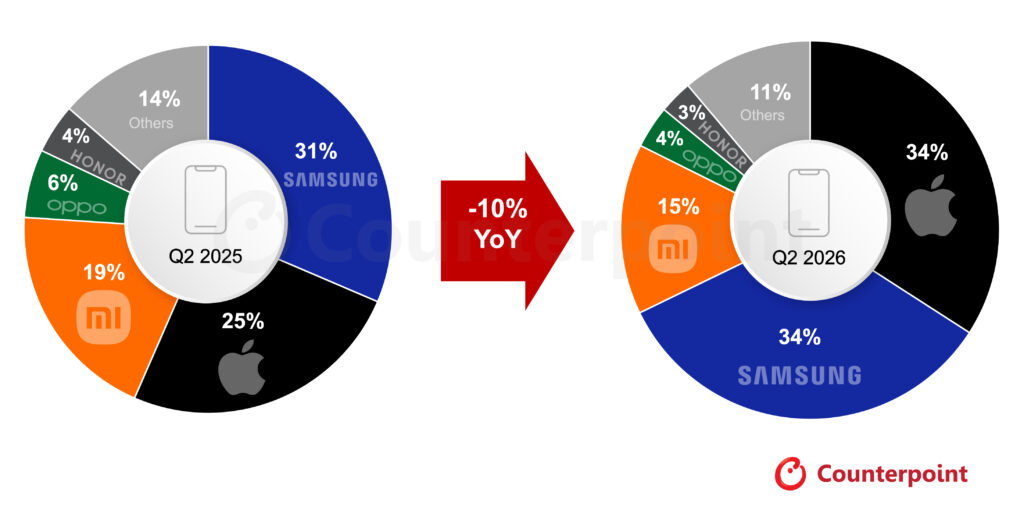
Les expéditions de smartphones sont à la peine en Europe. Counterpoint Research a fait le point et il n’est pas encourageant : 35 millions d’unités expédiées au deuxième trimestre, un volume en recul de 10 % par rapport à l’an dernier. Le marché européen retrouve le même niveau qu’en 2023.

« La situation reste très difficile pour le marché européen des smartphones », explique Jan Stryjak, directeur associé de la maison d’analyses. Il y a évidemment la crise de la mémoire qui oblige les constructeurs à augmenter les prix de leurs appareils, « une situation que n’arrange pas la rareté généralisée des promotions, les fabricants cherchant à préserver leurs marges ». Et puis la situation macroéconomique, avec les guerres en Ukraine et en Iran, fait flamber l’inflation et dégrade les perspectives financières de la région.

Il relève toutefois une situation « relativement meilleure » en Europe de l’Ouest, notamment grâce à Apple qui a pesé 34 % des expéditions au deuxième trimestre : un chiffre qui progresse de 9 points d’une année sur l’autre. Le constructeur a lancé l’iPhone 17e début mars ; ce modèle un peu moins cher que le reste de la gamme a probablement tapé dans l’œil et dans le budget de nombreux consommateurs. L’iPhone 17 conserve lui aussi un fort attrait.

Samsung a aussi tiré les marrons du feu, avec exactement le même pourcentage des expéditions qu’Apple (34 %). La progression du constructeur coréen est de 3 points par rapport à l’an dernier. Les autres acteurs affichent une contraction :- 3 points pour Xiaomi (15 %),- 2 points pour Oppo (4 %),- 1 point pour Honor (3 %). Tous des représentants de l’entrée de gamme, qui souffrent plus que les autres de la RAMpocalypse.

La situation ne devrait pas s’améliorer de sitôt. « Avec des stocks qui s’épuisent à travers l’Europe, nous nous attendons à de nouveaux reculs au cours des prochains trimestres, en particulier pour les acteurs positionnés sur l’entrée de gamme », décrypte Jan Stryjak. Apple restera une exception, ajoute-t-il.

Counterpoint a aussi relevé une baisse de 10 % en Amérique latine au deuxième trimestre, et de 8,6 % des ventes en Chine durant les 30 premières semaines de l’année.

Image : IDC

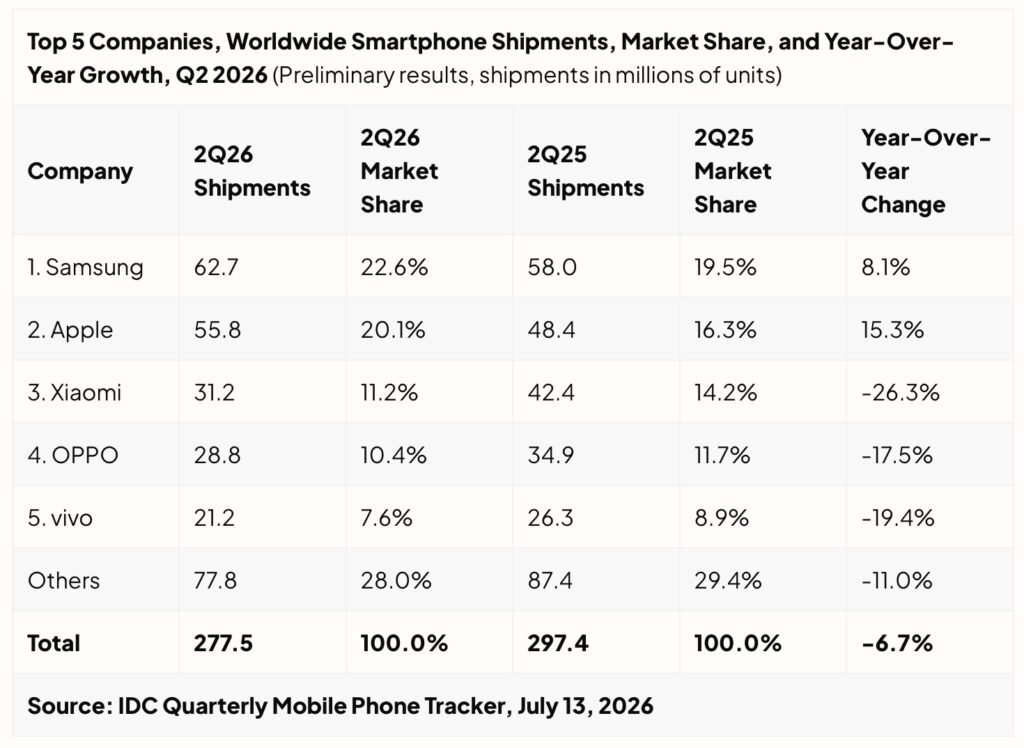
Sur un plan plus global, la température est tout aussi fraîche. IDC a relevé une baisse des expéditions de 6,7 % dans le monde durant le deuxième trimestre, pour un total de 277,5 millions d’unités. Les deux premiers, Samsung et Apple, sont les seuls constructeurs à enregistrer une hausse (de respectivement 8,1 et 15,3 %). Les autres essuient des chutes à deux chiffres.

« Le coût de la mémoire a augmenté de près de 300 % en un an et représente désormais plus de 65 % du coût des composants sur l’entrée de gamme », détaille la directrice de recherche Nabila Popal. La situation rend la survie de ces fabricants « de plus en plus difficile », soutient-elle.

  •  

La crise de la mémoire plombe les smartphones, en Europe et dans le monde

L'entrée de gamme s'effondre
La crise de la mémoire plombe les smartphones, en Europe et dans le monde

Comme prévu, ce n’est pas la joie sur le marché des smartphones, à part si on s’appelle Apple ou, dans une moindre mesure, Samsung. Les statistiques pour le deuxième trimestre confirment le coup de froid lié à la crise de la mémoire, que ce soit en Europe ou partout ailleurs dans le monde.

Les expéditions de smartphones sont à la peine en Europe. Counterpoint Research a fait le point et il n’est pas encourageant : 35 millions d’unités expédiées au deuxième trimestre, un volume en recul de 10 % par rapport à l’an dernier. Le marché européen retrouve le même niveau qu’en 2023.

« La situation reste très difficile pour le marché européen des smartphones », explique Jan Stryjak, directeur associé de la maison d’analyses. Il y a évidemment la crise de la mémoire qui oblige les constructeurs à augmenter les prix de leurs appareils, « une situation que n’arrange pas la rareté généralisée des promotions, les fabricants cherchant à préserver leurs marges ». Et puis la situation macroéconomique, avec les guerres en Ukraine et en Iran, fait flamber l’inflation et dégrade les perspectives financières de la région.

Il relève toutefois une situation « relativement meilleure » en Europe de l’Ouest, notamment grâce à Apple qui a pesé 34 % des expéditions au deuxième trimestre : un chiffre qui progresse de 9 points d’une année sur l’autre. Le constructeur a lancé l’iPhone 17e début mars ; ce modèle un peu moins cher que le reste de la gamme a probablement tapé dans l’œil et dans le budget de nombreux consommateurs. L’iPhone 17 conserve lui aussi un fort attrait.

Samsung a aussi tiré les marrons du feu, avec exactement le même pourcentage des expéditions qu’Apple (34 %). La progression du constructeur coréen est de 3 points par rapport à l’an dernier. Les autres acteurs affichent une contraction :- 3 points pour Xiaomi (15 %),- 2 points pour Oppo (4 %),- 1 point pour Honor (3 %). Tous des représentants de l’entrée de gamme, qui souffrent plus que les autres de la RAMpocalypse.

La situation ne devrait pas s’améliorer de sitôt. « Avec des stocks qui s’épuisent à travers l’Europe, nous nous attendons à de nouveaux reculs au cours des prochains trimestres, en particulier pour les acteurs positionnés sur l’entrée de gamme », décrypte Jan Stryjak. Apple restera une exception, ajoute-t-il.

Counterpoint a aussi relevé une baisse de 10 % en Amérique latine au deuxième trimestre, et de 8,6 % des ventes en Chine durant les 30 premières semaines de l’année.

Image : IDC

Sur un plan plus global, la température est tout aussi fraîche. IDC a relevé une baisse des expéditions de 6,7 % dans le monde durant le deuxième trimestre, pour un total de 277,5 millions d’unités. Les deux premiers, Samsung et Apple, sont les seuls constructeurs à enregistrer une hausse (de respectivement 8,1 et 15,3 %). Les autres essuient des chutes à deux chiffres.

« Le coût de la mémoire a augmenté de près de 300 % en un an et représente désormais plus de 65 % du coût des composants sur l’entrée de gamme », détaille la directrice de recherche Nabila Popal. La situation rend la survie de ces fabricants « de plus en plus difficile », soutient-elle.

  •  
❌