
Vue lecture

World's Central Banks Are Wary of AI and Struggling To Quit the Dollar, Survey Shows

An anonymous reader shares a report: AI is not a core part of operations at most of the world's central banks and digital assets are off the table, according to a survey released on Wednesday by the Official Monetary and Financial Institutions Forum. The working group of 10 central banks from Europe, Africa, Latin America and Asia managing roughly $6.5 trillion in assets also found that the institutions that have delved deepest so far into AI are the most cautious about the risks. The primary concern is that AI-driven behaviour could "accelerate future crises," the survey showed. "AI helps us see more, but decisions must remain with people," one participant was quoted as saying in the group's report. More than 60% of respondents said that AI tools - which have sparked layoffs already at technology companies and retail and investment banks - are not yet supporting core operations.

Read more of this story at Slashdot.
  •  

Sam Altman's Worldcoin Project Struggles Toward Billion-User Ambition With 17.5 Million Sign-Ups

Sam Altman's Tools for Humanity has verified around 17.5 million people through its iris-scanning Orb device. The company has set a goal of reaching 1 billion users, so it is less than 2% of the way there. The startup has raised $240 million from investors including Andreessen Horowitz, Bain Capital and Khosla Ventures. PitchBook estimates its valuation at $2.5 billion. The Orb is a volleyball-sized metal sphere that scans irises to generate a World ID. Users can claim tokens of the cryptocurrency Worldcoin, currently worth around 80 cents per coin. Business Insider spoke to former Tools for Humanity employees, a former Orb operator from Kenya, and a former head of operations in Mexico City. Some questioned whether the company had a clear long-term strategy. Nick Maynard, vice president of fintech market research at Juniper Research, said he does not see a killer use case that will drive major traction. The company also continues to face regulatory headwinds. In October, agencies in the Philippines, Colombia and Thailand took action to halt operations. German authorities determined last year that the company's data protection measures would not be sufficient to protect against cybercriminals or state attackers.

Read more of this story at Slashdot.
  •  

OpenAI CFO Says Company Isn't Seeking Government Backstop, Clarifying Prior Comment

OpenAI CFO Sarah Friar said late Wednesday that the AI startup is not seeking a government backstop for its infrastructure commitments, clarifying previous comments she made on stage during the Wall Street Journal's Tech Live event. From a report: At the event, Friar said OpenAI is looking to create an ecosystem of banks, private equity and a federal "backstop" or "guarantee" that could help the company finance its investments in cutting-edge chips. But in a LinkedIn post late Wednesday, Friar softened her stance. "I used the word 'backstop' and it muddied the point," Friar wrote. "As the full clip of my answer shows, I was making the point that American strength in technology will come from building real industrial capacity which requires the private sector and government playing their part." OpenAI has inked more than $1.4 trillion of infrastructure deals in recent months to try and build out the data centers it says are needed to meet soaring demand. The agreements have raised questions around how the company can afford to make such massive commitments.

Read more of this story at Slashdot.
  •  

Meet the Real Screen Addicts: the Elderly

Britain's National Centre for Gaming Disorders has treated 67 people over the age of 40 since opening in 2019. The oldest patient was a 72-year-old woman with a smartphone gaming obsession. Britons over 65 spent more than three hours a day online on smartphones, computers and tablets last year, according to Ofcom. They spent more than five and a half hours watching broadcast television. Over-65s are more likely than under-25s to own tablets, smart televisions, e-readers, and desktop and laptop computers, a seven-country survey by GWI found. Nearly a fifth of 55- to 64-year-olds own a games console. Ipsit Vahia, who heads the Technology and Ageing Laboratory at McLean Hospital, part of Harvard Medical School, said some older adults are increasingly living their lives through their phones the way teenagers or adolescents sometimes do. A 2022 study in South Korea estimated that 15% of those aged 60-69 were at risk of phone addiction. A meta-analysis published in April of studies on more than 400,000 older adults found that over-50s who regularly used digital devices had lower rates of cognitive decline than those who did not.

Read more of this story at Slashdot.
  •  

Jensen Huang Introduces NVQLink To Bridge Quantum and Classical Computing

Jensen Huang unveiled NVQLink at Nvidia's Washington conference on Tuesday. The interconnect links quantum processors to the AI supercomputers they require to function effectively. Nvidia is not building its own quantum computers but is positioning itself as critical infrastructure for the technology's future. Quantum processors harness principles of quantum physics to solve problems classical computers cannot address, but they need classical supercomputers to perform calculations beyond their capability and to correct the errors that naturally occur in their outputs. Tim Costa, Nvidia's general manager of industrial engineering and quantum, said AI will be necessary for full-scale error correction. Earlier attempts to integrate quantum processors with AI supercomputers failed to deliver the speed and scale needed for fast error correction at scale. Nvidia developed NVQLink with more than a dozen quantum companies including IonQ, Quantinuum and Infleqtion and worked with national labs including Sandia, Oak Ridge and Fermi. The interconnect operates on open architecture and works across different quantum modalities including trapped ion, superconducting and photonic systems. Costa declined to predict when quantum computing will produce meaningful commercial value, though some quantum companies estimate two to four years.

Read more of this story at Slashdot.
  •  

China Dives in on the World's First Wind-Powered Undersea Data Center

China has completed the first phase of what it claims is the world's first underwater data center in Shanghai's Lingang Special Area. The facility cost roughly 1.6 billion yuan ($226 million) and operates on twenty-four megawatts of power drawn entirely from wind energy. Seawater acts as a natural cooling system for the submerged servers. Traditional land-based data centers devote up to 50% of their energy consumption to air conditioning. The underwater design reduces cooling energy demand to less than 10%. The first phase is designed to achieve a power usage effectiveness rating of no more than 1.15. More than 95% of the facility's electricity comes from offshore wind turbines in the East China Sea. The project reduces land usage by more than 90% and eliminates the need for fresh water. The main contractors signed an agreement to launch another offshore wind-powered underwater data center with a capacity of 500 megawatts.

Read more of this story at Slashdot.
  •  

The latest updates on the Sigma Foveon X3 sensor with 1:1:1 technology

Matt Granger published a new video interview with Sigma’s CEO Kazuto Yamaki – here are the latest updates on the Sigma Foveon X3 sensor with 1:1:1 technology:

Short recap

  • Sigma is “still working on the development of the sensor” [17:00].
  • Current status: The project is still in the “technology development” stage [17:11]. They have not yet started the design of the actual, final sensor [17:11].
  • Focus: The team is currently working on the “design of the pixel architecture” [17:20].
  • Delays: The project has been “a little bit delayed” [17:30] because as they test prototype wafers, they encounter “technical issues” [17:53].
  • Development team: The sensor development is now being handled primarily by the Sigma Japan engineering team [18:02].
  • Path forward: Mr. Yamaki mentions that the technical problems “have been narrowing down” [18:12]. Once the team is confident that the technology is ready, they will start the final sensor design and move toward production [18:23].

Long recap

Current Development Stage:

  • Sigma is still in the pixel architecture design phase and has not yet begun fabricating the full sensor prototype. This involves second-round test-wafer runs to evaluate small-scale prototypes with reduced pixel counts.
  • Yamaki emphasizes that Sigma has “never designed a sensor by ourselves before,” highlighting the in-house challenges since acquiring Foveon in 2008. Previous Foveon sensors were co-developed, but this full-frame version is a from-scratch effort.

Technical Innovations and Improvements:

  • The new sensor aims for a full-frame (35mm) format with a stacked back-side illuminated (BSI) structure and on-chip phase-detect autofocus—features absent in older Foveon designs like the SD1 Merrill (2011) or Quattro series (2014-2016).
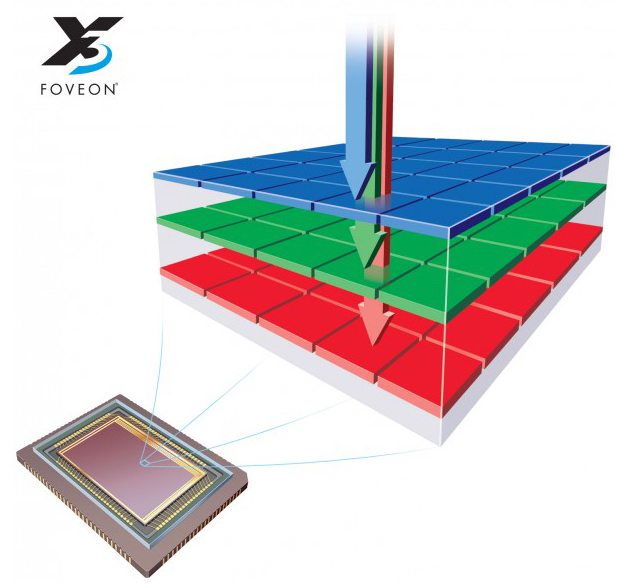
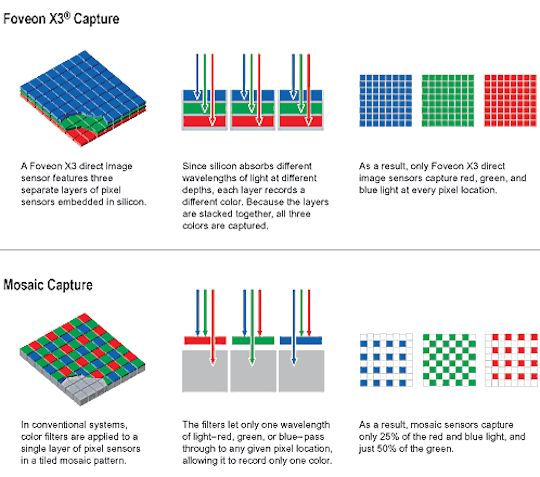
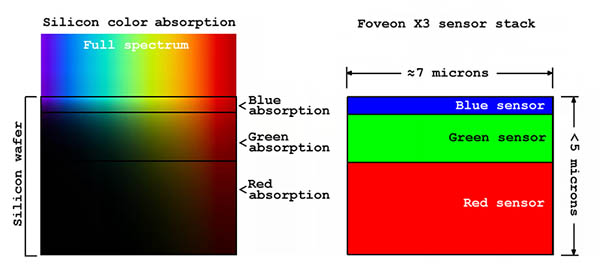
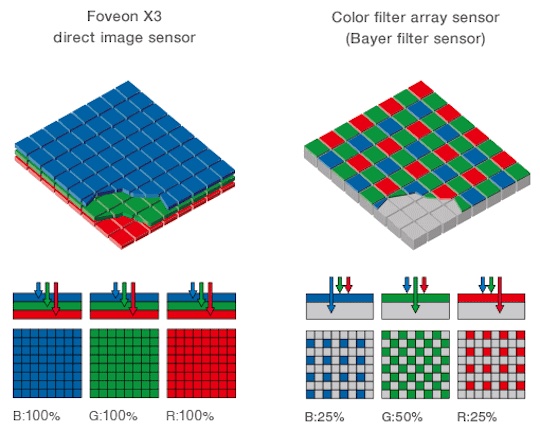
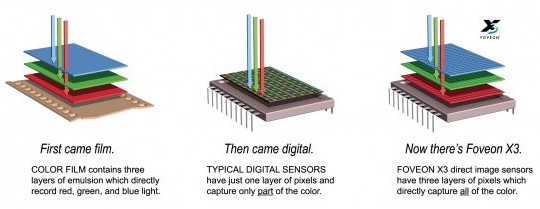
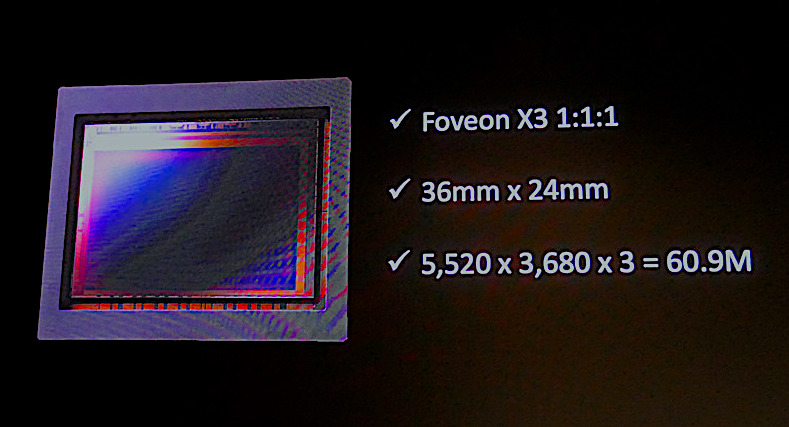
  • It retains the X3 1:1:1 layered architecture (equal pixel counts per RGB layer, unlike the 1:1:4 ratio in Quattro sensors), promising better dynamic range, color fidelity, and resolution (potentially 60MP effective).
  • Yamaki discusses crosstalk between RGB layers as a unique strength, enabling “distinct color gradation” that outperforms Bayer sensors in studio, landscape, and portrait work.

Challenges and Delays:

  • Development, first teased in 2018, has faced repeated setbacks, including ending a partnership with a sensor manufacturer, requiring a restart. As of October 2025, it’s “almost at the final stage of technology development” but not ready for mass production.
  • Key hurdles include power consumption, heat dissipation (due to three analog-to-digital converters), and achieving “perfect” pixel performance. Yamaki states they won’t proceed to production until issues are fully resolved: “The Foveon chip will appear when the pixel is perfect.”
  • No video capabilities are mentioned for the initial release, as early Foveon sensors struggled with even low-res video (e.g., 480p on DP series).

Future Outlook and Commitment:

  • Sigma remains dedicated, viewing Foveon as a “niche but valuable” technology for enthusiasts seeking ultimate image quality over high-volume sales. It could integrate into future Sigma fp mirrorless cameras (e.g., a “fp X3” variant).
  • Yamaki expresses optimism: “Technical problems have been narrowing down,” and once confident, they’ll move to full sensor design and production. However, no timeline is given—explicitly not in 2025, and possibly 2026 or later.
  • The video touches on broader philosophy: Sigma’s “beautiful foolishness” in pursuing innovative, non-mainstream tech like Foveon, despite market trends favoring Sony/ Canon sensors.

Sigma still committed to Foveon, they are now almost at the final stage of technology development

Sigma CEO: the Foveon X3 full-frame mirrorless camera will not be coming this year (2025)

The post The latest updates on the Sigma Foveon X3 sensor with 1:1:1 technology appeared first on Photo Rumors.

  •  

Samsung To Showcase Its First Ever Trifold Phone Later This Month

An anonymous reader shares a report: Samsung Electronics will unveil its highly-anticipated trifold smartphone when world leaders and global dignitaries gather at the Asia-Pacific Economic Cooperation summit in South Korea later this month. It will be the company's first device with two hinges -- allowing it to work as either a conventional smartphone or a significantly larger tablet when fully unfurled -- and will be displayed at an exhibition of cutting-edge Korean technology on the sidelines of the multilateral summit, according to a person familiar with the matter. For Samsung, the Gyeongju-hosted APEC event will provide a global spotlight for a product it hopes will burnish its reputation as an engineering pioneer. Alongside Huawei, Samsung has led the move to develop foldable phones, and Huawei introduced the world's first trifold device in China last year. The Korean company now has the opportunity to take the form factor global.

Read more of this story at Slashdot.

  •  

Nearly 40% of Kids Under 2 Years Old Interact With Smartphones, According To Their Parents

An anonymous reader shares a report: On Wednesday, Pew Research Center published a survey assessing how parents in the US with children under 12 manage their kids' screen time, which revealed that 61% of respondents overall reported their child ever uses or interacts with smartphones -- including 38% of those with children under 2 years old. Much of this smartphone screen time is likely made up by parents streaming kid-friendly cartoons for their little ones to watch on the go: the study also found that YouTube use among children under 2 has risen sharply from 45% to 62% over the last five years. But it appears that most American toddlers only need to wait a few years before they can get devices of their very own. The same survey showed that almost one in four US parents overall allow their children aged 12 and under to have their own smartphones, and this ballooned to nearly 60% when just looking at kids aged 11-12 years old.

Read more of this story at Slashdot.

  •