Vue lecture

Silicon Motion SM2508 PCIe 5.0 x4 NVMe SSD Controller Set for Mass Production

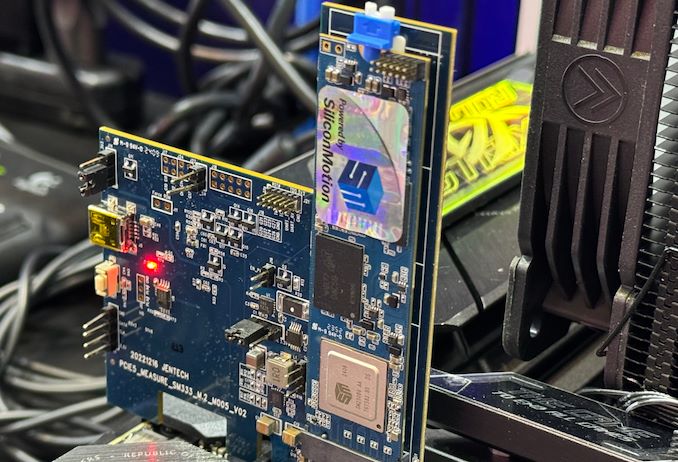
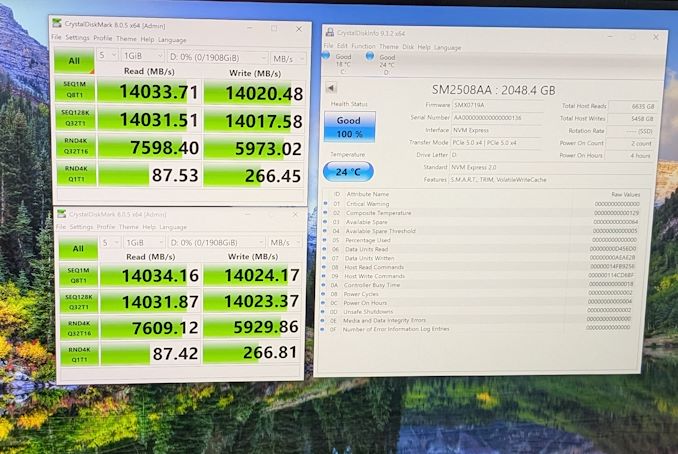
Silicon Motion has been teasing their SM2508 client SSD controller for more than a year now at various trade shows. The controller is finally set for mass production, just in time as the mainstream segment of the Gen 5 SSD market is poised to take off. Silicon Motion expects SSDs based on the SM2508 to be available for purchase by the end of the year.

At FMS 2024, the company was reusing the same information cards seen at Computex in June. The specifications of the SM2508 from our Computex coverage are reproduced here.

Silicon Motion NVMe Client SSD Controller Comparison
  SM2508 SM2264 SM2268XT2 SM2269XT
Market Segment High-End Mainstream
Manufacturing Process 6nm 12nm 12nm 12nm
CPU Cores 4x Cortex R8 4x Cortex R8 2x Cortex R8 2x Cortex R8
Error Correction 4K+ LDPC 4K LDPC 4K+ LDPC 4K LDPC
DRAM DDR4, LPDDR4X DDR4, LPDDR4X No No
Host Interface PCIe 5.0 x4 PCIe 4.0 x4 PCIe 4.0 x4 PCIe 4.0 x4
NVMe Version NVMe 2.0 NVMe 1.4 NVMe 2.0 NVMe 1.4
NAND Channels, Interface Speed 8 ch,
3600 MT/s
8 ch,
1600 MT/s
4 ch,
3600 MT/s
4 ch,
1600 MT/s
Sequential Read 14.5 GB/s 7.5 GB/s 7.4 GB/s 5.1 GB/s
Sequential Write 14 GB/s 7 GB/s 6.7 GB/s 4.8 GB/s
4KB Random Read IOPS 2500k 1300k 1200k 900k
4KB Random Write IOPS 2500k 1200k 1200k 900k

Current Gen 5 SSDs in the consumer client market are currently all based on Phison's E26 controller. The appearance of newer platform solutions for SSD vendors is bound to be good from both an end-user pricing and adoption perspective.

  •  

Solidigm 122 TB Enterprise QLC SSD Announced for Early 2025 Release

Solidigm's D5-P5336 61.44 TB enterprise QLC SSD released in mid-2023 has seen unprecedented demand over the last few quarters, driven by the insatiable demand for high-capacity storage in AI datacenters. Multiple vendors have recognized and started preparing products to service this demand, but Solidigm appears to have taken the lead in actual market availability.

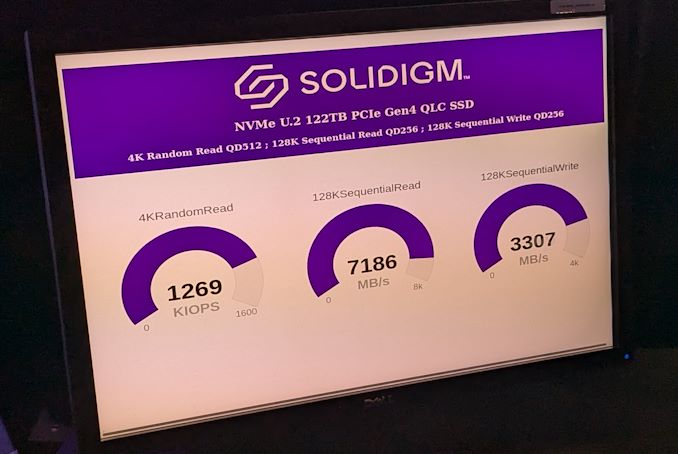
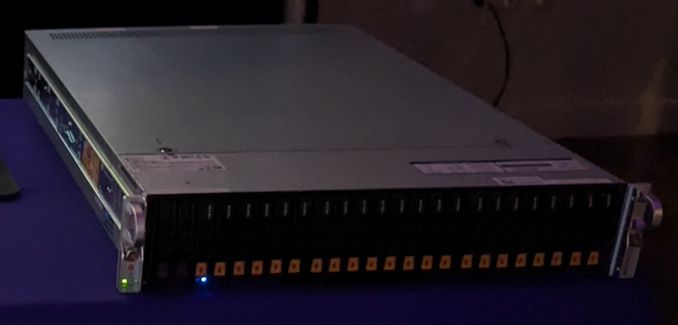
At FMS 2024, Solidigm previewed a U.2 version of their upcoming 122 TB enterprise QLC SSD. The proof-of-concept Gen 4 drives were running live in a 2U server, and Solidigm is preparing them for an early 2025 release.

Given the capacity play, Solidigm will be relying on QLC technology. However, the company was coy about confirming the NAND generation used in the product.

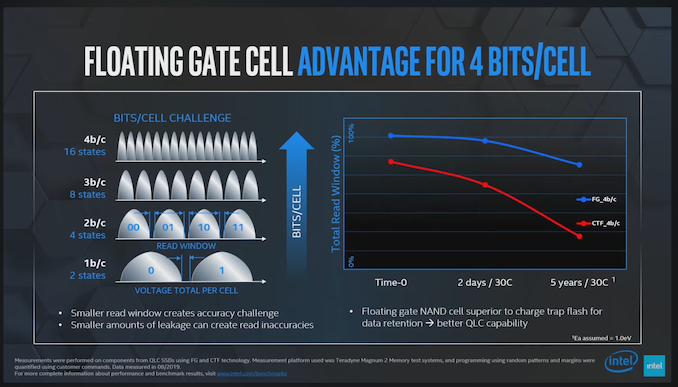
Floating gate architecture retains programmed voltage levels for a longer duration compared to charge trap, allowing QLC implementation
Source: The Advantages of Floating Gate Technology (YouTube)

The 61.44 TB D5-P5336 currently utilizes Solidigm's 192L 3D QLC based on the floating gate architecture. This has a distinct advantage for QLC endurance compared to the charge trap architecture also available to Solidigm from SK hynix. That said, SK hynix's 238L NAND also has a QLC avatar, which gives Solidigm the flexibility to use either NAND for the production version of the 122 TB drive. Solidigm expects to confirm this by the end of year in preparation for volume shipment in the first half of 2025.

  •  

Solidigm D7-PS1010 and D7-PS1030: PCIe 5.0 and 176L TLC Datacenter SSD Performance Play

Solidigm's datacenter SSD lineup includes models targeting different performance, endurance, and cost tradeoffs. Last year, the company had introduced the D5-P5336 QLC drive as a low-cost high-capacity drive for read-heavy workloads, while also preparing the SLC-based D7-P5810 for extremely write-intensive workloads requiring high endurance. The D7-P5520 / D7-P5620 Gen 4 drives with Solidigm's own 144L 3D TLC have been the high-performance offerings for generic workloads over the last couple of years.

Solidigm is announcing the availability of the successor to the D7-P5x20 today - the new D7-PS1010 and D7-PS1030. Both of these NVMe drives use SK hynix's 176L 3D TLC NAND and come with a PCIe 5.0 interface. The third digit in the model number matches the DWPD rating, with the D7-PS1010 targeting mixed workloads with a 1 DWPD rating, and the D7-PS1030 targeting write-intensive use-cases with a 3 DWPD rating.
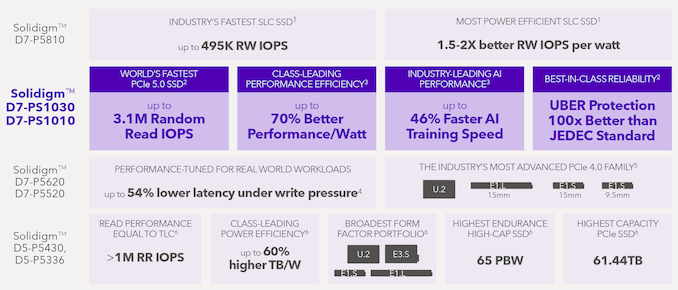
Compared to the previous generation D7-P5x20, the D7-PS10x0 series brings about the following upgrades:

  • Move from PCIe 4.0 x4 to PCIe 5.0 x4
  • Move from 144L floating gate 3D TLC (Solidigm) to 176L charge trap 3D TLC (SK hynix)
  • 25% longer mean-time between failures (MTBF) at 2.5M hours
  • 10x higher uncorrectable bit-error rate (UBER) at 1E-18
  • 1.8x to 2.8x improvement in high queue-depth random access IOPS
  • 2.0x to 2.2x improvement in high queue-depth sequential access throughput

The specifications of the two new SSD families are summarized in the table below.

Solidigm D7-PS1000 Series Enterprise SSDs
  D7-PS1030 D7-P1010
Form Factor U.2 2.5" 15mm
E3.S 7.5mm
Interface PCIe 5.0 NVMe 2.0
Capacities 1.6TB
3.2TB
6.4TB
12.8TB
1.92TB
3.68TB
7.68TB
15.36TB
NAND SK hynix 176L 3D TLC (Charge Trap Architecture)
Sequential Read (128 KB @ QD 128) 14500 MB/s
Sequential Write (128 KB @ QD 128) 4100 MB/s (1.6 TB / 1.92 TB)
8200 MB/s (3.2 TB / 3.84 TB)
9300 MB/s (6.4 TB / 7.68 TB / 12.8 TB / 15.36 TB)
Random Read (4 KB @ QD 512) 2.35 M (1.6 TB / 1.92 TB)
3.1 M (3.2 TB / 3.84 TB)
2.8 M (6.4 TB / 7.68 TB)
2.75 M (12.8 TB / 15.36 TB)
Random Write (4 kB) 0.35 M (1.6 TB)
0.716 M (3.2 TB)
0.8 M (6.4 TB / 12.8 TB)
0.15 M (1.92 TB)
0.315 M (3.84 TB)
0.4 M (7.68 TB)
0.38 M (15.36 TB)
Power Sustained Write 13 W (1.6 TB / 1.92 TB)
18 W (3.2 TB / 3.84 TB)
23 W (6.4 TB / 7.68 TB / 12.8 TB / 15.36 TB)
Sustained Read 17 W (1.6 TB / 1.92 TB)
19 W (3.2 TB / 3.84 TB)
22 W (6.4 TB / 7.68 TB)
23 W (12.8 TB / 15.36 TB)
Peak 18 W (1.6 TB / 1.92 TB)
22 W (3.2 TB / 3.84 TB)
29 W (6.4 TB / 7.68 TB)
30 W (12.8 TB / 15.36 TB)
Idle 5 W
Write Endurance 3 DWPD 1 DWPD
Warranty 5 years

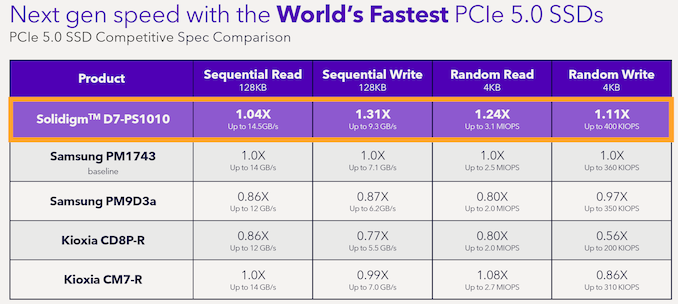
Based on Solidigm's own internal testing, the D7-PS1010 compares very favorably against the Gen 5 datacenter SSDs already in the market from Samsung and Kioxia. However, the recently introduced Micron 9550 series may present a better challenge to Solidigm's claims.
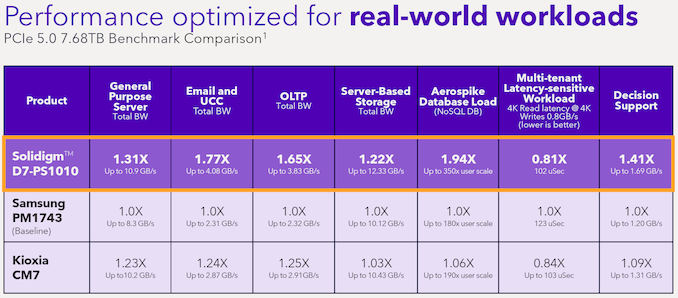
Gen 5 SSDs are well-suited for the storage-intensive tasks in AI workloads. Every new product needs to tie itself to the AI buzzword currently, but we should excuse SSD manufacturers for doing the same - after all training and inference needs to move large amounts of data back and forth between the processing engine and underlying memory. Solidigm expects the D7-PS10x0 to be a good fit as direct-attached storage internal to GPU servers or as all-flash tier supporting a HDD-only object tier in the cloud. For on-premises GPU servers, the flash / HDD tiered storage can be replaced by an all-QLC object tier.
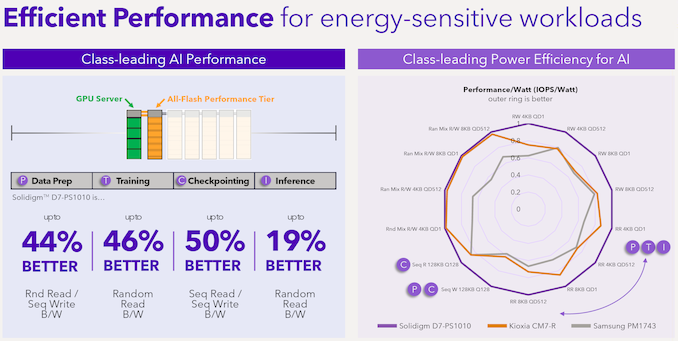
Solidigm claims better energy efficiency compared to the competitors' Gen 5 drives from last year for various AI workload traces. While the data ingest and archival processes require system designers to maximize the storage capacity per watt (the QLC-based Solidigm D5-P5336 is attractive here), the core processing steps require the optimization of performance per watt. The D7-PS10x0 have a natural fit in this segment.

Solidigm / Intel has been serving the datacenter SSD market since its inception. The company is well aware of the quality and reliability requirements in this space. The D7-PS1010 and D7-PS1030 include the usual enhanced PLI (power loss imminent) validation checks for data saved in the process of power loss / restoration. The critical SRAMs in the SSD controller also have ECC protection. UBER testing goes well beyond the suggested JEDEC specifications. The company also claims that its silent data corruption testing and modeling are better than its competitors.

The new D7-PS1010 and D7-PS1030 bring class-leading Gen 5 performance to the datacenter SSD market. They are available for purchase now in both U.2 and E3.S form factors, with capacities ranging from 1.6 TB - 12.8 TB (D7-PS1030) and 1.92 TB - 15.36 TB (D7-PS1010).

  •  

Western Digital: We Are Sampling 32TB SMR Hard Drives

In an unexpected announcement during their quarterly earnings call this week, Western Digital revealed that it has begun sampling an upcoming 32TB hard drive. The nearline HDD is aimed at hyperscalers, and relies on a combination of Westen Digital's EAMR technology, as well as shingled magnetic recording (SMR) technology to hit their highest capacity figures to date.

Western Digital's 32TB HDD uses all of the company's most advanced technologies. Besides energy-assisted magnetic recording (EAMR/ePMR 2 to be more precise) technology, WD is also leveraging triple-stage actuators for better positioning of heads and two-dimensional (TDMR) read heads, OptiNAND for extra performance and reliability, distributed sector (DSEC) technology and a proprietary error correcting code (ECC) technology. And, most importantly, UltraSMR technology to provide additional capacity.

"We are shipping samples of our 32TB UltraSMR/ePMR nearline hard drives to select customers," said David Goeckeler, chief executive of Western Digital, at the earnings call. "These drives feature advanced triple-stage actuators and OptiNAND technology which are designed for seamless qualification, integration and deployment in hyperscale cloud and enterprise data centers while maintaining exceptional reliability."

Seagate is currently shipping its 30TB Exos HDDs based on heat-assisted magnetic recording (HAMR) platform called Modaic 3+ to select exascalers, and the company has implied that it can build a 32TB version of the drive using SMR. Therefore, from capacity point of view, Western Digital's announcement means that the company has caught up with its rival.

As with the comapny's other UltraSMR drives, the 32TB nearline drive is aimed at WD's enterprise customers, whose infrastructure can handle the additional management requirements that SMR imposes. As SMR in enterprise drives is not transparent, it's up to the host to manage many of the complexities that come with a hard drive that isn't suited for random writes. Though at least in WD's case, the upshot is that UltraSMR also offers a more significant density increase than other SMR implementations, using a larger number of SMR bands to increase HDD capacity by up to 20%.

Working backwards, that 20% capacity increase also means that WD's new drive is starting from 2.56TB CMR platters. And while 2.56TB makes for a very decent areal density, this would mean that WD is still behind rival Seagate in terms of areal density overall, as Seagate has 3TB CMR platters in its latest HAMR-based Exos drives.

  •  
❌