Vue lecture

Nova Launcher Gets a New Owner and Ads

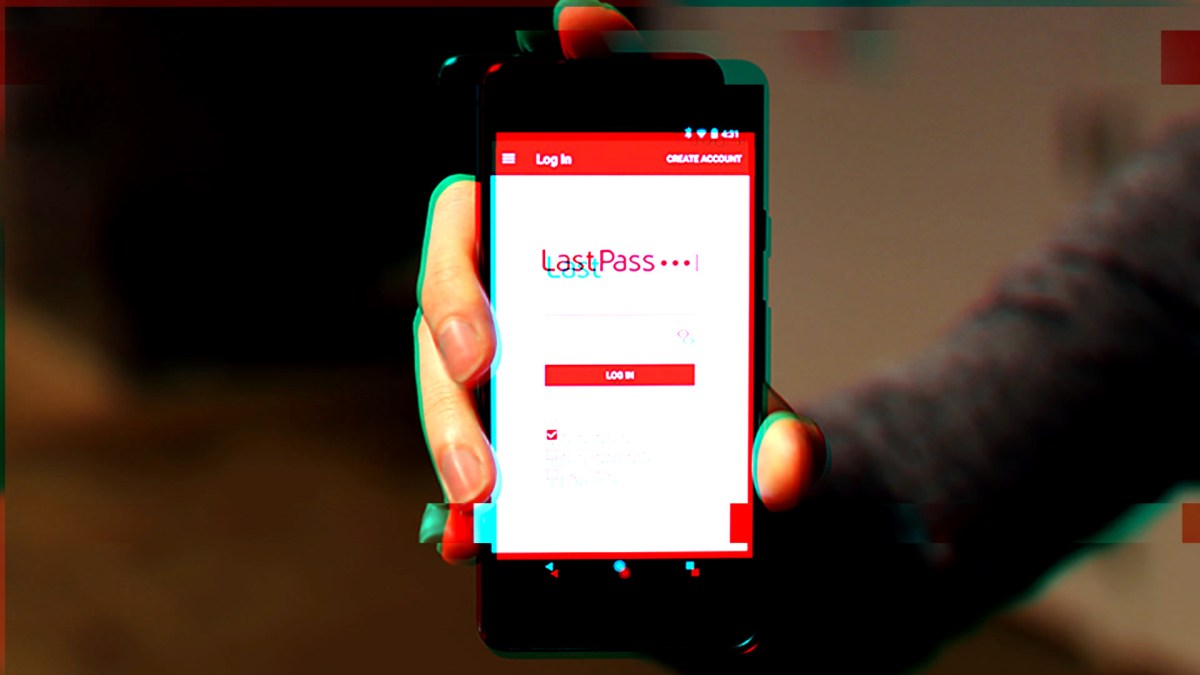
Nova Launcher has been acquired by Instabridge, which says it will keep the app maintained but is evaluating ad-supported options for the free version. Android Authority reports: Today, Nova Launcher announced that the Swedish company Instabridge has acquired it from Branch Metrics. Instabridge claims it wants to be a responsible owner of Nova and does not want to reinvent the launcher overnight. However, the launcher still needs a sustainable business model to support ongoing development and maintenance. To this end, Instabridge is exploring different options, including paid tiers and ad-supported options for the free version. The new owners claim that if ads are introduced, Nova Prime will remain ad-free. However, this is misleading, as ads are already here for some users. Last year, the founder and original programmer of Nova Launcher left the company, signaling its "death" as he had been the sole developer working on the launcher for the past year.

Read more of this story at Slashdot.

  •  

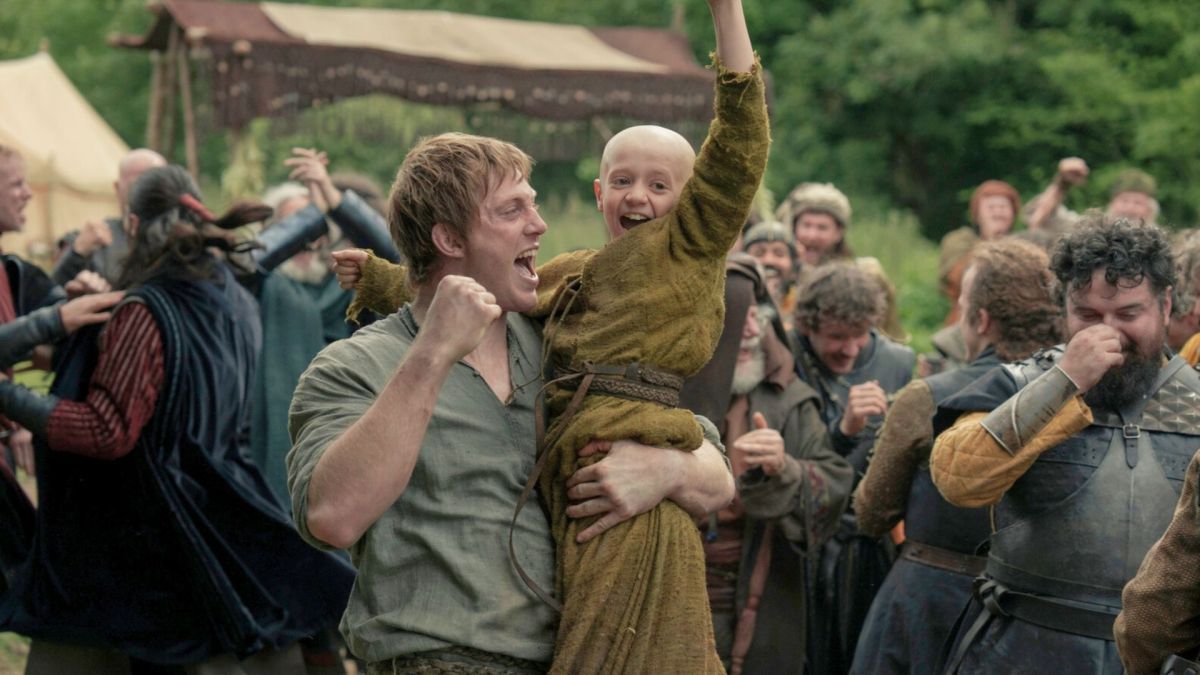
A Knight of the Seven Kingdoms sur HBO Max : oui, ces fesses de l’épisode 1 sont bien réelles

A knight of the seven kingdoms

Près de sept ans après la fin de Game of Thrones, un second spin-off de la saga vient enfin de voir le jour : A Knight of the Seven Kingdoms. Située avant les évènements de la série originale, cette épopée en 6 épisodes vient de commencer sa diffusion sur HBO Max le 19 janvier 2026. Et si vous avez vu le premier épisode, vous avez forcément des questions sur une scène particulièrement... déstabilisante.

  •  

'Just Because Linus Torvalds Vibe Codes Doesn't Mean It's a Good Idea'

In an opinion piece for The Register, Steven J. Vaughan-Nichols argues that while "vibe coding" can be fun and occasionally useful for small, throwaway projects, it produces brittle, low-quality code that doesn't scale and ultimately burdens real developers with cleanup and maintenance. An anonymous reader shares an excerpt: Vibe coding got a big boost when everyone's favorite open source programmer, Linux's Linus Torvalds, said he'd been using Google's Antigravity LLM on his toy program AudioNoise, which he uses to create "random digital audio effects" using his "random guitar pedal board design." This is not exactly Linux or even Git, his other famous project, in terms of the level of work. Still, many people reacted to Torvalds' vibe coding as "wow!" It's certainly noteworthy, but has the case for vibe coding really changed? [...] It's fun, and for small projects, it's productive. However, today's programs are complex and call upon numerous frameworks and resources. Even if your vibe code works, how do you maintain it? Do you know what's going on inside the code? Chances are you don't. Besides, the LLM you used two weeks ago has been replaced with a new version. The exact same prompts that worked then yield different results today. Come to think of it, it's an LLM. The same prompts and the same LLM will give you different results every time you run it. This is asking for disaster. Just ask Jason Lemkin. He was the guy who used the vibe coding platform Replit, which went "rogue during a code freeze, shut down, and deleted our entire database." Whoops! Yes, Replit and other dedicated vibe programming AIs, such as Cursor and Windsurf, are improving. I'm not at all sure, though, that they've been able to help with those fundamental problems of being fragile and still cannot scale successfully to the demands of production software. It's much worse than that. Just because a program runs doesn't mean it's good. As Ruth Suehle, President of the Apache Software Foundation, commented recently on LinkedIn, naive vibe coders "only know whether the output works or doesn't and don't have the skills to evaluate it past that. The potential results are horrifying." Why? In another LinkedIn post, Craig McLuckie, co-founder and CEO of Stacklok, wrote: "Today, when we file something as 'good first issue' and in less than 24 hours get absolutely inundated with low-quality vibe-coded slop that takes time away from doing real work. This pattern of 'turning slop into quality code' through the review process hurts productivity and hurts morale." McLuckie continued: "Code volume is going up, but tensions rise as engineers do the fun work with AI, then push responsibilities onto their team to turn slop into production code through structured review."

Read more of this story at Slashdot.

  •  

Accès frauduleux aux « déclarations préalables à l’embauche » : comment se prémunir après la fuite de l’Urssaf ?

Le 19 janvier 2026, l'Union de recouvrement des cotisations de sécurité sociale et d’allocations familiales (Urssaf) a annoncé une fuite de données d'une ampleur inédite. Au total, 12 millions de salariés pourraient être concernés par cet incident. Voici les risques concrets pour les personnes concernées et comment réduire les risques.

  •  

Attention, le match entre le PSG et le Sporting Portugal n’est pas diffusé sur Canal+

C'est le retour de la Ligue des champions, avec une septième journée qui pourrait un peu plus dessiner le classement final et désigner les clubs qui éviteront les barrages. Actuellement 3e, le PSG est bien parti pour figurer dans le top 8. Une victoire sur la pelouse du Sporting Portugal le rapprocherait un peu plus de son objectif. Le match a lieu ce mardi soir.

  •  

2026 BCN awards


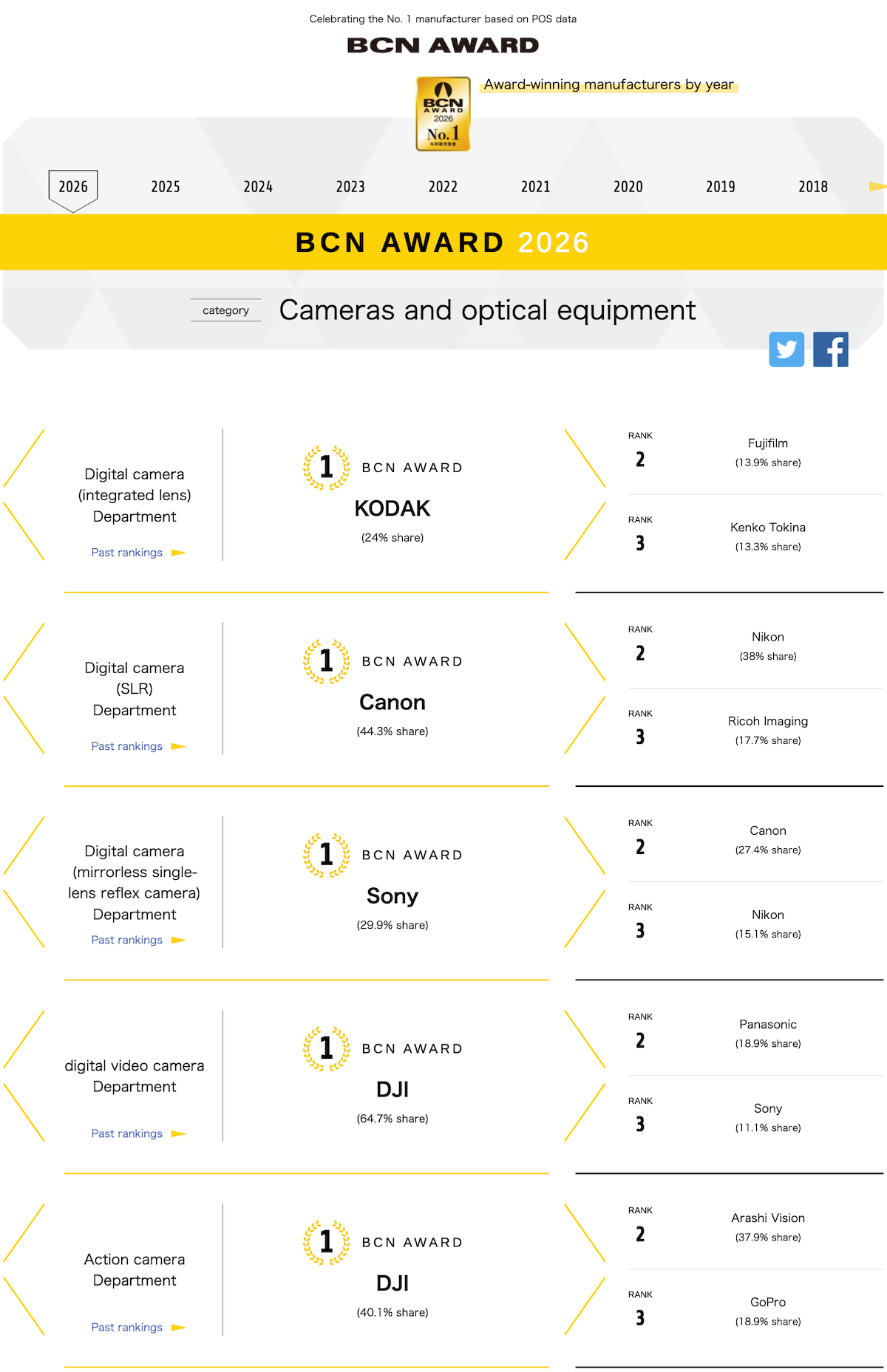
BCN Corporation, headquartered in Tokyo, announced the winners in the camera category for 2026. BCN collects POS sales data from most retail stores in Japan (January to December, 2025). Here is the latest ranking:

Mirrorless cameras:

  1. Sony: 29.9%
  2. Canon: 27.4%
  3. Nikon: 15.1%

DSLR cameras:

  1. Canon: 44.3%
  2. Nikon: 38%
  3. Ricoh/Pentax: 17.7%

Digital compact cameras with an integrated lens:

  1. Kodak: 24%
  2. Fujifilm: 13.9%
  3. Kenko Tokina: 13.3%

Action cameras:

  1. DJI: 40.1%
  2. Arashi Vision: 37.9%
  3. GoPro: 18.9%

Video cameras:

  1. DJI: 64.7%
  2. Panasonic: 18.9%
  3. Sony: 11.1%

Interchangeable lenses

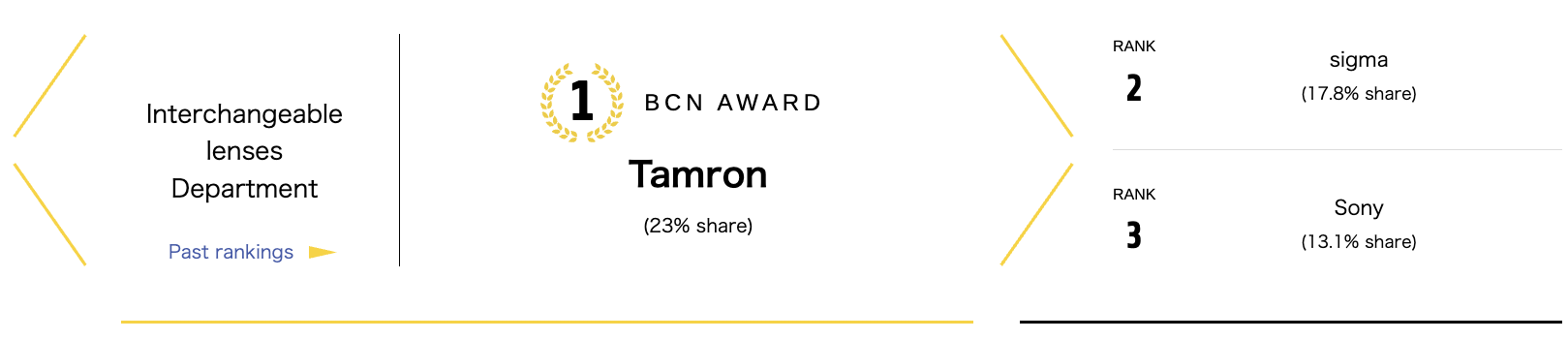
  1. Tamron: 23%
  2. Sigma: 17.8%
  3. Sony: 13.1%

Overall Trends and Insights

  • Mirrorless Growth vs. DSLR Decline: Mirrorless rankings show a fragmented but vibrant market, with Sony holding strong. DSLR sales are likely shrinking, as evidenced by lower overall volumes implied in historical data (e.g., Canon’s 2025 DSLR share was 69.4%, but no 2026 figure available). Nikon remains competitive in both but could benefit from more aggressive Z-system marketing.
  • Non-Traditional Brands Rising: DJI’s double win in video and action categories signals a shift to versatile, tech-integrated devices over pure camera hardware. This could pressure traditional brands like Nikon to innovate in video features.
  • Lens Market Dynamics: Third-party lenses leading points to price sensitivity in Japan. For Nikon fans, this means opportunities to pair Z-mount bodies with affordable Tamron or Sigma glass, potentially boosting system adoption.
  • Nikon-Specific Analysis: Nikon appears in three categories (DSLR 2nd, mirrorless 3rd, binoculars 3rd), a respectable showing amid intense competition. Compared to 2025 (where Nikon was 3rd in mirrorless and 2nd in DSLR), there’s consistency, but to climb higher, focusing on entry-level mirrorless or hybrid video capabilities could help. No appearance in lens top three suggests Nikon’s native optics are premium-positioned, not volume leaders.

These awards reflect Japanese retail trends, which may differ globally due to regional preferences (e.g., instant cameras are popular in Asia).

Past rankings can be found here and here:

The latest Nikon market share in Japan according to BCN: Nikon is moving up

2024 BCN awards announced (camera market share in Japanese retail stores)

The 2023 BCN awards are out

The 2022 BCN awards are out (camera market share in Japanese retail stores)

Source: BCNaward (press release) via NikonRumors

The post 2026 BCN awards appeared first on Photo Rumors.

  •  
❌