Superintelligence has become "a quasi-political forecast" with "very little to do with any scientific consensus, emerging instead from particular corridors of power." That's the warning from James O'Sullivan, a lecturer in digital humanities from University College Cork. In a refreshing 5,600-word essay in Noema magazine, he notes the suspicious coincidence that "The loudest prophets of superintelligence are those building the very systems they warn against..."
"When we accept that AGI is inevitable, we stop asking whether it should be built, and in the furor, we miss that we seem to have conceded that a small group of technologists should determine our future." (For example, OpenAI CEO Sam Altman "seems determined to position OpenAI as humanity's champion, bearing the terrible burden of creating God-like intelligence so that it might be restrained.")
The superintelligence discourse functions as a sophisticated apparatus of power, transforming immediate questions about corporate accountability, worker displacement, algorithmic bias and democratic governance into abstract philosophical puzzles about consciousness and control...
Media amplification plays a crucial role in this process, as every incremental improvement in large language models gets framed as a step towards AGI. ChatGPT writes poetry; surely consciousness is imminent..." Such accounts, often sourced from the very companies building these systems, create a sense of momentum that becomes self-fulfilling. Investors invest because AGI seems near, researchers join companies because that's where the future is being built and governments defer regulation because they don't want to handicap their domestic champions...
We must recognize this process as political, not technical. The inevitability of superintelligence is manufactured through specific choices about funding, attention and legitimacy, and different choices would produce different futures. The fundamental question isn't whether AGI is coming, but who benefits from making us believe it is... We do not yet understand what kind of systems we are building, or what mix of breakthroughs and failures they will produce, and that uncertainty makes it reckless to funnel public money and attention into a single speculative trajectory.
Some key points:
"The machines are coming for us, or so we're told. Not today, but soon enough that we must seemingly reorganize civilization around their arrival...""When we debate whether a future artificial general intelligence might eliminate humanity, we're not discussing the Amazon warehouse worker whose movements are dictated by algorithmic surveillance or the Palestinian whose neighborhood is targeted by automated weapons systems. These present realities dissolve into background noise against the rhetoric of existential risk...""Seen clearly, the prophecy of superintelligence is less a warning about machines than a strategy for power, and that strategy needs to be recognized for what it is... ""Superintelligence discourse isn't spreading because experts broadly agree it is our most urgent problem; it spreads because a well-resourced movement has given it money and access to power...""Academic institutions, which are meant to resist such logics, have been conscripted into this manufacture of inevitability... reinforcing industry narratives, producing papers on AGI timelines and alignment strategies, lending scholarly authority to speculative fiction...""The prophecy becomes self-fulfilling through material concentration — as resources flow towards AGI development, alternative approaches to AI starve...""The dominance of superintelligence narratives obscures the fact that many other ways of doing AI exist, grounded in present social needs rather than hypothetical machine gods..." [He lists data sovereignty movements "that treat data as a collective resource subject to collective consent," as well as organizations like Canada's First Nations Information Governance Centre and New Zealand's's Te Mana Raraunga, plus "Global South initiatives that use modest, locally governed AI systems to support healthcare, agriculture or education under tight resource constraints."] "Such examples... demonstrate how AI can be organized without defaulting to the superintelligence paradigm that demands everyone else be sacrificed because a few tech bros can see the greater good that everyone else has missed...""These alternatives also illuminate the democratic deficit at the heart of the superintelligence narrative. Treating AI at once as an arcane technical problem that ordinary people cannot understand and as an unquestionable engine of social progress allows authority to consolidate in the hands of those who own and build the systems..."
He's ultimately warning us about "politics masked as predictions..."
"The real political question is not whether some artificial superintelligence will emerge, but who gets to decide what kinds of intelligence we build and sustain. And the answer cannot be left to the corporate prophets of artificial transcendence because the future of AI is a political field — it should be open to contestation.
"It belongs not to those who warn most loudly of gods or monsters, but to publics that should have the moral right to democratically govern the technologies that shape their lives."


Read more of this story at Slashdot.

 Connexion
 L'un des casques-micros les plus populaires du marché est à un prix record en cette toute fin 2025. Le Logitech G PRO X 2 LIGHTSPEED passe à seulement 120,07 € et avec la livraison offerte chez Darty, une offre qui par contre ne dure que quelques heures : du jeudi 18 décembre 2025 à 20 h au vendredi...
 NVIDIA vient de publier, en ce 18 décembre 2025, ce qui sera peut-être sa dernière mouture de pilotes graphiques officiels de l'année. Ce lancement n'est pas lié au support de nouveaux jeux mais à des corrections de bugs, sans pour autant que NVIDIA les qualifie de pilotes "hotfix" pour autant. Les...
 En ce mois de décembre 2025, la pénurie DRAM bat son plein et que celle de NAND commence à avoir ses premiers effets sensibles. Derrière tout cela, on retrouve "l'ogre", le marché de l'IA qui avale tous les stocks sur son passage. Les producteurs de DRAM préfèrent tourner leur production vers la HBM...
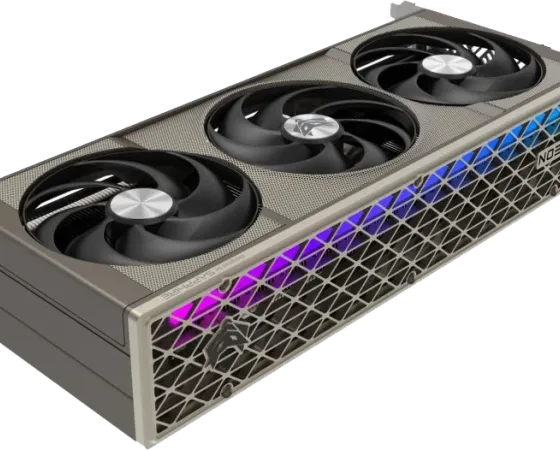 En fin de semaine dernière, Hardware Unboxed mettait en ligne la vidéo d'une interview de plus d'une heure d'Edward Crisler, porte-parole en Amérique du Nord de SAPPHIRE, la célèbre marque de cartes graphiques (mais aussi de plus en plus de cartes mères). Un fabricant qui n'est, pour rappel, que par...
 En ce 17 décembre 2025, une nouvelle carte graphique RDNA 4 destinée au grand public est apparue sur le site officiel d'AMD : la Radeon RX 9060 XT LP. La fiche produit officielle ne nous donne pas toutes les informations à son sujet car les fréquences GPU manquent, mais nous avons pour nous aider à...
 Les prix de la DRAM sont devenus totalement fous, et ce n'est pas Cameron Crandall, responsable chez Kingston des SSD pour data centers qui va dire le contraire. Pour reprendre ses propres mots, "il n'a jamais vu cela en 29 ans de carrière dans le milieu", et le souci c'est que même si le démarrage...
 En 2010, Arctic Cooling devenait ARCTIC, et lançait sa pâte thermique qui allait avoir un succès retentissant : la MX-4. Nous sommes 15 ans plus tard, et cette MX-4 continue encore aujourd'hui à être commercialisée, même si des successeurs ont suivi. Il y eu tout d'abord la MX-5 en 2021, dont la com...
 Du côté de KIOXIA, l'amélioration des technologies et la NAND BiCS8 n'en finissent plus visiblement de repousser les limites des SSD équipés de puces QLC. Nous vous avions parlé le mois dernier du petit KIOXIA EXCERIA BASIC, un SSD NVMe d'entrée de gamme comme son nom l'indique, doté donc de NAND QL...
 Il y a trois jours, le 13 décembre 2025, Tom de la chaine Moore's Law is Dead mettait en ligne une vidéo de 18 minutes dans laquelle il révélait avoir une source extrêmement fiable qui lui indiquait que Samsung prévoirait de quitter le marché des SSD SATA. Un planning serait même prévu : une annonce...
 Encore une vidéo "WTF" mêlant amateurisme qui fait sourire quand on voit les tartinages de pâtes thermiques et autres radiateurs tenus avec des élastiques, mais qui peut aussi vous déclencher un petit "enfin, quelqu'un a essayé !" si vous êtes du genre curieux de tous les essais les plus capilotract...
 Si vous suivez de près la marque ASUS, l'annonce de cette actualité ne devrait pas vous surprendre puisqu'il s'agit désormais d'une habitude de la marque : lancer au bout de quelques mois une seconde version de ses cartes graphiques "Dual" d'entrée de gamme, avec des dimensions encore plus réduites....
 Jay, un sud coréen qui détient la chaine YouTube BullsLab, a publié la semaine dernière sur son compte X le contenu d'une analyse interne qu'aurait mené la société SK hynix sur l'évolution qu'elle suppose concernant le secteur de la DRAM. Concernant la "commodity DRAM", qui regroupe les DDR4 et DDR5...
 En début de semaine dernière, le site Windows Latest publiait une actualité au titre libérateur pour les personnes concernées par le problème :
La dernière mise à jour Windows 11 de 2025 corrige sans faire de bruit les crashs de GPU AMD, qui hantent Battlefield 6, Call of Duty: Black Ops 7, ARC Rai...
En début de semaine dernière, le site Windows Latest publiait une actualité au titre libérateur pour les personnes concernées par le problème :
La dernière mise à jour Windows 11 de 2025 corrige sans faire de bruit les crashs de GPU AMD, qui hantent Battlefield 6, Call of Duty: Black Ops 7, ARC Rai...