Vue lecture

Femmes déshabillées par Grok : après la polémique, X limite la génération d’images aux abonnés payants

Après avoir suscité une polémique mondiale en laissant Grok, l’IA d’Elon Musk, générer des images sexualisées de femmes sans leur consentement sur X, plusieurs utilisateurs ont constaté que la génération d’images était désormais réservée aux abonnés premium de la plateforme.

  •  

Microsoft Turns Copilot Chats Into a Checkout Lane

Microsoft is embedding full e-commerce checkout directly into Copilot chats, letting users buy products without ever visiting a retailer's website. "If checkout happens inside AI conversations, retailers risk losing direct customer relationships -- while platforms like Microsoft gain leverage," reports Axios. From the report: Microsoft unveiled new agentic AI tools for retailers at the NRF 2026 retail conference, including Copilot Checkout, which lets shoppers complete purchases inside Copilot without being redirected to a retailer's website. The checkout feature is live in the U.S. with Shopify, PayPal, Stripe and Etsy integrations. Copilot apps have more than 100 million monthly active users, spanning consumer and commercial audiences, according to the company. More than 800 million monthly active users interact with AI features across Microsoft products more broadly. Shopping journeys involving Copilot are 33% shorter than traditional search paths and see a 53% increase in purchases within 30 minutes of interaction, Microsoft says. When shopping intent is present, journeys involving Copilot are 194% more likely to result in a purchase than those without it.

Read more of this story at Slashdot.

  •  

'The Downside To Using AI for All Those Boring Tasks at Work'

The promise of AI-powered workplace tools that sort emails, take meeting notes, and file expense reports is finally delivering meaningful productivity gains -- one software startup reported a 20% boost around mid-2025 -- but companies are discovering an unexpected tradeoff: employees are burning out from the relentless pace of high-level cognitive work. Roger Kirkness, CEO of 14-person software startup Convictional, noticed that after AI took the scut work off his team's plates, their days became consumed by intensive thinking, and they were mentally exhausted and unproductive by Friday. The company transitioned to a four-day workweek; the same amount of work gets done, Kirkness says. The underlying problem, according to Boston College economist and sociologist Juliet Schor, is that businesses tend to simply reallocate the time AI saves. Workers who once mentally downshifted for tasks like data entry are now expected to maintain intense focus through longer stretches of data analysis. "If you just make people work at a high-intensity pace with no breaks, you risk crowding out creativity," Schor says.

Read more of this story at Slashdot.

  •  

La course folle pour sécuriser les LLM continue, ChatGPT doit colmater une brèche qu’on pensait réglée

Les chercheurs de l’entreprise de cybersécurité Radware ont mis en garde, le 8 janvier 2026, contre une nouvelle attaque par injection indirecte visant ChatGPT.​ Cette offensive détourne une mécanique que l’on pensait réglée depuis quelques mois et cible spécifiquement l’outil Deep Research du chatbot.

  •  

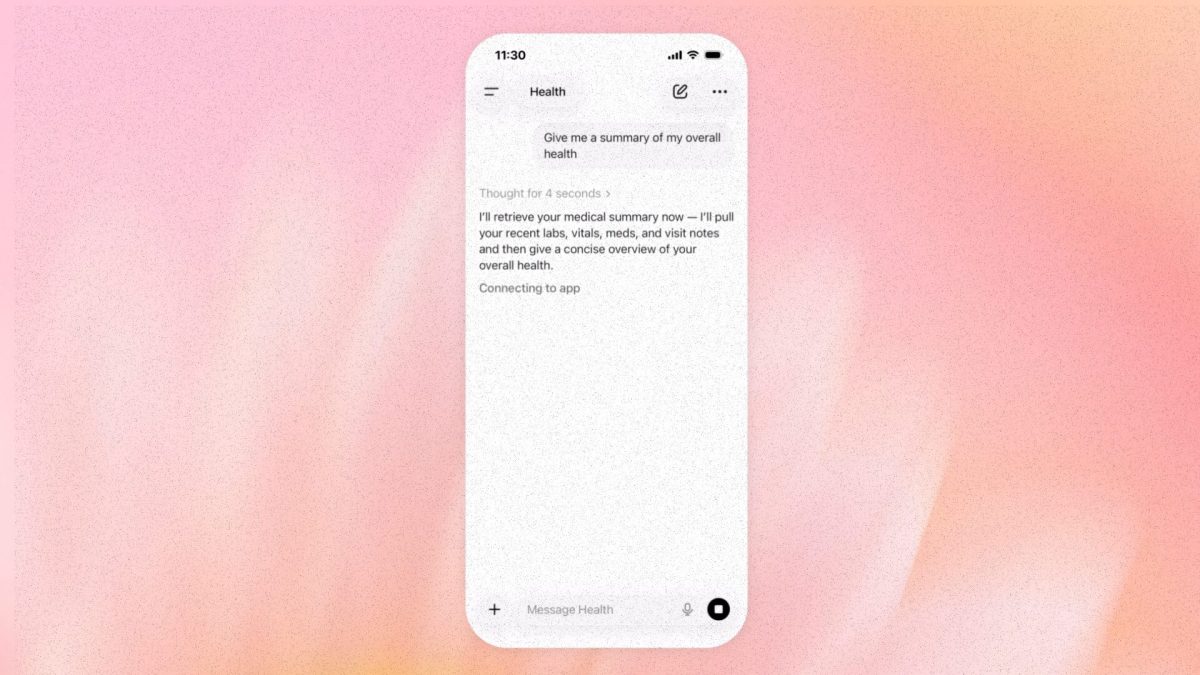
OpenAI Launches ChatGPT Health, Encouraging Users To Connect Their Medical Records

OpenAI has unveiled ChatGPT Health, a sandboxed health-focused mode that lets users connect medical records and wellness apps for more personalized guidance. The company makes sure to note that ChatGPT Health is "not intended for diagnosis or treatment." The Verge reports: The company is encouraging users to connect their personal medical records and wellness apps, such as Apple Health, Peloton, MyFitnessPal,Weight Watchers, and Function, "to get more personalized, grounded responses to their questions." It suggests connecting medical records so that ChatGPT can analyze lab results, visit summaries, and clinical history; MyFitnessPal and Weight Watchers for food guidance; Apple Health for health and fitness data, including movement, sleep, and activity patterns"; and Function for insights into lab tests. On the medical records front, OpenAI says it's partnered with b.well, which will provide back-end integration for users to upload their medical records, since the company works with about 2.2 million providers. For now, ChatGPT Health requires users to sign up for a waitlist to request access, as it's starting with a beta group of early users, but the product will roll out gradually to all users regardless of subscription tier. [...] In a blog post, OpenAI wrote that based on its "de-identified analysis of conversations," more than 230 million people around the world already ask ChatGPT questions related to health and wellness each week. OpenAI also said that over the past two years, it's worked with more than 260 physicians to provide feedback on model outputs more than 600,000 times over 30 areas of focus, to help shape the product's responses. "ChatGPT can help you understand recent test results, prepare for appointments with your doctor, get advice on how to approach your diet and workout routine, or understand the tradeoffs of different insurance options based on your healthcare patterns," OpenAI claims in the blog post.

Read more of this story at Slashdot.

  •  

An AI-Generated NWS Map Invented Fake Towns In Idaho

National Weather Service pulled an AI-generated forecast graphic after it hallucinated fake town names in Idaho. "The blunder -- not the first of its kind to be posted by the NWS in the past year -- comes as the agency experiments with a wide range of AI uses, from advanced forecasting to graphic design," reports the Washington Post. "Experts worry that without properly trained officials, mistakes could erode trust in the agency and the technology." From the report: At first glance, there was nothing out of the ordinary about Saturday's wind forecast for Camas Prairie, Idaho. "Hold onto your hats!" said a social media post from the local weather office in Missoula, Montana. "Orangeotild" had a 10 percent chance of high winds, while just south, "Whata Bod" would be spared larger gusts. The problem? Neither of those places exist. Nor do a handful of the other spots marked on the National Weather Service's forecast graphic, riddled with spelling and geographical errors that the agency confirmed were linked to the use of generative AI. NWS said AI is not commonly used for public-facing content, nor is its use prohibited. The agency said it is exploring ways to employ AI to inform the public and acknowledged mistakes have been made. "Recently, a local office used AI to create a base map to display forecast information, however the map inadvertently displayed illegible city names," said NWS spokeswoman Erica Grow Cei. "The map was quickly corrected and updated social media posts were distributed." A post with the inaccurate map was deleted Monday, the same day The Washington Post contacted officials with questions about the image. Cei added that "NWS is exploring strategic ways to continue optimizing our service delivery for Americans, including the implementation of AI where it makes sense. NWS will continue to carefully evaluate results in cases where AI is implemented to ensure accuracy and efficiency, and will discontinue use in scenarios where AI is not effective." A Nov. 25 tweet out of the Rapid City, South Dakota, office also had misspelled locations and the Google Gemini logo in its forecast. NWS did not confirm whether the Rapid City image was made with generative AI.

Read more of this story at Slashdot.

  •  

HarperCollins Will Use AI To Translate Harlequin Romance Novels

Book publisher HarperCollins said it will start translating romance novels under its famous Harlequin label in France using AI, reducing or eliminating the pay for the team of human contract translators who previously did this work. 404Media: Publisher's Weekly broke the news in English after French outlets reported on the story in December. According to a joint statement from French Association of Literary Translators (ATFL) and En Chair et en Os (In Flesh and Bone) -- an anti-AI activist group of French translators -- HarperCollins France has been contacting its translators to tell them they're being replaced with machines in 2026. The ATFL/ En Chair et en Os statement explained that HarperCollins France would use a third party company called Fluent Planet to run Harlequin romance novels through a machine translation system. The books would then be checked for errors and finalized by a team of freelancers. The ATFL and En Chair et en Os called on writers, book workers, and readers to refuse this machine translated future. They begged people to "reaffirm our unconditional commitment to human texts, created by human beings, in dignified working conditions."

Read more of this story at Slashdot.

  •  

Stratechery Pushes Back on AI Capital Dystopia Predictions

Stratechery's Ben Thompson has published a lengthy rebuttal to Dwarkesh Patel and Philip Trammell's widely discussed winter break essay "Capital in the 22nd Century," arguing that even in a world where AI can perform all human jobs, people will still prefer human-created content and human connection. Patel and Trammell's thesis draws on Thomas Piketty's work to argue that once AI renders capital a true substitute for labor, wealth will concentrate among those richest at the moment of transition, making a global progressive capital tax the only solution to prevent extreme inequality. The logic is sound, writes Thompson, but he remains skeptical on several fronts. His first objection: if AI can truly do everything, then everyone can have everything they need, making the question of who owns the robots somewhat moot. His second: a world where AI is capable enough to replace all human labor yet still obeys human property law seems implausible. He finds the AI doomsday scenario -- where such powerful AI becomes uncontrollable -- more realistic than a stable capital-hoarding dystopia. Thompson points to agricultural employment in the U.S., which dropped from 81% in 1810 to 1% today, as evidence that humans consistently create new valuable work after technological displacement. He argues that human preferences for human connection -- from podcasting audiences to romantic partners -- will sustain an economy for human labor simply because it is human. Sora currently ranks 59th in the App Store behind double-digit human-focused social apps, for instance.

Read more of this story at Slashdot.

  •  

'Godfather of SaaS' Says He Replaced Most of His Sales Team With AI Agents

joshuark shares a report from Business Insider: Jason Lemkin, known to some as the Godfather of SaaS, says the time has come to push the limits of AI in the workplace. Lemkin, the founder of SaaStr, the world's largest community of business-to-business founders. In a recent podcast Lemkin said that this means he will stop hiring humans in his sales department. SaaStr is going all in for AI agents, which are commonly defined as virtual assistants that can complete tasks autonomously. They break down problems, outline plans, and take action without being prompted by a user. He said the company now has 20 AI agents automating tasks once handled by a team of 10 sales development representatives and account executives. That move to AI was rapid from an entirely human workforce. During the SaaStr Annual a yearly gathering of over 10,000 founders, executives, and VCs, two of its high-paid sales representatives abruptly quit. Lemkin said he turned to Amelia Lerutte, SaaStr's chief AI officer, and said, "We're done with hiring humans in sales. We're going to push the limits with agents." Lemkin's calculus was that it just wasn't worth the cost of hiring another junior sales representative for a $150,000 a year position who would eventually quit, when he could use a loyal AI agent instead. [...] Lemkin said SaaStr is training its agents on its best humans. "Train an agent with your best person, and best script, then that agent can start to become a version of your best salesperson," he said. Lemkin said that the net productivity of agents is about the same as humans. However, he said, agents are more efficient and can scale -- just like software. Many companies are experimenting with AI agents, but risks remain. One of the big ones is the threat of data leaks and cybercrime.

Read more of this story at Slashdot.

  •  

Amazon's AI Assistant Comes To the Web With Alexa.com

An anonymous reader quotes a report from TechCrunch: Amazon's AI-powered overhaul of its digital assistant, now known as Alexa+, is coming to the web. On Monday, at the start of the Consumer Electronics Show in Las Vegas, the company announced the official launch of a new website, Alexa.com, which is now rolling out to all Alexa+ Early Access customers. The site will allow customers to use Alexa+ online, much as you can do today with other AI chatbots such as ChatGPT or Google's Gemini. [...] Related to this expansion, Amazon is updating its Alexa mobile app, which will now offer a more "agent-forward" experience. Or, in other words, it's putting a chatbot-style interface on the app's homepage, making it seem more like a typical AI chatbot. (While you could chat with Alexa before in the app, the focus is now on the chatting -- while the other features take a back seat.) On the Alexa.com website, customers can use Alexa+ for common tasks -- for instance, exploring complex topics, creating content, and making trip itineraries. However, Amazon aims to differentiate its assistant from others by focusing on families and their needs in the home. [...] The Alexa.com website features a navigation sidebar for quicker access to your most-used Alexa features, so you can pick up where you left off on tasks like setting the thermostat, checking your calendar for appointments, reviewing shopping lists, and more. In addition, Amazon aims to convince customers to share their personal documents, emails, and calendar access with Alexa+, so its AI can become a sort of hub to manage the goings-on at home, from kids' school holidays and soccer schedules to doctor's appointments and other things families need to remember -- like when the dog got its last rabies shot, or what day the neighbor's backyard BBQ is taking place. "Seventy-six percent of what customers are using Alexa+ for no other AI can do," says Daniel Rausch, VP of Alexa and Echo at Amazon. "Ninety-seven percent of Alexa devices support Alexa+, and we see now in adoption from customers that they're using Alexa across all those many years and many generations of devices," Rausch adds. "We support all of Alexa's original capabilities, the tens of thousands of services and devices that Alexa was integrated with already are carried forward to the Alexa+ experience." The report notes that Alexa.com will initially only be available to Early Access customers who sign in with their Amazon account.

Read more of this story at Slashdot.

  •  

Microsoft is Slowly Turning Edge Into Another Copilot App

Microsoft has started testing a "significant" visual overhaul for Edge in its Canary and Dev Channel preview builds, and the redesigned interface borrows heavily from the design language that first appeared in the company's standalone Copilot app rather than the Fluent Design system used across Windows 11, Xbox, and Office. The updated look touches context menus, the new tab page and settings areas, introducing rounder corners and the same color palette and typography found in Copilot. The new interface appears regardless of whether users have Copilot Mode enabled, though the new tab page reverts to MSN news articles and Bing search when Copilot Mode is turned off. Edge is not alone in this shift, Windows Central writes. Microsoft is also applying the Copilot design language to Copilot Discover, an AI-powered version of MSN.com that may be internally codenamed "Ruby." Windows and Xbox have not yet received similar treatment. The rollout remains uneven -- the refreshed UI is not appearing on all test machines -- and production releases are likely weeks away. If Microsoft continues down this path, Copilot, MSN and Edge will share a visual identity that looks noticeably different from the rest of the company's software lineup, the publication adds.

Read more of this story at Slashdot.

  •  

Capture de Maduro : SpaceX active Starlink d’urgence au Venezuela dans des circonstances floues

starlink maduro venezuela

L'opération militaire des États-Unis au Venezuela, qui a mené à la capture de Nicolás Maduro le 3 janvier 2026, a aussi perturbé les accès à Internet à Caracas. En réponse, SpaceX a annoncé l'activation de Starlink. Une manœuvre inédite, car le service n'a théoriquement aucune existence légale dans le pays.

  •  

L’armée américaine lance une élite d’officiers IA pour « surpasser, devancer et manœuvrer n’importe quel adversaire »

L’armée américaine ouvre un nouveau cursus pour former des officiers spécialistes de l’IA et du machine learning, officiellement réunis sous l’appellation 49B AI/ML Officer. Objectif affiché : transformer l’US Army en force « data‑centrée », capable de mieux tirer parti de l’écosystème d’outils d’IA déjà déployés sur le terrain.

  •  

Microsoft's Risky Bet That Windows Can Become The Platform for AI Agents

"Microsoft is hoping that Windows can once again serve as the platform where it all takes off," reports GeekWire: A new framework called Agent Launchers, introduced in December as a preview in the latest Windows Insider build, lets developers register agents directly with the operating system. They can describe an agent through what's known as a manifest, which then lets the agent show up in the Windows taskbar, inside Microsoft Copilot, and across other apps... "We are now entering a phase where we build rich scaffolds that orchestrate multiple models and agents; account for memory and entitlements; enable rich and safe tools use," Microsoft CEO Satya Nadella wrote in a blog post this week looking ahead to 2026. "This is the engineering sophistication we must continue to build to get value out of AI in the real world...." [The article notes Google's Gemini and Anthropic's Claude will also offer desktop-style agentsthrough browsers and native apps, while Amazon is developing "frontier agents" for automating business processes in the cloud.] But Microsoft's Windows team is betting that agents tightly linked to the operating system will win out over ones that merely run on top of it, just as a new class of Windows apps replaced a patchwork of DOS programs in the early days of the graphical operating system. Microsoft 365 Copilot is using the Agent Launchers framework for first-party agents like Analyst, which helps users dig into data, and Researcher, which builds detailed reports. Software developers will be able to register their own agents when an app is installed, or on the fly based on things like whether a user is signed in or paying for a subscription... Agents are meant to maintain this context across apps, ask follow-up questions, and take actions on a user's behalf. That requires a different level of trust than Windows has ever had to manage, which is already raising difficult questions for the company. Microsoft acknowledges that agents introduce unique security risks. In a support document, the company warned that malicious content embedded in files or interface elements could override an agent's instructions — potentially leading to stolen data or malware installation. To address this, Microsoft says it has built a security framework that runs agents in their own contained workspace, with a dedicated user account that has limited access to user folders. The idea is to create a boundary between the agent and what the rest of the system can access. The agentic features are off by default, and Microsoft is advising users to "understand the security implications of enabling an agent on your computer" before turning them on... There is a business reality driving all of this. In Microsoft's most recent fiscal year, Windows and Devices generated $17.3 billion in revenue — essentially flat for the past three years. That's less than Gaming ($23.5 billion) and LinkedIn ($17.8 billion), and a fraction of the $98 billion in revenue from Azure and cloud services or the nearly $88 billion from Microsoft 365 commercial.

Read more of this story at Slashdot.

  •  

Furiosa's Energy-Efficient 'NPU' AI Chips Start Mass Production This Month, Challenging Nvidia

The Wall Street Journal profiles "the startup that is now one of a handful of chip makers nipping at the heels of Nvidia." Furiosa's AI chip is dubbed "RNGD" — short for renegade — and slated to start mass production this month. Valued at nearly $700 million based on its most recent fundraising, Furiosa has attracted interest from big tech firms. Last year, Meta Platforms attempted to acquire it, though the startup declined the offer. OpenAI used a Furiosa chip for a recent demonstration in Seoul. LG's AI research unit is testing the chip and said it offered "excellent real-world performance." Furiosa said it is engaged in talks with potential customers. Nvidia's graphic processing units, or GPUs, dominated the initial push to train AI models. But companies like Furiosa are betting that for the next stage — referred to as "inference," or using AI models after they're trained — their specialty chips can be competitive. Furiosa makes chips called neural processing units, or NPUs, which are a rising class of chips designed specifically to handle the type of computing calculations underpinning AI and use less energy than GPUs. [Founder/CEO June] Paik said Furiosa's chips can provide similar performance as Nvidia's advanced GPUs with less electricity usage. That would drive down the total costs of deploying AI. The tech world, Paik says, shouldn't be so reliant on one chip maker for AI computing. "A market dominated by a single player — that's not a healthy ecosystem, is it?" Paik said... In 2024, at Stanford's prestigious Hot Chips conference, Paik debuted Furiosa's RNGD chip as a solution for what he called "sustainable AI computing" in a keynote speech. Paik presented data showing how the chip could run the then-latest version of Meta's Llama large language model with more than twice the power efficiency of Nvidia's high-end chips. Furiosa's booth was swarmed with engineers from big tech firms, including Google, Meta and Amazon.com, wanting to see a live demo of the chip. "It was a moment where we felt we could really move forward with our chip with confidence," Paik said.

Read more of this story at Slashdot.

  •  

Google's $250M Deal with California to Fund Newsrooms May Be Stalled

Remember how California's government negotiated a 2024 deal where Google contributed millions to California's local newsrooms to offset advertisers moving to the search engine? "A year after it was cemented — and billed as a model that could succeed where entire countries and continents had fallen short — the agreement is tangled in budget cuts, bureaucratic infighting and unresolved questions about who controls the money," reports Politico, "leaving journalists empty-handed and casting doubt on whether the lofty experiment will ever live up to its promise." The program, initially framed as a nearly $250 million commitment over five years, has secured just $20 million in new money for journalists in its first year, with no guarantee the funding will continue. It's changed hands twice since the University of California, Berkeley withdrew its support [with school officials "worried they wouldn't have enough of a say in how the money was distributed"]. Suggestions that other big tech players like ChatGPT-maker OpenAI could front more resources haven't materialized. A $62.5 million "AI accelerator" tied to the deal hasn't been set up yet. Not a single newsroom has seen a dollar of funding, and there's no definitive timeline spelling out when they will... [The article adds later that state officials "have yet to draft precise rules for how California will decide which newsrooms get cash..."] Conversations with at least 20 people involved in the deal's rollout reveal how California's budget shortfalls and intraparty spats among Democrats scrambled it... California's struggle to launch its program has dampened hopes of replicating its model in other states such as Oregon, Illinois and New York, where lawmakers have tried but failed to make Big Tech pay for news... When [California governor] Newsom unveiled his final state budget plan in May 2025 after a $12 billion deficit suddenly scrambled the state's finances, California's first-year commitment was reduced from $30 million to $10 million. Google followed suit within days and cut its first-year contribution from $15 million to $10 million... Whether the program even continues past 2026 is also unclear. Newsom's office declined to confirm whether the state will provide its $10 million commitment to the fund in the coming 2026-27 state budget. Newsom will also be termed out in 2027, and there's no requirement for his successor to honor the state's agreement with Google.

Read more of this story at Slashdot.

  •  
❌