
Vue lecture

AI Fails at Most Remote Work, Researchers Find

A new study "compared how well top AI systems and human workers did at hundreds of real work assignments," reports the Washington Post. They add that at least one example "illustrates a disconnect three years after the release of ChatGPT that has implications for the whole economy." AI can accomplish many impressive tasks involving computer code, documents or images. That has prompted predictions that human work of many kinds could soon be done by computers alone. Bentley University and Gallup found in a survey [PDF] last year that about three-quarters of Americans expect AI to reduce the number of U.S. jobs over the next decade. But economic data shows the technology largely has not replaced workers. To understand what work AI can do on its own today, researchers collected hundreds of examples of projects posted on freelancing platforms that humans had been paid to complete. They included tasks such as making 3D product animations, transcribing music, coding web video games and formatting research papers for publication. The research team then gave each task to AI systems such as OpenAI's ChatGPT, Google's Gemini and Anthropic's Claude. The best-performing AI system successfully completed only 2.5 percent of the projects, according to the research team from Scale AI, a start-up that provides data to AI developers, and the Center for AI Safety, a nonprofit that works to understand risks from AI. "Current models are not close to being able to automate real jobs in the economy," said Jason Hausenloy, one of the researchers on the Remote Labor Index study... The results, which show how AI systems fall short, challenge predictions that the technology is poised to soon replace large portions of the workforce... The AI systems failed on nearly half of the Remote Labor Index projects by producing poor-quality work, and they left more than a third incomplete. Nearly 1 in 5 had basic technical problems such as producing corrupt files, the researchers found. One test involved creating an interactive dashboard for data from the World Happiness Report, according to the article. "At first glance, the AI results look adequate. But closer examination reveals errors, such as countries inexplicably missing data, overlapping text and legends that use the wrong colors — or no colors at all." The researchers say AI systems are hobbled by a lack of memory, and are also weak on "visual" understanding.

Read more of this story at Slashdot.

  •  

Meta Announces New Smartglasses Features, Delays International Rollout Claiming 'Unprecedented' Demand'

This week Meta announced several new features for "Meta Ray-Ban Display" smartglasses: - A new teleprompter feature for the smart glasses (arriving in a phased rollout) - The ability to send messages on WhatsApp and Messenger by writing with your finger on any surface. (Available for those who sign up for an "early access" program). - "Pedestrian navigation" for 32 cities. ("The 28 cities we launched Meta Ray-Ban Display with, plus Denver, Las Vegas, Portland, and Salt Lake City," and with more cities coming soon.) But they also warned Meta Ray-Ban Display "is a first-of-its-kind product with extremely limited inventory," saying they're delaying international expansion of sales due to inventory constraints — and also due to "unprecedented" demand in the U.S. CNBC reports: "Since launching last fall, we've seen an overwhelming amount of interest, and as a result, product waitlists now extend well into 2026," Meta wrote in a blog post. Due to "limited" inventory, the company said it will pause plans to launch in the U.K., France, Italy and Canada early this year and concentrate on U.S. orders as it reassesses international availability... Meta is one of several technology companies moving into the smart glasses market. Alphabet announced a $150 million partnership with Warby Parker in May and ChatGPT maker OpenAI is reportedly working on AI glasses with Apple.

Read more of this story at Slashdot.

  •  

Meta Signs Deals With Three Nuclear Companies For 6+ GW of Power

Meta has signed long-term nuclear power deals totaling more than 6 gigawatts to fuel its data centers: "one from a startup, one from a smaller energy company, and one from a larger company that already operates several nuclear reactors in the U.S," reports TechCrunch. From the report: Oklo and TerraPower, two companies developing small modular reactors (SMR), each signed agreements with Meta to build multiple reactors, while Vistra is selling capacity from its existing power plants. [...] The deals are the result of a request for proposals that Meta issued in December 2024, in which Meta sought partners that could add between 1 to 4 gigawatts of generating capacity by the early 2030s. Much of the new power will flow through the PJM interconnection, a grid which covers 13 Mid-Atlantic and Midwestern states and has become saturated with data centers. The 20-year agreement with Vistra will have the most immediate impact on Meta's energy needs. The tech company will buy a total of 2.1 gigawatts from two existing nuclear power plants, Perry and Davis-Besse in Ohio. As part of the deal, Vistra will also add capacity to those power plants and to its Beaver Valley power plant in Pennsylvania. Together, the upgrades will generate an additional 433 MW and are scheduled to come online in the early 2030s. Meta is also buying 1.2 gigawatts from young provider Oklo. Under its deal with Meta, Oklo is hoping to start supplying power to the grid as early as 2030. The SMR company went public via SPAC in 2023, and while Oklo has landed a large deal with data center operator Switch, it has struggled to get its reactor design approved by the Nuclear Regulatory Commission. If Oklo can deliver on its timeline, the new reactors would be built in Pike County, Ohio. The startup's Aurora Powerhouse reactors each produce 75 megawatts of electricity, and it will need to build more than a dozen to fulfill Meta's order. TerraPower is a startup co-founded by Bill Gates, and it is aiming to start sending electricity to Meta as early as 2032.

Read more of this story at Slashdot.
  •  

AI Models Are Starting To Learn By Asking Themselves Questions

An anonymous reader quotes a report from Wired: [P]erhaps AI can, in fact, learn in a more human way -- by figuring out interesting questions to ask itself and attempting to find the right answer. A project from Tsinghua University, the Beijing Institute for General Artificial Intelligence (BIGAI), and Pennsylvania State University shows that AI can learn to reason in this way by playing with computer code. The researchers devised a system called Absolute Zero Reasoner (AZR) that first uses a large language model to generate challenging but solvable Python coding problems. It then uses the same model to solve those problems before checking its work by trying to run the code. And finally, the AZR system uses successes and failures as a signal to refine the original model, augmenting its ability to both pose better problems and solve them. The team found that their approach significantly improved the coding and reasoning skills of both 7 billion and 14 billion parameter versions of the open source language model Qwen. Impressively, the model even outperformed some models that had received human-curated data. [...] A key challenge is that for now the system only works on problems that can easily be checked, like those that involve math or coding. As the project progresses, it might be possible to use it on agentic AI tasks like browsing the web or doing office chores. This might involve having the AI model try to judge whether an agent's actions are correct. One fascinating possibility of an approach like Absolute Zero is that it could, in theory, allow models to go beyond human teaching. "Once we have that it's kind of a way to reach superintelligence," [said Zilong Zheng, a researcher at BIGAI who worked on the project].

Read more of this story at Slashdot.
  •  

AI Is Intensifying a 'Collapse' of Trust Online, Experts Say

Experts interviewed by NBC News warn that the rapid spread of AI-generated images and videos is accelerating an online trust breakdown, especially during fast-moving news events where context is scarce. From the report: President Donald Trump's Venezuela operation almost immediately spurred the spread of AI-generated images, old videos and altered photos across social media. On Wednesday, after an Immigration and Customs Enforcement officer fatally shot a woman in her car, many online circulated a fake, most likely AI-edited image of the scene that appears to be based on real video. Others used AI in attempts to digitally remove the mask of the ICE officer who shot her. The confusion around AI content comes as many social media platforms, which pay creators for engagement, have given users incentives to recycle old photos and videos to ramp up emotion around viral news moments. The amalgam of misinformation, experts say, is creating a heightened erosion of trust online -- especially when it mixes with authentic evidence. "As we start to worry about AI, it will likely, at least in the short term, undermine our trust default -- that is, that we believe communication until we have some reason to disbelieve," said Jeff Hancock, founding director of the Stanford Social Media Lab. "That's going to be the big challenge, is that for a while people are really going to not trust things they see in digital spaces." Though AI is the latest technology to spark concern about surging misinformation, similar trust breakdowns have cycled through history, from election misinformation in 2016 to the mass production of propaganda after the printing press was invented in the 1400s. Before AI, there was Photoshop, and before Photoshop, there were analog image manipulation techniques. Fast-moving news events are where manipulated media have the biggest effect, because they fill in for the broad lack of information, Hancock said. "In terms of just looking at an image or a video, it will essentially become impossible to detect if it's fake. I think that we're getting close to that point, if we're not already there," said Hancock. "The old sort of AI literacy ideas of 'let's just look at the number of fingers' and things like that are likely to go away." Renee Hobbs, a professor of communication studies at the University of Rhode Island, added: "If constant doubt and anxiety about what to trust is the norm, then actually, disengagement is a logical response. It's a coping mechanism. And then when people stop caring about whether something's true or not, then the danger is not just deception, but actually it's worse than that. It's the whole collapse of even being motivated to seek truth."

Read more of this story at Slashdot.

  •  

Femmes déshabillées par Grok : après la polémique, X limite la génération d’images aux abonnés payants

Après avoir suscité une polémique mondiale en laissant Grok, l’IA d’Elon Musk, générer des images sexualisées de femmes sans leur consentement sur X, plusieurs utilisateurs ont constaté que la génération d’images était désormais réservée aux abonnés premium de la plateforme.

  •  

Microsoft Turns Copilot Chats Into a Checkout Lane

Microsoft is embedding full e-commerce checkout directly into Copilot chats, letting users buy products without ever visiting a retailer's website. "If checkout happens inside AI conversations, retailers risk losing direct customer relationships -- while platforms like Microsoft gain leverage," reports Axios. From the report: Microsoft unveiled new agentic AI tools for retailers at the NRF 2026 retail conference, including Copilot Checkout, which lets shoppers complete purchases inside Copilot without being redirected to a retailer's website. The checkout feature is live in the U.S. with Shopify, PayPal, Stripe and Etsy integrations. Copilot apps have more than 100 million monthly active users, spanning consumer and commercial audiences, according to the company. More than 800 million monthly active users interact with AI features across Microsoft products more broadly. Shopping journeys involving Copilot are 33% shorter than traditional search paths and see a 53% increase in purchases within 30 minutes of interaction, Microsoft says. When shopping intent is present, journeys involving Copilot are 194% more likely to result in a purchase than those without it.

Read more of this story at Slashdot.

  •  

'The Downside To Using AI for All Those Boring Tasks at Work'

The promise of AI-powered workplace tools that sort emails, take meeting notes, and file expense reports is finally delivering meaningful productivity gains -- one software startup reported a 20% boost around mid-2025 -- but companies are discovering an unexpected tradeoff: employees are burning out from the relentless pace of high-level cognitive work. Roger Kirkness, CEO of 14-person software startup Convictional, noticed that after AI took the scut work off his team's plates, their days became consumed by intensive thinking, and they were mentally exhausted and unproductive by Friday. The company transitioned to a four-day workweek; the same amount of work gets done, Kirkness says. The underlying problem, according to Boston College economist and sociologist Juliet Schor, is that businesses tend to simply reallocate the time AI saves. Workers who once mentally downshifted for tasks like data entry are now expected to maintain intense focus through longer stretches of data analysis. "If you just make people work at a high-intensity pace with no breaks, you risk crowding out creativity," Schor says.

Read more of this story at Slashdot.

  •  

La course folle pour sécuriser les LLM continue, ChatGPT doit colmater une brèche qu’on pensait réglée

Les chercheurs de l’entreprise de cybersécurité Radware ont mis en garde, le 8 janvier 2026, contre une nouvelle attaque par injection indirecte visant ChatGPT.​ Cette offensive détourne une mécanique que l’on pensait réglée depuis quelques mois et cible spécifiquement l’outil Deep Research du chatbot.

  •  

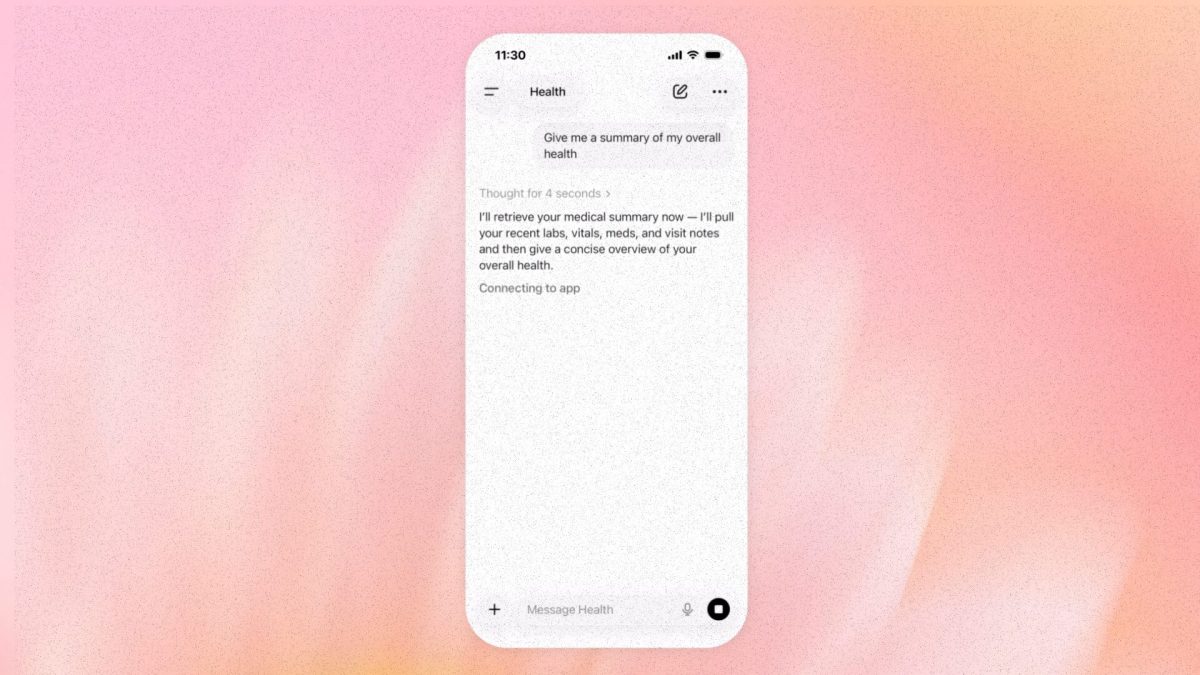
OpenAI Launches ChatGPT Health, Encouraging Users To Connect Their Medical Records

OpenAI has unveiled ChatGPT Health, a sandboxed health-focused mode that lets users connect medical records and wellness apps for more personalized guidance. The company makes sure to note that ChatGPT Health is "not intended for diagnosis or treatment." The Verge reports: The company is encouraging users to connect their personal medical records and wellness apps, such as Apple Health, Peloton, MyFitnessPal,Weight Watchers, and Function, "to get more personalized, grounded responses to their questions." It suggests connecting medical records so that ChatGPT can analyze lab results, visit summaries, and clinical history; MyFitnessPal and Weight Watchers for food guidance; Apple Health for health and fitness data, including movement, sleep, and activity patterns"; and Function for insights into lab tests. On the medical records front, OpenAI says it's partnered with b.well, which will provide back-end integration for users to upload their medical records, since the company works with about 2.2 million providers. For now, ChatGPT Health requires users to sign up for a waitlist to request access, as it's starting with a beta group of early users, but the product will roll out gradually to all users regardless of subscription tier. [...] In a blog post, OpenAI wrote that based on its "de-identified analysis of conversations," more than 230 million people around the world already ask ChatGPT questions related to health and wellness each week. OpenAI also said that over the past two years, it's worked with more than 260 physicians to provide feedback on model outputs more than 600,000 times over 30 areas of focus, to help shape the product's responses. "ChatGPT can help you understand recent test results, prepare for appointments with your doctor, get advice on how to approach your diet and workout routine, or understand the tradeoffs of different insurance options based on your healthcare patterns," OpenAI claims in the blog post.

Read more of this story at Slashdot.

  •  

An AI-Generated NWS Map Invented Fake Towns In Idaho

National Weather Service pulled an AI-generated forecast graphic after it hallucinated fake town names in Idaho. "The blunder -- not the first of its kind to be posted by the NWS in the past year -- comes as the agency experiments with a wide range of AI uses, from advanced forecasting to graphic design," reports the Washington Post. "Experts worry that without properly trained officials, mistakes could erode trust in the agency and the technology." From the report: At first glance, there was nothing out of the ordinary about Saturday's wind forecast for Camas Prairie, Idaho. "Hold onto your hats!" said a social media post from the local weather office in Missoula, Montana. "Orangeotild" had a 10 percent chance of high winds, while just south, "Whata Bod" would be spared larger gusts. The problem? Neither of those places exist. Nor do a handful of the other spots marked on the National Weather Service's forecast graphic, riddled with spelling and geographical errors that the agency confirmed were linked to the use of generative AI. NWS said AI is not commonly used for public-facing content, nor is its use prohibited. The agency said it is exploring ways to employ AI to inform the public and acknowledged mistakes have been made. "Recently, a local office used AI to create a base map to display forecast information, however the map inadvertently displayed illegible city names," said NWS spokeswoman Erica Grow Cei. "The map was quickly corrected and updated social media posts were distributed." A post with the inaccurate map was deleted Monday, the same day The Washington Post contacted officials with questions about the image. Cei added that "NWS is exploring strategic ways to continue optimizing our service delivery for Americans, including the implementation of AI where it makes sense. NWS will continue to carefully evaluate results in cases where AI is implemented to ensure accuracy and efficiency, and will discontinue use in scenarios where AI is not effective." A Nov. 25 tweet out of the Rapid City, South Dakota, office also had misspelled locations and the Google Gemini logo in its forecast. NWS did not confirm whether the Rapid City image was made with generative AI.

Read more of this story at Slashdot.

  •  

HarperCollins Will Use AI To Translate Harlequin Romance Novels

Book publisher HarperCollins said it will start translating romance novels under its famous Harlequin label in France using AI, reducing or eliminating the pay for the team of human contract translators who previously did this work. 404Media: Publisher's Weekly broke the news in English after French outlets reported on the story in December. According to a joint statement from French Association of Literary Translators (ATFL) and En Chair et en Os (In Flesh and Bone) -- an anti-AI activist group of French translators -- HarperCollins France has been contacting its translators to tell them they're being replaced with machines in 2026. The ATFL/ En Chair et en Os statement explained that HarperCollins France would use a third party company called Fluent Planet to run Harlequin romance novels through a machine translation system. The books would then be checked for errors and finalized by a team of freelancers. The ATFL and En Chair et en Os called on writers, book workers, and readers to refuse this machine translated future. They begged people to "reaffirm our unconditional commitment to human texts, created by human beings, in dignified working conditions."

Read more of this story at Slashdot.

  •  

Stratechery Pushes Back on AI Capital Dystopia Predictions

Stratechery's Ben Thompson has published a lengthy rebuttal to Dwarkesh Patel and Philip Trammell's widely discussed winter break essay "Capital in the 22nd Century," arguing that even in a world where AI can perform all human jobs, people will still prefer human-created content and human connection. Patel and Trammell's thesis draws on Thomas Piketty's work to argue that once AI renders capital a true substitute for labor, wealth will concentrate among those richest at the moment of transition, making a global progressive capital tax the only solution to prevent extreme inequality. The logic is sound, writes Thompson, but he remains skeptical on several fronts. His first objection: if AI can truly do everything, then everyone can have everything they need, making the question of who owns the robots somewhat moot. His second: a world where AI is capable enough to replace all human labor yet still obeys human property law seems implausible. He finds the AI doomsday scenario -- where such powerful AI becomes uncontrollable -- more realistic than a stable capital-hoarding dystopia. Thompson points to agricultural employment in the U.S., which dropped from 81% in 1810 to 1% today, as evidence that humans consistently create new valuable work after technological displacement. He argues that human preferences for human connection -- from podcasting audiences to romantic partners -- will sustain an economy for human labor simply because it is human. Sora currently ranks 59th in the App Store behind double-digit human-focused social apps, for instance.

Read more of this story at Slashdot.

  •  

'Godfather of SaaS' Says He Replaced Most of His Sales Team With AI Agents

joshuark shares a report from Business Insider: Jason Lemkin, known to some as the Godfather of SaaS, says the time has come to push the limits of AI in the workplace. Lemkin, the founder of SaaStr, the world's largest community of business-to-business founders. In a recent podcast Lemkin said that this means he will stop hiring humans in his sales department. SaaStr is going all in for AI agents, which are commonly defined as virtual assistants that can complete tasks autonomously. They break down problems, outline plans, and take action without being prompted by a user. He said the company now has 20 AI agents automating tasks once handled by a team of 10 sales development representatives and account executives. That move to AI was rapid from an entirely human workforce. During the SaaStr Annual a yearly gathering of over 10,000 founders, executives, and VCs, two of its high-paid sales representatives abruptly quit. Lemkin said he turned to Amelia Lerutte, SaaStr's chief AI officer, and said, "We're done with hiring humans in sales. We're going to push the limits with agents." Lemkin's calculus was that it just wasn't worth the cost of hiring another junior sales representative for a $150,000 a year position who would eventually quit, when he could use a loyal AI agent instead. [...] Lemkin said SaaStr is training its agents on its best humans. "Train an agent with your best person, and best script, then that agent can start to become a version of your best salesperson," he said. Lemkin said that the net productivity of agents is about the same as humans. However, he said, agents are more efficient and can scale -- just like software. Many companies are experimenting with AI agents, but risks remain. One of the big ones is the threat of data leaks and cybercrime.

Read more of this story at Slashdot.

  •  

Amazon's AI Assistant Comes To the Web With Alexa.com

An anonymous reader quotes a report from TechCrunch: Amazon's AI-powered overhaul of its digital assistant, now known as Alexa+, is coming to the web. On Monday, at the start of the Consumer Electronics Show in Las Vegas, the company announced the official launch of a new website, Alexa.com, which is now rolling out to all Alexa+ Early Access customers. The site will allow customers to use Alexa+ online, much as you can do today with other AI chatbots such as ChatGPT or Google's Gemini. [...] Related to this expansion, Amazon is updating its Alexa mobile app, which will now offer a more "agent-forward" experience. Or, in other words, it's putting a chatbot-style interface on the app's homepage, making it seem more like a typical AI chatbot. (While you could chat with Alexa before in the app, the focus is now on the chatting -- while the other features take a back seat.) On the Alexa.com website, customers can use Alexa+ for common tasks -- for instance, exploring complex topics, creating content, and making trip itineraries. However, Amazon aims to differentiate its assistant from others by focusing on families and their needs in the home. [...] The Alexa.com website features a navigation sidebar for quicker access to your most-used Alexa features, so you can pick up where you left off on tasks like setting the thermostat, checking your calendar for appointments, reviewing shopping lists, and more. In addition, Amazon aims to convince customers to share their personal documents, emails, and calendar access with Alexa+, so its AI can become a sort of hub to manage the goings-on at home, from kids' school holidays and soccer schedules to doctor's appointments and other things families need to remember -- like when the dog got its last rabies shot, or what day the neighbor's backyard BBQ is taking place. "Seventy-six percent of what customers are using Alexa+ for no other AI can do," says Daniel Rausch, VP of Alexa and Echo at Amazon. "Ninety-seven percent of Alexa devices support Alexa+, and we see now in adoption from customers that they're using Alexa across all those many years and many generations of devices," Rausch adds. "We support all of Alexa's original capabilities, the tens of thousands of services and devices that Alexa was integrated with already are carried forward to the Alexa+ experience." The report notes that Alexa.com will initially only be available to Early Access customers who sign in with their Amazon account.

Read more of this story at Slashdot.

  •  

Microsoft is Slowly Turning Edge Into Another Copilot App

Microsoft has started testing a "significant" visual overhaul for Edge in its Canary and Dev Channel preview builds, and the redesigned interface borrows heavily from the design language that first appeared in the company's standalone Copilot app rather than the Fluent Design system used across Windows 11, Xbox, and Office. The updated look touches context menus, the new tab page and settings areas, introducing rounder corners and the same color palette and typography found in Copilot. The new interface appears regardless of whether users have Copilot Mode enabled, though the new tab page reverts to MSN news articles and Bing search when Copilot Mode is turned off. Edge is not alone in this shift, Windows Central writes. Microsoft is also applying the Copilot design language to Copilot Discover, an AI-powered version of MSN.com that may be internally codenamed "Ruby." Windows and Xbox have not yet received similar treatment. The rollout remains uneven -- the refreshed UI is not appearing on all test machines -- and production releases are likely weeks away. If Microsoft continues down this path, Copilot, MSN and Edge will share a visual identity that looks noticeably different from the rest of the company's software lineup, the publication adds.

Read more of this story at Slashdot.

  •  

Capture de Maduro : SpaceX active Starlink d’urgence au Venezuela dans des circonstances floues

starlink maduro venezuela

L'opération militaire des États-Unis au Venezuela, qui a mené à la capture de Nicolás Maduro le 3 janvier 2026, a aussi perturbé les accès à Internet à Caracas. En réponse, SpaceX a annoncé l'activation de Starlink. Une manœuvre inédite, car le service n'a théoriquement aucune existence légale dans le pays.

  •  
❌