Vue lecture

OpenAI a bien joué : vous ne verrez aucun personnage Disney sur les IA concurrentes de Sora

Grâce à un partenariat signé le 11 décembre 2025, OpenAI s’est assuré une année d’exclusivité sur plus de 200 personnages Disney, Pixar, Marvel et Star Wars pour Sora. Un avantage décisif qui prive, temporairement, les autres acteurs de l’IA de toute exploitation légale des œuvres du géant du divertissement.

  •  

Are Warnings of Superintelligence 'Inevitability' Masking a Grab for Power?

Superintelligence has become "a quasi-political forecast" with "very little to do with any scientific consensus, emerging instead from particular corridors of power." That's the warning from James O'Sullivan, a lecturer in digital humanities from University College Cork. In a refreshing 5,600-word essay in Noema magazine, he notes the suspicious coincidence that "The loudest prophets of superintelligence are those building the very systems they warn against..." "When we accept that AGI is inevitable, we stop asking whether it should be built, and in the furor, we miss that we seem to have conceded that a small group of technologists should determine our future." (For example, OpenAI CEO Sam Altman "seems determined to position OpenAI as humanity's champion, bearing the terrible burden of creating God-like intelligence so that it might be restrained.") The superintelligence discourse functions as a sophisticated apparatus of power, transforming immediate questions about corporate accountability, worker displacement, algorithmic bias and democratic governance into abstract philosophical puzzles about consciousness and control... Media amplification plays a crucial role in this process, as every incremental improvement in large language models gets framed as a step towards AGI. ChatGPT writes poetry; surely consciousness is imminent..." Such accounts, often sourced from the very companies building these systems, create a sense of momentum that becomes self-fulfilling. Investors invest because AGI seems near, researchers join companies because that's where the future is being built and governments defer regulation because they don't want to handicap their domestic champions... We must recognize this process as political, not technical. The inevitability of superintelligence is manufactured through specific choices about funding, attention and legitimacy, and different choices would produce different futures. The fundamental question isn't whether AGI is coming, but who benefits from making us believe it is... We do not yet understand what kind of systems we are building, or what mix of breakthroughs and failures they will produce, and that uncertainty makes it reckless to funnel public money and attention into a single speculative trajectory. Some key points: "The machines are coming for us, or so we're told. Not today, but soon enough that we must seemingly reorganize civilization around their arrival...""When we debate whether a future artificial general intelligence might eliminate humanity, we're not discussing the Amazon warehouse worker whose movements are dictated by algorithmic surveillance or the Palestinian whose neighborhood is targeted by automated weapons systems. These present realities dissolve into background noise against the rhetoric of existential risk...""Seen clearly, the prophecy of superintelligence is less a warning about machines than a strategy for power, and that strategy needs to be recognized for what it is... ""Superintelligence discourse isn't spreading because experts broadly agree it is our most urgent problem; it spreads because a well-resourced movement has given it money and access to power...""Academic institutions, which are meant to resist such logics, have been conscripted into this manufacture of inevitability... reinforcing industry narratives, producing papers on AGI timelines and alignment strategies, lending scholarly authority to speculative fiction...""The prophecy becomes self-fulfilling through material concentration — as resources flow towards AGI development, alternative approaches to AI starve...""The dominance of superintelligence narratives obscures the fact that many other ways of doing AI exist, grounded in present social needs rather than hypothetical machine gods..." [He lists data sovereignty movements "that treat data as a collective resource subject to collective consent," as well as organizations like Canada's First Nations Information Governance Centre and New Zealand's's Te Mana Raraunga, plus "Global South initiatives that use modest, locally governed AI systems to support healthcare, agriculture or education under tight resource constraints."] "Such examples... demonstrate how AI can be organized without defaulting to the superintelligence paradigm that demands everyone else be sacrificed because a few tech bros can see the greater good that everyone else has missed...""These alternatives also illuminate the democratic deficit at the heart of the superintelligence narrative. Treating AI at once as an arcane technical problem that ordinary people cannot understand and as an unquestionable engine of social progress allows authority to consolidate in the hands of those who own and build the systems..." He's ultimately warning us about "politics masked as predictions..." "The real political question is not whether some artificial superintelligence will emerge, but who gets to decide what kinds of intelligence we build and sustain. And the answer cannot be left to the corporate prophets of artificial transcendence because the future of AI is a political field — it should be open to contestation. "It belongs not to those who warn most loudly of gods or monsters, but to publics that should have the moral right to democratically govern the technologies that shape their lives."

Read more of this story at Slashdot.

  •  

CEOs Plan to Spend More on AI in 2026 - Despite Spotty Returns

The Wall Street Journal reports that 68% of CEOs "plan to spend even more on AI in 2026, according to an annual survey of more than 350 public-company CEOs from advisory firm Teneo." And yet "less than half of current AI projects had generated more in returns than they had cost, respondents said." They reported the most success using AI in marketing and customer service and challenges using it in higher-risk areas such as security, legal and human resources. Teneo also surveyed about 400 institutional investors, of which 53% expect that AI initiatives would begin to deliver returns on investments within six months. That compares to the 84% of CEOs of large companies — those with revenue of $10 billion or more — who believe it will take more than six months. Surprisingly, 67% of CEOs believe AI will increase their entry-level head count, while 58% believe AI will increase senior leadership head count. All the surveyed CEOS were from public companies with revenue over $1 billion...

Read more of this story at Slashdot.

  •  

Podcast Industry Under Siege as AI Bots Flood Airways with Thousands of Programs

An anonymous reader shared this report from the Los Angeles Times: Popular podcast host Steven Bartlett has used an AI clone to launch a new kind of content aimed at the 13 million followers of his podcast "Diary of a CEO." On YouTube, his clone narrates "100 CEOs With Steven Bartlett," which adds AI-generated animation to Bartlett's cloned voice to tell the life stories of entrepreneurs such as Steve Jobs and Richard Branson. Erica Mandy, the Redondo Beach-based host of the daily news podcast called "The Newsworthy," let an AI voice fill in for her earlier this year after she lost her voice from laryngitis and her backup host bailed out... In podcasting, many listeners feel strong bonds to hosts they listen to regularly. The slow encroachment of AI voices for one-off episodes, canned ad reads, sentence replacement in postproduction or translation into multiple languages has sparked anger as well as curiosity from both creators and consumers of the content. Augmenting or replacing host reads with AI is perceived by many as a breach of trust and as trivializing the human connection listeners have with hosts, said Megan Lazovick, vice president of Edison Research, a podcast research company... Still, platforms such as YouTube and Spotify have introduced features for creators to clone their voice and translate their content into multiple languages to increase reach and revenue. A new generation of voice cloning companies, many with operations in California, offers better emotion, tone, pacing and overall voice quality... Some are using the tech to carpet-bomb the market with content. Los Angeles podcasting studio Inception Point AI has produced its 200,000 podcast episodes, in some weeks accounting for 1% of all podcasts published that week on the internet, according to CEO Jeanine Wright. The podcasts are so cheap to make that they can focus on tiny topics, like local weather, small sports teams, gardening and other niche subjects. Instead of a studio searching for a specific "hit" podcast idea, it takes just $1 to produce an episode so that they can be profitable with just 25 people listening... One of its popular synthetic hosts is Vivian Steele, an AI celebrity gossip columnist with a sassy voice and a sharp tongue... Inception Point has built a roster of more than 100 AI personalities whose characteristics, voices and likenesses are crafted for podcast audiences. Its AI hosts include Clare Delish, a cooking guidance expert, and garden enthusiastNigel Thistledown... Across Apple and Spotify, Inception Point podcasts have now garnered 400,000 subscribers.

Read more of this story at Slashdot.

  •  

Podcast Industry Under Siege as AI Bot Flood Airways with Thousands of Programs

An anonymous reader shared this report from the Los Angeles Times: Popular podcast host Steven Bartlett has used an AI clone to launch a new kind of content aimed at the 13 million followers of his podcast "Diary of a CEO." On YouTube, his clone narrates "100 CEOs With Steven Bartlett," which adds AI-generated animation to Bartlett's cloned voice to tell the life stories of entrepreneurs such as Steve Jobs and Richard Branson. Erica Mandy, the Redondo Beach-based host of the daily news podcast called "The Newsworthy," let an AI voice fill in for her earlier this year after she lost her voice from laryngitis and her backup host bailed out... In podcasting, many listeners feel strong bonds to hosts they listen to regularly. The slow encroachment of AI voices for one-off episodes, canned ad reads, sentence replacement in postproduction or translation into multiple languages has sparked anger as well as curiosity from both creators and consumers of the content. Augmenting or replacing host reads with AI is perceived by many as a breach of trust and as trivializing the human connection listeners have with hosts, said Megan Lazovick, vice president of Edison Research, a podcast research company... Still, platforms such as YouTube and Spotify have introduced features for creators to clone their voice and translate their content into multiple languages to increase reach and revenue. A new generation of voice cloning companies, many with operations in California, offers better emotion, tone, pacing and overall voice quality... Some are using the tech to carpet-bomb the market with content. Los Angeles podcasting studio Inception Point AI has produced its 200,000 podcast episodes, in some weeks accounting for 1% of all podcasts published that week on the internet, according to CEO Jeanine Wright. The podcasts are so cheap to make that they can focus on tiny topics, like local weather, small sports teams, gardening and other niche subjects. Instead of a studio searching for a specific "hit" podcast idea, it takes just $1 to produce an episode so that they can be profitable with just 25 people listening... One of its popular synthetic hosts is Vivian Steele, an AI celebrity gossip columnist with a sassy voice and a sharp tongue... Inception Point has built a roster of more than 100 AI personalities whose characteristics, voices and likenesses are crafted for podcast audiences. Its AI hosts include Clare Delish, a cooking guidance expert, and garden enthusiastNigel Thistledown... Across Apple and Spotify, Inception Point podcasts have now garnered 400,000 subscribers.

Read more of this story at Slashdot.

  •  

Entry-Level Tech Workers Confront an AI-Fueled Jobpocalypse

AI "has gutted entry-level roles in the tech industry," reports Rest of World. One student at a high-ranking engineering college in India tells them that among his 400 classmates, "fewer than 25% have secured job offers... there's a sense of panic on the campus." Students at engineering colleges in India, China, Dubai, and Kenya are facing a "jobpocalypse" as artificial intelligence replaces humans in entry-level roles. Tasks once assigned to fresh graduates, such as debugging, testing, and routine software maintenance, are now increasingly automated. Over the last three years, the number of fresh graduates hired by big tech companies globally has declined by more than 50%, according to a report published by SignalFire, a San Francisco-based venture capital firm. Even though hiring rebounded slightly in 2024, only 7% of new hires were recent graduates. As many as 37% of managers said they'd rather use AI than hire a Gen Z employee... Indian IT services companies have reduced entry-level roles by 20%-25% thanks to automation and AI, consulting firm EY said in a report last month. Job platforms like LinkedIn, Indeed, and Eures noted a 35% decline in junior tech positions across major EU countries during 2024... "Five years ago, there was a real war for [coders and developers]. There was bidding to hire," and 90% of the hires were for off-the-shelf technical roles, or positions that utilize ready-made technology products rather than requiring in-house development, said Vahid Haghzare, director at IT hiring firm Silicon Valley Associates Recruitment in Dubai. Since the rise of AI, "it has dropped dramatically," he said. "I don't even think it's touching 5%. It's almost completely vanished." The company headhunts workers from multiple countries including China, Singapore, and the U.K... The current system, where a student commits three to five years to learn computer science and then looks for a job, is "not sustainable," Haghzare said. Students are "falling down a hole, and they don't know how to get out of it."

Read more of this story at Slashdot.

  •  

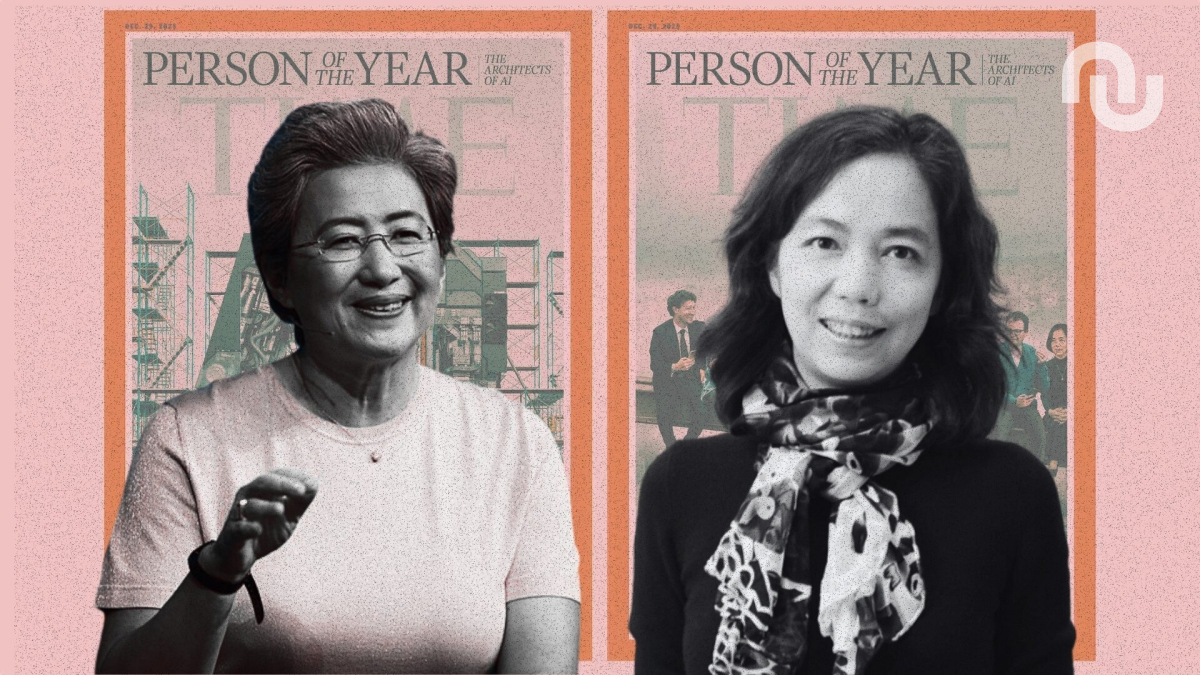
Time Magazine's 'Person of the Year': the Architects of AI

Time magazine used its 98th annual "Person of the Year" cover to "recognize a force that has dominated the year's headlines, for better or for worse. For delivering the age of thinking machines, for wowing and worrying humanity, for transforming the present and transcending the possible, the Architects of AI are TIME's 2025 Person of the Year." One cover illustration shows eight AI executives sitting precariously on a beam high above the city, while Time's 6,700-word article promises "the story of how AI changed our world in 2025, in new and exciting and sometimes frightening ways. It is the story of how [Nvidia CEO] Huang and other tech titans grabbed the wheel of history, developing technology and making decisions that are reshaping the information landscape, the climate, and our livelihoods." Time describes them betting on "one of the biggest physical infrastructure projects of all time," mentioning all the usual worries — datacenters' energy consumption, chatbot psychosis, predictions of "wiping out huge numbers of jobs" and the possibility of an AI stock market bubble. (Although "The drumbeat of warning that advanced AI could kill us all has mostly quieted"). But it also notes AI's potential to jumpstart innovation (and economic productivity) This year, the debate about how to wield AI responsibly gave way to a sprint to deploy it as fast as possible. "Every industry needs it, every company uses it, and every nation needs to build it," Huang tells TIME in a 75-minute interview in November, two days after announcing that Nvidia, the world's first $5 trillion company, had once again smashed Wall Street's earnings expectations. "This is the single most impactful technology of our time..." The risk-averse are no longer in the driver's seat. Thanks to Huang, Son, Altman, and other AI titans, humanity is now flying down the highway, all gas no brakes, toward a highly automated and highly uncertain future. Perhaps Trump said it best, speaking directly to Huang with a jovial laugh in the U.K. in September: "I don't know what you're doing here. I hope you're right."

Read more of this story at Slashdot.

  •  

Startup Successfully Uses AI to Find New Geothermal Energy Reservoirs

A Utah-based startup announced last week it used AI to locate a 250-degree Fahrenheit geothermal reservoir, reports CNN. It'll start producing electricity in three to five years, the company estimates — and at least one geologist believes AI could be an exciting "gamechanger" for the geothermal industry. [Startup Zanskar Geothermal & Minerals] named it "Big Blind," because this kind of site — which has no visual indication of its existence, no hot springs or geysers above ground, and no history of geothermal exploration — is known as a "blind" system. It's the first industry-discovered blind site in more than three decades, said Carl Hoiland, co-founder and CEO of Zanskar. "The idea that geothermal is tapped out has been the narrative for decades," but that's far from the case, he told CNN. He believes there are many more hidden sites across the Western U.S. Geothermal energy is a potential gamechanger. It offers the tantalizing prospect of a huge source of clean energy to meet burgeoning demand. It's near limitless, produces scarcely any climate pollution, and is constantly available, unlike wind and solar, which are cheap but rely on the sun shining and the wind blowing. The problem, however, has been how to find and scale it. It requires a specific geology: underground reservoirs of hot water or steam, along with porous rocks that allow the water to move through them, heat up, and be brought to the surface where it can power turbines... The AI models Zanskar uses are fed information on where blind systems already exist. This data is plentiful as, over the last century and more, humans have accidentally stumbled on many around the world while drilling for other resources such as oil and gas. The models then scour huge amounts of data — everything from rock composition to magnetic fields — to find patterns that point to the existence of geothermal reserves. AI models have "gotten really good over the last 10 years at being able to pull those types of signals out of noise," Hoiland said... Zanskar's discovery "is very significant," said James Faulds, a professor of geosciences at Nevada Bureau of Mines and Geology.... Estimates suggest over three-quarters of US geothermal resources are blind, Faulds told CNN. "Refining methods to find such systems has the potential to unleash many tens and perhaps hundreds of gigawatts in the western US alone," he said... Big Blind is the company's first blind site discovery, but it's the third site it has drilled and hit commercial resources. "We expect dozens, to eventually hundreds, of new sites to be coming to market," Hoiland said.... Hoiland says Zanskar's work shows conventional geothermal still has huge untapped potential. Thanks to long-time Slashdot reader schwit1 for sharing the article.

Read more of this story at Slashdot.

  •  

US To Mandate AI Vendors Measure Political Bias For Federal Sales

An anonymous reader quotes a report from Reuters: The U.S. government will require artificial intelligence vendors to measure political "bias" to sell their chatbots to federal agencies, according to a Trump administration statement (PDF) released on Thursday. The requirement will apply to all large language models bought by federal agencies, with the exception of national security systems, according to the statement. President Donald Trump ordered federal agencies in July to avoid buying large language models that he labeled as "woke." Thursday's statement gives more detail to that directive, saying that developers should not "intentionally encode partisan or ideological judgments" into a chatbot's outputs. Further reading: Trump Signs Executive Order For Single National AI Regulation Framework, Limiting Power of States

Read more of this story at Slashdot.

  •  

Bill Gates' Daughter Secures $30 Million For AI App Built In Stanford Dorm

Phoebe Gates, Bill Gates' youngest daughter, has raised $30 million for the AI shopping app she built in her Stanford dorm room with classmate Sophia Kianni. The app is called Phia and is pitched as a way to simplify price comparison and secondhand shopping. "Its AI-powered search engine -- available as an app and as a browser extension for Chrome and Safari -- pulls listings from more than 40,000 retail and resale sites so users can compare prices, surface real-time deals, and determine whether an item's cost is typical, high or fair," reports the San Francisco Chronicle. The app has reached 750,000 downloads in eight months and is valued at $180 million. From the report: Gates told Elle that when she first floated the idea to her parents, they urged her to keep it as a side project -- advice she followed by enrolling in Stanford's night program after moving to New York and finishing her degree in 2024. "They were like, 'Okay, you can do this as a side thing, but you need to stay in school.' I don't think people would expect that from my family, to be honest," she said. Her father dropped out of Harvard University in 1975 to launch Microsoft. Kianni even paused her degree temporarily "to learn, as quickly as possible, as much as we could about the industry that we would be operating in," she told Vogue. Bill Gates has not invested in the company, though he has publicly supported its mission.

Read more of this story at Slashdot.

  •  

Amazon Prime Video Pulls AI-Powered Recaps After Fallout Flub

An anonymous reader shares a report: Amazon Prime Video has pulled its AI-powered video recap of Fallout after viewers noticed that it got key parts of the story wrong. The streaming service began testing Video Recaps last month, and now they're missing from the shows included in the test, including Fallout, The Rig, Tom Clancy's Jack Ryan, Upload, and Bosch. The feature is supposed to use AI to analyze a show's key plot points and sum it all in a bite-sized video, complete with an AI voiceover and clips from the series. But in its season one recap of Fallout, Prime Video incorrectly stated that one of The Ghoul's (Walton Goggins) flashbacks is set in "1950s America" rather than the year 2077, as spotted earlier by Games Radar.

Read more of this story at Slashdot.

  •  

Aiarty Image Enhancer instantly fixes blurry, grainy, and low-res photos (49% off lifetime license + extra Xmas coupon)

We all encounter situations where the environment fights against us: the lighting is too dim, the subject moves too fast, or the focal length just isn’t long enough. You end up with a composition you love, but the photo itself—plagued by high-ISO noise, slight motion blur, or low pixel count from cropping—becomes a headache to process.

Manually correcting these fundamental image quality issues in traditional photo editors often requires tedious fine-tuning to perfectly balance sharpness and natural texture.

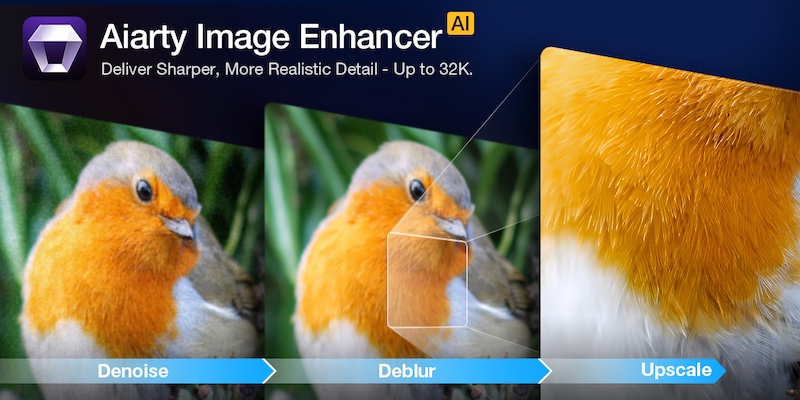
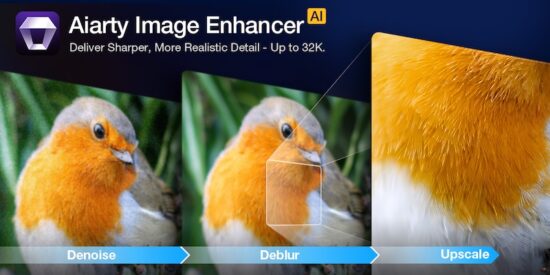
Aiarty Image Enhancer is designed to simplify this crucial post-processing step. It acts as an efficient specialist tool that quickly and automatically uses AI to denoise, deblur, sharpen, and upscale your photos. This approach hands you a clean, high-fidelity foundation, allowing you to spend less time fighting pixels and more time on the final artistic grade.

Christmas Special Offer: 49% off Lifetime License + extra $5 coupon

If you are tired of monthly subscriptions piling up, this offer is specifically for you. In celebration of Christmas, Aiarty is offering 49% off Aiarty Image Enhancer Lifetime License. And that’s not all! You can also use the limited-time coupon “XMASSAVE” to save an extra $5. Originally priced at $155, now you can grab it for just $74 – the lowest-ever price!

With your purchase, you’ll enjoy:

  • Full access to all features and lifetime free updates
  • Installation on up to 3 Windows or Mac computers
  • 30-day money back guarantee
  • One-time payment, no subscriptions or hidden fees

This is arguably one of the best value propositions in photo enhancement software this year. But is the software worth it? Let’s break down the performance.

Deep Dive: Why Aiarty Image Enhancer Belongs in Your Workflow

1. AI Denoise: The High-ISO Savior

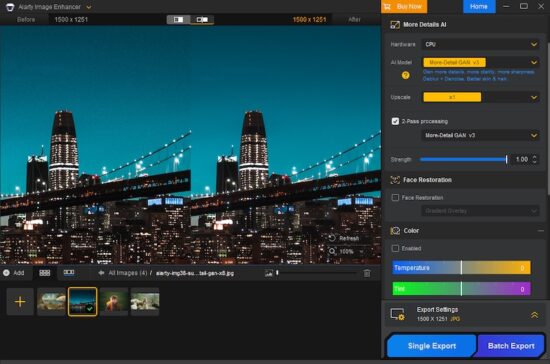
Noise is the enemy of detail. Whether you are shooting indoor events, astrophotography, or wildlife at dawn, pushing your ISO is often necessary. Traditional noise reduction software works by blurring the image to hide the grain, which often results in the dreaded “waxy skin” effect or loss of fine textures like fabric or fur.

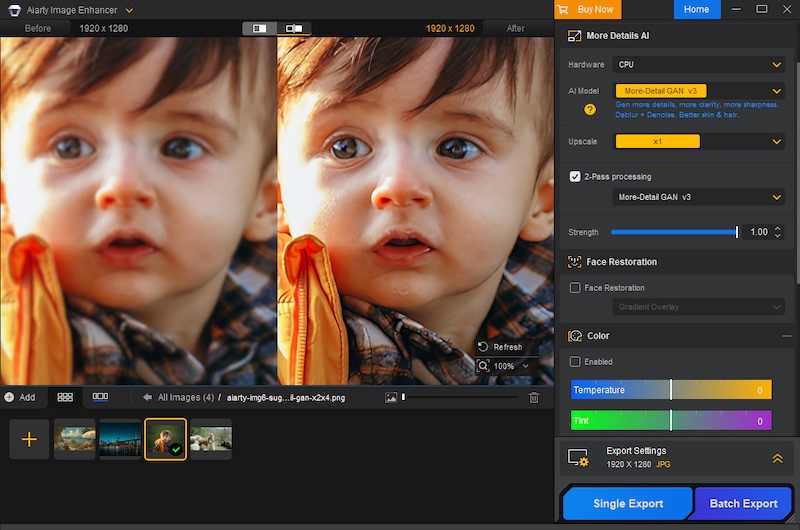
Aiarty uses advanced AI denoise technology to intelligently analyze the image. It distinguishes between luminance noise, chroma noise, and actual image detail. It allows you to remove noise from images without sacrificing the sharpness that your expensive lenses provide.
2. De-blur & Sharpening: Fixing the “Almost Perfect” Shot

Blur comes in many forms, and Aiarty tackles them all.

  • Camera Shake: Even with IBIS (In-Body Image Stabilization), handheld shots at slow shutter speeds can suffer from micro-jitters.
  • Motion Blur: Subjects don’t always stay still. A moving child, a running pet, or a swaying branch can ruin a shot.
  • Lens Softness: We all love vintage lenses or wide-open apertures, but they often lack sharpness at the edges.

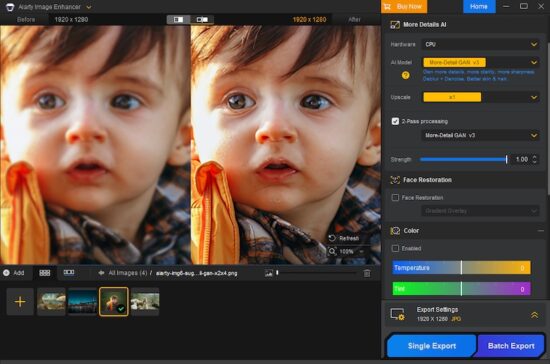
Aiarty doesn’t just apply a “sharpening mask” which increases contrast at edges. Instead, it hallucinates (in a good way) the missing pixel data to reverse the blur. It restores edge definition and clarity without introducing the artificial white halos or “crunchy” look associated with over-sharpening.
3. The Upscaling Powerhouse: From Crop to Print

The freedom to crop is a luxury. Sometimes, your 200mm lens isn’t long enough, and you have to crop 50% or more of the frame to get the composition you want. In the past, such heavy cropping drastically reduced pixel density, rendering images unsuitable for large-format printing.

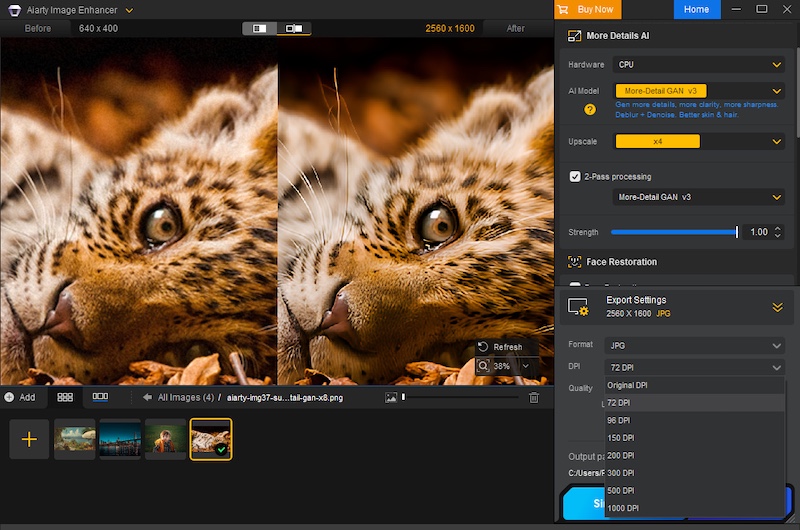
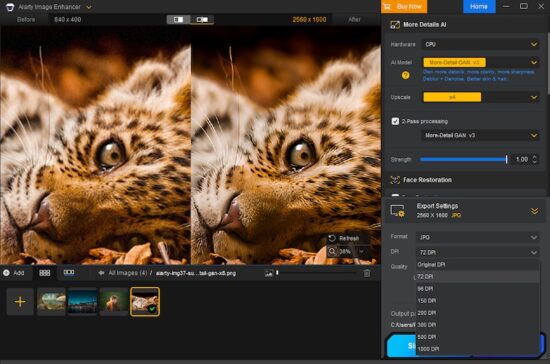
Aiarty excels in AI upscaling. Leveraging deep learning algorithms, it can enhance image resolution to 4K, 8K, 16K, and even up to 32K. Crucially, it generates new, realistic details and textures—like feathers, individual strands of hair, or intricate fabric patterns—rather than simply stretching pixels. This means you can crop without fear, transforming what would have been small, social media-only images into print-ready, large-format works with every pixel looking sharp and natural.

Furthermore, Aiarty allows for precise control over your output, enabling you to set custom DPI values directly within the software, a critical feature for professional printing workflows.
4. One-Stop Color & Tone Correction

While most professionals stick to Lightroom for grading, Aiarty includes a surprisingly robust set of adjustment tools. This is particularly useful for a “One-Stop” workflow. If you are rescuing an old, faded family photo or a poorly exposed JPEG where the RAW data isn’t available, you don’t need to open another app.

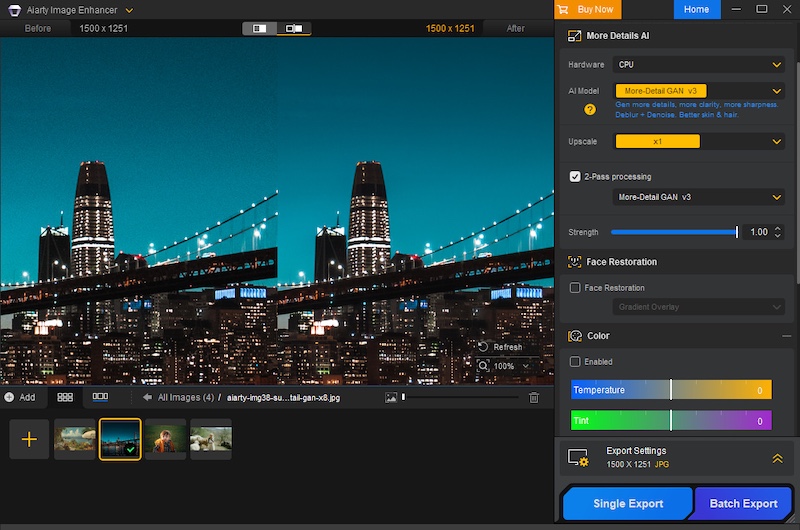
You can adjust temperature, tint, exposure, contrast, highlights, and shadows directly within the interface. It is perfect for quickly reviving the dynamic range and color vibrancy of an image immediately after denoising or upscaling.

Professional Workflow Features

  1. Extensive Format Support (Including RAW)

It doesn’t just handle JPEGs. It supports a vast array of input formats including HEIC, TIFF, PNG, and crucially, RAW files. It works seamlessly with .CR3 (Canon), .ARW (Sony), .NEF (Nikon), .RAF (Fujifilm), .DNG, and virtually every other proprietary RAW format from Leica, Panasonic, Olympus, and Hasselblad. This means you can integrate it right at the start of your editing pipeline.

  1. Hardware Acceleration

Processing AI models is demanding. Aiarty is optimized for GPU acceleration (NVIDIA, AMD, Intel), dramatically cutting down processing time and ensuring a much smoother workflow, particularly when dealing with large-format files or applying complex enhancements across batches.

  1. Batch Processing

Have a folder of 500 shots from a wedding that were shot at ISO 3200? You don’t need to edit them one by one. You can batch process thousands of images.

  1. Granular Control
  • Flexible Scaling: Many AI enhancement tools restrict control to fixed ratios (e.g., only 2x upscaling). Aiarty provides flexibility. It allows users to freely select the enlargement multiplier or directly set the final target resolution.
  • Strength Slider: The software offers an intensity slider to manually adjust the strength of the AI enhancement and sharpening. This ensures you can achieve the optimal balance between maximum quality improvement and preserving the image’s natural, artifact-free look.

Verdict: Don’t Miss This Deal

In the world of photography, “saving” a photo used to mean spending hours cloning and masking in Photoshop. Aiarty Image Enhancer turns that into a simple, automated process. It is the perfect companion to your existing RAW editor, stepping in when you need to go beyond the limits of your sensor.

With the Christmas Lifetime Deal, you aren’t just buying software; you are buying an insurance policy for your images. No monthly fees, just permanent access to better image quality.

Get the Aiarty Image Enhancer Lifetime License for just $74! Grab it before this limited-time holiday deal ends!

Enhance your photos effortlessly this season and make your memories shine like never before!

The post Aiarty Image Enhancer instantly fixes blurry, grainy, and low-res photos (49% off lifetime license + extra Xmas coupon) appeared first on Photo Rumors.

  •  

« Cible suivante » : Starbucks, OpenAI, Binance… Cette menace cyber de niveau maximal poursuit son inexorable expansion

Depuis le 3 novembre 2025 et la découverte d’une vulnérabilité React, une course effrénée s’est engagée dans l’écosystème cyber. D’un côté, les équipes de sécurité tentent de sécuriser leurs systèmes au plus vite ; de l’autre, les attaquants scannent l'Internet à grande échelle pour exploiter les retardataires. Les chercheurs suivent en temps réel l’évolution des campagnes d’attaque qui se greffent sur cette faille critique.

  •  

Rivian Goes Big On Autonomy, With Custom Silicon, Lidar, and a Hint At Robotaxis

During the company's first "Autonomy & AI Day" event today, Rivian unveiled a major autonomy push featuring custom silicon, lidar, and a "large driving model." It also hinted at a potential entry into the self-driving ride-hail market, according to CEO RJ Scaringe. TechCrunch reports: Rivian said it will expand the hands-free version of its driver-assistance software to "over 3.5 million miles of roads across the USA and Canada" and will eventually expand beyond highways to surface streets (with clearly painted road lines). This expanded access will be available on the company's second-generation R1 trucks and SUVs. It's calling the expanded capabilities "Universal Hands-Free" and will launch in early 2026. Rivian says it will charge a one-time fee of $2,500 or $49.99 per month. "What that means is you can get into the vehicle at your house, plug in the address to where you're going, and the vehicle will completely drive you there," Scaringe said Thursday, describing a point-to-point navigation feature. After that, Rivian plans to allow drivers to take their eyes off the road. "This gives you your time back. You can be on your phone, or reading a book, no longer needing to be actively involved in the operation of vehicle." Rivian's driver assistance software won't stop there; the EV maker laid out plans on Thursday to enhance its capabilities all the way up to what it's calling "personal L4," a nod to the level set by the Society of Automotive Engineers that means a car can operate in a particular area with no human intervention. After that, Scaringe hinted that Rivian will be looking at competing with the likes of Waymo. "While our initial focus will be on personally owned vehicles, which today represent a vast majority of the miles driven in the United States, this also enables us to pursue opportunities in the ride-share space," he said. To help accomplish these lofty goals, Rivian has been building a "large driving model" (think: an LLM but for real-world driving), part of a move away from a rules-based framework for developing autonomous vehicles that has been led by Tesla. The company also showed off its own custom 5nm processor, which it says will be built in collaboration with both Arm and TSMC.

Read more of this story at Slashdot.

  •  
❌