Vue lecture

New Linux 'Copy Fail' Vulnerability Enables Root Access On Major Distros

A newly disclosed Linux kernel flaw dubbed "Copy Fail" can let a local, unprivileged attacker gain root access on major Linux distributions, with researchers claiming the bug affects kernels shipped since 2017. "The POC exploit works out of the box today, but a future version that can escape from containers like Docker is promised soon," writes Slashdot reader tylerni7. "Technical details are available here." Slashdot reader BrianFagioli shares a report from NERDS.xyz: A newly disclosed Linux kernel vulnerability called Copy Fail (CVE-2026-31431) allows an unprivileged user to gain root access using a tiny 732-byte script, and it works with unsettling consistency across major distributions. Unlike older exploits that relied on race conditions or fragile timing, this one is a straight-line logic flaw in the kernel's crypto subsystem. It abuses AF_ALG sockets and splice to overwrite a few bytes in the page cache of a target file, such as /usr/bin/su. Because the kernel executes from the page cache, not directly from disk, the attacker can inject code into a setuid binary in memory and immediately escalate privileges. What makes this especially concerning is how quiet it is. The file on disk remains unchanged, so standard integrity checks see nothing wrong, while the in-memory version has already been tampered with. The same primitive can also cross container boundaries since the page cache is shared, raising the stakes for multi-tenant environments and Kubernetes nodes. The underlying issue traces back to an in-place optimization added years ago, now being rolled back as part of the fix. Until patched kernels are widely deployed, this is one of those bugs that feels less like a theoretical risk and more like a practical, reliable path to full system compromise.

Read more of this story at Slashdot.

  •  

What’s new on Kickstarter?


Here are the latest photography-related Kickstarter crowdfunding projects:


New: Viperpod full-size tripod that doesn’t rely on the ground: $45,076 raised of $10,000 goal with 133 backers and 32 days to go.


NEWProWrapp Impact+ gear wrapper with max shock resistance: $34,926 raised of $6,416 goal by 329 backers with 14 days to go.


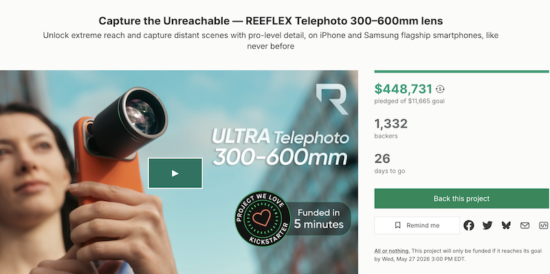
New: Reeflex 300–600mm telephoto lens for smartphones: $448,731 raised of $11,665 goal by 1,332 backers with 26 days to go.


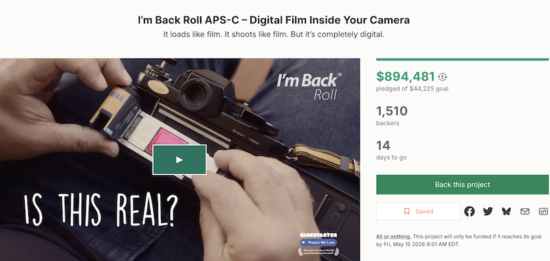
“I’m Back Roll” digital back sensor for film cameras: $894,481 raised of $6,416 goal with 329 backers and 14 days to go. Additional information on this project can be found here and here.


Rewindpix non-disposable digital “Film” camera: $890,941 raised of $15,000 goal from 6,377 backers with 10 days to go.


CamCast turns your camera into a smart, connected system (late pledge available)


Yashica pocket camcorder (late pledge available)

Via NikonRumors

The post What’s new on Kickstarter? appeared first on Photo Rumors.

  •  

EN DIRECT, guerre au Moyen-Orient : la situation est de nouveau « normale » à Téhéran après l’activation des systèmes de défense aérienne, selon les agences iraniennes

La défense antiaérienne est entrée en action, en soirée, dans le ciel de la capitale iranienne contre des « petits aéronefs et des drones de reconnaissance », ont annoncé les agences, sans préciser s’il s’agissait d’un exercice ou de la neutralisation d’appareils hostiles.

© Vahid Salemi / AP

A Téhéran, le 28 avril 2026.
  •  

In Real-World Test, an AI Model Did Better Than ER Doctors At Diagnosing Patients

A new study from Harvard Medical School and Beth Israel Deaconess found that an OpenAI reasoning model outperformed experienced ER doctors at diagnosing and managing patient cases using messy, real-world emergency department records. Researchers say the results don't support replacing doctors, but they do suggest AI could meaningfully reshape clinical workflows if tested carefully in prospective trials. NPR reports: The researchers ran a series of experiments on the AI model to test its clinical acumen -- including actual cases like the lupus patient who'd been previously treated at the emergency department at Beth Israel in Boston. The team graded how well the AI model could provide an accurate diagnosis at three moments in time, from the triage stage in the ER, up to being admitted into the hospital. Overall, AI outperformed two experienced physicians -- and did so with only the electronic health records and the limited information that had been available to the physicians at the time. "This is the big conclusion for me -- it works with the messy real-world data of the emergency department, " said Dr. Adam Rodman, a clinical researcher at Beth Israel and one of the study authors. "It works for making diagnoses in the real world." Other parts of the study focused on case reports published in the New England Journal of Medicine and clinical vignettes to suss out whether the AI model could meet well-established "benchmarks" and game out thorny diagnostic questions. "The model outperformed our very large physician baseline," said Raj Manrai, assistant professor of Biomedical Informatics at Harvard Medical School who was also part of the study. The authors emphasize the AI relied on text alone, while in real life, clinicians need to attend to many other inputs like images, sounds and nonverbal cues when diagnosing and treating a patient. The findings have been published Thursday in the journal Science.

Read more of this story at Slashdot.

  •  

135° - Paire de freins VTT enduro/Dh Magura MT7

199€ - bike-discount.de

Ils sont indémodables et restent parmis les plus performants du marché.
A environ 210€ livrés, ils deviennent un excellent rapport qualité prix.

  •  
❌