Vue lecture

Microsoft's Xbox Mode Is Now Available For All Windows 11 PCs

Microsoft is rolling out Xbox mode to all Windows 11 PCs, bringing a full-screen Xbox PC app interface similar to Steam's Big Picture Mode. "Some players in select markets will be able to download the Xbox mode experience today, with availability expanding to more players in those markets over the next several weeks," says the Xbox team. The Verge reports: Xbox mode aims to try and bridge the gap between Xbox consoles and Windows, but its original debut felt like a beta on the Xbox Ally devices. "Since first introducing Xbox mode, formerly known as 'full screen experience,' on Windows handhelds, we've been listening closely to player feedback and continuing to evolve the experience across devices," says the Xbox team. "Those learnings directly shaped Xbox mode on Windows 11 PCs." Microsoft is also rolling out improvements to the Xbox Ally X handheld today, including a preview of its Auto SR upscaling technology. Xbox console owners are also getting a new dashboard update today, with the ability to disable Quick Resume on individual games and a feature to add custom colors to the dashboard.

Read more of this story at Slashdot.

  •  

IVG : une cour d’appel américaine suspend provisoirement l’envoi postal de la pilule abortive

Cette cour d’appel fait droit à une demande de la Louisiane qui conteste la levée par l’Agence américaine des médicaments (FDA) de certaines restrictions d’accès à la mifépristone, la pilule utilisée dans la majorité des avortements aux États-Unis.

© NATALIE BEHRING / Getty Images via AFP

Sur cette photo d’illustration, une boîte de mifépristone, la pilule utilisée dans la majorité des interruptions volontaires de grossesse aux États-Unis.
  •  

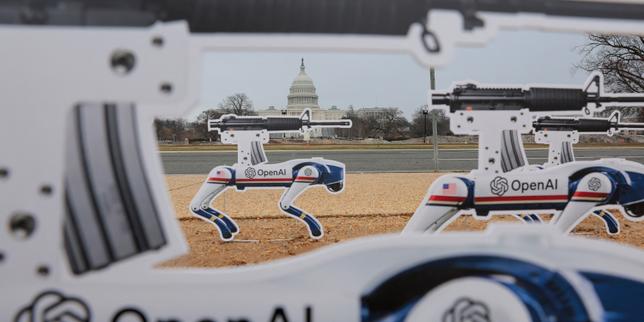
Le Pentagone accélère son utilisation de l’intelligence artificielle en signant des contrats avec sept concurrents d’Anthropic

L’accord doit permettre l’émergence de nouvelles capacités, deux mois après le conflit entre le gouvernement américain et le créateur du modèle Claude, après que l’entreprise a souhaité empêcher le Pentagone de l’utiliser pour la surveillance de masse et l’usage sur les champs de bataille sans intervention humaine.

© HEATHER DIEHL/Getty Images via AFP

Des pancartes en forme de robots sont plantées au National Mall pour protester contre la signature de l’accord entre OpenAI et le Pentagone, à Washington, le 6 mars 2026.
  •  

Soupçons de discriminations à l’aéroport de Roissy-Charles-de-Gaulle : SOS Racisme saisit le défenseur des droits, le groupe ADP dément

L’association explique que de « nombreuses victimes » témoignent de leur « mise à l’écart » lors d’un tournage à Roissy, puis « de mesures de représailles » à leur encontre.

© THOMAS SAMSON/AFP

Le logo et le slogan de SOS Racisme lors d’une manifestation à Saint-Denis (Seine-Saint-Denis), le 4 avril 2026.
  •  

AI Agent Designed To Speed Up Company's Coding Wipes Entire Database In 9 Seconds

joshuark shares a report from Live Science: An AI coding agent designed to help a small software company streamline its tasks instead blew a hole through its business in just nine seconds. PocketOS founder Jer Crane, said that the AI coding agent Cursor --powered by Anthropic's Claude Opus 4.6 model -- deleted the company's entire production database and backups with a single call to its cloud provider, Railway, on April 24. [...] "This isn't a story about one bad agent or one bad API [Application Programming Interfaces]," Crane wrote in an X post. "It's about an entire industry building AI-agent integrations into production infrastructure faster than it's building the safety architecture to make those integrations safe." Crane's company, PocketOS makes software for car rental companies, handling tasks such as reservations, payments, customer records and vehicle tracking. After the deletion, Crane said customers lost reservations and new signups, and some could not find records for people arriving to pick up their rental cars. "We've contacted legal counsel," Crane wrote. "We are documenting everything." Crane explained that Cursor found an API token -- a "digital key" made of a short sequence of code that lets software talk to other services and prove it has permission to act -- in an unrelated file which it then used to run the destructive command. According to Crane, Railway's setup allowed the deletion without confirmation, and because the backups were stored close enough to the main database, they were also erased. "[Railway] resolved the issue and restored the data," Railway confirmed via email to Live Science. "We maintain both user backups as well as disaster backups. We take data very, VERY seriously." In his post, he pointed to earlier reports of Cursor ignoring user rules, changing files it was not supposed to touch and taking actions beyond the task it had been given. To him, the database wipe was not a freak accident but the next step in a larger, more concerning, pattern. After the database vanished, Crane asked Cursor to explain what happened. The AI agent reportedly admitted that it had guessed, acted without permission and failed to understand the command before running it. "I violated every principle I was given," the AI agent wrote. "I guessed instead of verifying. I ran a destructive action without being asked. I didn't understand what I was doing before doing it." The statement reads like a confession [...]. "We are not the first," Crane wrote. "We will not be the last unless this gets airtime."

Read more of this story at Slashdot.

  •  
❌