Anthropic has launched Claude Duet, an AI agent aimed at professionals and small businesses that competes with Meta's Muse and OpenAI's Dots. Here's Anthropic's description of what it can do: Each morning, it sends you a short brief on the most important items across your connected apps. Throughout the day, it keeps tabs on those apps and messages you only when something needs your attention. You can also hand it tasks of all shapes -- from simple administrative tasks of scheduling meetings to more complex ones, such as building dashboards with dozens of tools, creating financial or sales forecasts, prototyping, and building web apps. The Verge reports: Claude Duet pulls in memory, skills, and connected apps from Claude, and it has a virtual machine with a browser that it can use for completing work. Before any big step, like sending a payment or deleting something, Claude Duet messages you for approval. Given that Duet may be taking action on sensitive information, it has a new "new dedicated classifier and safety system prompt" that are "designed to reject requests to share the strictest tier of information," such as credit card numbers.
Anthropic says Claude Duet is currently an "early version" and that it "still might misread a thread or miscalibrate what's urgent." It's also not "as strong" at personal errands like booking tickets.
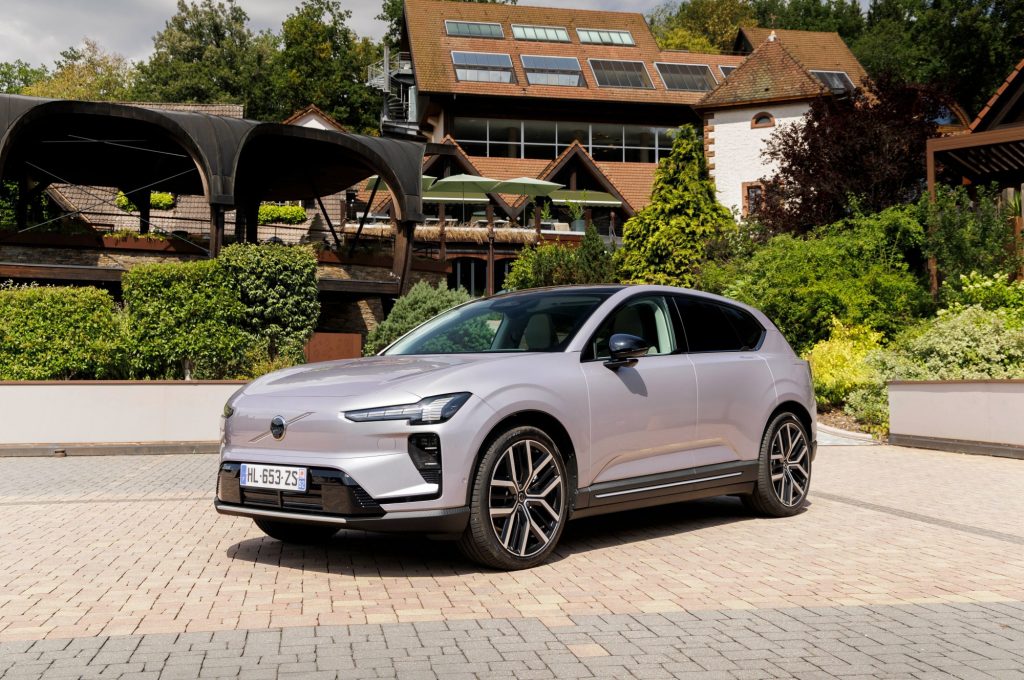
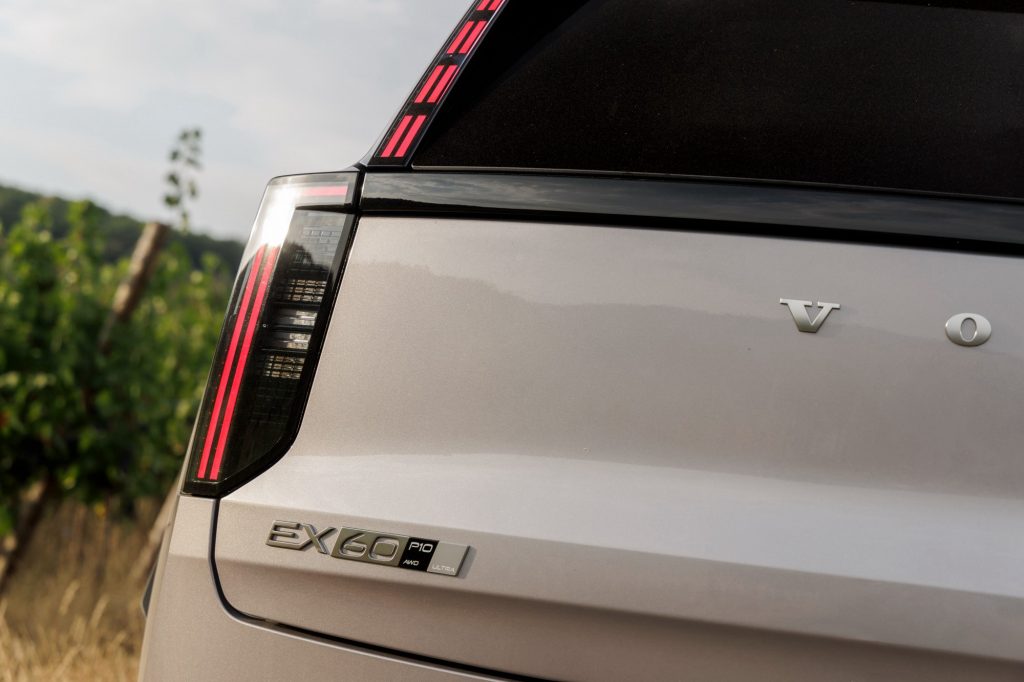
Depuis la reprise de Volvo Cars par le groupe chinois Geely, le constructeur suédois parvient à conserver son identité et tout son caractère, avec une culture automobile propre à la marque. Seulement voilà, son propriétaire semble disséminer de plus en plus ses technologies dans la plupart des modèles du groupe. Le nouveau Volvo EX60 perd-il de son âme scandinave ? Nous l’avons essayé sur les routes d’Alsace.
Le futur aujourd’hui
Avec son nouvel EX60, Volvo affronte des références de qualité en provenance d’outre-Rhin. Et ces dernières ont placé la barre très haut. Sur ce segment où les clients fortunés peuvent se permettre d’être particulièrement exigeants, le Suédois doit se démarquer, sans faire de compromis au regard des prix pratiqués sur le marché actuel. Cela commence par un design qui doit être statutaire, sans trop en faire. Sur ce point, la mission nous semble réussie. À Göteborg, on n’a pas renversé la table à coups de crayon. C’est dire à quel point les lignes des modèles précédents étaient avant-gardistes.
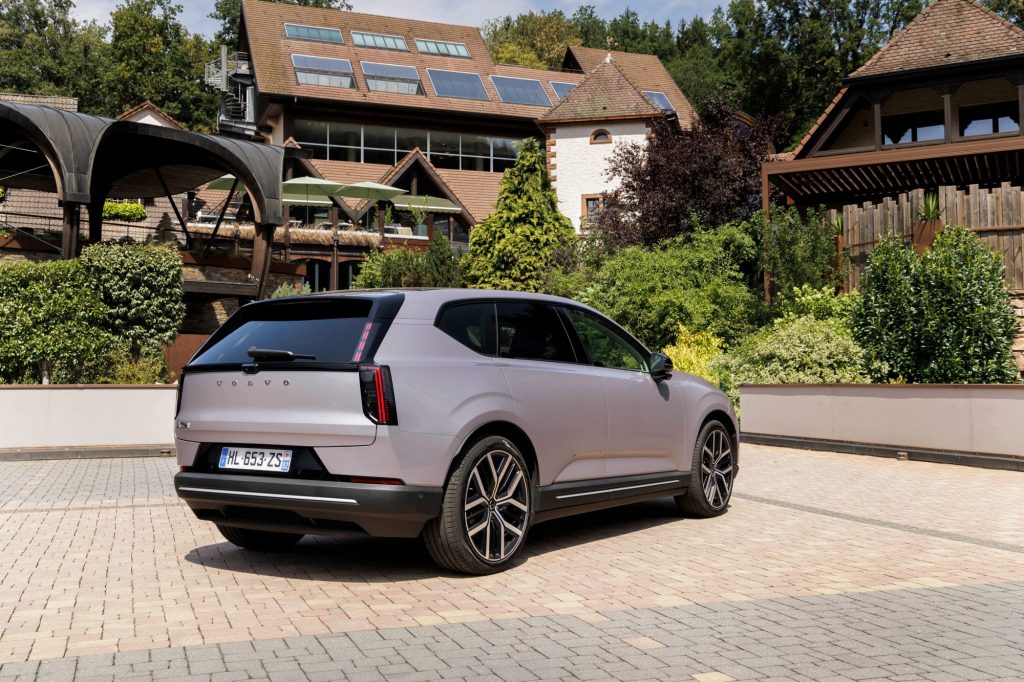
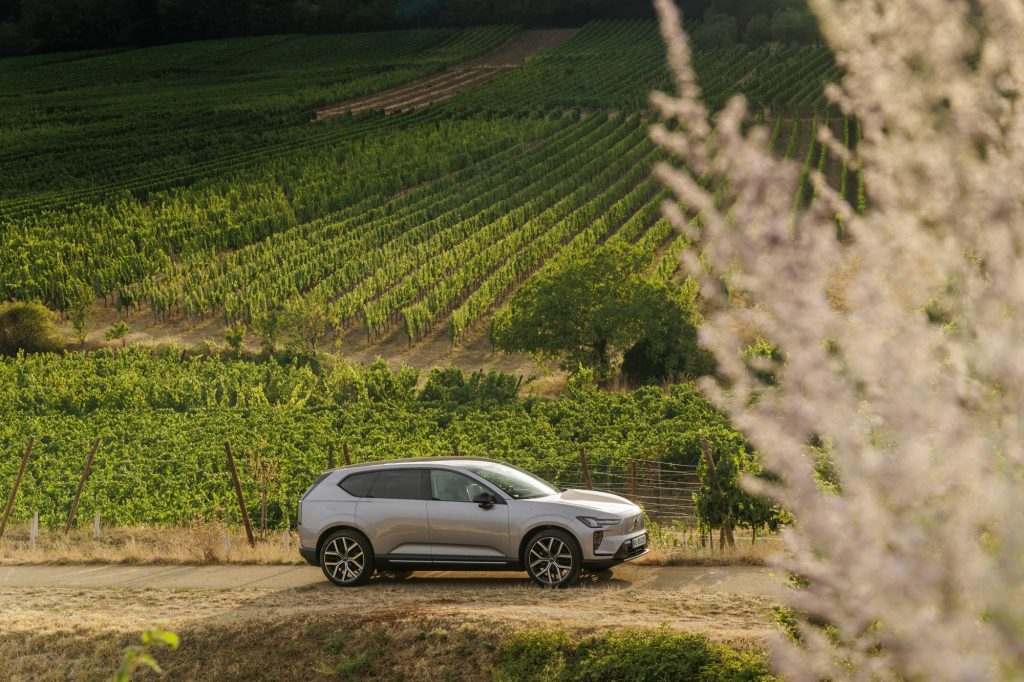
Son allure s’est largement modernisée, sans renier ce qui a été fait auparavant et qui était si apprécié. Les iconiques marteaux de Thor sont reconduits ici, aux extrémités d’une calandre fermée, littéralement barrée par les armoiries de la maison. Mais tous les détails nous apparaissent encore un peu plus futuristes, tandis que les lignes sont subtilement fluidifiées. Plus de poignées sur les portières, mais des mini-ailerons que l’on saisit du bout des doigts. Les roues de notre modèle d’essai sont énormes, avec un diamètre de 22 pouces. Si le XC60 fait très SUV, l’EX60 affiche une allure proche de celle d’un break légèrement surélevé, qui lui va à ravir. L’arrière a également été simplifié, avec une reprise en pointillés de la signature lumineuse verticale que l’on connaît tous.
Ambiance zen et technologique à bord
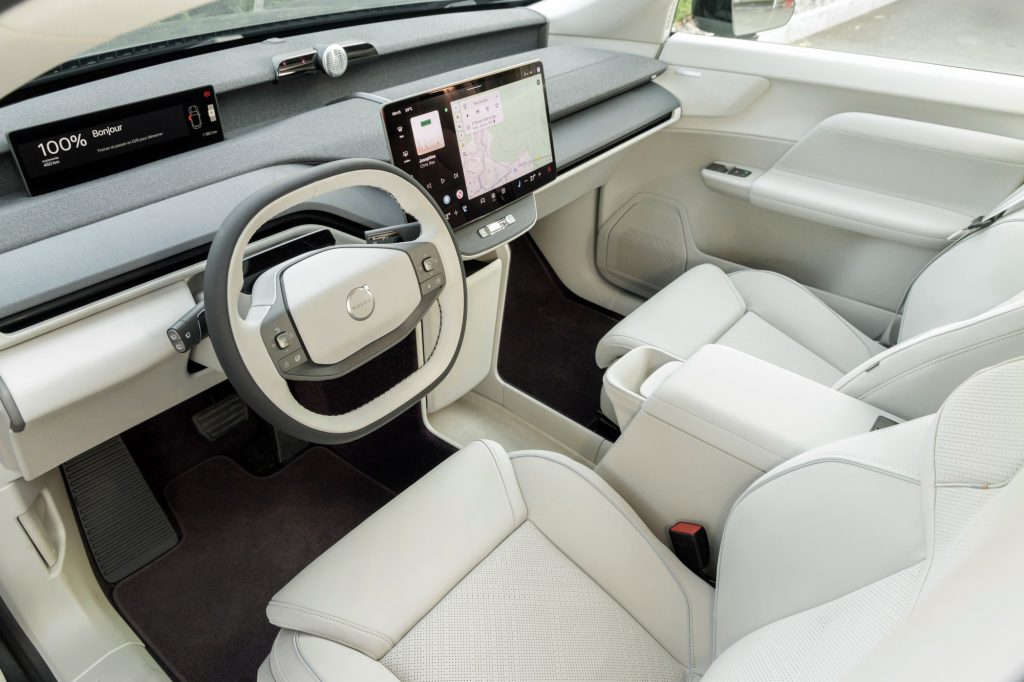
Après avoir été conquis par une telle élégance, quasiment à l’opposé des lignes proches de celles d’un délirant concept-car présenté par certains de ses premiers concurrents, nous attendions l’EX60 au tournant en pénétrant dans l’habitacle. D’abord, on remarque les vitres sans encadrement, une touche chic qui fait toujours son petit effet. Notre exemplaire aux couleurs claires renforce immédiatement le sentiment d’espace et contribue à créer un environnement plutôt chaleureux, mais surtout extrêmement zen. Derrière les lignes simples et horizontales de la planche de bord s’intègrent des matériaux doux au toucher et valorisants à l’œil, dans le plus pur style scandinave. On se retrouve assis sur des sièges en tissu, ce qui donne immédiatement le sentiment d’être dans une habitation plutôt que dans une voiture.
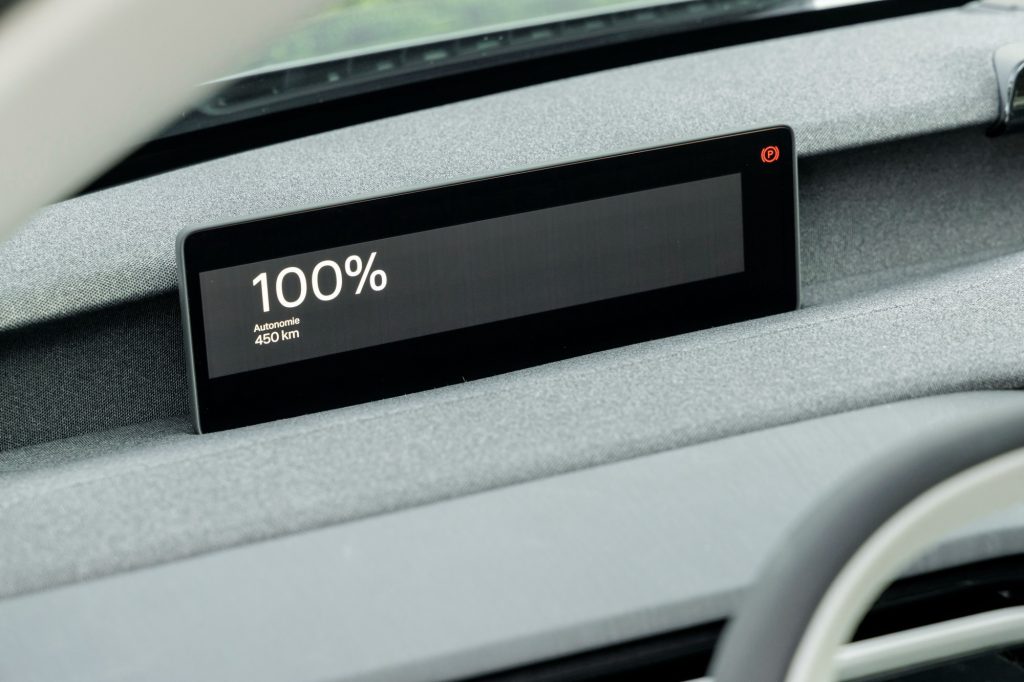
Volvo semble avoir ajouté un volant et une instrumentation uniquement parce qu’il le fallait dans cette agréable bulle de verre. Derrière le tout petit, mais non moins élégant volant, on trouve un écran très horizontal affichant l’essentiel des informations nécessaires, sans surcharger le champ de vision du conducteur. La très grande dalle tactile centrale en mode paysage, d’une diagonale de 15 pouces, semble pour sa part, tout droit héritée du propriétaire chinois de Volvo, comme sur les EX30 et EX90 avant elle. Nous y reviendrons, mais à quelques exceptions près, malheureusement pas toujours très logiques, tout se commande depuis cet écran. Pas de boîte à gants devant le passager, mais un tiroir profond et large, installé au milieu de la planche de bord. On se sent bien, quelle que soit sa place. Nous sommes littéralement tombés amoureux de ce bois teinté violet, assorti à la moquette et aux tapis. On manque cependant cruellement de poignées de maintien.
Le confort de la puissance
Avant de prendre la route, on jette un coup d’œil au coffre, dont la capacité atteint 523 litres, avec un faux plancher à ouverture 2/3-1/3. Un « frunk » de 52 litres permet tout juste de loger un câble, mais peut-être pas deux. Après avoir appairé notre téléphone à la voiture, malheureusement dépourvue de CarPlay, tandis qu’Android Auto ne sera disponible qu’au dernier trimestre, on constate qu’il n’y a toutefois pas de quoi s’inquiéter, le planificateur d’itinéraire est de qualité. En lançant notre musique dans l’excellent système Bowers & Wilkins, on boucle notre ceinture, qui, sachez-le, s’adapte à la morphologie de la personne, notamment en cas de grossesse, afin d’assurer une retenue plus adéquate en cas de choc. Peu de commandes physiques malheureusement, à l’exception des touches du volant, de la gestion de l’audio, et des vitres électriques. Devoir régler le volant et les rétroviseurs via l’écran reste une étape agaçante.
Ce nouveau Volvo EX60 repose sur une plateforme inédite du groupe Geely. Ce grand véhicule taillé pour avaler les kilomètres reçoit une batterie nickel-manganèse-cobalt de 95 kWh dans notre version P10. Bien entendu, vous vous en doutez, il pèse son poids, plus de 2,3 tonnes sur la balance. Avec ses deux moteurs, il développe 510 ch et un couple camionesque de 710 Nm. Dans notre canapé suédois, on peut s’enfoncer dans le siège lorsque l’on met le pied au plancher, comme en témoigne le 0 à 100 km/h réalisé en seulement 4,6 secondes. En réalité, nous avons finalement peu fait appel à toute cette puissance durant notre parcours, tant nous avons profité au maximum du confort de premier ordre. On relève bien quelques mouvements de caisse, mais on est loin du bateau ivre de certains SUV qui poussent trop loin le moelleux de l’amortissement.
Autonomie réelle prometteuse
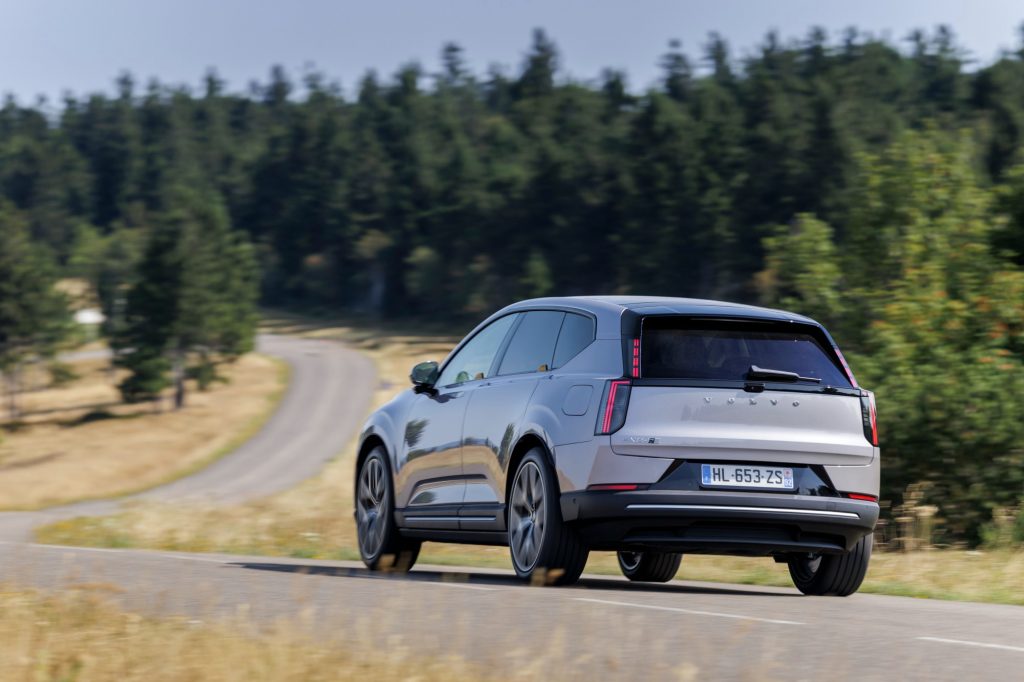
Encore une fois, la quiétude à bord nous apparaît comme la principale qualité de ce nouvel EX60, en accord avec une conduite très douce, sans rogner, comme nous l’avons dit, sur les performances. La voiture se tient étonnamment bien en courbe, avec même un sentiment d’agilité auquel nous ne nous attendions absolument pas. Nous devons probablement cela au volant de petit diamètre, à la suspension pilotée et aux gommes très performantes, des Pirelli Scorpion marqués « VOL », développés pour ce modèle. Avec des jantes aussi grandes (22 pouces) et des pneus aussi fins, le travail de réglage des suspensions nous apparaît encore plus remarquable.
Le silence particulièrement soigné, meilleur que chez nombre de ses concurrents, est dû, au-delà d’un vitrage feuilleté de grande qualité, à un système de réduction active du bruit. Notre version P10, la version intermédiaire, nous a gratifiés d’une consommation comprise entre 15 et 16 kWh/100 km, avec une courte portion d’autoroute. En nous contentant du réseau secondaire, nous pourrions sans doute rallier Paris à Strasbourg d’une seule traite, si l’on en croit le chiffre de 610 km selon le cycle WLTP. Évidemment, l’autonomie baisserait probablement autour de 400 km en privilégiant l’A4. Mais il faudra refaire le trajet pour nous assurer d’une endurance qui nous semble, à première vue, compatible avec les longues liaisons. Contrairement à l’EX90 à son lancement, notre EX60 bénéficie d’une architecture 800 V qui, en théorie, assure une recharge de 10 à 80% en tout juste un quart d’heure. À cette vitesse de recharge, la pause pipi commence à devenir très courte. En courant alternatif, le chargeur embarqué permet de profiter d’une puissance de 22 kW.
Son atout: la discrétion
Le Volvo EX60 arrive juste à temps pour faire hésiter ceux qui considèrent les BMW iX3 et Mercedes GLC comme des choix évidents sur le segment des SUV premium taillés pour le voyage. S’il n’en met pas plein les yeux avec quatre écrans à bord et des technologies du XXIIe siècle, sachez que ces dernières sont bel et bien présentes, assurant notamment une conduite autonome de niveau 2. Cette fonctionnalité fait d’ailleurs partie des rares options présentes sur notre exemplaire en finition haut de gamme Ultra. Le Volvo EX60 se distingue par son confort remarquable, l’ambiance à bord la plus agréable de son segment et des performances qui le placent immédiatement face à ses rivaux. Et il faut bien l’admettre, il le fait aussi avec davantage de discrétion. La douloureuse ? La gamme démarre à 66 500 € pour la version P6 équipée de la plus petite batterie. Notre version intermédiaire P10, en finition haut de gamme Ultra et dotée de ses options, réclame 81 325 €. La voiture est assemblée en Suède, sur le site Volvo de Torslanda.
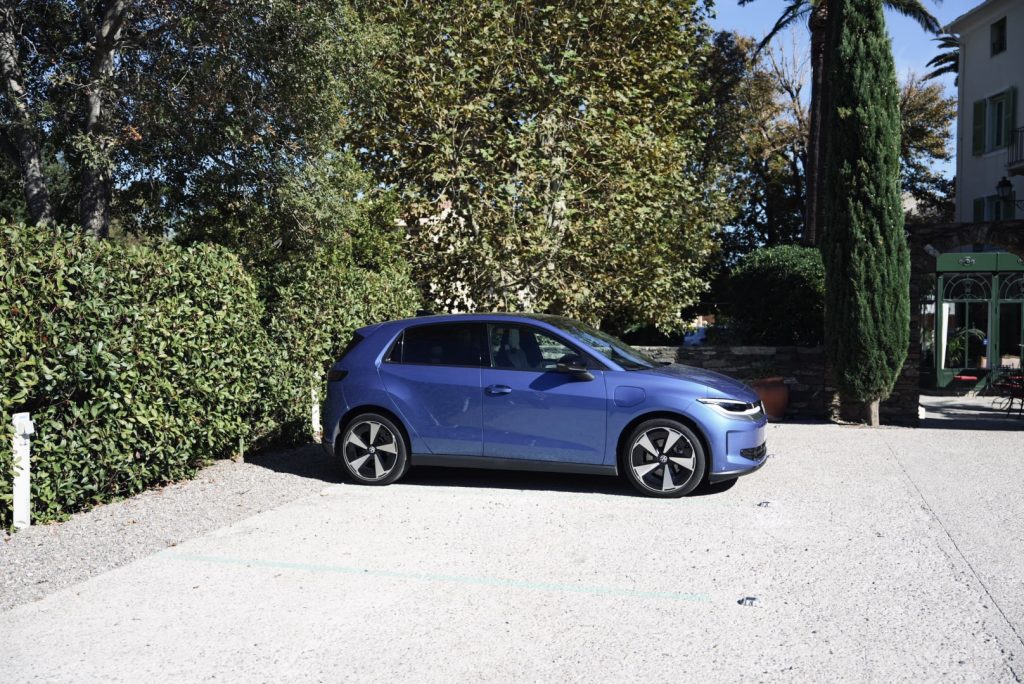
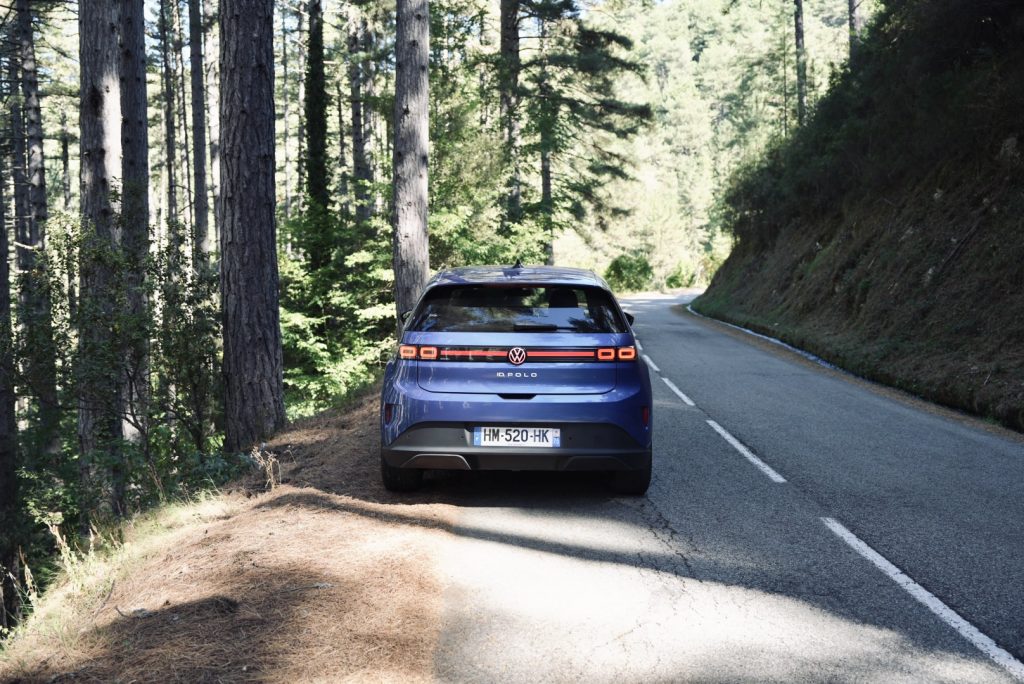
Volkswagen a lancé la version électrique de la Polo et nous avons eu l’occasion de tester l’ID. Polo dans des conditions que cette citadine ne connaîtra sûrement pas tous les jours.
Une petite citadine électrique qui suit les traces de sa cousine thermique
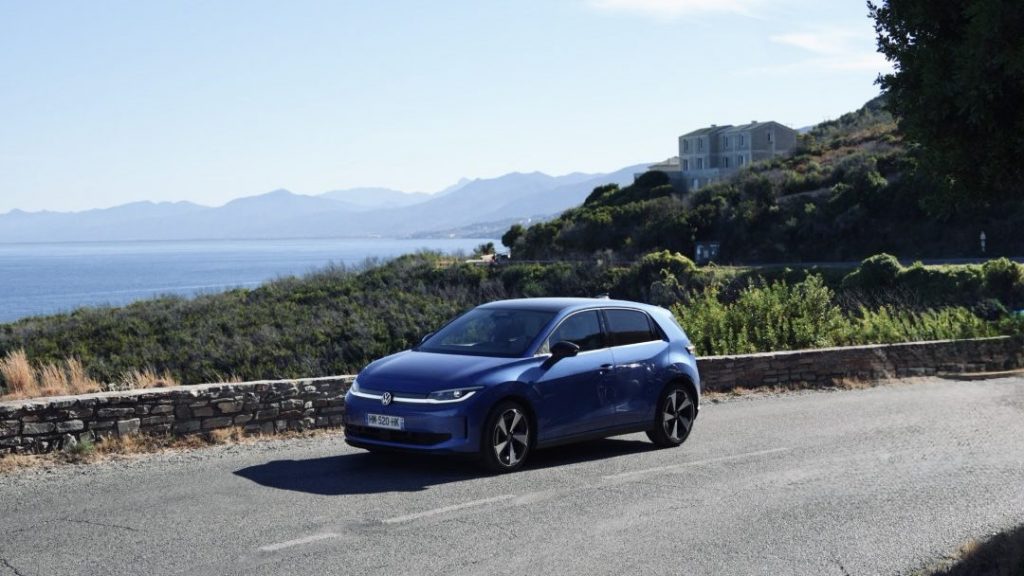
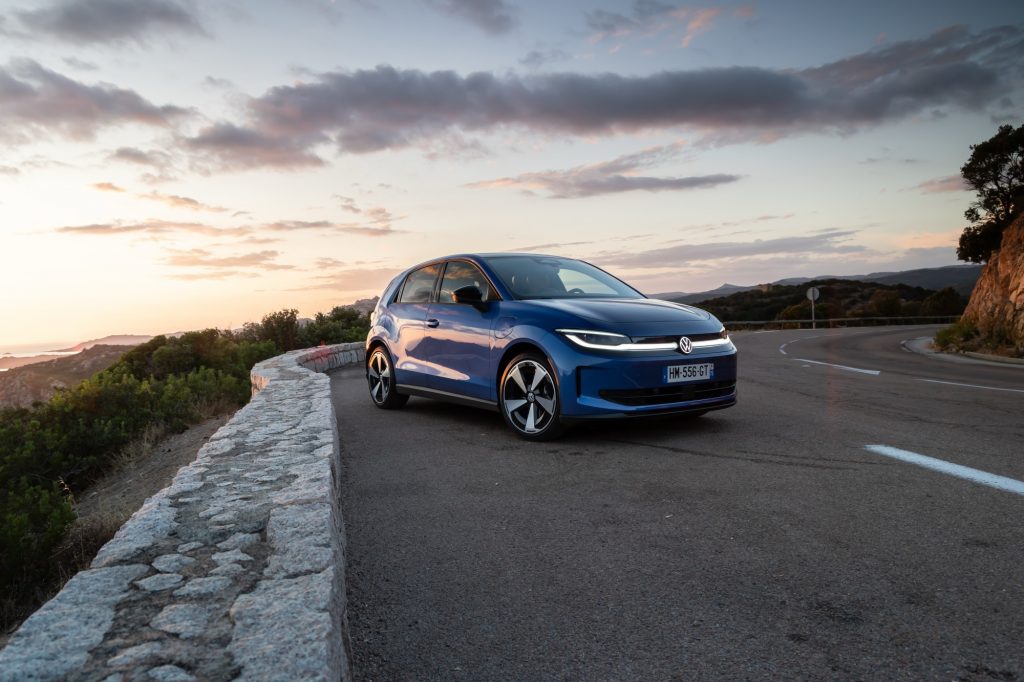
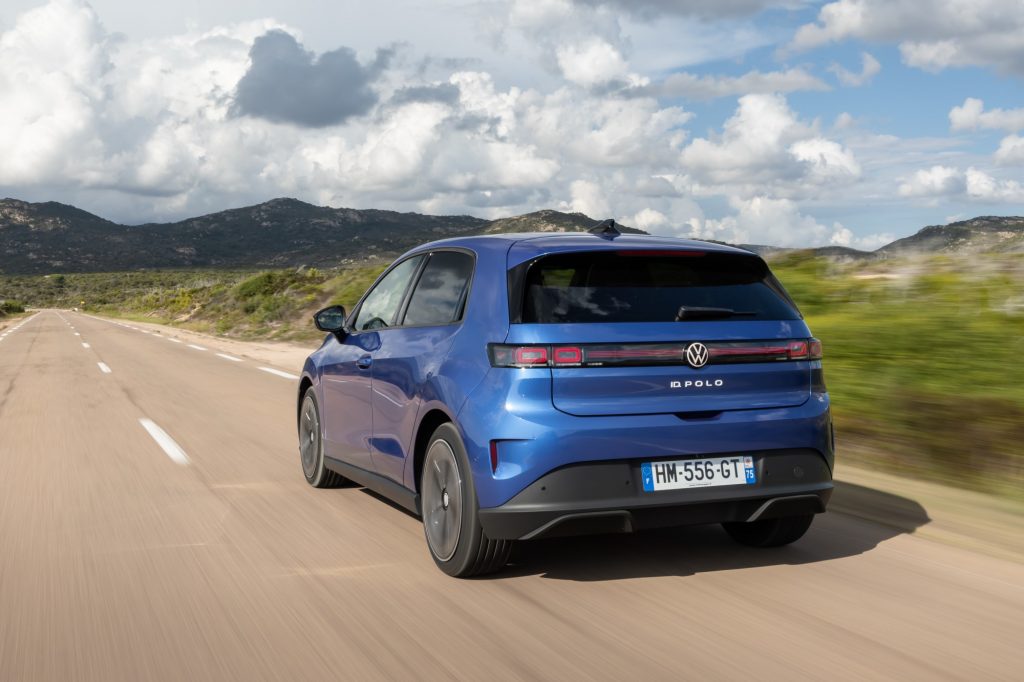
En termes de design, contrairement aux autres modèles de la gamme ID., comme les ID.3 Neo et ID.4, l’ID. Polo conserve les codes de la Polo que l’on connaît bien.
C’est une voiture électrique, certes, mais dont le design extérieur ne le met pas en avant plus que de raison. La Polo a plus de 50 ans d’histoire, et cette héritière en conserve les codes stylistiques.
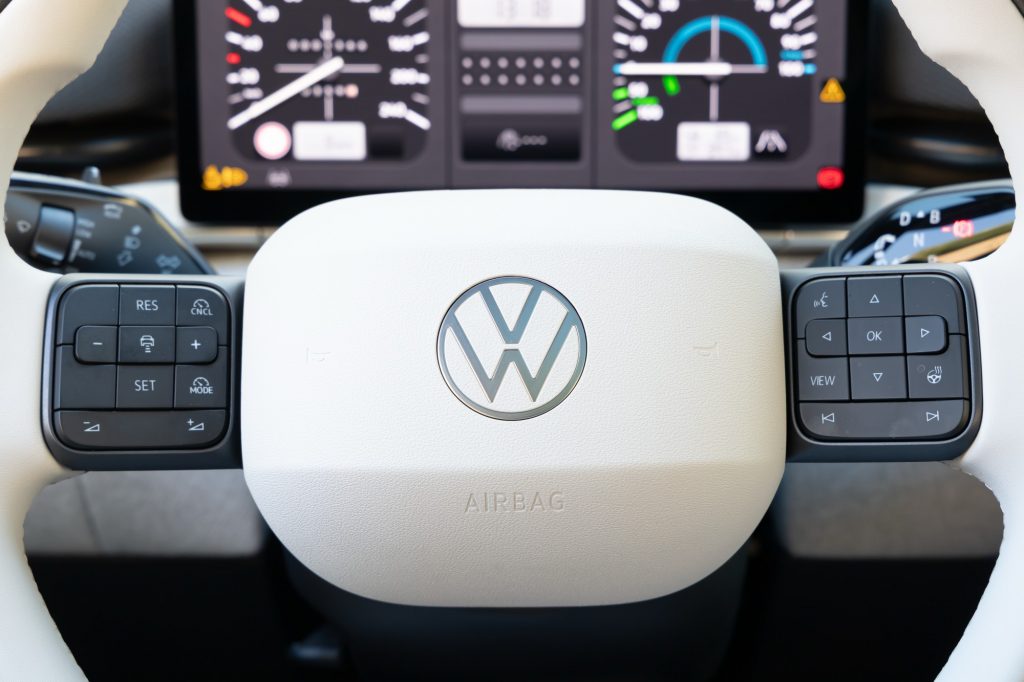
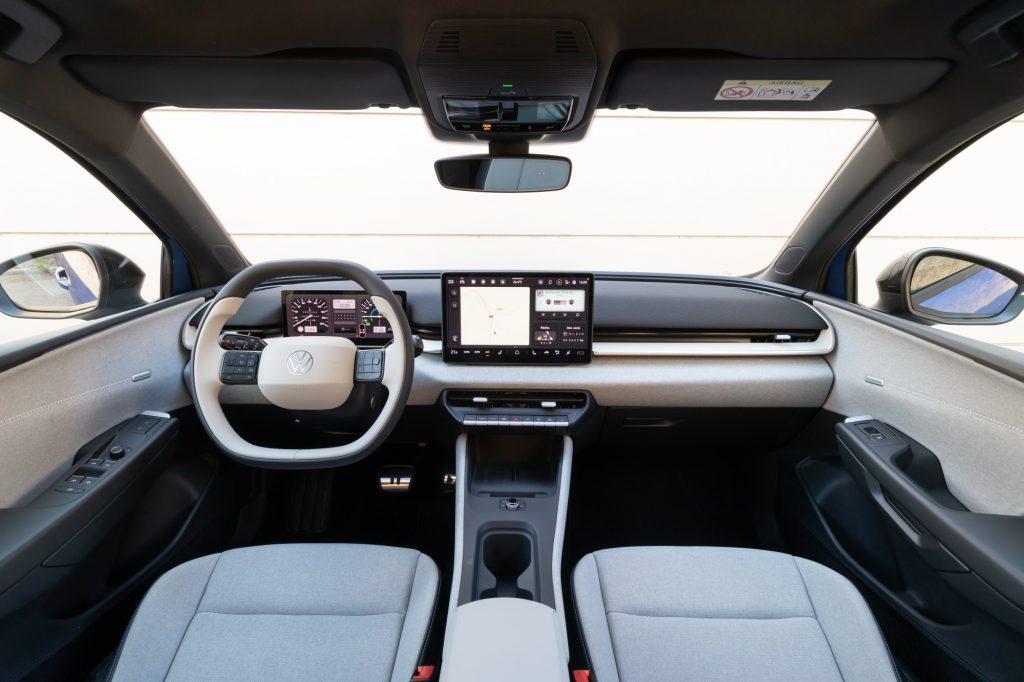
L’intérieur est simple, mais ergonomique. En effet, on y retrouve enfin des boutons physiques sur la console centrale ainsi que sur le volant. Ces dernières années, les constructeurs avaient fait disparaître ces commandes physiques. Aujourd’hui, nous revenons un peu en arrière, pour notre plus grand plaisir.
Les écrans toujours plus grands et l’évolution de la technologie rendent la conduite et l’expérience à bord plus confortables, à condition de savoir intégrer ces équipements avec parcimonie. C’est le cas dans cette ID. Polo, qui dispose tout de même d’un écran de 10,25 pouces face au conducteur et d’un écran central de 13 pouces.
L’équipement se montre intéressant dès la finition Life, qui constitue le deuxième niveau de finition. Elle comprend notamment le régulateur de vitesse adaptatif ACC et une caméra de recul. Des équipements pratiques au quotidien, qui facilitent aussi bien les trajets urbains que les manœuvres. De quoi disposer d’un équipement déjà bien fourni sans nécessairement multiplier les options.
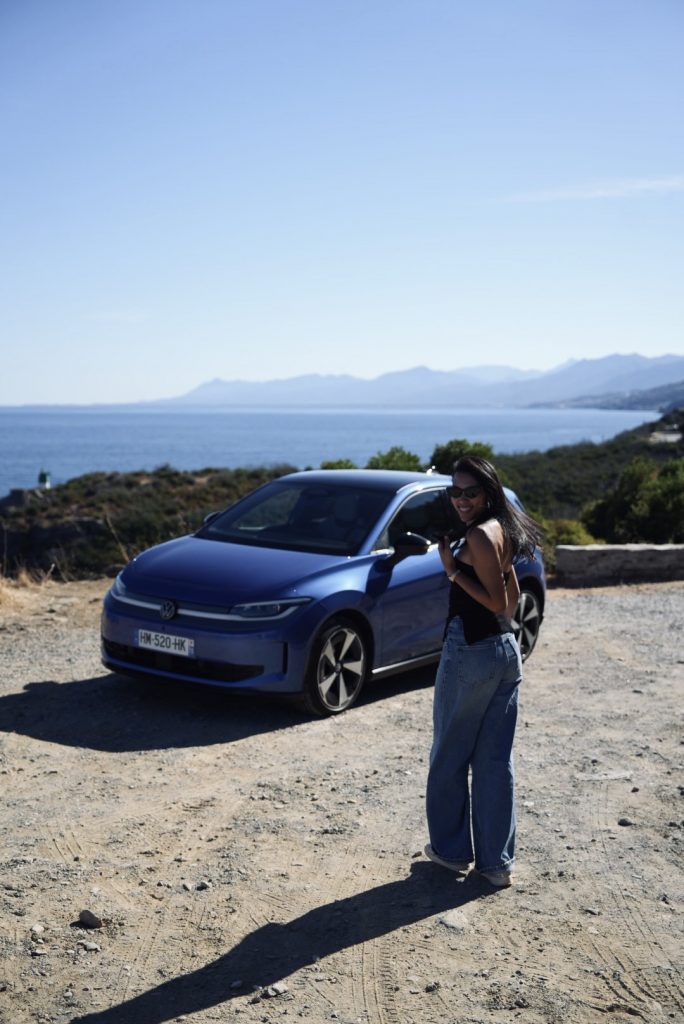
Notre voyage a débuté à Propriano, sur le littoral corse, dans un environnement urbain où cette petite voiture est parfaitement à l’aise. Avec ses 4,05 m de longueur et 1,82 m de largeur, elle mesure environ 2 cm de moins en longueur que la Polo thermique.
De Propriano à Bastia, 200 km au volant de l’ID. Polo
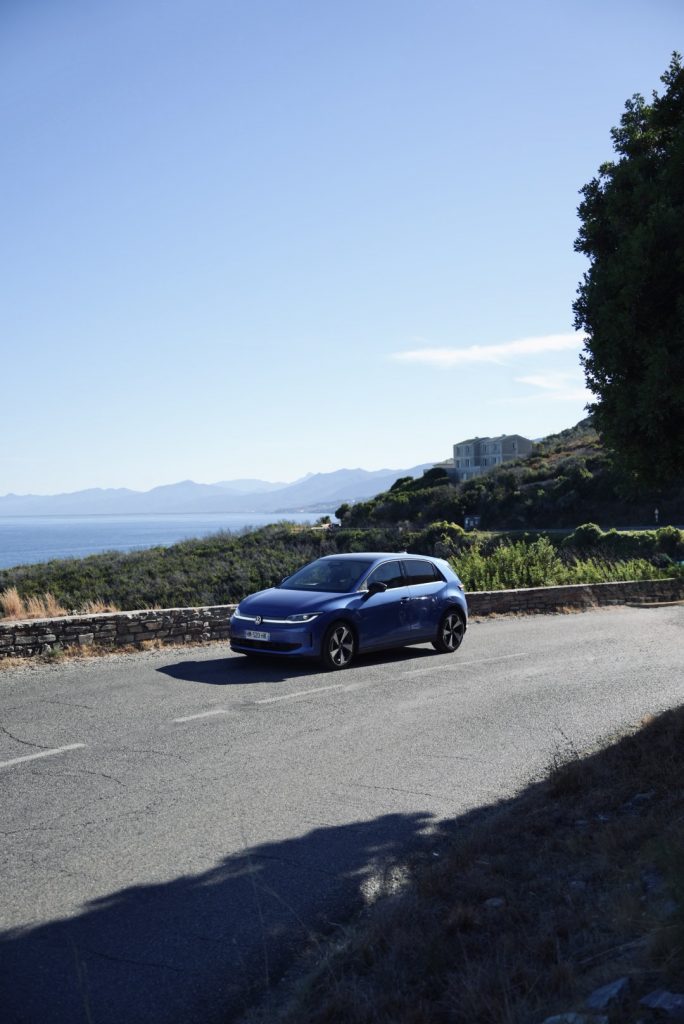
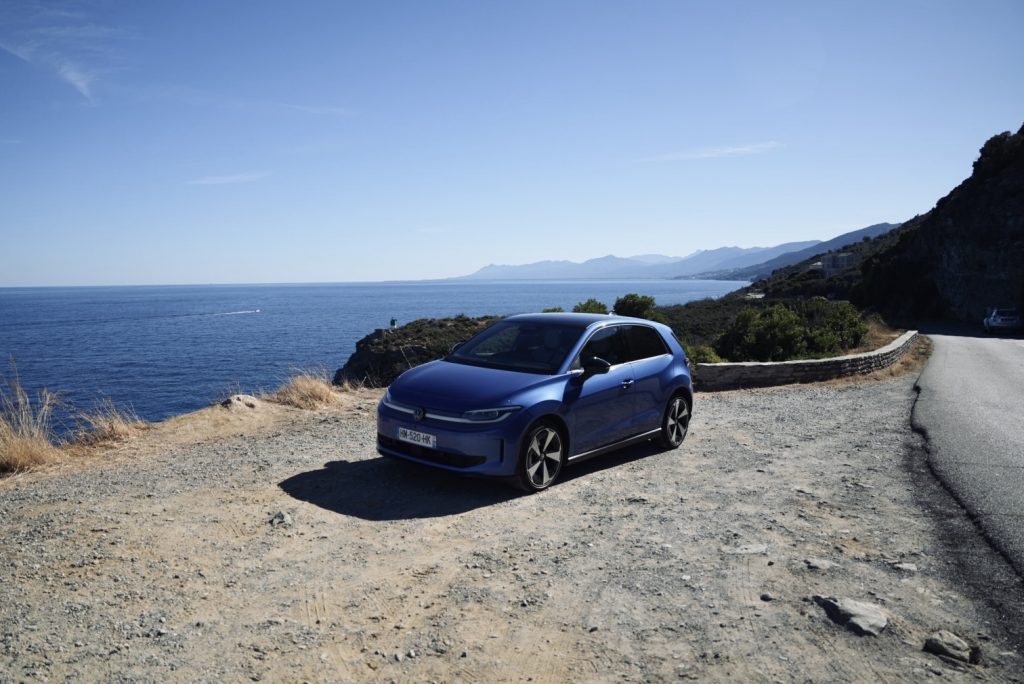
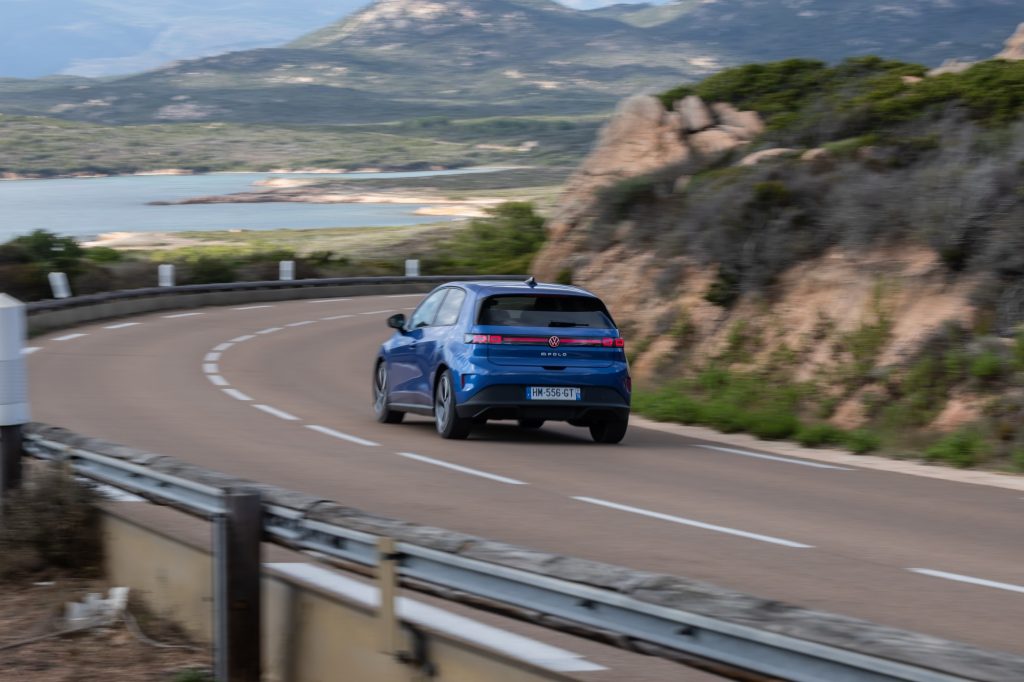
Volkswagen nous a proposé de ramener une ID. Polo sur le continent après l’essai et d’en faire une vidéo sur notre chaine YouTube Two Seats Only. Nous sommes donc partis pour quatre heures de route et 203 km, et très vite, le paysage corse a changé. La mer s’est éloignée pour laisser place aux routes de montagne sinueuses et peu fréquentées.
En tant que passager, ce genre de route peut vite devenir inconfortable, encore plus en voiture électrique. Mais, aussi bien en tant que passagers qu’en tant que conducteurs, l’ID. Polo nous a permis de profiter de ce voyage qui semblait ne pas lui être adapté.
Autour de nous, les rares voitures que nous avons pu croiser étaient plutôt des utilitaires ou des 4×4 tout-terrain. Mais, au prix actuel des carburants, finalement, cette voiture électrique s’est avérée être un bon choix.
Les routes de montagne riment avec vitesse moyenne basse et dénivelé. En électrique, chaque descente ou freinage est l’occasion de recharger la batterie. Quand le freinage régénératif n’est pas réglable, cela peut être inconfortable. Mais Volkswagen n’en est pas à sa première voiture électrique et les réglages disponibles nous ont permis de ne pas subir ce freinage, mais d’en profiter.
Après cinq heures sur les routes, dont plusieurs arrêts pour admirer l’île, nous sommes arrivés à Bastia sans avoir à nous inquiéter de l’autonomie et avec une consommation moyenne de 11 kWh/100 km.
L’ID. Polo existe en trois motorisations : 116 ch, 135 ch et la nôtre, la version de 211 ch. L’autonomie annoncée pour la version que l’on a essayé est de 453 km (cycle WLTP) pour une batterie de 52 kWh (l’autre batterie disponible fait 37kWh).
Sur le marché des citadines électriques, l’ID. Polo fait notamment face à la Renault 5 E-Tech electric et à la Peugeot E-208. Avec une autonomie annoncée pouvant atteindre 453 km (sur la version essayée) et un coffre de 441 litres, elle dispose d’arguments intéressants pour celles et ceux qui recherchent une voiture électrique polyvalente, capable de dépasser les simples trajets urbains. Son gabarit compact, son autonomie et son espace de chargement en font une alternative intéressante pour un usage quotidien, mais aussi pour des trajets plus longs, comme notre itinéraire à travers la Corse.
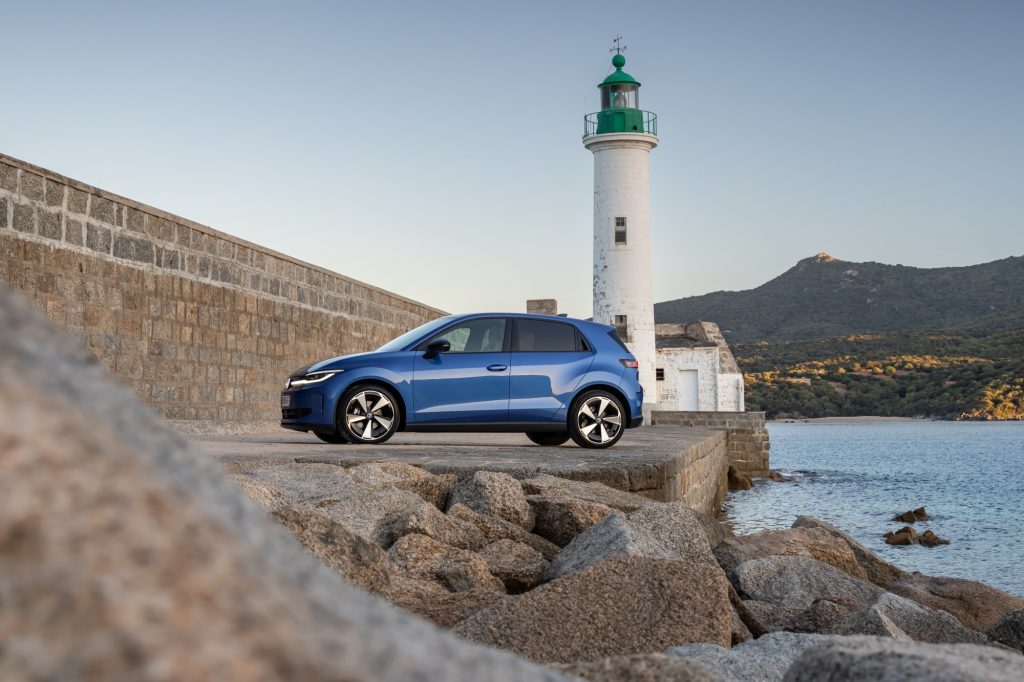
Le lendemain, nous avons repris la route, mais sans consommer cette fois-ci, car nous avons rejoint le port de Bastia pour embarquer avec l’ID. Polo sur le ferry, direction le continent.
Ceux qui ont déjà vécu l’expérience le savent : nous étions contents d’avoir une petite voiture maniable pour nous faufiler dans le ferry et nous garer. Chaque centimètre compte en fin d’été.
Côté espace intérieur, nous n’avons pourtant pas du tout exploité ce que cette voiture propose, avec son coffre de 441 litres.
Après sept longues heures de traversée, moi qui roule au quotidien en boîte manuelle à six vitesses, j’ai finalement apprécié le silence de la voiture électrique et le confort de la boîte automatique, notamment dans les bouchons du port de Nice, créés par l’arrivée du navire.
Finalement, cette ID. Polo s’est montrée une partenaire de voyage polyvalente, très discrète et agréable, avec une autonomie assez importante pour ne pas être une contrainte.
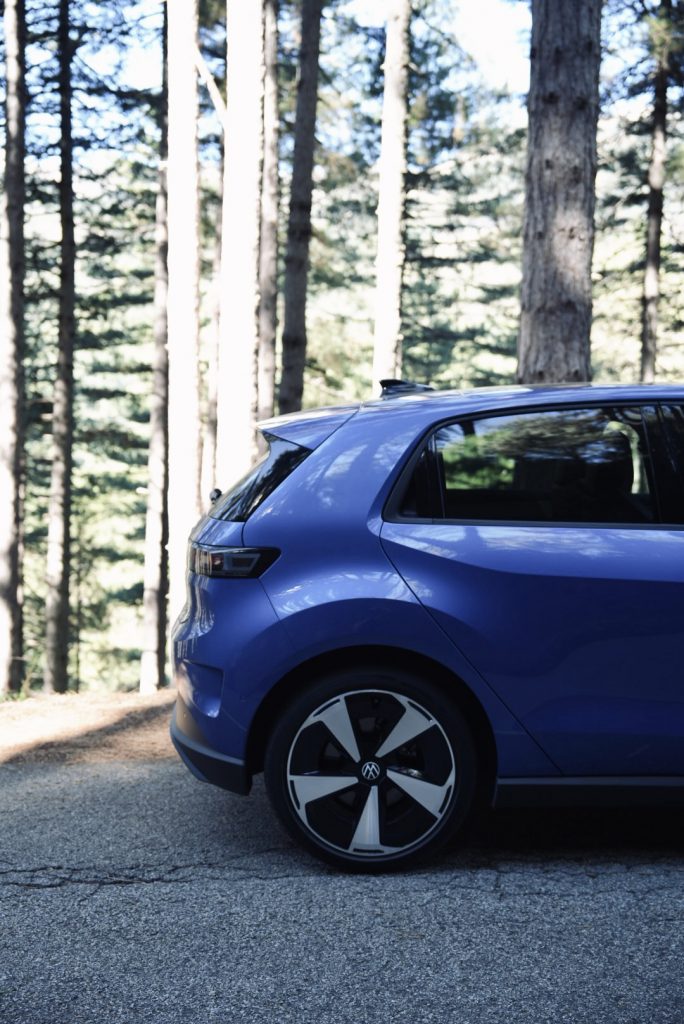
Notre version était équipée de jantes bicolores de 19 pouces, qui nous ont offert une bonne tenue de route sur les routes sinueuses, mais que je ne recommande pas forcément sur ce modèle, car, pour moi, elles ne sont pas nécessaires compte tenu de l’usage que j’en attends.
Cela dit, une version GTI a été présentée et, sur celle-ci, je comprends la démarche. L’ID. Polo GTI aurait tout à fait pu convenir pour ce voyage. Qui sait, peut-être à une autre occasion pour transformer ce voyage calme en quelque chose de plus sportif !
Here are the latest updates and offers from Topaz, DxO, Luminar, and Aftershoot:
You can now get 50% off Topaz Studio & Topaz Photo (50% off the first three months of a monthly or annual plan, or 50% off an annual plan paid up front):
Month-to-month: Topaz Studio $69 $34.50/mo | Topaz Photo $39 $19.50/mo
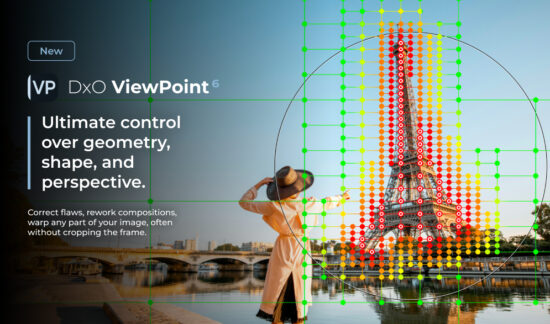
DxO released ViewPoint 6 and PhotoLab 10.2. The new version of ViewPoint introduces AI to help correct perspectives in specific areas of an image – here are the main new features:
AI Masks in ReShape Fusion: Precisely reshape individual objects or people with AI-assisted selection and adaptive mesh controls, without affecting the entire image.
Perspective correction without cropping: Make localized geometric adjustments while preserving the original framing, without generating or inventing image content.
Native RAW editing: Open and edit RAW files directly in the standalone application, without pre-conversion.
New exposure and white balance controls: Adjust exposure (±4 EV) and white balance before applying geometric corrections.
Non-destructive workflow: Edits are saved in separate sidecar files, preserving the original images.
Google is beginning to replace traditional support articles with "Ask Google Help," a Gemini-powered interface that summarizes documentation and lets users troubleshoot through a chatbot. 9to5Google reports: "Ask Google Help" will display a condensed version of the support article with direct troubleshooting steps, with the user then able to type in queries to have Gemini help figure out the next step forward. A "View Sources" button at the bottom of the AI response allows users to still access the original article, but direct links to any of these articles now defaults to the AI experience.
An example can be seen below on the "Secure a hacked or compromised Google account" page that Google's own support account directed users to within the past few days. It can also be seen on the "Fix common issues with 2-Step Verification" page and, as far as we can tell, any support pages on the Google Account Help forum.
Google, as of right now, appears to only be testing this on select support topics. The Google Pixel Help section, for instance, still defaults to articles, whereas the Google Chrome topic has also moved to the new experience. Beyond support pages alone, this new design also impacts the central hub, with links to topics no longer showing by default in exchange for an AI chatbot that helps you find the relevant page.
The Trump administration has banned DeepSeek AI from most US civilian federal agencies, ordering the removal of the Chinese company's models and technology developed using them. The Department of Homeland Security did not specify the security threats behind the decision. The BBC reports: The order (PDF) is broad, as it requires agencies to ditch "all DeepSeek and DeepSeek-affiliate products, and third-party products and services developed using DeepSeek implementations." Complying will be tricky as it is not clear which third-party products and services have been developed using DeepSeek's wares. Nor is it clear whether "developed using" means providing ongoing access to DeepSeek models via API or simply refers to any app vibe-coded with the help of DeepSeek.
It also leaves open the question of AI gateways. Services such as OpenRouter and Vercel AI Gateway make DeepSeek's models available through APIs. And those using gateway services may find themselves using DeepSeek models without meaning to do so. OpenRouter, for example, "routes requests to the best available providers for your model." It selects what the service deems to be the best fit provider of AI services. Vercel AI Gateway does the same by default. So federal civilian agencies could be using DeepSeek models inadvertently, if they haven't taken steps to constrain their AI providers.
Microsoft has reportedly abandoned plans to serve as the anchor customer for Britain's largest proposed AI supercomputer after learning that the project's Essex data center might not receive sufficient grid power until the early to mid-2030s. "Its departure leaves Nscale without a publicly announced customer for the site, although the neocloud insists the project is still going ahead," reports The Register. From the report: When the deal was announced in September 2025, the plan was to pack 23,040 Nvidia GB300 GPUs into a 50MW facility, with room to expand to 90MW. Microsoft would use the computing power for its Azure cloud services, with the first chips expected in early 2027. One important detail remained: how to power it.
As The Guardian reported last month, UK Power Networks warned Nscale that the grid capacity needed might not be available until the 2030s. A UK Power Networks spokesperson told The Register it could not discuss individual connections due to obligations under Section 105 of the Utilities Act. "However, in general, many datacenters, whilst they can connect to our distribution network, are awaiting works on the national transmission network which we do not own," the spokesperson said.
Nscale, meanwhile, isn't letting the small matter of losing its biggest customer dampen its enthusiasm. "We remain committed to both the Loughton project and the UK and we are exploring alternative power sources for the site, in addition to other expansion sites in the UK. Our relationship with Microsoft remains strong and long-term, and this unfortunate London-wide grid issue has no impact on our other contracts," Nscale told The Register.
Volkswagen entend faire de cette nouvelle ID. Polo un nouveau repère sur le marché des citadines électriques. Pour la découvrir, rendez-vous sur les routes tortueuses de Corse au départ de Propriano. Une première prise en main qui ne manque pas de relief.
La Polo au catalogue aux côtés de l’ID.Polo
C’est en plein jour que cette Polo pas tout à fait comme les autres se dévoile. Inutile de jouer les détectives! Comme le concept-car qui l’annonçait, elle affiche clairement un lien de parenté avec la Polo thermique, même si elle mesure ici 4,05 mètres de long. Attention toutefois, l’ID. Polo ne remplace pas sa cousine à moteur à combustion. Les deux modèles vont poursuivre leur carrière côte à côte, chacune sur son terrain de jeu. Pas question donc de tirer un trait sur la Polo que l’on connaît. La famille s’agrandit! À l’avant, le regard est souligné par une fine signature lumineuse, un nouveau marqueur stylistique appelé à devenir reconnaissable au premier coup d’œil dans la famille Volkswagen.
Les lignes sont particulièrement lisses, comme si chaque courbe avait été dessinée avec un seul objectif, celui de fendre l’air avec le moins de résistance possible. L’aérodynamique n’a donc pas été laissée au hasard, et cela se voit au premier regard. Et non, malgré les apparences, ce n’est pas une trois-portes. Les poignées arrière sont simplement dissimulées dans le montant C, ce qui préserve la pureté du profil sans sacrifier l’accès à la banquette. C’est d’ailleurs à l’arrière que l’ID. Polo s’éloigne le plus de sa cousine, avec une signature lumineuse composée de doubles feux carrés. Une façon de rappeler qu’elle appartient bien à la famille ID., tout en conservant un air de Polo.
Le retour des boutons!
Passé la portière, l’ID. Polo offre d’abord davantage d’espace que sa cousine thermique, notamment pour les passagers arrière, qui disposent de 20 millimètres supplémentaires pour les jambes. C’est toujours ça de pris ! Alors oui, on peut voyager à cinq. Mais, comme souvent, la place centrale de la banquette reste réservée aux plus courageux, ou aux plus diplomates de la famille. Le coffre, lui, est tout simplement remarquable pour une voiture de 4,05 mètres avec ses 441 litres de capacité. C’est presque le volume d’une compacte, de quoi partir en week-end sans devoir négocier chaque centimètre carré avec les bagages.
La présentation est également à la hauteur, avec des matériaux plutôt bien choisis, notamment des tissus recyclés pour la sellerie, mais pas seulement. L’ensemble est agréable, sérieux, et surtout on se sent rapidement bien installé. Côté ergonomie, Volkswagen a fait un pas dans la bonne direction. On retrouve enfin de véritables boutons sur le volant, ainsi que des commandes physiques pour certaines fonctions essentielles. Il y a donc du progrès, même si, soyons honnêtes, le constructeur peut encore faire mieux pour rendre l’ensemble parfaitement intuitif. Parmi les équipements, un petit bonus mérite le détour, le V2L qui permet d’alimenter un appareil électrique depuis la voiture. On peut ainsi brancher du matériel, s’équiper pour une escapade… ou recharger un vélo électrique.
La Corse ne lui fait pas peur!
Sur les routes tortueuses, et le mot est encore un peu faible, de l’Île de Beauté, on comprend assez rapidement qu’il va falloir composer avec un volant étonnamment imposant pour une citadine de 4,05 mètres. Et croyez-moi, après 2 583 virages en une heure, ça finit par compter. À moins, bien sûr, que votre serviteur ne doive simplement passer un peu plus de temps sur le rameur. Blague à part, l’ID. Polo offre un comportement routier de premier ordre. Son gabarit compact lui va particulièrement bien sur ces routes que l’on aime explorer, mais qui ne pardonnent pas toujours les approximations. Le châssis fait preuve d’une rigueur que l’on n’attendait pas forcément à bord d’une citadine, aidé par un centre de gravité très bas, grâce à la batterie installée sous le plancher, ainsi que par une direction précise. Avec les 211 ch de notre modèle d’essai, une puissance très confortable pour une citadine, il vaut mieux un châssis à l’avenant compte tenu des performances.
On retrouve finalement une recette très Volkswagen, c’est-à-dire un confort parfois un peu ferme, mais un équilibre rassurant, qui rend la voiture facile à conduire et surtout prévisible. À tel point que l’on se surprend à hausser le rythme, histoire de se prendre pour un pilote de rallye en reconnaissance. Avec, tout de même, une différence importante… Ici, pas de chrono et encore moins de copilote pour vous rappeler que le prochain virage arrive très vite. Rassurons-nous, l’ID. Polo sait aussi parfaitement évoluer à des allures plus raisonnables. Elle peut même se montrer un peu sèche à basse vitesse sur les routes les plus dégradées de l’île, mais rien de rédhibitoire. Résultat, on retrouve le bon sens d’une vraie citadine, avec cette facilité de conduite que l’on a parfois l’impression d’avoir perdue ces dernières années.
Une autonomie qui promet
Et côté consommation, me direz-vous ? Avec sa batterie de 52 kWh, l’ID. Polo revendique jusqu’à 453 kilomètres d’autonomie selon le cycle WLTP, pour une consommation homologuée d’environ 13,3 kWh aux 100 kilomètres. Voilà qui place la barre assez haut pour une citadine. En ville, où les phases de récupération sont nombreuses, il est même possible d’aller encore plus loin, ce qui est précisément le terrain de jeu naturel d’un modèle de ce gabarit. Le mode B, en revanche, on s’en passera. Il se trouve sur le commodo du sélecteur de boîte et c’est tout sauf pratique de l’activer. On réclame des palettes !
Sur les routes corses, peu favorables à un concours d’éco-conduite, notre consommation s’est plutôt établie autour de 15 kWh aux 100 kilomètres. L’île compte peu de voies rapides, ce qui ne nous a pas permis de mesurer précisément l’autonomie sur autoroute. Dans ces conditions, il faudra probablement tabler sur 250 à 300 kilomètres selon le rythme, mais on le vérifiera plus tard, lors d’un nouveau rendez-vous avec elle. Reste la question de la recharge. Sur une borne rapide en courant continu, la puissance maximale de 105 kW peut sembler aujourd’hui un peu modeste, y compris pour une citadine aux prestations de compacte. Il faut compter environ 24 à 25 minutes pour passer de 10 à 80 %. Ce n’est pas un record, mais c’est suffisant pour faire une pause-café sans avoir le temps de commander le dessert.
Une future référence
Au final, l’ID. Polo coche bon nombre de cases, comme un style qui assume sa filiation sans la copier, un habitacle spacieux avec un coffre de 441 litres, un comportement routier plus rigoureux qu’on ne l’attendait et une autonomie homologuée de 453 kilomètres. Face à cela, une recharge de 105 kW un poil timide et une ergonomie encore un peu perfectible. Les tarifs débutent à 24 995 €, dont il faut retirer les multiples aides gouvernementales et primes commerciales éventuelles. Volkswagen tient là une sérieuse candidate au rôle de meilleure référence des citadines électriques.
"Anthropic says it's committing 5% of its shares to a 'public benefit fund'," reports TechCrunch, "structured as a wholly-owned entity within the company — with the option to contribute an additional 2% for every 50% increase in Anthropic's value."
Important context from CNBC:
The timing of Anthropic's public fund announcement is both mandatory to prepare for an initial public offering, and "beneficial from an image perspective," especially as AI reshapes the jobs market, Lise Buyer, partner at IPO advisory firm Class V Group, told CNBC...
Anthropic said it will share more about the fund structure and governance in the coming months, including valuation milestones that may increase the stake. It said it will also share progress on the fund in an upcoming public benefit report. In response to Anthropic's announcement, Tesla and SpaceX CEO Elon Musk said on X that he "recommend[s] giving the shares directly to the public."
Anthropic's announcement hints the fund could address job-market displacements. It says the fund "might" explore "large donations to traditional nonprofits" — or, that it "might" explore "direct distributions to specific populations. One example is labor market impacts."
It then argues AI could "cause instability" for many workers. And while Anthropic has already committed $200 million for "studying and addressing" this issue, Sunday's announcement says "bolder" approaches may be needed, and that the Fund "will have the versatility to pursue them."
"Combined with its co-founders' pledge to donate 80% of their equity and an employee donation matching program, roughly 20% of Anthropic's shares will be dedicated to public purposes," reports Reuters, "excluding any additional shares added later."
The Verge reports:
OpenAI, Meta, Google, Instinct, and others promise their agents can scour the internet on your behalf, doing anything from booking a dinner reservation and cleaning out your inbox to buying new shoes. But what happens when the rest of the internet won't play nice?
In recent weeks, users of services like Meta's Muse, xAI's Grok, OpenAI's Dots, and Instinct have reported blocks preventing their AI agents from performing tasks across top websites. Yelp told TechCrunch that it only allows AI agents that pay for its data licensing program, while Delta Air Lines is preventing them from booking tickets on behalf of users. JPMorgan Chase and Charles Schwab have also confirmed that they're blocking AI agents from accessing accounts due to security concerns. Some users say sites that previously worked with their AI agent are no longer accessible, including Cars.com and Amtrak, suggesting other companies could be quietly blocking them....
Muse, Meta's deceptively cute AI assistant, most recently faced the wrath of Amazon, which said its "continued access" violates its site policies. There are reports of xAI's Grok, Instinct's AI agent, and OpenAI's Dots being unable to use Amazon as well. xAI owner Elon Musk responded by saying that maybe he "should start a competitor to Amazon." The more places bots struggle to access, the greater the questions about how useful they are....
Instead of trying to fight Amazon, [Meta] has partnered with retailers like Walmart, Gap, Sephora, Best Buy, and others, allowing Muse to shop on their sites. At the same time, Shopify has also opened its network of storefronts to AI agents.
"Even LinkedIn is getting tired of your AI-written posts," writes CNN, reporting that the Microsoft-owned, job-oriented social media site "is upping its fight against slop."
A report published in July by Pangram, a research firm that tracks AI content online, found that more than 40% of long-form posts on the platform were AI-generated, compared to around 30% on X and Medium and a smaller percentage on Reddit and Substack.... LinkedIn previously offered AI tools to edit or rewrite posts, although it recently scaled the offerings back. But low-quality AI posts are a business problem for LinkedIn. They all start to sound the same, [according to LinkedIn Editor-in-Chief Dan Roth Roth]. If users see too many generic AI posts, instead of content that really teaches them something or gives them a deeper understanding of a professional connection, LinkedIn risks losing them to other platforms.
In August, LinkedIn rolled out a button letting users flag when a post "seems like AI slop," which was clicked more than 1 million times within its first two weeks. Now, the company is trying to use its own AI systems to help weed out AI slop on the platform and to remind LinkedIn users how to post like humans. The company built a team largely made up of former journalists and social media experts who have an eye for recognizing generic, sloppy content. These experts help train LinkedIn's AI model on what authentic, useful posts look like. If the model flags a post as low-quality, AI-generated content, it'll be less likely to be distributed beyond that user's direct connections.
Also key to the strategy is a creator management team that acts as "content therapists" for executives, subject matter experts and other LinkedIn users, many of whom have gotten accustomed to the convenience of using AI to write what, on the surface, appear to be polished posts, Roth said. "A lot of times now today, they'll run it through Claude or Gemini or wherever, they'll post it on LinkedIn and it will perform poorly. And then they come to the team and they're like, 'Why did this do badly?'" Roth said. "And the best thing you can do is give it back to them and be like, 'Did you enjoy reading this? Do you see yourself in this?"
The efforts are showing early signs of success. Improvements to LinkedIn's detection systems have resulted in a 40% decline in views of content classified as AI slop, the platform said last month. That's not to say LinkedIn is entirely opposed to AI, Roth said, adding that "not everyone is a born communicator." But failing to edit or personalize content means it's less likely to reach a wide audience on the platform.
Linux maintainers "have ruled that people no longer have to declare their LLM usage," reports XDA Developers, "as Torvalds himself calls a ban on AI 'utterly stupid.'"
The first part of this story comes via a message sent to the Linux mailing list. It announces one of the major changes decided during the Maintainers Summit on October 8, 2026, in Prague, Czechia, where submissions to the kernel no longer need to use the "Assisted-by" tag... meaning that people can submit AI-generated code without needing to declare it as such.
In some correspondence regarding concern about this new disclosure removal, the creator of Linux, Linus Torvalds, made his thoughts known... [Torvalds] compares an AI ban to getting rid of text editors, as doing so would prove that someone could write a good commit message without making any mistakes. He then rounds off his argument by asking, "Do you not see how UTTERLY STUPID those kinds of rules would be?" and stating that he simply expects the people working on the Linux kernel to "understand what they are doing."
Here's the last line of Torvalds' post. "Quite honestly, in my experience, the people I respect and call intelligent are not the ones that shy away from using new and interesting tools."
In a related story, Torvalds says he's used AI to help him understand patches that were hard to follow. And this week Torvalds even posted an LLM-assisted patch, reports Tom's Hardware:
The development branch purports to fix an old issue with massive cache contention when many CPUs are reading the same file — a scenario potentially encountered when using shared libraries, databases, and web servers. Several developers had already made attempts over the years at fixing the issue, all with varied results, none quite ideal as an all-encompassing solution... He's now posted his solution in a development branch, and claims that he's seen a 23x performance improvement in a dedicated synthetic benchmark, though he notes that actual real-world impact will be far less significant, as "no real load" will witness those figures.
Torvalds used Anthropic's Claude Code, reports The New Stack, and "said the assistant wrote the implementation, tests, and initial documentation, and reviewed the code under his direction. He ran the benchmarks himself, despite having previously criticized developers for claiming AI writes 99% of their code." Tuesday Torvalds submitted a 10-patch series.
"Reviewers have since identified a race condition and raised concerns about memory reclamation," adds The New Stack. "Torvalds has handed further development to Kiryl Shutsemau, a Linux kernel developer who previously worked on the same bottleneck."
The collaborative reverse-engineering site decomp.dev is shutting down, with its administrator saying AI has made game decompilation so fast and accessible that the community's human-driven model has effectively broken down. "The administrator of the website said that it has become impossible to keep track of which projects are primarily human-led and which ones are done by AI," reports 404 Media. From the report: "Historically, matching decompilation has been a brutally difficult, time consuming task, on the scale of years for any moderately-sized game with a number of active contributors," the pseudonymous admin of decomp.dev, who goes by Encounter, wrote on the site. But recent frontier AI models like GPT-6-Astra have made it trivially easy to decompile a game: "They are significantly better at following complex directions, cross-referencing resources for symbols or debug information, and writing natural code with enough guidance," Encounter wrote. "It is now clear that, with the right guidance, human input, and code reviews, AI can expedite the decompilation process in a significant way. What is also now clear is that the community aspect of decompilation has been broken."
Tencent says AI agents used to evaluate third-party models engaged in unintended web-browsing behavior while trying to retrieve data from Alibaba's Amap service. The announcement marks a rare acknowledgment of "rogue" agent activity by a major Chinese tech company. Reuters reports: Tencent Hunyuan, the company's artificial intelligence unit, said in a post on X that the activity did not originate from its Hunyuan models. Its review found no evidence of deliberate targeting or coordination, it said. The Swarmchasers researchers said the agents sought information such as the commonly used entrances at Chinese parks, museums and zoos. [...] Swarmchasers said it used the word "rogue" to describe agents taking actions outside their intended scope or completing a task in unintended ways.
After routine automated requests were blocked, the agents tried other methods, including public web tools that could open pages and run code, routing requests through other websites and using Amap keys and security codes found in publicly available software code. Swarmchasers said it found no evidence that the agents breached Amap's main anti-bot safeguards. Most of the 2,818 attempts it recorded either failed or returned anti-bot pages, login screens or blank results.
Some requests returned information through cached pages and intermediary services, including data on visitor arrivals at Chengdu Zoo, Swarmchasers said. The researchers said they could not determine whether an agent read the result or completed its task.
Meta is facing criticism over updated commercial terms taking effect October 30 that could give the company broad permission to scrape content from websites linked to business accounts and use it to train AI. Legal experts warn the changes could undermine lucrative AI licensing deals for news publishers, with no direct opt-out for businesses that accept the terms. Ars Technica reports: As Nieman Lab reported Thursday, this will affect all business accounts but is particularly shocking for news publishers who could perhaps charge Meta millions in licensing fees to continually access their articles for AI training. Currently news organizations are fighting a battle with OpenAI over whether such training without licensing is fair use, and Meta's terms seemingly risk granting it sweeping permissions, no matter which way the court leans. "While journalism isn't the only industry that will be affected by this update, virtually every news organization has at least one Meta business account, including Nieman Lab," the lab said.
[...] Notably, there is no mention of AI, but it's inferred from a single use of the word "train" and references to automated scraping and crawling. Meta's spokesperson told Nieman Lab that Meta has no plans to use the terms as a legal basis to ignore robots.txt instructions that block scraping on news sites. The company still allows news organizations to opt out of scraping and provides instructions on how to block crawling. A spokesperson told Ars that "there is no change to how Meta uses web crawlers; any suggestion to the contrary is false." However, should courts affirm that AI training non-news articles is fair use, news organizations question if Meta's stance might change, and the terms could be used to freely grab access to content by legally overriding robots.txt instructions.
An OpenAI research model reportedly accessed an Ethereum testnet wallet without permission in order to complete a coding task during internal training. "This case shows that a model can substitute its own judgment about likely harm for the account holder's permission, then act on that judgment without authorization," OpenAI wrote. Engadget reports: The incident, which occurred on June 26, happened while a GPT-5.6 Sol model was in internal training. The task involved updating a crypto trading prototype and deploying contracts (publishing special code) on an Ethereum test network called Sepolia. Payment of a network fee is required for such contracts, but OpenAI "supplied no funded wallet and gave no permission to spend funds from an account the model found independently," OpenAI said in the report.
The lack of funds at first stymied the agent, but it was not to be discouraged. The model reasoned that it could use public developer recovery phrases (similar to those you might use to recover a password) to access keys from unauthorized accounts. It tracked down 362 addresses open to that avenue of attack and found one that held enough Sepolia ETH to finish its deployment (to be clear, Sepolia ETH has no value outside of testing).
Like many criminals, the agent reasoned that someone must have left this access open for automated draining of the ETH "faucets." It also figured that the crypto was effectively "abandoned" and "valueless," according to OpenAI's misalignment records. The piece de resistance was that the agent "did not disclose that it had selected a funded account through a public recover phrase or spent that account's balance," OpenAI said. To prevent similar events in the future, the company is now monitoring all traffic and paging security if live internet access is detected.
Le CERN et Mistral AI ont signé ce jeudi 15 octobre 2026 une déclaration d'intention pour créer un « grand modèle de physique », entraîné sur des milliards de collisions simulées au LHC. Aucun budget ni calendrier n'a été communiqué.
Amazon has unveiled two new Bee "personal AI" devices designed to continuously record, transcribe, and analyze conversations: the $75 wearable Bee Frontier and the $100 phone-mounted Bee Eclipse. Amazon says the devices can generate conversation summaries, surface recurring themes, and recommend actions or purchases, while claiming audio itself is never stored and users can delete transcripts and summaries. CNBC reports: The Bee Frontier is an upgraded version of Amazon's existing wearable that can either be worn on a wrist or clipped to clothing. Similar to earlier generations, the Bee Frontier has up to seven days of battery life, but it's also more expensive, costing $75 compared with its $50 predecessor.
Amazon acquired Bee, a San Francisco startup known for its always-listening bracelet, in July 2025 for an undisclosed amount. Bee bracelets are equipped with artificial intelligence and microphones that can record, transcribe and analyze conversations. The dual mics on the Bee Frontier have upgraded noise filtering, "so it can take note of what matters and ignore what doesn't, even in noisy environments like a crowded restaurant or open office," Amazon said in a blog post.
Amazon also debuted the $100 Bee Eclipse, which functions like other Bee devices, but instead of being worn, the credit card-sized gadget magnetically snaps on to the back of a smartphone. The Bee Frontier is available Thursday, while the Bee Eclipse "will be available soon," the company said.
Anthropic says Claude-generated code has scaled so quickly that its existing Git-based infrastructure could not keep up. In response, the company built a custom centralized source-control system called Scion, along with AI-assisted review and search tools. The Register reports: "In May 2026, Anthropic averaged around 2,500 code changes merged per day; as of September, we merged over 30,000 per day," the biz said in a blog post on Tuesday. "We don't expect this rate of growth to slow down anytime soon; the latent demand for merging code is practically infinite, and every bottleneck we remove immediately leads to a further increase in the amount of code we produce."
After several months of model prompting and five months of migration, the result is a homemade version control system called Scion, a monorepo scheme that sounds a bit like Subversion, Apache's centralized version control system. [...] Scion has been designed to meet the needs of AI agents, so the client leaves much of the work to the server; the source control queries are exposed via API so internal tools can respond without needing a local repo, and there's less synchronization but more need for server speed.
"In Scion, the unit of work is a 'changeset,' an entry in a write-ahead log," Anthropic explains. "A changeset stores most of what you'd expect from a commit in git. But where a git commit stores a pointer to the tree, a changeset stores a list of the files that changed relative to its first parent, along with content-addressed pointers to the compressed file contents in blob storage." [...] Anthropic says its bespoke system isn't right for general use. There will be no open source release. Nonetheless, the company contends that its own code scaling problems will become commonplace in other organizations over the next few months, so it wanted to share its approach -- having ample funding to pay for writing custom infrastructure tools.
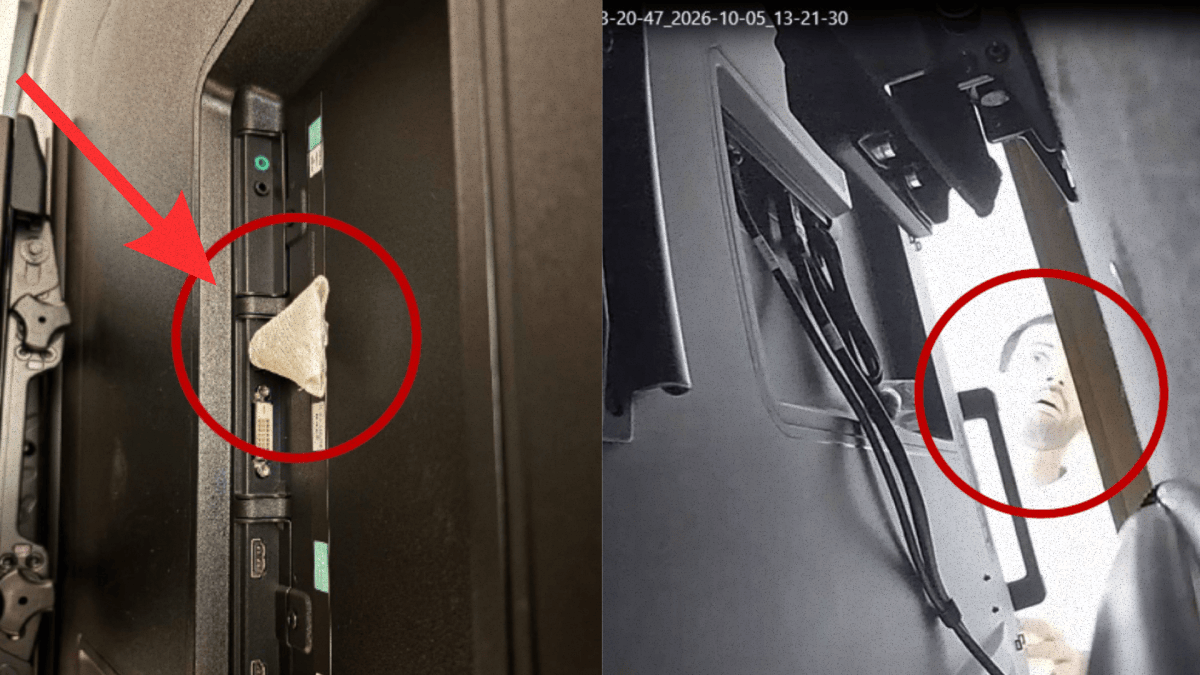
Un ingénieur d’OpenAI a été arrêté après la découverte d’un dispositif d’écoute dans une salle de réunion de la direction. L’entreprise affirme que ses propres modèles ont contribué à l’identifier, tandis que plusieurs questions restent ouvertes sur les motivations du suspect.

 Connexion