Vue lecture

Sony registered a new camera WW308784: could be a new RX or APS-C model


Sony registered a new digital camera with the Indonesian certification body POSTEL, but the entry was later removed. The new WW308784 will be made in China (not Thailand), and DCLife speculates it could be a new RX or APS-C model becuase it was registered as “Digital Camera” rather than “Interchangeable Lens Digital Camera.”


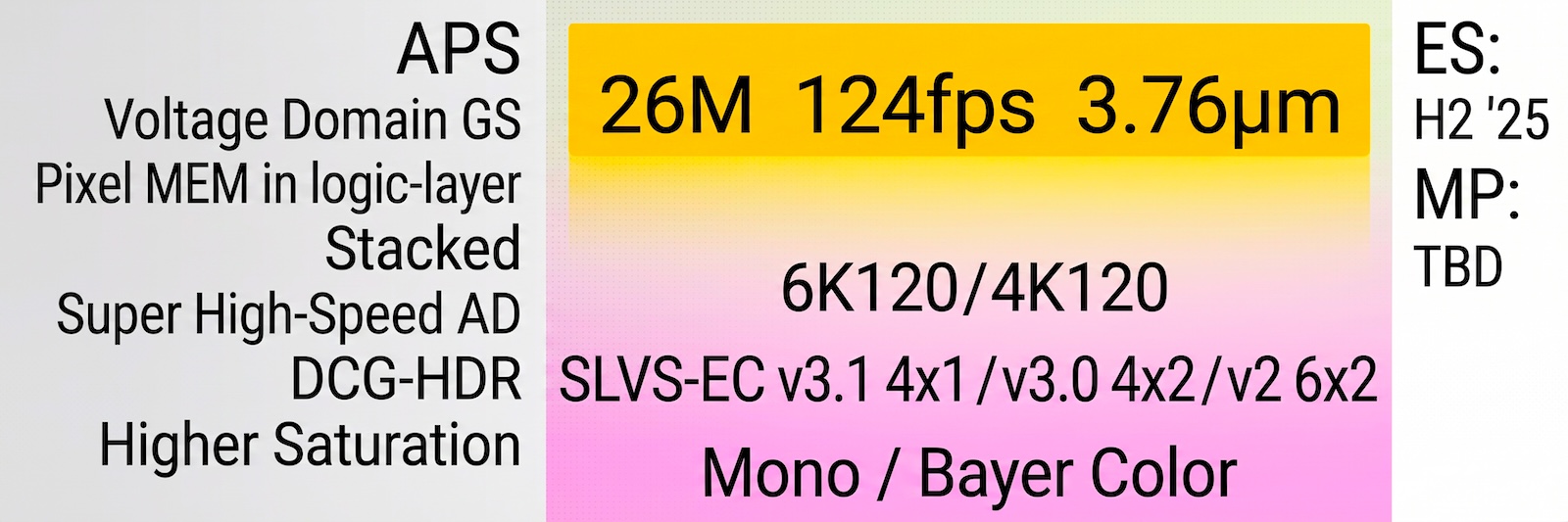
Here is a leaked Sony sensor roadmap from a few months ago – you can see what is expected in 2026 and 2027 :


Somy Indonesia will hold an Alpha event on June 26-28, which is a weekend, so I doubt they will announce a new product:

The “Sony Alpha Event” scheduled for June 26–28 is the Alpha Festival 2026 hosted by Sony Indonesia, taking place at the Sports Hall in Agora Mall, Central Jakarta. It is a multi-day regional community and product showcase rather than a global broadcast.


The post Sony registered a new camera WW308784: could be a new RX or APS-C model appeared first on Photo Rumors.

  •  

20 years of Sony Alpha cameras: from the Alpha 100 to mirrorless leadership in 2026


Exactly 20 years ago today, on June 5, 2006, Sony announced the Alpha 100, the camera that launched the Sony Alpha system. What began as an outsider’s entry into the DSLR market, built on the Konica Minolta A-mount platform acquired by Sony, has evolved into one of the most innovative and influential camera lines in the history of photography and videography.

Two decades later, Sony Alpha stands as a benchmark for hybrid photo/video performance, autofocus intelligence, resolution, and speed. From the groundbreaking in-body stabilization of 2006 to the global-shutter flagship of 2023 and the highest-resolution Alpha camera yet in 2026, the journey has left a significant mark on the industry.

The Early Years (2006–2012)

Sony entered the digital camera arena by acquiring Konica Minolta’s camera division, inheriting the A-mount lens ecosystem. The Alpha 100 (10.2MP APS-C CCD) introduced SteadyShot INSIDE in-body image stabilization- a major first for compatible lenses at the time, along with the BIONZ processor and an accessible price point for enthusiasts.
The system quickly expanded:

  • 2007: Alpha 700 brought a 12.2MP CMOS sensor, better AF, and a magnesium body.
  • 2008: The Alpha 900 became Sony’s first full-frame DSLR, featuring a 24.6MP sensor and the world’s first full-frame in-body stabilization.
  • 2009–2010: Entry-level and mid-range DSLRs proliferated (A200/A300 series, A500/A550). Then came the revolutionary SLT (Single Lens Translucent) cameras: the Alpha 33 and Alpha 55 in 2010, which used a fixed translucent mirror for continuous phase-detection autofocus during both stills and video.

The SLT line peaked with the Alpha 99 (2012), the world’s first full-frame SLT, delivering 24.3MP and full-time phase-detect AF.

The Mirrorless Revolution Begins (2013)

In 2013, Sony fundamentally changed the industry with the launch of the Alpha 7 and Alpha 7R – the first full-frame mirrorless cameras. Compact, lightweight, and featuring hybrid AF and the new E-mount, they proved that professional image quality no longer required a bulky DSLR body. This was the true turning point. The E-mount system offered a shorter flange focal distance, enabling smaller, sharper lenses and paving the way for the vast native FE lens lineup we have today (while still supporting legacy A-mount glass via adapters).

Rapid Innovation and Category Leadership (2014–2022)

Sony didn’t rest. Key milestones followed at an impressive pace:

  • 2014: Alpha 7 II introduced 5-axis in-body stabilization (IBIS) to full-frame mirrorless.
  • 2015: Alpha 7R II brought a 42.4MP back-illuminated sensor and excellent 4K video.
  • 2016: APS-C models like the Alpha 6300 and Alpha 6500 delivered class-leading autofocus speed and point counts.
  • 2017: The Alpha 9 introduced blackout-free 20fps shooting with advanced tracking, redefining action and sports photography.
  • 2019: Alpha 7R IV hit 61 megapixels; real-time Eye AF became a Sony signature.
  • 2020–2021: Alpha 7S III redefined low-light video; the Alpha 1 combined 50MP stills with 8K video and 120 AF/AE calculations per second.
  • 2022: Alpha 7R V introduced AI-based autofocus with subject recognition and improved ergonomics.

Pushing Boundaries: 2023–2026

Sony continued to break new ground:

  • 2023: The Alpha 9 III became the world’s first full-frame global shutter camera (24.6MP), enabling true 120fps blackout-free shooting and pre-capture.
  • 2024-2025: Refinements across the lineup, including the partially stacked sensor in the Alpha 7 V.
  • 2026: The Alpha 7R VI arrives as the highest-resolution Alpha camera to date, further extending Sony’s dominance in the high-megapixel segment:

Why Sony Alpha Matters

Sony didn’t just compete; it often forced the entire industry to accelerate. The shift to mirrorless, the emphasis on hybrid video capabilities, compact pro bodies, advanced real-time AF (Eye AF, animal/bird/vehicle tracking), and stacked/global-shutter sensors all trace their significant momentum back to Sony’s Alpha developments.

Previous coverage of Sony cameras (all 1,633 blog posts) going back to 2009 can be found here.

The post 20 years of Sony Alpha cameras: from the Alpha 100 to mirrorless leadership in 2026 appeared first on Photo Rumors.

  •  

No, Sony is not working on a new display technology that will noticeably improve battery life


Another clickbait story is circulating the Internet:

“Sony is working on a new display technology for its Alpha cameras after 2026/Q3”
“New rumor suggests upcoming Sony cameras could have noticeably better battery life”

Editors are publishing made-up stories without even doing a simple Google search. The article in question is a 2011 research paper by Korean academics and has nothing to do with Sony or any upcoming Sony cameras. Here are the details:

The 2011 paper (“Full-Color LCD Microdisplay System Based on OLED Backlight Unit and Field-Sequential Color Driving Method”) was written by researchers from Daegu Gyeongbuk Institute of Science and Technology (DGIST) and Catholic University of Daegu in South Korea. It describes a prototype 0.7″ FSC (field-sequential color) LCD microdisplay using a custom 0.76″ patterned RGB OLED as the backlight unit (BLU), combined with a high-temperature polysilicon (HTPS) LCD panel supplied by ILJIN Display Co., Ltd. (a Korean company).

There is no mention of Sony anywhere in the paper (including the authors, acknowledgments, references, or experimental details). The work is independent academic/industrial research from Korean institutions focused on low-cost, high-efficiency microdisplays for potential use in viewfinders, projectors, HMDs, etc.

Sony does not appear to be implementing (or planning to implement) this specific technology. Sony’s actual microdisplay approach: Sony Semiconductor Solutions develops and uses direct-emissive OLED microdisplays (OLED-on-silicon/OLEDoS) for electronic viewfinders (EVFs) in its cameras. These are self-emissive panels with high resolution, contrast, and fast response – no separate backlight or color filters in the same way as the paper’s LCD + OLED BLU design. Sony has released multiple generations of these for Alpha cameras and AR/VR applications.

In short, the paper is unrelated to Sony, and while Sony is exploring FSC-based LCD improvements for efficiency in future cameras, there is no indication that it involves the specific OLED-backlit microdisplay approach described in the 2011 paper.

You can download the original PDF research paper from 2011 here.

The post No, Sony is not working on a new display technology that will noticeably improve battery life appeared first on Photo Rumors.
  •  

Spider-Noir : et si la meilleure série Marvel n’était en fait pas sur Disney+ ?

Avec un score critique impressionnant de 91% d'opinions positives sur Rotten Tomatoes, la nouvelle série en prises de vues réelles Spider-Noir crée l'événement. Portée par un Nicolas Cage totalement habité, cette production exclusive Prime Video réussit là où le MCU s'est parfois pris les pieds dans le tapis récemment : proposer une œuvre chorégraphiée, unique et résolument mature. Voici pourquoi vous devez absolument la regarder.

  •  

Le casque Sony WH-1000X The ColleXion est une merveille pour les oreilles (et un peu pour les yeux)

À l'occasion des dix ans de sa gamme de casques audio premium, ceux aux noms à coucher dehors, Sony lance un modèle anniversaire d'exception. Le WH-1000X The ColleXion (inspiration) est un produit qui a deux qualités majeures : un design exquis et un rendu sonore incroyable. Ça cause fort, pour un casque.

  •  
❌