Vue lecture

Micron Ships Gigantic 245TB SSD

BrianFagioli writes: Micron says it is now shipping the world's highest-capacity commercially available SSD, and the numbers are honestly hard to wrap your head around. The new Micron 6600 ION packs 245TB into a single drive and is aimed squarely at AI infrastructure, hyperscalers, and cloud providers dealing with exploding data growth. According to the company, the SSD can reduce rack counts by 82 percent compared to HDD deployments offering similar raw capacity, while also cutting power usage and cooling requirements. Micron says the drive tops out at roughly 30W, which it claims is about half the power draw of comparable hard drive setups. The announcement also feels like another warning sign for spinning disks in the enterprise. Hard drives still dominate bulk storage because of lower cost per terabyte, but SSD capacities keep climbing into territory that used to belong exclusively to HDDs. Micron is also touting major performance gains, claiming up to 84 times better energy efficiency for AI workloads and dramatically lower latency versus HDD-based systems. While nobody is dropping one of these into a home NAS anytime soon, the idea of a quarter petabyte on a single SSD no longer sounds like science fiction.

Read more of this story at Slashdot.

  •  

AI Hard Drive Shortage Makes Archiving the Internet Harder

An anonymous reader quotes a report from 404 Media: Skyrocketing hard drive and storage costs caused by the AI data center boom are making it more expensive and more difficult for digital archivists, academics, Wikipedia, and hobby data hoarders to save data and archive the internet. Specific drives favored by some high profile organizations like the Internet Archive have become far more expensive or are difficult to find at all, archivists said. Over the last several months, prices for both consumer level and enterprise solid state drives, hard drives, and other types of storage have skyrocketed. As an example, a 2TB external Samsung SSD I purchased last fall for $159 now costs $575. PC Part Picker, a website that tracks the average price of different types of drives, shows a universal increase in storage prices starting in about October of last year. Prices of many of the drives it tracks have doubled or increased by more than 150 percent, and at some stores SSDs and hard drives are simply sold out. There is now even a secondary market for some SSDs, with people scalping them on eBay and elsewhere. Brewster Kahle, founder of the Internet Archive and the Wayback Machine, the most important archiving projects in the history of the internet, told 404 Media that the skyrocketing costs of storage is "a very real issue costing us time and money." "We have found that the preferred 28-30TB drives are just not available or at very high price," Kahle said. "We gather over 100 terabytes of new materials each day, and we have over 210 Petabytes of materials already archived on machines that need continuous upgrades and maintenance, so we need to constantly get new hard drives." "We are fortunate to have an active community that donates to the Archive, and we are also looking for help from hard drive manufacturers in these difficult times. We are always looking for more help," he added. "So far we have ways to work around these shortages, but it is a very real issue causing us time and money." The Wikimedia Foundation, which runs Wikipedia and various other projects, including Wikimedia Commons, an open repository of royalty free media, told 404 Media that the cost of storage has become a concern for the foundation's projects as well. "With over 65 million articles on Wikipedia alone, access to server and storage capacity is vital to us. We've certainly seen price increases since the end of 2025. These price increases are of concern to us, as with every other player in the industry. We see the primary impact in the purchase of memory and hard drives but also in terms of lead times on server deliveries and our capacity to place future orders," a Wikimedia Foundation spokesperson told us. "The Wikimedia Foundation is a non-profit, and as such how we allocate budget is very carefully considered. We maintain our own data centers to serve our users from all over the world. We're putting workarounds in place where we can, mainly involving being smart with how we prioritize investment in hardware, building in flexibility as well as extending the life of existing hardware where possible." Western Digital, one of the largest manufacturers of hard drives and other storage systems, said that it has essentially sold out of its 2026 inventory to enterprise clients, many of which run data centers. Micron, which made RAM and SSDs under the brand name Crucial, has exited the consumer market altogether because "AI-driven growth in the data center has led to a surge in demand for memory and storage. Micron has made the difficult decision to exit the Crucial consumer business in order to improve supply and support for our larger, strategic customers in faster-growing segments."

Read more of this story at Slashdot.

  •  

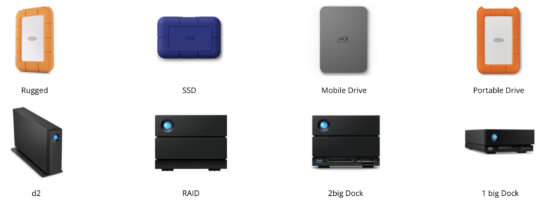
LaCie just increased prices in the US by around 9-12%


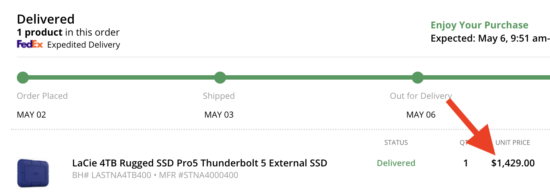
A few days ago, I purchased two external LaCie hard drives from B&H Photo for a project. I received the hard drives today and realized I need a third drive. I went back to the B&H website, and I was surprised to notice that prices have gone up significantly since I placed my order just a few days ago:

LaCie 4TB Rugged SSD Pro5 Thunderbolt 5 External SSD price from a few days ago:


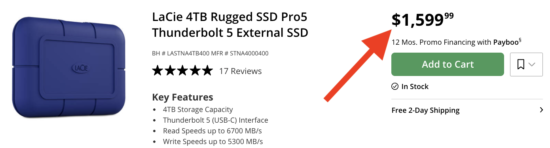
LaCie 4TB Rugged SSD Pro5 Thunderbolt 5 External SSD price now (from $1,429 to $1,599, or around 12% up):


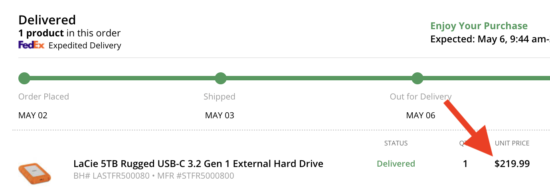
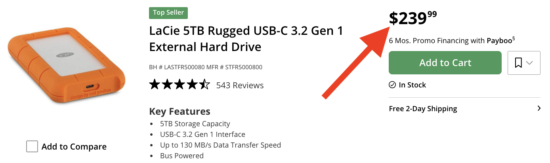
LaCie 5TB Rugged USB-C 3.2 Gen 1 External Hard Drive price from a few days ago:


LaCie 5TB Rugged USB-C 3.2 Gen 1 External Hard Drive price now (from $219.99 to $239.99, or around 9% up):

If you are planning to buy any kind of memory storage, I strongly suggest you do it asap before the next price increase kicks in. Amazon is pretty much out of stock on many popular storage devices, but I noticed that B&H Photo still has many in stock.

ProGrade and OWC already announced price increases – all other brands will follow soon:

ProGrade memory cards price increase coming on May 1st, others will follow

OWC announced a memory card price increase, while B&H is running a sale on Lexar memory cards

The post LaCie just increased prices in the US by around 9-12% appeared first on Photo Rumors.

  •  

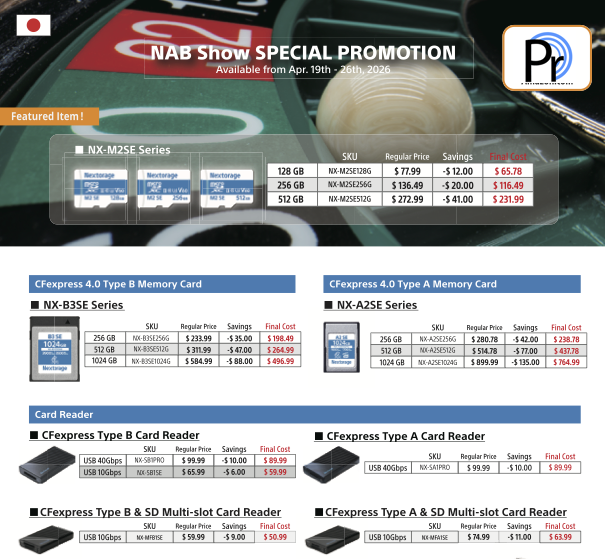
Nextorage launched NAB show specials: up to $354 off on memory cards and card readers


Nextorage today announced the start of its NAB Special Deals at B&H Photo and Amazon. The promotion includes significant discounts on CFexpress™ memory cards and card readers.

  • Period: April 19 – 26, 2026
  • Maximum Savings: up to $354

At the 2026 NAB show, Nextorage will showcase a wide range of professional memory storage solutions, including the upcoming next-generation CFexpress Type B memory card NX-B2PRO+. The Nextorage NX-B2PRO+ Series is the newest addition to Nextorage’s CFexpress Type B lineup. It is the world’s first CFexpress Type B memory card (as of the November 2025 announcement) to officially support both VPG1600 and VPG400 standards simultaneously. (additional informtion):

Nextorage developed the world’s first memory card supporting both VPG1600 and VPG400 standards

The post Nextorage launched NAB show specials: up to $354 off on memory cards and card readers appeared first on Photo Rumors.

  •  

Remembering Zip Drives - the Trendy Storage Technology of the 1990s

Back in the 1990s, floppy disks "had a mere capacity of 1.44MB," remembers XDA Developers, "which would soon become absolutely tiny for the increasingly large pieces of software that would come about." Floppy disks also felt quite fragile, and while we got "superfloppy" formats that were physically larger and had more capacity, those were pretty unwieldy as portable storage. Enter 1994, when a company called Iomega introduced its variant of a "superfloppy", the Zip drive... [T]he initial capacity introduced in 1994 reached a whopping 100MB, which was huge number when put up against the traditional floppy disk. Zip drives also had major performance benefits, with read speeds that could average 1.4MB/s, as opposed to the comparatively sluggish 16kB/s speeds of a traditional floppy disk, as well as a seek time of around 28ms seconds, whereas a floppy disk averaged 200ms. Zip drives weren't quite as fast as desktop HDDs, but for portable storage, this was a huge step forward... [I]n 1998, Iomega introduced the Zip 250 disks, which increased the capacity to 250MB, and, already in the new millennium, we got the Zip 750, which took that further to 750MB... It was an appealing enough proposition that big computer manufacturers like Dell started including a Zip drive in some of their PCs. Even Apple included Zip drives in some of its Power Macintosh models from the mid-to-late 90s. However, things started to shift towards the end of the decade as other portable formats rose to prominence, most notably CDs and USB flash drives. Despite their initial success, it didn't take long for users to start noticing a major drawback of Zip drives: many times, they would just fail. It wasn't necessarily related to age or any particular misuse of the disks, it just happened. It was a big enough phenomenon that it became known as the "click of death", and once it happened, your drive was gone. The problem was estimated by Iomega to affect around 0.5% of Zip drives, but while that sounds like a small number, when you sell products by the thousands, it becomes fairly widespread. It was a big enough issue that, in September 1998, a class action lawsuit was filed against Iomega for the common problems. Some of the complaints in that lawsuit were eventually dismissed by the court of Delaware, but others were not, and once the public became aware of the problems with Zip drives, it was hard for the brand to make a comeback. It didn't help that this happened around the same time as formats such as CDs were becoming more popular... And eventually, USB flash drives became the most popular way to carry data around since they were smaller and offered much faster speeds... Eventually, after seeing its profits plummet by the mid-2000s, Iomega was sold to a company called EMC in 2008, and in 2013, EMC and Lenovo formed a joint venture that took over Iomega's business and removed all of the Iomega branding from its products. The article does note that "as late as 2014, some aviation companies were still using Zip drives to distribute updates for navigation databases." Are there any Slashdot readers who still remember their own Zip drive experiences? Share your memories in the comments of that once-so-trendy storage technology from the 1990s...

Read more of this story at Slashdot.

  •  

Microsoft Increases the FAT32 Limit From 32GB To 2TB

Longtime Slashdot reader AmiMoJo writes: Windows has limited FAT32 partitions to a maximum of 32GB for decades now. When memory cards and USB drives exceeded 32GB in size, the only options were exFAT or NTFS. Neither option was well supported on other platforms at first, although exFAT support is fairly widespread now. In their latest blog post, Microsoft announced that the limit for FAT32 partitions is being increased to 2TB. Of course, that doesn't mean that every device that supports FAT32 will work flawlessly with a 2TB partition size, but at least there is a decent chance that older devices with don't support exFAT will now be usable with memory cards over 32GB.

Read more of this story at Slashdot.

  •  

Thousands of Rare Concert Recordings Are Landing On the Internet Archive

A Chicago concert superfan Aadam Jacobs who has recorded more than 10,000 shows since the 1980s is working with Internet Archive volunteers to digitize the collection before the cassettes deteriorate. "So far, about 2,500 of these tapes have been posted on the Internet Archive, including some rare gems like a Nirvana performance from 1989," reports TechCrunch. From the report: For many of these recordings, Jacobs was using pretty mediocre equipment, but the volunteer audio engineers working with the Internet Archive have made these tapes sound great. One volunteer, Brian Emerick, drives to Jacobs' house once a month to pick up more boxes of tapes -- he has to use anachronistic cassette decks to play the tapes, which get converted into digital files. From there, other volunteers clean up, organize, and label the recordings, even tracking down song names from forgotten punk bands. The archive is available here.

Read more of this story at Slashdot.

  •  

The AI RAM Shortage is Also Driving Up SSD Prices

In 2024 the Verge's consumer tech reporter paid $173 for a WD Black SN850X 2TB SSD. But "now that same SSD costs $649..." "Like with RAM, demand from the AI industry is swallowing up supply from a limited number of manufacturers, leading to a drastic reduction in the inventory that's available to consumers" — and skyrocketing prices: The price on my WD Black drive nearly quadrupled since November 2025, and consumer SSDs across the board are seeing similar increases, much like with RAM. The 4TB version of the popular Samsung 990 Pro SSD previously cost $320, but will now run you nearly $1,000. External SanDisk SSDs saw a 200 percent price hike at the Apple Store in March.... According to price trends from PC Part Picker, NVMe SSD prices began ticking upward in December 2025, with prices on 256GB to 4TB SSDs now double or triple what they were just a few months ago, and continuing to climb.

Read more of this story at Slashdot.

  •  

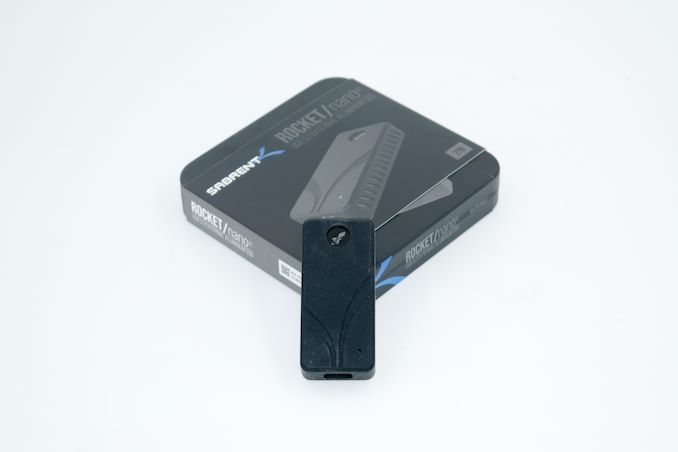
Sabrent Rocket nano V2 External SSD Review: Phison U18 in a Solid Offering

Sabrent's lineup of internal and external SSDs is popular among enthusiasts. The primary reason is the company's tendency to be among the first to market with products based on the latest controllers, while also delivering an excellent value proposition. The company has a long-standing relationship with Phison and adopts its controllers for many of their products. The company's 2 GBps-class portable SSD - the Rocket nano V2 - is based on Phison's U18 native controller. Read on for a detailed look at the Rocket nano V2 External SSD, including an analysis of its performance consistency, power consumption, and thermal profile.

  •  

CXL Gathers Momentum at FMS 2024

The CXL consortium has had a regular presence at FMS (which rechristened itself from 'Flash Memory Summit' to the 'Future of Memory and Storage' this year). Back at FMS 2022, the company had announced v3.0 of the CXL specifications. This was followed by CXL 3.1's introduction at Supercomputing 2023. Having started off as a host to device interconnect standard, it had slowly subsumed other competing standards such as OpenCAPI and Gen-Z. As a result, the specifications started to encompass a wide variety of use-cases by building a protocol on top of the the ubiquitous PCIe expansion bus. The CXL consortium comprises of heavyweights such as AMD and Intel, as well as a large number of startup companies attempting to play in different segments on the device side. At FMS 2024, CXL had a prime position in the booth demos of many vendors.
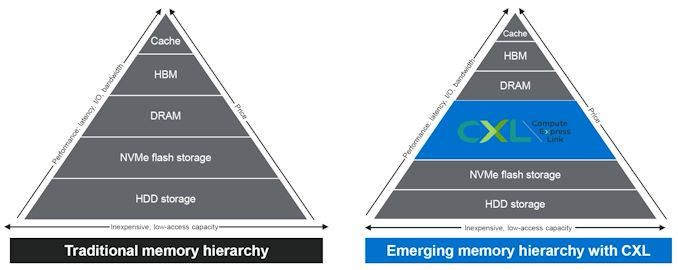
The migration of server platforms from DDR4 to DDR5, along with the rise of workloads demanding large RAM capacity (but not particularly sensitive to either memory bandwidth or latency), has opened up memory expansion modules as one of the first set of widely available CXL devices. Over the last couple of years, we have had product announcements from Samsung and Micron in this area.

SK hynix CMM-DDR5 CXL Memory Module and HMSDK

At FMS 2024, SK hynix was showing off their DDR5-based CMM-DDR5 CXL memory module with a 128 GB capacity. The company was also detailing their associated Heterogeneous Memory Software Development Kit (HMSDK) - a set of libraries and tools at both the kernel and user levels aimed at increasing the ease of use of CXL memory. This is achieved in part by considering the memory pyramid / hierarchy and relocating the data between the server's main memory (DRAM) and the CXL device based on usage frequency.
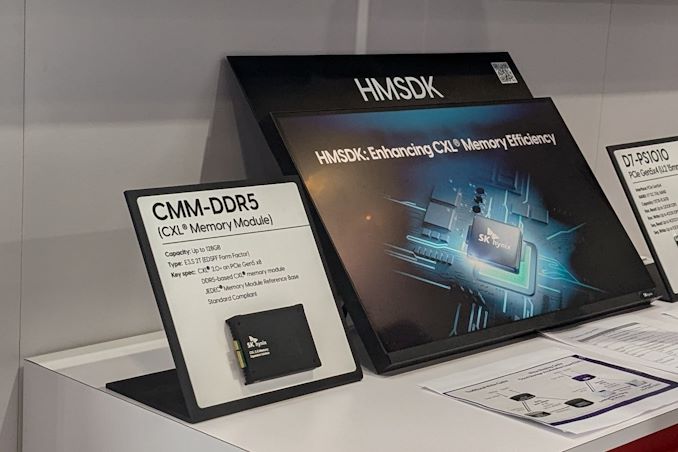
The CMM-DDR5 CXL memory module comes in the SDFF form-factor (E3.S 2T) with a PCIe 3.0 x8 host interface. The internal memory is based on 1α technology DRAM, and the device promises DDR5-class bandwidth and latency within a single NUMA hop. As these memory modules are meant to be used in datacenters and enterprises, the firmware includes features for RAS (reliability, availability, and serviceability) along with secure boot and other management features.

SK hynix was also demonstrating Niagara 2.0 - a hardware solution (currently based on FPGAs) to enable memory pooling and sharing - i.e, connecting multiple CXL memories to allow different hosts (CPUs and GPUs) to optimally share their capacity. The previous version only allowed capacity sharing, but the latest version enables sharing of data also. SK hynix had presented these solutions at the CXL DevCon 2024 earlier this year, but some progress seems to have been made in finalizing the specifications of the CMM-DDR5 at FMS 2024.

Microchip and Micron Demonstrate CZ120 CXL Memory Expansion Module

Micron had unveiled the CZ120 CXL Memory Expansion Module last year based on the Microchip SMC 2000 series CXL memory controller. At FMS 2024, Micron and Microchip had a demonstration of the module on a Granite Rapids server.
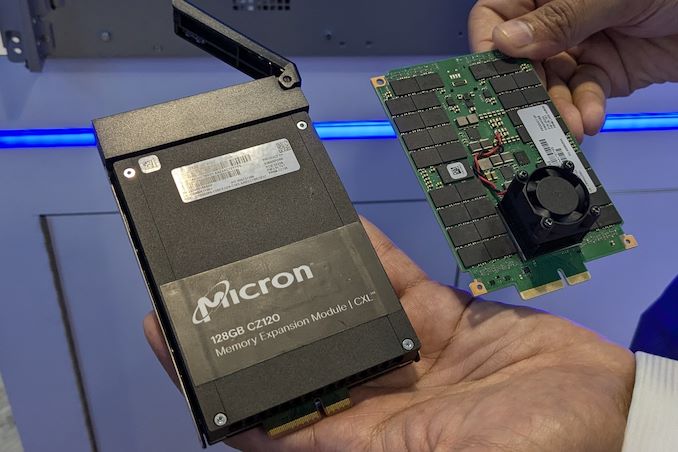
Additional insights into the SMC 2000 controller were also provided.
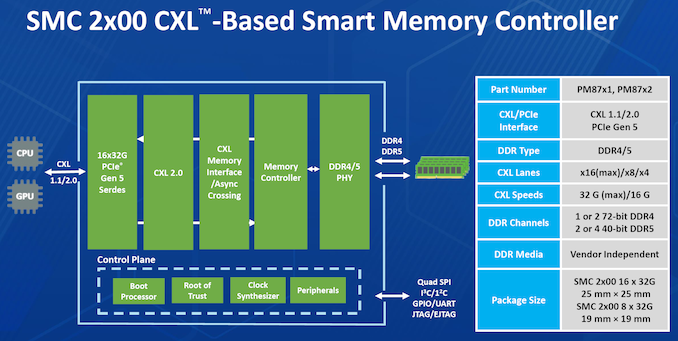
The CXL memory controller also incorporates DRAM die failure handling, and Microchip also provides diagnostics and debug tools to analyze failed modules. The memory controller also supports ECC, which forms part of the enterprise class RAS feature set of the SMC 2000 series. Its flexibility ensures that SMC 2000-based CXL memory modules using DDR4 can complement the main DDR5 DRAM in servers that support only the latter.

Marvell Announces Structera CXL Product Line

A few days prior to the start of FMS 2024, Marvell had announced a new CXL product line under the Structera tag. At FMS 2024, we had a chance to discuss this new line with Marvell and gather some additional insights.
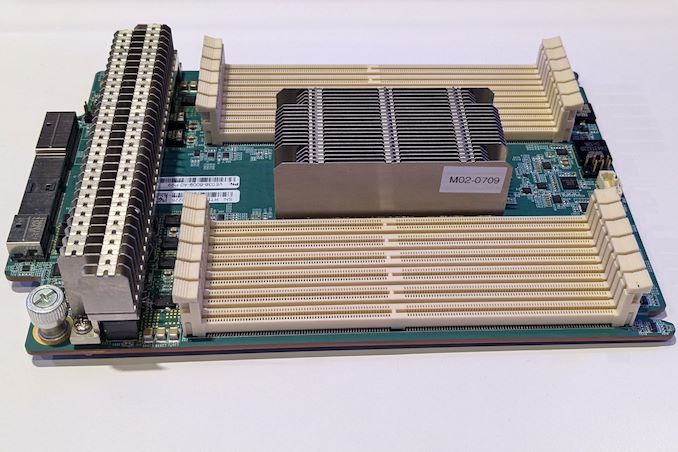
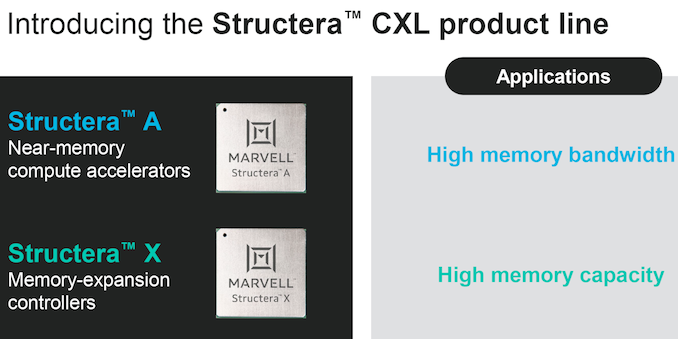
Unlike other CXL device solutions focusing on memory pooling and expansion, the Structera product line also incorporates a compute accelerator part in addition to a memory-expansion controller. All of these are built on TSMC's 5nm technology.
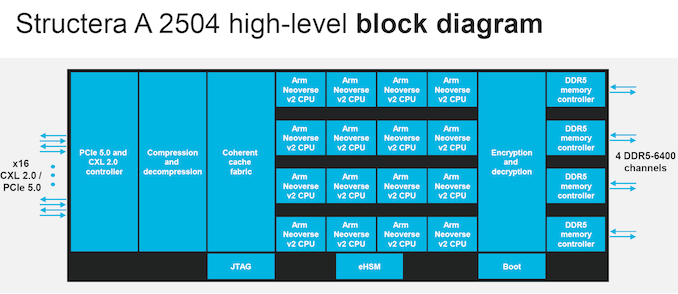
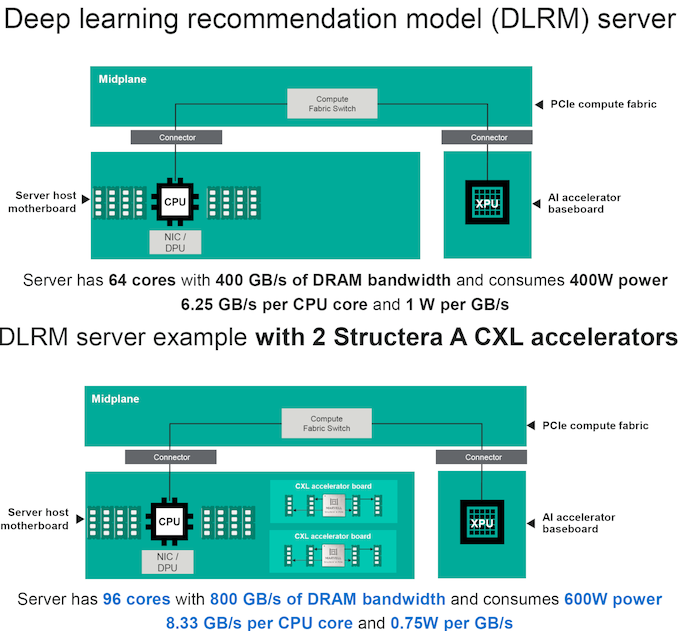
The compute accelerator part, the Structera A 2504 (A for Accelerator) is a PCIe 5.0 x16 CXL 2.0 device with 16 integrated Arm Neoverse V2 (Demeter) cores at 3.2 GHz. It incorporates four DDR5-6400 channels with support for up to two DIMMs per channel along with in-line compression and decompression. The integration of powerful server-class ARM CPU cores means that the CXL memory expansion part scales the memory bandwidth available per core, while also scaling the compute capabilities.
Applications such as Deep-Learning Recommendation Models (DLRM) can benefit from the compute capability available in the CXL device. The scaling in the bandwidth availability is also accompanied by reduced energy consumption for the workload. The approach also contributed towards disaggregation within the server for a better thermal design as a whole.
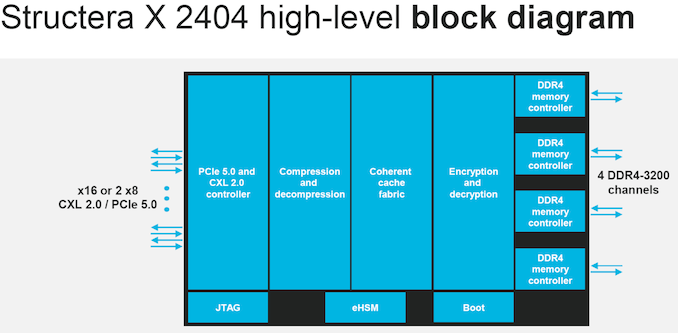
The Structera X 2404 (X for eXpander) will be available either as a PCIe 5.0 (single x16 or two x8) device with four DDR4-3200 channels (up to 3 DIMMs per channel). Features such as in-line (de)compression, encryption / decryption, and secure boot with hardware support are present in the Structera X 2404 as well. Compared to the 100 W TDP of the Structera X 2404, Marvell expects this part to consume around 30 W. The primary purpose of this part is to enable hyperscalers to recycle DDR4 DIMMs (up to 6 TB per expander) while increasing server memory capacity.
Marvell also has a Structera X 2504 part that supports four DDR5-6400 channels (with two DIMMs per channel for up to 4 TB per expander). Other aspects remain the same as that of the DDR4-recycling part.

The company stressed upon some unique aspects of the Structera product line - the inline compression optimizes available DRAM capacity, and the 3 DIMMs per channel support for the DDR4 expander maximizes the amount of DRAM per expander (compared to competing solutions). The 5nm process lowers the power consumption, and the parts support accesses from multiple hosts. The integration of Arm Neoverse V2 cores appears to be a first for a CXL accelerator, and enables delegation of compute tasks to improve overall performance of the system.

While Marvell announced specifications for the Structera parts, it does appear that sampling is at least a few quarters away. One of the interesting aspects about Marvell's roadmaps / announcements in recent years has been their focus on creating products tuned to the demands of high-volume customers. The Structera product line is no different - hyperscalers are hungry to recycle their DDR4 memory modules and apparently can't wait to get their hands on the expander parts.

CXL is just starting its slow ramp-up, and the hockey stick segment of the growth curve is definitely definitely not in the near term. However, as more host systems with CXL support start to get deployed, products like the Structera accelerator line start to make sense from a server efficiency viewpoint.

  •  

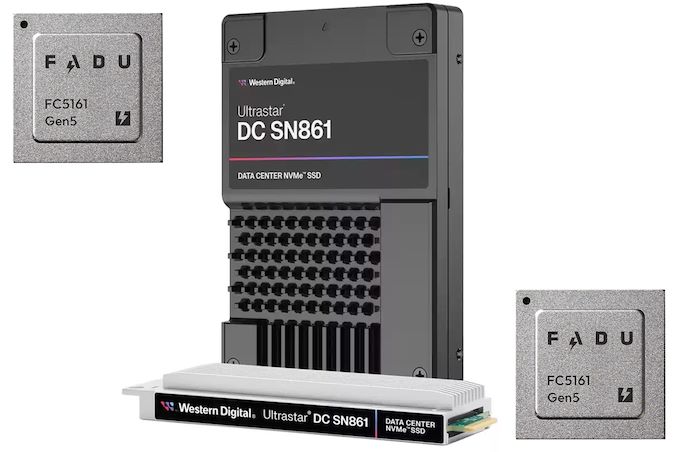
Fadu's FC5161 SSD Controller Breaks Cover in Western Digital's PCIe Gen5 Enterprise Drives

When Western Digital introduced its Ultrastar DC SN861 SSDs earlier this year, the company did not disclose which controller it used for these drives, which made many observers presume that WD was using an in-house controller. But a recent teardown of the drive shows that is not the case; instead, the company is using a controller from Fadu, a South Korean company founded in 2015 that specializes on enterprise-grade turnkey SSD solutions.

The Western Digital Ultrastar DC SN861 SSD is aimed at performance-hungry hyperscale datacenters and enterprise customers which are adopting PCIe Gen5 storage devices these days. And, as uncovered in photos from a recent Storage Review article, the drive is based on Fadu's FC5161 NVMe 2.0-compliant controller. The FC5161 utilizes 16 NAND channels supporting an ONFi 5.0 2400 MT/s interface, and features a combination of enterprise-grade capabilities (OCP Cloud Spec 2.0, SR-IOV, up to 512 name spaces for ZNS support, flexible data placement, NVMe-MI 1.2, advanced security, telemetry, power loss protection) not available on other off-the-shelf controllers – or on any previous Western Digital controllers.  
The Ultrastar DC SN861 SSD offers sequential read speeds up to 13.7 GB/s as well as sequential write speeds up to 7.5 GB/s. As for random performance, it boasts with an up to 3.3 million random 4K read IOPS and up to 0.8 million random 4K write IOPS. The drives are available in capacities between 1.6 TB and 7.68 TB with one or three drive writes per day (DWPD) over five years rating as well as in U.2 and E1.S form-factors. 
While the two form factors of the SN861 share a similar technical design, Western Digital has tailored each version for distinct workloads: the E1.S supports FDP and performance enhancements specifically for cloud environments. By contrast, the U.2 model is geared towards high-performance enterprise tasks and emerging applications like AI.
Without any doubts, Western Digital's Ultrastar DC SN861 is a feature-rich high-performance enterprise-grade SSD. It has another distinctive feature: a 5W idle power consumption, which is rather low by the standards of enterprise-grade drives (e.g., it is 1W lower compared to the SN840). While the difference with predecessors may be just 1W, hyperscalers deploy thousands of drives and for their TCO every watt counts.

Western Digital's Ultrastar DC SN861 SSDs are now available for purchase to select customers (such as Meta) and to interested parties. Prices are unknown, but they will depend on such factors as volumes.

Sources: FaduStorage Review

  •  

PCI-SIG Demonstrates PCIe 6.0 Interoperability at FMS 2024

As the deployment of PCIe 5.0 picks up steam in both datacenter and consumer markets, PCI-SIG is not sitting idle, and is already working on getting the ecosystem ready for the updats to the PCIe specifications. At FMS 2024, some vendors were even talking about PCIe 7.0 with its 128 GT/s capabilities despite PCIe 6.0 not even starting to ship yet. We caught up with PCI-SIG to get some updates on its activities and have a discussion on the current state of the PCIe ecosystem.

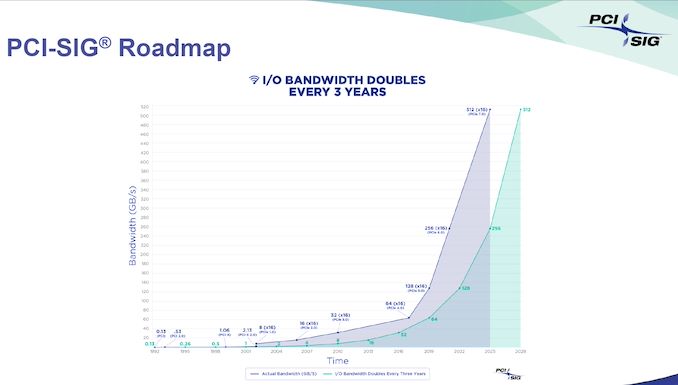
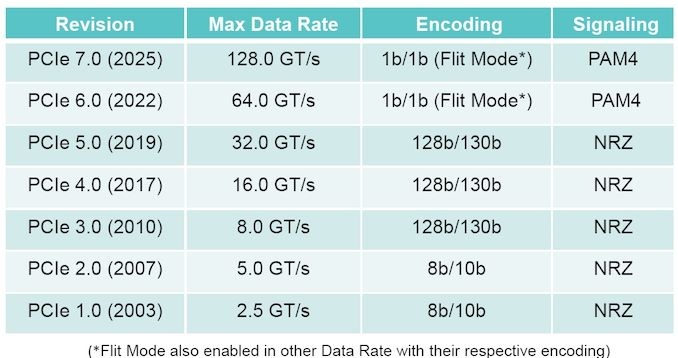
PCI-SIG has already made the PCIe 7.0 specifications (v 0.5) available to its members, and expects full specifications to be officially released sometime in 2025. The goal is to deliver a 128 GT/s data rate with up to 512 GBps of bidirectional traffic using x16 links. Similar to PCIe 6.0, this specification will also utilize PAM4 signaling and maintain backwards compatibility. Power efficiency as well as silicon die area are also being kept in mind as part of the drafting process.

The move to PAM4 signaling brings higher bit-error rates compared to the previous NRZ scheme. This made it necessary to adopt a different error correction scheme in PCIe 6.0 - instead of operating on variable length packets, PCIe 6.0's Flow Control Unit (FLIT) encoding operates on fixed size packets to aid in forward error correction. PCIe 7.0 retains these aspects.

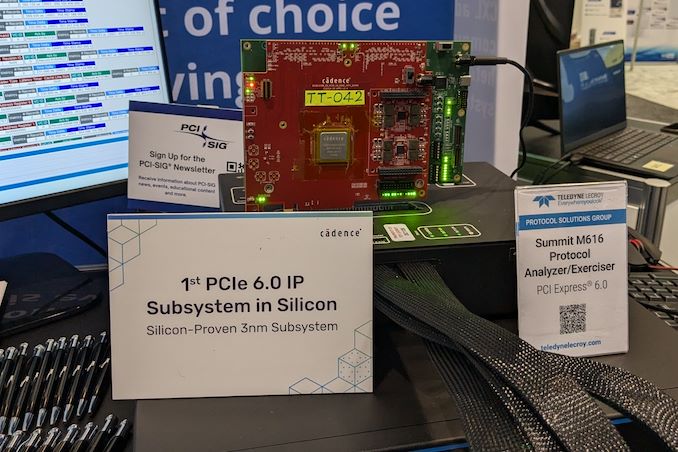
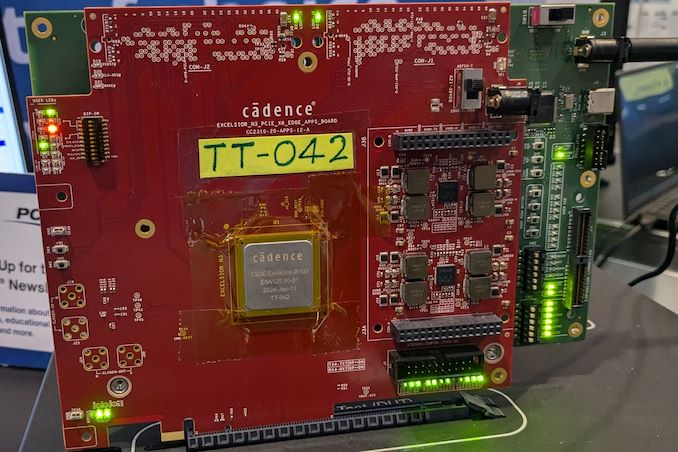
The integrators list for the PCIe 6.0 compliance program is also expected to come out in 2025, though initial testing is already in progress. This was evident by the FMS 2024 demo involving Cadence's 3nm test chip for its PCIe 6.0 IP offering along with Teledyne Lecroy's PCIe 6.0 analyzer. These timelines track well with the specification completion dates and compliance program availability for previous PCIe generations.

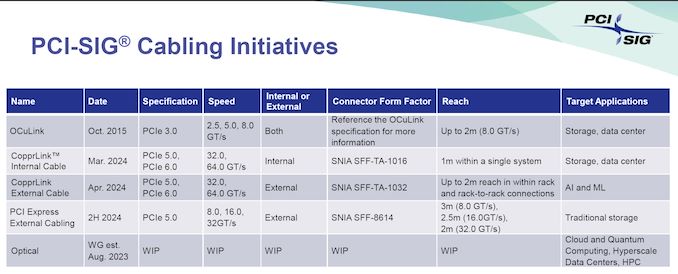
We also received an update on the optical workgroup - while being optical-technology agnostic, the WG also intends to develop technology-specific form-factors including pluggable optical transceivers, on-board optics, co-packaged optics, and optical I/O. The logical and electrical layers of the PCIe 6.0 specifications are being enhanced to accommodate the new optical PCIe standardization and this process will also be done with PCIe 7.0 to coincide with that standard's release next year.

The PCI-SIG also has ongoing cabling initiatives. On the consumer side, we have seen significant traction for Thunderbolt and external GPU enclosures. However, even datacenters and enterprise systems are moving towards cabling solutions as it becomes evident that disaggregation of components such as storage from the CPU and GPU are better for thermal design. Additionally maintaining signal integrity over longer distances becomes difficult for on-board signal traces. Cabling internal to the computing systems can help here.

OCuLink emerged as a good candidate and was adopted fairly widely as an internal link in server systems. It has even made an appearance in mini-PCs from some Chinese manufacturers in its external avatar for the consumer market, albeit with limited traction. As speeds increase, a widely-adopted standard for external PCIe peripherals (or even connecting components within a system) will become imperative.

  •  

DapuStor and Memblaze Target Global Expansion with State-of-the-Art Enterprise SSDs

The growth in the enterprise SSD (eSSD) market has outpaced that of the client SSD market over the last few years. The requirements of AI servers for both training and inference has been the major impetus in this front. In addition to the usual vendors like Samsung, Solidigm, Micron, Kioxia, and Western Digital serving the cloud service providers (CSPs) and the likes of Facebook, a number of companies have been at work inside China to service the burgeoning eSSD market within.

In our coverage of the Microchip Flashtec 5016, we had noted Longsys's use of Microchip's SSD controllers to prepare and market enterprise SSDs under the FORESEE brand. Long before that, two companies - DapuStor and Memblaze - started releasing eSSDs specifically focusing on the Chinese market.

There are two drivers for the current growth spurt in the eSSD market. On the performance side, usage of eTLC behind a Gen 5 controller is allowing vendors to advertise significant benefits over the Gen 4 drives in the previous generation. At the same time, a capacity play is happening where there is a race to cram as much NAND as possible into a single U.2 / EDSFF enclosure. QLC is being used for this purpose, and we saw a number of such 128 TB-class eSSDs on display at FMS 2024.

DapuStor and Memblaze have both been relying on SSD controllers from Marvell for their flagship drives. Their latest product iterations for the Gen 5 era use the Marvell Bravera SC5 controller. Similar to the Flashtec controllers, these are not meant to be turnkey solutions. Rather, the SSD vendor has considerable flexibility in implementing specific features for their desired target market.

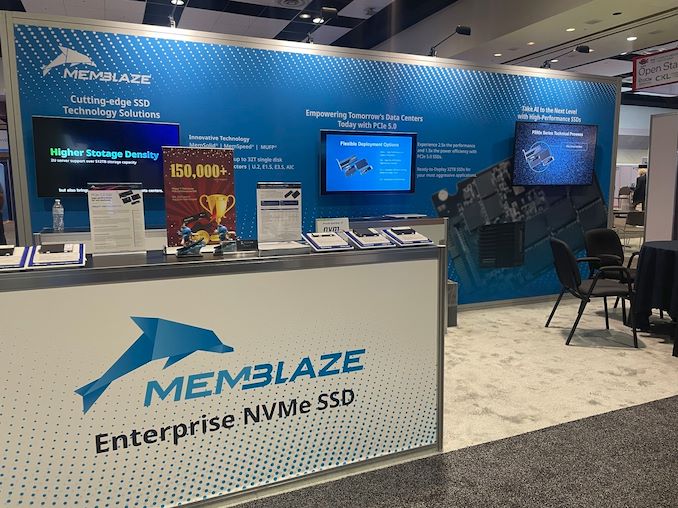
At FMS 2024, both DapuStor and Memblaze were displaying their latest solutions for the Gen 5 market. Memblaze was celebrating the sale of 150K+ units of their flagship Gen 5 solution - the PBlaze7 7940 incorporating Micron's 232L 3D eTLC with Marvell's Bravera SC5 controller. This SSD (available in capacities up to 30.72 TB) boasts of 14 GBps reads / 10 GBps writes along with random read / write performance of 2.8 M / 720K - all with a typical power consumption south of 16 W. Additionally, the support for some of NVMe features such as software-enabled flash (SEF) and zoned name space (ZNS) had helped Memblaze and Marvell to receive a 'Best of Show' award under the 'Most Innovative Customer Implementation' category.

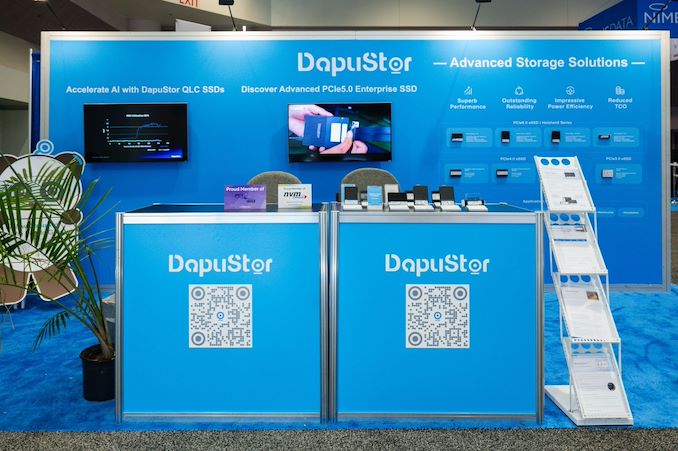
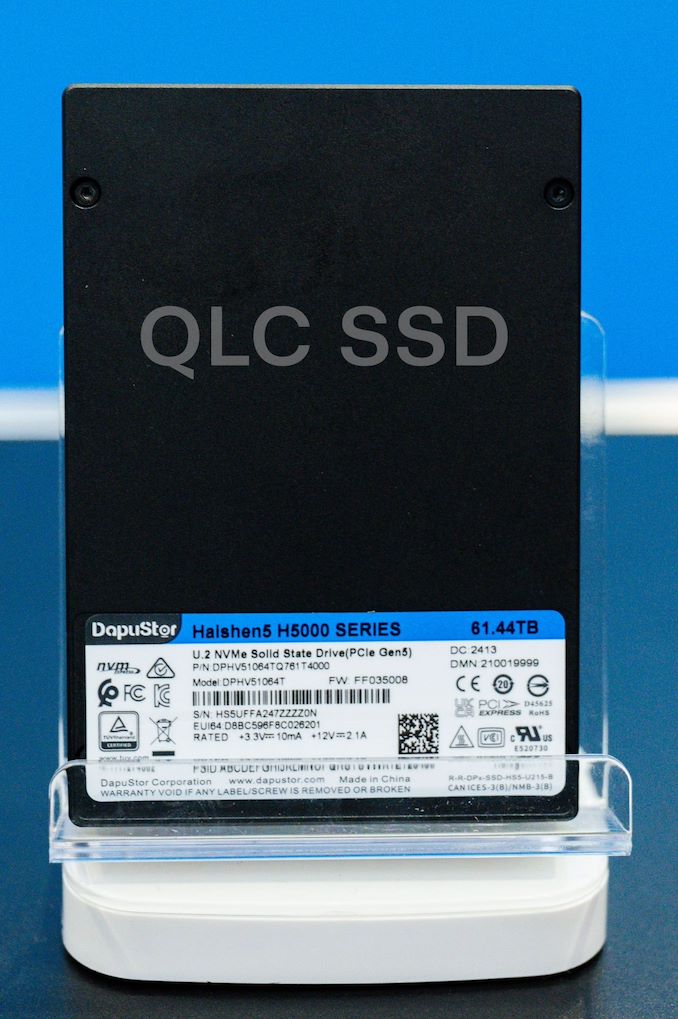
DapuStor had their current lineup on display (including the Haishen H5000 series with the same Bravera SC5 controller). Additionally, the company had an unannounced proof-of-concept 61.44 TB QLC SSD on display. Despite the label carrying the Haishen5 series tag (its current members all use eTLC NAND), this sample comes with QLC flash.

DapuStor has already invested resources into implementing the flexible data placement (FDP) NVMe feature into the firmware of this QLC SSD. The company also had an interesting presentation session dealing with usage of CXL memory expansion to store the FTL for high-capacity enterprise SSDs - though this is something for the future and not related to any current product in the market.

Having established themselves within the Chinese market, both DapuStor and Memblaze are looking to expand in other markets. Having products with leading performance numbers and features in the eSSD growth segment will stand them in good stead in this endeavor.

  •  

Phison Enterprise SSDs at FMS 2024: Pascari Branding and Accelerating AI

At FMS 2024, Phison devoted significant booth space to their enterprise / datacenter SSD and PCIe retimer solutions, in addition to their consumer products. As a controller / silicon vendor, Phison had historically been working with drive partners to bring their solutions to the market. On the enterprise side, their tie-up with Seagate for the X1 series (and the subsequent Nytro-branded enterprise SSDs) is quite well-known. Seagate supplied the requirements list and had a say in the final firmware before qualifying the drives themselves for their datacenter customers. Such qualification involves a significant resource investment that is possible only by large companies (ruling out most of the tier-two consumer SSD vendors).

Phison had demonstrated the Gen 5 X2 platform at last year's FMS as a continuation of the X1. However, with Seagate focusing on its HAMR ramp, and also fighting other battles, Phison decided to go ahead with the qualification process for the X2 process themselves. In the bigger scheme of things, Phison also realized that the white-labeling approach to enterprise SSDs was not going to work out in the long run. As a result, the Pascari brand was born (ostensibly to make Phison's enterprise SSDs more accessible to end consumers).

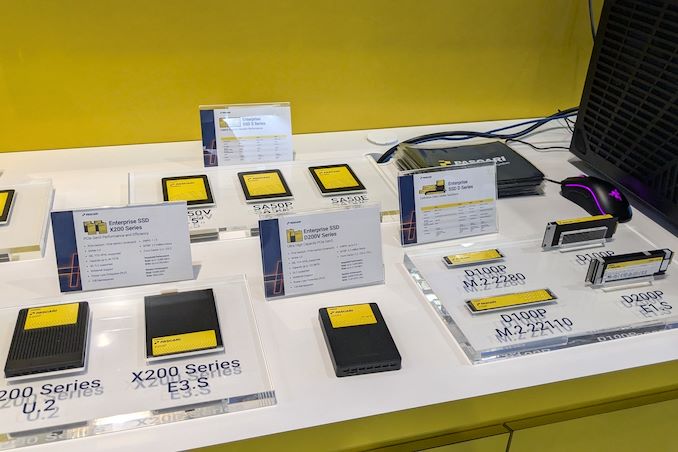
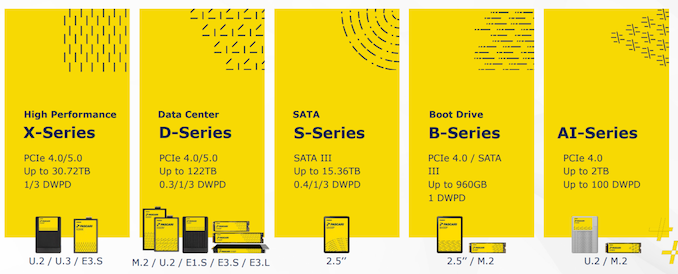
Under the Pascari brand, Phison has different lineups targeting different use-cases: from high-performance enterprise drives in the X series to boot drives in the B series. The AI series comes in variants supporting up to 100 DWPD (more on that in the aiDAPTIVE+ subsection below).

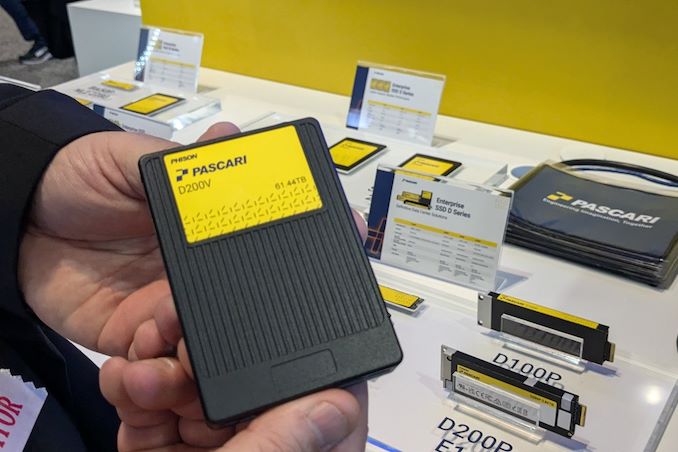
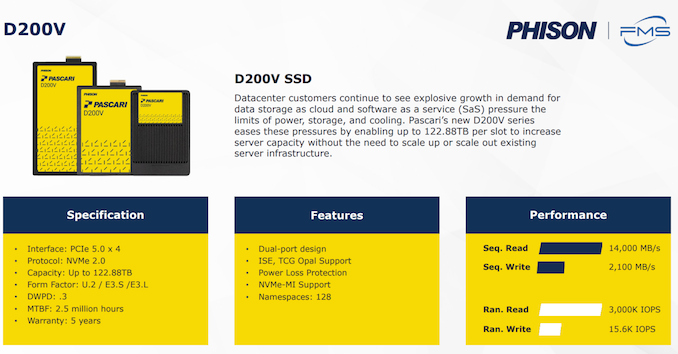
The D200V Gen 5 took pole position in the displayed drives, thanks to its leading 61.44 TB capacity point (a 122.88 TB drive is also being planned under the same line). The use of QLC in this capacity-focused line brings down the sustained sequential write speeds to 2.1 GBps, but these are meant for read-heavy workloads.

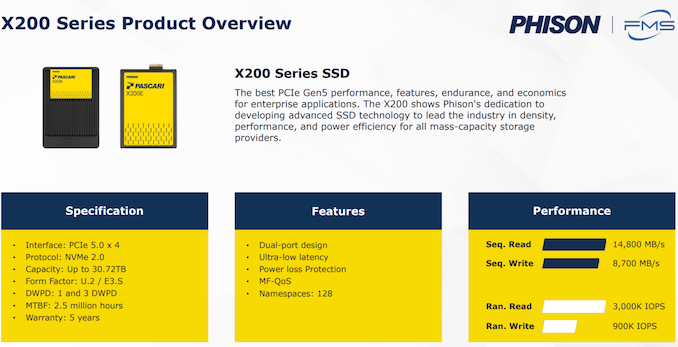
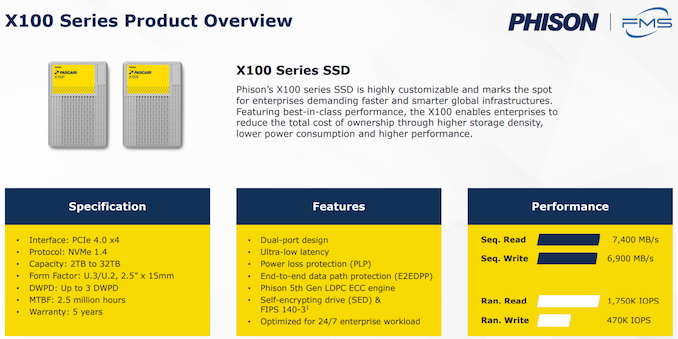
The X200, on the other hand, is a Gen 5 eTLC drive boasting up to 8.7 GBps sequential writes. It comes in read-centric (1 DWPD) and mixed workload variants (3 DWPD) in capacities up to 30.72 TB. The X100 eTLC drive is an evolution of the X1 / Seagate Nytro 5050 platform, albeit with newer NAND and larger capacities.


These drives come with all the usual enterprise features including power-loss protection, and FIPS certifiability. Though Phison didn't advertise this specifically, newer NVMe features like flexible data placement should become part of the firmware features in the future.

100 GBps with Dual HighPoint Rocket 1608 Cards and Phison E26 SSDs

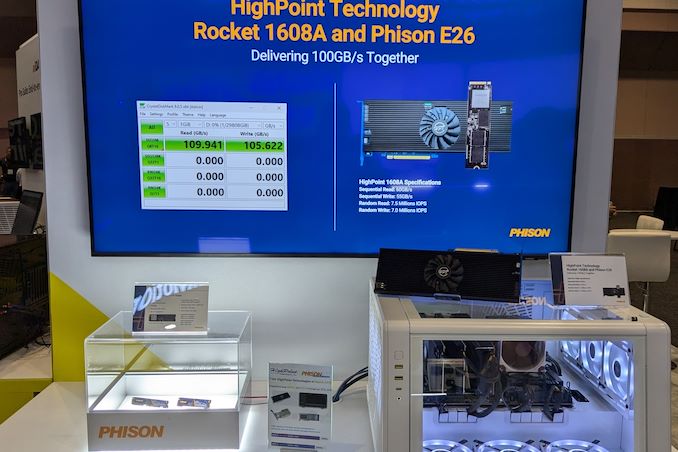
Though not strictly an enterprise demo, Phison did have a station showing 100 GBps+ sequential reads and writes using a normal desktop workstation. The trick was installing two HighPoint Rocket 1608A add-in cards (each with eight M.2 slots) and placing the 16 M.2 drives in a RAID 0 configuration.

HighPoint Technology and Phison have been working together to qualify E26-based drives for this use-case, and we will be seeing more on this in a later review.

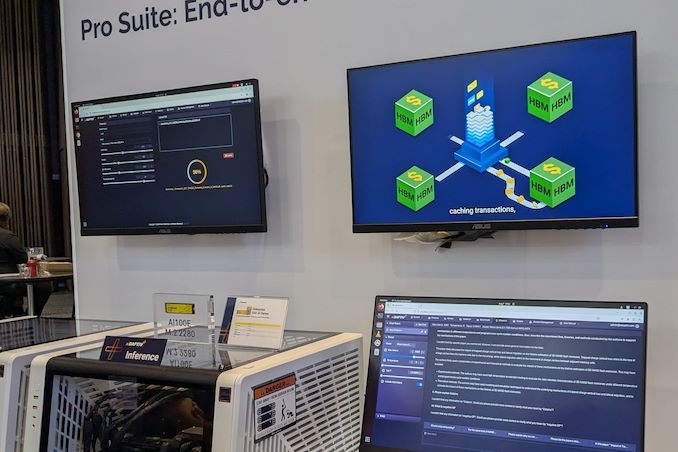
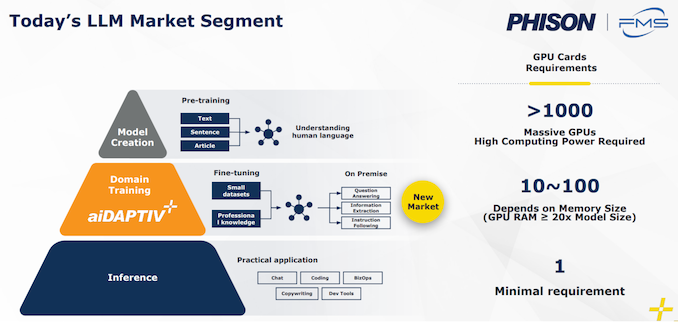
aiDAPTIV+ Pro Suite for AI Training

One of the more interesting demonstrations in Phison's booth was the aiDAPTIV+ Pro suite. At last year's FMS, Phison had demonstrated a 40 DWPD SSD for use with Chia (thankfully, that fad has faded). The company has been working on the extreme endurance aspect and moved it up to 60 DWPD (which is standard for the SLC-based cache drives from Micron and Solidigm).

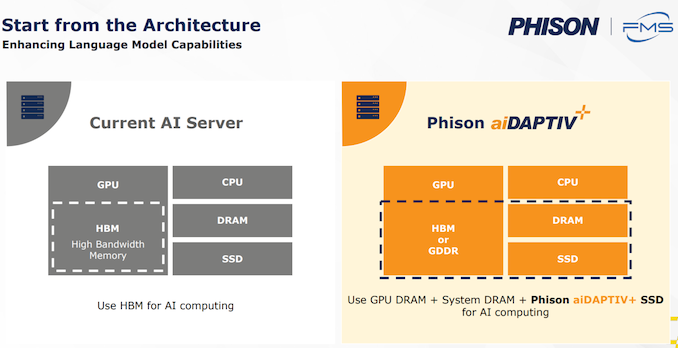
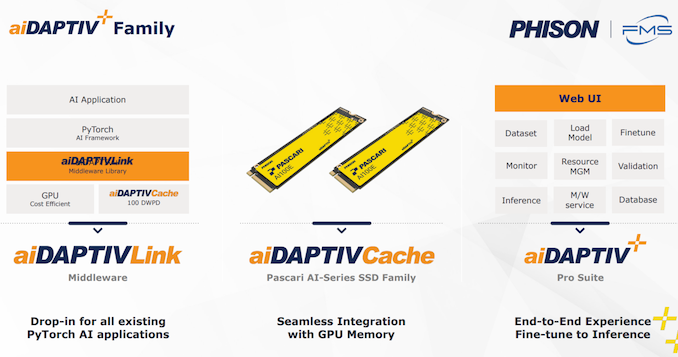
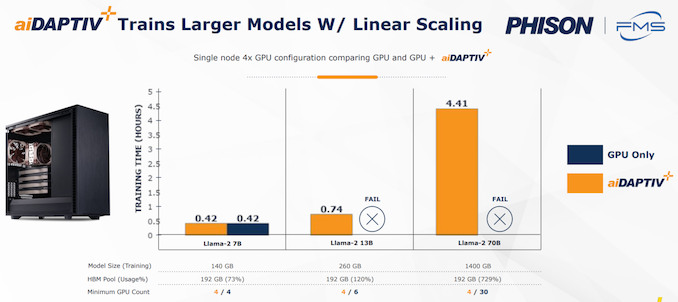
At FMS 2024, the company took this SSD and added a middleware layer on top to ensure that workloads remain more sequential in nature. This drives up the endurance rating to 100 DWPD. Now, this middleware layer is actually part of their AI training suite targeting small business and medium enterprises who do not have the budget for a full-fledged DGX workstation, or for on-premises fine-tuning.


Re-training models by using these AI SSDs as an extension of the GPU VRAM can deliver significant TCO benefits for these companies, as the costly AI training-specific GPUs can be replaced with a set of relatively low-cost off-the-shelf RTX GPUs. This middleware comes with licensing aspects that are essentially tied to the purchase of the AI-series SSDs (that come with Gen 4 x4 interfaces currently in either U.2 or M.2 form-factors). The use of SSDs as a caching layer can enable fine-tuning of models with a very large number of parameters using a minimal number of GPUs (not having to use them primarily for their HBM capacity).

  •  

Samsung's 128 TB-Class BM1743 Enterprise SSD Displayed at FMS 2024

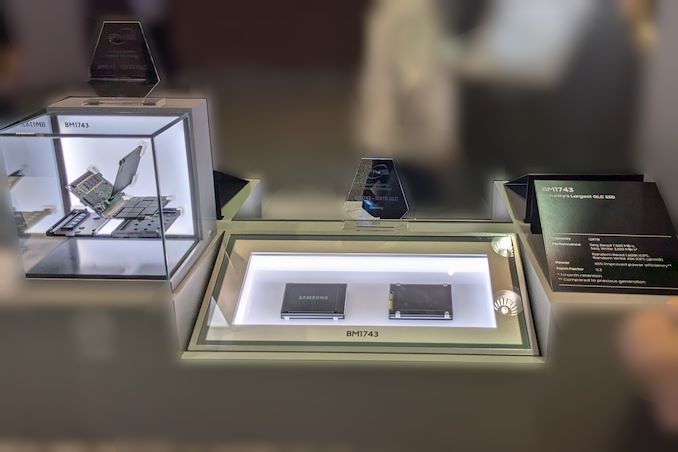
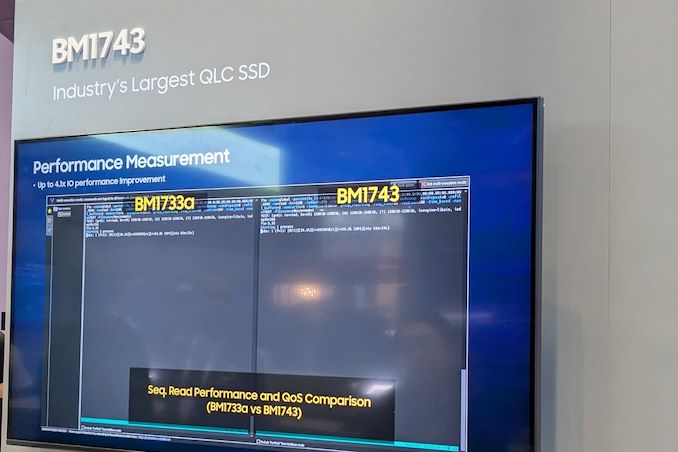
Samsung had quietly launched its BM1743 enterprise QLC SSD last month with a hefty 61.44 TB SKU. At FMS 2024, the company had the even larger 122.88 TB version of that SSD on display, alongside a few recorded benchmarking sessions. Compared to the previous generation, the BM1743 comes with a 4.1x improvement in I/O performance, improvement in data retention, and a 45% improvement in power efficiency for sequential writes.

The 128 TB-class QLC SSD boasts of sequential read speeds of 7.5 GBps and write speeds of 3 GBps. Random reads come in at 1.6 M IOPS, while 16 KB random writes clock in at 45K IOPS. Based on the quoted random write access granularity, it appears that Samsung is using a 16 KB indirection unit (IU) to optimize flash management. This is similar to the strategy adopted by Solidigm with IUs larger than 4K in their high-capacity SSDs.

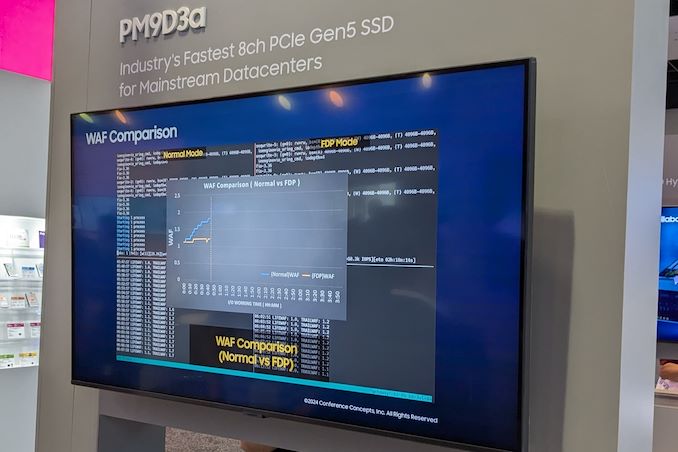
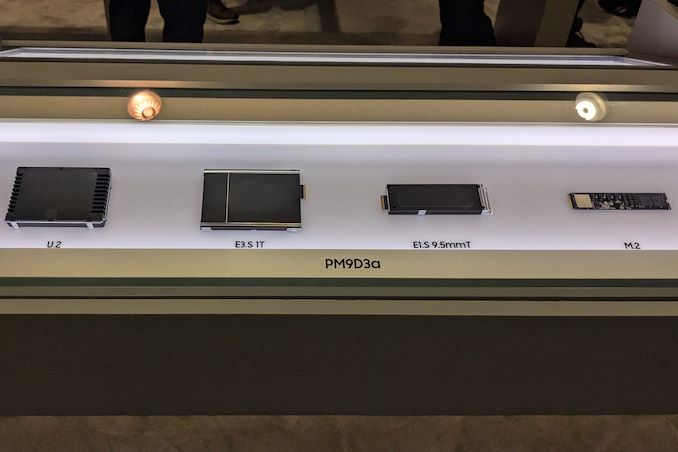
A recorded benchmark session on the company's PM9D3a 8-channel Gen 5 SSD was also on display.

The SSD family is being promoted as a mainstream option for datacenters, and boasts of sequential reads up to 12 GBps and writes up to 6.8 GBps. Random reads clock in at 2 M IOPS, and random writes at 400 K IOPS.

Available in multiple form-factors up to 32 TB (M.2 tops out at 2 TB), the drive's firmware includes optional support for flexible data placement (FDP) to help address the write amplification aspect.

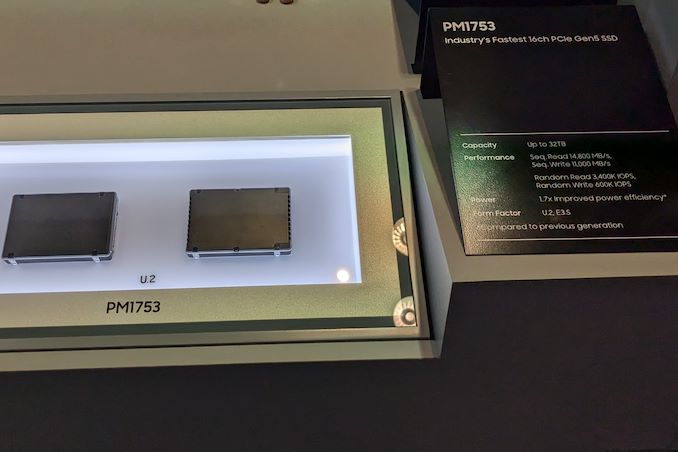
The PM1753 is the current enterprise SSD flagship in Samsung's lineup. With support for 16 NAND channels and capacities up to 32 TB, this U.2 / E3.S SSD has advertised sequential read and write speeds of 14.8 GBps and 11 GBps respectively. Random reads and writes for 4 KB accesses are listed at 3.4 M and 600 K IOPS.

Samsung claims a 1.7x performance improvement and a 1.7x power efficiency improvement over the previous generation (PM1743), making this TLC SSD suitable for AI servers.

The 9th Gen. V-NAND wafer was also available for viewing, though photography was prohibited. Mass production of this flash memory began in April 2024.

  •  

Kioxia Demonstrates Optical Interface SSDs for Data Centers

A few years back, the Japanese government's New Energy and Industrial Technology Development Organization (NEDO ) allocated funding for the development of green datacenter technologies. With the aim to obtain up to 40% savings in overall power consumption, several Japanese companies have been developing an optical interface for their enterprise SSDs. And at this year's FMS, Kioxia had their optical interface on display.

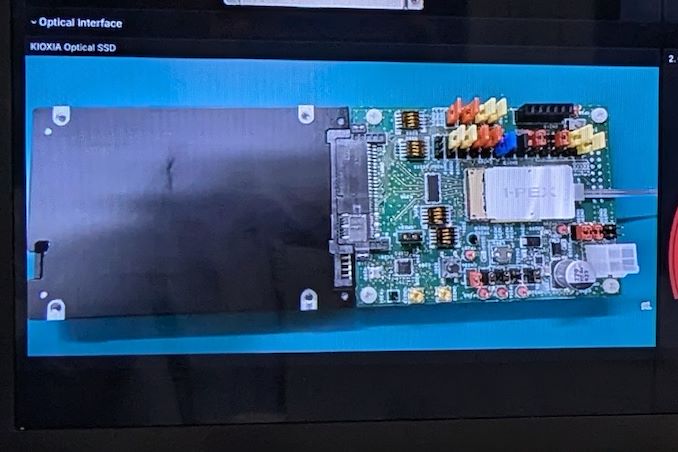
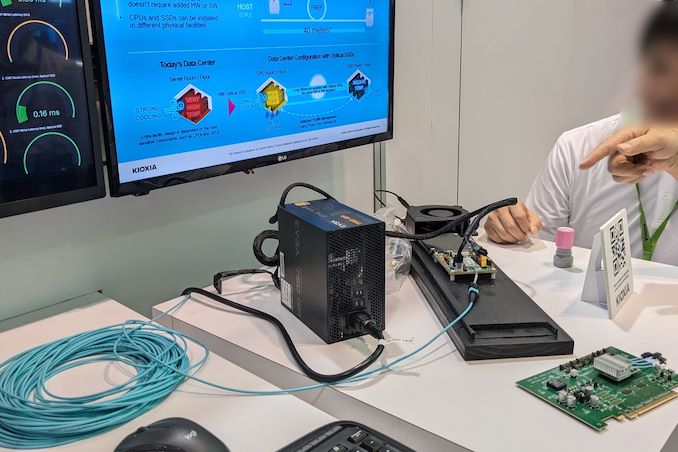
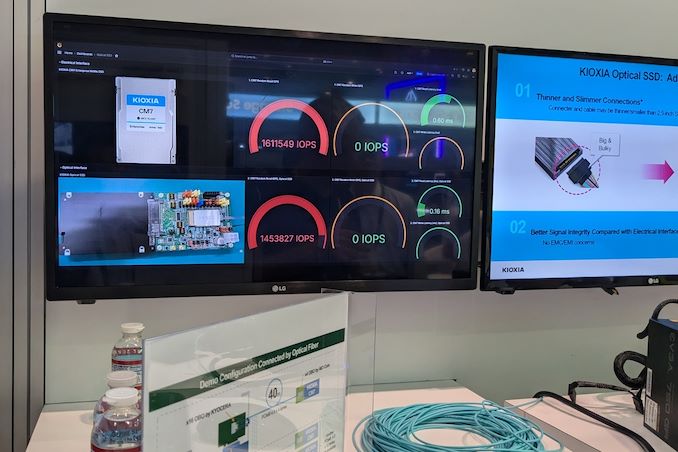
For this demonstration, Kioxia took its existing CM7 enterprise SSD and created an optical interface for it. A PCIe card with on-board optics developed by Kyocera is installed in the server slot. An optical interface allows data transfer over long distances (it was 40m in the demo, but Kioxia promises lengths of up to 100m for the cable in the future). This allows the storage to be kept in a separate room with minimal cooling requirements compared to the rack with the CPUs and GPUs. Disaggregation of different server components will become an option as very high throughput interfaces such as PCIe 7.0 (with 128 GT/s rates) become available.

The demonstration of the optical SSD showed a slight loss in IOPS performance, but a significant advantage in the latency metric over the shipping enterprise SSD behind a copper network link. Obviously, there are advantages in wiring requirements and signal integrity maintenance with optical links.

Being a proof-of-concept demonstration, we do see the requirement for an industry-standard approach if this were to gain adoption among different datacenter vendors. The PCI-SIG optical workgroup will need to get its act together soon to create a standards-based approach to this problem.

  •  

Silicon Motion Demonstrates Flexible Data Placement on MonTitan Gen 5 Enterprise SSD Platform

At FMS 2024, the technological requirements from the storage and memory subsystem took center stage. Both SSD and controller vendors had various demonstrations touting their suitability for different stages of the AI data pipeline - ingestion, preparation, training, checkpointing, and inference. Vendors like Solidigm have different types of SSDs optimized for different stages of the pipeline. At the same time, controller vendors have taken advantage of one of the features introduced recently in the NVM Express standard - Flexible Data Placement (FDP).

FDP involves the host providing information / hints about the areas where the controller could place the incoming write data in order to reduce the write amplification. These hints are generated based on specific block sizes advertised by the device. The feature is completely backwards-compatible, with non-FDP hosts working just as before with FDP-enabled SSDs, and vice-versa.

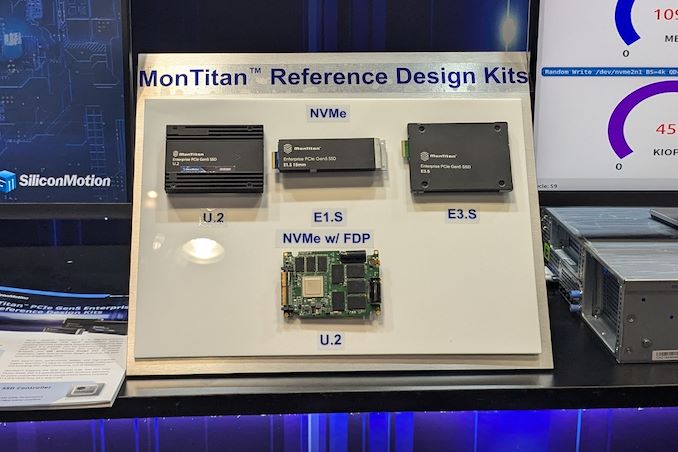
Silicon Motion's MonTitan Gen 5 Enterprise SSD Platform was announced back in 2022. Since then, Silicon Motion has been touting the flexibility of the platform, allowing its customers to incorporate their own features as part of the customization process. This approach is common in the enterprise space, as we have seen with Marvell's Bravera SC5 SSD controller in the DapuStor SSDs and Microchip's Flashtec controllers in the Longsys FORESEE enterprise SSDs.

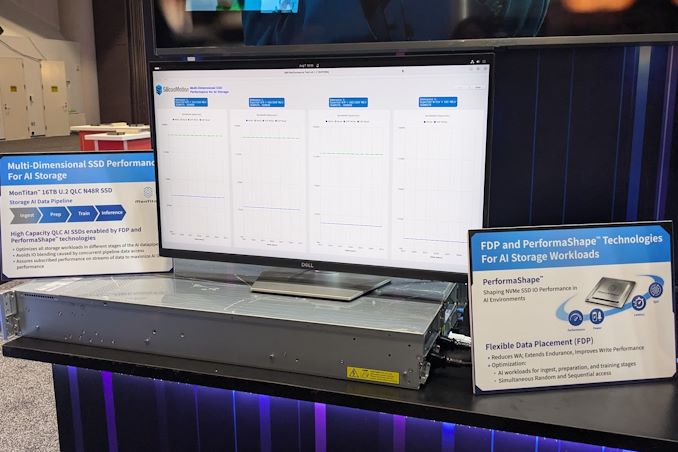
At FMS 2024, the company was demonstrating the advantages of flexible data placement by allowing a single QLC SSD based on their MonTitan platform to take part in different stages of the AI data pipeline while maintaining the required quality of service (minimum bandwidth) for each process. The company even has a trademarked name (PerformaShape) for the firmware feature in the controller that allows the isolation of different concurrent SSD accesses (from different stages in the AI data pipeline) to guarantee this QoS. Silicon Motion claims that this scheme will enable its customers to get the maximum write performance possible from QLC SSDs without negatively impacting the performance of other types of accesses.

Silicon Motion and Phison have market leadership in the client SSD controller market with similar approaches. However, their enterprise SSD controller marketing couldn't be more different. While Phison has gone in for a turnkey solution with their Gen 5 SSD platform (to the extent of not adopting the white label route for this generation, and instead opting to get the SSDs qualified with different cloud service providers themselves), Silicon Motion is opting for a different approach. The flexibility and customization possibilities can make platforms like the MonTitan appeal to flash array vendors.

  •  

Kioxia Demonstrates RAID Offload Scheme for NVMe Drives

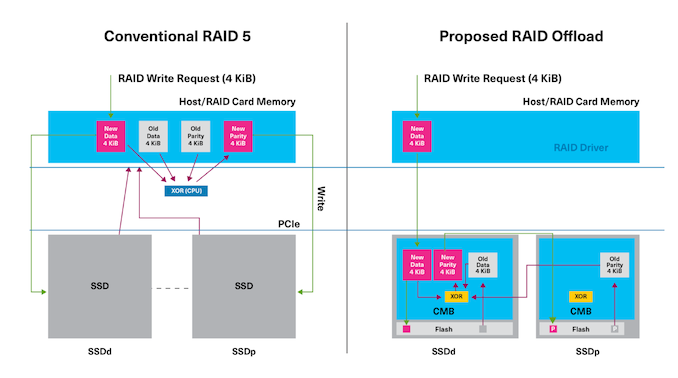
At FMS 2024, Kioxia had a proof-of-concept demonstration of their proposed a new RAID offload methodology for enterprise SSDs. The impetus for this is quite clear: as SSDs get faster in each generation, RAID arrays have a major problem of maintaining (and scaling up) performance. Even in cases where the RAID operations are handled by a dedicated RAID card, a simple write request in, say, a RAID 5 array would involve two reads and two writes to different drives. In cases where there is no hardware acceleration, the data from the reads needs to travel all the way back to the CPU and main memory for further processing before the writes can be done.

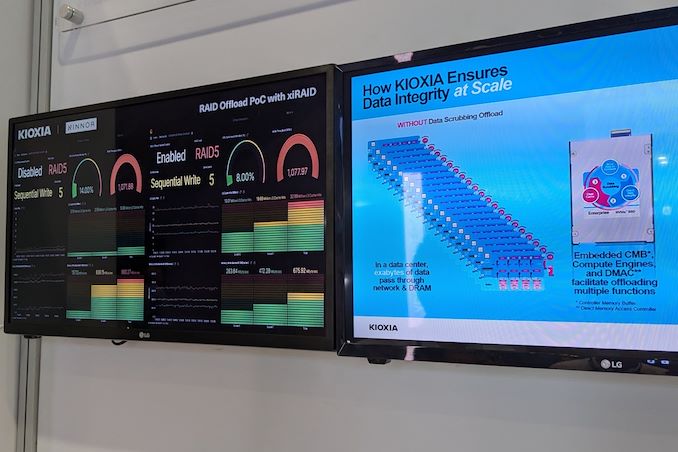
Kioxia has proposed the use of the PCIe direct memory access feature along with the SSD controller's controller memory buffer (CMB) to avoid the movement of data up to the CPU and back. The required parity computation is done by an accelerator block resident within the SSD controller.

In Kioxia's PoC implementation, the DMA engine can access the entire host address space (including the peer SSD's BAR-mapped CMB), allowing it to receive and transfer data as required from neighboring SSDs on the bus. Kioxia noted that their offload PoC saw close to 50% reduction in CPU utilization and upwards of 90% reduction in system DRAM utilization compared to software RAID done on the CPU. The proposed offload scheme can also handle scrubbing operations without taking up the host CPU cycles for the parity computation task.

Kioxia has already taken steps to contribute these features to the NVM Express working group. If accepted, the proposed offload scheme will be part of a standard that could become widely available across multiple SSD vendors.

  •  

Western Digital Introduces 4 TB microSDUC, 8 TB SDUC, and 16 TB External SSDs

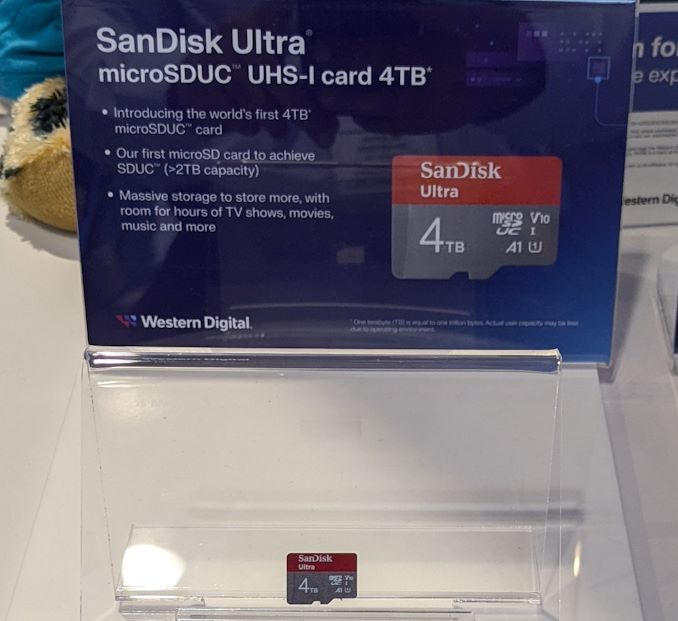
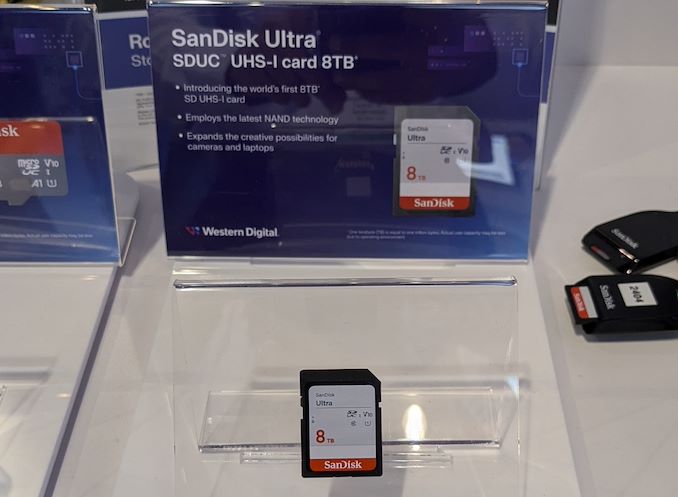
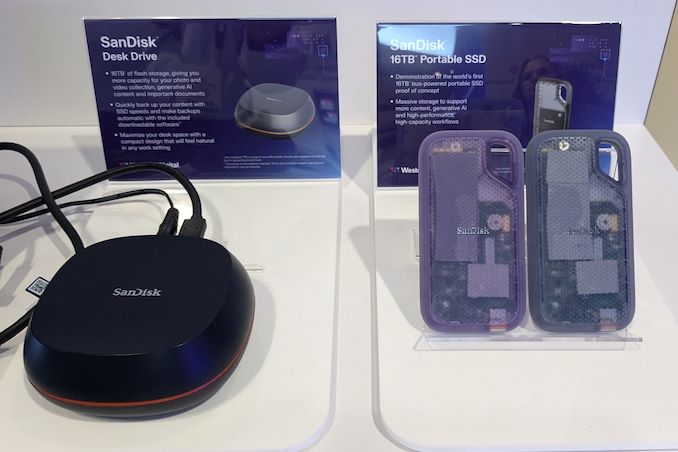
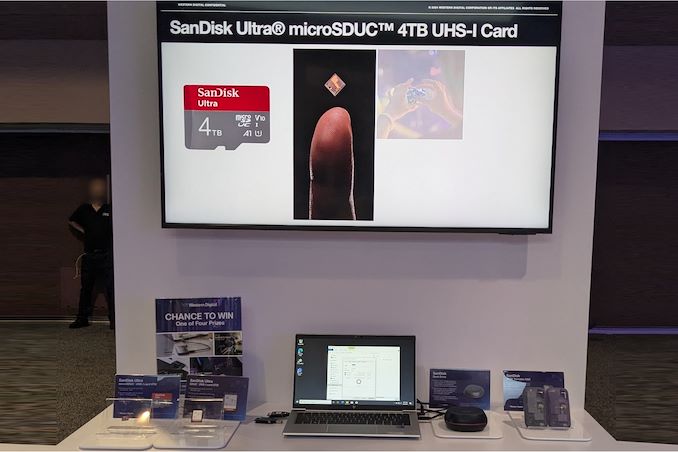
Western Digital's BiCS8 218-layer 3D NAND is being put to good use in a wide range of client and enterprise platforms, including WD's upcoming Gen 5 client SSDs and 128 TB-class datacenter SSD. On the external storage front, the company demonstrated four different products: for card-based media, 4 TB microSDUC and 8 TB SDUC cards with UHS-I speeds, and on the portable SSD front we had two 16 TB drives. One will be a SanDisk Desk Drive with external power, and the other in the SanDisk Extreme Pro housing with a lanyard opening in the case.

All of these are using BiCS8 QLC NAND, though I did hear booth talk (as I was taking leave) that they were not supposed to divulge the use of QLC in these products. The 4 TB microSDUC and 8 TB SDUC cards are rated for UHS-I speeds. They are being marketed under the SanDisk Ultra branding.

The SanDisk Desk Drive is an external SSD with a 18W power adapter, and it has been in the market for a few months now. Initially launched in capacities up to 8 TB, Western Digital had promised a 16 TB version before the end of the year. It appears that the product is coming to retail quite soon. One aspect to note is that this drive has been using TLC for the SKUs that are currently in the market, so it appears unlikely that the 16 TB version would be QLC. The units (at least up to the 8 TB capacity point) come with two SN850XE drives. Given the recent introduction of the 8 TB SN850X, an 'E' version with tweaked firmware is likely to be present in the 16 TB Desk Drive.

The 16 TB portable SSD in the SanDisk Extreme housing was a technology demonstration. It is definitely the highest capacity bus-powered portable SSD demonstrated by any vendor at any trade show thus far. Given the 16 TB Desk Drive's imminent market introduction, it is just a matter of time before the technology demonstration of the bus-powered version becomes a retail reality.

  •  

Kioxia Details BiCS 8 NAND at FMS 2024: 218 Layers With Superior Scaling

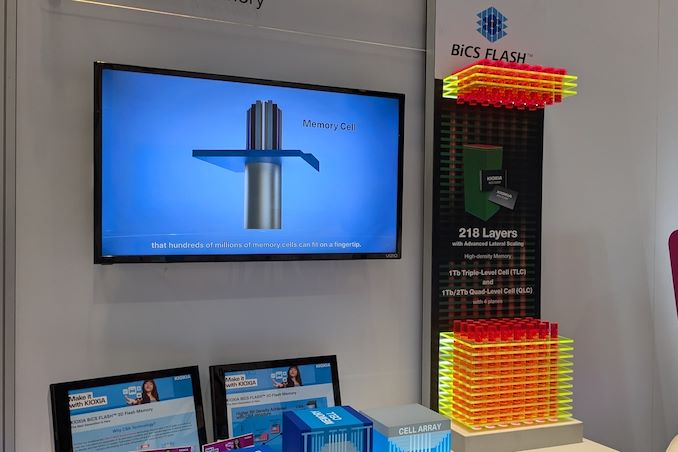
Kioxia's booth at FMS 2024 was a busy one with multiple technology demonstrations keeping visitors occupied. A walk-through of the BiCS 8 manufacturing process was the first to grab my attention. Kioxia and Western Digital announced the sampling of BiCS 8 in March 2023. We had touched briefly upon its CMOS Bonded Array (CBA) scheme in our coverage of Kioxial's 2Tb QLC NAND device and coverage of Western Digital's 128 TB QLC enterprise SSD proof-of-concept demonstration. At Kioxia's booth, we got more insights.

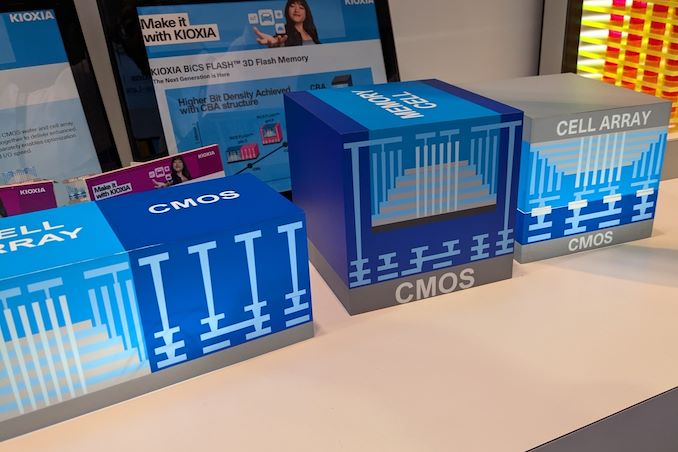
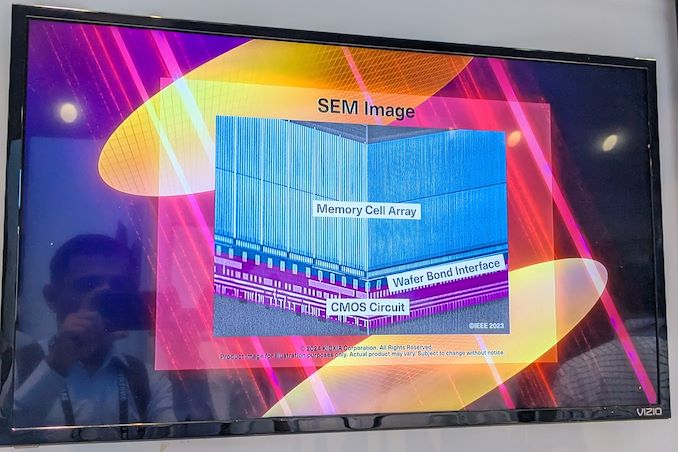
Traditionally, fabrication of flash chips involved placement of the associate logic circuitry (CMOS process) around the periphery of the flash array. The process then moved on to putting the CMOS under the cell array, but the wafer development process was serialized with the CMOS logic getting fabricated first followed by the cell array on top. However, this has some challenges because the cell array requires a high-temperature processing step to ensure higher reliability that can be detrimental to the health of the CMOS logic. Thanks to recent advancements in wafer bonding techniques, the new CBA process allows the CMOS wafer and cell array wafer to be processed independently in parallel and then pieced together, as shown in the models above.

The BiCS 8 3D NAND incorporates 218 layers, compared to 112 layers in BiCS 5 and 162 layers in BiCS 6. The company decided to skip over BiCS 7 (or, rather, it was probably a short-lived generation meant as an internal test vehicle). The generation retains the four-plane charge trap structure of BiCS 6. In its TLC avatar, it is available as a 1 Tbit device. The QLC version is available in two capacities - 1 Tbit and 2 Tbit.

Kioxia also noted that while the number of layers (218) doesn't compare favorably with the latest layer counts from the competition, its lateral scaling / cell shrinkage has enabled it to be competitive in terms of bit density as well as operating speeds (3200 MT/s). For reference, the latest shipping NAND from Micron - the G9 - has 276 layers with a bit density in TLC mode of 21 Gbit/mm2, and operates at up to 3600 MT/s. However, its 232L NAND operates only up to 2400 MT/s and has a bit density of 14.6 Gbit/mm2.

It must be noted that the CBA hybrid bonding process has advantages over the current processes used by other vendors - including Micron's CMOS under array (CuA) and SK hynix's 4D PUC (periphery-under-chip) developed in the late 2010s. It is expected that other NAND vendors will also move eventually to some variant of the hybrid bonding scheme used by Kioxia.

  •  
❌