
Vue lecture

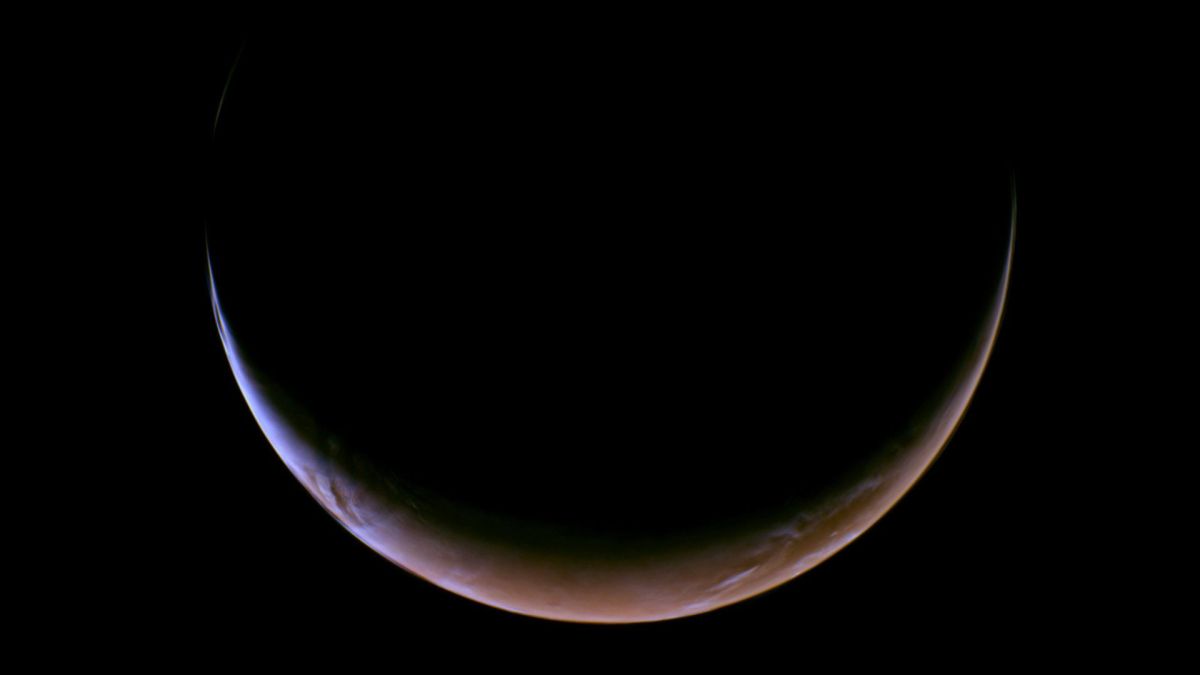
Mars en croissant : la magnifique et surprenante photo capturée par la sonde Psyché
croissant mars

En route vers son mystérieux astéroïde de métal, la sonde Psyché a profité d'un survol de Mars le 15 mai 2026 pour s'offrir un coup d'accélérateur cosmique. Un « vol rase-motte » spectaculaire qui lui a aussi permis d'immortaliser la planète rouge sous un angle rare : un fin croissant lumineux sculpté par les poussières martiennes.


  •  

Course à la Lune : l’ESA tape du poing sur la table face au déclin européen

Ariane 6

Lunar Gateway suspendu, Mars Sample Return sabré... Face aux choix unilatéraux des États-Unis, le directeur général de l’ESA tire la sonnette d’alarme. Pour Josef Aschbacher, l'Europe doit d’urgence s’unir pour financer son autonomie spatiale avant d'être définitivement reléguée au rang de simple passagère de l'Histoire.

  •  

En plein vol rase-motte, la sonde Psyché de la NASA immortalise une vue inédite de Mars

croissant mars

En route vers son mystérieux astéroïde de métal, la sonde Psyché a profité d'un survol de Mars le 15 mai 2026 pour s'offrir un coup d'accélérateur cosmique. Un « vol rase-motte » spectaculaire qui lui a aussi permis d'immortaliser la planète rouge sous un angle rare : un fin croissant lumineux sculpté par les poussières martiennes.
  •  

Webb Discovers One of the Universe's First Galaxies

Astronomers using the James Webb Space Telescope have identified an ultra-faint galaxy seen just 800 million years after the Big Bang. The galaxy contains almost no heavy elements, shows signs of intense early stellar radiation, and could offer a rare glimpse into the first stages of galaxy formation. Phys.org reports: In a paper published in the journal Nature, a team of scientists led by Kimihiko Nakajima, an astronomer at Kanazawa University, Japan, describes how they used the telescope to study a part of the deep universe and discovered a faint galaxy called LAP1-B. "LAP1-B establishes a 'fossil in the making,' a direct high-redshift progenitor of the ancient ultra-faint dwarf galaxies observed in the local universe," they wrote. Because the galaxy is so small and distant, it would normally be impossible to see. However, it was spotted due to a phenomenon known as gravitational lensing, in which a massive cluster of closer galaxies acts like a giant magnifying glass, boosting the light from LAP1-B by 100 times. The scientists realized that most of the light from the galaxy wasn't coming from the stars, but from glowing clouds of gas. They analyzed this light by splitting it into a spectrum and studying the emission lines, which revealed the chemical composition of the gas. They found that the galaxy contains almost no heavy elements, and its oxygen abundance is about 240 times lower than the sun's, making it one of the most primitive star-forming galaxies ever observed. The emission lines also revealed intense ionizing radiation, which is what scientists expect to see from the first generation of stars. The team also measured an elevated carbon-to-oxygen ratio. This matches the predicted chemical signature for the first star explosions in history from Population III stars, the first stars to exist in the universe. The stars we see today are Population I stars, which formed later and contain more heavy elements. Another fascinating finding is that, after measuring the gas's motion and speed, the researchers concluded that the galaxy is held together by a massive cloud of invisible dark matter.

Read more of this story at Slashdot.

  •  

S’unir ou subir : il est urgent que l’Europe cesse d’être à la remorque de la conquête spatiale, prévient l’ESA

Ariane 6

Lunar Gateway suspendu, Mars Sample Return sabré... Face aux choix unilatéraux des États-Unis, le directeur général de l’ESA tire la sonnette d’alarme. Pour Josef Aschbacher, l'Europe doit d’urgence s’unir pour financer son autonomie spatiale avant d'être définitivement reléguée au rang de simple passagère de l'Histoire.

  •  

Tempêtes solaires : le satellite Smile s’envole pour filmer notre bouclier magnétique en action

Vue d'artiste de la mission Smile

La mission Smile a décollé dans la matinée du 19 mai depuis le Centre spatial guyanais de Kourou. Il s'agit d'un satellite, fruit d'une collaboration entre l'Europe et la Chine, qui doit récolter des informations sur les vents solaires, ces flux encore mal connus qui mettent parfois à mal nos satellites en orbite autour de la Terre.

  •  

Smile, la mission européenne et chinoise qui part explorer les vents solaires

Vue d'artiste de la mission Smile

La mission Smile a décollé dans la matinée du 19 mai depuis le Centre spatial guyanais de Kourou. Il s'agit d'un satellite, fruit d'une collaboration entre l'Europe et la Chine, qui doit récolter des informations sur les vents solaires, ces flux encore mal connus qui mettent parfois à mal nos satellites en orbite autour de la Terre.

  •  

'We Still Can't See Dark Matter. But What If We Can Hear It?'

"We may have accidentally detected dark matter back in 2019," writes ScienceAlert. "What if instead of trying to see dark matter, scientists attempted to hear it instead?" asks Space.com: New research suggests dark matter could leave a tiny but discernible imprint in the cacophony of ripples in spacetime called "gravitational waves" that ring through the cosmos when two black holes slam together and merge... Fortunately, when it comes to detecting gravitational waves from colliding black holes, humanity's instruments, such as LIGO (Laser Interferometer Gravitational-Wave Observatory), are getting more and more sensitive all the time... Vicente and colleagues searched through data gathered by LIGO and its fellow gravitational wave detectors, KAGRA (Kamioka Gravitational Wave Detector) and Virgo, focusing on 28 of the clearest signals from merging black holes. Of these, 27 appeared to have come from mergers that occurred in the relative vacuum of space. One signal, however, GW190728, first heard on July 19, 2019, and the result of merging binary black holes with a combined mass of 20 times that of the sun and located an estimated 8 billion light-years away, seemed to carry the telltale trace of this merger occurring in a region of dense, "buttery" dark matter. The team behind this research is quick to point out that this can't be considered a positive detection of dark matter, but does say it gives us a hint at what to look for and thus where to direct follow-up investigations... "We know that dark matter is around us. It just has to be dense enough for us to see its effects," said team leader Josu Aurrekoetxea, of the Massachusetts Institute of Technology (MIT) Department of Physics. "Black holes provide a mechanism to enhance this density, which we can now search for by analyzing the gravitational waves emitted when they merge." They published their results this week in the journal Physical Review Letters.

Read more of this story at Slashdot.

  •  

Artémis III : la NASA juge qu’un journaliste a « mal interprété » ses propos, les enregistrements montrent l’inverse

artémis lune

En démentant le report de la mission Artémis III à fin 2027, le patron de la NASA a tenté un rétropédalage. Pour justifier la confusion, Jared Isaacman a pointé du doigt la mauvaise interprétation d'un journaliste… avant que l'enregistrement de ses propres déclarations ne refasse surface pour le contredire.

  •  

SpaceX Unveils Sweeping Starship V3 Upgrades

SpaceX has detailed major Starship V3 upgrades ahead of a launch targeted as early as May 19. The changes are meant to move Starship closer to its core goals: rapid reuse, Starlink deployment, orbital refueling, and eventually Moon and Mars missions. Longtime Slashdot reader schwit1 shares a report from Teslarati: Here is an explicit, broken-down list of the key changes, first starting with the changes to Super Heavy V3: - Grid Fin Redesign: Reduced from four fins to three. Each fin is now 50% larger and stronger, repositioned for better catching and lifting performance. Fins are lowered on the booster to reduce heat exposure during hot staging, with hardware moved inside the fuel tank for protection. - Integrated Hot Staging: Eliminates the old disposable interstage shield. The booster dome is now directly exposed to upper-stage engine ignition, protected by tank pressure and steel shielding. Interstage actuators retract after separation. - New Fuel Transfer System: Massive redesign of the fuel transfer tube -- roughly the size of a Falcon 9 first stage -- enables simultaneous startup of all 33 Raptors for faster, more reliable flip maneuvers. - Engine Bay/Thermal Protection: Engine shrouds removed entirely; new shielding added between engines. Propulsion and avionics are more tightly integrated. CO? fire suppression system deleted for a simpler, lighter aft section. - Propellant Loading Improvements: Switched from one quick disconnect to two separate systems for added redundancy and reduced pad complexity. Next, we have the changes to Starship V3: - Completely Redesigned Propulsion System: Clean-sheet redesign supports new Raptor startup, larger propellant volume, and an improved reaction control system while reducing trapped or leaked propellant risk. - Aft Section Simplification: Fluid and electrical systems rerouted; engine shrouds and large aft cavity deleted. - Flap Actuation Upgrade: Changed from two actuators per flap to one actuator with three motors for better redundancy, mass efficiency, and lower cost. - Faster Starlink Deployment: Upgraded PEZ dispenser enables quicker satellite release. - Long-Duration Spaceflight Capability: New systems for long orbital coasts, orbital refueling, cryogenic fluid management, vacuum-insulated header tanks, and high-voltage cryogenic recirculation. - Ship-to-Ship Docking + Refueling: Four docking drogues and dedicated propellant transfer connections added to support in-space refueling architecture. - Avionics Upgrades: 60 custom avionics units with integrated batteries, inverters, and high-voltage systems (9 MW peak power). New multi-sensor navigation for precision autonomous flight. RF sensors measure propellant in microgravity. ~50 onboard camera views and 480 Mbps Starlink connectivity for low-latency communications. "Believe it or not, there's more," writes schwit1. "Two years ago, the biggest and most powerful rocket ever flown was Starship V1. Last year, it was Starship V2. V3 is about to become the biggest and most powerful rocket ever flown -- but don't worry, the company already has plans for V4."

Read more of this story at Slashdot.

  •  

Physicists Find Possible Errors In 100-Year-Old Model of the Universe

A trio of preprint papers suggests the universe may not be perfectly uniform on the largest scales, finding tentative 2-to-4-sigma deviations from a core assumption of standard cosmology known as FLRW geometry. Live Science reports: The work combines observations of distant exploding stars and large-scale galaxy surveys to probe whether the universe truly follows a nearly 100-year-old mathematical framework known as Friedmann-Lemaitre-Robertson-Walker (FLRW) cosmology. The analyses revealed mild-but-intriguing deviations from the predictions of the standard model. "We saw a surprising violation of an FLRW curvature consistency test, hinting at new physics beyond the standard model," study co-author Asta Heinesen, a physicist at the Niels Bohr Institute in Copenhagen and Queen Mary University in London, told Live Science via email, referring to the assumption that the space's curvature is the same everywhere. "This could potentially be due to various effects, but more research is needed to address the cause of the FLRW violation that we see empirically." [...] The analyses revealed small but potentially important departures from the predictions of standard FLRW cosmology. Depending on the dataset and analysis method, the discrepancy reached a statistical significance of about 2 to 4 sigma. In physics, sigma measures how likely a result is to arise purely by chance; a 5-sigma result is typically required before scientists claim a discovery, so the new findings remain tentative. Still, the results suggest that something unexpected may be affecting the geometry or expansion of the universe. "The main finding is that you can directly measure Dyer-Roeder and backreaction effects from available cosmological data, and clearly distinguish these effects from other alterations of the standard cosmological model, such as evolving dark energy and modified gravity theories," Heinesen said. "This was previously not possible in such a direct way, and this is what I think is the breakthrough in our work." "If these indicated deviations from an FLRW geometry are real, it would signify that most of the cosmological solutions considered for solving the cosmological tensions -- evolving or interacting dark energy, new types of matter or energy, modified gravity and related ideas within the FLRW framework -- are ruled out," the researchers wrote. The next step will involve applying the new theoretical framework to larger and more precise datasets. "It is to apply our theoretical results to data to test the standard model and to produce constraints on the Dyer-Roeder and backreaction effects," Heinesen said.

Read more of this story at Slashdot.

  •  

La fusée géante Starship a son plan de vol, mais zappe sa manœuvre la plus spectaculaire

Retour du Super Heavy sur Terre après le 5e vol du Starship

Le 19 mai, SpaceX lancera le douzième vol d'essai de sa fusée géante Starship. Pour ce vol inaugural de la « Version 3 », marqué par une refonte technologique et de nouveaux moteurs Raptor, l'entreprise privilégiera la prudence avec un amerrissage en mer du booster plutôt qu'une capture spectaculaire par la tour.

  •  
❌