Hier, le 22 juin 2026, Valve lançait officiellement sa Steam Machine. Elle peut être réservée sur sa page officielle, avec un prix de départ de 1039 € si l'on se contente de 512 Go de stockage. Au lendemain de cette annonce, nous vous proposons de découvrir ce que nos différents confrères, qui ont t...
La 4L est de retour. Sous forme électrique, sous forme de SUV, et désormais sous forme découvrable. La Renault 4 E-Tech electric Plein Sud est une anomalie dans le paysage automobile actuel : un véhicule du quotidien, polyvalent, familial, qui offre en plus une ouverture sur le ciel. Rare. Très rare.
Il y a des voitures qu’on achète avec la tête. Et d’autres avec le cœur. La Renault 4 E-Tech electric Plein Sud, elle, revendique les deux. C’est le pari — un peu fou ou courageux — que Renault a décidé de tenir : offrir une version à toit ouvrant en toile d’un SUV électrique compact, sans sacrifier un seul gramme de praticité. Résultat ? Une voiture qui se démarque franchement dans un segment des petits SUV électriques qui ressemble de plus en plus à une mer de clones.
Nous l’avons essayée. Voici ce qu’on en pense.
Une silhouette qu’on reconnaît, un toit qu’on remarque
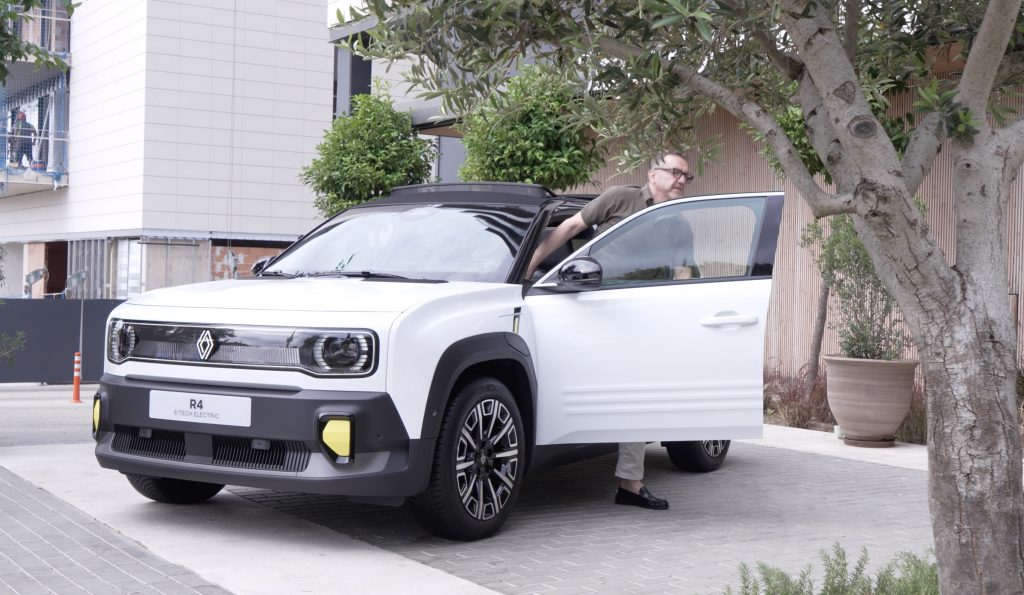
Inutile de chercher longtemps ce qui distingue la Plein Sud de la Renault 4 standard : c’est le toit. Un pavillon en toile noire qui remplace le toit fixe d’origine et donne à la voiture un profil inédit. Les barres de toit disparaissent — incompatibles avec le mécanisme — et l’antenne migre discrètement vers la lunette arrière. Pour le reste, c’est la même Renault 4 : 4,14 mètres de long, l’empattement de 2,62 mètres, les roues de 18 pouces, la calandre lumineuse emblématique et cette silhouette que les amateurs de la « 4L » originelle reconnaissent immédiatement.
Renault propose 11 coloris de carrosserie en finition Techno, 7 en Iconic. Le capot peut rester dans la couleur de la carrosserie ou passer au noir. La Plein Sud ne cherche pas à crier son originalité avec des stickers ou des décors exubérants. Elle assume son identité avec sobriété. C’est bien vu.
92 x 80 cm de ciel au-dessus de la tête
Le toit, c’est l’argument numéro un. Et les chiffres parlent d’eux-mêmes : 92 cm de longueur d’ouverture, 80 cm de largeur. Près d’un mètre carré de toile qui disparaît. C’est la plus grande ouverture du marché sur les segments A et B, et ce n’est pas qu’un argument commercial — à bord, l’effet est immédiat. L’habitacle est baigné de lumière, les passagers avant comme arrière profitent pleinement de l’ouverture.
L’opération prend dix secondes. Pas plus. Un bouton au plafonnier suffit, ou une simple commande vocale adressée à Reno, l’assistant IA embarqué qui repose sur de la génération de langage naturel — pas besoin de réciter une phrase préétablie. On dit ce qu’on pense, le toit s’exécute. En position intermédiaire, totalement ouvert, ou refermé en cas d’averse imprévue : toutes les positions sont possibles.
Mieux encore : on peut rouler toit ouvert à vitesse autoroutière. Un filet anti-remous limite les turbulences et le bruit dans l’habitacle. La limite ? 90 km/h pour l’ouverture ou la fermeture en mouvement — une fois ouvert, on peut rouler sans contrainte de vitesse maximale. En pratique, c’est une liberté qu’on n’attendait pas dans cette catégorie de véhicule.
La parole à un utilisateur au quotidien
Guillaume Sicard n’est pas venu à la Renault 4 par hasard. Utilisateur au quotidien, il a adopté la voiture pour ses trajets professionnels et familiaux. Nous lui avons demandé ce que la version Plein Sud changerait concrètement dans son usage.
Ce que son témoignage révèle, c’est quelque chose que beaucoup de conducteurs ressentent sans toujours l’admettre : un véhicule électrique peut être rationnel et désirable en même temps. Ce n’est pas une contradiction. La Plein Sud en est la démonstration concrète.
Aucun compromis. Vraiment aucun.
C’est là que Renault mérite d’être salué. La tentation était grande, sur une version « plaisir », de rogner quelque part. Sur le coffre, sur le volume habitable, sur les capacités utilitaires. Rien de tout ça n’a eu lieu.
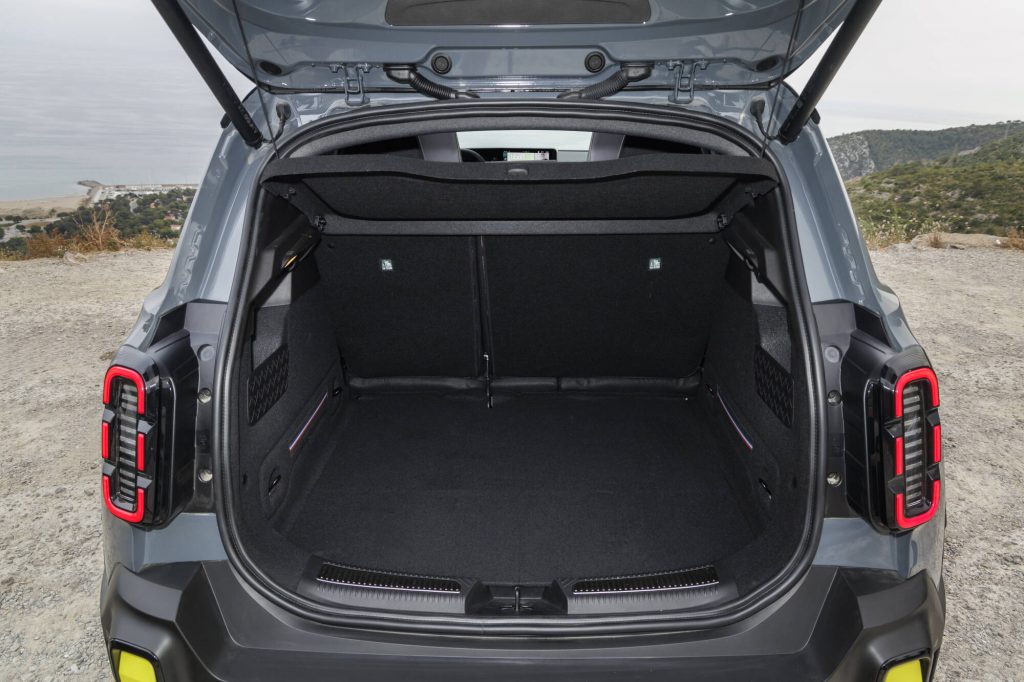
Le coffre affiche toujours 420 litres, dont 44 dissimulés sous le plancher. Le seuil de chargement reste à 61 cm — dix centimètres en dessous de la moyenne des concurrents. La banquette arrière se rabat, le siège passager avant se met à plat, offrant jusqu’à 2,20 mètres de longueur de chargement. On peut toujours tracter une remorque ou une petite caravane jusqu’à 750 kg. Les poches aumônières au dos des sièges avant sont là, les rangements aussi, pour un total de 23,3 litres d’espaces de rangement en cabine.
La magie est dans les détails d’ingénierie. Pour limiter le surpoids induit par le mécanisme d’ouverture et les renforts de carrosserie nécessaires, Renault a opté pour des éléments de structure en matériaux composites plutôt qu’en métal. Résultat : 19 kilos supplémentaires seulement par rapport à la version à toit fixe, à finition égale. Et un impact sur l’autonomie de… 7 km en cycle WLTP. La Plein Sud en finition Techno affiche 392 km d’autonomie contre 399 km pour la version standard.
Sept kilomètres. Pour du ciel ouvert. Le calcul est vite fait.
L’aérodynamisme a également été soigné : le SCx passe de 0,762 à 0,778, une légère hausse maîtrisée qui confirme le sérieux du travail effectué en soufflerie pour conserver à la fois confort acoustique et efficience.
La dynamique : la Renault 4, c’est avant tout du plaisir
La plateforme RGEV small n’a pas changé. Le train arrière multi-bras assure une agilité et un dynamisme que les petits SUV électriques n’ont pas tous. La direction est précise, la tenue de route saine, et l’ensemble donne envie de prendre les virages plutôt que de les subir.
Toit ouvert, la sensation change radicalement. On entend davantage le vent — maîtrisé mais présent — et l’expérience de conduite prend une dimension qu’on ne trouve nulle part ailleurs dans cette catégorie de prix. C’est simple, mais c’est fort. Une ligne droite sur une route de campagne, toit grand ouvert, soleil de côté : on comprend immédiatement pourquoi Renault a fait ce véhicule.
Prix et positionnement : une anomalie sur le marché
La Renault 4 E-Tech electric Plein Sud est disponible à partir de 31 110 euros, dans une offre de financement à 299 euros par mois sur 48 mois. Elle est naturellement un peu plus onéreuse que la silhouette standard et se décline en deux finitions : Techno et Iconic.
Dans un marché des petits SUV électriques qui carbure au raisonnable, à l’efficiente, au pratique-mais-sans-charme, la Plein Sud représente quelque chose de différent. Pas une niche exotique réservée aux nostalgiques de la décapotable. Pas une voiture de week-end qui dort au garage la semaine. Une proposition complète, quotidienne, familiale, qui ajoute une dimension émotionnelle que ses concurrents n’ont tout simplement pas.
Renault renoue ici avec une idée ancienne mais toujours valide : une voiture accessible peut aussi être désirable. Ce n’est pas un oxymore. C’est une ambition.
Notre avis
La Renault 4 E-Tech electric Plein Sud est l’une des propositions les plus cohérentes et les plus enthousiasmantes du marché en ce moment. Elle ne réinvente pas la roue — mais elle réinvente le plafond. Dans un univers électrique qui cherche encore son âme, c’est une bouffée d’air frais. Littéralement.
On aime : le toit géant (92 x 80 cm), l’absence totale de compromis sur la praticité, les 19 kg de surpoids seulement, la commande vocale intuitive, le prix d’entrée raisonnable.
On aime moins : la garde au toit légèrement réduite à l’arrière (813 mm contre 853 mm), l’absence de barres de toit si vous en aviez besoin.
Renault 4 E-Tech electric Plein Sud — à partir de 31 110 euros — Disponible en finitions Techno et Iconic
Le 29 mai 2026, Intel officialisait sa première génération de processeurs spécialement conçue pour les consoles portables. Son fleuron est l'Arc G3 Extreme, une puce issue de l'architecture Panther Lake, disposant d'une partie CPU à 14 cœurs et d'une partie GPU à 12 cœurs (Arc B390). Le 6 juin, nous...
Nous ne sommes jamais totalement fans à H&Co des Bons plans avec des conditions comme dans le cas présent, où il faut être abonné à Amazon Prime pour pouvoir en bénéficier. Si vous ne l'avez pas déjà utilisé auparavant, il vous est néanmoins possible de profiter d'un mois d'abonnement gratuit à...
AMD annonçait que ce serait dans le courant du mois de juillet 2026, mais c'est finalement avec un peu d'avance que le FSR 4.1 débarque officiellement pour les Radeon RX 7000 à architecture RDNA 3 ! La bonne nouvelle arrive via la publication en ce 22 juin 2026 de nouveaux pilotes graphiques du côté...
Il aura fallu attendre bien longtemps, mais nous y sommes. Après avoir été annoncée le 13 novembre 2025, la Steam Machine arrive, enfin presque. Valve va avoir un stock de sa console de salon, mais on sent que la firme sait d'avance que celui-ci ne suffira pas. Alors, elle lance une phase de réserva...
Les alimentations PC CORSAIR, il n'y a pas à dire, c'est de la "bonne came". La marque a d'ailleurs su, au fil du temps, devenir une référence incontournable du marché sur ce secteur. Quand on se focalise sur le cœur des gammes CORSAIR destinées aux passionnés de hardware qui montent eux-mêmes leurs...
America's state prison systems need ways "to keep people from returning to prison," reports the Wall Street Journal, "when an estimated 40% end up back behind bars within three years."
Part of the problem comes in the form of filing cabinets, manila folders and legacy digital databases. In other words, records for a single prisoner might be kept in a dozen places... Now a group of 19 prison systems are tackling the problem with digital tools and artificial intelligence in some cases. They are contracting with San Francisco nonprofit Recidiviz, whose computer systems bring together prisoner data from its disparate sources into digital dashboards. From there, corrections staff can see information — such as court records and notes from parole-board hearings — about a prisoner or parolee all in one place.
The company says its efforts are working: Recidivism has fallen 16% in the prison population its systems track. It is the result of "just streamlining these workflows and knitting someone's journey together end to end," says Clementine Jacoby, chief executive officer of Recidiviz. Some criminal-justice groups show that recidivism is trending downward in general, though most of that data is nearly a decade old... The statistics from 11 states stop at 2019, and for four states stop at 2016. With 10 other states, no data was reported.
À la simple évocation d'une machine à glaçons, certains d'entre vous sont peut-être déjà en train de fermer les yeux et de s'imaginer plongeant la tête dedans...Du côté de la chaine YouTube TrashBench, on a d'autres projets plus "hardwariens" pour une telle machine, et cela passe par du bricolage ge...
A private tutor who charged money to take dozens of exams for students and submit coursework for them "has been jailed for three years," reports the BBC, "after his scam earned him £300,000."
Shahid Adnan completed assignments and online tests for more than 120 students at Liverpool John Moore's University, the Crown Prosecution Service said. The 43-year-old, of Lysander Close, Liverpool, was caught in February 2023 after a student handed in a USB drive containing suspicious coursework to Dr Tom Berry of the university's school of computer science and mathematics. Berry's checks revealed the drive was used by Adnan with documents linked to a company he set up called Study Sharp Ltd.
Excel spreadsheets containing details of other students, their study modules, coursework due dates, and their personal login credentials were also found. Further checks confirmed suspicions that Adnan was accessing the university's network to submit fraudulent work and sit examinations on behalf of students... [I]nvestigations led police to believe Adnan may have been doing work for 124 students at universities all over the world.
The BBC also interviewed detective sergeant Adam Dagnall from Merseyside Police's cybercrime unit, who said Adnan was living a lavish lifestyle "well beyond" his stated occupations as a private tutor and Amazon delivery driver. His bank accounts held more than £2m ($2,645,100 USD).
"About 59% of TikTok videos served to a new account's For You feed are AI slop," writes Search Engine Journal, "according to a report from Kapwing, the video creation tool company. That's roughly three times the rate Kapwing found on YouTube."
The company manually reviewed over 10,000 TikTok videos across 20 categories and ran a separate fresh-account test, counting AI-generated content in the first 500 For You videos. Kapwing ran the same fresh-account test on YouTube and found that 104 of the first 500 Shorts, or 21%, were AI slop. On TikTok, 294 of 500 For You videos hit that threshold...
Of the 2,000 videos Kapwing reviewed in TikTok's Kids category, 57% were AI slop. That was the highest rate of any category in the analysis. The highest-rate tag was #cartoonkids, where 97 of 100 featured videos were AI-generated. Tags like #cartoons and #babysong both reached 83%, and #forkids came in at 79%. After Kids, the next highest AI slop rates were in Science and Education (35%), Health (33%), and History (33%). All three are categories where visual illustration and voiceover narration make up much of the content.
On the other end, categories where on-camera presence or physical demonstration are central had the lowest rates. Fashion came in at 1.3%, Music at 1.5%, and Fitness at 1.6%.
The article notes that by last November, TikTok "had already labeled 1.3 billion videos as AI-generated, according to the report."
The blog Linuxiac reports:
A new systemd fork has appeared with a specific purpose: removing systemd's recently added support for storing a user's birth date in JSON user records.
The fork, called Liberated systemd, published its first tagged release as v261 shortly after the official systemd 261 release. In other words, the fork follows upstream systemd while reverting the change that added the new optional birthDate field.
Importantly, this is not a new init system, a wider redesign of systemd, or a general-purpose alternative to the upstream project. Its stated purpose is to remain close to upstream systemd while removing what the author describes as "surveillance enablement"... The author recommends testing the fork in a virtual machine before using it on real hardware and warns nightly builds are more likely to be unstable than named releases.
"There's a revolution in battery technology hiding in plain sight," reports The Wall Street Journal. "The 3-D printing of batteries has the potential to put energy storage inside any device.
"This will enable lightweight and long-lasting consumer gadgets, long-range military drones and even nanoscale robots."
Almost all the innovations we regularly hear about — from cheaper, tougher electric-vehicle batteries to "Holy Grail" solid-state batteries — are about changing the chemistry of batteries. The promise of battery-tech 3-D printing (aka additive manufacturing) is simple: What if batteries could fill any available space, even structural elements of our gadgets, rather than always taking a rigid shape like a pouch or cylinder?
The new approach has obvious appeal. The entire airframe of a drone could be filled with energy storage for increased range. Smartglasses could have sleek battery-packed frames, so they look like everyday eyewear rather than "Revenge of the Nerds" props. One of the biggest advantages of 3-D printing is that it works with any battery, regardless of its cell chemistry. It could advance today's lithium-ion as well as emerging sodium-ion and solid-state tech... Some [startups] are trying to use 3-D printing to create efficiencies in existing battery manufacturing systems. A brave handful of startups are pursuing radical new designs and approaches. They're starting with defense applications, where cost and scale are less of an issue...
At Silicon Valley-based Sakuu... [r]ather than trying to 3-D-print whole batteries, the company is working on replacing one of battery manufacturing's biggest pain points, says Arwed Niestroj, Sakuu's chief operating officer, who is also a nuclear physicist and former head of Mercedes-Benz Research & Development North America. Existing battery assembly lines include football-field-long ovens for drying layers of material that have been dissolved in solvents. This requires a huge amount of energy and is a significant contributor to manufacturing costs, a big reason EV batteries aren't cheaper. Sakuu's process, under development for years, uses additive manufacturing to lay down key battery components without solvents, eliminating the need for ovens, says Niestroj.
Sakuu is currently working to commercialize this tech with a major battery manufacturer...
Electrek reports:
Tesla wants to sell modular AI data center hardware, according to a new trademark application for a product called "Megapod." The filing describes a complete, self-contained computing system for AI workloads...
Tesla filed the "Megapod" trademark (serial number 99893717) with the U.S. Patent and Trademark Office this month, through its longtime IP counsel. It's an intent-to-use application, meaning Tesla is claiming the name for a product it hasn't launched yet. The goods-and-services description is unusually specific for a trademark. Megapod covers "modular data center hardware systems for artificial intelligence computing, comprised of computer servers, computer hardware for artificial intelligence data processing, networking equipment, power distribution units, and cooling systems." It also covers "self-contained modular computing hardware systems for artificial intelligence workloads," integrated platforms sold as a single unit — an enclosure bundling compute, power distribution, and cooling — and downloadable software to monitor, manage, and optimize those systems.
In plain terms: Tesla wants to sell a turnkey AI data center building block. Not a battery, not a chip on its own, but the full rack-and-room of servers, networking, power, and cooling that AI training and inference run on.
Tesla's offering would have to compete with Nvidia's liquid-cooled, rack-scale systems that simulates a giant GPU, the article points out. But "The bigger issue is that Tesla has no merchant compute-hardware business to build on."
Tesla's own AI training cluster, Cortex at Gigafactory Texas, runs on roughly 67,000 Nvidia H100-equivalent GPUs. In other words, Tesla is one of Nvidia's customers, not a competitor selling alternative hardware... Where Tesla does have a real AI-data-center business is power, not compute. Its Megapack and new Megablock energy storage products are selling into AI data centers as grid buffers — Musk's own xAI has bought roughly $1 billion of Megapacks to keep its training runs powered. That energy-storage strength is the one credible thread here. A Megapod that bundles Tesla's power electronics, thermal management, and the enclosure — the "shell" around the chips rather than the chips themselves — would at least sit adjacent to a business Tesla actually runs.
PC Gamer reports:
The UK government is considering an Australia-style ban on social media for under-16s, with Prime Minister Keir Starmer saying that the ban could take effect as soon as spring next year. As for the much nearer future, Science and Technology Secretary Liz Kendall told BBC Breakfast earlier this week, "We will make further statements in July about VPNs and further restrictions."
To be clear, no specific restrictions have yet been announced and Kendall sounded somewhat cautious about an outright ban during a parliament debate that took place the same day. "I have commissioned further research about their usage. There are really important issues to balance here," she says. "Many people want to use VPNs for privacy — that is important — but we know that some children use them to get around restrictions. I will come back to that in July in our response to the consultation." So, we'll have to wait until next month for anything definite, but it's hard not to feel like a full ban on VPNs is already on the table. If that does come to pass, more than the contents of my Bluesky inbox will be at stake.
Utah in the US has already tried to implement a full VPN ban (though this was postponed until September after Aylo, the parent company of Pornhub, challenged the law in court)... [T]he UK could just be the next domino after Utah, potentially setting off a chain reaction that affects users around the world.
The article also argues that age checks can also be a privacy nightmare "with the security breach that exposed the personal info of 70,000 Discord users last year being one case in point."
Here's the complete statement from UK Technology Secretary Kendall. "I'll come back in July with a further statement around VPNs but also additional measures that we want to look at, further restrictions on AI chatbots that parents have found very worrying, more about overnight curfews or breaks in doomscrolling for 16- and 17-year-olds."
404 Media remembers how a Florida police office looked up his ex-girlfriend's license plate in the Flock automated license plate reader system at least 69 times in 2024 — even searching for her mom's license plate at least 24 times. The police office was charged with stalking and hacking-related offenses, serving one day in prison with five years of probation — but his case "was not a one-off." [Alternate link via Bruce Schneier]
Local news reports from around the country repeatedly detail police abusing the Flock surveillance system in order to stalk their partners or ex-partners. The contours of each story are much the same, with the police officer in question using their access to the system to repeatedly track a specific person over the course of weeks or months. The cases highlight the fact that Flock can be used to track the whereabouts of individual people, that police do not get a warrant in order to use the system, and that, if they have access to the system, they have the technical ability to look up any license plate they want for any reason they want. An April study by the civil rights group Institute for Justice found that at least 18 police officers have been caught around the country using Flock to stalk a romantic interest in the last few years; another database, called the ALPR Abuse Library, has documented 20 specific cases of "stalking/targeting" around the country.
The known cases of police stalking are almost certainly a vast underreporting of the overall abuse, because they largely include only cases in which the behavior was so egregious that it led to police officers being fired, arrested, or both. Flock told 404 Media that it is "aware of 15 incidents of abuse, each surfaced because of the transparency and accountability features deliberately built into our platform.... There are also 140,000 monthly active users of Flock, so the relatively rare instances of abuse, while obviously wrong and awful, are exactly that — rare," a Flock spokesperson told 404 Media. [One in 10,000.] "Humans are fallible; unlike most tools society provide law enforcement, Flock ensures that in the instances when our technology is misused, the evidence used to hold responsible parties accountable, is right there in our system. We also encourage all our customers to have a usage policy, regular training, and to implement our Audit Assistance tool, which proactively flags unintended use...."
But it is also the case that Flock has strenuously fought against lawsuits and potential regulations that are seeking to require police to get a warrant to use the system. And many cases of abuse have not been detected by police departments themselves but by those private citizens, journalists, and stalking victims who have found patterns of abuse in public records files they have obtained from their local police departments. In most cases of Flock-related stalking reviewed by 404 Media, the abuse occurred over the course of months or years, and the victims were subjected to dozens or hundreds of lookups. Other abuse cases have been discovered using the website HaveIBeenFlocked.com, a website that compiles Flock searches released via public records requests and turns them into a searchable database. Flock has repeatedly tried to get that website taken down, as we have previously reported.
Tech Times reports:
Linux 7.2's merge window closed out a cleanup campaign on Friday that most kernel developers had stopped expecting to see end: the complete removal of strncpy(), a C string-copy function that the kernel's own documentation labels "actively dangerous," from every subsystem, driver, and architecture-specific file in the kernel source tree.
The merge landed June 20, 2026. After around 362 commits spread across six years of incremental work, no call site using the function remained, and the function itself — including the last per-CPU-architecture optimized implementations — was struck from the source. The removal matters beyond housekeeping. strncpy() is a persistent source of a specific class of memory error: kernel buffers that contain sensitive data can leak bytes past an unterminated string boundary, a pattern that enables memory disclosure vulnerabilities. Eliminating the function from the tree removes that entire class from the kernel's attack surface — and, critically, makes strncpy() unavailable to any future contributor, turning a best-practice suggestion into an enforced policy.
Phoronix notes it's replaced by five different functions:
In place of strncpy, Linux kernel code should use strscpy() for NUL terminated destinations, strscpy_pad() for NUl-terminated destinations with zero-padding, strtomem_pad() for non-NUL-terminated fixed-width fields, memcpy_and_pad() for bounded copies with explicit padding, or memcpy() for known-length memory copies.
"The reason five functions were needed," explains Tech Times, "is that different parts of the kernel were using strncpy() for five semantically distinct memory operations — each with a different intent, different termination requirement, and different padding behavior. "
The original function obscured all of those differences under a single ambiguous name. The 362-commit campaign to replace it was, in effect, a codebase-wide audit that forced every call site to declare its actual intent in code That is an engineering outcome with lasting value: the kernel's string-handling semantics are now explicit where they were previously implicit, and future maintainers can read a function name and understand what a copy operation actually does.
NBC News reports:
A group of companies that specialize in tracking international shipments of sensitive technologies is backing a Capitol Hill bill that would require America's most powerful AI chips to incorporate stronger security mechanisms aimed at preventing the chips from reaching China and other adversaries. The letter, signed by six companies, says the Chip Security Act (CSA) would increase American chip companies' competitiveness and close key loopholes in the U.S. export control regime.
The move clashes with claims from semiconductor lobbying groups that the requirements would constrain America's booming chip industry. Sent to congressional leadership Thursday morning and seen by NBC News, the dispatch instead argues that more robust security verification would assure chip customers and manufacturers that they are abiding by sensitive restrictions on chip sales. The companies argue that the boosted confidence will "lead to increased sales, faster export approvals, larger transactions, greater access to new markets, and more expansive chip deals."
Despite U.S. export control laws banning sales of advanced AI chips to certain countries, including China, loopholes in current requirements have allowed billions of dollars' worth of America's best AI chips to be sold to entities in third-party countries that can then forward them to China. In just one case in March, the Justice Department charged three people with conspiring to forward $2.5 billion of AI chips to China. The CSA aims to address those loopholes, mandating that chip exporters better track where advanced chips are sent, via either bespoke location-verification hardware or software that can run on existing hardware. That, bill proponents claim, would ensure that sensitive chips could be sold to countries like Malaysia or Indonesia without fear of further transfer to China... Experts say that because chips perform the advanced computations required for frontier AI systems, cutting off access to the chips is crucial to prevent geopolitical rivals from using AI systems for military or economic purposes.
While the Rust Foundation has a Security Initiative to protect its ecosystem, "the threats have expanded," they announced this week, "and so has the kind of help maintainers need."
Much of this comes back to a single shift: Automated tooling (much of it now built on large language models) has gotten good enough to surface real vulnerabilities in open source code quickly and at scale. That is useful, and several large Rust projects have already received and fixed credible issues found this way. The same tooling has also made it trivial to generate vulnerability reports that look plausible and are worthless. Maintainers across the ecosystem are losing real hours sorting these from the reports that matter, and the noise tends to bury the signal.
So, with funding from the Alpha-Omega Project, the Rust Foundation is bringing on a full-time AI Security Engineer in Residence dedicated to the Rust ecosystem. This position is being funded with part of the $12.5M in open source security funding that the Linux Foundation announced in March.
The role exists to take pressure off maintainers. The person in this position will use a mix of human-led and AI-assisted methods to proactively review Rust itself and the crates the ecosystem leans on most and help us separate real, exploitable issues from false positives and low-signal noise before anything reaches a maintainer...
This role will run full-time for six months to start, with room to extend depending on what we learn and the funding available. Methods, playbooks, and prompts will be documented so the work doesn't end with the contract. We are grateful that Rust is not embarking on this work in isolation. Several other ecosystems have received parallel Alpha-Omega grants for the same kind of work (e.g., the PHP Foundation and the Drupal Association) and we plan to share tooling, triage practices, and what we learn rather than duplicating work
A statement from Rust's new AI Security Engineer in Residence acknowledges that "One of our next challenges is the wave of bugs discovered by the next generation of AI-powered developer tools."
This week the Ubuntu desktop's director of engineering announced they're bringing speech-to-text dictation to Ubuntu Desktop, aiming for an experience "that feels like a natural part of the desktop while respecting user privacy and running entirely on local hardware."
"Speech recognition has become a common feature on modern platforms, and we think it should be a first-class experience on Ubuntu Desktop as well."
More details from the blog It's FOSS:
For Ubuntu 26.10, the initial version of Myna is expected to be a desktop dictation tool built around GNOME on Wayland with a push-to-talk mechanism gatekeeping when your microphone accepts input. Using it means holding a hotkey, speaking, and letting go. A small activity indicator shows while it is listening, and the transcribed text lands wherever the cursor was sitting when dictation started.
Recognition itself happens inside a sandboxed component called the Canonical Inference Snap, while a Speech Orchestrator manages the session and an Audio Adapter handles whatever the microphone picks up, denoising and chunking it before it ever reaches the model... Speech recognition will happen locally, and an internet connection is not needed once the appropriate model is installed... The audio data won't be sticking around either, being stored in a small in-memory buffer that gets discarded the moment the session ends. Features like dictation into password fields, wake words, continuous listening, voice assistants, voice commands, translation, speaker identification, and automatic language detection are all off the table...
You should also know that Canonical is looking for feedback before the specs for Myna are finalized, especially from people who already rely on dictation or assistive tools on Linux.

 Connexion
 Hier, le 22 juin 2026, Valve lançait officiellement sa Steam Machine. Elle peut être réservée sur sa page officielle, avec un prix de départ de 1039 € si l'on se contente de 512 Go de stockage. Au lendemain de cette annonce, nous vous proposons de découvrir ce que nos différents confrères, qui ont t...




 Le 29 mai 2026, Intel officialisait sa première génération de processeurs spécialement conçue pour les consoles portables. Son fleuron est l'Arc G3 Extreme, une puce issue de l'architecture Panther Lake, disposant d'une partie CPU à 14 cœurs et d'une partie GPU à 12 cœurs (Arc B390). Le 6 juin, nous...
 Nous ne sommes jamais totalement fans à H&Co des Bons plans avec des conditions comme dans le cas présent, où il faut être abonné à Amazon Prime pour pouvoir en bénéficier. Si vous ne l'avez pas déjà utilisé auparavant, il vous est néanmoins possible de profiter d'un mois d'abonnement gratuit à...
 AMD annonçait que ce serait dans le courant du mois de juillet 2026, mais c'est finalement avec un peu d'avance que le FSR 4.1 débarque officiellement pour les Radeon RX 7000 à architecture RDNA 3 ! La bonne nouvelle arrive via la publication en ce 22 juin 2026 de nouveaux pilotes graphiques du côté...
 Il aura fallu attendre bien longtemps, mais nous y sommes. Après avoir été annoncée le 13 novembre 2025, la Steam Machine arrive, enfin presque. Valve va avoir un stock de sa console de salon, mais on sent que la firme sait d'avance que celui-ci ne suffira pas. Alors, elle lance une phase de réserva...
 Les alimentations PC CORSAIR, il n'y a pas à dire, c'est de la "bonne came". La marque a d'ailleurs su, au fil du temps, devenir une référence incontournable du marché sur ce secteur. Quand on se focalise sur le cœur des gammes CORSAIR destinées aux passionnés de hardware qui montent eux-mêmes leurs...

 À la simple évocation d'une machine à glaçons, certains d'entre vous sont peut-être déjà en train de fermer les yeux et de s'imaginer plongeant la tête dedans...Du côté de la chaine YouTube TrashBench, on a d'autres projets plus "hardwariens" pour une telle machine, et cela passe par du bricolage ge...