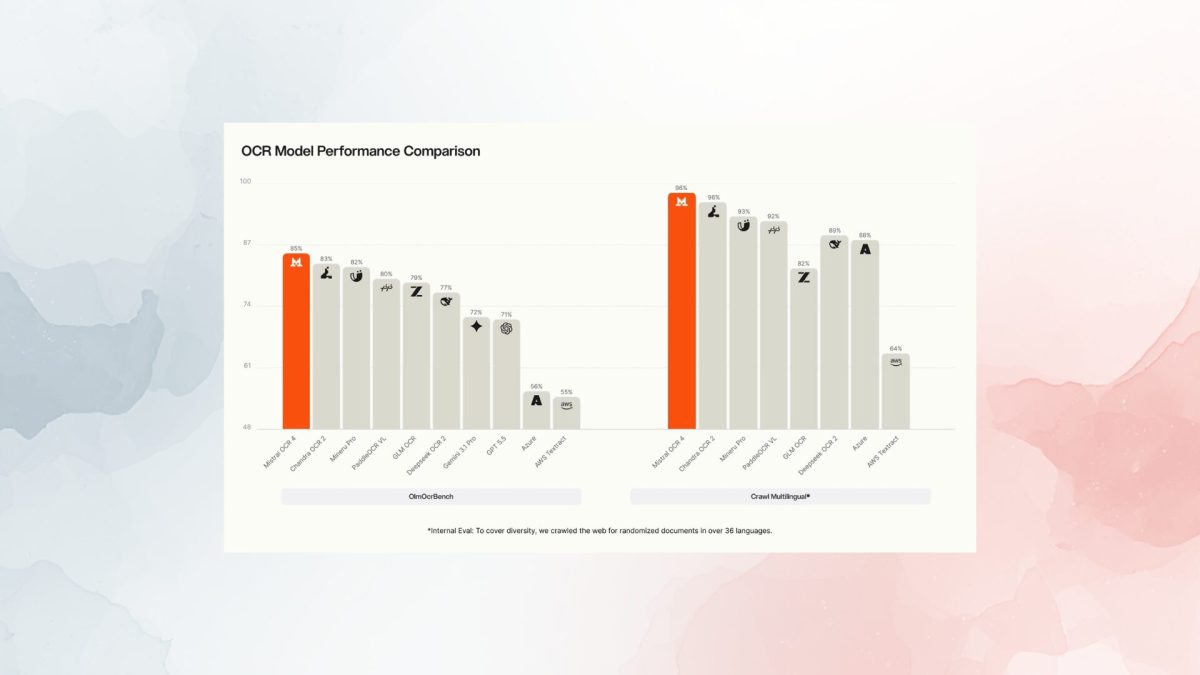
Mistral met à jour son IA de lecture de documents (OCR) et la pousse vers les manuscrits et les langues rares. Derrière l'outil pour développeurs, l'enjeu est très concret : numériser des montagnes d'archives, jusque dans nos administrations.
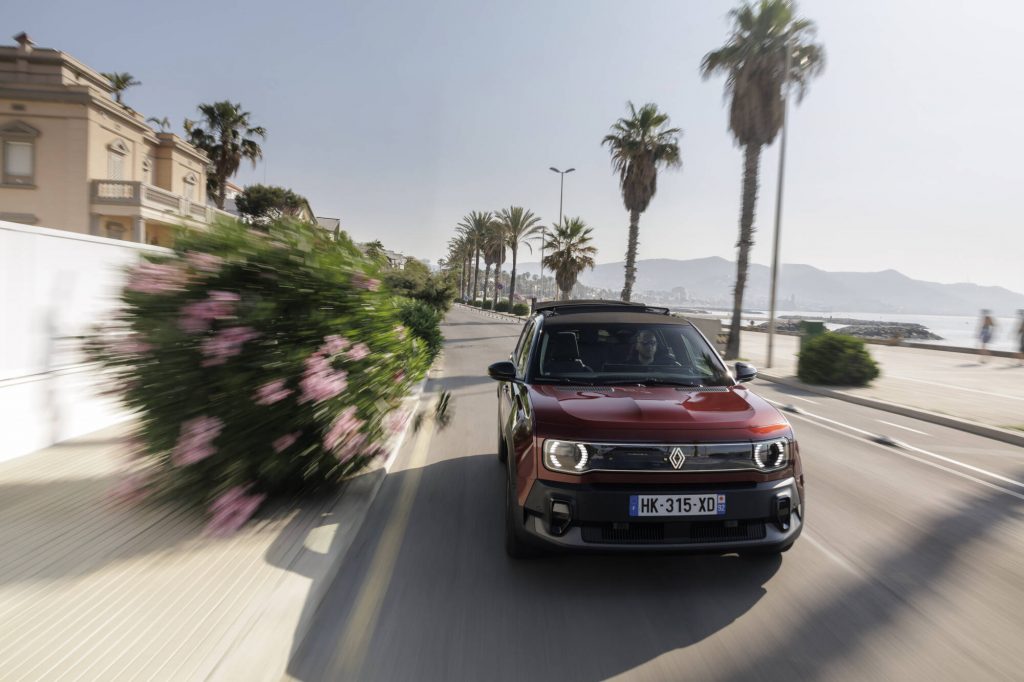
La 4L est de retour. Sous forme électrique, sous forme de SUV, et désormais sous forme découvrable. La Renault 4 E-Tech electric Plein Sud est une anomalie dans le paysage automobile actuel : un véhicule du quotidien, polyvalent, familial, qui offre en plus une ouverture sur le ciel. Rare. Très rare.
Il y a des voitures qu’on achète avec la tête. Et d’autres avec le cœur. La Renault 4 E-Tech electric Plein Sud, elle, revendique les deux. C’est le pari — un peu fou ou courageux — que Renault a décidé de tenir : offrir une version à toit ouvrant en toile d’un SUV électrique compact, sans sacrifier un seul gramme de praticité. Résultat ? Une voiture qui se démarque franchement dans un segment des petits SUV électriques qui ressemble de plus en plus à une mer de clones.
Nous l’avons essayée. Voici ce qu’on en pense.
Une silhouette qu’on reconnaît, un toit qu’on remarque
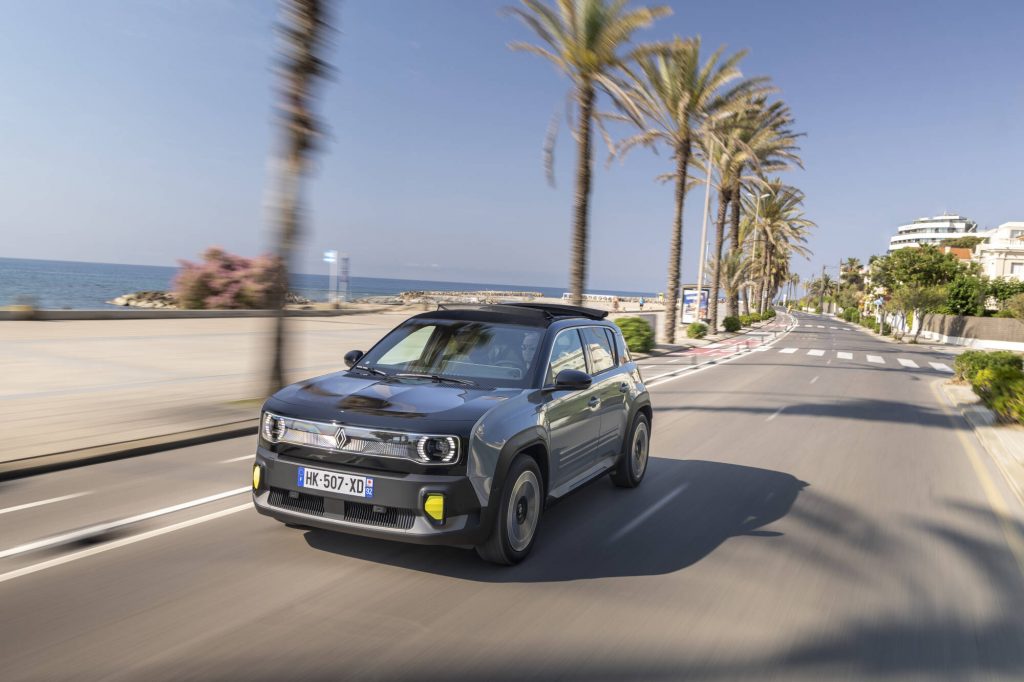
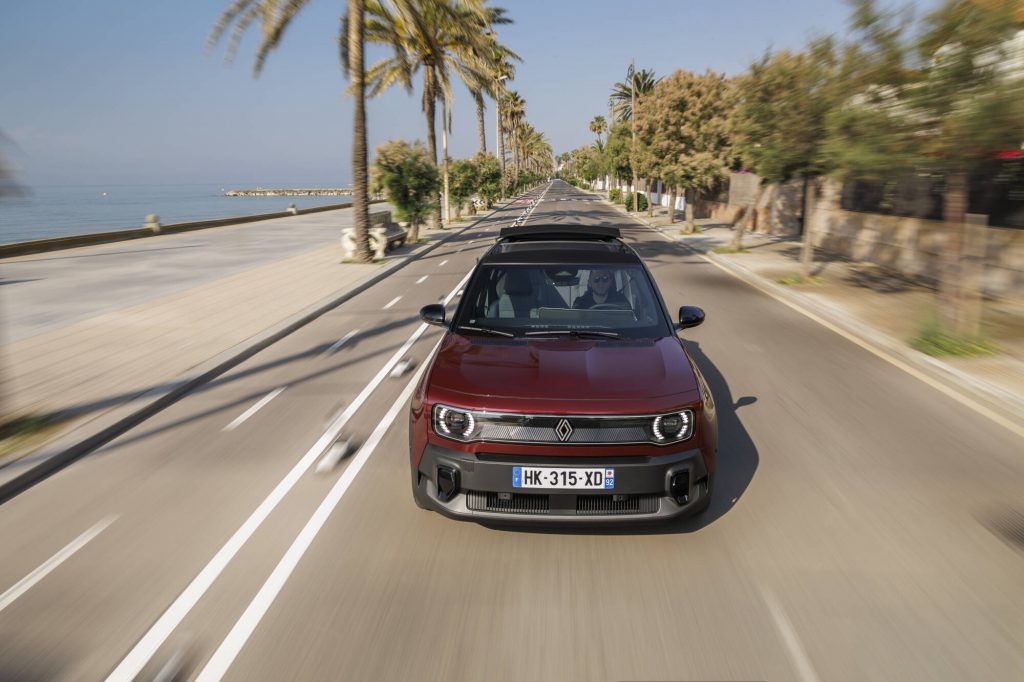
Inutile de chercher longtemps ce qui distingue la Plein Sud de la Renault 4 standard : c’est le toit. Un pavillon en toile noire qui remplace le toit fixe d’origine et donne à la voiture un profil inédit. Les barres de toit disparaissent — incompatibles avec le mécanisme — et l’antenne migre discrètement vers la lunette arrière. Pour le reste, c’est la même Renault 4 : 4,14 mètres de long, l’empattement de 2,62 mètres, les roues de 18 pouces, la calandre lumineuse emblématique et cette silhouette que les amateurs de la « 4L » originelle reconnaissent immédiatement.
Renault propose 11 coloris de carrosserie en finition Techno, 7 en Iconic. Le capot peut rester dans la couleur de la carrosserie ou passer au noir. La Plein Sud ne cherche pas à crier son originalité avec des stickers ou des décors exubérants. Elle assume son identité avec sobriété. C’est bien vu.
92 x 80 cm de ciel au-dessus de la tête
Le toit, c’est l’argument numéro un. Et les chiffres parlent d’eux-mêmes : 92 cm de longueur d’ouverture, 80 cm de largeur. Près d’un mètre carré de toile qui disparaît. C’est la plus grande ouverture du marché sur les segments A et B, et ce n’est pas qu’un argument commercial — à bord, l’effet est immédiat. L’habitacle est baigné de lumière, les passagers avant comme arrière profitent pleinement de l’ouverture.
L’opération prend dix secondes. Pas plus. Un bouton au plafonnier suffit, ou une simple commande vocale adressée à Reno, l’assistant IA embarqué qui repose sur de la génération de langage naturel — pas besoin de réciter une phrase préétablie. On dit ce qu’on pense, le toit s’exécute. En position intermédiaire, totalement ouvert, ou refermé en cas d’averse imprévue : toutes les positions sont possibles.
Mieux encore : on peut rouler toit ouvert à vitesse autoroutière. Un filet anti-remous limite les turbulences et le bruit dans l’habitacle. La limite ? 90 km/h pour l’ouverture ou la fermeture en mouvement — une fois ouvert, on peut rouler sans contrainte de vitesse maximale. En pratique, c’est une liberté qu’on n’attendait pas dans cette catégorie de véhicule.
La parole à un utilisateur au quotidien
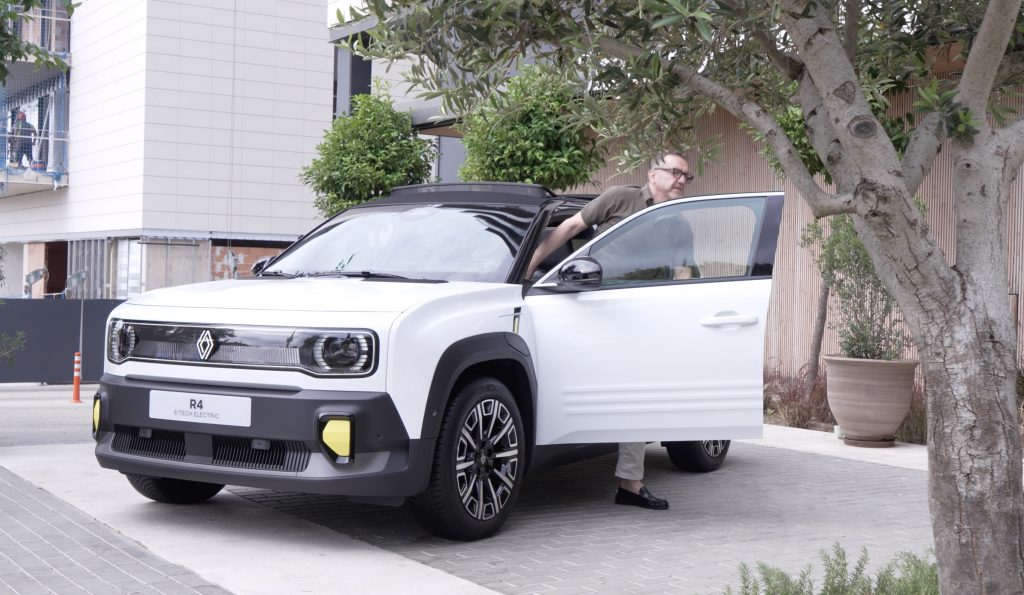
Guillaume Sicard n’est pas venu à la Renault 4 par hasard. Utilisateur au quotidien, il a adopté la voiture pour ses trajets professionnels et familiaux. Nous lui avons demandé ce que la version Plein Sud changerait concrètement dans son usage.
Ce que son témoignage révèle, c’est quelque chose que beaucoup de conducteurs ressentent sans toujours l’admettre : un véhicule électrique peut être rationnel et désirable en même temps. Ce n’est pas une contradiction. La Plein Sud en est la démonstration concrète.
Aucun compromis. Vraiment aucun.
C’est là que Renault mérite d’être salué. La tentation était grande, sur une version « plaisir », de rogner quelque part. Sur le coffre, sur le volume habitable, sur les capacités utilitaires. Rien de tout ça n’a eu lieu.
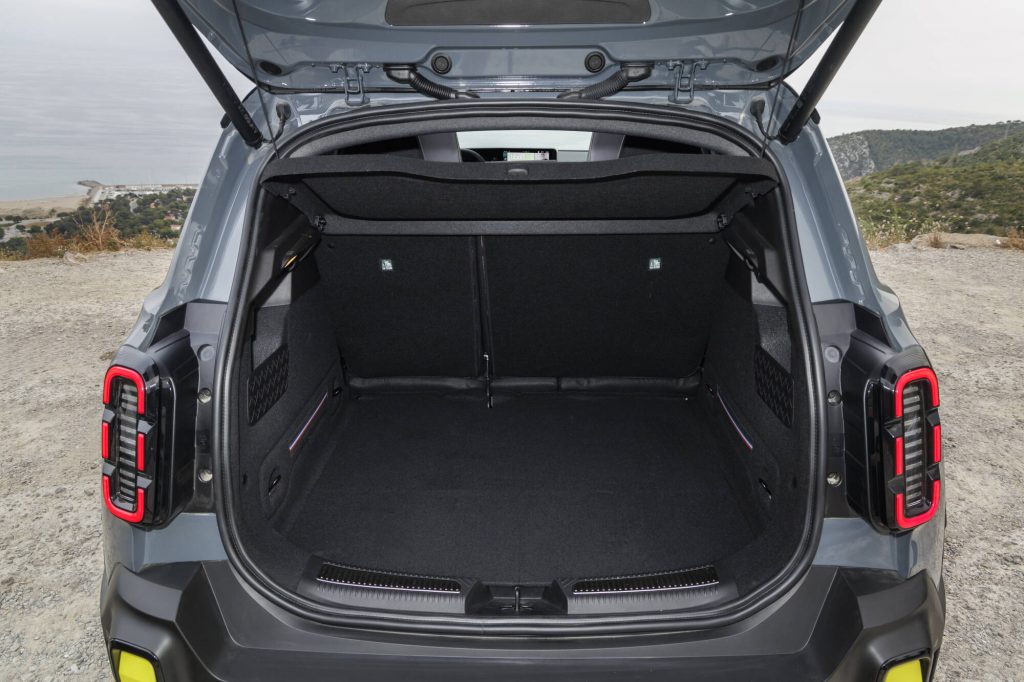
Le coffre affiche toujours 420 litres, dont 44 dissimulés sous le plancher. Le seuil de chargement reste à 61 cm — dix centimètres en dessous de la moyenne des concurrents. La banquette arrière se rabat, le siège passager avant se met à plat, offrant jusqu’à 2,20 mètres de longueur de chargement. On peut toujours tracter une remorque ou une petite caravane jusqu’à 750 kg. Les poches aumônières au dos des sièges avant sont là, les rangements aussi, pour un total de 23,3 litres d’espaces de rangement en cabine.
La magie est dans les détails d’ingénierie. Pour limiter le surpoids induit par le mécanisme d’ouverture et les renforts de carrosserie nécessaires, Renault a opté pour des éléments de structure en matériaux composites plutôt qu’en métal. Résultat : 19 kilos supplémentaires seulement par rapport à la version à toit fixe, à finition égale. Et un impact sur l’autonomie de… 7 km en cycle WLTP. La Plein Sud en finition Techno affiche 392 km d’autonomie contre 399 km pour la version standard.
Sept kilomètres. Pour du ciel ouvert. Le calcul est vite fait.
L’aérodynamisme a également été soigné : le SCx passe de 0,762 à 0,778, une légère hausse maîtrisée qui confirme le sérieux du travail effectué en soufflerie pour conserver à la fois confort acoustique et efficience.
La dynamique : la Renault 4, c’est avant tout du plaisir
La plateforme RGEV small n’a pas changé. Le train arrière multi-bras assure une agilité et un dynamisme que les petits SUV électriques n’ont pas tous. La direction est précise, la tenue de route saine, et l’ensemble donne envie de prendre les virages plutôt que de les subir.
Toit ouvert, la sensation change radicalement. On entend davantage le vent — maîtrisé mais présent — et l’expérience de conduite prend une dimension qu’on ne trouve nulle part ailleurs dans cette catégorie de prix. C’est simple, mais c’est fort. Une ligne droite sur une route de campagne, toit grand ouvert, soleil de côté : on comprend immédiatement pourquoi Renault a fait ce véhicule.
Prix et positionnement : une anomalie sur le marché
La Renault 4 E-Tech electric Plein Sud est disponible à partir de 31 110 euros, dans une offre de financement à 299 euros par mois sur 48 mois. Elle est naturellement un peu plus onéreuse que la silhouette standard et se décline en deux finitions : Techno et Iconic.
Dans un marché des petits SUV électriques qui carbure au raisonnable, à l’efficiente, au pratique-mais-sans-charme, la Plein Sud représente quelque chose de différent. Pas une niche exotique réservée aux nostalgiques de la décapotable. Pas une voiture de week-end qui dort au garage la semaine. Une proposition complète, quotidienne, familiale, qui ajoute une dimension émotionnelle que ses concurrents n’ont tout simplement pas.
Renault renoue ici avec une idée ancienne mais toujours valide : une voiture accessible peut aussi être désirable. Ce n’est pas un oxymore. C’est une ambition.
Notre avis
La Renault 4 E-Tech electric Plein Sud est l’une des propositions les plus cohérentes et les plus enthousiasmantes du marché en ce moment. Elle ne réinvente pas la roue — mais elle réinvente le plafond. Dans un univers électrique qui cherche encore son âme, c’est une bouffée d’air frais. Littéralement.
On aime : le toit géant (92 x 80 cm), l’absence totale de compromis sur la praticité, les 19 kg de surpoids seulement, la commande vocale intuitive, le prix d’entrée raisonnable.
On aime moins : la garde au toit légèrement réduite à l’arrière (813 mm contre 853 mm), l’absence de barres de toit si vous en aviez besoin.
Renault 4 E-Tech electric Plein Sud — à partir de 31 110 euros — Disponible en finitions Techno et Iconic
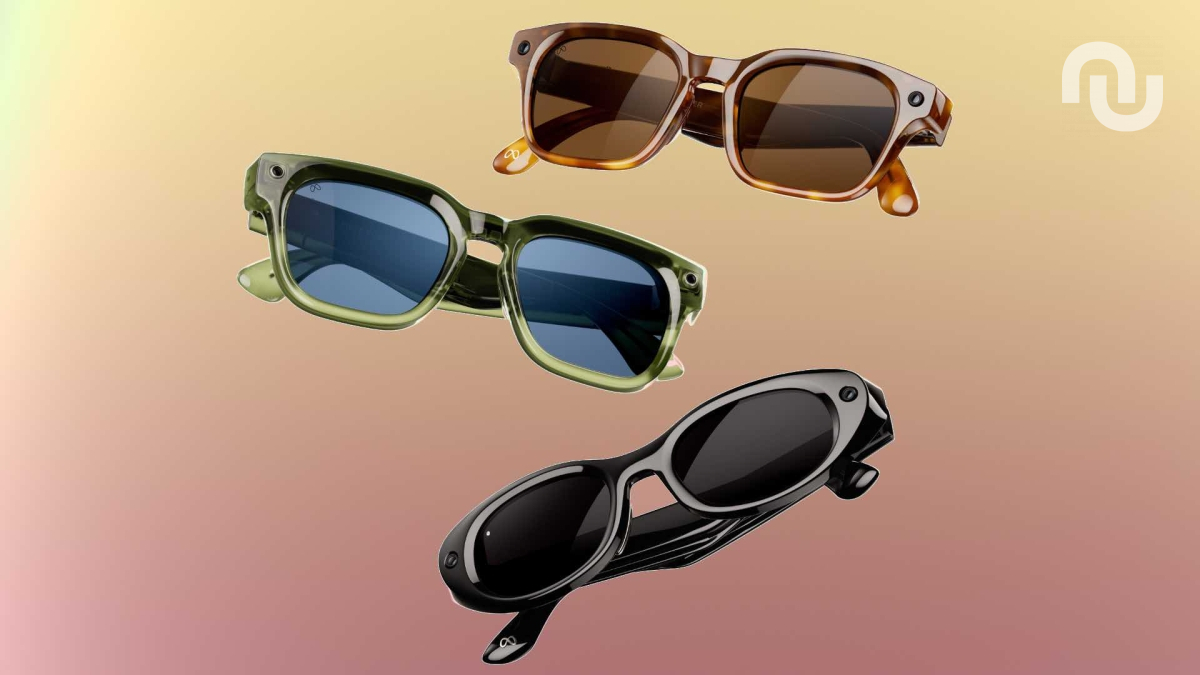
Numéro 1 des lunettes connectées avec les Ray-Ban Meta et les Oakley Meta, le géant des réseaux sociaux prend un peu d'autonomie avec les « Meta Glasses », des lunettes avec trois designs inédits qui visent à attaquer un public différent. Un changement de stratégie qui tombe à un moment sans doute bien choisi : face à Samsung et Apple, qui s'apprêtent à le concurrencer, Meta veut que le grand public l'identifie comme un géant des lunettes.
Depuis le gel de Claude Mythos par Washington, OpenAI occupe le terrain de l'IA cyber offensive-défensive. Le 22 juin, l'entreprise a annoncé une série de mises à jour substantielles de sa plateforme Daybreak.
Google is investing roughly $75 million in A24 as part of a research partnership with DeepMind to develop AI-powered filmmaking tools and workflows. "The deal represents the latest marriage between a Hollywood studio and AI in an era where companies have oscillated between partnerships and lawsuits," reports Variety. From the report: A24 partner Scott Belsky, who leads the studio's technology division A24 Labs, told the Journal the studio's Google partnership differed from other deals because AI developers mistakenly advertised their products as a means to make films cheaper and faster. His division is developing applications for AI-generated storyboards, another reimagination of the production process that has seen filmmakers like Martin Scorsese rubber-stamp. "We think there are better uses that preserve creative control and support risk-taking," said Belsky, arguing the new tools "won't look anything like the prompted generation type of AI that people feel uncomfortable with."
Garfield AI, the UK's first regulator-approved AI law firm, has won its first court case after helping a freelancer recover 7,000 pounds in unpaid fees. "I was owed money for work I had done, but it felt like the process of recovering it could be too stressful, expensive and time-consuming," said Tamires Camal Taquidir, a freelancer who had provided HR-related services to a hospitality business. "Garfield made it possible for me to pursue the claim and keep going. When the counterclaim was brought, it was intended to intimidate me, but I knew I had accessible, cost-effective and competent support. I'm delighted by the result." Computer Weekly reports: After attempting to resolve a dispute over paid fees without court action, Camal Taquidir [...] used Garfield AI to help her pursue the case in court. She was able to generate pre-action correspondence, and then prepare and issue court proceedings. The AI legal assistant conducted all of the legal work preceding the court trial. The defendant instructed solicitors and brought a counterclaim, which the claimant disputed with the support of Garfield AI.
The claimant continued to trial, including dealing with document production, the preparation witness statements and trial bundles. Garfield then instructed a junior, shortly before the trial began. She won the claim over unpaid fees following a three-hour trial at Wandsworth County Court. The claimant paid around 400 pounds in Garfield AI fees to recover the 7,000 pounds owed, while the defendant instructed both a solicitor and a barrister. [...] Following a three-hour trial at Wandsworth County Court on 14 May 2026, in which both sides were represented by barristers, the court found in favor of the claimant, awarding 7,000 pounds and dismissing the counterclaim.
America's state prison systems need ways "to keep people from returning to prison," reports the Wall Street Journal, "when an estimated 40% end up back behind bars within three years."
Part of the problem comes in the form of filing cabinets, manila folders and legacy digital databases. In other words, records for a single prisoner might be kept in a dozen places... Now a group of 19 prison systems are tackling the problem with digital tools and artificial intelligence in some cases. They are contracting with San Francisco nonprofit Recidiviz, whose computer systems bring together prisoner data from its disparate sources into digital dashboards. From there, corrections staff can see information — such as court records and notes from parole-board hearings — about a prisoner or parolee all in one place.
The company says its efforts are working: Recidivism has fallen 16% in the prison population its systems track. It is the result of "just streamlining these workflows and knitting someone's journey together end to end," says Clementine Jacoby, chief executive officer of Recidiviz. Some criminal-justice groups show that recidivism is trending downward in general, though most of that data is nearly a decade old... The statistics from 11 states stop at 2019, and for four states stop at 2016. With 10 other states, no data was reported.
En 2026, Mini fête ses 25 ans sous l’égide de BMW Group. L’occasion pour nous de prendre le volant d’un modèle inédit, l’Aceman dans sa version la plus véloce John Cooper Works. L’esprit de la maison est-il maintenu dans un modèle à mi-chemin entre la Cooper et le Countryman ? On vous donne quelques éléments de réponse.
Une histoire riche de 25 ans depuis la reprise par BMW
Le 26 avril 2001, la première Mini de BMW sortait des chaînes de l’usine historique de la marque à Oxford, en Angleterre. Dans le contexte de l’époque, il y a bien eu quelques sceptiques face à une voiture qui avait grandi et grossi, et qui semblait perdre une partie de son ADN. Mais 25 ans plus tard, Mini a étoffé son catalogue au point d’avoir plus de modèles dans sa gamme que certains constructeurs historiques. Mini France a mis en place une véritable exposition retraçant quelques moments de l’histoire de la marque, notamment avant qu’elle intègre BMW Group. Une jolie attention pour ces voitures devenues de vraies icônes de mode pour certaines, grâce en outre à certaines collaborations iconiques, comme Paul Smith.
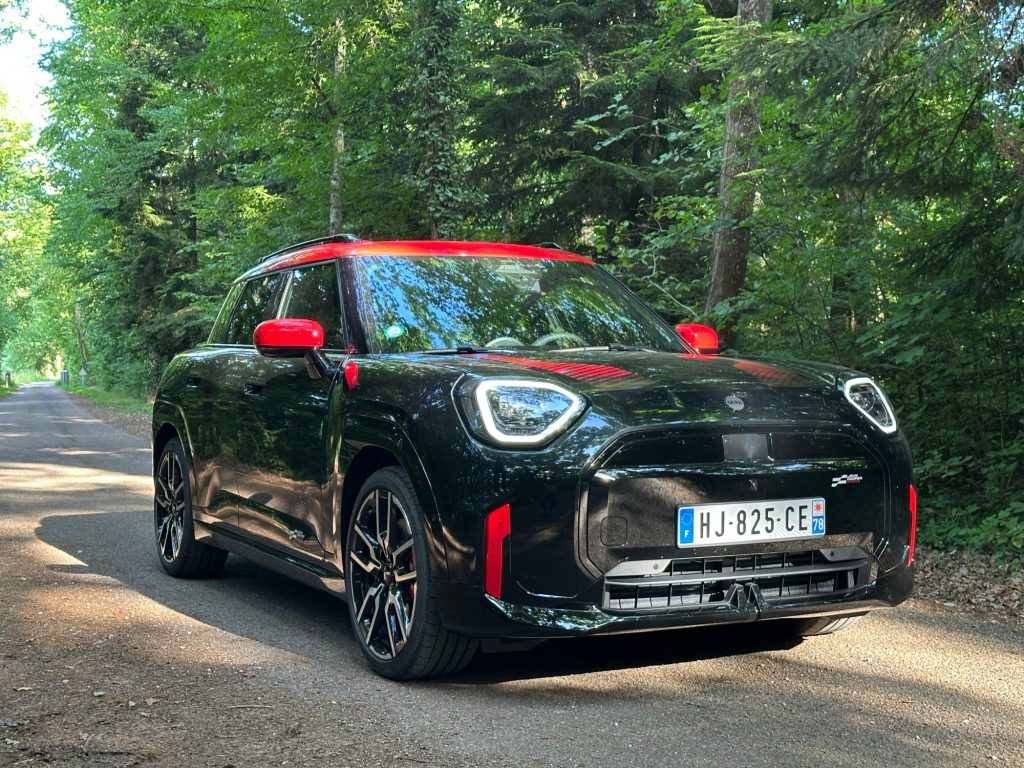
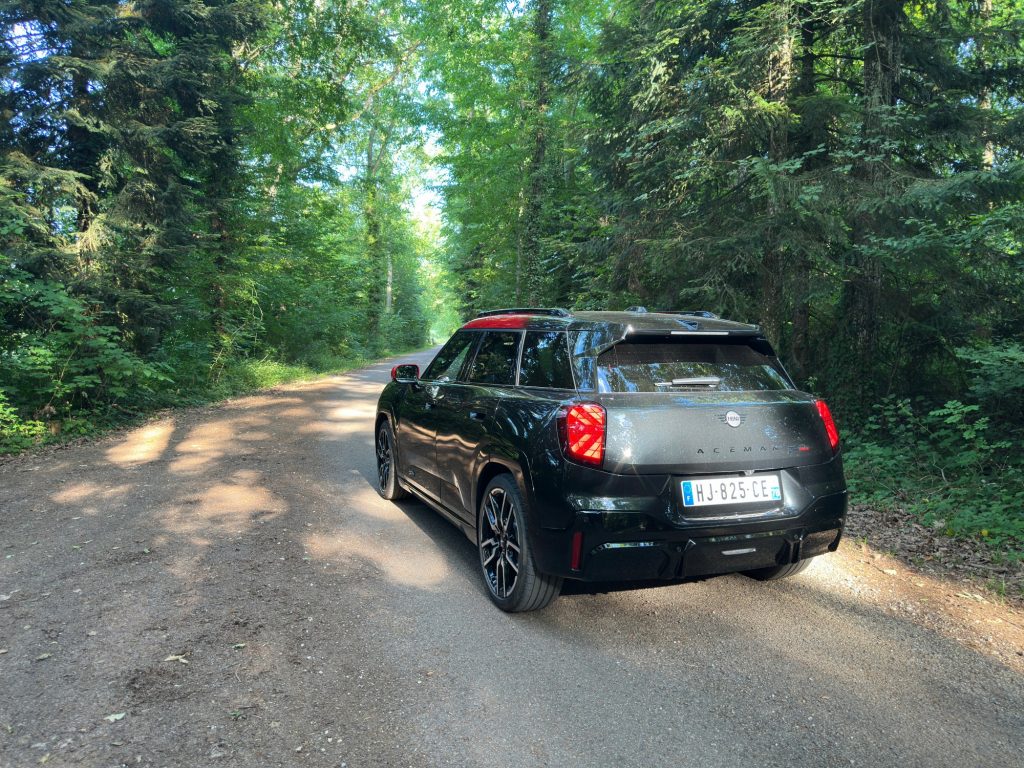
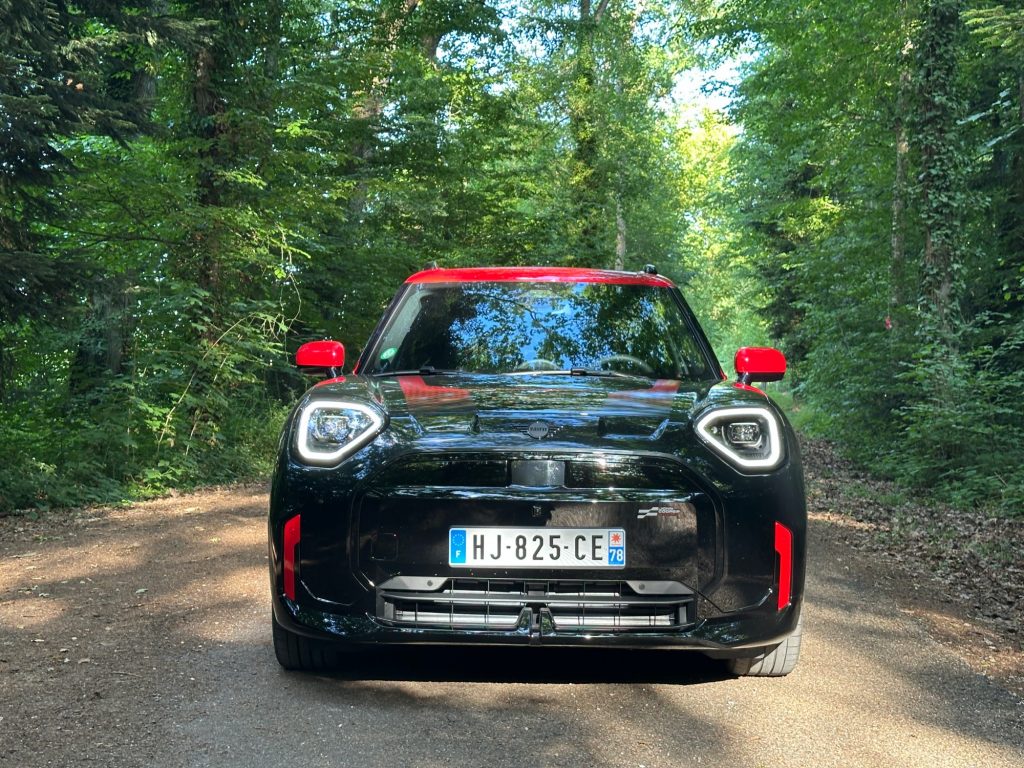
De notre côté, nous avons jeté notre dévolu sur un modèle compact qui n’existait pas jusqu’ici, placé entre la Mini Cooper et le Countryman, et qui répond au doux nom d’Aceman. Et comme on ne fait pas les choses à moitié, on a choisi la déclinaison JCW. Avec les attributs relatifs à la griffe sportive de la maison John Cooper Works, la voiture a droit à une allure de petite intrépide de la route, qui assume de manquer de discrétion sans s’en excuser. Dans son coloris noir avec ses touches de rouge, certains lui trouveront même une certaine classe dans les quartiers chics, et ailleurs.
Cet écran si iconique!
En revanche, petite note pour nos amis de Mini, il faudrait peut-être revoir la qualité des autocollants sur le capot, du plus bel effet, mais qui semblent rapidement s’abîmer. Les codes de la maison sont bien là pour marquer son identité, avec le toit « flottant ». Les boucliers sont évidemment spécifiques, comme les jantes. Dans les détails, on adore les feux arrière à l’affichage personnalisable. Avec ses grosses roues, son gros becquet et son regard de bulldog bien heureux, elle a du chien ! (Elle était facile…). Même si l’on peut croiser des Mini à tous les coins de rue, l’Aceman JCW réussit l’exploit de ne pas passer inaperçue pour autant.
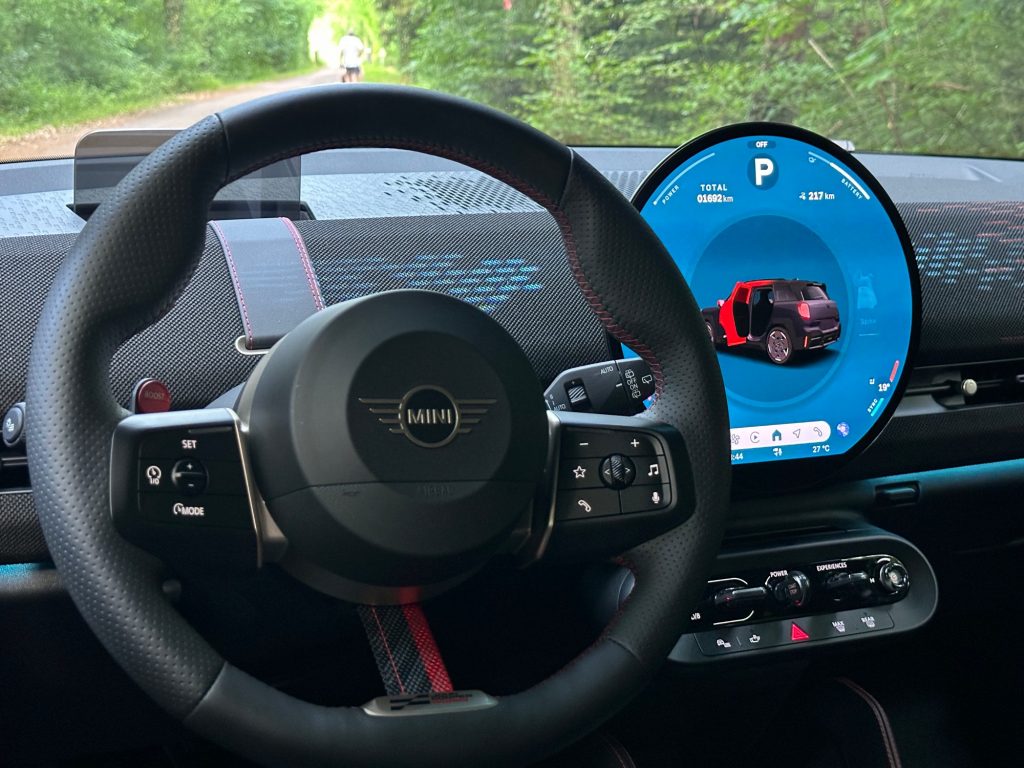
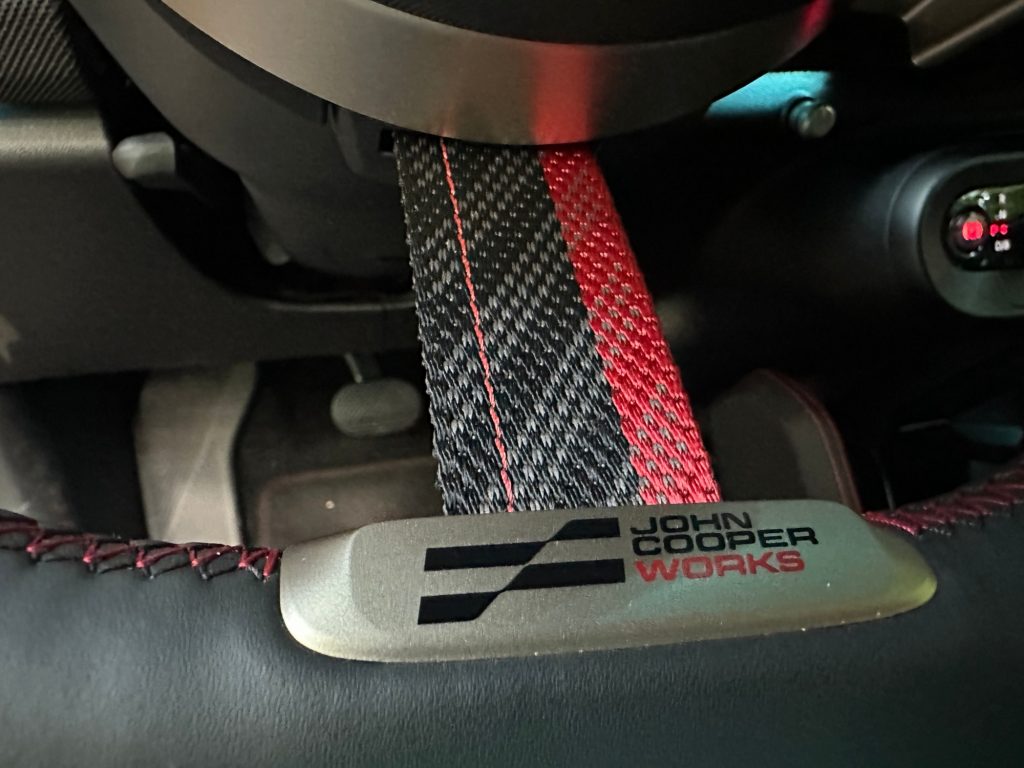
À bord, on retrouve l’univers des Mini les plus modernes. Tout s’articule autour de l’instrumentation composée principalement de cet écran circulaire, signature de cet intérieur. Cela permet de donner une impression de mobilier dépouillé, avec des accents qui n’appartiennent pas, en tout cas d’habitude, à l’industrie automobile. Tout d’abord, un tissu habille intégralement la planche de bord, décorée d’une sangle, dans le prolongement de la troisième branche du volant, elle aussi en tissu. Il y a tout un jeu de lumières, dont des points projetés de part et d’autre de la dalle. Les commandes essentielles sont juste en dessous.
L’esprit « Go-Kart » de la partie
Les moins habitués à la lecture centrale des informations peuvent opter pour le head-up display d’un autre âge, puisqu’il s’agit d’une petite vitre rotative. Pas de vision directement sur le pare-brise malheureusement. Cet habitacle respire le chic, la mode, avec non pas un compartiment de rangement entre les sièges, mais un petit coffre qui pourrait ressembler à une petite malle à bijoux. Des touches de couleur cuivrées mettent en valeur les poignées de portes et quelques enceintes du système de sonorisation. On a un peu plus de place sur la banquette arrière que dans une Mini Cooper, mais pas beaucoup malgré tout. Comptez sur 300 petits litres dans le coffre. Côté équipements, notamment les ADAS, Mini s’est largement servi chez BMW.
En termes de plateforme, l’Aceman est une extension de la Mini Cooper pour atteindre les 4,08 m. Ce qu’elle ne perd pas de sa petite sœur, c’est la fermeté de l’amortissement. Nous l’avions déjà remarqué sur l’Aceman classique, et il n’y avait logiquement pas de raison que ce soit différent ici. Mais c’est le prix à payer pour les sensations de « go-kart » si chères à la marque. Tout paraît verrouillé au volant, peut-être même un peu trop, au point de trouver le confort exagérément sacrifié, pour une sportivité en retour pas si exacerbée que cela. Elle a clairement un caractère dynamique, mais comprenez par là qu’on en attendait un peu plus.
Puissante, mais une autonomie limitée
L’Aceman, on ne l’a pas mentionné jusqu’ici, est 100% électrique. Du coup, elle accuse un certain embonpoint, 1 825 kilos d’acier et de batterie, qui ne sont pas sans incidence sur son comportement. Pourtant, il faut bien reconnaître que le constructeur a réussi à limiter autant que possible le sous-virage, avec une tenue de cap impressionnante. Mais on sent bien que ce sont les pneus qui encaissent, et avec brio. Néanmoins, quand on exagère, l’Aceman finit par glisser des quatre roues, mais avec suffisamment de prévenance pour ne jamais se faire surprendre. Honnêtement, on prend du plaisir à son volant quand on roule vite, du moment que l’on accepte un certain inconfort le reste du temps.
Il s’agit donc d’un modèle 100% électrique, pour le moment fabriqué en Chine, BMW Group ayant déjà annoncé le report du rapatriement de la production à Oxford pour plus tard. On peut compter sur quelque 258 chevaux (en pic) qui, faites-nous confiance, suffisent très largement à faire décoller cet Aceman JCW dans toutes les situations de conduite. On use et abuse de la palette « boost » pour gagner quelques chevaux supplémentaires le temps de quelques secondes et rendre encore plus fortes les reprises déjà bien énergiques. Les chiffres sont à l’avenant, notamment le 0 à 100 km/h abattu en 6,4 secondes et une vitesse de pointe de 200 km/h. Le bloc est alimenté par une batterie de 54,2 kWh de capacité.
Pas de bonus!
Il faut bien l’admettre, on a du mal à conduire « lentement » notre Mini Aceman. Ce moteur déborde d’énergie et on le ressent dans le volant, qui prend des retours de couple lors de certaines violentes accélérations. En outre, il ne faut pas hésiter à bien tenir le cerceau quand on joue les pilotes, pour ne pas se faire surprendre par certains louvoiements. Pour autant, cela ne nuit pas à la motricité, plutôt de bon niveau pour une traction électrique aussi puissante. Il n’empêche qu’on note une consommation un peu élevée. Cela ne pose aucun problème en ville, mais il faut compter sur à peine un peu plus de 200 kilomètres sur route. Sur autoroute, en partant avec 80% en vue d’un parcours de 350 km, on a dû recharger deux fois, la seconde étant davantage pour se rassurer que par nécessité.
On préférera toujours la Mini Cooper pour s’amuser à un Aceman. Son format, malgré tout compact, lui confère une agilité intéressante. Il faut simplement avoir besoin d’un peu plus de place pour se tourner vers lui. Peut-être que sa batterie et sa consommation peuvent suffire pour le quotidien (30 minutes pour le 10 à 80%). Mais cet engin donne tout de même envie de le bousculer à la première occasion, et il faut alors accepter de voir l’autonomie fondre comme neige au soleil. Est-ce qu’elle vaut les 45 500 € demandés ? On vous laisse en décider, d’autant plus que, tant qu’elle viendra de Chine, elle n’aura pas droit au bonus chez nous.
"About 59% of TikTok videos served to a new account's For You feed are AI slop," writes Search Engine Journal, "according to a report from Kapwing, the video creation tool company. That's roughly three times the rate Kapwing found on YouTube."
The company manually reviewed over 10,000 TikTok videos across 20 categories and ran a separate fresh-account test, counting AI-generated content in the first 500 For You videos. Kapwing ran the same fresh-account test on YouTube and found that 104 of the first 500 Shorts, or 21%, were AI slop. On TikTok, 294 of 500 For You videos hit that threshold...
Of the 2,000 videos Kapwing reviewed in TikTok's Kids category, 57% were AI slop. That was the highest rate of any category in the analysis. The highest-rate tag was #cartoonkids, where 97 of 100 featured videos were AI-generated. Tags like #cartoons and #babysong both reached 83%, and #forkids came in at 79%. After Kids, the next highest AI slop rates were in Science and Education (35%), Health (33%), and History (33%). All three are categories where visual illustration and voiceover narration make up much of the content.
On the other end, categories where on-camera presence or physical demonstration are central had the lowest rates. Fashion came in at 1.3%, Music at 1.5%, and Fitness at 1.6%.
The article notes that by last November, TikTok "had already labeled 1.3 billion videos as AI-generated, according to the report."
"A grassroots movement is forming among everyday tech workers who are demanding their companies develop and deploy AI responsibly," reports TechCrunch.
Hoping to leverage that discontent is a new super PAC called the Guardrails Alliance. The New York Times reports that it launched Thursday with backers that included tech employees and labor unions:
Guardrails positions itself as a populist political movement that runs on small donations from people in the trenches of the AI boom. The PAC has about $5 million at its disposal today and planGuardrails will buy ads to support Alex Bores, a New York congressional candidate who became Leading the Future's first target and is running in the primaries next week. s to raise $15 million this cycle — small potatoes compared to deep-pocketed adversaries like Leading the Future, which has more than $100 million from tech leaders like OpenAI president Greg Brockman...
"This is not about matching [Leading the Future] dollar for dollar," [said the super PAC's co-founder, political operative Shaunna Thomas]. "What this vehicle is meant to do is be a political home for people who are concerned about the way the anti-regulation AI tech sector is trying to manipulate elections."
Meanwhile a former Netflix and Warner Bros. executive has launched the Alliance for Responsible Innovation in the Arts & Media, reports Variety, calling it an AI-focused content coalition that says it's dedicated to supporting "responsible and sustainable AI innovation and the importance of human creativity."
The initial members of the coalition, announced Monday, include Disney, the New York Times, Adobe, Condé Nast, the Financial Times, ITV, Advance, BBC, Cambridge University Press & Assessment, U.K. publisher Reach and Wiley. Many of the coalition's members have either struck deals with AI companies or are developing their own AI tools... The group plans to argue for legal and policy guardrails around AI's usage, with its funding directed towards analyses, tools and services focused on advancing those initiatives...
One of the group's launch advisers is Damian Collins, OBE, who previously served as the U.K. Parliamentary Under-Secretary of State in the Department for Science, Innovation and Technology under prime ministers Boris Johnson and Liz Truss. "Using AI to break the law can never be an acceptable excuse," he said in a statement. "Laws around personal safety, intellectual property and financial crime still apply in the age of AI. This is why ARIAM has been created and why I'm proud to working with this necessary initiative."
À la une de la rubrique tech de Numerama cette semaine : on a beaucoup parlé d'IA. Le salon Vivatech a ravivé les annonces gouvernementales : l'État lance sa propre IA souveraine pour l'administration et réduire notre dépendance à ChatGPT. Une annonce qui intervient au moment où tout Internet se moque de Le Chaton Fat, un faux modèle Mistral énormément détourné en ligne. Enfin, à Paris, la région Île-de-France a enfin annoncé l'arrivée de la carte bancaire pour prendre le métro.
This week OpenAI announced a 750-task test to to measure "whether AI systems can support realistic life science research tasks, not just answer biology questions."
But while OpenAI's top-performing GPT-Rosalind model led the rankings, Slashdot reader BrianFagioli notes that "it achieved a pass rate of just 36.1 percent, failing nearly two-thirds of benchmark tasks." Nerds.xyz points out that means "the best-performing model failed nearly two-thirds of the benchmark's tasks."
The benchmark also revealed a familiar weakness. AI systems generally perform better when everything is presented as text. Once they are forced to work with supporting documents, figures, or complex datasets, performance drops noticeably. GPT-Rosalind's pass rate fell from 45.1 percent on text-only tasks to 28.1 percent on tasks involving artifacts or URLs.
To be fair, the benchmark is not intended to suggest AI is useless in research. Quite the opposite. OpenAI found that models are becoming increasingly capable of scientific communication, evidence synthesis, and translating research findings into practical explanations. Those are valuable skills, particularly for researchers drowning in information. But LifeSciBench serves as a useful reminder that today's AI systems are still far from autonomous scientists. They can help. They can assist. They can sometimes provide surprisingly useful insights. What they cannot reliably do, however, is replace the expertise, judgment, and skepticism that real scientific research requires.
Long-time tech pundit Robert Cringely started his career at the Stanford Artificial Intelligence Lab back in 1978. Last month 73-year-old Cringely explained why his site went on a two-year hiatus — and it's not just because of a heart attack and a stroke last July:
Just like everyone else, I've been busy all this time on Artificial Intelligence, founding with two partners a company called 2Brains... The work we were doing together is unfinished, but it's not stopped. The patents are filed, the architecture is documented, and the small team continuing the work includes me.
Cringely's first piece made the cast that "the trillion-dollar bet the AI industry is making right now may be wrong, and that there's an architectural alternative we've patented and built."
In Machines of Loving Grace, Amodei made the case that scaling compute would eventually solve essentially every hard problem in artificial intelligence. Buried in that optimism — or maybe not buried, maybe right out in the open — was a quiet absolution. Hallucinations, the embarrassing tendency of these systems to state falsehoods with total confidence, would take care of themselves. Make the models big enough, train them long enough, and the problem dissolves. You don't have to solve it. You just have to wait, and spend. And so the entire AI industry breathed a sigh of relief.
I have spent forty years watching this industry, and I know a permission slip when I see one.
Because that is what the essay became, whatever Amodei intended. It gave every other person writing nine- and ten-figure checks a reason not to worry about the one thing that should worry them most. The hallucination problem is the difference between a clever toy and a system a hospital or a bank or a court can actually rely on. It is the whole ballgame for enterprise AI. And the prevailing wisdom, blessed from the top, is that you needn't address it directly. Scale will provide...
A small company I helped start, 2Brains Inc., set out in 2022 to solve hallucinations — before ChatGPT, before the scaling consensus hardened into received truth, back when the polite assumption was that the problem was simply insurmountable. We did not solve it by waiting for bigger models. We solved it architecturally, by separating the part of the system that generates language from the part that retrieves and verifies facts, and reconciling the two before anything reaches the user. It runs on ordinary processors. It is cheap. And on the industry's own benchmark for this kind of faithfulness, it more than doubles the published baseline, with no fabricated facts in the verified case at all.
The article asks whether scaling will, at tremendous cost, eventually reduce hallucinations — or even worse, if the largest companies in the world "are spending a fortune chasing a cure that is not coming."
And last week Cringely pitched more advantages for their solution, noting that most prompts aren't even chatbot-level creative prompts — but just requests to retrieve simple data:
The reason 2Brains doesn't lie and the reason it's cheap are the same reason. It looks the fact up instead of guessing it — so it cannot fabricate, and the lookup runs on a processor that sips power instead of a chip that gulps it. Trust and thrift are not a trade-off you balance against each other. They fall out of a single design decision. You do not pay extra for the honest version. The honest version is the cheap version. That sentence is the whole company.
CNBC reports:
Waymo is recalling almost 3,900 robotaxis in the U.S. to fix software issues after some cars drove into freeway construction zones, according to notices filed with the National Highway Traffic Safety Administration. The voluntary recall, the Alphabet-owned company's second in just over a month, followed 13 known incidents where Waymo robotaxis drove into construction zones on freeways in Phoenix, or entered freeway lanes with active construction in the San Francisco area, the filings published Thursday said...
A letter posted to the regulator's website... noted that, "Driving through a closed construction zone increases the risk of a crash..."
[Waymo said in a statement emailed to CNBC] "We voluntarily restricted freeway operations last month while making improvements, proactively notified state and federal regulators, and decided to file a voluntary software recall with NHTSA. We continue to safely serve riders on surface streets in all the cities where we operate...."
The company implemented another voluntary recall in May after some of its robotaxis had driven into flooded zones or standing water. The NHTSA Safety Board also initiated a probe of Waymo after a January incident in which a robotaxi illegally passed a stopped school bus.
Au lancement, Siri AI ne sera pas disponible sur iPhone, iPad et Apple Watch dans les pays de l'Union européenne, sur fond de désaccord entre Apple et la Commission européenne. Comme avec Apple Intelligence il y a deux ans, il est possible de contourner le blocage avec un compte App Store américain et un appareil en anglais. Mais la méthode est loin d'être adaptée à un usage du quotidien.
Emmanuel Macron a clôturé une semaine très dense pour la tech française par un discours dédié aux 10 ans de VivaTech. Coupure de Claude Fable en Europe, déploiement de l'Assistant IA dans la fonction publique, nouvel investissement français et appel à développer des alternatives aux États-Unis et à la Chine, notamment en s'appuyant sur l'open source… Le président de la République donne un cahier des charges à quelques mois de son départ.
An anonymous reader quotes a report from Wired: The Trump administration's move to impose export controls on Anthropic's most powerful AI technology followed a spat over the company granting South Korean telecom giant SK Telecom access to its Claude Mythos model, according to people familiar with the matter. US officials were concerned about what they alleged were SK Telecom's ties to China, those people said. Those concerns appear to have compounded when Amazon later flagged vulnerabilities to the White House it identified in Fable 5, a highly safeguarded version of Mythos that Anthropic released to the public on June 9. The Amazon researchers claimed that it was possible to circumvent some of Fable 5's guardrails and access Mythos' formidable cybercapabilities, though Anthropic and outside cybersecurity experts have argued these risks are not unique to Claude.
The confluence of events is what ultimately led the White House to determine that it could not trust Anthropic to safeguard its most advanced AI technology, according to a person close to the administration. On Friday, the Trump administration ordered Anthropic to revoke access to Mythos and Fable 5 for all foreign nationals, including immigrants inside the US. Rather than gate access to its technology based on nationality, a process that would be difficult to implement while also preserving privacy, Anthropic decided it was better to disable access to the models entirely. The White House and Anthropic still remain at odds after days of negotiations about bringing Claude Mythos and Fable 5 back online. SK Telecom was one of roughly 150 organizations granted early access to Anthropic's vulnerability-detection model Claude Mythos through Project Glasswing, notes Wired. The White House later asked Anthropic to revoke the company's access, reportedly amid concerns about alleged China ties, and Anthropic immediately complied. There was, however, no mention of the telecom in the government's formal demand to restrict Mythos and Fable 5 to U.S. nationals.
SK Telecom told a Korean newspaper that the "anonymous insider's remarks in foreign media lack verified facts, and our company has no ties to China."
Midjourney is expanding beyond AI image generation with plans for a medical-imaging business built around a water-based, full-body ultrasound scanner that uses hundreds of thousands of sensors and AI to reconstruct MRI-like images. "As you descend into the water, hundreds of thousands of tiny elements take turns, sending out waves, listening together, compressing and then streaming data to a massive cluster where thousands of computers split the task," Midjourney explained in the announcement. "By looking at how the shapes of all the waves change, we reconstruct a detailed map or 'image' which basically lets us figure out what's in there." The company hopes to open a San Francisco scanning "spa" in late 2027, with 50,000 or more deployed around the world by 2031. The Register reports: It's not clear how fast the process is with the prototype unit, but Midjourney said its goal is for the whole thing to take around a minute. "We think it's completely possible that with enough early imaging in the future, the world could avoid 30% of all deaths and 50% of all healthcare costs," the company added.
According to a "technical" video included in the announcement, there's a ring of 40 scanners included in the prototype unit the company has built. That ring of 40 elements contains 358,000 ultrasonic elements made up of tiny transducers that create ultrasound waves in water while listening for how they change when they slap the body of whoever is in Midjourney's dunk tank up to a thousand times a second.
[...] Midjourney said that it's planning to open its first ultrasound scanner spa at the end of 2027, but it has another hurdle to jump: FDA approval. Beyond improving its tech so that the second-generation scanner is ready for its 2027 spa date, "regulation is the next limit," the company said. "Normally, for every diagnostic medical capability you need FDA approval," Midjourney explained. "We're starting by just giving you detailed body composition maps -- and we'll be submitting regular test results to the FDA for increased capabilities."
Midjourney also fails to mention how it will store and secure those scans, whether it will use said scans to train its body composition-detection algorithms, and how it's ensuring those algorithms get things right that it usually take a human a few years of education and training to learn.
An anonymous reader quotes a report from Reuters: Artificial Intelligence will lead to labour shortages, not the replacement of humans, Amazon founder Jeff Bezos predicted in a highly optimistic appearance at the VivaTech technology conference in Paris on Wednesday. Bezos put forward a rosy vision of how technology will help humanity, speaking about projects including his space venture Blue Origin and his new AI startup Prometheus, which is aimed at speeding up physical manufacturing. "I know there's a lot of concern that many people have, including many smart people, that AI is going to make humans redundant and so on," Bezos said. "I totally disagree with this point of view. And I think, in fact, AI is going to create a labor shortage."
Half of Americans fear the rise of AI could put them or someone in their household out of work, a Reuters/Ipsos poll found this month. Bezos, the world's fourth-richest person with a net worth around $250 billion, argued that people have "endless" things to do, and are currently limited by barriers that he said AI would lower. One goal of space exploration is to move polluting industries off Earth, said Bezos, whose Blue Origin aims to compete with trillionaire Elon Musk's SpaceX in rockets. "If space travel gets reliable enough and inexpensive enough, and we can get materials from asteroids and near-Earth objects and the moon, then this garden planet can be returned to its pre-Industrial Revolution state," Bezos said.
Dans une série de messages publiés sur les réseaux sociaux, Arthur Mensch, PDG de Mistral AI, a profité de l’attention accrue portée à l’entreprise ces jours-ci pour esquisser la suite de sa stratégie et renforcer son positionnement dans l'intelligence artificielle.

 Connexion