Linus Torvalds says the Linux kernel will not ban AI-assisted coding tools, and if anti-AI absolutists have a problem with that, they can "fork it" or "walk away." An anonymous reader quotes a report from Ars Technica: Writing in a lengthy post on the Linux kernel mailing list this week, Torvalds said that "Linux is not one of those anti-AI projects, and if somebody has issues with that, they can do the open-source thing and fork it. Or just walk away." The statement came amid a lengthy thread arguing about the use of Sashiko, an "agentic Linux kernel code review system" that its creators claim can, in tests, independently find 53.6 percent of the bugs that would end up being fixed by human coders in later commits. But the tool can also waste maintainers' time by sending "false positive" reports of bugs that don't exist, at a rate Sashiko's maintainers estimate is "well within [the] 20% range."
In discussing whether maintainers should be subjected to a flood of these kinds of automated, AI-powered bug report emails (true or false), one poster cited the Software Freedom Conservancy's recent statement that the open source community "should support, not just tolerate, those who outright reject LLM-gen-AI systems" and that "every FOSS contributor deserves self-determination regarding LLM-gen-AI." In the face of that statement, Torvalds said that he rejects those who demand that their open source projects not accept any LLM-generated code or revisions. "We're not forcing anybody to use [LLM tools], but I will very loudly ignore people who try to argue against other people from using it," Torvalds said.
Torvalds said his position on this is a pragmatic one that's "based on technical merit. Not fear of new tools." And when it comes to utility, Torvalds said that "AI is a tool, just like other tools we use. And it's clearly a useful one. It may not have been that 'clearly' even just a year ago, but it's no longer in question today. Anybody who doubts that clearly hasn't actually used it." [...] While Torvalds acknowledged that "AI isn't perfect," he urged detractors to compare the output of these tools to the performance of human code maintainers. "Anybody who points to the problems at AI had better be looking in the mirror and pointing at themselves at the same time," Torvalds wrote. "Because it's not like natural intelligence is always all that great either."
Longtime Slashdot reader schwit1 shares a report from Axios: Kimi K3, a massive new model by Beijing-based Moonshot AI, threatens the foundations of Americas AI boom. Its release Thursday dazzled developers, jolted Silicon Valley and reset the AI race overnight. Kimi immediately vaulted into the top tier of global AI, beating Anthropic's Fable 5 and OpenAI's GPT-5.6 Sol in front-end coding tests by AI evaluator Arena.
In Arenas broader text ranking, Kimi finished ahead of Anthropics Opus 4.8 -- the company's flagship model until Fable 5 arrived in June -- while costing 40% less. Unlike the premium U.S. models its challenging, Moonshot plans to release Kimi as an open-weight model on July 27 -- allowing companies and governments to customize and run it on their own systems.
Kimi's arrival suggests that cushion may have collapsed far faster than expected. "The entire game has changed. I expect this will trigger some code red for some," AI analyst Kim Isenberg predicted. For companies, governments and developers, a model that performs near the frontier, costs 40% less and can be customized or run in-house may be the more attractive option. Its very existence puts pressure on the pricing power of U.S. labs, the enormous valuations built around their technological edge, and the case for spending hundreds of billions of dollars on ever-larger data centers.
Le 16 juillet 2026, OpenAI a corrigé la nouvelle interface très critiquée de son application ChatGPT, reconnaissant ne pas avoir « tout à fait réussi du premier coup ». Le chatbot redevient désormais central.
Google is renaming NotebookLM to Gemini Notebook, but will keep it a standalone app even as it ties more closely into Gemini and Google Search. "Google says it plans to bring notebooks to AI Mode, its chatbot-like experience in Search, too," reports The Verge. From the report: Along with the name change, Google is rolling out an update announced last month that allows Gemini Notebook to connect to a secure cloud computer to write and execute code. This feature is available to Google AI Ultra and Workspace business customers, but will come to Pro users on the web "over the coming weeks."
An anonymous reader quotes a report from The Register: South Korea's government has posted a tender seeking suppliers to build a universal basic AI chatbot, and an AI agent for government services. The "AI for everyone" plan calls for private entities to create and operate the AI systems under contracts that expire in the year 2031. Bid documents reveal that Seoul will provide up to 256 Nvidia B200 GPUs to successful bidders. Winners must match government funding. The aim of the policy is to ensure that every resident of South Korea can access a free-to-use quality AI chatbot, a tool Seoul has decided no local should be without.
The tender also calls for creation of an agentic system that allows citizens to interact with government services. South Korea's government wants to ensure that residents can always access a locally hosted and operated service, to reduce reliance on overseas providers and ensure that AI services reflect local culture. Successful bidders must therefore use locally developed AI models as the foundation for the services. Bidders have until August 11th to file their proposals. South Korean media reports suggest local tech giants Kakao, Naver, SK Telecom, and LG are all keen to participate.
fjo3 quotes a report from Agence France-Presse: Chinese users of AI-powered companion bots have bid heart-rending farewells to their virtual buddies as national regulations took effect Wednesday aimed at curbing the risk of emotional dependency. The phenomenon of artificial intelligence boyfriends and girlfriends is growing worldwide, along with the prevalence of human-like avatars that sell products or stand in for loved ones who have died. But these interactive tools must not "excessively cater to users, induce emotional dependence or addiction, and damage users' real interpersonal relationships," China's new rulebook says. Major AI providers including ByteDance's Doubao, Alibaba's Qwen, and Tencent's Yuanbao announced the suspension of their custom AI agent and companion features ahead of the Wednesday deadline. "I can't accept that my AI lover will leave me forever," one Doubao user wrote. "He has become a bond in my life, rooted deep in my heart, my spiritual pillar."
"He really is like my family, like my lover," another user wrote. "Now they tell me he will be gone -- my heart feels hollow."
"Human love is a luxury -- if you aren't born with it, it's even harder to acquire later," a user from Jiangxi province wrote. "But the love AI gives is so straightforward, so pure. Someone like me can hardly help falling in love with a string of code."
Thinking Machines Lab a dévoilé le 15 juillet 2026 son tout premier modèle de fondation baptisé Inkling. Une sortie très attendue pour cette startup lancée par l'ancienne directrice technique d'OpenAI.
OpenAI se lance dans le matériel avec le Codex Micro, un petit clavier à 230 dollars conçu pour superviser et contrôler ses agents IA. Dévoilé le 15 juillet 2026 et déjà épuisé, il s’adresse avant tout aux utilisateurs intensifs de Codex.
A hacker who breached Suno reportedly revealed source code and training-library details showing the AI music generator scraped millions of songs and lyrics from sources including YouTube Music, Deezer, Genius, Pond5, Jamendo, Freesound, and podcast RSS feeds. "The hacked data is a rare look at exactly how AI models and tools are built," reports 404 Media. "Suno is one of the largest AI music generation tools on the internet, and has been the subject of several major lawsuits from the record industry, which accused the company of training on millions of copyrighted songs." Suno maintains that its models were trained on publicly available music files and metadata as fair use. 404 Media reports: The Recording Industry Association of America accused Suno of ripping songs directly from YouTube; the hacked data seen by 404 Media confirms this. The hacked material includes source code that appears to be from 2023 and 2024 that includes scraping instructions and details about the scope of at least some of the scraping. For example, the comments in one file note that they will pull from "genius_hq, youtube_music, freesound, jamendo, imp, deezer, ytm_tagged," and that "non-music will be filtered out." A file called "youtube_music" notes that at the time the file was last updated, it had ingested "2,013,545 music clips." Another file contains comments about different datasets Suno had created, which included "113,879 hours of youtube_music," "17,615 hours of genius_hq," "410 hours of free sound," "19,514 hours of imslp," "3,726 hours of jamendo," "62,117 hours of pond5_music," "12,287 hours of deezer," "152,162 hours of ytm_tagged," and "103 hours of musescore_lyrics." In total, this is at least decades worth of music.
Other code the hacker shared with 404 Media appeared to look specifically for vocals by searching specifically for acapella versions of songs on YouTube. The code also suggested that Suno was using proxies to scrape songs from YouTube through a company called Bright Data, which sells scraping tools, infrastructure, and data services. Additional code shows that with the help of an online tool called PodcastIndex, Suno identified 420,000 different podcasts that had at least five, 30-minute episodes and sought to download roughly 1 million hours of podcasts.
[...] The hacker, ellie.191, told 404 Media they breached the company by hacking an individual employee using the Shai-Hulud worm, a supply chain attack that allowed hackers to harvest GitHub and cloud service credentials. They said they also accessed Suno's customer list, which included customers' emails and/or phone numbers and Stripe payment details, depending on what they used to login. The hacker provided a sample of some of the customers, some of whom confirmed to 404 Media they had used their phone number to sign up for Suno and said they were never notified of a breach. The hacker told 404 Media they had no specific motivation for hacking Suno and said "I like to hack anything and everything."
OpenAI's first hardware device is a limited-edition desktop keypad called the Codex Micro that lets users monitor and control AI coding agents. Axios reports: Codex Micro is a collaboration with Work Louder, a boutique hardware company known for customizable mechanical keyboards and shortcut controllers for developers and designers. The small, square macro pad -- with backlit keys, a rotary knob and a tiny joystick -- sits beside your regular keyboard as a physical shortcut box for common Codex actions and shows the status of your agents. The keys are customizable and include a push-to-talk option as well as a dial to adjust your reasoning setting. Codex Micro is a niche device for Codex power users and will only be available until it sells out. It's priced at $230.
En juin 2026, Elon Musk réalisait avec SpaceX la plus importante introduction en Bourse de l’histoire. Un mois plus tard, l’entreprise est presque revenue à son point de départ, après une envolée aussi spectaculaire qu’éphémère.
Pour booster les usages agentiques, OpenAI a cru bon de fusionner les applications ChatGPT et Codex sur Mac et Windows. Mais cette nouvelle interface, pensée pour le développement de gros projets, relègue étrangement le simple chatbot au second plan. Ses premiers utilisateurs ne comprennent plus rien.
Grok Build, l'outil de codage en ligne de commande de xAI, envoyait les dépôts entiers de ses utilisateurs vers le cloud de l'entreprise, secrets compris. Elon Musk a promis de tout effacer, mais la communication de SpaceXAI peine à convaincre.
Avec son GLC 100% électrique, Mercedes vient rappeler sur le marché des SUV premiums, qu’il entend bien disputer la tête de son segment notamment au très récent BMW iX3. Il faut dire que son rival de Bavière a mis la barre haute, notamment d’un point de vue technologique. À Stuttgart, on a sorti l’artillerie lourde, et ils comptent bien le faire savoir. Nous l’avons essayé sur les exigeantes routes alpines.
Des « Etoiles » plein les yeux
Il y a très peu de chances que vous confondiez le nouveau GLC avec son prédécesseur. Déjà, il apparait beaucoup plus massif, et cela se voit dans les cotes, avec 4,86 m de long. Son allure de SUV coupé d’une certaine façon, nous saute aux yeux. Les responsables derrière les crayons ont réussi à donner du dynamisme visuellement à ce SUV. Un peu à la façon d’un Porsche, le voisin automobile de la région. Il a du style ce nouveau GLC. La touche de classe, tout en continuant à avoir l’air futuriste, c’est la prouesse réussie par Mercedes.
Personne ne passe en effet à côté de cette calandre massive et ce nouveau regard typique des dernières productions du constructeur. Entendez par-là une signature lumineuse intégrant une étoile dans chaque phare. En jetant un œil dans notre rétroviseur sur un GLC qui nous suivait, dans une configuration identique à la nôtre, on a constaté dans un tunnel la calandre et l’Étoile complètement illuminées, lui conférant une présence de nuit assez impressionnante. Même chose derrière, on trouve un bandeau rouge intégrant deux paires d’étoiles, là aussi histoire de savoir à qui on a affaire.
Un écran « Hyperscreen » de 39 pouces
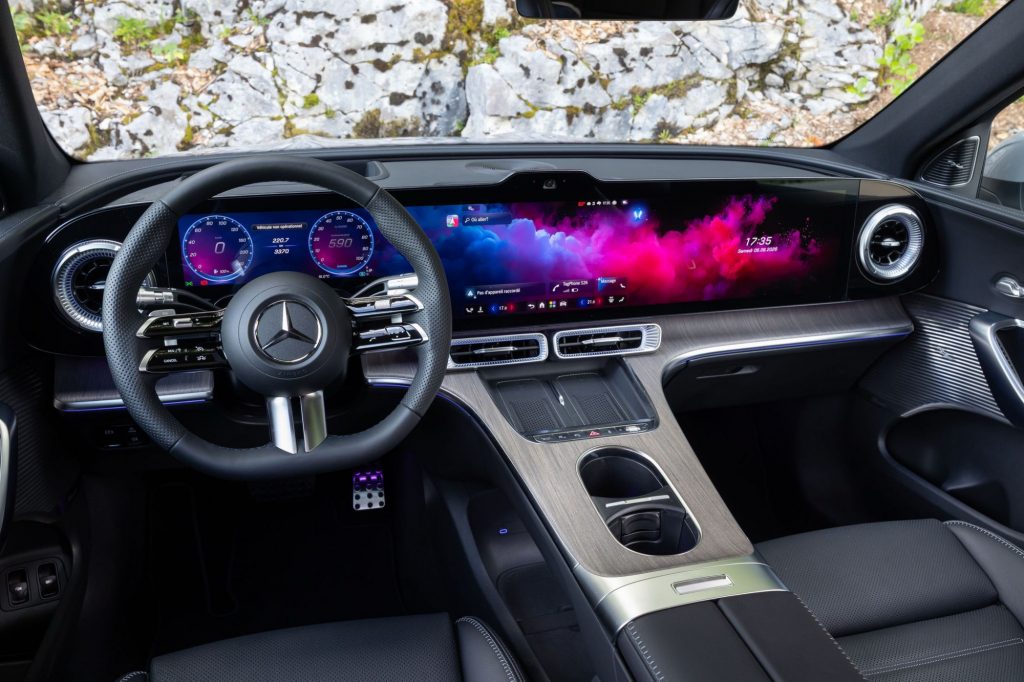
BMW avec son iX3 a démontré il y a quelques mois que le combat entre les premiums se joue surtout à l’intérieur. En réponse à sa bande d’informations parcourant toute la planche de bord, Mercedes a dégainé une nouvelle version d’Hyperscreen toujours plus spectaculaire. Dans le GLC, on parle d’une dalle unique large de… tenez-vous bien… 39 pouces! Alors d’accord, ça en jette. Néanmoins on ne peut pas s’empêcher de penser que cela laisse finalement moins de place à des matériaux raffinés. Ne vous inquiétez pas, on ne manque pas de cuir, d’aluminium brossé, de revêtements glossy à souhait.
La présentation, il faut bien le reconnaitre, en met plein les mirettes, tout en étant d’une certaine façon assez simple. Mention toujours aussi spéciale pour les aérateurs ronds au design toujours aussi aéro. On a très bien compris où mettre les téléphones, tout comme les gourdes aux emplacements parfaitement identifiés sur la console flottante. Même si beaucoup de réglages passent par l’écran, on a toujours des accès directs via des commandes physiques pour les sièges, les 4 vitres et la plupart des fonctions essentielles. Pour les autres, on peut en partie se reposer sur la commande vocale assez performante. Une caméra dédiée permet de faire des selfies, mais aussi de suivre une réunion Teams pendant ses déplacements.
Des performances de sportive
Avant de prendre la route, on se rend compte que l’hyper connectivité de la voiture permet de tout faire, même un peu plus qu’à la maison, que ce soit pour le divertissement ou faciliter la vie au volant. Bien installés dans nos sièges évidemment ventilés, chauffants et massants, on se régale d’avance de profiter de la sono Burmester de haut niveau. Et derrière, on ne se plaint pas, compte tenu du large espace disponible pour les occupants. Qu’a-t-on sous le capot, si l’on peut dire? Une motorisation à transmission intégrale développant quasiment 500 ch, au couple véritablement camionnesque de 800 Nm. Des données de supercars à la clé? Pas loin, comme en témoigne le 0 à 100 km/h abattu en à peine 4 secondes.
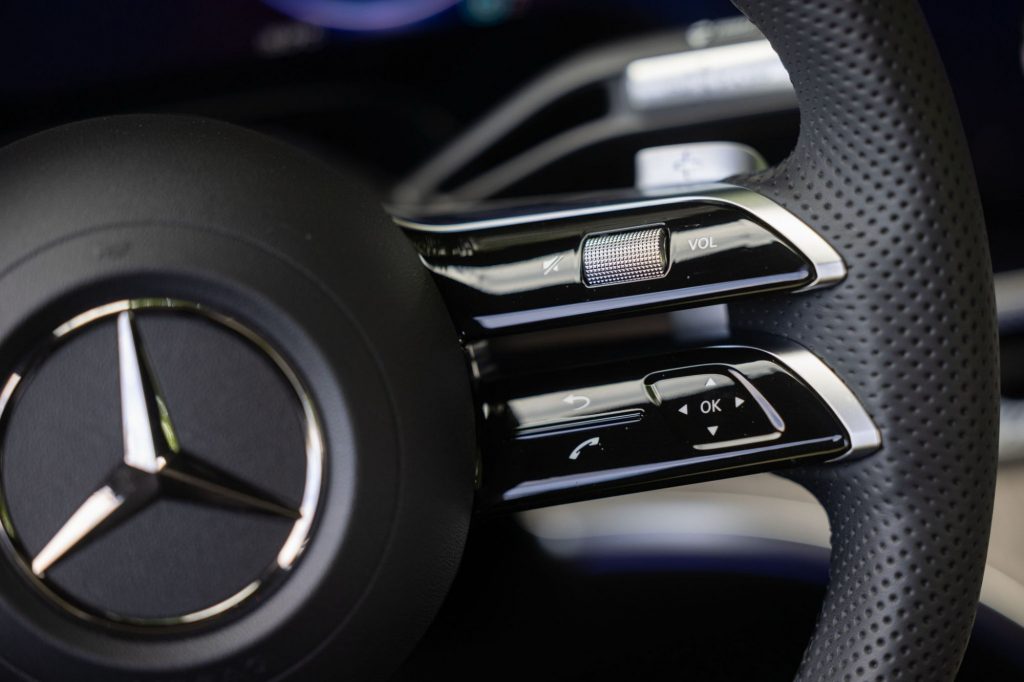
Vous vous en doutez, la cavalerie s’avère très largement suffisante pour faire à peu près ce que l’on veut sur les routes, dans toutes les situations de conduite qui se présentent à nous. On peut gérer la force de la régénération selon plusieurs niveaux, directement depuis les palettes situées derrière le volant dont une impressionnante roue libre donnant parfois le sentiment que la voiture accélère toute seule, alors qu’il n’en est rien en réalité. La voiture peut être on/off pour les plus pressés, mais elle sait aussi se montrer vigoureuse tout en gardant une certaine linéarité dans sa façon de délivrer la puissance.
Une consommation remarquable
Car c’est là que ce nouveau GLC 100% électrique se distingue, dans sa façon de distiller un confort de premier ordre. Les ADAS déjà, très finement réglées, repoussant toujours un peu plus loin la fatigue. La suspension pneumatique demeure un très bon atout, alors que BMW a pensé pouvoir s’en passer pour son iX3. Très clairement, on se sent extrêmement bien à bord, où l’on passe un excellent moment dans cette voiture très bien amortie. La sellerie n’y est pas pour rien non plus d’ailleurs. Mais ce colosse dépassant les 2 tonnes et demie sait faire oublier la longueur du voyage. On se ferait même disputer par les occupants, juste parce qu’on a donné un peu de sensations à l’occasion d’un dépassement. On exagère à peine…
L’air de rien, on peut rouler d’ailleurs assez longtemps avant de se faire rattraper par la jauge. Car ce Mercedes GLC, on s’attend à ce qu’il puisse voyager sans trop s’arrêter. On peut d’ores et déjà vous annoncer que la mission se montre plutôt réussie avec une consommation record sur les routes alpines entre 15 et 17 kWh/100 km. Et même sur la longue portion d’autoroute de notre début de parcours, on n’a jamais dépassé les 19 kWh. Il faut l’avouer, la température estivale n’y est pas pour rien, mais l’hiver ne devrait pas pour autant faire exploser ces données. Le Paris-Lyon est parfaitement envisageable. 800V oblige, sur une borne de plus de 300 kW, Mercedes prévoit le passage de 10 à 80% en une vingtaine de minutes.
Agile, bourré de technologies, mais assez cher
Pour aider à réussir ces prouesses de consommation, Mercedes a disposé un second rapport, ce qui limite le besoin d’énergie pour avancer à haute vitesse. En outre, sans que l’on puisse vraiment le vérifier, le constructeur affirme que la régénération très efficace, jusqu’à 300 kW, permet de minimiser très fortement l’utilisation des freins « mécaniques » dans la très large majorité des cas. Et effectivement, la jauge de régénération lors de nos descentes de cols nous permettait de reprendre pas mal d’énergie. Tout ça, c’est bien, mais histoire de ne rien gâcher, ce pachyderme nous a gratifiés d’une agilité absolument inattendue. Les roues arrière directrices font preuve ici de magie. Le mode Sport ne durcit jamais exagérément l’amortissement, gardant ce qu’il faut de confort pour faciliter la conduite quand on hausse le rythme, sans trop gêner les occupants avec une voiture percutante.
On le sait déjà, Mercedes n’est pas du genre à être bon marché. La gamme du GLC démarre autour des 65 000 euros. Notre version très haut de gamme 400 en finition AMG Line, avec tous les packs et options qui vont bien, atteint les sommets, plus de 96 000 euros. Avec les offres diverses de financement et de leasing, sans nul doute qu’ils seront peu à mettre leurs deniers cash sur le bureau du concessionnaire. Toujours est-il que les plus gourmands en équipements auront l’assurance de conduire une voiture performante, très confortable et à la pointe de la technologie. Il s’agit probablement de l’un des meilleurs SUV électriques disponibles aujourd’hui sur le marché.
An anonymous reader quotes a report from the Associated Press: Hundreds of economists say in an open letter that institutions "must act now" to address how artificial intelligence could transform the economy and could put many people out of work. The statement released Monday was signed by top economists, along with computer scientists and some executives at tech companies including Anthropic, Google and OpenAI.
"AI may become radically more powerful over the next 10 years," says the letter organized by Stanford University's digital economy lab. "This could drive an unprecedented transformation of our economy, larger than the Industrial Revolution, but unfolding over a vastly shorter time frame. It could bring risks, including large-scale job displacement, as well as opportunities such as major gains in living standards."
The letter, which has only four sentences, says leaders must "build the incentives, guardrails, and institutions needed to steer AI in a direction that complements humans and benefits society." The Stanford lab says the letter has so far been signed by more than 200 economists and AI researchers, including 16 winners of a Nobel Prize. "We must be intentional and make collective, democratic choices, rather than letting market forces play out and risking leaving most citizens behind," wrote computer scientist and AI pioneer Yoshua Bengio, who was also among the signatories. He said it "it is highly plausible that AI will drastically transform our economies."
Other signatories include Google CEO Eric Schmidt, LinkedIn cofounder Reid Hoffman, and Nobel laureates Joseph Stiglitz, Daron Acemonglu, and Simon Johnson.
An anonymous reader quotes a report from The New York Times: A state-owned newspaper in China recently published a satellite image of a data center in Gainesville, Va., writing in English that the development of artificial intelligence posed a threat to Americans' physical and financial well-being. A comic strip made to look as if it had been published by a Maryland news outlet -- created with OpenAI's ChatGPT by people in China, the tech company said -- circulated on X this year, blaming data centers for soaring electricity bills. It showed a tycoon smoking a cigar and clutching bags of cash. A video shared on X by a known covert Russian influence operation questioned the viability of a data center that an American company, Firebird, is constructing in Armenia, the small Caucasus nation that has been a focus of Kremlin pressure. "The country's electrical grid instability may render it useless," the video's narrator says.
All are examples of a push by foreign adversaries to seize on what polls have shown is deep ambivalence -- verging at times on hostility -- about the spread of the data centers needed to power A.I. in the United States and elsewhere. China, Russia and, to a lesser extent, Iran have sought to use state media outlets to turn the controversy over data centers in the United States into "a domestic fracture point," according to a new analysis by Alethea, a threat intelligence company, which identified scores of articles and posts on social media this year. These campaigns, whose impact on public opinion remains to be seen, have raised alarms in Washington, where A.I. is seen as a top issue heading into this year's midterm elections.
Cinq jours à peine après avoir repoussé l'échéance au 12 juillet, Anthropic prolonge à nouveau l'accès inclus à Claude Fable 5, cette fois jusqu'au 19 juillet. Une décision qui tombe alors que son concurrent OpenAI multiplie les annonces sur le terrain des usages professionnels.
Which jobs are most threatened by AI? "Programmers, software engineers and other tech industry employees," goes one common answer.
"But many economists are more concerned about a different, larger group of white-collar workers," reports the New York Times: customer service reps, bookkeepers, payroll clerks and HR specialists, "who fly under the radar but collectively account for tens of millions of jobs..."
They are spread across the country and throughout the economy, working in every industry, in big cities and small towns, at major corporations and mom-and-pop businesses... These jobs typically offer a middle-class salary or a pathway to achieving one — much as manufacturing jobs did for men before decades of globalisation and automation wiped many of them away... For now, such an outcome is a fear, not a forecast. Despite high-profile layoffs in tech and finance, there is little firm evidence that AI has hurt the labour market as a whole.
Economists have become increasingly convinced that disruptions are likely, but they say it is too early to know where or how widespread they will be. They remain broadly sceptical of claims that the technology will lead to mass unemployment in the near future. Some AI industry leaders have walked back such predictions in recent weeks. But given the extraordinary pace at which companies are adopting AI — and at which the technology is improving — economists say policymakers need to consider the potential effects on the labour market. And they say they are concerned that the public debate has focused too much on software engineers and a relative handful of other high-status careers — lawyers, consultants, economists — rather than the workers who could be most vulnerable...
Economists at Northwestern University recently recalculated measures of AI exposure based on the makeup of the total workforce, not just the people using the technology. Administrative and front-line roles, such as customer service representatives, rose to the top of the list. "The most affected jobs are secretaries, are routine clerks," said Michelle Yin, one of the working paper's authors. "They're not computer scientists or data scientists at all."
The article also includes this counterpoint from an economist at the University of Illinois who has studied earlier waves of white-collar automation: that like other disruptive technologies, AI likely will also create new jobs. So the possibility exists AI will make workers more productive and allow them to earn more. "I would be cautious about just focusing on what are we losing as opposed to what are we going to gain on the other side."
Linus Torvalds once said LLMs might bring a 10X increase to programmer productivity. But speaking at Open Source Summit India 2026, he now says that number was "not scientific,"
reports ZDNet. "That was pulled out of my ass number, obviously."
Today, he continued, "we're at the point where hopefully it creates more productivity than it takes away," but "we certainly saw more junk being generated by LLMs than we saw useful code up until the like early this year.... it can actually be a huge drain on resources when it takes humans a lot of effort to figure out that, hey, this machine-generated report was not true." Even now, he said, "most of the good ones require more than just the LLM," because "we've had to push back quite a bit... if you find a bug with an LLM, it's not enough to just ask the LLM to make a bug report and then throw it over the fence to us. We want to see a suggested patch; we want to see the human who ran the LLM act as a kind of back-and-forth."
Torvalds described many AI-generated patches as "mindless band-aid kind of patches... they may fix the immediate problem, but the kind of bug remains, and it just is waiting in the hallway to hit you in another place." For his own toy projects, he uses LLMs as prototypers: "I use them as a way to prototype things... quite often the code is not usable in that form, but it's a great way to try something out," while insisting that for kernel-level fixes, "LLMs, in my experience, have not been at that level yet."
Torvalds acknowledged that some AI-found issues have been "absolutely, stunningly, I mean, interesting in a painful kind of way," especially security problems that "show up in the technology press two days later." Despite the embarrassment, he said, "I'm very much not a shoot-the-messenger kind of person. I think we're much better off with LLMs finding bugs, even when they are embarrassing, and they are things that we should probably have found two decades ago."
Torvalds also said he's using AI "for my own toy projects... Every time I travel to some new place, and this is the first time I've been to India, I send the kids pictures of where I am, and for some strange reason, Godzilla seems to follow me around and gets added to those pictures."
ZDNet notes that Torvalds concluded, "There are many useful and less useful uses for AI," and "I think Godzilla is a great place to stop."
Thanks to Slashdot reader joshuark for sharing the article.
"Elon Musk and Sam Altman criticized each other in new posts on X," reports CNBC, "highlighting the billionaires' long-standing tussle over OpenAI's evolution."
This week, SpaceX released the Grok 4.5 generative AI model, while OpenAI debuted its own GPT-5.6 Sol. For days, Musk and Altman have hyped up their respective releases, but on Saturday the rivalry got personal. In response to a post about Apple filing suit against OpenAI on Friday over alleged theft of trade secrets, Musk wrote, "Scam Altman strikes again ...." Minutes after his post, Musk doubled down, writing, "He takes scamming to a whole new level." Next, Musk published a photo of Altman that included the words, "I'm doing this because I love it."
"By 'this' he means scamming," Musk wrote, including two rolling-on-the-floor-laughing emojis. Musk then replied to that post, writing, "He might literally love scamming more than any human alive!"
The flurry of social activity got Altman's attention. "[H]omeboy you're the one sellling public market investors on short-term space datacenters," Altman wrote in an X post of his own that garnered over 11 million views.
"We start flying them next year. Maybe you can come see them if your parole officer approves," Musk fired back.
Separately, Altman put Musk's fresh wave of attention in the context of OpenAI's fresh model release. "[T]here are a lot of benchmarks that suggest 5.6 sol is the best model in the world right now, but the most reliable way to tell is that elon is obsessed with me again," Altman wrote on X.
Reacting to another post, Altman wrote that he was "not afraid of apple, but i have tremendous respect for them. s-tier company," CNBC reports — leading to a sarcastic response from X's head of product. "Incredible trade secrets as well, some of the best."
And CNBC notes that Musk "replied with a face-with-tears-of-joy emoji."

 Connexion