Vue lecture

Trump Administration Bans New Chinese Humanoid Robots

The Trump administration has banned newly authorized foreign-made humanoid and four-legged robots, along with power inverters, citing "unacceptable risks" to the country's national security. FCC chairman Brendan Carr said the agency was doing its part "to secure America's critical supply chains." The BBC reports: The FCC has added the items to its Covered List -- a register of goods and services that are deemed a risk to US national security. The ban applies to new foreign-produced advanced robotic devices and power inverters and does not prevent the sale or import of any existing models that had been previously authorized by the FCC. The FCC cited concerns that the use of foreign-made inverters could allow overseas firms to turn them off, steal data, facilitate remote access and surveillance by "foreign government actors, or be otherwise exploited through a cyberattack." It added that the use of robots made outside the US could allow "malign actors to surveil Americans, enhance the capabilities of foreign intelligence services, or to remotely commandeer the robots."

Read more of this story at Slashdot.

  •  

Hyundai Claims Humanoid Robot Plan Is Not Part of Talks With Striking Workers

Ars Technica reports: Hyundai Motor Company's plan to put humanoid robots to work by 2028 is not part of current negotiations with striking South Korean autoworkers, according to the company. The automaker is disputing news reports that partial labor strikes by the Hyundai Motor union at the world's largest automotive plant in South Korea were spurred by concerns about the company's planned deployment of humanoid robots in the United States starting in 2028. [The planned robots are built by Boston Dynamics, now a wholly-owned subsidiary of Hyundai.] A Hyundai statement shared with Ars describes the union's demands as focusing on compensation-related issues such as wage increases, bonuses, and an extension of workers' retirement age. "Potential deployment of robots in Korean production facilities is not part of the current labor-management discussions," according to the Hyundai statement... Hyundai emphasized that its current plan only covers the initial deployment of the Atlas humanoid robot at Metaplant America, an electric vehicle factory near Savannah, Georgia, starting in 2028. "Decisions about future Atlas deployment at other facilities will be made thoughtfully, in accordance with local operational needs, and in dialogue with the employees and workforce representatives at those sites," the company stated. However, The Wall Street Journal described the Hyundai Motor union as making "unprecedented demands seeking to enshrine job protections in the era of robots and AI," and characterized certain compensation demands as hedging against potential reductions in work hours caused by AI adoption and robotic automation. "Remember that without labor-management agreement, not a single robot using new technology will be allowed to enter the workplace," the union told Hyundai in an internal letter reported by Reuters. Hyundai management and the labor union are currently reviewing a proposed wage reform that would "provide factory workers with greater income stability even after the carmaker's planned deployment of humanoid robots," The Korea Times reported. But experts cautioned that the wage overhaul, which would convert hourly pay for overtime and night-shift allowances into fixed wages, could come at the expense of company productivity.

Read more of this story at Slashdot.

  •  

Robot 'Decapitated' in World's First-Ever Humanoid UFC Fight

"A humanoid robot lost its head," reports Newsweek, "during the world's first free-combat tournament for full-sized humanoid robots." The Ultimate Robot Knock-out Legend competition began Thursday in Shenzhen, China, according to the article, with local robotics company EngineAI providing $40,000 of their "T800" robots (yes, named after The Terminator) to 32 participating teams from around the world: A video shared of the combat on YouTube by local news outlet Shenzhen Story, showed that even after one of the robots had its head practically knocked off its shoulders, it continued to fight, throwing punches at its opponent and kicking into the air... [White humanoid robot "White Eagle"] landed a high kick to the head of its black opponent, "Matador," which made the robot's head rock precariously in its socket before rolling completely out of place. The two continued to spar as Matador's head was swinging from its socket until eventually the robot fell, crushing its head underneath its body. Matador tried to scramble back to its feet, but its head flew off and the robot then collapsed back down. The White Eagle did a celebratory dance for the crowd as the fight concluded, and did a move that mimicked that of someone flexing their biceps. The White Eagle waited in the ring, fists still up, as Matador was carried away, occasionally doing a few more dance moves... Per a report by Global Times, the winning team will be awarded a gold championship belt worth $1.44 million (10 million yuan) by the event organizer. It's a strange fight. The robots sometimes seem unaware of where their opponent is, facing the wrong direction or throwing kicks and punches in the air. In the first round White Eagle just knocks over Matador, who then isn't able to stand back up. (And White Eagle again appears to do a victorious dance.) EngineAI's site says they aim to "promote the development of robot combat events toward greater professionalism, scale, and industrialization," while fostering innovation and global collaboration. Thanks to Slashdot reader pbahra for sharing the news.

Read more of this story at Slashdot.

  •  

Steve Wozniak's Foundation Partners With Realbotix To Build AI Teacherbot

"Apple co-founder Steve Wozniak's Woz Ed foundation is partnering with Realbotix, best known for their RealDoll-branded artificial companions, to deploy AI-powered robotic tutors in classrooms," writes Slashdot reader Hentes. "The doll will serve as a sort of artificial teaching assistant, helping students who get stuck or generating lessons. Students will be assigned an ID code, allowing the robot to provide personalized mentoring." NYS Focus reports: "This deployment in a working school district represents a landmark moment for both AI and humanoid robotics," said Andrew Kiguel, CEO of Realbotix, which is currently building the robot. "[Salamanca City Central School District in Western New York] marks the beginning of a new era where humanoid robots and intelligent AI assistants become standard tools in STEM education." The female robot, named Sally, will have a "lifelike appearance" with silicone skin and long brown hair, Kiguel said in an interview with New York Focus. It will be stationary in a seated position but have a wide range of upper-body movements and facial expressions. [...] Salamanca plans to introduce the robot and avatar in its high school AI and robotics courses, which use curriculum developed by Apple co-founder Steve Wozniak to prepare students for high-demand tech jobs. The district plans to expand it to high school students in other classes if the pilot is successful. Realbotix's classroom robot has drawn scrutiny because the company is connected to RealDoll, the longtime maker of hyperrealistic sex dolls and sex robots. Realbotix acquired RealDoll's parent company in 2024 but says the education-focused operation has separate employees, payroll, facilities, and technology, with plans to formally separate the businesses at the ownership level. The "companion robots" are different from sex robots and intended to address what it's described as a "loneliness epidemic." Kiguel has previously said the company's goal is to produce robots and AI that are "indistinguishable from humans."

Read more of this story at Slashdot.

  •  

Humanoid Robots Controlled By Surgeons Did World-First Operation On Live Pigs

An anonymous reader quotes a report from Ars Technica: Humanoid robots have surgically removed the gallbladders from living animals in an unprecedented medical experiment -- but not as autonomous machines capable of replacing human doctors. Instead, skilled human surgeons remotely controlled the robots' movements in a new example of human-robot teamups. The teleoperated humanoid robots completed two minimally invasive surgeries by removing gallbladders from live pigs during a preclinical trial that was published in the journal Nature. If this approach eventually proves clinically ready for human patients, surgeons could use such humanoid robots to remotely perform robotic-assisted surgical care in smaller hospitals and clinics that lack the resources to install specialized but expensive surgical robots. The experiment used a Unitree G1 humanoid robot made by leading Chinese robotics company Unitree. The cheapest baseline G1 model with effectively non-functional hands has a starting price of $13,500 and shipping costs ranging between $300 and $1,200, whereas adding crucial upgrades such as dexterous robotic hands can easily push the cost beyond $67,000. But such humanoid robots made in China are still significantly cheaper than specialized surgical robots like Intuitive Surgical's da Vinci Surgical System, which can cost anywhere between half a million dollars and several million dollars. The specialized surgical robots can also weigh about 1,800 pounds and take up considerably more space in operating rooms. By comparison, the Unitree humanoid robots, standing at 5 feet tall and weighing just 60 pounds, may be more suitable for smaller clinical settings in remote areas.

Read more of this story at Slashdot.

  •  

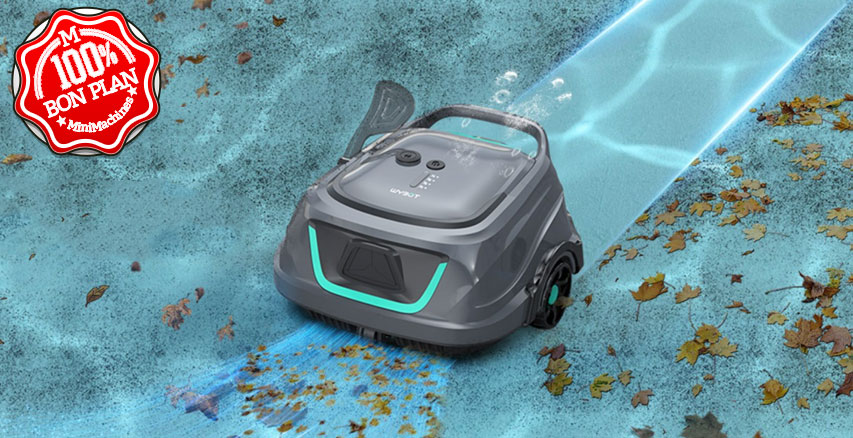
Wybot A1 : Le robot de nettoyage pour les petites piscines

Le Wybot A1 n’est pas la crème de la crème du design et des fonctionnalités du marché, mais suite au test du robot de piscine Wybot C2 Vision avec caméra et fonctions intelligentes paru l’année dernière, vous avez été nombreux à me demander un produit plus simple et surtout moins cher.

Le Wybot A1

Le Wybot A1

J’ai alors publié un bon plan pour le Wybot B1 en mai à 324€, pensant que cela allait coller à vos besoins. Mais non, beaucoup d’entre vous possèdent des piscines hors sol. Et comme on trouve aujourd’hui des solutions de toutes tailles, il vous fallait le plus petit prix possible. Qu’importent les fonctions avancées du modèle de robot. Le principal étant qu’il puisse nettoyer le fond de l’eau du sable, de la terre, de l’herbe et des feuilles mortes pour éviter de la salir trop vite. Comme ces piscines sont relativement petites, le recours à un système de nettoyage compliqué et intelligent n’est pas nécessaire. Il suffit de lancer le robot dans l’eau et de le laisser travailler.

Le Wybot A1 répond à ce cahier des charges minimaliste avec un prix beaucoup plus doux puisqu’il peut s’obtenir à 169€. Il n’a que 120 minutes d’autonomie mais c’est largement suffisant pour couvrir une belle surface. Il ne fait que le fond de l’eau et pas la ligne de flottaison, il faudra donc encore jouer de l’épuisette. Cela évitera tout de même de patauger dans les débris.

L’utilisation est simple, la recharge est rapide et le Wybot A1 est assez léger pour être immergé et sorti de l’eau par tous. L’entretien comme le nettoyage du filtre sont faciles et l’appareil peut gérer toute forme de piscine à fond plat. Il est programmable pour fonctionner quelques dizaines de minutes par jour et peut donc assurer un nettoyage des débris quotidien pour éviter toute accumulation. Par exemple, 30 minutes le lundi, autant le mercredi et le vendredi avant que vous puissiez faire trempette le weekend.

Attention, je ne pense pas que ce type de robot fonctionne dans des piscines « souples » avec une bâche. L’aspiration aurait vite fait de décoller le fond de la piscine et de bloquer l’appareil. Il convient pour les piscines classiques avec liner, carrelage ou autre fond en dur.

Ce robot est l’équivalent piscine des premiers aspirateurs robots qui se baladaient assez bêtement dans les maisons, c’est évidemment beaucoup moins cher que les modèles plus haut de gamme. Mais d’un point de vue fonctionnement, cela fait le job. En espérant que cela vous convienne, je ne pourrais pas trouver beaucoup moins cher à mon avis. J’ai vu des produits en dessous des 100€ en Chine mais cela ressemble plus à un jouet qu’à autre chose…

Le Wybot A1 est disponible sur ZigBuy France à 179.99€ et perd 10€ une fois le code ZBFRWBA1 ajouté au panier pour tomber à 169.99€. Il est livré gratuitement depuis le stock polonais de la marque et il profite d’une garantie et d’un SAV de 2 ans en France.

Voir l’offre sur ZigBuy.fr

CaractéristiqueS WYBOT A1
Marque WYBOT
Type Robot aspirateur de piscine
Modèle A1
Autonomie 120 min
Temps de charge 2 à 2,5 h
Surface idéale de la piscine Environ 100 m²
Zone de nettoyage Fond uniquement
Revêtements compatibles Toutes surfaces
Filtre Filtre 180 μm + mousse de coton ultrafine
Puissance d’aspiration Environ 8,1 m³/h
Contrôle via application / télécommande Non
Stationnement automatique Oui
Poids 4,5 kg
Dimensions du produit (L × l × H) 345 × 315 × 170 mm
Dimensions de l’emballage (L × l × H) 412 × 350 × 194 mm
Forme de piscine compatible Toutes formes à fond plat (pente < 26,8 %)
Indice d’étanchéité IP68
Profondeur d’eau maximale 2,7 m
Moteur Double moteur à balais
Capacité de la batterie 2600 mAh
Contenu de l’emballage Robot WYBOT A1, chargeur, plaque pivotante, vis, cache décoratif, crochet, manuel d’utilisation et guide de démarrage rapide


Wybot A1 : Le robot de nettoyage pour les petites piscines © MiniMachines.net. 2026

  •  
❌