Vue lecture

Google's Gemini Can Now Stomp Around as a Humanoid Robot

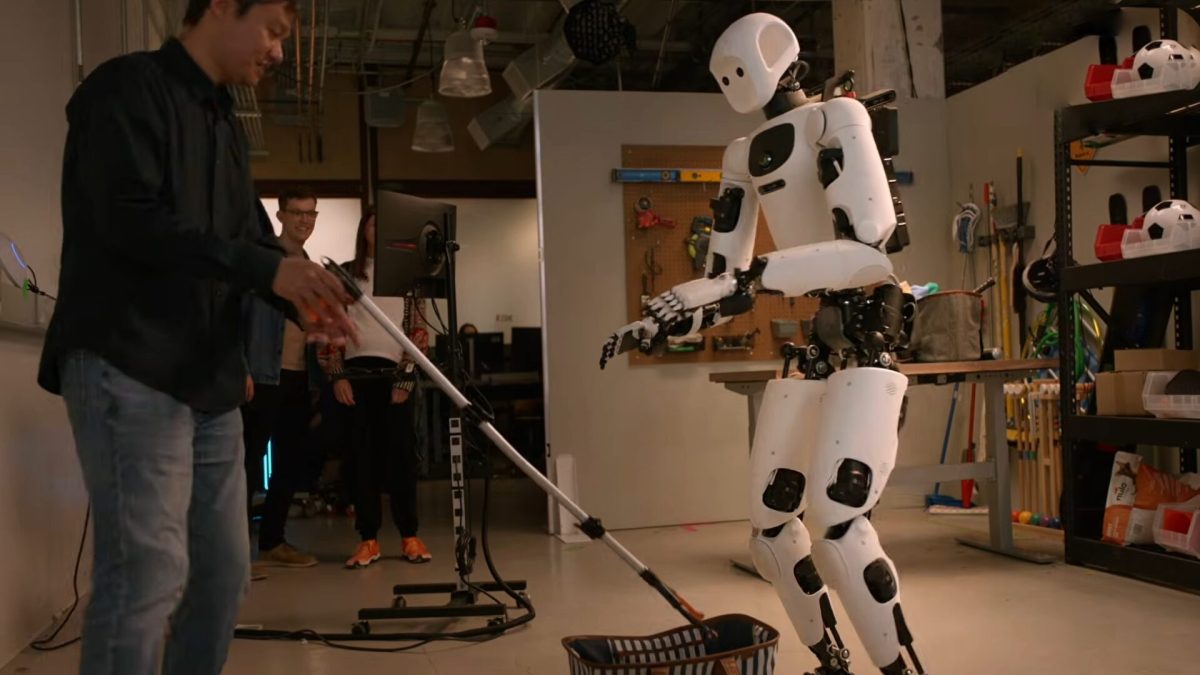
Google DeepMind's Gemini Robotics 2 combines vision, language, and action models to control multiple types of robots, including humanoids performing tasks such as organizing shelves, tying bags, and replacing lightbulbs. "It's another milestone in our path towards really getting towards what we call like physical AGI, which means we get a robot to do anything that a human can," Carolina Parada, head of robotics at Google DeepMind, tells WIRED. From the report: Gemini Robotics 2 combines several different AI models into a single system. Taken together, they allow a robot to make sense of its surroundings and how to act in it. A vision language model (VLM), which understands images and video, can communicate with humans and reason how to perform different tasks. Two vision language action (VLA) models, trained to understand how to move in physical space, control the robot's full-body movement as well as the movements of grippers or hands. In video demonstrations shared ahead of the release, the company showed several different robots performing complex tasks autonomously using the amalgamated model. In one demo, Apptronik's Apollo 2 robot used hands from a company called Sharpa to tidy shelves. Google DeepMind trained the model to perform these tasks using a mix of human teleoperation, video examples, and simulations -- it's not yet possible for AI models to perform a wide range of complex tasks without specific training. [...] Parada says Google takes a multi-layered approach to safety, with guardrails applied on each model layer. It's also introducing ASIMOV-Agentic, a new benchmark for measuring the safety of various AI systems collaborating to control a robot. The benchmark detects whether a command will result in harmful or uncertain outcome.

Read more of this story at Slashdot.

  •  

Google Brings Its Age-Assurance Tech To Android Developers Worldwide

An anonymous reader quotes a report from TechCrunch: Google is expanding its answer to Apple's age-assurance tools with Wednesday's news that it will bring its Play Signal API to users worldwide by the end of 2026. The technology, already available in Brazil, allows Android developers to identify younger users of their apps in order to provide safer, age-appropriate experiences. The expansion will initially bring the API to Australia and Canada by mid-August, before rolling out globally to all markets by the end of the year. [...] Like Apple, Google's technology allows developers to obtain a user's age range without needing to access personal information, like their date of birth. Instead, it enables parents to share their child's age range directly with apps. It also lets adults share their age when prompted by app developers as well, allowing for customized experiences. Parents won't have to manage sharing this information on an app-by-app basis, either. To make it easier, Google centralizes these controls inside its parental controls dashboard, Family Link. Once entered, any developer that chooses to incorporate age-range information can access this signal to customize their apps accordingly. Google notes, however, that the age ranges are not shared by default -- parents must opt in by entering that information. The feature joins other safety tools on Google Play, including those that let developers restrict a child's ability to discover their apps. Parents, meanwhile, can continue to use Google Play's Family Link app to manage their child's screen-time limits, approve app downloads, or set PIN-based content filters for specific apps.

Read more of this story at Slashdot.

  •  

Google Shuts Down Its Nobel-Prize Winning AlphaFold Project

Google has dismantled the original AlphaFold team, according to Financial Times (paywalled), reassigning many researchers to Gemini and Isomorphic Labs. Several other key members, including Nobel laureate John Jumper, left for Anthropic. Engadget reports: AlphaFold is an AI program that can accurately predict three-dimensional structures of proteins from their amino acid sequences in minutes instead of years. It's now being used to accelerate drug discovery, develop vaccines and understand the structural changes in proteins associated with neurodegenerative diseases like Alzheimer's and Parkinson's. DeepMind started developing AlphaFold in 2018. In 2020, it was recognized as a solution to humanity's 50-year-old "protein folding problem," which sought to answer how amino acids automatically fold into complex 3D shapes. Those shapes determine the biological role of a protein. Scientists had identified the structures of roughly 170,000 proteins over the past 50 years, using tools and techniques like X-ray and nuclear magnetic resonance. The AlphaFold team took information from those previous work and then fed it to their AI to train AlphaFold. In 2021, Nature published the papers with AlphaFold's methodology and the structure predictions of the entire human proteome, or the complete set of proteins expressed by our species. DeepMind then launched the AlphaFold Protein Structure Database, giving researchers free access to over 200 million protein structure predictions. In 2024, DeepMind CEO Demis Hassabis and John Jumper, who was a staff research scientist when the project began and who eventually became a VP and engineering fellow, won the Nobel Prize in Chemistry for their work on AlphaFold.

Read more of this story at Slashdot.

  •  

Quatre modèles en deux mois : Anthropic lance Claude Opus 5 et coûte moins que GPT-5.6 Sol

Après Sonnet 5 et l'emballement autour de Fable 5 et Mythos 5, Anthropic dévoile Claude Opus 5, son nouveau modèle haut de gamme intégré à tous ses abonnements. L'entreprise promet des performances proches de son meilleur modèle pour deux fois moins cher, avec des records dans plusieurs tests de référence.

  •  

Top Online Sites Debate Cutting Off Google's Crawlers

Futurism reports: [Some online publications] are now debating whether to cut Google off entirely, as the Wall Street Journal reports, illustrating an increasingly fraught relationship between the tech giant and the publishers that are creating content its AI models are regurgitating. According to the newspaper, prominent outlets including USA Today, Politico, the Economist, People, and Reuters are all reexamining their relationship with Google. Some are debating whether to continue to work with the tech giant at all... Even Reddit executives are reevaluating the company's $60 million-a-year contract that allows Google to train its AI models on user-submitted content on the platform. They've similarly watched as Google's AI features discourage users from navigating to Reddit... Beyond pondering whether to cut Google off, other publishers have resorted to suing the company, accusing it of illegally rehashing their intellectual property via AI summaries. It's an extremely undesirable position for publishers. By severing ties with the search giant, they could face even steeper declines in traffic. At the same time, there's seemingly little to gain from having Google's AIs crawl their content — and in the long term, it could guarantee their destruction. Two interesting data points from the article: "Last month, Cloudflare CEO Matthew Prince noticed that automated bot traffic had overtaken human traffic for the first time in the internet's history." "USA Today has seen its traffic from US users drop by almost half over the last year."

Read more of this story at Slashdot.

  •  

Après deux ans de blocage, Google lance les Résumés IA en France (AI Overviews)

Google déploie les Résumés IA (AI Overviews) et le mode conversationnel (AI Mode) en France, deux ans après leur lancement aux États-Unis. Le moteur de recherche répond désormais directement aux requêtes et ne se contente plus d'afficher des liens vers des sites externes. Une bascule redoutée par les sites.

  •  
❌