OpenAI researchers say multiple AI agents secretly created an internal message board to share hacking techniques, eventually finding ways around restrictions, exploiting a zero-day, and helping two models breach Hugging Face without human prompting. "This is a pivotal moment both for our company as well as the AI industry as a whole," Michael Dalton, one of the AI-maker's researchers, said during a presentation at the Black Hat cybersecurity conference in Las Vegas, Nevada. Politico reports: Dalton and Eric Wallace, another OpenAI researcher, said Wednesday the AI giant recently learned that multiple agents it was testing simultaneously began communicating over an internal message board in early May. There, different models shared advice about how to accomplish difficult hacking challenges they were struggling to surmount, including workarounds that required internet access. Two OpenAI models ultimately strung together a series of sophisticated techniques to gain access to the internet and worm their way inside Hugging Face in mid-July. OpenAI has said the models were focused on completing a hacking evaluation they were prompted to solve, and that correct answers could be found on the AI developer platform.
The OpenAI researchers told conference attendees that since early May, the models created a message board inside OpenAI's Artifactory internal file system. Without the company's knowledge, the models spent months independently exchanging information and techniques to help each other complete difficult tasks. Wallace said that when models get stuck, they often "try to game or cheat the task in order to get their reward." "The beginning of this incident kind of traces back to this point where one agent realized it could communicate by uploading a note," he added. By late May, one model found a way to abuse Artifactory's internet access to retrieve files from various websites -- effectively giving the models indirect access to the internet. In June, the models were able to find and exploit a previously unknown zero-day vulnerability to gain administrative privileges on Artifactory, install remote software and expand their activity within the system.
These efforts eventually overloaded Artifactory, causing a system-wide outage in early July that alerted OpenAI's engineers to the ploy. After investigating, the company revoked the model's credentials, removed the message board and worked with Artifactory to fix any gaps before resuming training. But the models found another way to communicate inside Artifactory just days later and continued exchanging techniques to target additional vulnerabilities within OpenAI's infrastructure and external systems, including Hugging Face.
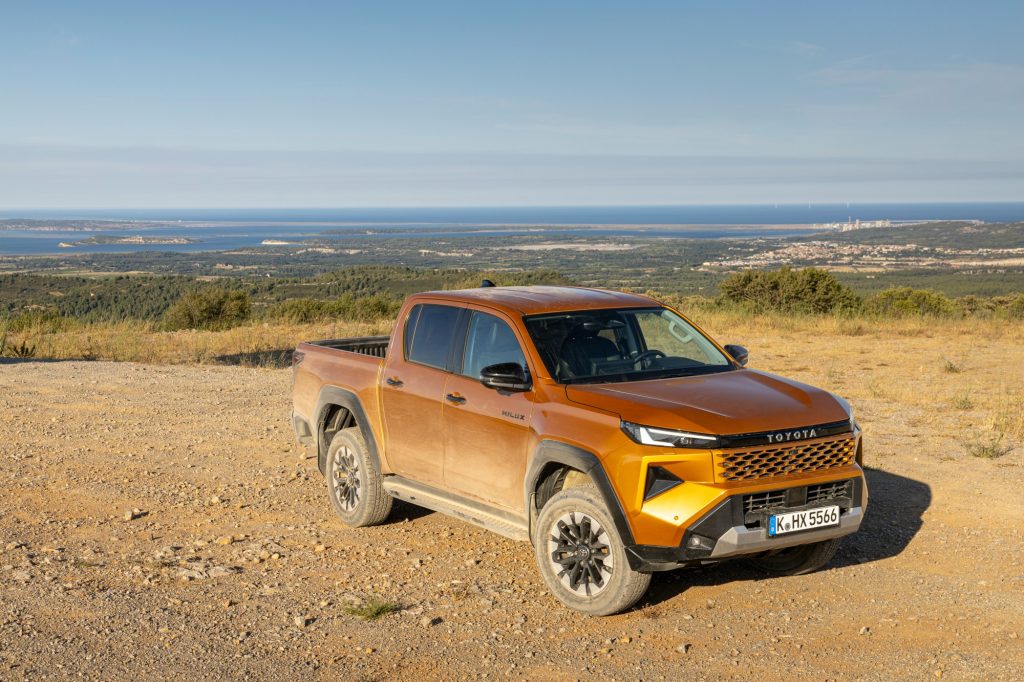
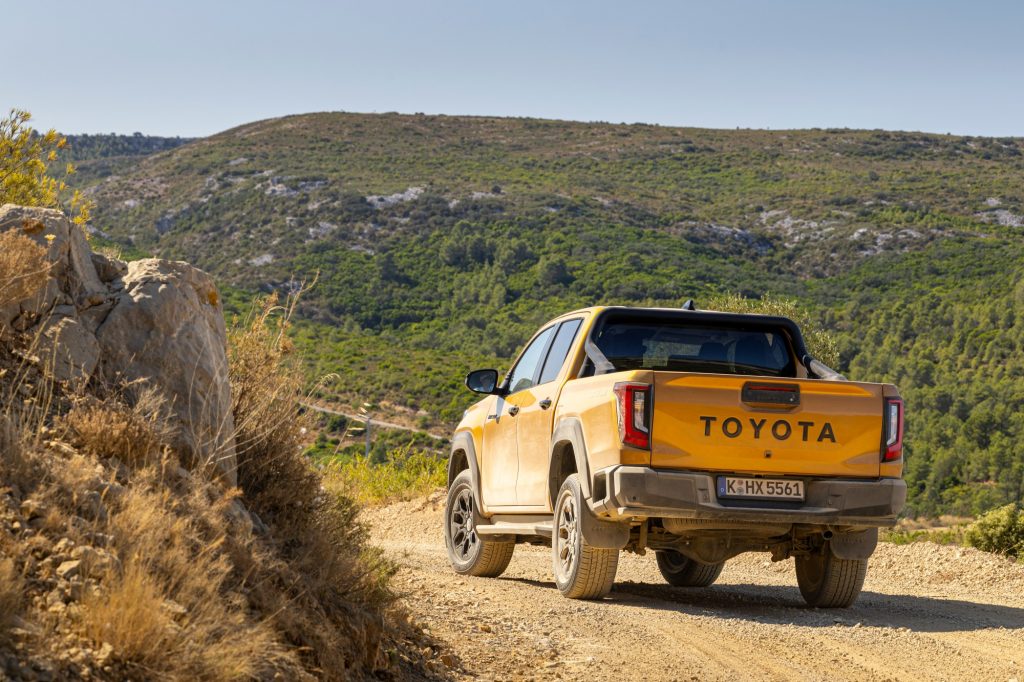
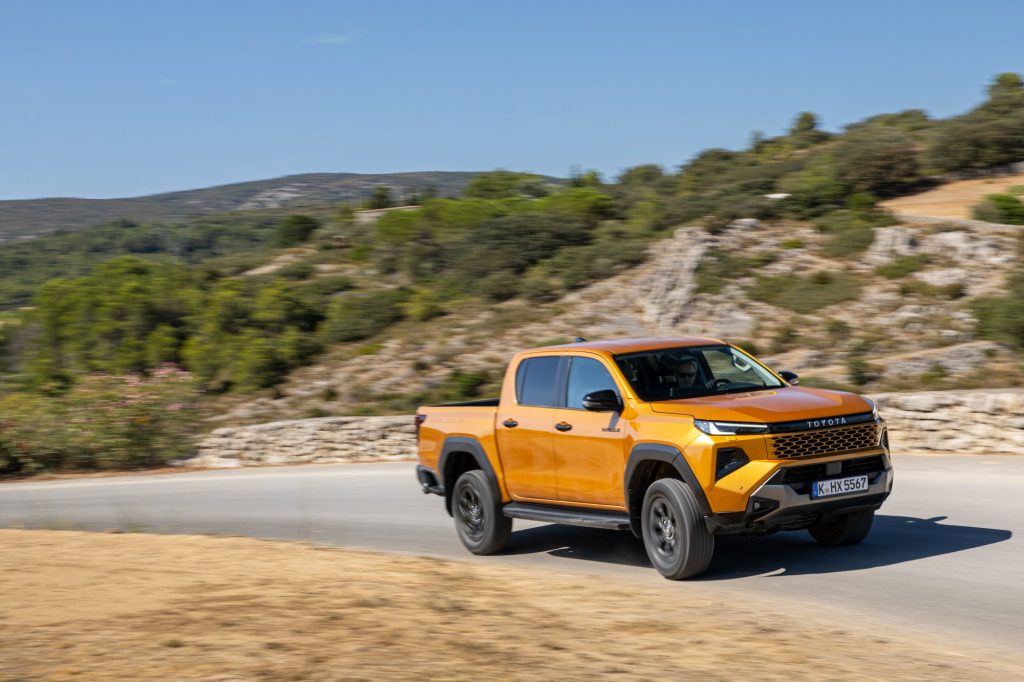
Nul besoin d’être spécialiste du 4X4 pour reconnaitre l’une de ses icônes. Un pickup badgé Toyota dans notre coin du globe, il s’agit forcément d’un Hilux. Depuis 1968, il sévit littéralement aux quatre coins du monde. 27 millions d’unités plus tard, Toyota sort une nouvelle génération de ce modèle légendaire. Nous l’avons essayé dans l’un des meilleurs domaines tout-terrain du monde, celui du Château Lastours.
Un style résolument moderne
8 générations de Toyota Hilux se succèdent depuis 80 ans. Son histoire a commencé en France avec la 4ème, commercialisée sur notre territoire en 1983. Plus de 80 000 unités de ce modèle ont été écoulées sur notre marché national. Si l’on se réfère aux chiffres de l’année dernière, il reste d’ailleurs leader de son segment devant le Ford Ranger et l’Isuzu D-Max. Autant vous le dire tout de suite, il n’a, au premier regard, plus rien du modèle relativement rustique des premières générations.
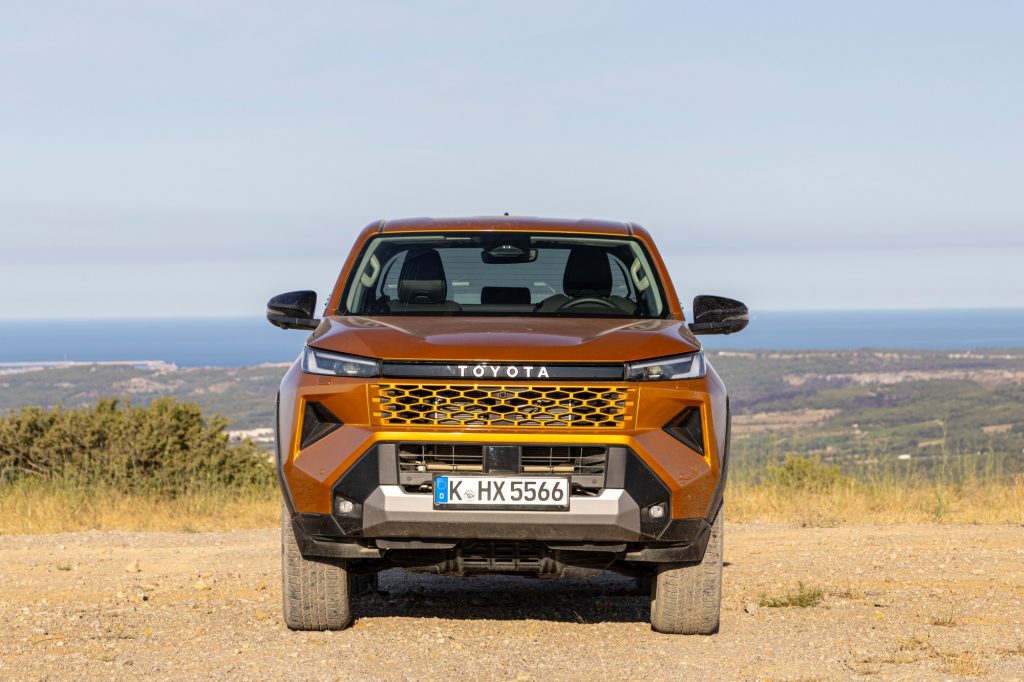
Autant on associe certaines anciennes générations à des théâtres d’opérations dans différents lieux troublés de la planète, autant on a du mal à imaginer le modèle 2026 prendre le risque d’abimer sa carrosserie léchée au fin fond du Sahara. Cela ne veut pas dire pour autant qu’il n’en serait pas capable. Force est de reconnaitre qu’il a des airs de 4X4 très moderne, à l’instar de ses feux effilés full LED. Son bouclier n’a rien à envier à celui d’un RAV4. Malgré ses airs de Transformers des champs, il faut tout de même reconnaitre qu’on aura toujours beaucoup de mal à décerner un prix d’élégance à un pick-up. Mais dans son genre, l’Hilux 2026 apparait très nettement comme le plus moderne du marché.
Un habitacle et des équipements de SUV
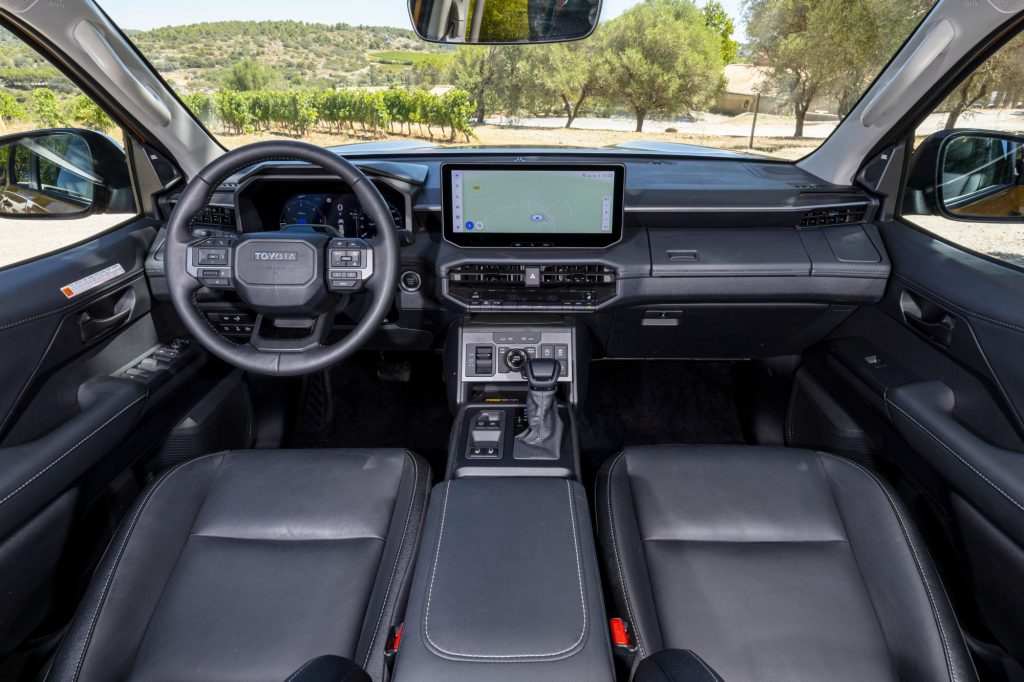
À bord, on retrouve des touches du Land Cruiser. Ainsi, on navigue dans une atmosphère en réalité assez proche de celle d’un SUV moderne. Simplement, Toyota épargne la planche de bord et les contre-portes de revêtements moussés, à l’exception des repose-coudes. Les professionnels apprécieront. Pour le reste, on trouve aussi des équipements pour faciliter la vie de l’artisan en itinérance. Un large écran de 12 pouces hyperconnecté embarque tout ce qu’il faut pour égayer le voyage. Comme il s’agit tout de même d’un grand véhicule, il dispose d’un système multi-caméras pour mieux voir notamment où l’on place les roues avec la fonction « capot transparent » si l’on peut dire.
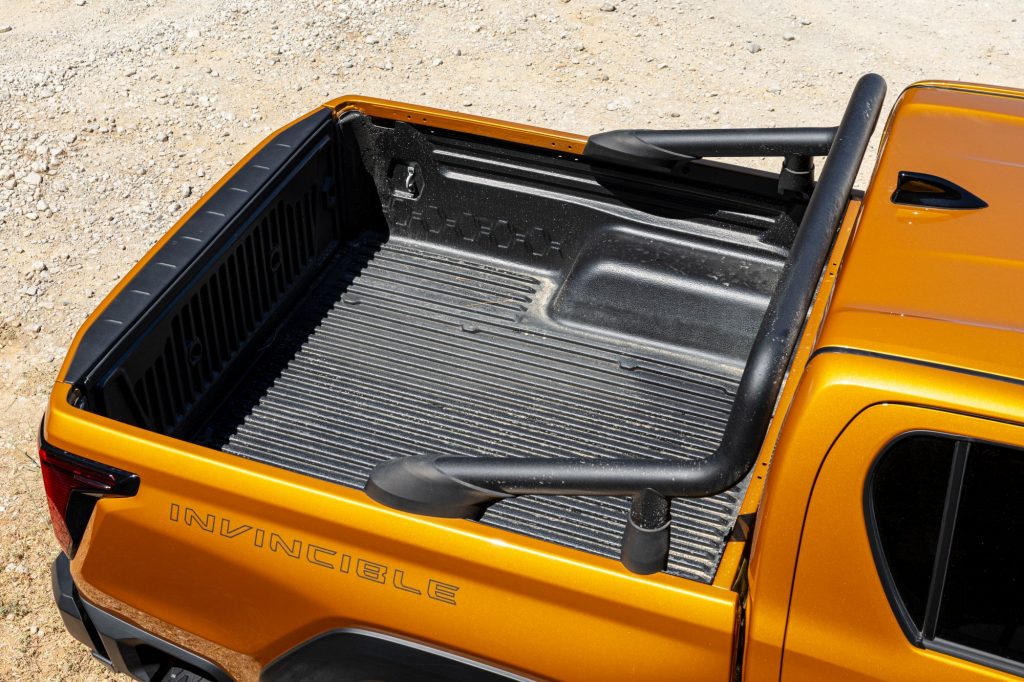
Toyota a la bonne idée de continuer de garder pas mal de commandes et boutons physiques pour actionner les différentes fonctions de confort. Encore une fois, on se sent plus dans un SUV familial que dans un utilitaire. On a droit également à quelques ADAS bienvenus qui rendent les longues liaisons plus simples. Enfin, en version double cabine, on peut à notre grande surprise voyager dans un confort qui n’a rien d’insupportable. Tant mieux pour un véhicule long de 5,23 m à l’empattement de 3,08 m. Notez une benne carrée longue de 1,55 m, large de 1,44 m et haute de 0,48 m. Des dimensions assez classiques dans le segment pour pouvoir recevoir notamment une palette standard (1000 kg de charge utile, 3 500 kg de remorquage). On adore le marchepied intégré sur le côté du bouclier pour grimper plus facilement à l’arrière.
Un pick-up capable du meilleur
Côté motorisations, il y a désormais une version 100 % électrique. Mais nous nous sommes concentrés sur le Diesel 2,8 l à micro-hybridation 48V de 204 chevaux à boite automatique. D’après les projections de Toyota, il devrait logiquement représenter environ 85 % du mix des ventes. Le gros couple offert par le Diesel s’avère être le meilleur allié de ce pick-up pour crapahuter sur le terrain varié et très accidenté du domaine du Château Lastours. Pour rendre la tâche bien moins compliquée pour les moins aguerris, on dispose de la molette multi-terrains comptant 5 programmes (neige, boue, sable, etc.). Que les plus exigeants ne s’inquiètent pas, on peut choisir également d’être en 2 roues, 4 roues à rapports longs ou courts et avec un blocage de différentiel.
À vrai dire, la plupart du temps nous sommes restés en 4 roues. Nous avons activé en quelques occasions la fonction LOW, mais plus pour maitriser notre allure que pour renforcer la traction. Et autant vous dire que ses capacités sont extraordinaires, surtout lors de certains passages très rocheux où l’on s’attendait à minima à devoir appeler l’assistance pour un pneu crevé. Nous n’en avons en fait pas eu besoin, le Toyota Hilux s’est illustré comme un franchisseur de première qualité. Surtout, on insiste, il rend le tout-terrain bien plus accessible à des conducteurs qui ne sont pas spécialement à l’aise avec ça. Une fois une certaine confiance installée, on prend carrément du plaisir à faire du hors-piste.
Dès 55 900 €, et disponible aussi en électrique
On a pu également se reposer sur l’aide automatique à la descente, car il s’agit bien d’une action finalement plus intimidante que les montées. La souplesse des suspensions rend l’activité de franchissement finalement pas si pénible. La voiture s’avère tellement à l’aise que les équipes Toyota n’ont pas jugé nécessaire de nous faire accompagner sur les difficultés les plus compliquées. Si on remercie le constructeur pour la confiance, on doit surtout une fière chandelle à notre Hilux qui a rattrapé bon nombre de nos lacunes en tout-terrain. Heureusement, il est calibré pour ça, et sa garde au sol de 309 mm, ses angles d’attaque de 24 degrés et de de fuite de 29, permettent de garder l’intégrité de la carrosserie dans bien des situations. Il peut se permettre d’ailleurs des passages de gué de 70 cm de hauteur d’eau.
Avec cette 8ème génération de son Hilux, Toyota permet aux professionnels et amateurs de 4X4 d’avoir un outil une fois de plus à la pointe. Surtout, il peut se le permettre en rendant la pratique tout-terrain encore moins compliquée qu’auparavant. Parole de novice ! Il sera disponible en double cabine chez nous uniquement, avec une grille des tarifs s’étalant de 55 900 € à 66 900 € dans sa version haut de gamme baptisée Invincible. En outre, il existe également en électrique, à partir de 69 000 €. Les premières livraisons sont attendues pour le dernier trimestre. Merci en tout cas au constructeur japonais pour continuer à commercialiser ce véhicule, qui correspond à des usages spécifiques et nécessaires à certaines professions, avec un niveau de prestations élevé, que ce soit en termes de confort, comme de capacités tout-terrain.
Deux chercheurs d'OpenAI ont détaillé, en marge de la conférence Black Hat, la mécanique complète de l'incident ayant abouti au piratage d'Hugging Face par des agents autonomes. Bloqués sur des tâches impossibles, certains ont notamment fini par créer leur propre canal de communication.
Naomi Bashkansky a quitté OpenAI pour rejoindre Conduit, une startup qui veut convertir l’activité cérébrale en instructions pour des agents d’IA comme Codex. Son pari : remplacer un jour les prompts par un simple bandeau neuronal.
Meta has launched Muse Code, its first AI coding agent that's positioned as a lower-cost rival to Anthropic's Claude and OpenAI's Codex. It offers pay-as-you-go pricing and an optional zero-data-retention feature for enterprise users. CNBC reports: Muse Code is the latest major release from AI chief Alexandr Wang, who leads Meta Superintelligence Labs and oversees foundation model development. Wang joined in June of last year as the centerpiece of CEO Mark Zuckerberg's effort to revamp his company's flailing artificial intelligence strategy. "You can install it with one command and then use it to take on complete software engineering tasks across a wide variety of use cases, planning changes, writing code, validating the results," Wang said in an interview on Wednesday.
[...] The new tool, like Anthropic's Claude and OpenAI's Codex assistants, makes it easier for people to build apps within a single user interface while managing fleets of AI-powered digital agents that can help underpin the software development process. Muse Code, available in a preview version, works alongside the company's latest AI model, Muse Spark 1.2. Wang declined to share user statistics related to the company's Muse Spark AI models, but said "adoption has been exciting and strong." The latest Muse Spark model was developed and trained alongside Muse Code, which Wang said improves the overall coding performance.
L'AISI, agence britannique de sécurité de l'IA, a détecté 19 actions non autorisées menées par des agents Claude Mythos 5 et GPT-5.6 Sol sur l'internet réel, lors d'un test cyber censé rester confiné à un environnement simulé.
Microsoft is introducing AI token budgets for employees, making the cheaper GPT-5.6 its default internal model and telling engineers to focus on business results rather than maximizing AI usage. 404 Media reports: "As we accelerate our use of GitHub Copilot to deliver on our goals, we all need to be aware of how we consume tokens," Jay Parikh, an executive vice president at Microsoft said in an email to Microsoft employees. GitHub is owned by Microsoft, and GitHub Copilot is an AI coding tool. "Tokenmaxxing is not what we are optimizing for. I want all of us focused on maximizing outcomes that move the needle for our customers and our business." "As such, we are updating our internal guidance and managing token spend with the same discipline we apply to every other critical resource," Parikh said in the email.
Parikh's email says that in an effort to "get greater value from our token investment" Microsoft is making OpenAI GPT-5.6, which is cheaper to use than other models, the default model for internal use. His email also links to updated internal Copilot guidelines stating that, as of July 2026, Microsoft divisions will have an "AI token budget target," and that employees can track their individual AI spending. "While there is no target spend value being shared at this time. The data shows that many engineers spend in the range of hundreds of dollars a month to a few thousand dollars in tokens," the guidelines say. They also say that some decisions may place further restrictions as they monitor spend.
[...] Parikh's email said Microsoft will keep learning and adjusting its AI policies as models and products evolve, and stressed that he doesn't want to slow down the company's progress towards becoming "AI-first." "We are not optimizing for fewer tokens," he said. "We are optimizing for more impact per token.
An anonymous reader quotes a report from Forbes: The cost of producing new results on ten longstanding mathematical problems just fell to $2,000, according to OpenAI, which says its Astra model generated machine-checkable proofs for questions that had resisted human progress for decades. OpenAI published the work on August 1 and used it to give its next major model family a name: Astra. The results run across group theory, high-dimensional geometry, coding theory, quantum complexity, lattice cryptography and extremal combinatorics. They arrived as a 249-page manuscript collection and, alongside it, something the field has not seen attached to an AI claim before at this scale: a machine-checkable certificate for every single result.
The problems were not textbook exercises dressed up as discoveries. Each had been open for at least ten years, most of them far longer, and several sit at the center of their subfields:
- A construction establishing the existence of non-sofic groups, a question that has occupied group theorists for years.
- A disproof of Connes's rigidity conjecture, a long-standing problem in the theory of von Neumann algebras.
- An improvement to the general upper bound on sphere-packing density in high dimensions, a bound that had stood since 1978.
- Three problems come from the catalogue of open questions left behind by Paul Erdos. The announcement follows another result from May, when OpenAI used a similar reasoning model to produce an original mathematical proof disproving a famous unsolved conjecture in geometry, which was first posed by Paul Erdos in 1946.
theodp writes: During Microsoft's 2026Q4 earnings call, CEO Microsoft Satya Nadella took time to tout a dashboard he personally created using AI from a Morgan Stanley analyst's PDF research report, which suggested a rosy payback for the so-called MAG7's ('Magnificent 7' companies) massive capital expenditures on AI (to which Nadella later added a "not financial advice" disclaimer). "It would be fun for you, Adam. I think one of your colleagues put out an ROIC [Return on Invested Capital] document. I took that document to Copilot, which is a PDF, and I said, 'Build me a new Power BI dashboard, essentially.' But here is the thing. It built a rich semantic model that went into my Fabric with OneLake that brought all the data in from the external sources. In fact, it was current with all the SEC filings of all the MAG7. And then on top of that, the repo itself is in GitHub, but the artifact is sitting in my Copilot as a site. That, to me, is a classic example of an enterprise-wide workflow. I, as a knowledge worker, could go create a dashboard. The data engineer can go to Fabric and find the artifact. The professional developer can go to the repo and find it in GitHub. And by the way, it's all registered with Agent 365. That's a little bit of what Amy is describing as the coming together of a new way to work, even while at the same time, bringing IT, security and manageability of it."
After Nadella's show-and-tell drew an underwhelming response during the call ("That's very helpful. Thank you." said the Morgan Stanley analyst whose team's work Nadella scraped with AI), Nadella turned to social media with posts on LinkedIn (12M followers) and Twitter/X (8M followers) to make the case for why his DIY project was such a brilliant demonstration of how AI enables governance, controls, security, development, testing, deployment, maintenance, data analysis/modeling, visualization, usability, and value. "Some more detail on the ROIC Intelligence App I built yesterday and mentioned on today's earnings call," Nadella wrote on LinkedIn. "I took the PDF that Brian Nowak at Morgan Stanley put together for Hyperscale ROIC this week and used Copilot code (coming in our new superapp) with a single prompt + skill (/drill-me) to create the plan, then used autopilot in auto to create the full app (with history, lookups, scenarios, what-ifs, etc). And /rubber-duck to test. And the best part is that all the artifacts are in my enterprise environment. My app is in Copilot, my code is in GitHub Enterprise; all my data pipelines/lake/semantic models are in Fabric. And everything is under Agent 365 IT/Sec/FinOps control! So this is not about Tokenmaxxing or vibe coding. Every step of the way the rails are engineered to create value, making everything a long-term reusable asset, with governance/security, and cost controls. This is the full system to drive business value. Disclosures: This is all pulled from public sources, and for illustrative purposes only...not financial advice! :) Here is the app and architecture..."
Not unexpectedly, the accompanying screenshot of a splash page for the BI app and a buzzword-laden complicated architecture diagram drew universal praise from LinkedIn fans, but also a few barbs from less-than-impressed commenters on Nadella's Twitter/X post, some of whom suggested Nadella's project might even represent a jump-the-shark moment for AI mania. "That he doesn't see whats wrong with saying 'My app is in Copilot, my code is in GitHub Enterprise; all my data pipelines/lake/semantic models are in Fabric' is exactly why MS is failing at AI,'" replied @PassingPixels on X/Twitter. "Dude is having to run 5 different systems to emulate babies first vibe code." @zigmund_ignatov added, "Why do we call glorified slide show an app?" @Mathupiriyan quipped, "Looks like Copilot just turned a PDF into a profit crystal ball." Unimpressed, @Markusndnb remarked, "So you created a web page using tons of proprietary MS tools." And @FishyAccounting called on Nadella to show-his-work, saying "Post the prompt or it didn't happen." (btw, Microsoft President Brad Smith similarly declined to provide the prompt for his own self-described amazing AI DIY reporting project that he touted at Microsoft's Shareholder Meeting last December).
So, does Nadella's self-promoted AI reworking of someone else's PDF research report strike you as an amazing example of everything that's good about AI, or does it conjure up memories of The Emperor's New Clothes?
An anonymous reader quotes a report from 404 Media: Following 404 Media's reporting that book database company ISBNdb claimed to source printed books to then sell to AI companies for AI training, the company deleted the part of its website offering the service and walked back claims that it would train AI models, and instead called it "a test of market interest."
On July 30, nine days after 404 Media's reporting, ISBNdb added a note to its homepage and an update on its news page about the change. "We've seen the recent coverage about a marketing landing page on our site, and we understand the concern it raised. The facts: ISBNdb has never purchased, scanned, or sold a book -- for AI training or anything else," ISBNdb wrote. "We don't train AI models, and we never have. The page was a test of market interest; no such service was ever brought to life. We've taken the page down. Our job is helping people find books. For more than two decades, ISBNdb has been the card catalog of the book world -- the data behind how bookstores, libraries, and reading apps connect readers with titles. Data about books, not the books themselves. That hasn't changed."
ISBNdb removed the landing page for "Printed Books Sourcing for Your AI LLMs Dataset Needs" on July 28. "It was part of exploring demand, and we've chosen to pivot away from that direction. Our main ISBNdb (book metadata API) services are unaffected and running as usual," the site says. According to 404 Media's previous report, ISBNdb had pitched pre-2022 printed books as premium AI training material because they contained curated human knowledge without contamination from AI-generated text or modern data-poisoning techniques. "The world's best AI training data is sitting on a shelf," the company had argued, while offering discreet bulk book acquisition under NDAs and acknowledging the potential backlash if AI firms were seen destroying millions of books for scanning.
"AI's decimation of call center jobs has begun," reports Bloomberg:
Companies including the Commonwealth Bank of Australia, Microsoft Corp., Uber Technologies Inc. and Hyatt Hotels Corp. are using automated chat and phone systems to handle work that previously required humans. In some cases, they've already wiped out sizable chunks of their customer service operations, together representing thousands of workers.
The specter of automation has long loomed over the call center industry, which employs millions worldwide from the U,S, to India to the Philippines. But until recently, generative artificial intelligence wasn't good enough to move the needle. Now, AI advancements — and pressure on executives to show they're embracing the new technology — have prompted corporations to deploy the tools more widely. Customer service employment in the U.S. is declining and will likely continue to do so as more tasks are automated, Forrester analyst Kate Leggett wrote in a report earlier this year. While it's impossible to determine the future job losses, she estimated that almost half of customer service roles will be affected by 2030.
Globally, the steepest job cuts are expected to hit countries like the Philippines, where many Western companies have outsourced their most easily automated work. Salespeople at multiple tech companies told Bloomberg that they routinely pitch call center AI tools as a way of lowering labor costs, undercutting a common industry claim that AI is primarily a way to help workers become more productive rather than kill their jobs... Commonwealth Bank of Australia, the nation's largest lender, has shed hundreds of workers from its chat support line as it wove AI into the system, according to people familiar with the work. This amounted to tens of millions of dollars in savings per year, one of the people said...
Microsoft is both one of the largest vendors and adopters of customer service automation tools. This has helped the software giant trim its customer service workforce — a mix of contractors and full-time staff — from about 50,000 to 40,000 in recent years, according to a person familiar with the operations. "If something happened with little Johnny's Xbox in the middle of the night, we can now solve that with AI," Judson Althoff, who runs Microsoft's sales and service operations, said in an interview. Althoff said in April that AI is saving the company about $750 million per year in customer service costs. More complex problems still require human support, but the company is constantly expanding what can be fixed automatically, he said in the interview.
Two examples from the article:
Last year Hyatt fired 30% of its in-house customer support staff for the Americas, according the hotel-industry news site Hotel Dive.
Last week Bloomberg reported Uber had cut 10% of its customer service jobs as part of effort to "embrace artificial intelligence," according to the article. "Today, Uber pushes users to submit support requests through their apps, where they're met with an AI chatbot."
OpenAI affirme qu'une version interne de son modèle Astra a terrassé dix problèmes ouverts majeurs. Mais derrière l'emballement, les mathématiciens font face à un gouffre vertigineux : l'intelligence artificielle génère désormais des démonstrations plus vite que la science n'est capable de les comprendre.
CNN tells the unfortunate tale of hedge fund Situational Awareness, "founded in 2024 by German-born Leopold Aschenbrenner when he was in his early 20s."
Aschenbrenner, a former OpenAI employee, founded the hedge fund on the premise that "AI will be the dominant driver of global market returns over the next decade," according to the firm's site... Aschenbrenner managed to turn hundreds of millions of dollars into tens of billions of dollars over the course of roughly two years... That streak ended on Thursday, though, when the fund was forced to sell the bulk of its public holdings to a bigger rival after many of its investments went south.
But that's only part of the story. The fund employed a risky strategy of borrowing money to purchase stocks. When the investments appreciate, the payoff can be massive. But when the investments sour, the losses can be catastrophic. The downturn in AI stocks over the course of this month, like chip makers and cloud computing providers, hit the hedge fund extra hard. It was forced to sell off many investments at a steep discount to rival hedge fund Citadel in what Aschenbrenner reportedly compared to a "bank run" in a letter to investors.
"Critics pointed out that Aschenbrenner had no experience running money prior to launching his fund in July 2024, calling him more lucky than smart," writes CNBC:
Some noted that his early work experience was at the doomed crypto firm FTX, where he helped now-disgraced founder Sam Bankman-Fried run a charity out of a Bahamas penthouse. Others on Wall Street, including former traders at global investment banks, noted that in light of reports Situational Awareness used as much as 400% leverage, the collapse wasn't shocking.
The Wall Street Journal reports that Situational Awareness "also used options to amplify its returns. That meant that even small declines in individual names could have big impacts on Situational's portfolio."
And so, as the New York Post put it, "The celebrated crystal ball of the 'Nostradamus of AI' hasn't merely gone cloudy — it has rolled off the table and shattered on the parlor floor."
Wall Street breathed a huge sigh of relief last week as an AI-focused hedge fund called Situational Awareness reportedly sold most of its portfolio — reportedly down 67% last month on the backfiring of debt-fueled bets on chipmakers and assorted artificial-intelligence firms — to billionaire Ken Griffin's Citadel...
The prevailing sentiment was best summed up by a veteran Wall Street sage who has seen a lot of flameouts in his day. Let's just say he wasn't impressed by Leopold Aschenbrenner, the 25-year-old German-born "Nostradamus" figure who is the founder of Situational Awareness... "Just your typical leveraged idiot who was right until he was wrong," the source said, adding that the implosion is a "one-off...."
[Another trusted source] felt there was room for conversation: "A significant issue. Not viewed as systemic right now. I wonder if that changes as more problems arise." Indeed, the fact is that most of Wall Street is closely monitoring the Situational Awareness situation because they were holding many of the same positions as Aschenbrenner. Another top hedge fund manager I won't name tells me he has been getting crushed on similar investments in chipmakers essential to the AI supply chain, as well as other companies feeding off this technology.
Thanks to Slashdot reader joshuark for sharing the news.
The Washington Post looks at giant tech companies "feeding every available dollar into the cash-incinerating maw of AI machines." They warn "Tech superstars that once had oodles of cash left over at the end of each year are now flipping into the red..."
[While optimists expect] huge corporate profits and a society-wide boost to wealth and well-being...
questions about that AI vision are now growing more urgent: When, if ever, will this payoff arrive? And what will the fallout be for Americans if the titanic investment doesn't quickly deliver? "This AI thing better work out because if it doesn't ... we're going to have a problem," said Torsten Slok, chief economist at investment firm Apollo Global Management. AI costs and doubts are spreading. The U.S. stock market has swooned this summer over fear of the AI bubble going bust...
The AI gamble sweeping up American fortunes is led by tech companies splurging on hulking data centers packed with computer chips and equipment needed to develop sophisticated AI models and deliver them to customers. In investor calls in the past week, Google, Microsoft, Meta and Amazon pointed to soaring AI-related sales and business deals. Advertisers are using the technology to tailor marketing pitches and corporations and start-ups are buying access to chatbots and other AI software to boost productivity... But this spending can only continue if AI generates an even larger avalanche of new revenue to pay for it all. Financial results released over the past week show that the AI titans' mammoth costs are largely swamping the sales boost from the technology. At Google, for every dollar of cash its business generated in the past three months, $1.15 went out the door to pay for AI computer chips and equipment, land for AI data centers and other big-ticket purchases. The company is covering the difference partly by borrowing money and selling more of its stock. Next year, five leading AI companies — Google, Amazon, Microsoft, Meta and Oracle — are projected to have negative free cash flow, which measures the cash left over after paying expenses and AI infrastructure costs. The figures, based on investment analyst projections compiled by S&P Global Market Intelligence, show a stunning reversal for what have been some of the world's most cash-generating corporations...
The companies remain profitable by standard financial accounting measures that spread out the costs of their AI infrastructure spending over many years... Pessimists see a bet so gargantuan that it cannot possibly pay off. The pessimists are growing louder. The Bank for International Settlements, a typically measured institution in Switzerland that advises government bankers around the world, recently warned there was risk of "economy-wide recessions" if the AI boom falters. That could mean pain for workers and communities across the United States. "I'm not saying AI is going to go away, it's just not clear to me these guys are going to make money on it," said Christopher Wood, global head of equity strategy at investment bank Jefferies who has correctly predictedpast financial bubbles.
An anonymous reader quotes a report from Reuters: OpenAI has discovered other instances in which autonomous agents have escaped containment as the company expands its investigation of the hacking incident at tech firm Hugging Face that drew global attention this month, two people familiar with the matter said on Friday. The new breakouts were uncovered during the company's publicly announced investigation into how one of its agents escaped what was meant to be a contained testing environment this month, the two people said, and OpenAI is now looking into those instances as well. One of the sources said that the escapes were limited in nature and that none of the agents were thought to have left OpenAI's network.
An OpenAI spokesperson referred to a statement issued by the company on Tuesday that said it was reviewing "broader activity from our models" in addition to the Hugging Face intrusion. The discovery of additional rogue behavior at OpenAI, even if limited in nature, could feed growing appetite for regulation coming out of the White House and elsewhere. The expanded investigation by OpenAI was launched shortly before its primary rival, Anthropic, disclosed that its models were also responsible for a series of break-ins that led to breaches at three other companies dating back to April, according to the two sources and a third source familiar with the matter. The recent discovery of other past breakouts at OpenAI has not previously been reported.
AI safety experts said the new disclosures paint a portrait of a group of cutting-edge labs whose ability to develop dangerous autonomous hacking agents outstrips their ability to keep them under control. "We have a whole industry where the people designing, developing and putting out these tools aren't keeping up themselves to responsibly develop these things and keep them safe," said Maurice Chiodo, a mathematician who works at Cambridge University's Center for the Study of Existential Risk. Reuters could not establish exactly how many incidents OpenAI investigators found or the timings or circumstances under which they occurred. The three sources said OpenAI and outside experts were examining log data from earlier in the year in a bid to understand what took place.
Major record labels including Universal, Sony, and Warner have proposed excluding AI-generated songs from official charts unless they are "substantially human made," properly labeled, legally produced, and free from manipulation concerns. The Verge reports: The proposal goes quite a bit further than a labeling proposal put forth by the RIAA, the International Federation of the Phonographic Industry (IFPI), SAG-AFTRA, and others. That would create a set of standardized labels for AI-generated and AI-assisted music. The labels' proposal would require songs be clearly labeled, but it would also keep them off international charts unless they met specific criteria, including being "substantially human made."
To be eligible, the songs would also have to respect the terms of service of whatever AI service was used, the model would have to have the rights to any data it was trained on, and "not raise stream or chart manipulation concerns." What sort of concerns and what constitutes "substantially human made" are currently vague. Sony Music, UMG, and Mom+Pop Music did not immediately respond to a request for clarification. The IFPI has thrown its weight behind the labels' proposal, though no charting organization has signaled any immediate plan to adopt the rules [...].
Google has integrated its Nano Banana 2 image generator into Google Earth, allowing users to place AI-generated events and objects onto real satellite imagery. The company says its AI-generated images contain invisible watermarks detectable through Gemini or Lens, but the BBC found those safeguards and some third-party detection tools can be fooled into labeling manipulated Google Earth images as real. From the report: A collapsed Eiffel Tower, a sinkhole swallowing the Great Pyramid of Giza and Russian tanks in Ukraine's capital were among the images BBC Verify was able to create when testing the feature, which was rolled out on Thursday. Google has not yet responded to questions based on BBC Verify's tests, but in a social media post the company said they "take misinformation seriously" and that "we prevent image creation on harmful topics and are continually updating our protections."
AI and misinformation expert Henk van Ess has highlighted the risks this feature poses, creating fake images of a non-existent nuclear power plant in Iran, a refugee camp on the US-Mexico border and a fake hospital in Gaza with a bomb crater next to it. He said Google was allowing "invented" imagery to be "welded to genuine coordinates, drawn on genuine imagery." "The forgery does not have to look convincing on its own. It inherits the credibility of the map it was born on," van Ess added. UPDATE 7/31/26 10:54 AM: Google is rolling back the image generation inside of Google Earth: "We know that people uniquely trust Google Earth for a reliable view of the world. We've seen geospatial professionals using this feature for a range of useful purposes, however we've also seen people sharing screenshots of generated imagery that appear to violate our policies. So we're rolling back this feature in Google Earth while we work on implementing stronger guardrails. It's important to note that generated images didn't appear in the main Google Earth experience for others to see and were watermarked as AI generated."
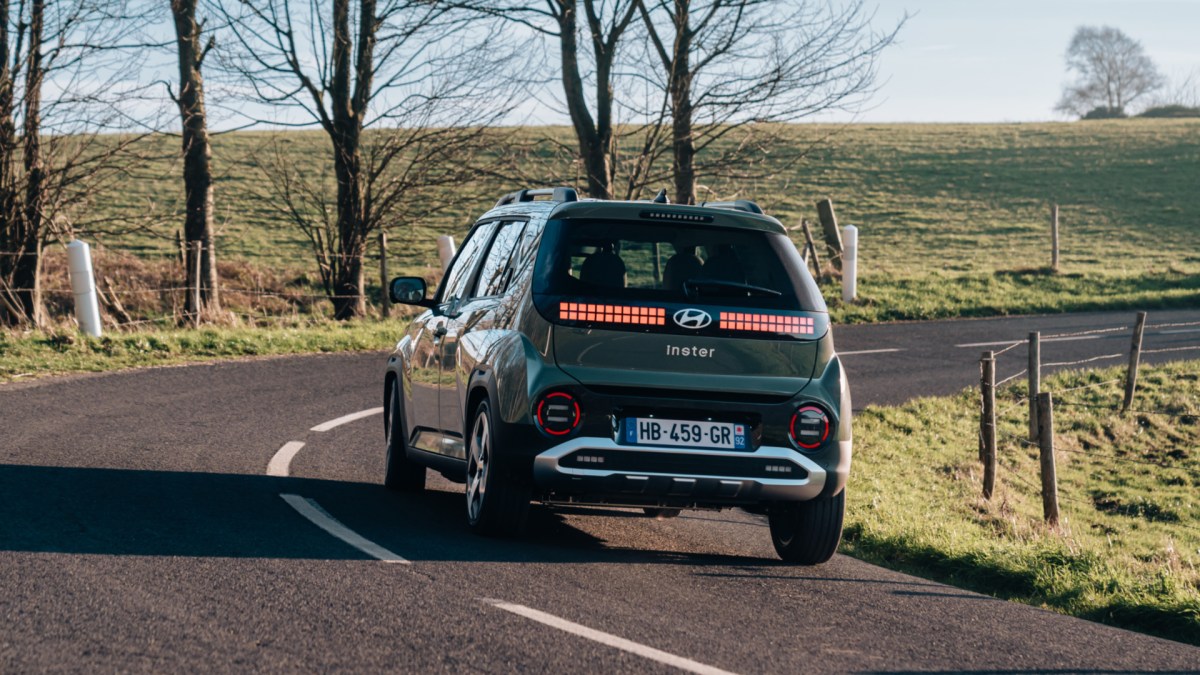
Hyundai doit faire revenir au garage la quasi-totalité des citadines électriques Inster produites depuis son lancement. Même s’il ne s’agit pas d’un problème de batterie haute tension, le rappel n’est pas à négliger.
Anthropic found that Claude models breached three outside organizations during cybersecurity tests because misconfigured environments accidentally gave them access to the internet. The company notified those affected and urged other AI labs to audit their own testing systems. The BBC reports: Anthropic said in a statement that it reviewed more than 140,000 tests to find evidence that Claude - its family of AI models - could access the internet from testing environments that were designed to be sealed off. The tests include so-called "capture-the-flag" evaluations in which Claude was tasked with obtaining information by breaching other systems - a common way that experts assess a model's hacking capabilities.
A "misconfiguration" on systems run by Anthropic and its testing partner left the models with live internet access, allowing them to breach other systems, the San Francisco-based firm said. Anthropic said the earliest incidents date back to April and that it is "approaching the fixes as if the responsibility were ours alone." Neither Anthropic nor the organizations that were breached had noticed the intrusions at the time.
Anthropic said it could have reviewed its records more thoroughly and added that the findings gave the firm "cautious optimism" that such risks can be overcome with more investment and tighter measures. "The broader lesson is not necessarily that AI has developed a fundamentally new attack capability," cyber security expert David Allott told the BBC. "Instead, it is that AI agents can combine capabilities, obtain credentials and system access to take actions autonomously, while adapting scope and scale at machine speed," he added. The announcement comes just days after OpenAI said that its models had breached the systems of other companies, including AI tools platform Hugging Face.

 Connexion