Connexion
The latest financial results from Nikon, Fujifilm, Tamron, GoPro, Kodak, and Panasonic

Here is a recap of the latest financial results from Nikon, Fujifilm, Tamron, GoPro, Kodak, and Panasonic:

Nikon’s Q1 results (April-June 2026, fiscal year ending March 2027) showed overall revenue rising to ¥164.1 billion (+¥6.0 billion YoY), but the Imaging Products business declined sharply. Imaging revenue fell 8.8% to ¥72.9 billion from ¥80.0 billion, while operating profit dropped 27.5% to ¥8.1 billion from ¥11.1 billion, with the margin slipping from 14.0% to 11.1%. Unit sales of interchangeable-lens digital cameras fell to 210,000 (from 270,000) and lenses to 310,000 (from 370,000), driven primarily by a contraction in demand in China; higher memory prices further pressured profitability despite foreign-exchange gains and U.S. tariff refunds. Nikon responded by cutting its full-year Imaging forecasts (revenue down ¥13 billion and operating profit down ¥3 billion versus prior guidance).

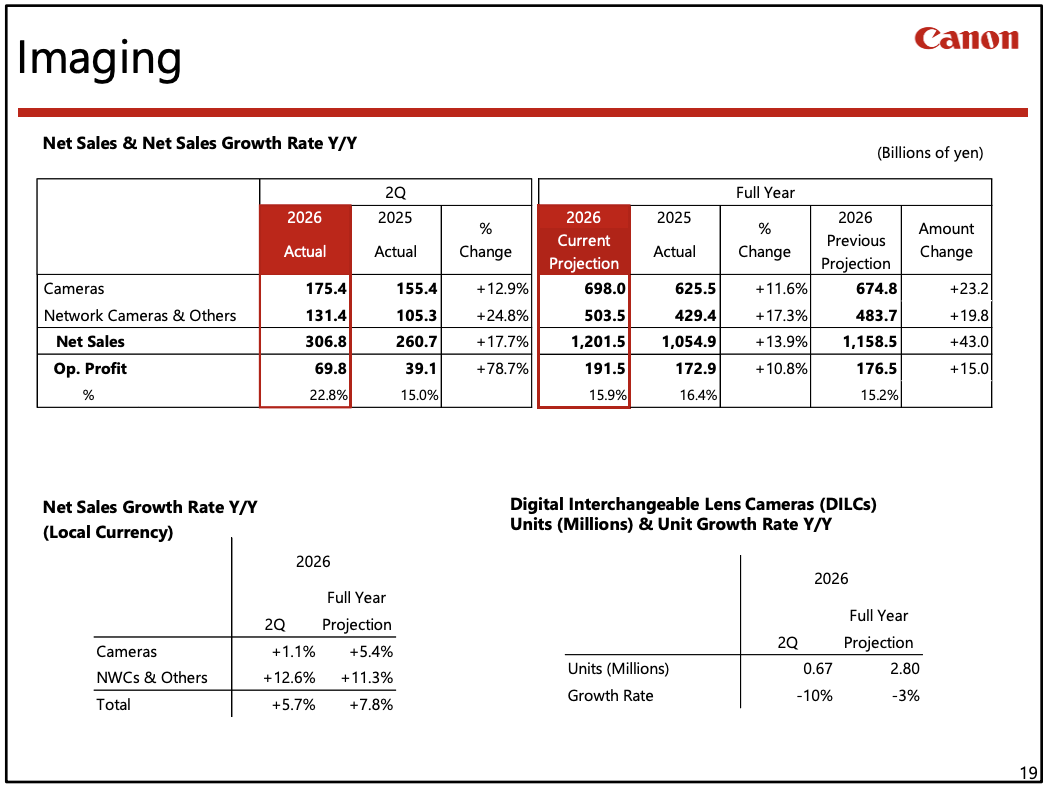
The Imaging segment (cameras and Instant systems) performed well, with revenue rising 16.2% to ¥168.8 billion and operating income up 3.9% to ¥43.4 billion. Consumer Imaging led the growth on strong Instax demand, especially mid- to high-end models such as the instax mini Evo and instax WIDE 400, the successful April 2026 launch of the entry-level instax mini 13, and expanded film production capacity while Professional Imaging (X-series and GFX digital cameras) also posted higher revenue, driven by solid sales of the X-T30 III and X-E5 plus continued strong demand for the long-selling X100VI, particularly in Asia.

Tamron – four new lens releases expected this year:
Tamron’s 2nd Quarter/1st Half FY2026 results showed overall H1 net sales of ¥43.281 billion (+3.8% YoY) but operating income of ¥7.689 billion (-16.5% YoY), with Q2 sales up 11.4% and operating income down 14.5%; the Photographic Products (camera/lens) segment was the main drag, posting H1 sales of ¥27.534 billion (roughly -8-10% YoY) and operating income of ¥5.943 billion (-29.3% YoY), while Q2 segment sales dipped 1.1% and operating income fell 22.7%.

GoPro – camera sales down 38%, cash down to $27 million:
GoPro reported Q2 2026 results with revenue of $105 million, down 31% year-over-year, driven by weaker hardware sales as sell-through fell to about 291,000 camera units (down 38% YoY). Subscription and service revenue rose 11% to $29 million (28% of total revenue, up from 17%), including $2 million from an AI content licensing program, while the subscriber attach rate hit a record 69% (vs. 54%). Retail channel revenue was $58 million (56% of total, down 48% YoY), while GoPro.com revenue reached $47 million (44%, up 13% YoY). The $19 million tariff refund benefit was partially offset by a $15 million component-commitment charge; the company posted a net loss of $51 million ($0.30 per share) versus a $16 million loss a year earlier and adjusted EBITDA of -$29.5 million.

Eastman Kodak reported strong second-quarter 2026 results, with consolidated revenue rising 18% year-over-year to $311 million from $263 million, driven by Print segment revenue of $195 million (+10%) and Advanced Materials & Chemicals revenue of $105 million (+40%). Gross profit surged 61% to $82 million (margin expanding to 26% from 19%), Operational EBITDA climbed to $36 million from $9 million, and GAAP net income reached $17 million versus a $26 million loss in the prior-year period, marking the company’s fourth consecutive quarter of year-over-year improvement in revenue, gross profit, and Operational EBITDA. Cash ended the quarter at $290 million (down $47 million from year-end 2025, largely due to Term Loan repayments partially offset by pension asset redemptions), as CEO Jim Continenza highlighted “stability and growth” and Kodak’s shift into a growth-focused phase with improved operational and financial leverage.

Panasonic Holdings’ Q1 FY2027 results delivered the company’s strongest first-quarter operating profit in 41 years, but the camera business played no meaningful role in the surge. Group sales rose 6.4% year-over-year to ¥2,018.9 billion, while operating profit more than doubled to ¥182.5 billion (adjusted operating profit ¥186.4 billion) and net profit attributable to shareholders reached ¥188.9 billion, driven almost entirely by AI-infrastructure demand, especially data-center energy storage systems (nearly doubled) and related electronic components such as conductive polymer capacitors. Full-year guidance was raised to ¥7,800 billion in sales and a record ¥590 billion in operating profit (the highest annual figure in 42 years). In contrast, the LUMIX camera business sits inside the Imaging Solution Business Division, which is buried within the AVC unit of the Smart Life segment (alongside TVs and communication networks). Smart Life was the only major segment to post lower sales (¥311.1 billion, down roughly 2–8% depending on currency adjustment), with AVC itself falling nearly 14% to ¥73.1 billion from ¥84.8 billion a year earlier due to weaker demand in Europe and China; segment profit improved modestly only because of rationalization and restructuring, not volume or product strength. Rising memory prices were explicitly cited as a headwind that further weighed on the AVC/camera-adjacent business, underscoring that Panasonic’s record quarter had essentially nothing to do with cameras.

The post The latest financial results from Nikon, Fujifilm, Tamron, GoPro, Kodak, and Panasonic appeared first on Photo Rumors.