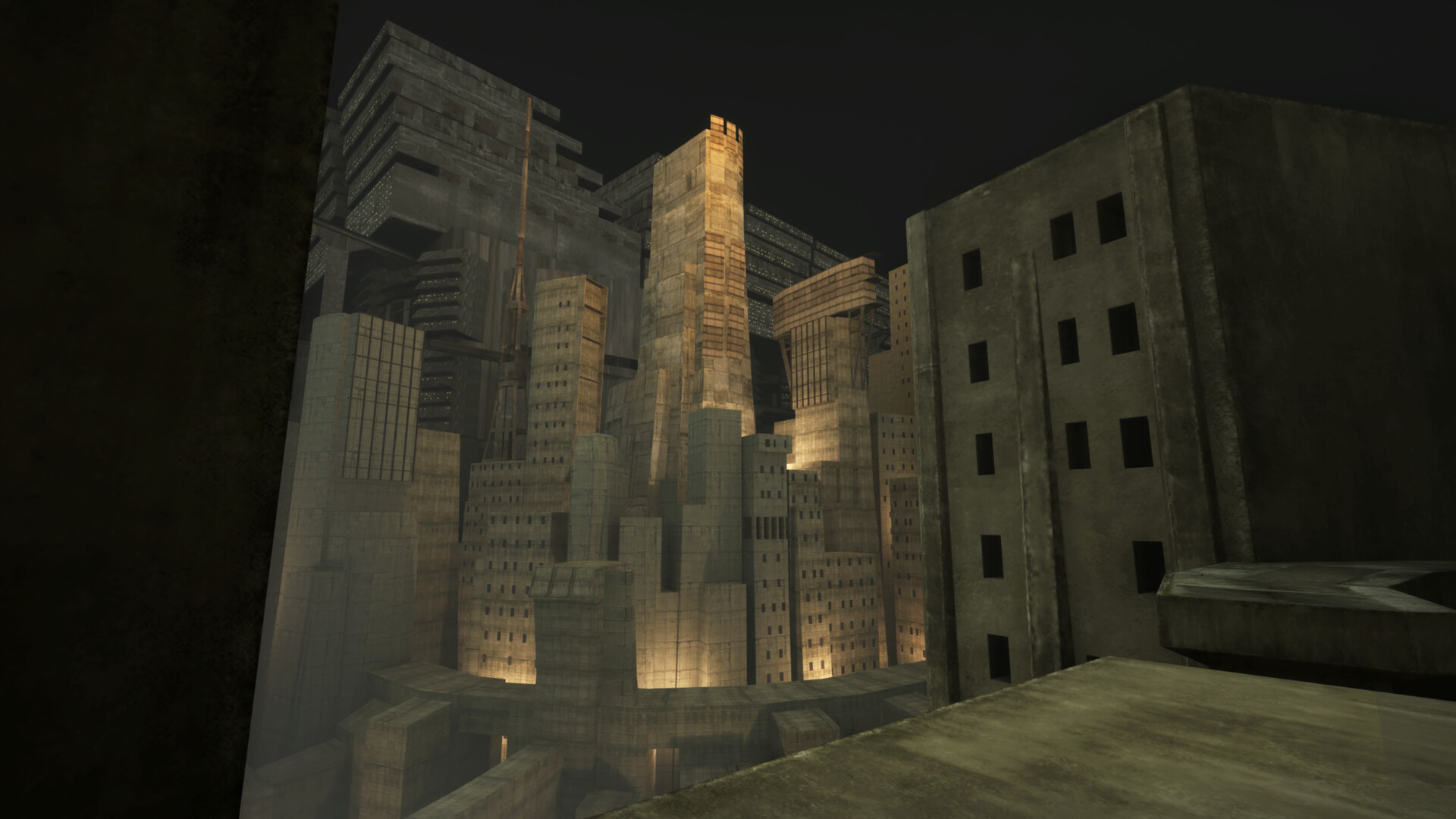
VHOLUME, c’est ce nouveau jeu centré sur le parkour qui nous plonge dans une ambiance dystopique marquée par l’architecture brutaliste de ses environnements, le tout concocté par l’un des devs de BABBDI ou encore Straftat, qui nous avaient bien plu. Eh bien, ça vient de sortir, et surprise, c’est top ! Après vous l’avoir présenté l’an dernier, on avait pu jeter un oeil à la démo lors du Steam Néo Fest, et nos impressions avaient été, dès lors, très positives. À présent, le bon pressentiment se confirme avec les excellents premiers retours des joueurs, qui vantent notamment la satisfaction du gameplay et l’atmosphère unique du soft.
Les développeurs ont donc marqué cette release par un trailer final, et annoncé dans la foulée par un billet de blog Steam que le jeu prenait en charge les niveaux créés par la communauté dès le lancement. Avec son mode multi et les mappeurs qui commencent déjà à faire des merveilles sur le titre, l’aspect communautaire de ce dernier laisse présager de belles choses. VHOLUME, en promo à -10 % jusqu’au 28 août, coûte actuellement un peu plus de 6 €, et la démo est toujours disponible pour ceux qui hésitent encore. Sinon, vous pouvez toujours mettre le jeu dans votre wishlist via sa page Steam s’il attise votre curiosité.
Ne passons pas par 4 chemins et mettons les pieds dans le plat : Ce trailer existe pour nous rappeler que NEO BERLIN 2087 existe, et qu’il sortira suffisamment tôt pour que les enfants de nos enfants l’aient un jour entre les mains. Si vous avez vu les teasers précédents du jeu, considérez que celui-ci ne vous apprendra rien de plus. On y voit la même chose qu’avant : une métropole cyberpunk somme toute assez classique, mais possédant un rendu graphique – il faut l’admettre – tout à fait remarquable (coucou Unreal Engine 5), théâtre d’un gameplay mixant gunfights, infiltration et exploration. Et si les animations sont parfois plus rigides qu’une baguette de la semaine passée, le ton énigmatique de la narration rend assez curieux d’en découvrir plus sur l’univers du soft.
Rappelons que ces images appartiennent au premier titre d’un studio naissant (nouvellement édité par ByteRocker’s Games), qui plus est, toujours loin du terme de son développement. Il est donc tout à fait logique, à ce stade, de noter quelques imperfections, notamment visuelles. Cela dit, il faut admettre que plus de 3 ans après le premier reveal du projet, on commence à se lasser de voir les mêmes images encore et encore… Et, alors que l’on était tout à fait en droit de s’attendre à une date de sortie prochainement, voilà que le vague « 2028 » vient éteindre toute lueur de hype dans nos yeux de gamers frustrés. Enfin, espérons que d’ici-là, les devs auront retravaillé les ralentis, disons… perfectibles, que l’on peut voir sur ces séquences de gameplay. Entre temps, n’hésitez pas à ajouter NEO BERLIN 2087 à votre wishlist Steam si le jeu vous intrigue.
The RocXZoom pairs a 50x hybrid zoom with an AI tracking system that recognizes more than 300 bird species. It’s boasts the kind of reach that used to demand a telephoto lens and a tripod, all in a body that fits in a jacket pocket.
Farseer
Long-range photography has always come with a bit of a packing problem. Getting close to a hawk in the distance or a bear traversing a faraway hillside traditionally means carrying a full-frame body, a telephoto lens the size of your forearm, a tripod to steady it all, and the patience to keep a subject in frame by hand. The Farseer RocXZoom reimagines that kit with a camera that only weighs about 400 grams.
The RocXZoom combines 20x optical zoom with 50x hybrid zoom for a 40 to 2000mm equivalent range, which is the kind of telephoto territory that’s normally reserved for dedicated lens setups. The difference is that this one delivers it without the large traditional lens-and-tripod rig, and in a package that’s light enough to carry on a trail all day.
Automatically follow the action
Farseer
At the equivalent of 2000mm, a subject can exit the frame with a flick of a wing, which is where the camera’s Physical AI system comes in. The intelligent vision system is designed to identify subjects, track their movement, and keep them framed while zooming, with a powered pan-and-tilt system that physically follows the action. It’s built for the subjects that punish slow hands like birds, wildlife, athletes, and other fast-moving targets.
For birders specifically, there’s a learning layer built in. The AI recognition system can identify more than 300 bird species in real time, so the camera helps users understand what they’ve captured, not just capture it.
Steady at the extremes
Farseer
Handheld shooting at extreme telephoto lengths usually produces shake. The RocXZoom helps remedy that with dual stabilization, pairing a gimbal with electronic image stabilization to help keep long-range photos and video steady without a tripod. A dedicated mobile app rounds out the control capabilities by letting users operate the camera remotely, adjust framing, and manage shooting from a connected device.
Ready for anything
Farseer
A camera geared toward capturing wildlife and sports action has to thrive where those subjects live. The RocXZoom’s aluminum body carries an IP54 rating and is designed for demanding outdoor environments, from dusty trails to unpredictable weather on the sidelines.
The RocXZoom has an MSRP of $799, but early backers can get it for $449 on Kickstarter. For anyone who has left the long lens at home one too many times, its lightweight design makes a compelling case for always bringing it along.
And, for those who’d like to pair the RocXZoom with another camera, there’s the RocXZoom pro package, a gimbal bundle that allows you to mount the RocXZoom onto your existing camera via a hot shoe mount. This improves tracking stability, enables object tracking, and supports APP control. The RocXZoom Pro has an MSRP of $2,099, but early backers can get it for $849 on Kickstarter.
Community member Johan O E, known as Ocoloy on the forums, prefers New Zealand as his base for minimalist black-and-white photography.
Johan O E
Meet Johan O E
Home base: Sweden
Community member Johan O E, known as Ocoloy in the forums, has a passion for minimalist black-and-white photography. Many of his photos are portraits of ordinary people going about their daily lives, each with a unique angle that tells a particular part of their story.
“Since as long as I can remember, I´ve been in love with photography. From the album covers I saw as a child in the 80s to the surf and music magazines in the 90s. I´ve been photographing for nearly 30 years, but the last 15 years have been more intense. My dad is a photographer as well, but he has never influenced me in any form when it comes to photography. I was never allowed to use his cameras.”
Our ‘What’s in your bag?’ community spotlight series features readers sharing their favorite gear and photography, including from past DPReview collaborators. See below for what Johan has to share.
Fujifilm X-E1 | Fujifilm XF 18mm F2 R @ 18mm | F8 | 1/500 sec | ISO 320 Johan O E
“I shoot whatever inspires me. Preferably, there needs to be a person in the shot, but some of my best shots are free from people. I tend to go more for a minimalistic black-and-white vibe when I’m out and about. Been photographing all over the world. New Zealand has been my favorite by far. I also love portraits and candid moments.
I am in my third year with one camera, one lens, and a one-year project, OCOLOY. This time it is the Nikon ZF and the Voigtlander 40mm F1.2, and I only shoot in black and white. Accepts 36 images in color. I made a list of 36 things I love, which I will later print in color A4 and save.”
I like rough, wild and different environments. From stormy seas to deep jungles or the backstreets of towns in Europe.”
Preferred camera bag: “I carry with me the simplest Caselogic bag available on the market. It has just enough space for the camera and barely anything more. I have two different camera bag setups, depending on my mood. My main bag is just my camera, an extra battery, a CPL and a mist filter. If I am out working, I also bring my tablet for editing and an Instax printer for special moments to give away prints.”
Must-have accessories: “I always bring music. I make playlists for different moods and photowalks. In fact, I am recording a song about photography at the moment in my recording studio. I got a crystal from a chandelier and sometimes put it in front of my lens to create different images. I try to carry as little as possible when I am out and about.”
Why is New Zealand on your visit list?
“In the backstreets of England, I came across a lone book reader.”
Fujifilm X-T2 | Fujifilm XF 23mm F2 R WR @ 23mm | F4 | 1/35 sec | ISO 200
Johan O E
“I have been on the road for the past 26 years, spending many years in New Zealand, Spain and Sweden. I’ve seen remote places in Asia, done a total of 12 months of van trips throughout Europe, spent 5 months in Sri Lanka, and taken surf trips to Hawaii and the Lofoten Islands. My most memorable photography trip was probably the COVID year, when I was 6 months into my time in New Zealand. I made a bucket list and got most of the shots, which later on boosted my photography career.”
Any strategies you’d pass along to your fellow photographers?
“This gentleman allowed me a quick photo as he stared across the street.”
Fujifilm X-S10 | Fujifilm XF 35mm F1.4 R @ 35mm | F2 | 1/125 sec | ISO 400
Johan O E
“It builds confidence to capture something unique and what I have not seen before. I use my eyes rather than predefined or scripted techniques. I almost always shoot in M mode, mostly with manual lenses, to create exactly what I want. I want a photograph to create emotions and make people look again.”
Photograph what you love and do not photograph purely for likes. Also, a good professional photography lesson will give you way more than any new camera or lens.”
Do you peer into Johan’s photos and see another person’s unique life looking back at you? He enjoyed participating in this spotlight article and would love to hear what you think of his photography in the comments below.
Editor’s note: This article continues a series, ‘What’s in your bag?’, highlighting DPReview community members, their photography and the gear they depend on. Would you like your photography to be featured in a future installment? Tell us a bit about yourself by filling out this form.
About the Author: Mathew Anderson is a proud Community Manager for the technology industry and a past visitor to DPReview.com for all his camera needs. He is currently the lead of DPReview’s community and primary communication link between the community and DPReview’s team.
Want to stay up to date on the latest product news and releases? Add DPReview as a preferred source to ensure our independent journalism makes it to the top of your Google search results.
Google’s Pixel 11 phones offer two very different angles on computational photography: let AI find the moment, or define your look before you shoot. Here’s how each performed in real-world testing.
Google’s new Pixel 11 smartphones include two headline camera features that represent different approaches to computational photography. Magic Capture aims to take the stress out of capturing the perfect moment by letting AI identify the decisive moment for you, while Camera Looks gives you greater control over your creative output by letting you define a visual style before you ever press the shutter button.
We’ve been testing both features on a Pixel 11 Pro XL to see how they work in practice, and whether the results hold up. The short answer is yes, but not without trade-offs.
What Magic Capture actually does and what the sample photos reveal
Magic Capture replaces the act of pressing a shutter button at the right moment. You roll video instead of shooting stills, and Google’s AI analyzes the footage to identify what it believes are the most compelling frames, then turns them into photos. The feature goes beyond simply extracting a frame from video and saving it as a still image: according to Google, the system analyzes roughly 400 frames in real time, combining on-device processing with Gemini AI technology.
Magic Capture appears as a button to the left of the camera button in the Pixel’s camera app.
After stopping a recording, you can see the phone’s initial frame selections quickly, but they look flat and unfinished. Once the Gemini AI processing completes, which took around a minute or so in our testing for a 15-second clip, the selected frames become noticeably improved, popping with more detail, and with HDR scenes in particular looking significantly better. The final output is a 12MP still image.
The sample images below come from a 14-second Magic Capture clip of a surfer riding a standing wave in a river. Google’s AI did a pretty good job of selecting frames that captured the highlights.
Photo created by Magic Capture.Photo created by Magic Capture.Photo created by Magic Capture.
Image quality exceeds what you would typically expect from simply extracting a frame from a 4K video shot on a smartphone; it’s crisper, with better colors, and displays in HDR (when viewed on an HDR display). It’s not quite up to the quality I’m used to seeing from a standard still photo shot on a modern 12MP smartphone, but it gets the job done, particularly if it’s mostly going to be viewed on other mobile devices.
For the best results, Google recommends enabling Video Boost before using Magic Capture, which ensures the underlying footage is captured in 10-bit 4K. That setting is worth locating before you go out to shoot, not after. Processing time is manageable for a single clip, but if you shoot several Magic Capture sequences back-to-back, the phone queues them for analysis, which can take a few minutes to complete.
For the best results, Google recommends enabling Video Boost before using Magic Capture, which ensures the underlying footage is captured in 10-bit 4K.
One thing we haven’t fully assessed: how consistently Google’s AI selects the frame a photographer would have chosen. The feature’s premise, that the AI identifies the peak moment better than you can, is a pretty strong claim. Whether it matches a photographer’s instincts for capturing the decisive moment would require more testing to answer.
How Camera Looks works and what the photos look like
Camera Looks gives the Pixel 11 camera a selection of color and tone styles you can apply before you shoot. Google says the goal is to produce images that feel less processed and more like a deliberate photographic choice. The system is built around two layers that work together: base styles and creative presets.
In addition to Original (Google’s standard photo processing pipeline), there are three alternative base styles: Natural, Shadows and Vanilla, which sit at the top of the processing pipeline. They aren’t filters. They change how the camera collects and processes light before an image is generated, affecting how aggressively HDR merges multiple frames, how dark shadows are allowed to stay and how edge sharpening is handled. Think of them as choosing the core processing pipeline the camera runs on.
The Pixel 11 series includes four base looks: Original, Natural, Shadows and Vanilla. They can be combined with creative styles to create a variety of looks.
On top of those base styles, you can apply one of six creative presets: Editorial, Velvet, Classic, Digi, Black Tie and Minimal. These apply LUTs meant to emulate film chemistry, specific eras of digital photography or stylized monochrome profiles. The combination you pick matters: applying Velvet on top of the Original base produces a different output than Velvet layered over Vanilla.
The three alternative base styles can be set as your default shooting mode and can be customized. The six creative presets live in a separate carousel, and the interface can take a moment to get used to. The distinction between the two layers isn’t obvious at first glance, and understanding which choices you can adjust versus those you can simply apply requires some exploration. Once you’re oriented, the workflow makes sense, though.
Original base style.Shadows base style.Vanilla base style.Original base style with Editorial preset.Original base style with Velvet preset.Original base style with Classic preset.Original base style with Digi preset.Original base style with Black Tie preset.
Camera Looks fits a trend that’s already well established among both dedicated cameras and smartphones, where manufacturers offer in-camera film simulations, LUTs or custom picture profiles that let photographers customize their own looks. Google is applying the same logic to the Pixel 11 series, which means photographers who already think in terms of a preferred style will find the concept familiar.
Who are these features for?
Magic Capture and Camera Looks take different philosophical approaches to computational photography. Magic Capture removes a decision – when to fire the shutter – and replaces it with an AI judgment call. Camera Looks adds a decision, letting you define a visual style before you shoot rather than correcting for it afterward. One reduces your control while the other expands it.
Magic Capture removes a decision… Camera Looks adds a decision.
Magic Capture makes the most sense for scenarios where keeping up with fast, unpredictable action is genuinely hard: kids, sports, pets, or anything where the peak moment is difficult to catch manually. Or, as Google pitches, it lets you “live in the moment” by just rolling video and not stressing about capturing the decisive moment. If you really care about which exact frame gets selected, though, you’re trading that choice for convenience. Google’s AI selections in our sample photos were solid, but the feature works best when you’re willing to accept its judgment.
Camera Looks, by contrast, gives photographers something to bite into and exert creative control. Setting a default look before you shoot is a reasonable workflow for anyone who knows the aesthetic they want and doesn’t want to recreate it in editing every time.
Both features reflect where Google is taking the Pixel camera: toward a model where AI handles more of the technical and even creative work. Whether that’s a net gain depends on how much of that work you wanted to do yourself.
About the Author: Dale Baskin is a professional photographer, writer, and filmmaker based in the Pacific Northwest. He is the Managing Editor of DPReview.com.
Want to stay up to date on the latest product news and releases? Add DPReview as a preferred source to ensure our independent journalism makes it to the top of your Google search results.
We celebrate World Photography Day today with a forum discussion featuring your photos showcasing diverse local landscapes.
CaseyD
We love to celebrate world events and special days as they approach. Last Friday, we asked the community what type of landscapes are near them and to share a photo with the rest of us. A key objective of the ask was to take a fresh photo only after our announcement. We wanted to see what people experience right outside their doors. It’s always fun to see the different places our community calls home.
“The journey of preserving images in time, which began with the invention of the daguerreotype, has evolved to the point where even the fleeting fury of lightning can be captured and immortalized. It bears witness to a powerful response from nature in an age when urban sprawl narrows the sky, and concrete stands in opposition to the natural world. The photograph makes visible the striking encounter between humanity’s desire to reshape nature and nature’s enduring power to remind us of its presence.” – Hicret
Here are some of the photos and comments they shared. Even our own team got in on the fun! Click each photo to see more within the forum conversation.
Vladimir Nogin
This is a local pond in Xuzhou city, China. It is full of lotus flowers and very beautiful a whole year. I love coming to this place, which is usually full of people.
Nikon Z5 with Nikkor Z 50 F1.4Vladimir Nogin
Ofer Agiv
The photo was taken with a Sony a7R4 in Greenland near the EQI Glacier.Ofer Agiv
DNZM
I grew up in the coastal west of the Netherlands, but I moved north decades ago. For the last decade and a half (give or take), I’ve been living in Leeuwarden. That’s the major city in this area, but there are tons of little, sometimes very little, villages dotting the landscape.
One of the things that always makes me feel at home and that I really associate with “Frisian landscape” is totally flat land (either with crops or with cows on it), never far from a body of water, wide skies with clouds, and wherever you look, you’ll almost always have two, three, sometimes more churches.DNZM
Slass
More than a hundred cyclists are waiting for the bridge to be lowered after a boat has passed. The picture was taken at the canals in Copenhagen, Amager.
Not exotic, but the city street lined with mature sycamore trees in the last hour of summer daylight was too good to miss taking a photo: Samsung a15 with the VWFNDR_MBL app for Android to bypass oversharpened, oversaturated, overprocessed photography. Low light, but leaning against a tree to steady the shutter release.gpwitteveen
CaseyD
A shot of Philadelphia from the Heritage Park Boardwalk in Pennsauken, NJ.CaseyD
keepreal
Near the entrance to Zion National Park, Utah. Taken at sunset in very weak light.
Nikon D300 Sigma 12-24mm F4.5-5.6 DG HSM at 12mm.keepreal
Joe Explore Photography
Here is a sunset at low tide at Town Beach in Mackay in Central Qld, Australia, that I took yesterday. I was out in the low-tide zone photographing Eastern Curlews and Masked Lapwings when this composition revealed itself.
Canon R6II with RF 24-105mm F4 lens.Joe Explores Photography
Abby Ferguson
I’m barely squeezing this in since I admittedly forgot to get a photo during my very busy weekend. Because I didn’t have much time today, I just walked down to the creek that runs through our neighborhood and took a photo from the bridge that runs over it. It was midday, during a heat bubble in Florida in August, so while this may look refreshing and nice, I can assure you, it was not. Also, don’t venture down there unless you want to be engulfed in mosquitoes. The light is far from ideal, either, but sometimes you have to embrace bad conditions and just take the photo.
I used the Panasonic S1RII for this shot, with the Lumis S Pro 16-35mm F4, because that’s what I had charged and sitting on my desk when I needed to run out the door. Basically, today was all about convenience just so that I could participate in this challenge. Maybe next World Photography Day, I’ll remember a bit earlier and have time to make something more exciting.Abby Ferguson
tranceliner
My photo captures the Sacred and the Profane: the historic Addolorata Church on Tal-Ħorr alongside the Three Towers directly across the road. Taken just a 10-minute walk from my home, this view illustrates the profound transformation of the Maltese landscape over the last two decades. Shot on a Panasonic FZ1000 and processed using DxO and the Nik Collection, as monochrome suits the scene best.
Federation Square, Melbourne, on a Saturday afternoon in winter. A popular place to meet friends, enjoy the unseasonally lovely weather and watch the passing parade.Gayle159626
leunam
Ortenberg Castle through the grapes, the city of Offenburg in the distance. My favorite spot for sunset photos (30 minutes of pedaling). Captured 90 minutes before the deadline with a Sony A7 + Pergear 35mm 1.4 at f8leunam
There are so many other photos we couldn’t fit in this article that are shared in the forums. While not all met the requirements for inclusion in this article, they all deserve praise. Thanks to everyone who took the time to step outside and capture the unique landscapes of your region.
Feel free to share your local landscapes to continue to celebrate the day with us. We can’t wait to see more!
About the Author: Mathew Anderson is a proud Community Manager for the technology industry and a past visitor to DPReview.com for all his camera needs. He is currently the lead of DPReview’s community and primary communication link between the community and DPReview’s team.
Want to stay up to date on the latest product news and releases? Add DPReview as a preferred source to ensure our independent journalism makes it to the top of your Google search results.
User-requested features being developed, now this fundamental detail is fixed
Richard Butler
It’s been over a month since we launched the new DPReview.com website, and we wanted to give you an update.
We realize that a lot of the work we’ve been doing hasn’t been especially public-facing, so it hasn’t necessarily been obvious that this really is a Beta: we are listening to feedback and we are continuing to improve the site.
As well as fixing some glitches around user logins, we’ve been doing a lot of work to ensure that the site always delivers completely untouched, out-of-camera JPEGs, when you click through or download an image. This isn’t a requirement that the CMS software we’re using is usually expected to maintain, with the consistency that we need. So it’s meant a lot of work behind the scenes to ensure that we can live up to the high standards that we demand and that you can expect.
OOC images and HDR support
As a result of this work, we can now be confident that “Ultra HDR JPEG” files: JPEGs with HDR gain maps embedded, can be viewed correctly when you click through, but also when they appear within articles, if you have a compatible screen and browser.
HDR imagery is only likely to become more accessible and more prevalent in the coming years, so being able to correctly represent these files was important to us: both so that we can show the progress as it’s made and because it ensures we’re delivering all images exactly as they came out of the camera.
This may seem esoteric but it’s fundamental to the way our reviews are conducted: we provide unedited files precisely so you can draw your own conclusions, rather than just take our words for it.
Light mode and improved camera comparisons
With this done, we’re continuing to work on projects that you’ve been requesting and things that will be more obviously visible to readers of the site and members of the community. These include a “light” version of the site for editorial content, for those people who don’t like the site’s original white-on-black appearance. We’re also working on a more advanced camera comparison tool that makes more extensive use of our camera specs database.
Neither is ready yet, but they’re just two of the more obvious features that we’ve heard the demand for, and are planning to deliver. In the meantime, please bear with us and keep letting us know how we can make the site even better.
About the Author: Richard graduated as a scientist but had a lot more fun writing and shooting for his university magazine. A number of years spent variously as a reporter, writer and editor on science and engineering titles combined his knowledge of science with his interest in images and words. But it was spotting the connections between emission spectra, white balance and all the nonsense he’d taught himself playing around in Photoshop that helped kindle an interest in digital photography. Searching for a camera led to him discovering DPReview and Richard was recruited by Phil Askey in 2007. He’s been combining his love of photography, communication and attention to detail (pedantry?) ever since.
He has unusually strong opinions about lenses for the APS-C format.
Want to stay up to date on the latest product news and releases? Add DPReview as a preferred source to ensure our independent journalism makes it to the top of your Google search results.
The NEEWER CM26 MAX provides creators with a portable, affordable solution for capturing better voice audio with less setup and more control.
NEEWER
For filmmakers and content creators, a lavalier microphone is one of the simplest ways to improve production quality: it keeps dialogue close, clear and consistent while allowing subjects to move naturally on camera. The NEEWER CM26 MAX is an affordable, compact USB-C wireless lavalier microphone kit designed for mobile, desktop, indoor and outdoor recording setups. Its advanced features include AI noise reduction, a high sampling rate and low latency, plus a built-in color display, convenient app control, generous range and long battery life.
Studio-quality audio on location and on set
NEEWER
The CM26 MAX’s built-in AI chip and noise-reduction algorithm separate speech from background sound using two selectable modes: A1 for indoor spaces, which reduces noise by up to -15dB, and A2 for outdoor environments such as traffic, wind and street noise, which reduces noise by up to -40dB. This makes the kit practical for recording dialogue in rooms, on sidewalks, at events or while moving between locations. For outdoor use, the included windshield helps reduce wind noise, while one-tap mute helps protect privacy during breaks.
Advanced features and hassle-free monitoring
NEEWER
With a 48kHz/24-bit sampling rate, a 20Hz-20kHz frequency response and a high 88dB signal-to-noise ratio, the CM26 MAX captures natural, detailed audio for everything from talking-head videos to sit-down interviews, livestreams and podcasts. Flexible low-cut modes at 75Hz, 150Hz or “off” help reduce rumble, while adaptive gain control and limiter support manage sudden level changes and clipping. The output volume is adjustable from -6dB to +6dB, with the option for mono, stereo or safety track recording. Conveniently, sound can be monitored in real time through the 3.5mm TRS output, so any audio issues can be caught before a take is lost.
Pro-grade connectivity and easy app control
NEEWER
The NEEWER CM26 MAX supports fast setup across mobile and desktop workflows. Its USB-C receiver connects directly to iPhone models with a USB-C port and Android phones, as well as tablets, PCs, computers and laptops, giving creators a stable plug-and-play connection for recording, livestreaming, video calls and content creation. (For iPhone 14 and earlier models, full compatibility requires an MFi-certified Lightning to USB-C OTG audio cable, purchased separately.)
The free NEEWER MIC App for iOS and Android unlocks even more options. In Control Mode, users can adjust transmitter and receiver settings, enable AI noise cancellation and choose from three vocal enhancement levels for clearer, more balanced sound. In Recorder Mode, the app works as a standalone voice recorder with AI noise processing available even when the microphone is not connected.
Performance that goes the distance
NEEWER
The CM26 MAX kit offers up to 50 hours of total runtime, with a charging case that provides about 1–1.2 full recharges for the transmitters and receiver. That makes it practical for travel, events, interviews and full shooting days. The 2.4GHz system reaches up to 394 ft (120 m) line of sight in open areas, or up to 98 ft (30 m) when obstacles are present. Each transmitter weighs just 0.8 oz (24 g), while the receiver weighs 0.7oz (20 g), keeping the system light enough for clothing or camera rigs
Whether recording interviews, tutorials, vlogs, livestreams or location footage, a compact wireless lavalier system helps reduce reliance on built-in microphones and makes clean voice capture easier in real-world environments. The NEEWER CM26 MAX provides creators with a portable, affordable solution for capturing better voice audio with less setup and more control. Its advanced noise reduction, monitoring and connectivity options provide confidence in the studio and the field, while its generous long battery life and extended range make it a strong option for everyday content creation and longer shooting days.
A recent podcast interview covers street photographer Richard Bram’s background, his philosophy on chance and intention and the specific moment he believes transforms a captured scene into something that resonates.
Eyeshot
American street photographer Richard Bram has spent more than four decades finding small gestures and stories in public spaces. In a recent episode of the Eyeshot 50mm podcast, Bram reflects on his self-taught route into photography and his creative philosophy, resulting in a wide-ranging conversation that offers interesting insights and practical advice for anyone trying to improve their photography, particularly on the street.
One of the things that stood out to me most was Bram’s view on what takes an image from reality to fiction and how important context is. “I think when you click a shutter, it goes from reality to fiction just automatically,” he says. “Reality is four dimensions because there’s time. A rectangle is three dimensions, so it’s frozen, it’s pulled out, it’s completely out of context.”
I also found it interesting that he points photographers toward painting as a resource for understanding light. Studying how painters from different eras constructed light and shadow, he suggests, can sharpen your ability to read and use available light on the street in ways that photography tutorials rarely cover.
The conversation is aimed at street photographers, but the ideas apply to anyone interested in photography, no matter what the genre. Whether you shoot portraits, landscapes or anything in between, Bram’s perspectives are useful challenges if you’re looking to improve your photography. There are many more fascinating thoughts throughout the conversation that I didn’t cover here, making it well worth listening to.
About the Author: Abby Ferguson holds an MFA in photography and blends a fine-art background with extensive editorial and commercial experience. She built and led an in-house imaging program for a large vacation rental company and has served as an associate editor at Popular Photography. She also teaches at a local community college and serves on its Photographic Technology Program Advisory Board, sharing her knowledge and enthusiasm for the medium.
Want to stay up to date on the latest product news and releases? Add DPReview as a preferred source to ensure our independent journalism makes it to the top of your Google search results.
The Hidden Worlds category makes its debut this year, spotlighting the ocean’s smallest inhabitants.
Andrea Michelutti
The finalists for Ocean Photographer of the Year 2026 have been announced, featuring images that highlight the complexity and diversity of the world’s oceans. Presented by Oceanographic and Blancpain, the contest is now in its seventh year and showcases work across seven categories.
What sets this year’s iteration apart is a new category: Ocean Unseen: Hidden Worlds, which is dedicated to the ocean’s smallest inhabitants. Other categories include Adventure, Wildlife, Fine Art, Conservation Impact, Conservation Hope and Human Connection. The 2026 shortlist is among the most geographically and thematically varied the competition has fielded.
As the pressures on our ocean grow, so does the importance of the artists who bear witness to them.
Will Harrison, Ocean Photographer of the Year founder and director
Will Harrison, the competition’s founder and director, said: “These photographs don’t just capture what’s beneath the surface; they surface the stories our planet most needs us to hear. As the pressures on our ocean grow, so does the importance of the artists who bear witness to them. This year’s finalists have produced work of extraordinary depth and courage, and we’re proud that Ocean Photographer of the Year continues to be the platform where those stories reach the world.”
Below is a small selection of the finalists. The full set of finalists across all seven categories is available on the Ocean Photographer of the Year winners gallery. Category winners and the overall Ocean Photographer of the Year 2026 will be announced in September 2026.
Ocean Unseen: Hidden Worlds
Mitsuna Kawai
Photographer: Mitsuna Kawai
Caption: A ribbonfish rises vertically through the dark waters of Osezaki, Japan. Its long, silver body and delicate fins are adapted for life in the open ocean. This image was captured during a winter blackwater dive. Around the ribbonfish, a swarm of salps – small, jelly-like animals that feed on tiny particles in the ocean – creates a glimpse of life moving through the deep sea.
Technical details: Canon EOS R10 | Canon RF-S 18-150mm F3.5-6.3 IS STM @ 18mm | F9 | 1/160 sec | ISO 200
Ocean Unseen: Hidden Worlds
Steven Lopez
Photographer: Steven Lopez
Caption: A close view of a giant black sea bass reveals tiny parasitic copepods clustered around its eye in a Catalina Island kelp forest. Once misidentified on other hosts, these copepods are now known to have a specific relationship with this threatened fish. In the late 1970s and early 1980s, the giant black sea bass was nearly extinct in Southern California but is now recovering through protection efforts. This image highlights how even a giant predator can support a hidden community of much smaller organisms
Technical details: Not available
Wildlife
Rafael Fernandez Caballero
Photographer: Matty Smith
Caption: In the Pacific waters of Mexico, this photograph captures the aftermath of a successful orca hunt. Nearly an hour after a pod separated a humpback whale calf from its mother, the orcas resurfaced carrying their prey between them. The event reveals the cooperative hunting strategies of orcas, where multiple individuals work together to isolate and subdue large prey. What the image doesn’t show is that after the kill, other scavengers, including silky sharks, were drawn to the remains, showing how one event can influence an entire marine food web.
Technical details: Nikon Z9 | Nikon AF-S Fisheye 8-15mm F3.5-4.5E ED @ 14mm | F9 |1/320 | ISO 800
Wildlife
Yuta Shigeno
Photographer: Yuta Shigeno
Caption: This photograph captures a male cardinalfish releasing the larvae he has been brooding inside his mouth. Although this species is common in Japanese waters, the image reveals a rarely noticed stage of its life cycle. The male carries and protects the developing eggs for around a week, eating little or nothing during this period. The larvae are released over several events, with the first release containing the largest number.
Technical details: Nikon Z8 | Nikon Nikkor Z MC 105mm F2.8 VR S | F18 | 1/200 sec | ISO 500
Conservation Impact
Celia Kujala
Photographer: Celia Kujala
Caption: A California sea lion has plastic netting tightly wrapped around her neck. This is a stark reminder of the lasting impacts of marine plastic pollution. The wound had already cut deep into her skin, yet rescuing her was impossible because of her location within a crowded colony. Images like this reveal the hidden cost of discarded waste and give a face to an often-unseen crisis. The catchlight in her eye creates an intimate connection that is difficult to ignore.
Caption: A silky shark circles helplessly after taking bait from an illegal longline, its fate sealed by a steel hook and heavy line designed to prevent escape. Photographed less than 48 hours after Baja California’s seasonal shark fishing ban ended, the image reveals a hidden reality unfolding far from shore. A small group of pilot fish remains beside the shark, highlighting how the loss of one animal can ripple through an entire ecosystem.
Technical details: Not available
Conservation Hope
Francesca Page
Photographer: Francesca Page
Caption: Thousands of juvenile European lobsters are raised at the National Lobster Hatchery in Padstow, Cornwall, UK, before being released into the wild. By protecting the young lobsters during their most vulnerable stage, the Hatchery greatly improves their chances of survival. Here, these baby lobsters are being transferred into the space-efficient AquaHive system, an innovative hatchery design where each unit holds around 4,000 juveniles, safely separated across individual trays to prevent cannibalism.
Technical details: Sony a7 IV | Sony E 70-180mm F2.8 @ 111mm | F13 | 1/250 sec | ISO 400
Conservation Hope
Daniel Edmond Sullivan Jr.
Photographer: Daniel Edmond Sullivan Jr.
Caption: Thirty days after the 2023 Lahaina wildfire claimed 102 lives, thousands gathered off West Maui for a traditional Hawaiian paddle-out ceremony. Surfers and families formed a circle on the ocean, linking hands and releasing leis in memory of those lost. Photographed from above, the image captures a community transforming grief into a shared expression of love, remembrance and connection to the sea.
Caption: Volunteers, surfers, lifeguards and conservation groups work together to refloat stranded short-finned pilot whales. While many animals initially returned to the sea, the pod stranded again further along the coast, highlighting the complexity of mass strandings. The image captures compassion in action, but it also reflects how wildlife rescue continues to evolve. In the months that followed, international experts trained the local community in safer, science-based stranding response techniques, strengthening future rescue efforts.
Technical details: Canon EOS 5D IV | Canon EF 16-35mm F2.8L III USM @ 26mm | F6.3 | 1/640 sec | ISO 400
Human Connection Award: People and Planet Ocean
Qingsheng Sun
Photographer: Qingsheng Sun
Caption: Thousands of fish-farming cages stretch across the sea, connected by floating walkways and small wooden huts to form a vast floating community. Extending for kilometers, this carefully organized aquaculture network supports local livelihoods while transforming the coastal landscape.
Technical details: Not available
Adventure
Ben Thouard
Photographer: Ben Thouard
Caption: A surfer races through the barrel of Teahupoʻo, French Polynesia, photographed from beneath the wave using a slow shutter speed. Rather than freezing the action, the technique blurs the rushing water while keeping the surfer as the focal point, conveying the incredible speed inside the wave. Teahupoʻo is a busy surf spot, yet the photographer has managed to capture an isolated surfer at this iconic location.
Technical details: Canon EOS R5 | Canon EF 85mm F1.4L IS USM | F12 | 1/10 sec | ISO 50
Adventure
Daan Verhoeven
Photographer: Daan Verhoeven
Caption: Freediver Arnaud Jerald descends into Dean’s Blue Hole in the Bahamas during a successful world record attempt at the Vertical Blue competition. Photographed from more than 30 meters below, the image captures the scale of one of the world’s deepest marine sinkholes. Crystal-clear water, sunlight and drifting sand combined to create a rare view of this remarkable moment.
Technical details: Canon EOS R5 | Canon EF 11-24mm F4L USM @ 11mm | F5/6 1/250 sec | ISO 100
Fine Art
Chelsea Mayer
Photographer: Chelsea Mayer
Caption: A pod of short-beaked common dolphins swims beneath the bow of a ship off the coast of southern California. Dolphins are known to ride the pressure wave created by moving vessels, using it to travel with little effort in a behavior known as bow riding. Calm seas and exceptional water clarity reveal the dolphins’ markings, while the reflection of the white, yellow and blue paint from the National Geographic Venture creates a psychedelic, abstract image.
Technical details: Not available
Fine Art
John Kowitz
Photographer: John Kowitz
Caption: Five-spotted eagle rays glide above the sandy seabed, their dark bodies and white markings contrasting against the pale background. These rays often travel together while searching for prey, using electroreceptors to detect hidden mollusks and crustaceans beneath the sand. Photographed during a dive in search of manta rays, this formation appeared during the journey back to shore.
Technical details: Sony a1 | Sony FE 16-35mm F2.8 GM @ 16mm | F5.6 | 1/160 sec | ISO 125
About the Author: Abby Ferguson holds an MFA in photography and blends a fine-art background with extensive editorial and commercial experience. She built and led an in-house imaging program for a large vacation rental company and has served as an associate editor at Popular Photography. She also teaches at a local community college and serves on its Photographic Technology Program Advisory Board, sharing her knowledge and enthusiasm for the medium.
Want to stay up to date on the latest product news and releases? Add DPReview as a preferred source to ensure our independent journalism makes it to the top of your Google search results.
In 1884, George Eastman of Rochester, NY, helped advance photography by developing a practical, flexible roll film, building on earlier photographic processes. Rather than relying on heavy glass or metal plates, Eastman’s approach used a light-sensitive gelatin emulsion on a paper backing – an early flexible film, though not yet the transparent film we know today.
Just a few years later, in 1888, Eastman introduced the Kodak camera, helping make photography accessible to a much wider audience.
If you want to learn more about the origins of the World Photography Day, check out our article from last year’s mini-challenge.
Take a landscape photo and celebrate with us
We’ve decided to celebrate World Photography Day by taking pictures, and we’re challenging you to do the same. But this time, have the photo represent your local landscapes.
Take a new photo representing your local landscapes sometime after this announcement. Landscapes can mean anything from mountains, an urban park environment, an interesting retention pond, or even something in your backyard.
Submit your photo in a comment reply below. Tell us something about it (at least 25 words), along with what camera you used.
Photos need to be submitted by 12pm PT / 3pm ET / 7pm UTC on Monday, August 17th, to be considered for inclusion in our honorary photo album.
Please only submit 1 or 2 photos
That’s it! We’ll pick our favorites and publish them in an exclusive album on the DPReview homepage next week, along with similar photos taken by DPReview’s staff. The article will also be mentioned in an upcoming newsletter.
You can use any camera or technique, but if you manage to shoot a daguerreotype between now and then, we can pretty much guarantee your submission will be selected.
About the Author: Mathew Anderson is a proud Community Manager for the technology industry and a past visitor to DPReview.com for all his camera needs. He is currently the lead of DPReview’s community and primary communication link between the community and DPReview’s team.
Want to stay up to date on the latest product news and releases? Add DPReview as a preferred source to ensure our independent journalism makes it to the top of your Google search results.
Community member Mikael Aguirre, known as Orioto in the forums, finds the motion of excitement among the youth in Paris, France, a great opportunity for some interesting photography.
Mikael Aguirre
Meet Mikael Aguirre
Home base: Paris, France
Community member Mikael Aguirre, known as Orioto in the forums, loves hanging out among the crowds in his local area of Paris, France. The streets are where his photography comes alive. In the following chat we had with Mikael, it quickly became clear that the excitement and unpredictable nature of a crowd brings up some great opportunities for unplanned but unique photography.
“I studied cinema at university, and as I had bought a Canon EOS 550D for that filming need, I figured I would try photography one day out of curiosity. Love at first sight. I then started documenting my experiences, and soon after, fell in love with French humanist photographers and street photography. I also experiment a lot with video too.”
Our ‘What’s in your bag?’ community spotlight series features readers sharing their favorite gear and photography, including from past DPReview collaborators. See below for what Andrew has to share.
Running in Rivoli street after PSG won its second Champion’s League – 2026
Sony α7 III | Sony FE 35mm F1.8 @ 35mm | F7.1 | 1/640 sec | ISO 8000
Mikael Aguirre
“I love to shoot in Paris, as there is a special sort of photography history there. Now I love to shoot young people being alive and messy. Seeing the motion and excitement is rejuvenating. To me, the mixed kids playing with cardboard in Robert Doisneau’s 50’s-era photography are teens and young adults being crazy in the street nowadays.
To illustrate the point, the above photo shows teens running in the middle of the road after PSG won the Champions League. I have others where teens are diving in the Canal St Martin (which is against the law).”
What’s in Mikael’s bag
Mikael Aguirre’s camera bagMikael Aguirre
Favorite cameras(s): Sony A7III with a Sony FE 35mm F1.8 lens
Preferred camera bag: “I carry with me the simplest Caselogic bag available on the market. It has just enough space for the camera and barely anything more.”
Must-have accessories: “An umbrella sometimes, because the rain always seems to surprise. And of course any snacks that I can get my hands on.”
For these spotlights, we often receive long lists of cameras, lenses and all sorts of accessories. But sometimes we’re surprised by the simplicity of a photographer’s setup, reminding us that great photography doesn’t necessarily require fancy equipment.
How has your photography changed since University?
Kids enjoying the snow in the Tuileries – 2026
Sony α7 III | Sony FE 35mm F1.8 @ 35mm | F9 | 1/500 sec | ISO 8000
Mikael Aguirre
“I love to shoot events where people get wild, and whenever Paris gets different, unique. It can be heavy rain, snow, pride or anything.
“At first, I was mimicking old black and white photos, trying to find humanist type stuff, such as cute and melancholic. I needed years and years to discover and appreciate modern street photography.
I started wanting to get closer, wider, with less blur and more colors in my photos. It isn’t just for aesthetics, but cause I realized that’s what humanism should be nowadays. Nothing artificial or dated, it should be raw and make you feel like you’re there in the scene. So, I went from a 70-300mm to an 85mm, and several other sizes. I found that 28mm is too wide for how I want to fill the frame.”
How do you optimize for a great shot?
A kid defying cops by jumping in the Canal St-Martin – 2026
Sony α7 III | Sony FE 35mm F1.8 @ 35mm | F10 | 1/800 sec | ISO 500
Mikael Aguirre
“I’m not yet an expert in the Webb-type multilayered approach, and my photography is subject-centered rather than visually driven. By that, I mean I’m not necessarily looking for visuals; I’m looking for interesting subjects or moments. Then I try to create the best visual I can with them, depending on the subject.”
The goal is to make things like figure-to-ground relationships, the rule of thirds and the golden ratio automatic enough that they appear naturally in your mind without requiring too much conscious thought.
Mikael Aguirre
“I rely quite a bit on intuition. I’ll try to frame my subject in a way that allows the surroundings to contribute to the overall effect I intend, but most of the time I shoot very quickly, so I can’t really focus on everything unless I’m in a slower situation. It’s more about optimizing on the fly and relying on quick intuition.
Also, I tend to move very quickly to find a better angle. The goal is to make things like figure-to-ground relationships, the rule of thirds and the golden ratio automatic enough that they appear naturally in your mind without requiring too much conscious thought.”
Why street photography?
A girl really happy to be there after 14th of July’s Fireworks – 2026
Sony α7 III | Sony FE 35mm F1.8 @ 35mm | F2.5 | 1/400 sec | ISO 8000Mikael Aguirre
“I think street photography was born from literally documenting the streets, and it feels a little narrow when some intellectuals want to turn it into something more abstract. You can’t remove the core idea from something and then say that’s what it is now.
Street photography has become a niche bubble, but photographs that stand the test of time generally show us something. They aren’t just the product of an aesthetic challenge. As for me, I’m going to keep documenting life in Paris!”
Mikael enjoyed participating in this spotlight article and would love to hear what you think of his photography. He’s happy to answer any of your questions in the comments below.
Editor’s note: This article continues a series, ‘What’s in your bag?’, highlighting DPReview community members, their photography and the gear they depend on. Would you like your photography to be featured in a future installment? Tell us a bit about yourself by filling out this form.
About the Author: Mathew Anderson is a proud Community Manager for the technology industry and a past visitor to DPReview.com for all his camera needs. He is currently the lead of DPReview’s community and primary communication link between the community and DPReview’s team.
Want to stay up to date on the latest product news and releases? Add DPReview as a preferred source to ensure our independent journalism makes it to the top of your Google search results.

 Connexion