❌

Vue lecture

Apple’s folding phone is here and it’s called the iPhone Duo

The company has gone for the “passport” style form factor.

Foldable smartphone with a large, edge-to-edge display showing the time 9:41 and a desert landscape wallpaper, held in a hand against a plain white background.Apple

Apple has announced its long-awaited take on the folding smartphone form-factor, and it’s called the iPhone Duo*. It features a “passport” style design, which is relatively short and wide, giving the interior screen an aspect ratio that’s better for watching video, viewing photos, and running apps side-by-side.

Like the iPhone Air, Apple says it’s managed to fit everything it needs to into the phone by putting “critical components” in the camera plateau. Of course, the protrusion also houses the Duo’s camera system, which, appropriately, features two cameras. The main camera features a 26mm equiv. lens and an F1.6 aperture – no adjustable aperture here – as well as a 48MP stabilized sensor. While the company doesn’t typically share sensor size info, the specs are an exact match for the iPhone Air’s Type 1/1.56 (48mm²) main camera, which would make it a substantial step down from the larger sensor used in the Pro phones.

Apple also says it’s using the same 48MP ultra-wide camera as the iPhone 18 Pro, which is almost certainly the same model found in the iPhone 17 Pro, featuring a Type 1/2.55 (23.5mm²) sensor.

The iPhone Duo, proped up and automatically taking pictures.Apple

Like Google before it, Apple is using the folding form factor to enhance the camera experience. It has a mode that lets you halfway fold the phone, so it will sit up on a surface with the cameras pointing outwards. The phone will then analyze the scene, taking pictures when it recognizes that everyone’s posing. The company says this makes it easier to take group shots and selfies without having to worry about a timer. There’s also a mode that will play cartoons on the front screen, aimed to make kids smile as you’re taking pictures of them.

Apple says durability was a big focus for the phone, and that the inner folding display is “designed to withstand the wear of everyday use.” Its frame is made from titanium, with the back glass getting Apple’s Ceramic Shield coating that makes it relatively resistant to shattering from drops. The glass covering the outer 5.4″ display uses the scratch-resistant Ceramic Shield 2 coating. The phone has an IP68 water and dust resistance rating, a rarity among folding phones (though Google’s Pixel Fold series has had it since last year).

According to Apple, the Duo has the “largest display for an iPhone” ever, with its interior screen measuring 7.6″ It features a “nano-texture” surface, similar to what Apple’s been providing on its iPads and Macs, that Apple says will minimize the risk of scratches (a common concern with foldables, which typically have a plastic screen protector that can be marked with a fingernail), and the visibility of the crease. Both of the phones’ screens have a 1:1.4 aspect ratio, and are capable of reaching 3000 nits peak brightness outdoors, and 1600 nits when viewing HDR content. Support for using them with the USB-C version of the Apple Pencil stylus will be coming in a later firmware update.

A foldable smartphone held in a hand shows two product pages featuring a wavy rug and a wooly pillow. A smoothie and bowl of fruit sit on a wooden table in the background.Apple

The phone does away with the FaceID authentication system that’s been ubiquitous on Apple’s phones for the past few years. The phone instead features a fingerprint reader integrated into the power button. The phone also foregoes the customizable “Action” button, but keeps the touch-sensitive “Camera Control” button, which lets you launch the camera and control various settings, like zoom. However, the camera app doesn’t feature the manual control mode debuted on the iPhone 18 Pro, nor does it have the Reference Image content authenticity mode, ProRes Raw recording, Apple Log 2, and a host of other video features that Apple reserves for its pro phones.

The iPhone Duo uses the same A20 Pro system on a chip as the iPhone 18 Pro, which Apple says will provide an up to 35% performance uplift compared to the standard iPhone 17 Pro. It also features Apple’s new, in-house “C2” chip for cellular and wireless connectivity. To that matter, the phone is e-SIM only, world wide; that’s been the case for the company’s US models for a while, but international models have typically come with a slot. However, Apple says it needed as much room for the battery as possible.

Foldable device in an open position displaying internal hardware, with a central hinge and an Apple A20 Pro chip visible on the right side; shown against a plain light background.Apple

Thankfully, the phone retains Apple’s MagSafe wireless charging system, which it can use to charge at up to 25W. It also has a 10Gbps USB-C port on the bottom. (Though Apple says you can use the phone in any orientation, so who’s to say it’s not the top or the side?) The compnay claims the phone has “all day battery,” though per usual doesn’t provide specific capacity figures. It does, however, say it can do 31 hours of video playback with the inner screen, and 44 hours with the outer screen, putting it a touch behind the 18 Pro Max, which can do 45 hours.

Apple says the iPhone Duo is its thinnest phone ever when unfolded, coming in at just 5.2mm thick. Of course, it takes up a bit more room when folded, at 11.3mm. It’s also relatively hefty at 254g (~9oz).

As is often the case, Apple’s first crack at the form factor is launching into a relatively mature market. Samsung is up to its eighth generation of foldables, which first debuted in 2019. Earlier this year, the company announced the Galaxy Z Fold 8 Ultra, which features a triple-camera setup, alongside the dual-camera Galaxy Z Fold 8, which features a “passport” form factor that’s a bit wider and substantially shorter. Likewise, Google recently announced its fourth foldable, the Pixel 11 Pro Fold, which features three cameras. Companies like Xiaomi and Oppo also have several options, and have experimented with exotic form factors, such as tri-folds.

Two partially open foldable smartphones, one silver and one black, are displayed on a plain background. Both screens feature a mountain landscape at different times of day.Apple

The phone will be available in black and silver. It starts at $1999 for a model with 256GB of storage, and the company says pre-orders start on October 16th, with the phone becoming available on the 23rd.

* – Nerdy fact: Microsoft already used this name for a foldable in 2020.

About the Author: Mitchell started taking pictures at 10 and hasn’t stopped since. It’s been a wide-ranging adventure, spanning a wide variety of genres and locales, and occasionally dipping into fascinations with video and filmmaking. They honed their technical knowledge doing documentation, programing and QA, writing for The Verge, and just generally messing around on the computer to see what breaks.

Want to stay up to date on the latest product news and releases? Add DPReview as a preferred source to ensure our independent journalism makes it to the top of your Google search results.

  •  

The iPhone 18 Pro is here, complete with a variable aperture and manual camera controls

Apple has unveiled the iPhone 18 Pro and Pro Max at its annual fall event, both of which feature an adjustable aperture and more control over images and videos.

Image showing a phone camera with aperture bladesApple

Apple has announced the iPhone 18 Pro and Pro Max at its annual fall keynote. Although the company started the event with AI features, the standout change in the new models’ camera system is the adjustable aperture.

Apple is pitching the new aperture system as a way to get more “creative control” while taking images and videos. Contrary to the rumors, the adjustable aperture is available on both sizes of the iPhone Pro. The company says it comprises six laser-cut blades, each thinner than a human hair.

Like the 17 Pro models, the 18 Pro and Pro Max feature a 48MP main camera with a 24mm equiv. lens. The ultrawide and telephoto cameras are also unchanged from their predecessors, both of which use 48MP Type 1/2.55 (23.5mm²) sensors.

Screenshot of the Apple Pro Controls UI for the iPhone 18 Pro.Apple

The main camera is the only one that features the new adjustable aperture system, which can go from F1.48 to F4 (the 17 Pro’s main camera had a fixed F1.78 aperture), allowing for four adjustments. Apple is also finally adding “Pro Controls,” which allows users to manually control aperture, white balance and shutter speed, something people have been asking Apple to add for years. Additionally, its Photography Styles option now supports control over grain.

For video features, the camera supports 4K time-lapses, and you can now use cinematic mode (which adds fake background blur) at up to 4K/60.

Apple also touched on image authenticity, a hot-button topic in the age of AI. We’ve seen other phone manufacturers, like Google, implement C2PA content credentials in their cameras, letting you verify that a photograph hasn’t been altered since it was taken. Now, Apple is following suit, characteristically introducing its own system called Apple Reference Image.

Illustration of the iPhone 18 Pro's aperture blades.Apple

The company says it’s made possible by a new sensor in the main camera that “can sign every pixel it sees.” Photos taken in the “Reference mode” will capture “signed sensor data that Private Cloud Compute develops into an unalterable reference image.” Oddly, the Apple Reference Image authenticity feature is not available in China, and won’t be available in the EU to start.

The company also says it’s adding support for the SynthID standard, which adds an invisible watermark to images created or edited using AI.

The iPhone 18 Pro features an A20 Pro system on a chip, which has a 6-core CPU with 2 “super” cores and 4 efficiency cores. It also features a 7-core GPU that Apple says is 40% faster than the previous generation. It should offer double the AI processing capacity as a result of double the neural cores. Apple also says it’s doubled the battery life, despite the battery being smaller. It supports faster wired charging, letting you charge it to 50% in 15 minutes.

Image showing the four colors of the iPhone 18 Pro: black, silver, light blue, and burgundy.Apple

Apple is offering the Pro in four color options this year, where it’s traditionally been three. It will be available in black, silver, “Glacier” blue, and “Burgundy.” Last year, some people were upset that there wasn’t a black option, so this will likely be a welcome addition to the lineup.

The iPhone 18 Pro will cost $1199 for the 256GB version, while the Pro Max comes in at $1299. Both the 18 Pro and 18 Pro Max are $100 more than their predecessors.

About the Author: Abby Ferguson holds an MFA in photography and blends a fine-art background with extensive editorial and commercial experience. She built and led an in-house imaging program for a large vacation rental company and has served as an associate editor at Popular Photography. She also teaches at a local community college and serves on its Photographic Technology Program Advisory Board, sharing her knowledge and enthusiasm for the medium.

Want to stay up to date on the latest product news and releases? Add DPReview as a preferred source to ensure our independent journalism makes it to the top of your Google search results.

  •  

Télex

The Blood of Dawnwalker est un carton plein, avec plus d'un million d'exemplaires écoulés en l'espace de trois jours. Avant même que l'équipe de développement n'ait le temps de dire ouf, le directeur narratif Jakub Szamałek a déjà annoncé plancher sur la suite. ER.
  •  

Remake a Wish

Nintendo vient de donner des nouvelles du très attendu remake de The Legend of Zelda : Ocarina of Time : dans la bande-annonce, on voit des paysages très jolis se succéder sur une musique apaisante, Link adulte en train de galoper à travers champ, plonger dans des eaux azurées, taper la discute avec l'arbre Mojo et combattre des créatures dans un donjon, jusqu'à ce que ne survienne une vision cauchemardesque : un gros plan sur le visage de Link enfant, qui, dans un audacieux choix de character design, ressemble à la fois à un tableau de Francisque Poulbot et à un bébé photographié par Anne Geddes. « C'est laid, mais je vais quand même y jouer », nous a rapporté notre grand reporter Kocobé, qui a donc prévu de se cramer la rétine le 5 novembre prochain. ER.
  •  

Ricoh ends Pentax K-mount production but still has DSLR plans

Company says it will develop DSLRs based on “an entirely new concept”

Moody photo of a Pentax K-1 II, shot from the front and above.

In a somewhat cryptic statement, Ricoh has said it is ending production of all current Pentax K-series DSLRs. However, it also says it will “continue to pursue the shooting style that is unique to SLR cameras.”

Ricoh says: “we will leverage the K-mount legacy that was built over more than half a century, to develop a new series of digital SLR cameras based on an entirely new concept,” but warns “it will take time for these products to come to life.”

It says it will provide updates as development continues.

About the Author: Richard graduated as a scientist but had a lot more fun writing and shooting for his university magazine. A number of years spent variously as a reporter, writer and editor on science and engineering titles combined his knowledge of science with his interest in images and words. But it was spotting the connections between emission spectra, white balance and all the nonsense he’d taught himself playing around in Photoshop that helped kindle an interest in digital photography. Searching for a camera led to him discovering DPReview and Richard was recruited by Phil Askey in 2007. He’s been combining his love of photography, communication and attention to detail (pedantry?) ever since. He has unusually strong opinions about lenses for the APS-C format.

Want to stay up to date on the latest product news and releases? Add DPReview as a preferred source to ensure our independent journalism makes it to the top of your Google search results.

  •  

OM System’s updated 14-42mm kit lens finally gets weather sealing and closer focus

The 14-42mm F3.5-5.6 III is a small update, but brings the lens into line with what people expect from OM System.

A person holding the OM System PEN with a 14-42mm lens attached and extended.OM System

When you use DPReview links to buy products, the site may earn a commission.

Alongside the new PEN camera, OM System has announced an upgrade to its 14-42mm (28-84mm equiv.) F3.5-5.6 standard zoom lens for Micro Four Thirds. Beyond being one of the kit options for the PEN, The M.Zuiko Digital 14-42mm F3.5-5.6 III is more protected from the elements than its predecessor, and can focus closer.

Like the II, the III is made up of eight elements in seven groups, with three aspherical lenses. However, that doesn’t mean it’ll perform exactly the same. OM System says it can now focus as close as 0.13m (5.1″) at the wide end, down from the 0.25m (9.8″) on its predecessor. This helps you get a little tighter, reproducing objects at up to 0.26x, where the previous lens maxed out at 0.19x. However, this minimum focusing distance does extend a bit as you zoom in, going up to 0.3m (11.8″) when you get to 42mm for 0.19x reproduction.

C68_PEN_SLV_Right_12-45_Setdown
The lens is relatively small once retracted.
OM System

OM System also says it’s improved the weather resistance of the lens, with it now being IPX1 rated when paired with a dust and splash proof camera. While that’s the lowest tier of IP rating, only requiring a device to survive dripping water for 10 minutes, it’ll still provide a bit of peace of mind for anyone hoping to use it as a travel lens (though if you expect to encounter rain, it might be worth picking up the sold-separately lens hood to keep the front element clear).

The company also says that it’ll focus faster, and support the computational in-body focus stacking features found on many OM System cameras.

These changes have resulted in a lens that’s a touch heavier than its 112g (4oz) predecessor, as it now weighs 125g (4.4oz). It’s also slightly larger, with a 60mm diameter and being 51mm long. This also equates to it taking larger filters; 46mm rather than 37mm. However, it’s still quite a small lens for what it is, made smaller by its retracting design.

The OM System 14-42mm F3.5-5.6 III will be available in late October and retail for $350 standalone. However, we suspect it’ll be more popular as a kit lens for the new PEN, where you can get it for a $100 premium over the body-only price.

You can see several shots taken with the lens in our sample gallery for the OM System PEN.

About the Author: Mitchell started taking pictures at 10 and hasn’t stopped since. It’s been a wide-ranging adventure, spanning a wide variety of genres and locales, and occasionally dipping into fascinations with video and filmmaking. They honed their technical knowledge doing documentation, programing and QA, writing for The Verge, and just generally messing around on the computer to see what breaks.

Want to stay up to date on the latest product news and releases? Add DPReview as a preferred source to ensure our independent journalism makes it to the top of your Google search results.

  •  

Sony is finally making a fisheye zoom for E-mount shooters who love the look

The 8-14mm F3.5 can do circular fisheye, or fill the frame.

Black camera lens with visible focus and zoom markings, held in a hand against a blurred background.Sony

When you use DPReview links to buy products, the site may earn a commission.

With Sony offering over 70 E-mount lenses, it’s unusual for the company to release something that’s a first in its lineup. And yet today it’s doing so: the new FE 8-14mm F3.5 Fisheye G is the company’s first standalone fisheye lens for E-mount, one that it says is the most compact of its kind.

At 8mm, the lens creates a circular fisheye image, the kind popularized in ’90s skateboarding videos. At 14mm, the image fills the frame. Both capture a 180° field of view, but the zoom lets you choose which way you want it presented. You can also turn distortion compensation off to switch from equisolid rendering, where the center of the image is larger, with the edges being compressed, to equidistant rendering where the center looks smaller and the image looks more “even” overall. This is mostly a JPEG setting, as, if you shoot Raw, you can change whether you’re using distortion correction in post.

Person wearing a yellow outfit taking selfies on a city street lined with tall buildings, depicted through fisheye and wide-angle lenses for varying perspectives.
A sample image provided by Sony, with 8mm on the left and 14mm on the right.
Sony

The lens is made up of 16 elements in 13 groups, with three aspheric elements, four extra-low dispersion (ED) elements and one aspheric ED lens, with the company promising minimal chromatic aberration across the frame. It has a 7-blade aperture, and can focus as close as 0.15m (5.9″) throughout its focal range. Focusing is handled by a pair of linear motors, which, when paired with a high-end camera, can track subjects at 120fps.

Physically, the lens is surprisingly small for a full-frame option. It weighs 314g (11.1oz), which is substantially less than the 476g RF 7-14mm F2.8-3.5 L Fisheye STM that Canon recently released (though that is a touch faster and wider at its wide end). The Sony has a diameter of 63mm, and is 83mm (3.3″) long. It also zooms internally, meaning it’ll stay that length. Its lens hood is removable, though, depending on your focal length, you’ll have to take it off to avoid it appearing in the frame. It’s also sealed for dust and moisture resistance, and has a flourine coating on its front element to repel dirt and oil.

Despite its small size, Sony hasn’t skimped on features. The lens has an aperture ring, which can be clicked or declicked, a customizable button, zoom lock switch (which can hold the lens in circular fisheye and diagonal fisheye for both APS-C and full-frame) and a rear filter holder. It also has an AF/MF/FH switch, the latter of which locks your focus after you set it manually, which Sony says will be handy if you’re shooting astro or VR content.

Two black Sony cameras positioned side by side on a black cart, with camera cables and a power adapter nearby.Sony

Sony clearly sees this lens not just as a photography tool, but one for video and VR as well. The company says it has minimal focus breathing and that you can use a pair of them for VR capture, or a trio for recording 360° footage. When shooting flat (aka standard) video, though, there is one small downside: in 16:9, you won’t get the full circle, though you can avoid that if you have one of the few cameras Sony makes capable of shooting 3:2 open gate.

The Sony FE 8-14mm F3.5 Fisheye G will launch in October, and will retail for $1599.

Sample gallery

Editor’s note: Due to a memory card failure, this sample gallery contains fewer images than usual; most of the photos captured for it were lost before they could be transferred. We attempted data recovery without success and are working with Sony to arrange additional time with the lens to capture more samples.

Please do not reproduce any of these images on a website or any newsletter/magazine without prior permission (see our copyright page). We make the originals available for private users to download to their own machines for personal examination or printing; we do so in good faith, so please don’t abuse it. 

Loading gallery…

Sony FE 8-14mm F3.5 Fisheye G specifications

Quick Specs

Lens Type
Zoom lens
Zoom range
Wideangle
Fisheye
Yes
Perspective control
No
Macro
No
Mirror
No
Max format size
35mm FF
Minimum Focal length (W)
8 mm
Maximum Focal length (T)
14 mm
Max aperture (W)
F3.5
Max aperture (T)
F3.5
Aperture ring
Yes
No. of diaphragm blades
7
Aperture actuation
Electronic
No. of elements
16
About the Author: Mitchell started taking pictures at 10 and hasn’t stopped since. It’s been a wide-ranging adventure, spanning a wide variety of genres and locales, and occasionally dipping into fascinations with video and filmmaking. They honed their technical knowledge doing documentation, programing and QA, writing for The Verge, and just generally messing around on the computer to see what breaks.

Want to stay up to date on the latest product news and releases? Add DPReview as a preferred source to ensure our independent journalism makes it to the top of your Google search results.

  •  

Sigma’s 20-60mm F2.8-4 gives full-frame shooters who bought the kit lens a serious upgrade

Its size makes it travel- and everyday carry-friendly, and its price is approachable. What’s not to love?

A person holds a Sony camera up to their eye with the Sigma 20-60mm F2.8-4 attached.Sigma / Jack Redgate

When you use DPReview links to buy products, the site may earn a commission.

Sigma has announced the 20-60mm F2.8-4 DG Contemporary, a full-frame zoom lens that goes from quite wide to approaching telephoto. For full-frame shooters who wish their kit lens was just a bit more capable, or for anyone looking for a compact but relatively versatile option, it could be a great pick… as long as the company that makes your camera has decided to allow Sigma to use its mount.

One of the big appeals of the lens is its size. It weighs 385g (13.6oz), and is 88mm (3.5″) long at its shortest (though it will extend as you zoom in). It also takes 67mm filters, helping you keep your photography kit relatively small. Sigma says it’s dust and splash resistant, too, and that the front element has a water and oil-repellent coating. It is, however, relatively sparse on controls; you get the zoom ring and a manual focus ring: that’s pretty much it.

Three quarter view of the L-mount Sigma 20-60mm F2.8-4, showing its front element.Sigma

The lens is made up of 15 elements in 13 groups, with three aspheric lenses and three SLD elements. It can focus on objects as close as 15.8cm at 28mm, providing a maximum reproduction of 0.43x, though at the long end that goes down to a still-respectable 0.34x.

Autofocusing is handled by a linear motor, making for a responsive shooting experience even at higher framerates*.

Side view of the L-mount Sigma 20-60mm F2.8-4 extended
The lens gets a touch bigger when extended.
Sigma

Arguably, the biggest downside of this lens has nothing to do with Sigma. The 20-60mm F2.8-4 DG Contemporary will be available for L-mount and Sony E-mount, but, as we’ve come to expect, not for Nikon Z or Canon RF, despite the fact that it’d make a great pairing for budget cameras like the EOS R8 and Nikon Z5II. Of course, anyone outside of those systems now have an excellent step-up option from their relatively slow kit-lenses, one that doesn’t ask them to sacrifice size or versatility for light-gathering ability. 

First impressions:

This first thing you notice about the 20-60mm is how compact it is, to the point that I had to look for the letters ‘DG’ to confirm to myself that it was designed to cover full-frame.

Despite going significantly wider than a conventional 24-70mm, and without losing much at the long end, it’s a usefully small and light option.

As such, it probably shouldn’t be a surprise to find that the lens drops away from its F2.8 maximum aperture almost immediately. Mounted on a Panasonic body, that reports aperture value with an unusual level of precision, the lens drops to F2.9 before you’ve zoomed as far as 21mm, so it’s worth thinking of this lens as closer to being an F4 than an F2.8 zoom.

The other factor contributing to the lens’s small size is its use of digital distortion corrections as part of its design. On L-mount bodies these are typically applied automatically, but third-party lens makers can’t force E-mount bodies to Auto apply them, so it’s essential that you engage them if you’re shooting on Sony.

Aperture progression
F-numberFocal length
F2.820mm
F2.920.5mm
F3.021mm
F3.223mm
F3.529mm
F4.047mm

This is a pretty standard approach for lenses in Sigma’s more cost-sensitive ‘Contemporary’ series, and it’s worth recognizing that this lens wouldn’t be possible at this size, weight or price if geometric distortion was handled using glass elements.

In use, we’ve been pretty impressed with the results and extremely impressed with the flexibility of an ultra-wide to standard zoom. I’d be inclinded look at this lens as a replacement for the basic kit lens on any system that Sigma’s been allowed to make it for (E and L-mount, so far).

The ultrawide 20mm setting also makes the lens a handy option for video, as does its gimbal-friendly size and weight. It extends a fair amount on zooming but it’s light enough that this shift in its center of gravity shouldn’t be too much for a good gimbal to handle.

Both E and L-mounts have 20-something zooms available already, but this is smaller and more ambitious than the Panasonic 20-60mm F3.5-5.6 and much smaller and lighter than the Sony 20-70mm F4. Its extra range over the Tamron 20-40mm F2.8 is likely to be more valuable as an everyday lens than the extra stop of brightness that the Tamron offers for much of its range.

The lens will retail for $849, and will be available starting October 6.

* – Though Sony limits continuous autofocus on third party lenses to 15fps, so the motor’s responsiveness won’t help beyond that. That’s not an issue on L-mount, though.


  •  

Sigma’s 85mm F1.2 for Sony and L-mount portrait photographers is here and costs $1599

For those who need their backgrounds as blurry as possible.

A pair of hands holding the Sigma 85mm F1.2 Art attached to a Sony body.Sigma

When you use DPReview links to buy products, the site may earn a commission.

Sigma is finally releasing its 85mm F1.2 DG Art for E and L-mount, after announcing that the lens was in development early this year. This is the company’s third F1.2 prime, following 35mm and 50mm options, and provides a classic focal length for portraiture.

The lens has 17 elements in 12 groups, with two SLD elements and three aspheric lenses. It has 13 aperture blades, which is a few more than we’d typically expect. It can focus as close as 84cm (33″), for a maximum reproduction of 0.11x.

04_PPhoto_85_1.2_dg_A026_Lmt_show-front-lensSigma

Sigma says the lens is the “smallest and lightest in its class.” It weighs 905g (31.9oz), which is around 24% lighter than Canon’s 85mm F1.2 for RF, and 22% less than Nikon’s Z 85mm F1.2 S. (Of course, this lens doesn’t directly compete with those options, as it’s not available on those mounts.) The E-mount version is around 122mm long – the L-mount version is 2mm shorter – and both have an 87mm diameter. It can accept 82mm filters, and is “dust- and splash-resistant.”

Despite its focus on being relatively light, the lens still feels premium, and has all the features we’d expect of a high-end prime. It has an aperture ring, which can be clicked or declicked, a switch that locks it into or out of ‘A’ mode for aperture (which hands over control to the camera body) and a customizable button, duplicated in the portrait and landscape shooting orientations.

05_PPhoto_85_1.2_dg_A026_Lmt_switch-side
The lens has just the right number of controls and switches.
Sigma

Its autofocus is handled by dual linear motors, and the company says it’s designed to have minimal focus breathing for video shooters. 

As my colleague Richard Butler pointed out when this lens was first announced, its release means that all four major full-frame mirrorless systems now have an autofocusing 85mm F1.2 option; the lenses previously available for E and L-mount only went down to F1.4 (though relative newcomer SongRaw has announced its own 85mm F1.2 for Sony and Nikon systems, but it doesn’t seem to be widely available yet).

While Nikon and Canon’s 85mm F1.2s retail for $2999 and $3099, respectively, Sigma’s comes in at substantially less. It costs $1599, and will be available starting October 6.


  •  

The Nikon ZR is getting fixes for (some of) videographers’ most common complaints

There are still a few outstanding issues, but Nikon is already promising further updates.

The Nikon ZR with a large microphone attached to it.Mitchell Clark

When you use DPReview links to buy products, the site may earn a commission.

Nikon will be releasing a new firmware update for its video-focused ZR, which seems to correct some of the complaints videographers have had with the camera, including the more mature Log3G10 curve only being available when shooting in Raw, the relatively heavy-handed noise reduction and focus peaking not always being available. The company is also promising a big update for next year that will unlock open-gate recording, a first for its mirrorless cameras.

Nikon says firmware version 2.00 will make Log3G10 available when recording in H.265. Previously, you could use Log3G10 – a Red-developed Log curve that we found to be more sophisticated – in the R3D NE Raw format, which takes up substantially more space and requires more post-processing. You could shoot Log in H.265, but only using Nikon’s NLog. 

The company says it’s also adding an option that lets you select the level of High ISO noise reduction when recording H.265 in Log, “enabling image rendering tailored to the creator’s intent and the tone of the work.” When we reviewed the camera, we found that the ZR was clearly applying more noise reduction in the shadows than the Z6III with which it shares a sensor. This problem was also famously highlighted by YouTuber and cinematographer Philip Bloom, who cited it as a major issue with the camera. It’s good to see that Nikon’s taking that feedback and giving users more control over the effect.

Finally, the firmware will let you use focus peaking when recording in R3D NE, a feature that was bizarrely missing from the camera since its launch last year. The ZR supported focus peaking in its other Raw recording modes, just not the one that was introduced with the camera.

The company also says its goal is to add additional requested features to the ZR next year via a firmware update, including adding an open gate mode and a desqueeze assist mode for shooting with anamorphic lenses.

Many of the changes coming in V2.00 were already being promised by company representatives earlier this year, though there are still a few things they brought up that aren’t included in the upcoming updates Nikon’s announcing today. There’s no mention of a further compressed mode of R3D NE, like the one that exists for N-Raw, which uses half the bitrate. Arguably, this has become even more important since this summer, as the cost of SSDs and storage media has continued to rise thanks to AI. (It’s also a bit of an odd exclusion, given that R3D NE appears to be heavily based on N-Raw.) 

I’m also not quite sure Nikon is delivering on its promise of general improvements to H.265 recording, based on what’s in its press release. Control over noise reduction is a great first step, but there are still a few odd issues to have on such a video-focused camera, including the bitrate being substantially lower in the first few seconds of footage, and the camera not providing an accurate report of how much record time it has left.

Still, it’s great to see that Nikon is solving some of the community’s biggest issues with the ZR, and promising to make it even more powerful in the next few years. The update may be a bit overdue, but if it’s done right it’ll have been worth the wait. Nikon also says it’s updating the Red Control and Red Control Pro apps to support remotely controlling the ZR, and says it will “continue to enhance its products through firmware updates that address user needs, while also contributing to the development of imaging culture in the field of cinema.”

The firmware update is due out at some point this year.

About the Author: Mitchell started taking pictures at 10 and hasn’t stopped since. It’s been a wide-ranging adventure, spanning a wide variety of genres and locales, and occasionally dipping into fascinations with video and filmmaking. They honed their technical knowledge doing documentation, programing and QA, writing for The Verge, and just generally messing around on the computer to see what breaks.

Want to stay up to date on the latest product news and releases? Add DPReview as a preferred source to ensure our independent journalism makes it to the top of your Google search results.

  •  

Nikon formally announces the nine cinema lenses it’s been teasing for a year

But there’s still plenty of mystery left.

A Nikon-branded 50mm T1.9 cinema lens with gold accents.Nikon

Nikon is announcing a series of nine T1.9 cinema lenses, following up on a teaser from this time last year and another (slightly more detailed) one in April. The company is still keeping plenty of aspects about the line under wraps, though. There’s no word on pricing, when they’ll be available or what focal lengths will be included, with one exception.

Here’s what Nikon has said: the lenses will be branded as the “Nikkor Z Cinema T1.9 VV ” series, and one the nine lenses will be a 50mm. (While there’s no word on what the other options will be, the relatively fast T1.9 figure suggests they’ll all be primes.) The company also says it’ll be the “first Nikkor lens series to feature an image circle large enough to cover the V-Raptor [X] VV sensor,” which has a 46.3mm diagonal, versus standard full-frame’s 43mm.

The lenses will cover Red’s V-Raptor [X] VV sensor

The company also says the lenses will feature “a highly precise autofocus mechanism,” though that was hinted at in the teaser by the presence of an AF/MF switch. It also seems safe to assume they’ll be fitted with the Z-mount, given both the name and the fact that many more standard cinema mounts like PL don’t support autofocus. 

It’s hard to guess when we’ll get the next drop of information about these lenses. This is one of several cinema and video related announcements this month, which are likely tied to the International Broadcasting Convention happening in Amsterdam this week. And while there’s a National Association of Broadcasters (NAB) show happening in New York in October, the main event is scheduled for next April.

About the Author: Mitchell started taking pictures at 10 and hasn’t stopped since. It’s been a wide-ranging adventure, spanning a wide variety of genres and locales, and occasionally dipping into fascinations with video and filmmaking. They honed their technical knowledge doing documentation, programing and QA, writing for The Verge, and just generally messing around on the computer to see what breaks.

Want to stay up to date on the latest product news and releases? Add DPReview as a preferred source to ensure our independent journalism makes it to the top of your Google search results.

  •  

Télex

After the Wane, le prochain jeu du studio bordelais Nova-box, vient tout juste d'avoir une date de sortie : c'est prévu pour le 10 novembre prochain, et la démo est toujours disponible sur Steam si vous voulez vous faire une idée. ER.
  •  

On tombe des nues : Squadron 42 est reporté à 2027, la faute à GTA VI

Oui, l’information date de fin août, mais elle nous a tellement dévastés à la rédac’ qu’on ne pouvait pas décemment en parler sur le coup de l’émotion. Mais après un temps de deuil douloureux, voici le moment de vous la transmettre : Squadron 42, pourtant promis, juré, craché, pour 2026, est finalement reporté à 2027. Saint Chris Roberts lui-même, par le biais de son divin clavier, a écrit un message à ses ouailles pour annoncer la terrible nouvelle. « C’est la faute à GTA VI », peut-on lire entre les lignes de la désolante annonce. Dans sa grande humilité, le guide spirituel de la plus grande communauté colombophile concède néanmoins que le titre de Rockstar évolue dans une autre dimension, mais il explique, dans sa grande mansuétude, pour quelle raison il était préférable de décaler la sortie du pendant solo de Star Citizen. En effet, il ne s’agit pas d’un problème de concurrence, mais, d’après lui, d’un problème de disponibilités. Eh oui, si tout le monde est occupé à occire des prostituées dans des commissariats sur GTA VI, plus personne ne sera là pour admirer les efforts incommensurables des développeurs de Cloud Imperium Games pour produire les plus beaux bugs de la galaxie. Et ce serait bien dommage, car le jeu est terminé à 100 %, croix de bois, croix de fer !

C’est pourquoi le prophète des cétacés annonce que Squadron 42 ne sera pas disponible dès le début de 2027, mais bien au deuxième trimestre, parce que pourquoi pas, bande de connards ? Et alors, vous allez faire quoi ? Si, le jeu est terminé, on vous dit ! Alors fermez bien vos gueules, bande de rageux.

En parallèle, le développement de Star Citizen semble bien progresser, comme on a pu le voir lors d’un récent live de quelques développeurs du studio pour montrer à quel point l’alpha 4.10 était d’une finition exemplaire. On n’a jamais été aussi proches d’une release finale !

  •  

À plus dans Bus Driver

Tout juste repassé indépendant depuis sa séparation forcée avec Xbox, le studio Double Fine vient d'annoncer son prochain titre : ça s'appelle Thank You Bus Driver (j'adore déjà le titre, j'espère que vous faites aussi partie de ces personnes qui remercient systématiquement le conducteur au moment de descendre à votre arrêt), et vous y incarnez un chauffeur de bus qui doit faire respecter différentes règles à chaque trajet. La bande-annonce nous montre, par exemple, un périple vers un silo à grains où le coupage d'ongles de pied et les coups de fil sont strictement prohibés. Ça a l'air foutraque à souhait, et je suis très curieuse d'incarner ce chauffeur qui dispose d'une interprétation toute personnelle du code de la route, mais aussi d'un bras élastique qui lui permet de gifler violemment les usagers qui iraient à l'encontre de son autorité. ER.
  •  

Breathedge 2, le jeu de survie spatial avec des poulets, est sorti en accès anticipé avec peu de contenu

Comme vous le savez sans doute si vous lisez régulièrement NoFrag, on n’est pas tous très fans de jeux de survie à la rédac. Aussi, la sortie en accès anticipé de Breathedge 2 nous en touche une sans faire bouger l’autre, d’autant que le précédent opus ne nous avait pas convaincus, malgré un thème pipi/caca très attirant pour le joueur moyen de FPS. La suite semble être plus ou moins du more of the same, donc pas de quoi sauter au plafond. On n’est sans doute pas les seuls à penser cela, car la courbe de joueurs dépasse à peine celle du premier jeu pour le moment.

Si quelques-uns se plaignent du peu de contenu de cette version, indiquant qu’il y a à peine plus de matière que dans la démo de l’année dernière, la majorité apprécie toutefois la finition et le fait qu’il soit fun. Mais même les avis positifs hésitent à recommander le jeu pour l’instant, alors ne vous attendez tout de même pas à grand-chose.

Si vous êtes convaincus par l’exploration spatiale arrosée d’urine et de fientes de poulets, vous pouvez retrouver l’accès anticipé de Breathedge 2 en promo pour la sortie à –20 % sur Steam, ce qui le fait à 16 € jusqu’au 12 septembre.

  •  

Les bons plans NoFrag du week-end font leur rentrée en retard

Cette semaine, c’était la rentrée. Et manque de bol, les bons plans NoFrag du week-end avaient complètement oublié d’acheter leurs fournitures, trop occupés à glander ! Vite, on fonce sur les derniers cahiers qui restent en rayon, on prend un paquet de crayons, quelques gommes et un compas, puis on fourre tout ça dans un beau sac. Quoi ? Les téléphones sont interdits en classe ? Ils n’ont rien dit pour les tablettes, alors pourquoi s’en priver ? Et si on y adjoint un casque à réduction de bruit active, plus besoin de s’emmerder à parler avec de vrais gens pendant les récréations. Ensuite, en cas de petite fringale dans la matinée, il ne faut pas oublier la boîte à goûter et la petite gourde. Voilà, on est prêts pour la rentrée !

Les bons plans Amazon

Comme à son habitude, notre cher Gothax nous a concocté une petite liste bien sympathique :

Et si aucun de ces produits ne vous fait de l’œil, vous pouvez tout de même nous soutenir en ajoutant ?tag=nofrag-21 à la fin de l’URL de n’importe quelle marchandise sur Amazon et ainsi nous permettre de grappiller quelques euros fort utiles.

La pause souris

Ragnock Ergostrike 7 promo NOFRAG

Comme vous étiez nombreux à nous demander quelle était la souris qu’on utilise souvent en stream (la Ragock ErgoStrike 7), on s’est dit qu’on pouvait peut-être contacter le fabricant (chinois) pour savoir si on pouvait avoir une petite réduction. Et ils ont bien voulu nous faire une promo de 12 % avec le code NOFRAG. Les frais de port sont offerts en France métropolitaine, ce qui porte le prix total à un peu moins de 93 €. On précise que ce n’est pas un lien sponsorisé. À noter que le « recul » est vraiment gadget, mais que le reste de la souris (précision, usage à long terme) est très bon. Malgré sa forme atypique, elle se rapproche beaucoup d’une souris ergonomique, ce qui permet d’éviter les tensions dans le poignet. C’est la raison de son utilisation exclusive par l’un des membres de la rédaction. Un test détaillé de l’engin est prévu dans les prochaines semaines.

Gamesplanet S36

Les bons plans Gamesplanet

Cette semaine, notre partenaire Gamesplanet propose l’un des meilleurs FPS en escouade sortis cet été, le très bon (et un peu buggé) Hell Let Loose: Vietnam, qui est à –15 %, soit 34 € pour l’édition classique et 51 € pour l’édition Deluxe. Mais il y a évidemment plein d’autres choses :

Et dans tous les cas, si vous trouvez des choses qui vous intéressent, vous pouvez ajouter ?ref=nofrag à la fin de l’URL pour nous faire gagner quelques centimes. Ça arrivera dans notre porte-monnaie virtuel Gamesplanet et nous permettra de nous payer les clefs que les éditeurs ne nous envoient pas !

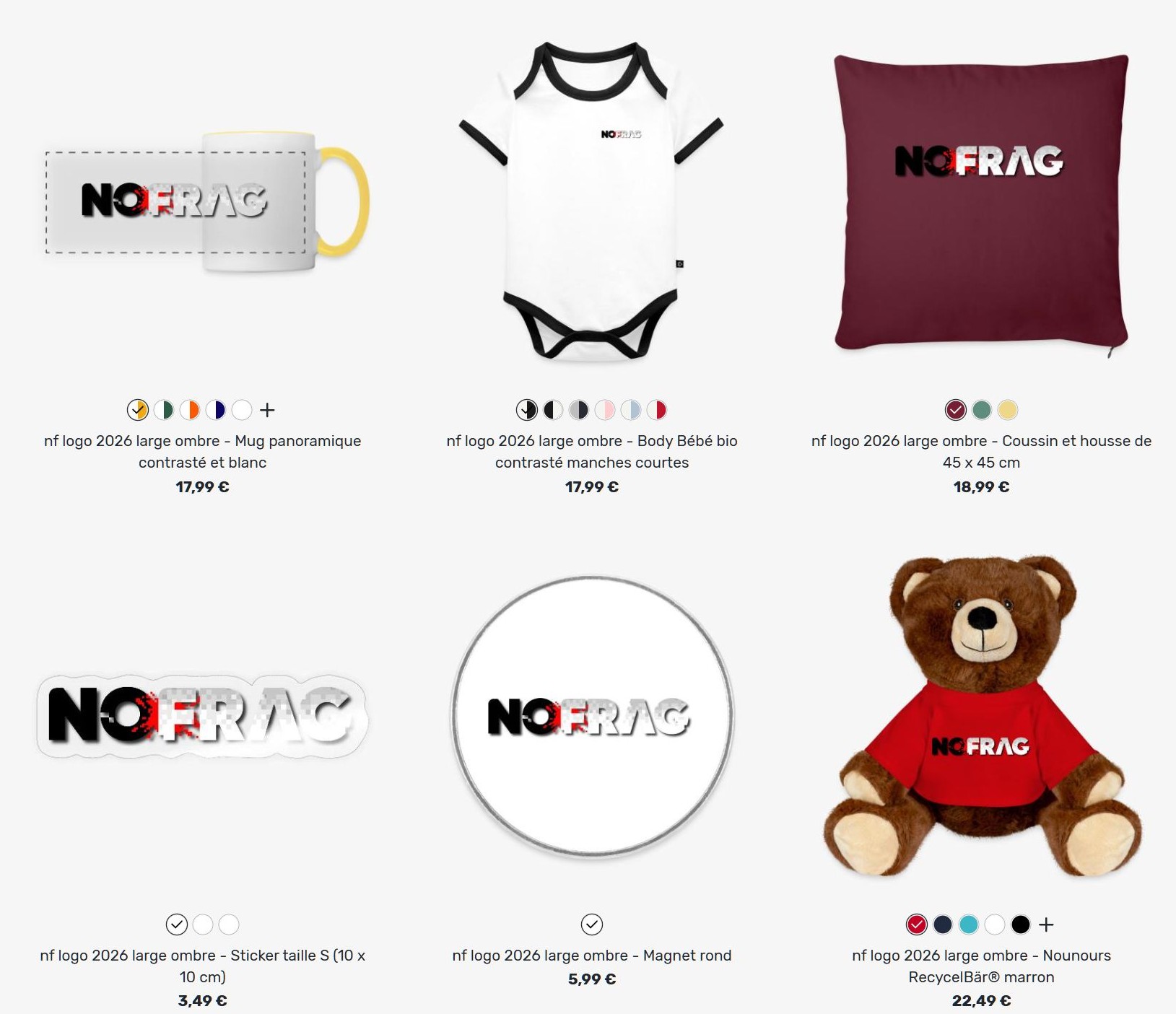
On termine cette page de bons plans avec notre boutique ! Si vous avez encore quelques euros à jeter par la fenêtre, on a récemment mis à jour le catalogue Spreadshirt avec les nouveaux logos. Alors pourquoi ne pas craquer pour un body bébé, un magnet, une gourde ou un tapis de souris ?

Spreadshirt mai 2026

Merci à tous pour votre soutien !

  •  

This is refreshing: Blackmagic is making some of its cameras over $1000 cheaper

These days, it’s not often you get to write about prices going down, rather than up.

A Blackmagic Cinema Camera 6K in front of a desert landscape.Blackmagic

Here’s a refreshing bit of news: there’s at least one camera company out there whose products are getting appreciably cheaper. Today, cinema company Blackmagic Design announced that it’s slashing the prices of its full-frame Cinema Camera 6K and Pyxis 6K models by over $1000, something it says it can do after “securing better pricing on parts.”

Neither camera is particularly new: the Cinema Camera was announced in 2023, and the Pyxis in 2024. So it’s not surprising that Blackmagic is able to make them for less than it initially was. What I wouldn’t typically expect is the company passing those savings on to its customers, given our age of prices rising due to AI-driven chip scarcity and inflation. 

New PriceOld PriceSavingsLaunch Price
Blackmagic Cinema Camera 6K$1595$2715$1120$2595
Blackmagic PYXIS 6K L$1995$3080$1085$2995
Blackmagic PYXIS 6K EF$1995$3070$1075
Blackmagic PYXIS 6K PL$2195$3265$1070

It’s also not a situation where Blackmagic raised prices due to tariffs in the US, and is lowering them back down now that they’re gone. It did raise prices – the Cinema Camera 6K launched for $2595 – but the new prices are well below what the cameras were originally announced at.

Realistically, I realize most of our audience won’t be interested in dedicated cinema cameras in an age when the best hybrid mirrorless models excel in both video and stills, no matter how inexpensive they are. But I’d like to think this is a sign that things might be changing in the camera world. While it may be too much to hope that we’ll see new models that are cheaper than their predecessors, or similar price reductions for existing cameras – I suspect the bigger, more established companies are already getting parts for as cheaply as they can, and Blackmagic is just moving up towards that level of economy of scale – perhaps we’ll at least see some cameras that aren’t substantially more expensive than their predecessors.

About the Author: Mitchell started taking pictures at 10 and hasn’t stopped since. It’s been a wide-ranging adventure, spanning a wide variety of genres and locales, and occasionally dipping into fascinations with video and filmmaking. They honed their technical knowledge doing documentation, programing and QA, writing for The Verge, and just generally messing around on the computer to see what breaks.

Want to stay up to date on the latest product news and releases? Add DPReview as a preferred source to ensure our independent journalism makes it to the top of your Google search results.

add as a preferred source on google

  •  

GoPro’s CEO says the company isn’t done with cameras despite its merger promises

The company’s announcement earlier this week placed a lot of emphasis on AI and national security.

The three GoPro Mission 1 cameras against a dark black background.GoPro

GoPro’s merger with Starman Optical doesn’t mean the company will stop making action cameras, according to a letter from the action cam company’s CEO, Nick Woodman. Earlier this week he said the company planned to address “important areas of national security related to cameras, optics and AI infrastructure,” but now tells the GoPro community that he expects the merger to “make GoPro a stronger, more capable camera company than ever before.”

If you missed the merger announcement earlier this week, that statement may seem unnecessary; of course GoPro would keep making cameras, that’s the main thing it does. But its consumer-facing business didn’t get much attention in its merger announcement, with the company talking more about expanding into “AI data center, government, defense and aerospace markets.” It did promise to “continue to fully support its existing consumer products and its subscription and cloud platform,” but the word “existing” made some (myself included) wonder how much work it’d put into future consumer cameras.

“we’ll be in a much better position to innovate, invent and advance the future of consumer and professional content creation”

Nick Woodman

In his new letter, Woodman says the company’s “improved financial strength” after the merger, planned for later this year, pending regulatory approval, will put the company in “a much better position to innovate, invent and advance the future of consumer and professional content creation.” He also says that Starman is passionate about the GoPro brand, too.

“We plan to bring you more innovative cameras, smarter accessories, and more powerful software and services designed to make capturing, editing and sharing your experiences easier and more exciting than ever,” he says later in the letter.

Personally, I’m glad to hear this, as I think GoPro is an important competitor in the action camera space, even if it’s struggled to keep up with the pace set by other companies like DJI and Insta360 in recent years. Of course, there’s a storied history of companies and executives making promises about what things will be like post-merger, with the reality ending up very different. But for now, it sounds like GoPro plans to continue working on cameras alongside bringing manufacturing of optics and transceivers to the US and breaking into the defense market.  

About the Author: Mitchell started taking pictures at 10 and hasn’t stopped since. It’s been a wide-ranging adventure, spanning a wide variety of genres and locales, and occasionally dipping into fascinations with video and filmmaking. They honed their technical knowledge doing documentation, programing and QA, writing for The Verge, and just generally messing around on the computer to see what breaks.

Want to stay up to date on the latest product news and releases? Add DPReview as a preferred source to ensure our independent journalism makes it to the top of your Google search results.

add as a preferred source on google

  •  

Télex

Microsoft instaure un plafond d'heures mensuelles pour le Cloud Gaming du Game Pass et facturera le reste à l'heure. Pas de panique, assure le géant : cela ne toucherait que 4 % des joueurs. Bref, si vous rentabilisez un peu trop votre abonnement en jouant beaucoup en Cloud, vous repasserez à la caisse. Remercier les clients fidèles, c'est important. P.
  •  

Lomography’s Fisheye No. 2 Graffiti is a budget gateway to analog fisheye

The new camera features the same 170° optics and fixed F8 lens as the standard Fisheye No. 2, wrapped in a new graphic design.

A colorful, toy-like camera with a large yellow lens and artistic designs is held in a hand against a blurred, vibrant graffiti wall background.Lomography

Lomography recently launched the Fisheye No. 2 Graffiti, a redesigned version of its long-running Fisheye No. 2 camera that pairs a 170° fisheye lens with a graffiti-styled 35mm body. It sits below the brand’s LomoApparat in price, and Lomography says it packs bulb mode, multiple-exposure capability and a built-in flash into a compact, beginner-friendly body.

The Graffiti edition shares its core optics and feature set with the standard Fisheye No. 2 but distinguishes itself with its graphic design. It still is a point-and-shoot camera with a fixed F8 aperture and 1/100 sec shutter speed. There are also no ISO settings. Its bulb mode allows for long exposures, and multiple-exposure support lets photographers play with layered images in camera for unexpected results. 

Red and blue neon signs displaying the word IZAKAYA are illuminated against a dark background, with reflections on nearby surfaces and additional neon symbols and text surrounding them.Lomography

Lomography describes the lens as producing heavy vignetting and spherical distortion, characteristics that the brand frames as exciting features rather than flaws. The camera focuses as close as 10cm, which opens up the opportunity for exaggerated wide-angle close-up shots. The beginner-friendly features and its relatively affordable price make it an ideal option for experimental shooters looking for an easy entry into analog fisheye photography.

This isn’t the most affordable camera Lomography has launched this year, either. The brand recently added a $35 half-frame camera that gives photographers twice the frames on a single roll of film. These build on a broader industry trend of releasing beginner-friendly film cameras, a pattern Kosmo Foto’s Stephen Dowling recently argued is good for the medium.

The Fisheye No. 2 Graffiti is available now for $69 through the Lomography shop.

About the Author: Abby Ferguson holds an MFA in photography and blends a fine-art background with extensive editorial and commercial experience. She built and led an in-house imaging program for a large vacation rental company and has served as an associate editor at Popular Photography. She also teaches at a local community college and serves on its Photographic Technology Program Advisory Board, sharing her knowledge and enthusiasm for the medium.

Want to stay up to date on the latest product news and releases? Add DPReview as a preferred source to ensure our independent journalism makes it to the top of your Google search results.

add as a preferred source on google

  •  
❌