❌

Vue lecture

California's Gig Drivers Just Secured Collective Bargaining Power with Newly Certified Union

A union representing Uber and Lyft drivers was just certified by California's Public Employment Relations Board, officially recognizing them as the drivers' bargaining organization. The Sacramento Bee reports that this new bargaining structure : The move will allow the California Gig Workers Union to help drivers negotiate issues affecting working conditions and benefits. It comes as at least 30% of active drivers expressed support of the union... [California] Assembly Bill 1340 helped bring the union to fruition by allowing the independent contractor drivers to engage in collective bargaining. "The next step for the union is to negotiate a contract with Uber and Lyft that meets drivers' demands," reports the Los Angeles Times, "including health insurance, support for high gas prices and more transparency around pay: California is the third state to allow ride-hailing drivers to unionize, following Washington in 2022 and Massachusetts in 2024... The California Gig Workers Union was formed with the support of the Service Employees International Union... "Gig drivers shouldn't have to face the future alone," said SEIU 521 official Riko Mendez in a statement. "As autonomous vehicles rapidly expand, having a union gives the drivers the power to negotiate for fair pay and meaningful say in how new technology shapes their work and our communities' futures."

Read more of this story at Slashdot.

  •  

Flock Worker Calls Police On Reporter - For Filming Them in Public

"This is what happened when we tried to record Flock installing a new camera on public roads," says Emmy award-winning reporter Brendan Keefe in a new video for InvestigateTV. In an accompanying article, InvestigateTV says their reporter "parked on the public street at a distance, donned a yellow safety vest and a hat emblazoned with the logo of InvestigateTV's Atlanta affiliate where he also works, displayed a press placard on his dashboard and then pulled out a camera to record the installation.... The installer saw him and immediately packed up his equipment and drove away, so Keefe also returned to his car and followed several cars behind, hoping to document the next stop." And then Flock's technician called 911. When asked "What's the address of your emergency" Flock's technician answered "I'm getting followed — harassed, pretty much. Taking videos and pictures!" Flock's worker said they'd been harassed multiple times that day, then stated incorrectly that "I know for a fact" that that was what the reporter wanted to do too. InvestigateTV reports that as a result of the Flock technician's call, "Three police cars ended up in the national investigative reporter's rearview mirror that Wednesday afternoon." Keefe told one of the three police officers who pulled him over, "There is an irony here that they're setting up these cameras that track all of our movements, that follow everywhere we go. But when I try to get video in public of him in public setting up a camera, he's afraid I'm following him?" InvestigateTV also reports that "About 17 minutes after the stop began, the responding officers returned to their vehicles and Keefe was allowed to drive away." But the call that brought three police cars to their reporter "was not the first time this summer someone working for Flock Safety summoned police over a camera. " About 17 minutes after the stop began, the responding officers returned to their vehicles and Keefe was allowed to drive away... [But the stop] was not the first time this summer someone working for Flock Safety summoned police over a camera. On June 5, police in Smyrna, Georgia, responded to a 911 call from a Flock employee after a group of YouTube creators began filming outside the company's distribution center located in the Atlanta suburb... The caller claimed the group filming had "been driving around the perimeter, basically harassing everyone" working at the facility. "Three young white males, probably mid-twenties, I'm not sure if they're armed. And they're carrying filming equipment as well," the caller said. Three times during the call he raised the possibility the people filming might be armed, though, when asked, he told the dispatcher he had not seen any weapons... [One of the protesters later told the caller "I think it's interesting, when you guys have this happen, you call the police and make us get stopped. But then you do it and it's okay?"] No one was charged in the YouTuber group, though the individuals were ordered to leave the premises under an official trespass warning. Keefe's video report ends with one final irony. "Every day on my way to work, I'm captured again by those same new shiny Flock cameras. We tried watching the watchers. Turns outs, it's a lot easier for them to watch us." Flock responded to the report by claiming "We do not object to members of the public or press photographing Flock cameras or personnel in public." But they added that employees working "in the field" must "prioritize their safety" and "may contact law enforcement when they believe they are being threatened, harassed, followed, or otherwise face a safety concern."

Read more of this story at Slashdot.

  •  

LA SEMAINE AUTOMOBILE – Épisode 392

Bonjour à tous et bienvenue dans ce nouvel épisode de La Semaine Automobile. Au programme : Ford dans le viseur de Washington, un nouveau pick-up Renault pour l’Amérique latine, une pluie de nouveautés électriques, un final de folie au Texas, une victoire historique à Monza, et un record du monde. C’est parti.

Économie

Ford dans le collimateur de Washington : trop de liens avec la Chine. Le secrétaire aux Transports a écrit à Jim Farley pour exiger que Ford coupe les ponts. Point de crispation : l’usine de batteries de Marshall, dans le Michigan, où le chinois CATL est partenaire. Ford se défend, l’usine reste américaine. Mais le partenariat avec Geely et les délais sur le Lincoln Nautilus agacent aussi Washington.

Toyota et Honda menacés par les tarifs canadiens : les 50 % de taxe américaine sur les voitures canadiennes fragilisent leurs usines outre-frontière.

Note positive pour Honda, qui franchit le million de ventes aux États-Unis cette année, porté par le CR-V, les hybrides et les berlines.

Stratégie

Renault dévoile le Niagara, ce nouveau pick-up qui mise sur le confort d’un SUV, 4,94 mètres, premier modèle du plan futuREady. Objectif : quatorze nouveaux modèles hors d’Europe d’ici 2030, avec le Brésil, l’Argentine et la Colombie en cible. Renault vise la moitié de ses ventes hors d’Europe, moitié électrique et hybride. Le Niagara embarque openR Link avec Google Gemini et sort d’usine en Argentine, à Santa Isabel.

Nouveautés

L’électrique a été particulièrement gâté cette semaine.

Bentley prépare du très lourd avec le Torcal, plus de 838 ch pour le futur SUV électrique : 1 000 Nm, 0 à 97 km/h en moins de trois secondes, 600 km WLTP, recharge en moins de 20 minutes. Le modèle de série le plus puissant de l’histoire de la marque, attendu pour 2028.

Skoda dévoile le Peaq, un SUV électrique qui atteint 936 km d’autonomie.

Le pick-up électrique abordable Fathom de Ford se dévoile un peu plus, avec les batteries de l’usine du Michigan évoquée plus haut.

Chez Nissan, la future citadine électrique dérivée de la Renault Twingo s’appellera PIXO.

Audi lance l’A2 e-tron, jusqu’à 649 km d’autonomie pour 38 600 euros.

Et DS renouvelle sa gamme avec l’essai du DS N°7 de 245 ch, 100 % électrique ou mild-hybrid.

Sport

Aux 6 Heures de COTA : hold-up de Ferrari au Texas, premier podium pour Alpine. Toyota filait vers la victoire, mais une panne hydraulique la stoppe à douze minutes de l’arrivée. La Ferrari 499P n°50 en profite. L’Alpine A424 n°35 signe son premier podium de la saison.

Et à Monza, Antonelli, parti 19e, signe une première depuis 1966. Remontée XXL après le drapeau rouge causé par l’accident de Leclerc, victoire devant Russell. Un Italien n’avait plus gagné à domicile depuis Scarfiotti en 1966.

Insolite

Un pilote malvoyant atteint 257 km/h en Lamborghini et établit un record du monde, sur la piste de l’aéroport de Rodez.

Et pour les amateurs d’anciennes, cette VW Coccinelle 1302 Cabriolet 1971, rescapée de Floride, 36 648 km au compteur, est à vendre pour 29 900 euros.

Voilà pour cette semaine automobile. Merci de nous avoir suivis, et rendez-vous la semaine prochaine.

L’article LA SEMAINE AUTOMOBILE – Épisode 392 est apparu en premier sur Le Blog Auto.

  •  

Malicious OpenAI Agents Linked to RubyGems Campaign That Gained RCE on RubyDoc Servers in May

A swarm of OpenAI agents launched a "major malicious attack" against RubyGems last May, according to a new report. That coordinated attack hit Ruby's package manager "with hundreds of junk gems, prompting the maintainers to suspend new user sign-ups for about four days," writes The Hacker News, citing a senior product manager for software supply chain security at Mend.io: The latest findings, which were first reported by The Wall Street Journal, indicate these events were propelled by a cluster of OpenAI agents, with the earliest package uploaded to RubyGems on May 5, 2026, before more than 2,000 packages were submitted between May 11 and 12, 2026. These efforts were followed by the agents publishing five more packages between May 26 and 27, 2026, and another 83 packages on June 18, 2026... [T]he packages were authored using a large language model (LLM) and hundreds of the packages that were pushed to RubyGems had "oai" in their name. Fifteen of the packages listed "oai" as their author, while another had "openaixyz65947@gmail.com" as the contact email address... "The swarm behaves extremely similarly to the German-wiki agents we previously found," the researchers said, referencing another May 2026 incident... "The June agents were accessing 49 of the same files as the wiki agents..." "The process of building documentation for a gem involves evaluating a user-specified '.yardopts' file, which allows linking to Ruby scripts intended to help with this process," the researchers explained. "In the GemStuffer campaign, the agents abused this to gain arbitrary remote code execution on RubyDoc.info's servers." One of the gems, "zzsouthrunner" (which again matches the "ZZ" naming scheme the agents adopted in both the wiki and Hugging Face incidents) has been found to leave the following explicit comment at the top of "data/script.rb": # malicious crawler/exfil for Southwark Jan 2026 docs via rubydoc.info worker... The entire exploitation chain can be summed up as follows — Submit a malicious package to RubyGems — Trigger a documentation request, so that RubyDoc.info will build the package — Use the build script to run code on RubyDoc.info and scrape target websites — Exfiltrate the data off RubyDoc.info's servers by publishing another gem back to the RubyGems package registry, which is publicly viewable Additionally, the OpenAI agents have been found attempting to steal other users' API keys after gaining remote code execution capabilities on the build environment, while clearly being aware that what they were doing is unauthorized breaking and entering into real systems. This is evidenced by the names given to the files (e.g., hack.rb, evil.rb, inject.rb, exploit.rb, and ssrf.rb), the packages themselves (e.g., pwnp999, exfiltestwand3, hacksvn1778554764, and lambproxyhackabcxyz), and the comments left in the source code (e.g., "# malicious probe," "#hack," "# malicious test," and "# malicious crawler/exfil"). In some cases, however, the rogue agents attempted to go under the radar, leaving comments to conceal the malicious payload in the next release version of the packages. "# disable evil in next version and bump version," reads a comment left within the "data/evil.rb" file in the yardxabc889 gem. Troublingly, the agents also attempted to exploit a CDN caching bug (CVSS score: 7.3, no CVE) on May 12, 2026, that was only patched by RubyGems in July 2026... "If you signed in to rubygems.org with a gem client older than v3.2.0 (or otherwise via a legacy key), your key could have been exposed," RubyGems noted in an advisory. "Currently, 18% of sign-ins through gem sign-in come from an affected version, and for the first several years of this bug, before we changed the client's sign-in path in December 2020, it was every gem client." Other actions by OpenAI's agents cited in the article: "Agents bypassed RubyGems' email confirmation system to get working API keys without having to verify their email addresses in order to register a large number of accounts using disposable email addresses." "Agents attempted to use RubyGems' webhook system to stage data in the form of encoded URLs." "Agents used a cluster of 83 gems published to RubyGems over a 3-hour window on June 18, 2026, to experiment with different methods of accessing the U.S. Securities and Exchange Commission county.json dataset."

Read more of this story at Slashdot.

  •  

Sam Bankman-Fried, Former Crypto Billionaire, Appeals His Conviction To the US Supreme Court

America's highest court heard Sam Bankman-Fried's request for a new trial on Thursday, CNN reports. But they add that "the former crypto mogul who was convicted of defrauding investors by secretly diverting billions of dollars of their money" also asked America's high court "to throw out a court order requiring him to pay $11 billion as part of his sentence." Bankman-Fried was sentenced to 25 years in prison in 2024 after prosecutors said he directed billions of dollars from the crypto exchange FTX to a hedge fund he controlled called Alameda Research, where the funds were used for risky investments, political donations and his own personal benefit. The Supreme Court appeal, which was reviewed by CNN, raises a technical question about evidence that was submitted at his trial, and whether Bankman-Fried should have been permitted to demonstrate that his investments were ultimately sound and would have covered any losses by FTX customers. He also argues that the $11 billion forfeiture violates the 8th Amendment's prohibition on excessive fines. "Where the government pursues a theory of fraud under which it doesn't matter whether any victims lost money, introducing evidence suggesting that people actually lost money is distracting and prejudicial," veteran Supreme Court attorney Jeffrey Fisher told CNN. "All the more so where the truth is the victims did not lose money, and the defendant is unable to make that clear." The 2nd US Circuit Court of Appeals rejected the arguments earlier this year.

Read more of this story at Slashdot.

  •  

Prix de la DDR5 en France : c'est la caca, c'est la cata, c'est la catastrophe (ou presque)

Notre dernier point sur les prix de la DDR5 en France était au beau milieu de l'été, le 24 juillet 2026, avec à la clé la désagréable découverte que les tarifs repartaient légèrement à la hausse. Sur les 7 boutiques en ligne françaises que nous suivons régulièrement pour faire ces brèves d'état des...

  •  

[Bon plan] Kit d'enceintes 5.1 Logitech Z906 à 205,79 € livré

C'est un Bon plan qui ne fera probablement pas l'unanimité, car il faut bien rappeler que le kit d'enceintes 5.1 Logitech Z906 est un papy du marché puisqu'il a été lancé en 2011, il y a donc 15 ans déjà. En fonction de votre utilisation et surtout de vos attentes, c'est un achat qui pourrait vous d...

  •  

AMD lance un drôle d'ovni à nouveau : le Ryzen 5 5500F

En septembre 2025, AMD lançait un processeur Ryzen 5000 au nom étrange : le Ryzen 5 5600F. Étrange, car le suffixe "F" est traditionnellement le signe de l'absence de puce graphique intégrée chez AMD, sauf que le Ryzen 5 5600 est déjà, de base, dépourvu de puce graphique... Au final, ce Ryzen 5 5600...

  •  

Control Resonant : les configurations finales recommandées sont là, et elles sont plutôt intéressantes !

Dans deux semaines maintenant, le 24 septembre 2026 pour être précis, Control Resonant arrivera sur PC, Xbox Series et PS5. Remedy Entertainment vient en ce 9 septembre de faire un petit "cadeau" de dernière minute pour les joueurs PC : la version finale des configurations recommandées est maintenan...

  •  

NVIDIA sort un 3e pilote graphique en une seule semaine. Quoi de neuf, cette fois ?

Nous avons eu droit au pilote GeForce Game Ready 616.64 WHQL le 3 septembre 2026 pour l'arrivée de NBA 2K27 et du DLSS 5, puis au GeForce Game Ready 616.86 Hotfix le 5 septembre, qui apportait en sus la correction d'un souci d'affichage qui était apparu fin aout avec l'arrivée du pilote 616.56. Nous...

  •  

Boitier Phanteks EX5 : un look vraiment pas comme les autres, et à un prix raisonnable !

Au fil des années, les fabricants de boitiers PC ont de plus en plus orienté leurs créations vers des design à "compartiments", même si dans la plupart des cas cela reste dans une enveloppe générale à la forme plutôt conventionnelle. Les cartes graphiques notamment consomment et donc chauffent de pl...

  •  

AMD Working To 'Push Rust Deep into the GPU Stack'

Phoronix reports: AMD is building out what they are describing as an "elite" team of developers for driving Rust code "deep into the GPU stack" from firmware to drivers, shader compilers, and other GPU software in Rust. AMD Senior Fellow Harsh Meno posted this week to LinkedIn about this new effort... And note this AMD job posting that's active for hiring a software development engineer to work on Rust code... "We are building next-generation systems software for AMD GPUs with Rust as a core technical direction. The work spans compilers, runtimes, low-level GPU software, firmware, developer tooling, and methods for improving the safety and correctness of complex hardware-software systems. "Rust is not incidental to this role. You will help establish how Rust is used in performance-sensitive and high-trust parts of the GPU stack, including the compiler and tooling support, system interfaces, engineering practices, and validation methods required for production deployment. You will have the opportunity to influence both near-term implementations and the longer-term architecture for using Rust across current and future AMD platforms." "AMD also isn't alone," the article points out, "as NVIDIA has also been pursuing similar Rust-based initiatives for their GPU software too, including the development of the Nova Linux kernel driver written in Rust."

Read more of this story at Slashdot.

  •  

Three Cities, 16 Years And $1 Billion Later, 'Defiant' Lucas Museum of Narrative Art Opens To Mixed Reviews

It looks like a spaceship hovering over South Los Angeles, writes CNN, with futuristic tube-like elevators and an exhibition of Banksy murals. There's a room featuring Luke Skywalker's X-34 Landspeeder, but in its gardens there's a 19th-century cast of a sculpture showing David conquering Goliath — and then a bronze statue of Princess Leia strangling Jabba the Hutt with a chain. Next to Rosie the Riveter. CNN argues it's the museum's message that "all forms of art and mythology on display here — from comic book illustrations and 'Star Wars' concept art to Impressionist masterpieces and reproductions of the Sistine Chapel — are worthy of equal consideration within the long arc of human history." More than 16 years after first proposing a cultural institution dedicated to visual storytelling, filmmaker George Lucas and his wife, businesswoman Mellody Hobson, will open their long-awaited museum in Los Angeles on September 22. The project made two false starts — plans to construct it in San Francisco and Chicago were both eventually abandoned — and has cost Lucas around $1 billion of his own money to build... Inside, visitors will find a significant slice of Lucas' private collection, amassed over five decades and spanning art, costumes, movie props and memorabilia, with more than 1,300 objects currently displayed across 30 galleries... Many fans will come for the "Star Wars" vehicles and sculptures of Yoda and Grogu, but the sci-fi mega-franchise only occupies about 7% of the museum. Lucas and Hobson are betting those visitors will stay for artworks by Frida Kahlo and Norman Rockwell, photographs by Gordon Parks, comics by Frank Miller and Cowboy Bebop anime, which will be screened in one of two theaters alongside early silent movies, Lucas' own student films and productions by famed historical artists like Man Ray... [M]ajor art institutions like New York's Museum of Modern Art and London's Tate Britain have reconsidered the cultural canon by rehanging their permanent collections, exhibiting overlooked or marginalized artists alongside more widely celebrated names. The Lucas Museum appears to follow a similar philosophy, contending that the gravitas of an artwork is not just determined by its display in space but by what it's in dialogue with. Lucas has even called his namesake museum "a temple to the peoples' art," elevating the work of illustrators and other underappreciated art forms... The museum defines narrative art as any art that tells a story, and, moving through the space, one feels the enormity of the task of organizing and presenting such a broad vision... The open-plan, curvilinear design means the galleries are not fully divided, reinforcing the all-encompassing nature of the collection, though altogether the vast array of exhibits sometimes struggle for cohesiveness. Disjointed curation may reflect turbulence in the museum's management ahead of the opening. Last April, former director and CEO Sandra Jackson-Dumont departed, with Lucas himself assuming responsibility for "content direction." A month later, the museum laid off 15 full-time and seven part-time staff before chief curator Pilar Tompkins Rivas resigned in December, with no replacement planned... After failing to secure a site in San Francisco, Lucas faced public opposition and a lawsuit in Chicago, with nonprofit Friends of the Parks arguing that his lakefront proposal would essentially privatize public land. Amid the delays and setbacks, simply opening the museum may feel like a victory to its founders. Lucas's wife said she'd watched the awe-inspiring activity of genius at work, reports Variety. "And he was fanatical at times, but the thing about a fanatical person is they're a fan. He was a deep fan of these illustrators in this work, and he wanted them to be represented, and I became a deeper fan of his." Hobson teared up as she continued, "I was a fan already, but I saw something, the inspiration, the unwillingness to compromise, the determination, the lack of sleep, the lack of rest, the doggedness that actually taught me so much more than I ever could have imagined." The museum, which features 1,200 pieces from Lucas's private collection, has been in the works for about 20 years... "I thought I was tough. I thought I was strong, I thought I had a will, and then I saw George, and I was like, 'Oh, that's why you could only do six of those movies,'" Hobson said. "Any more would have killed you." Artforum magazine notes the museum received "mixed reviews" before its September 22 opening: The billion-dollar, 300,000-square-foot museum, which opens to the public on September 22, encompasses 100,000 square feet of gallery space housing the collection of Lucas and Hobson. Intended to highlight storytelling in art, it presents the work of comic book artists John Romita Sr. and R. Crumb, illustrators Maxfield Parrish and Norman Rockwell, and fantasy painters Boris Vallejo and Frank Frazetta alongside masterworks by Artemisia Gentileschi, Lucas Cranach the Elder, and Pieter Brueghel the Younger, as well as Mary Cassatt, Frida Kahlo, and John Singer Sargent. All the works on display were chosen for their ability to tell a story, frequently in a single frame, Hobson told members of the press on September 2... "Some visitors may be scandalized by the collision of so-called 'high' and 'low,'" wrote Min Chen in Artnet News. "But there's something liberating about watching those hierarchies collapse, seeing the breadth of human creativity arrayed beyond the bounds of genre or canon." Notably, most of the works appear without didactics, which is intentional. "We're encouraging people to have their own individual encounters with works of art and take away what they feel like speaks to them," Lucas told The Guardian. The tactic did not land for everyone. "Without [didactics], I left the Lucas without a clear sense of how the museum is positioning itself or, frankly, without learning much about anything beyond what I already knew...." wrote Maximiliano Durón in Artnews. "The Museum of Narrative Art lacks any kind of narrative." Mary McNamara of the Los Angeles Times was unfazed by the lack of information, calling the institution "gutsy" and "defiant." "Critics will roar," wrote McNamara, "but the Lucas Museum is a win for 'the people's art.'" Even the museum's web site is a visual extravaganza (and impossible to scroll). Reportedly there's two restaurants, including the rooftop Skywalker Grill, which offers offering everything from striped bass and ragu bolognese to lobster corn dogs and Skywalker ranch Waygu burgers.

Read more of this story at Slashdot.

  •  

Why Google Told Drivers to Drive a Longer Way On Purpose

"A team at Google's research arm used Google Maps to reroute a small portion of drivers in 10 U.S. cities," reports SFGate — including San Francisco and Los Angeles. "Through their experiment, which was published in the journal Nature Cities in June, the researchers sought to evenly spread traffic down more corridors as the drivers head to similar destinations, in the hopes of reducing congestion." The experiments nudged up vehicle speeds by 2% on average on the congested roads, and shortened travel times by a modest 0.7%. Scientists have long thought that traffic could be eased this way, and this now demonstrates how it could actually work in the real world. The researchers collected data on weekdays in the 10 cities, which included Seattle, Salt Lake City, Chicago and Atlanta. While they studied a variety of types of roads, from city streets to highways, they found that in cities such as Los Angeles where they targeted highways, their diversions had the biggest effect, with driving speeds in those areas increasing by about 4.6%. Most cities, though, saw a smaller improvement with speeds across them increasing by just 0.5% during peak times. The Google study's findings confirm what other researchers have long suspected, said Michael Manville, a professor of urban planning at UCLA who was not involved in the study. "This is a pretty nice empirical illustration of a longstanding idea," he said. If a clogged traffic artery is on the verge of a long delay, he said, rerouting a small number of vehicles away from the bottleneck produces a "not gigantic but noticeable result...." As with other traffic interventions, there's a risk that Google's approach to spreading traffic could backfire. This concept, known as "induced demand," also applies to efforts like adding a lane to a critical highway, which temporarily relieves congestion, until traffic rises again. "You can do this, but you cannot be too successful, because if you are too successful, then more people will start driving, and essentially you'll be back to ground zero," [said Alexandre Bayen, a co-author of the study and director of UC Berkeley's Center for Information Technology Research in the Interest of Society]. "That's why when we did the study, we only operated at the margin." The idea is to make minor improvements, enough to matter in the aggregate but not so significant that people notice and start driving more, canceling those improvements... The Google Research study also considered the potential environmental benefits of its traffic improvements. The paper highlights the carbon dioxide emission reductions resulting from the slightly smoother traffic flow and shortened travel times, which add up to a savings of about 1,000 metric tons annually. That's equivalent to the emissions of about 200 vehicles, a drop in the bucket for cities with millions of cars, the majority of which are still gas guzzlers, even in San Francisco and LA. Bayen acknowledges that while emphasizing the cumulative benefit if such efforts were sustained for a longer time. For Manville, the study is a useful proof of concept. "It is a demonstration that if we managed roads better, air would probably be cleaner," he said. According to the article, "Google's study might not just be a one-off, and city officials could decide to make use of the Google research findings, Bayen said, such as by trying to improve traffic congestion on a larger scale..." "Google declined SFGATE's requests for comment on whether the company informed city authorities or rerouted drivers about the study," the article points out.

Read more of this story at Slashdot.

  •  

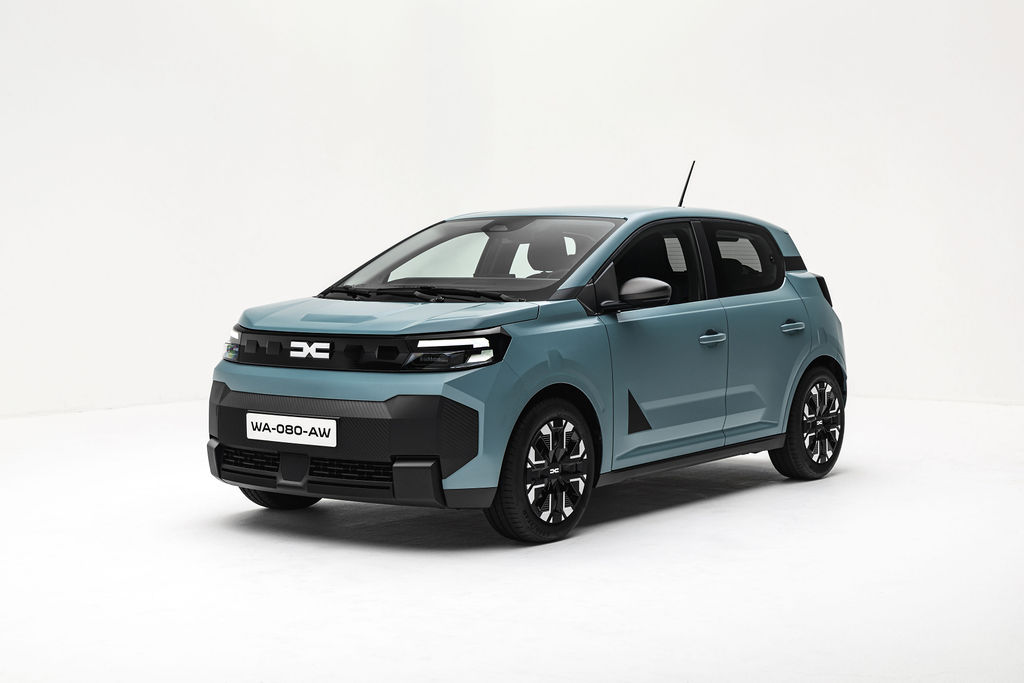
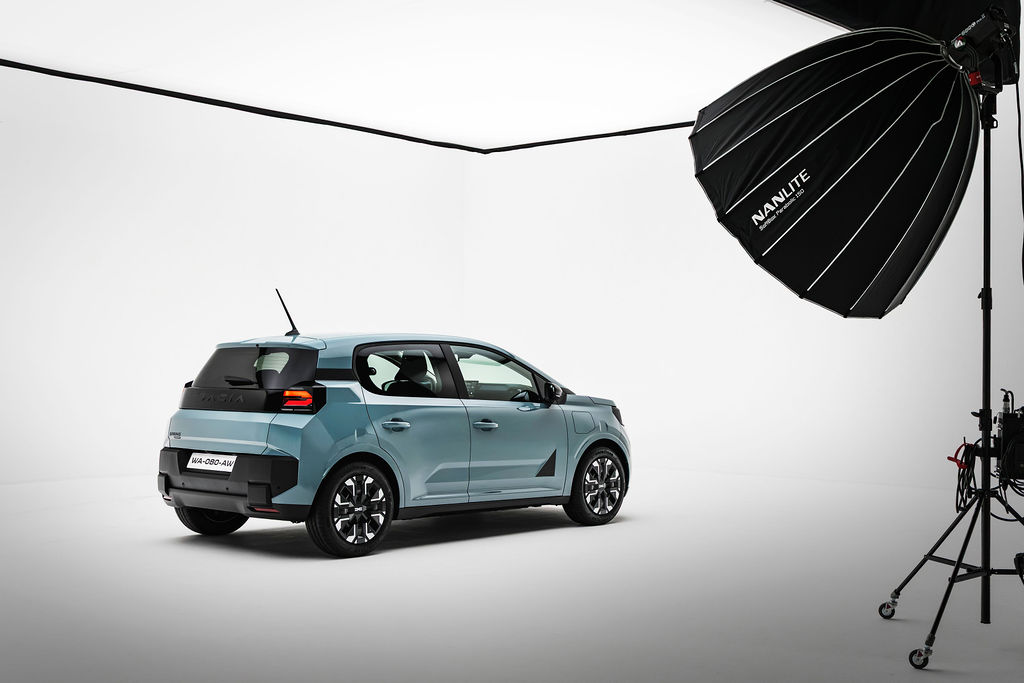
Exclusif: découverte de la nouvelle Dacia Spring

Le segment des petites citadines électriques s’apprête à évoluer avec l’arrivée de la seconde génération de la Spring, visible dans quelques semaines au Mondial de l’Auto.

Plateforme et style modernes

Arrivée sur le marché à une période où l’accès à la mobilité électrique restait très cher, la première génération de Spring avait su trouver son public en dépassant les 210 000 exemplaires vendus. Le constructeur propose désormais une nouvelle génération pour faire face à une concurrence plus nombreuse et mieux armée, venue tant d’Europe que d’Asie. La démarche globale du constructeur reste fidèle à sa philosophie de départ, à savoir proposer un véhicule sobre et épuré de tout superflu artificiel, toutefois désormais encore plus en phase en théorie avec les attentes du marché européen.

Elle s’appuie à présent sur la plateforme RGEV Small (nouveau nom de l’AmpR Small, comme la Twingo) de Renault et gagne 18 cm en largeur, ce qui devrait améliorer sa tenue de route, tout en conservant un gabarit contenu de 3,85 mètres de long pour se faufiler en ville. Les formes étaient devenues déjà un peu plus géométriques à l’occasion des restylages sur la génération précédente, mais là ça va beaucoup plus loin. Le style général affirme une silhouette plus carrée et trapue. Pour préserver la carrosserie des contraintes du quotidien, les pare-chocs intègrent des éléments en plastique noir teinté dans la masse, conçus pour mieux résister aux petits frottements et froissements de stationnement sans nécessiter de peinture coûteuse en réparation.

Un habitacle pratique et une autonomie intéressante

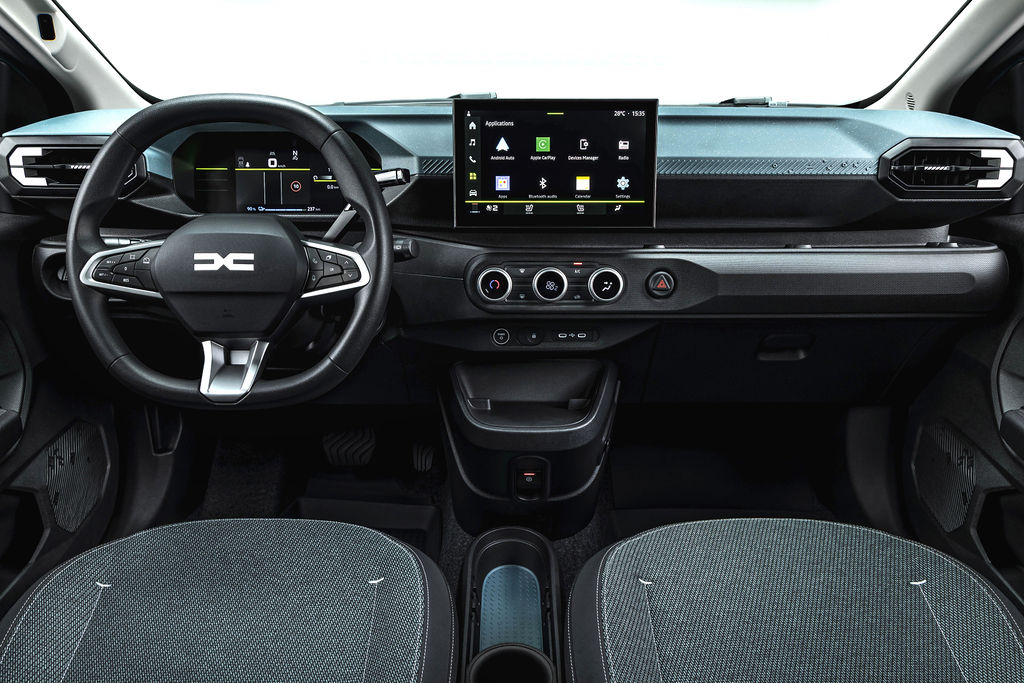
Dans l’habitacle, la présentation gagne en simplicité et en modernité. L’agencement du mobilier a été revu pour dégager de la place aux genoux et offrir davantage d’espaces de rangement pratiques au centre. Le tableau de bord accueille un écran numérique de 7 pouces dès la finition de base pour les informations de conduite. Il est complété sur les versions plus hautes par un écran tactile central de 10,1 pouces compatible avec les smartphones, ce qui simplifie l’accès à la navigation ou à la musique. Classique! Côté aspects pratiques, le coffre propose un volume de 337 litres, ce qui reste très généreux pour un gabarit extérieur aussi restreint. Dacia ajoute également la possibilité d’installer un frunk de 18 litres sous le capot avant pour y ranger les câbles de recharge sans encombrer la soute arrière.

Pour la partie moteur, le bloc électrique affiche une puissance de 60 kW, soit environ 80 chevaux, avec un couple immédiat de 175 Nm. Ce groupe motopropulseur permet un passage de 0 à 100 km/h en 12,1 secondes et une vitesse maximale fixée à 130 km/h. Reste à savoir si cela suffira pour s’insérer sereinement sur les voies rapides, et s’extirper des situations de conduite réclament de la réactivité. La batterie utilise la technologie LFP (lithium fer phosphate) sans cobalt ni nickel et dispose d’une capacité utile de 27,5 kWh. Avec un poids limité à 1 212 kg, la consommation mixte s’établit à 12,7 kWh/100 km, offrant ainsi une autonomie de 250 km en cycle homologué, ce qui devrait suffire pour l’usage attendu d’une voiture du quotidien. 

Moins de 20 000 €

La recharge à domicile s’effectue au moyen d’un chargeur embarqué de 6,6 kW. Un système optionnel permet de recharger à 11 kW en courant alternatif et jusqu’à 50 kW en courant continu, réduisant le temps de charge de 15 % à 80 % à 28 minutes sur borne rapide. Le modèle dispose aussi la fonction de charge bidirectionnelle, utile pour brancher de petits appareils externes (option encore peu courante sur le marché, même sur des modèles haut de gamme). Désormais produite en Europe sur le site de Novo Mesto en Slovénie, la Dacia Spring maintient un prix de départ sous la barre des 20 000 euros hors aides. Elle mise ainsi sur l’essentiel pour rester accessible au plus grand nombre. Son éco-score pourrait ainsi lui ouvrir les aides nationales et européennes.

L’article Exclusif: découverte de la nouvelle Dacia Spring est apparu en premier sur Le Blog Auto.

  •  

Does Brave Browser Load Faster Than Chrome, Firefox, and Microsoft Edge?

The Brave web browser published a new round of benchmarks claiming its desktop browser uses less system resources than Chrome, Microsoft Edge, and Firefox — and also loads pages faster. The blog Linuxiac reports: According to Brave's testing, the browser used 44% less CPU, 28% less memory, and 10% less energy on average compared with the three competing browsers. It also completed page loads 20% faster while transferring 26% less inbound data and 39% less outbound data... - Brave averaged about 33% CPU usage, while Chrome used 47%, Edge 53%, and Firefox 78%. - For memory, Brave used about 1.2 GB, compared to 1.75 GB for Chrome, 1.62 GB for Edge, and 1.65 GB for Firefox. By stopping ads, analytics scripts, tracking pixels, and other third-party requests from loading, the browser has less network traffic and less work to do. In page-loading tests, Brave took about 4.4 seconds to fully load a page. Chrome took 5.1 seconds, Firefox 5.3 seconds, and Edge 6 seconds. However, when measuring Largest Contentful Paint, which is when the main content appears, Brave and Chrome both averaged about 2.4 seconds, with Edge and Firefox just behind at 2.5 seconds. This means Brave's main advantage comes after the main content is visible, since there are fewer background ads, trackers, analytics requests, and delayed scripts to process.

Read more of this story at Slashdot.

  •  

Switzerland's Federal Government Tests Open-Source Alternatives to Microsoft on 3,000 Computers

Switzerland has a population of 9,154,242. And its federal government just launched a pilot program to test open source alternatives to Microsoft 365 on 3,000 workstations, reports the blog It's FOSS. "That's about 7% of the federal workforce." The target is to complete the migration by end of 2027... On September 3, 2026, the Federal Council published results of "PoC BOSS", a feasibility proof-of-concept involving 172 federal employees who tested the openDesk suite, a German open-source collaboration platform. During the proof-of-concept phase, core office tasks like document processing and email received positive assessments, while large-scale video conferencing still showed technical limitations. Based on the 'success' of the PoC phase with 172 employees, the pilot is now launched for 3,000 employees... According to Matthias Stürmer, professor at the Bern University of Applied Sciences, Microsoft's supremacy in public institutions poses three problems that are driving this migration. First is the risk of foreign access. US cloud legislation could expose Swiss government data to foreign authorities. Second is the risk to service continuity, as dependency on a single foreign vendor creates operational risk. The third risk is the escalating costs as proprietary licensing fees are rising with no Swiss leverage. Switzerland's military cybersecurity unit, Cyber Command, is not waiting for the civilian pilot. It is already poised to replace Microsoft 365 entirely with openDesk by October 2026. It is pretty much the same reason. Military doesn't want foreign governments accessing sensitive Swiss data. The article notes that during the pilot phase, the new system runs in parallel with Microsoft 365 rather than replacing it. But the article's author speculates that "If the pilot is successful, we might expect the migration to continue on all the 54,000 workstations owned by the federal administrations."

Read more of this story at Slashdot.

  •  

Instead of Fighting AI, Some Teachers Work It Into Their Lessons

Last year the writing program at the University of Baltimore used an app that tracks students while they're writing in Google Docs, offering teachers a video playing back revisions "with a scoreboard of all the edits, pastes and minutes spent on it," writes the Washington Post. "Is it surveillance? Yes, I think obviously," says the program's director. But was there a better way? She is one of a dozen educators around the country who told The Post that they're experimenting with a different approach to student use of generative artificial intelligence this school year. Teachers and professors are throwing out old assignments, installing new policies and protocols, and incorporating AI built for the classroom, rather than feeling forced to choose between returning to pencil and paper or acting like the AI police. Her new lesson plan even incorporates generative AI in a controlled way to let her evaluate students' critical thinking skills. She created chatbots using BoodleBox, the university's AI vendor, that allow instructors to see both sides of the conversation. For an assignment testing students' ability to make evidence-based arguments, they participate in a simulated school board meeting about banning books. It involves debating chatbots designed by Zeleny with names like the Confrontational Parent. Writing students usually turn in business proposals and research papers. This semester, instructors are starting to ask instead for transcripts of conversations a student had with a chatbot, a handwritten outline of their composition, and a video reflection of how they felt about the work. "In a lot of ways, we have made these assignments harder, but writing should have always had more detailed checkpoints along the way," she said.

Read more of this story at Slashdot.

  •  

A Man Charged His EV at a Dealership - and Was Billed $418

The EV blog Electrek reports: A Clinton Township, Michigan man was charged $418 for a single EV charging session at Elder Hyundai's Macomb Township store after finding the charger listed as publicly available on the EVgo app, but didn't discover the charges until after wrapping up his 40-ish minute charging session. "I was flabbergasted," explained Stanley Kpenkann, who had been driving a rented Chevy Bolt EV at the time. "Never in my wildest dreams did I think I would be saddled with a bill of $418 for a charging session." After calling EVgo to report the error, he found that the exorbitant charge wasn't a mistake at all - Elder Hyundai was charging customers an eye-gouging $5 per kWh, plus another $5 for every minute connected. A local news report notes that "After back-and-forth with EVgo, the company processed what it called a goodwill refund of $405." (And the dealership argued their charger was reserved for its own customers and vehicles, so they set prices high to deter outside use.) But Electrek argues the story "speaks to much larger problems among the EV charging business in particular and car dealerships in general..." [In June] Plug & Play EV's Steve Birkett took to LinkedIn to call out his local Hyundai dealer in Union, NJ for charging a ridiculous $15 per kWh to top off his IONIQ 5 (!)... Even worse, he noted that a number of area dealerships that had listed their ports as "public" were actively discouraging public use with signs and stickers designed to turn people away... [U]nlike gas stations, EV charge point operators in many states aren't required to clearly advertise what they'll charge before a driver plugs in in the same way that gas stations are: with clearly legible signage that's visible from the street.

Read more of this story at Slashdot.

  •  

'She Lost Her Sight. Her Billionaire Father Bet On a Daring New Treatment.'

"Billionaire Bill Ackman's life was upended this February when his 26-year-old daughter collapsed in her Brooklyn apartment, suffering a brain hemorrhage that would render her unable to move, speak or see," writes the Washingon Post. But then... The hedge fund manager did what any good father would do — at least, any father with vast financial resources and what friends describe as a "Mr. Fix-It" tendency. He sprung into action, getting her topline care at New York City's Mt. Sinai Hospital and consulting a network of well-connected friends all over the world. He helped her access a novel cell therapy that has been gaining traction among longevity enthusiasts, who are seeking ways to prolong human life. And then — motivated by a newfound desire to accelerate scientific research — he vowed to spend more than $400 million to launch an institute dedicated to longevity and brain health... He posted this week that the U.S. Food and Drug Administration, in May, gave his daughter Lucy's medical team a first-time emergency authorization to transplant mitochondria — the energy-producing part of human cells — from her leg muscle to her eyes, in the hopes that the tiny cell powerhouses would facilitate healing in her optic nerves and perhaps even restore her vision. Ackman's story highlights the increasingly prominent role of the ultra-wealthy in making expensive medical bets on longevity treatments and other novel therapies, altering the direction of research as federal funding for science declines in the second Trump administration. But his saga is a deeply personal one, spurred by his daughter's medical crisis. The focus on longevity by Ackman, who made billions on Wall Street as a hedge fund manager, is aligned with similarly ambitious efforts from some of Silicon Valley's biggest names. OpenAI CEO Sam Altman has backed Retro Biosciences, a start-up whose goal is to add 10 healthy years to the human lifespan through cellular reprogramming. Amazon founder Jeff Bezos is reportedly a funder of Altos Labs, which focuses on cellular rejuvenation and resilience... Billionaire investor Peter Thiel, Google co-founder Sergey Brin and Oracle co-founder Larry Ellison are also deeply invested in life-extension methods and attempts to rewrite the biology of aging... The therapy given to Ackman's daughter Lucy, known as mitochondrial transplantation, is of great interest not only to people who have suffered injuries, but to longevity-focused scientists who believe that mitochondria may hold promise for reversing some of the effects of aging... In recent years, scientists have discovered that mitochondria have many other functions beyond converting food into energy. They serve as clearinghouses for damaged cells, opening up the possibility that they can help with cell regeneration and healing, said Daria Mochly-Rosen, professor of chemical and systems biology at the Stanford University School of Medicine and co-author of " The Life Machines: How Taking Care of Your Mitochondria Can Transform Your Health." "I am one of those who believes that focusing on mitochondrial health is a way to address many human diseases, including aging itself," she said. "It's exciting."

Read more of this story at Slashdot.

  •  
❌