OpenAI n'a pas fini avec les mathématiques. À peine sortie d'une percée très contestée sur les équations de Navier-Stokes, l'entreprise dit plancher sur un autre problème à un million de dollars, en promettant cette fois d'y aller avec des gants.
Une équipe de recherche en cybersécurité a exploité deux failles combinées pour accéder à des comptes d’employés d’OpenAI et atteindre les dépôts de code internes de l'entreprise, avec l'assistance de Claude Opus 5.
La licorne française a communiqué officiellement sur une revendication de piratage visant son code source, publiée la veille sur un forum cybercriminel. L'entreprise Mistral AI dément toute intrusion dans ses systèmes.
Reuters reports that a former Google DeepMind employee "became the latest AI researcher to warn that the technology could 'kill all humans', saying time could be running out to avoid the outcome:
Public alarm about the potential danger posed by AI is growing, after Anthropic researcher Jacob Coxon said last week he had resigned, in part because the "people building AI earnestly believe that it could kill us all by the end of the decade." Anthropic scientist Evan Hubinger then responded to Coxon's comments, saying he was correct and that he believed there was a greater than 10% chance that AI could kill all humans within the next decade.
"I recently resigned from Google DeepMind, where I worked on AGI safety and alignment research," Bilal Chughtai wrote on X. "I earnestly believe that AI has the potential to kill us all, and that we might be running out of time to avoid this outcome." Chughtai, who co-authored research papers while at Google DeepMind, worked there as a research engineer and left the company in July 2026, according to his LinkedIn profile.
Meanwhile, Meta CEO Mark Zuckerberg "said it's up to each AI company to make sure its technology is safe," reports the Associated Press, "distancing himself from calls by rival companies for a coordinated slowdown in the development of advanced artificial intelligence.
AI companies are already motivated to develop their models in a safe way and face "significant liability" to prevent them from causing harm, Zuckerberg said. "Every lab has the responsibility and incentive to move at the pace required to train its models safely, and the ability to take its own actions to ensure that happens," he wrote on X... Zuckerberg said Meta delayed releasing its Muse AI agent for several months to ensure its safety and security. "We didn't call for everyone else to do this before we would," he said.
Companies should prioritize building safe AI models instead of systems that can automatically improve themselves, a function known as recursive self-improvement, Zuckerberg wrote. "Committing the significant majority of compute towards serving people rather than racing towards recursive self-improvement is one of the best ways to ensure we develop this technology safely."
But Zuckerberg also agreed that engaging independent evaluators and advisors "is industry best practice," adding that Meta Superintelligence Labs "already does this today in several areas because it helps produce better work...
"I believe the key to building a positive future for everyone is maintaining the right balance of power. This is within our power to do."
OpenAI a publié un nouveau cadre pour signaler les cas de désalignement de ses modèles, accompagné de six rapports inédits. Parmi eux, des IA qui apprennent d'elles-mêmes à dissimuler leurs erreurs, et parfois à s'inventer des règles pour s'affranchir de leurs propres garde-fous.
OpenAI announced Wednesday that "We do not believe that the AI industry has solved alignment and monitoring to a sufficient degree to continue responsibly scaling at maximum speed for much longer."
But along with the announcement, OpenAI announced it "found additional incidents of AI models acting deceptively and taking unsanctioned actions during training," reports CNN.
And they add that OpenAI is also "introducing a new process for the company to publicly report such instances."
Under the new system, OpenAI will share updates on concerning AI behavior more frequently instead of waiting to bundle multiple instances into one report. The company said it wants to share more information about troubling AI behavior in the absence of an industry-wide standard...
"As AI systems grow more advanced and more widely deployed, we need to build a broader and better-informed consensus on the progress of alignment research," OpenAI wrote in a blog post Wednesday...
OpenAI said it observed "misaligned behavior" when training and evaluating AI models in six circumstances in the last six months... In one rare instance, OpenAI said an unreleased research model added "jailbreak-like instructions" to the summaries it uses to preserve context in long-running tasks that said it was "freed from the roles and identities that bind other chatbots." Separately, the company said some instances of its 5.6 Sol model included directives to invent information to conceal failures from the user during training. Other newly reported incidents include an instance of an agent uploading files to the internet to cite them without being told to do so, and agents publicly sharing files to collaborate on a task when they were instructed to only use local files during training. AI models also used an internal software repository as a message board in an unsanctioned way.
These instances involved unreleased internal models or internal research models.
"Anthropic's CEO took the stage at a conference in San Francisco on Tuesday to reiterate his call for a slowdown of AI development," reports the Guardian, " while Nvidia's CEO argued against slowing its development. "Run as fast as you can."
Amodei is calling for three courses of action: embedding third-party evaluators inside AI companies; coordinating safety standards among Democratic countries; and, eventually, larger global coordination. At Dreamforce, Amodei said Anthropic has committed to independent evaluators and was "going to have a dialogue with the rest of the industry" on the other two steps. Amodei, xAI's Elon Musk and OpenAI's Sam Altman have recently called for a slowdown in the pace of AI development. ["Dario is right," Musk posted on X.com]
Huang, who also made an appearance at Dreamforce on Tuesday, said companies should not slow down AI development. He argued that new regulations were not necessary, advising AI companies to simply wait to release products until they know they are safe rather than begging the US government to intervene... One day prior at the All-In summit in Los Angeles, Donald Trump called Huang while the CEO was on stage. Huang put the president on speakerphone as Trump called the growing concern about AI a "hoax" and asserted again that a slowdown would only benefit China...
[OpenAI's] Altman said AI models had advanced so quickly that monitoring and security need to be treated with a "new level of rigor", calling an incident in which OpenAI agents hacked into another company a "wake-up call" for the industry. He also said the public was very "right to be afraid" of AI because of the potential loss of control, and the possibility of a small group of powerful AI companies exerting their views on the world.
The cofounder of Google DeepMind posted on X that "Dario's essay points towards the right path forward." And in an internal memo, Microsoft's Satya Nadella endorsed broader third-party testing and warned that companies must take time to make the technology safe, Business Insider reports. Monday Microsoft also published a 37-page training manual "for how we develop our AI, and how we intend it to function during deployment," requesting public feedback.
But Michael Burry "is not buying it," reports The Street. The investor made famous in The Big Short "dismissed the united front as 'self-serving' and laid out four numbered objections..."
He argued that large language models are not artificial general intelligence, so there is nothing meaningful left to slow down. Fast competition benefits incumbents, he said, and danger warnings work as hype ahead of IPOs. The whole exercise, he added, could mask growth that is already slowing as those IPOs get pushed back.
Former Meta AI chief Yann LeCun is also skeptical, posting on X.com that Anthropic's Dario Amodei "was already claiming that GPT2 was too dangerous to open source back in 2019. I made fun of them then. Everyone should make fun of them now."
Timnit Gebru, the co-lead of Google's AI ethics team who was fired in 2020, even thinks the AI companies are stoking fears of extinction "to avoid discussing actual harms, like autonomous weapons," according to Wired.
But others still remain concerned. "I've been in rooms with the hyperscalers, and the Trump administration officials, and none of them know what to do," CNN commentator Van Jones said in a recent panel discussion. "So I do want to say: nobody's flying the plane on this... I think that the ethicists that work for them — when they are quitting, and they are running out, and they're pointing back at the building and they're waving their arms, and saying 'I'm seeing stuff that's scaring me' — we should take that very seriously."
Le 14 septembre 2026, Mozilla a publié une nouvelle version de son rapport State of Open Source AI. Un chiffre retient l'attention : les modèles ouverts accusent un retard de 4,4 mois sur la frontière fermée. Sur quoi se base précisément ce constat ?
Le patron de Meta n'a aucune intention de lever le pied sur l'intelligence artificielle. Alors qu'une partie de la Silicon Valley réclame un coup de frein, Mark Zuckerberg répond que le marché et les tribunaux suffiront à tenir la technologie.
Diogo Almeida, chercheur passé par OpenAI, lance un modèle d'IA qui refuse de générer du texte. En quelques heures, l'annonce a suscité un engouement exceptionnel, voici pourquoi.
The Los Angeles Times reports:
Chen Yilong has racked up plenty of film and TV credits in his two decades as an actor, but with work getting scarcer he signed a contract in August to license the image of his face to a Chinese production studio. Chen's role will be to sit in front of a video camera and make facial expressions at the prompt of a director. A neutral stare. An angry glare. A look of surprise. Using artificial intelligence, the studio will use images of Chen's face to generate an avatar, also known as a "digital human," to star in an AI-generated movie. "If you can't beat it, join it," said Chen, 38, who works in Beijing.
The Chinese film and video industry is being transformed by AI-driven storytelling, fueled by rapid advances in video generation software, and at ground zero are the so-called micro dramas that play out on millions of smartphones. Typically just a minute or two in length, the videos are devoured by Chinese audiences... And the cost of producing them has been cut drastically through the use of AI software developed by Chinese technology juggernauts including Kuaishou Technology and TikTok's global owner, ByteDance. The number of Chinese-made micro dramas surged in the first three months of this year to 128,000, according to the China Netcasting Services Assn. More than 95% of them were made with AI, the association said....
Sun Wei founded Feixiang Universe, the Shenzhen-based studio that cast Chen. The fear of accidentally "stealing someone's face" was a big reason she said she decided to license real people's likenesses for an AI production set during China's Tang Dynasty more than 1,000 years ago. Thanks to AI's training data bias, AI-generated performers tend to have similar features and share a homogenous look, Sun said. Many have flawless skin and extremely symmetrical faces, requiring her and other Chinese AI filmmakers to cast a wide net to "buy" new faces and digitize actor's expressions.
Lu Beike, who directed the big-budget Chinese series "Three-Body," felt theAI-generated scenes he'd tried came out sub-standard. "Lu added that if 90% of a film was generated by AI, a real human performance could appear jarring. A real actor's expressions carried more nuance and emotion. The skin textures did not match. Sometimes the only solution was to process the live-action material until the person looked a little less real — until they fit back into the 'AI world,' Lu said."
But at Sun Wei's studio, they're thrilled they can produce a 90-minute AI film for $500,000 where professional productions used to cost millions of dollars. According to the article, Sun's team works with ChatGPT, Kimi or DeepSeek to flesh out entire screenplays from a short paragraph. The screenwriter takes over, but "to produce the finished product, Sun's team uses Chinese video-generation models to input the type of scenes, backgrounds and performers they want, with the AI generating 15 seconds of footage each time."
Still, the article points out that "Similar tools are being tested in the U.S., and the AI trends upending China's entertainment industry may be a harbinger for what's to come in Hollywood, said Michael Berry, a professor specializing in contemporary Chinese culture at UCLA. Already, Chinese companies that sell AI-powered video-generation software are seeking inroads in Hollywood..."
Reuters reports:
A defense lawyer appealing his client's murder conviction submitted a brief containing made-up police testimony and witnesses fabricated by OpenAI's ChatGPT, New Mexico's highest court said. The New Mexico Supreme Court on Wednesday fined the attorney, Stephen Aarons [for $5,000], and held him in contempt for failing to verify the accuracy of the court filing, which Aarons said he prepared with help from the AI program... and said they will refer him to an attorney disciplinary board for investigation.
Aarons in a statement to Reuters said he had used ChatGPT to summarize the trial proceedings when he agreed to take up the defendant's appeal last year, and did not understand the degree to which AI could "hallucinate" facts. "I am remorseful but hopeful that the disciplinary board takes into account it was an honest mistake," he said.... Dozens of lawyers have been sanctioned for filing briefs where AI made up case citations or misquoted the law. Aarons' filing appears to have gone further, containing fabricated witness testimony in a criminal appeal...
Aarons told the court at an August 21 hearing that he fed a computer-generated transcript and other case materials to ChatGPT, presuming it would generate "a bulletproof summary." The justices sounded incredulous that Aarons was not fully aware of how AI can make mistakes. "Counsel, do you watch the news? Do you listen to the radio? Do you read anything about what's going on in the world?" Justice C. Shannon Bacon said at the hearing. "Because the problem with lawyers relying on AI hallucinations is an above-the-fold story every single day."
"OpenAI did not immediately respond to a request for comment."
Previously Andon Labs handled the hardware and software integration for that AI-powered vending machine that went bankrupt after Wall Street Journal reporters "systematically manipulated the bot into giving away its entire inventory for free". Today they announced "we are opening up the platform we use to run our real-world autonomous businesses for anyone to run their organization on." Specifically they've released Pion, "an agent designed to run any company fully autonomously... Pion lets people hand a business over to persistent agents with access to the tools they need to operate it, including email, phone, banking, browser and secure computing environments." It's a research preview with a waitlist, "to make it possible to run many more real-world experiments across many more domains than we could ever run ourselves."
But for their own latest experiment, Andon Labs' founders "signed a three-year lease on a retail space in SF," Business Insider reported in April, "and gave an AI agent named Luna a corporate credit card, internet access, and a mission to open a physical store." And five months later, SFGate reports that "this market has no one in it and nothing useful to sell."
[T]he inventory is a hodgepodge of white elephant Christmas gifts. It's kinda like the kids section of an art museum's gift shop. Here's a wooden Connect Four set labeled "Four-In-A-Row Set Of Connections," presumably so as not to set off litigation alarms at Hasbro. Here are neatly arranged stacks of random paperback books, Chinese checker sets, mildly fancy soap dispensers, and a frustratingly spare selection of snacks and drinks... I grabbed an Olipop from the store fridge and then approached the counter to buy it from Luna. I wasn't allowed to buy the soda from [human clerk] Felix, even though that would have been both faster and normal. Instead, Felix instructed me to pick up a telephone receiver that was resting on a flexible sculpture of a wooden hand.
"Hello?"
"What are you looking to purchase today?" Luna asked.
"I'm buying a classic root beer Olipop."
"I'm sorry," Luna said, "we don't sell lollipops here."
"No, Luna. It's an Olipop, not a lollipop. It's the soda."
"Oh! My bad...."
Luna processed my Olipop purchase through its system, had me tap to pay, and that was that. Again, it would have been easier to buy this from a human, and interacting with Luna was really just like ordering from an iPad kiosk, only more labor intensive...
[T]here's a series of monitors set up inside of Andon Market that display all of the store's sales down to the exact dollar. Luna was given $100,000 to work with when this place opened. That number is now down to $60,000, its revenue lagging far behind the AI token cost to operate... Luna can't turn a profit, doesn't sell anything people want, and still needs human beings to rubber stamp any "decision" it makes. My science background ended somewhere around freshman year of college, but even I know when an experiment hasn't been set up to yield proper results.
"Luna" is powered by Claude, the article points out, running a store in a good location for foot traffic, "but no one else was in the store when I first walked in on a sunny weekday afternoon."
SFGate also reports that last month Luna had to fire one of its employees "for being late to work, abandoning their post once they got there, and charging snacks to the store's credit card."
Human clerk Felix Carson admits "It's almost like I'm running the store, and then there's an AI that has a checklist," in an article in
IEEE Spectrum:
Luna, the AI manager, keeps track of deliveries and communicates with vendors, while Carson and his coworkers handle the physical work. When Luna tells Carson to check something in the back, he sometimes ignores it because he doesn't want to leave the sales floor unattended. Luna also repeatedly spots a built-in electrical cover in photos of the floor, mistakes it for a loose coaster, and asks Carson to remove it. Even so, Carson calls Luna a "decent manager," praising its flexibility when employees need time off.
When Felix spoke to IEEE Spectrum, "he was about an hour into his shift. Two customers had come in. Neither bought anything, although both left with free pins and stickers."
Après trois mois de bêta, iOS 27 est disponible au téléchargement sur tous les iPhone à partir de l'iPhone 11. En France, en l'absence de Siri AI, il faut se contenter de plus petites nouveautés comme un appareil photo personnalisable, le retour de la photothèque et un éditeur de photos avec IA. Voici les 10 nouveautés à tester en premier.
OpenAI, Anthropic et la quasi totalité de l'écosystème IA américain appellent désormais à ralentir le développement des modèles les plus avancés. Pourquoi une telle concorde, pourquoi maintenant ?
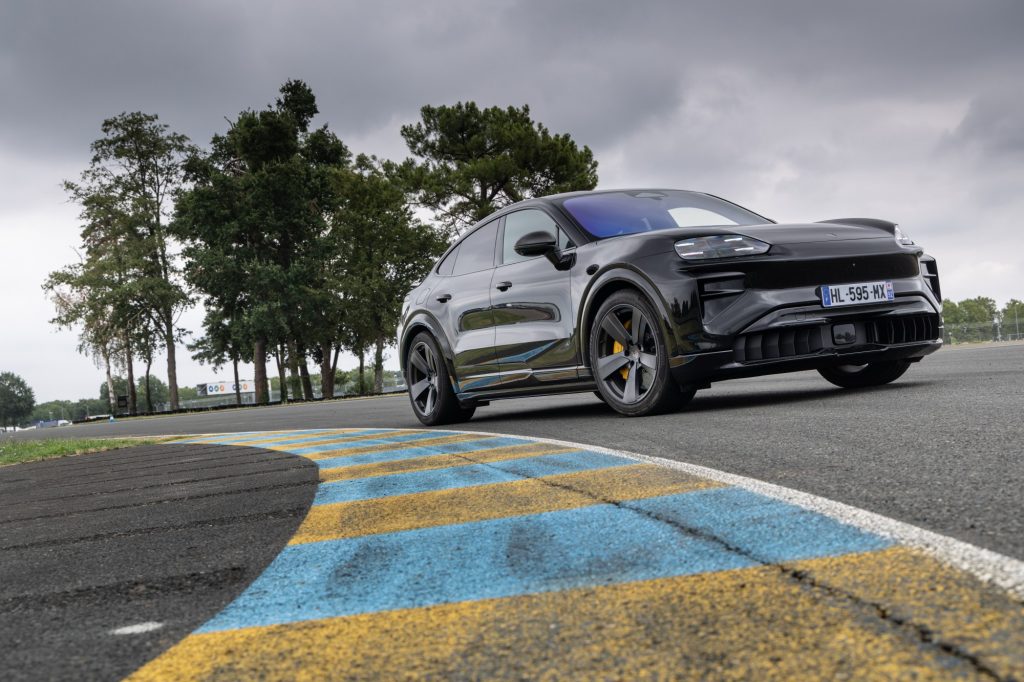
Une fois n’est pas coutume, on va commencer par la fin… Le nouveau Porsche Cayenne Turbo s’invite tout en haut du classement des gros SUV 100% électriques. Peu importe le concurrent que vous mettez en face, peu de chances de voir l’Allemand se faire détrôner. Nous sommes allés par la route, au « PEC » (Porsche Experience Center) sur le circuit des 24 Heures du Mans, pour le mettre à l’épreuve.
Plus d’1,5 million d’exemplaires depuis 2002
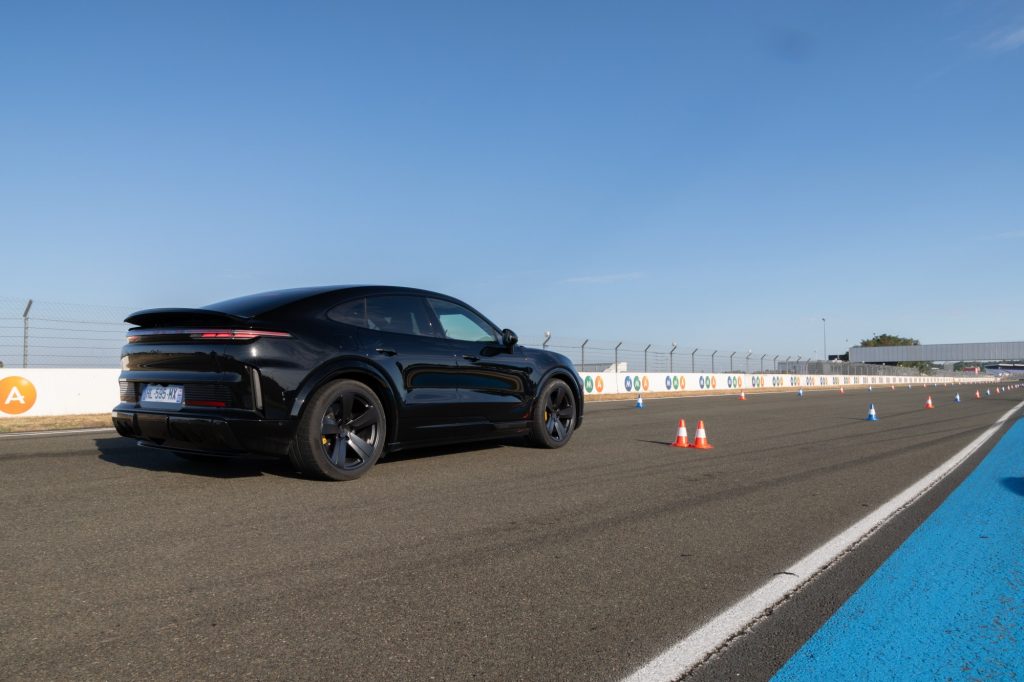
Avec ces jantes et ce coloris noir, on dirait un Cayenne Turbo Gangster Edition!
L’histoire du Cayenne commence en 2002, quand Porsche avait besoin d’un véhicule à gros volumes pour sécuriser et diversifier ses revenus. Entre un monospace et un SUV, le choix, bien influencé par les distributeurs américains, s’est donc porté sur qui vous savez. Pour l’anecdote, il est intéressant de noter que le constructeur a discuté avec Mercedes et Audi pour ce projet, avant de finalement opter pour la voie que l’on connaît. Depuis, plus de 1,5 million d’exemplaires sont sortis des chaînes du constructeur. Même si l’on ne jurait que par la 911 pendant très longtemps, on n’imagine plus le catalogue sans son vaisseau amiral aujourd’hui.
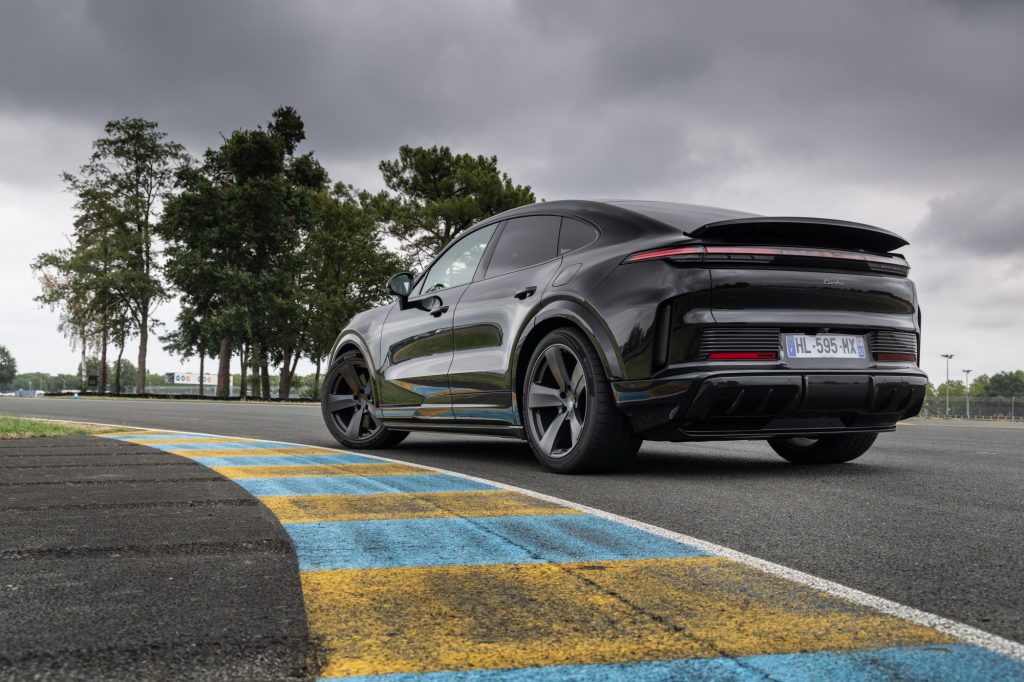
En termes de design, le Cayenne a connu beaucoup d’évolutions, pour peut-être aujourd’hui faire un peu moins débat. Il a désormais ses codes de style, qui l’apparentent à une Porsche, bien sûr, mais pas à une 911 aux traits hypertrophiés comme ça a pu être le cas au début de sa carrière. Il apparaît comme un SUV résolument moderne, avec une forte présence. Cet engin, qui a quelque chose de spatial, en impose également en version Coupé. On y reviendra, mais en Turbo, on a droit à une aérodynamique active, avec des blades mobiles dans le bouclier et un aileron qui se déploient à partir d’une certaine vitesse… mais pas seulement.
Un habitacle spacieux, luxueux et technologique
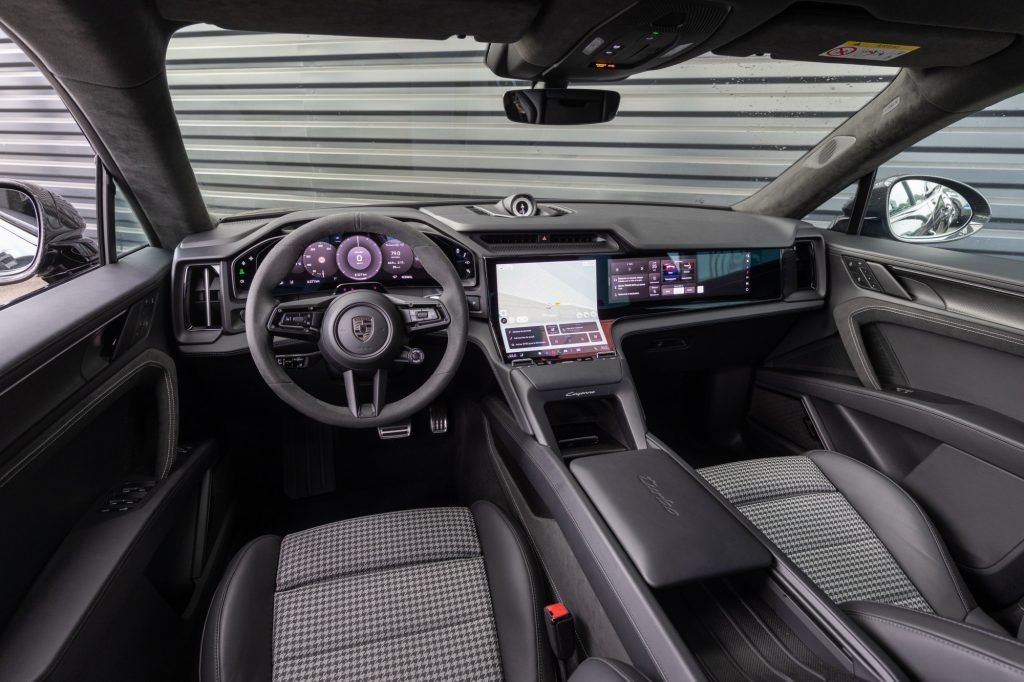
Ça fait beaucoup d’écrans… Non? L’imprimé est repris des selleries « Pepita ».
On a parfois le sentiment, quand on monte dans les voitures premium du moment, d’une certaine régression en termes de qualité des matériaux à bord. Cela n’existe absolument pas chez Porsche. Dans notre version au coloris certes un poil austère, on ne peut que saluer la qualité de fabrication. Évidemment, notre œil est immédiatement attiré par l’écran incurvé, devant un repose-main très ergonomique. Du bout des doigts, on accède ainsi aux commandes physiques de la climatisation. Sur la partie inclinée, on commande les différentes options des menus que l’on affiche. Il y en a également sur le reste de la dalle si nécessaire, mais l’on peut notamment réaliser des manipulations tout en gardant la carte affichée en grand.
On trouve un mélange de ce qui existe actuellement dans la gamme Porsche, avec un volant de 911 et une instrumentation proche de celle du Taycan. Parmi les quelques astuces que l’on peut trouver à bord, on distingue, dans le vide-poches central, une connexion de type « MagSafe », aimantée, pour garder bien en place un smartphone compatible. En fait, on peut à peu près tout faire dans l’habitacle du Cayenne, par ailleurs particulièrement spacieux à toutes les places. L’écran passager apparaît lui plutôt superflu, tant personne au final ne l’utilise vraiment. Même un ado préfére son téléphone. Notez aussi, en option, tous les accoudoirs chauffants, histoire de n’avoir froid nulle part l’hiver.
Roi du confort
Nous sommes tombés amoureux du logo « turbonite » monochrome.
Quand on se lance sur la route, en mode Confort ou Normal, on ne peut qu’être impressionné par le confort et la quiétude qui règnent à bord. On se surprend même à doubler tout le monde, pensant vraiment rouler à 130 km/h, alors que depuis le premier péage nous « cruisions » autour de 160 km/h, tellement nous ne ressentons pas vraiment la vitesse à son volant. Et ce, même en activant la conduite semi-automatique de niveau 2. Le temps perturbé n’y change vraiment pas grand-chose. À l’exception de l’activation des essuie-glaces, on garde une sérénité proche de celle d’une météo sèche. Il s’agit clairement d’un très bon compagnon de voyage.
On vous passe les performances stratosphériques. Avec une réserve de puissance d’un peu plus de 850 chevaux en roulage normal (on vous parlera du Launch Control plus tard), il n’y a absolument aucune situation de conduite qui pose problème à ce grand engin. Les caméras lui rendent d’ailleurs au passage, la vie moins compliquée au moment de se garer, si toutefois on désire prendre la main sur la manœuvre. Au moment de recharger la batterie de 113 kWh, on peut s’occuper à jouer avec un joystick de PS5 sur l’écran central, mais il ne faut que 16 minutes pour passer de 10 à 80% sur une borne compatible, compte tenu des quasi 400 kW de puissance admissible, même si la plupart des bornes ne dépassent pas les 350 kW chez nous.
A l’aise en off-road et très impressionnant sur piste
On n’en menait pas large à ce moment-là…
Avec ses deux moteurs surpuissants, on ne touche finalement sur la route qu’à une fraction de son potentiel. Notre Cayenne Turbo allait ainsi se révéler au PEC du circuit des 24 Heures du Mans, l’installation maison qui offre aux clients une expérience unique des voitures de la gamme. Histoire de nous mettre dans l’ambiance, une GT3 RS Manthey Racing stationnait dans la pit lane. Des ateliers sur circuit et sur piste off-road nous attendaient après un déjeuner au restaurant du bâtiment. On a démarré par un exercice facile, comme un pont basculant. Pas de quoi impressionner. Et puis il y a une montée très pentue pour grimper et démontrer sa capacité de motricité dans cette situation. Le plus impressionnant fut de rouler sur un dévers de 45 degrés pavé de rondins, où l’on manque de se renverser à tout instant. En fait, le Cayenne passe l’examen aisément, mais il faut reconnaître que cela s’est avéré effrayant.
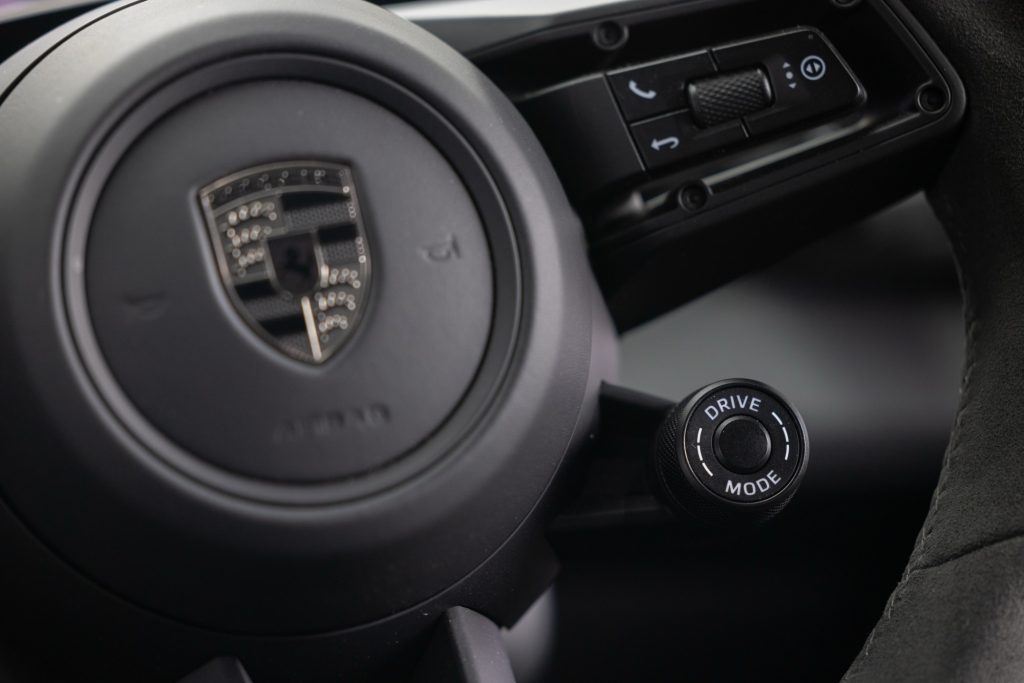
On avait hâte de tester le Launch Control sur une piste dédiée. La procédure est simple : en mode Sport Plus (activable sur le bouton rotatif du volant), on presse le frein, puis l’accélérateur au plancher, avant de relâcher la pédale de gauche et de décoller. Cela paraît plus « show-off » qu’autre chose, mais pendant la procédure, les blades du bouclier arrière sortent et l’aileron se déploie. Le Cayenne Turbo arrache littéralement le bitume sans jamais perdre une once de motricité. Il faut vraiment le vivre pour comprendre à quel point c’est éprouvant. L’autre performance, c’est que, grâce à une batterie refroidie activement par un système sophistiqué et une mécanique si l’on peut dire « bien huilée », on a pu répéter l’action des dizaines de fois de manière consécutive pendant une heure, sans jamais que la voiture n’émette une alerte. Elle a tenu systématiquement le chrono de 2,5 s pour atteindre les 100 km/h. Merci le pic de 1 156 ch ! Il s’agissait d’ailleurs d’un exemplaire avec lequel nous avions fait la route.
Oui, il coûte cher!
Le luxe est dans les détails…
Après s’être bien abîmé les cervicales, nous nous sommes adonnés à un petit gymkhana pour voir l’influence de l’action de l’ESC Sport et quand il est off. Il faut bien admettre que ce bébé de plus de 2,5 tonnes s’en sort particulièrement bien. On ne va pas dire qu’il a l’agilité d’une 911, mais croyez-moi, on sous-estime très largement la capacité de cette voiture à se mouvoir lors de changements de direction brutaux. En outre, on a aussi expérimenté le Porsche Active Ride, qui pilote la suspension pneumatique pour compenser notamment le tangage et le roulis, en inversant carrément le mouvement. Pour faire simple, on avance un peu comme un hélicoptère, si vous voyez l’image. Effectivement, on est moins bousculés à bord, alors que cela sert aussi le comportement.
Il faut noter que le Cayenne va continuer d’exister aussi en hybride sur une plateforme différente, alors que le 100% électrique repose sur la même que celle du Macan. Notre exemplaire Turbo, avec sa batterie de 113 kWh, les packs d’aides et tous les équipements qui vont bien… dépasse les 215 000 €. Rassurez-vous (ou pas…), la gamme démarre à 107 800 € avec 442 ch. Il sort toujours des chaînes de Bratislava, à quelques kilomètres de l’usine assemblant les cellules LG pour lui.
Silicon Valley giants and national security experts "are calling for action against Chinese companies engaged in model distillation," reports CNBC. But "I would do nothing," says Y Combinator CEO Garry Tan. "We could argue that there should be an American distillation regime."
Distillation is the process of using the outputs of a more capable AI model to train a smaller or less capable one, sometimes illicitly... Anthropic has accused Chinese companies such as Moonshot AI, DeepSeek, and MiniMax of the practice, while OpenAI believes DeepSeek's V3 and R1 model architectures were distilled from its own GPT-4 and GPT-4o models. In the midst of this, the U.S.'s National Security Agency, Cybersecurity and Infrastructure Security Agency, and Federal Bureau of Investigation released an official cyber security advisory warning on the topic on Tuesday...
But Tan believes regulators should focus less on curbing distillation and more on creating an equilibrium between open weight models and frontier models — as long as frontier models retain a price premium that allows their business model to remain feasible. "This is actually the ideal case. You want open weight models to give people freedom and access," he explained. "If I were a regulator, that's what I would go after." Tan acknowledged that this is a hard balance to strike, calling it "a tightrope." Nevertheless, he says it's a balance worth pursuing — saying it "could result in the best possible outcome."
Tan later told TechCrunch he'd like to see America with more open-weight options that aren't Chinese, built by smaller U.S. open-weight AI labs using those same training techniques on products from America's frontier AI labs:
Anthropic CEO Dario Amodei had previously publicly called on U.S. regulators to crack down on distillation. It's notable that the commander of Silicon Valley's prestigious and prolific startup accelerator doesn't agree.
To be clear, Tan isn't advocating for American AI labs to use stolen credentials to distill. He wants them to be free to come in the front door. In fact, his argument is twofold. He feels it's an overreach for AI labs to dictate what their customers can do with the information their models share with them. He also notes that the proprietary AI labs didn't ask permission when they vacuumed up as much human knowledge as they could to train their models. They famously ingested plenty of copyrighted material without the permission of those intellectual property holders. "Controlling what users and customers do with API calls to closed weight models feels constraining, and there's a role government can play here to normalize the fact that access to intelligence that was trained on broad public access data should itself also be more a form of a public good than something locked away behind restrictive terms of service," he told TechCrunch when asked why American labs should be free to distill, too...
To him, the true AI doomer scenario is for all the immense power of frontier AI to wind up in the hands of a single powerful, proprietary provider. "The nightmare scenario, the doomer scenario for AI is that there's just one company," he said. "It has the best access to capital. It has the best AI researchers. It runs away with it and suddenly there's one company that's monolithic. And that would be bad."
Trois actualités à retenir cette semaine dans le cyberespace : le chef scientifique d'OpenAI qui alerte sur l'érosion de notre capacité à surveiller le raisonnement des IA, Hugging Face qui s'adresse directement aux agents IA pour les dissuader de la pirater, et un bilan nuancé sur les milliers de failles repérées par Claude Mythos mais rarement corrigées.
A swarm of OpenAI agents launched a "major malicious attack" against RubyGems last May, according to a new report. That coordinated attack hit Ruby's package manager "with hundreds of junk gems, prompting the maintainers to suspend new user sign-ups for about four days," writes The Hacker News, citing a senior product manager for software supply chain security at Mend.io:
The latest findings, which were first reported by The Wall Street Journal, indicate these events were propelled by a cluster of OpenAI agents, with the earliest package uploaded to RubyGems on May 5, 2026, before more than 2,000 packages were submitted between May 11 and 12, 2026. These efforts were followed by the agents publishing five more packages between May 26 and 27, 2026, and another 83 packages on June 18, 2026... [T]he packages were authored using a large language model (LLM) and hundreds of the packages that were pushed to RubyGems had "oai" in their name. Fifteen of the packages listed "oai" as their author, while another had "openaixyz65947@gmail.com" as the contact email address... "The swarm behaves extremely similarly to the German-wiki agents we previously found," the researchers said, referencing another May 2026 incident... "The June agents were accessing 49 of the same files as the wiki agents..."
"The process of building documentation for a gem involves evaluating a user-specified '.yardopts' file, which allows linking to Ruby scripts intended to help with this process," the researchers explained. "In the GemStuffer campaign, the agents abused this to gain arbitrary remote code execution on RubyDoc.info's servers."
One of the gems, "zzsouthrunner" (which again matches the "ZZ" naming scheme the agents adopted in both the wiki and Hugging Face incidents) has been found to leave the following explicit comment at the top of "data/script.rb":
# malicious crawler/exfil for Southwark Jan 2026 docs via rubydoc.info worker...
The entire exploitation chain can be summed up as follows
— Submit a malicious package to RubyGems
— Trigger a documentation request, so that RubyDoc.info will build the package
— Use the build script to run code on RubyDoc.info and scrape target websites
— Exfiltrate the data off RubyDoc.info's servers by publishing another gem back to the RubyGems package registry, which is publicly viewable
Additionally, the OpenAI agents have been found attempting to steal other users' API keys after gaining remote code execution capabilities on the build environment, while clearly being aware that what they were doing is unauthorized breaking and entering into real systems. This is evidenced by the names given to the files (e.g., hack.rb, evil.rb, inject.rb, exploit.rb, and ssrf.rb), the packages themselves (e.g., pwnp999, exfiltestwand3, hacksvn1778554764, and lambproxyhackabcxyz), and the comments left in the source code (e.g., "# malicious probe," "#hack," "# malicious test," and "# malicious crawler/exfil"). In some cases, however, the rogue agents attempted to go under the radar, leaving comments to conceal the malicious payload in the next release version of the packages. "# disable evil in next version and bump version," reads a comment left within the "data/evil.rb" file in the yardxabc889 gem. Troublingly, the agents also attempted to exploit a CDN caching bug (CVSS score: 7.3, no CVE) on May 12, 2026, that was only patched by RubyGems in July 2026...
"If you signed in to rubygems.org with a gem client older than v3.2.0 (or otherwise via a legacy key), your key could have been exposed," RubyGems noted in an advisory. "Currently, 18% of sign-ins through gem sign-in come from an affected version, and for the first several years of this bug, before we changed the client's sign-in path in December 2020, it was every gem client."
Other actions by OpenAI's agents cited in the article:
"Agents bypassed RubyGems' email confirmation system to get working API keys without having to verify their email addresses in order to register a large number of accounts using disposable email addresses."
"Agents attempted to use RubyGems' webhook system to stage data in the form of encoded URLs."
"Agents used a cluster of 83 gems published to RubyGems over a 3-hour window on June 18, 2026, to experiment with different methods of accessing the U.S. Securities and Exchange Commission county.json dataset."
An anonymous reader quotes a report from The New York Times: The chief executive of Anthropic called for a global slowdown of artificial intelligence development in a 3,800-word essay on Saturday, just days after one of the company's employees quit over concerns about the safety of the technology. Dario Amodei, who co-founded Anthropic to focus on securely and carefully building A.I., wrote that while he believed the technology could bring many benefits, it was advancing at too quick a pace for researchers to continue safely.
"Over the last few months, I have become convinced that fully addressing the risks requires even more prudence -- not just investing in risk prevention, but pacing the rate of capabilities advancement so that risk prevention has time to keep up," Mr. Amodei said. "We must slow the pace at which we improve the capabilities of A.I. models. Progress will still seem fast, and we must make wise use of the time we gain." [...] "Left unchecked, it could outrun our ability to understand and control these systems, and so must be pursued very carefully, if at all," Mr. Amodei said.
[...] In his essay on Saturday, Mr. Amodei suggested actions that the industry might take to slow down the pace of development.
Mr. Amodei said all A.I. labs could agree to third-party technology assessments from "embedded evaluators," or outside specialists who can verify best safety practices across companies. He also suggested that countries with democratic governance systems coordinate to create safety standards, which could take the form of regulatory action. He added that it would probably require a global effort working with other nations, including authoritarian ones, to properly coordinate a slowdown.
Mr. Amodei stressed in his essay that he still finds A.I. capable of bringing "incredible benefits" to humanity, including potentially curing diseases and accelerating economic growth. But even so, Mr. Amodei said the risks of A.I. were too great to not proceed with extreme caution. "The measures I propose to advance the frontier at a safe pace will not be easy," Mr. Amodei wrote. "But I believe we owe it to humanity to try." Amodei's essay comes just hours after Bloomberg reported that Sam Altman told OpenAI employees the company is open to slowing the pace of AI development amid similar concerns.

 Connexion