"In a few weeks, KDE will turn 30 years old," writes core contributor Kevin Ottens, celebrating with some special KDE community data analytics (including a 30-year graph of the number of contributors):
It peaks around 180 on average (and sometimes reaches towards around 200 people) then shrinks again hitting bottom around 110 persons on average in 2017... Since then, we had two major events happening. First, 2018 is the year where we had the first set of KDE Goals being picked by the community, one being "Streamlined onboarding of new contributors". Second, we had the transition to GitLab which was fully delivered early in the second quarter of 2020...
Now it seems like the team size is around 140 people on average, so closer to the all time high of 2010 but we didn't fully close the gap yet. Interestingly though, the commit count is much closer to the one we had in 2010, with a bit less people. We even had an all time high commit count in 2023 which surpassed any other week since the creation of the project. And to make things even brighter, the trends at the end of the plot point upwards. Looks like 2026 will be a very good year. Hopefully the growth will stay stable this time and then the community will be the biggest it's ever been...
[For the KDE Plasma desktop] We find the 2010 dip but it's much less dramatic than in all the other plots. It stabilized much quicker and managed to stay with an almost identical team size. We also find the increase leading up to 2020. And clearly it's one of the projects which benefitted the most of the GitLab transition. It's average team size almost doubled during the transition! Earlier I asked where the increase we could see on KDE as a whole but not on applications was coming from? Well, this is probably it. Like the rest of KDE, 2026 will be a very good year for Plasma as well. I wonder... will it double in size again next year compared to 2020?
"I'm rather happy that KDE as a whole seems very healthy..." the post concludes. "It looks like in almost 30 years KDE built a great community and many awesome products..."
"Kudos to all the people involved for the past 30 years! Even if you're not involved any more you helped contribute something beautiful and precious to the world. We're the living proof that large commons can be created and made sustainable thanks to passionate people."
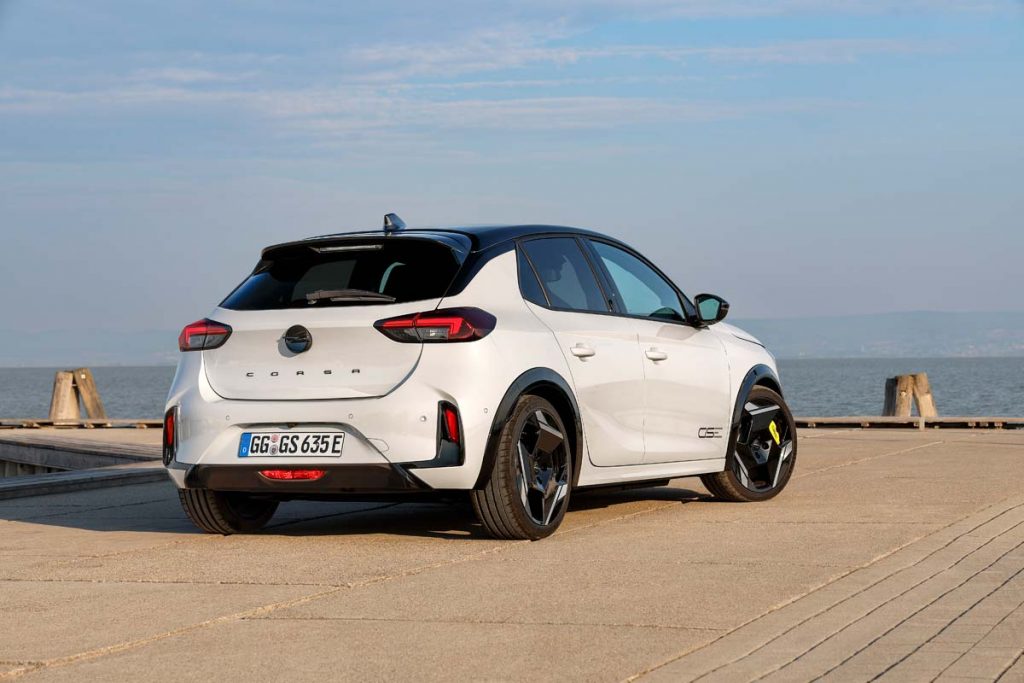
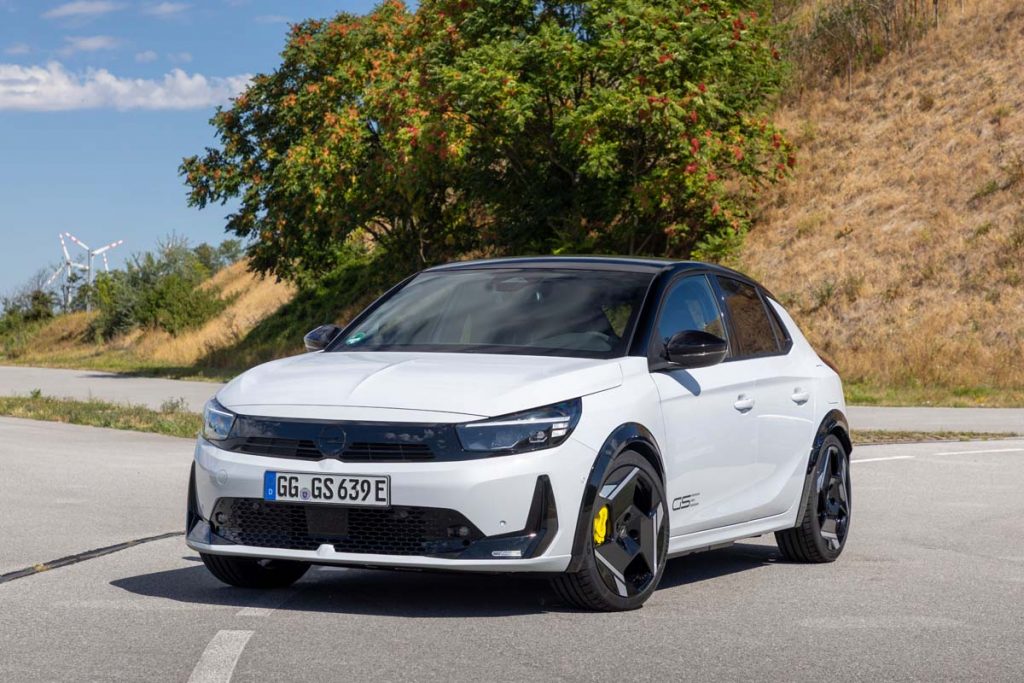
Dix ans après l’arrêt de la Corsa OPC, Opel ressuscite sa citadine sportive, et le fait avec un badge inédit : GSE, pour Grand Sport Electric. Après le Mokka GSE l’an dernier, c’est au tour de la Corsa de recevoir le traitement haute performance version zéro émission. Présentée en mai dernier et dévoilée aux médias en août, elle fera sa première apparition publique au Mondial de l’Automobile de Paris en octobre, avec des commandes ouvertes dès septembre.
Une citadine qui joue des coudes
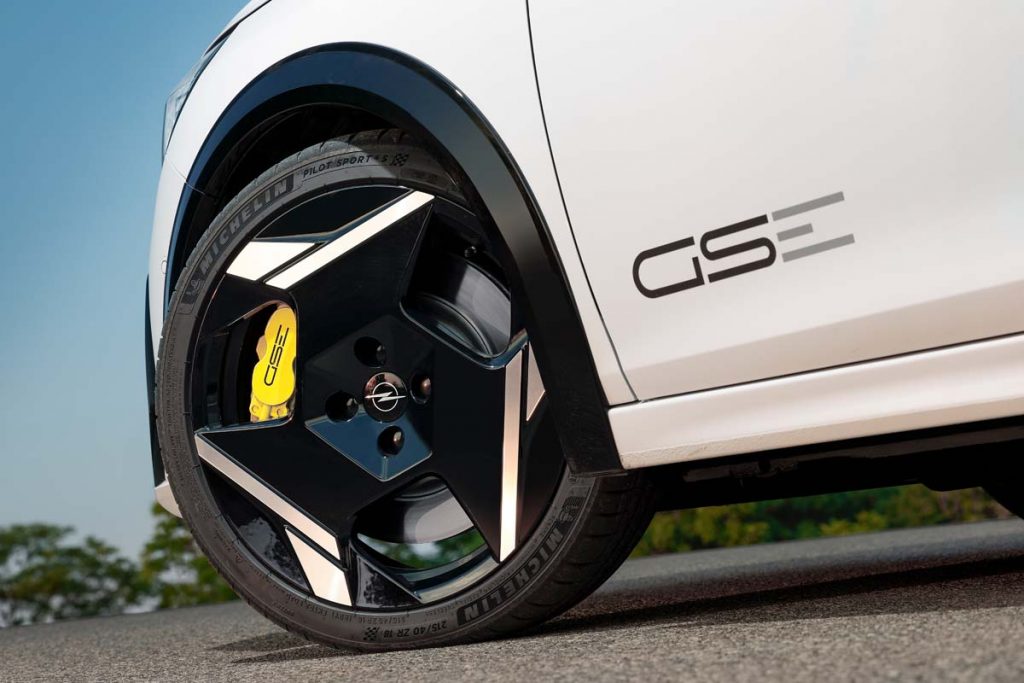
Difficile de confondre cette Corsa avec une version de base. Le bouclier avant spécifique GSE attire immédiatement le regard, tandis que l’arrière adopte un traitement tout aussi affirmé, avec des inserts noirs qui courent sur le bas de caisse et autour des passages de roues élargis. Le toit et le spoiler arrière passent au noir, en contraste marqué avec la carrosserie, et les jantes de 18 pouces à trois branches, chaussées de Michelin Pilot Sport 4S en 215/40, laissent entrevoir des étriers de frein Alcon peints en jaune et floqués du logo GSE. Une signature visuelle qui ne cache rien de ses ambitions.
Un habitacle qui rend hommage à la Corsa GSi
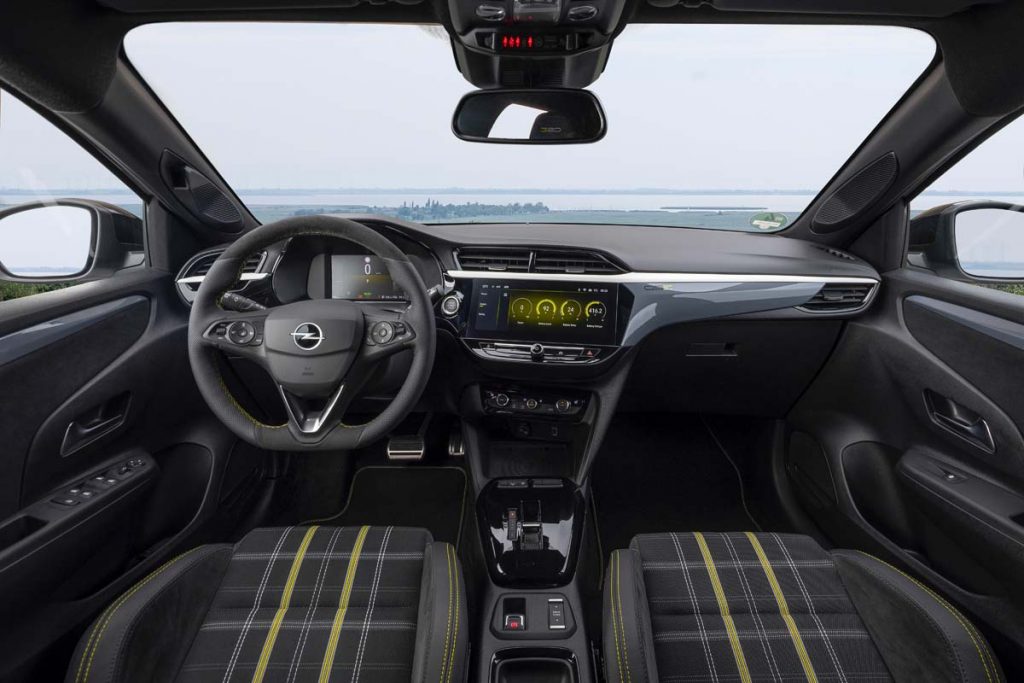
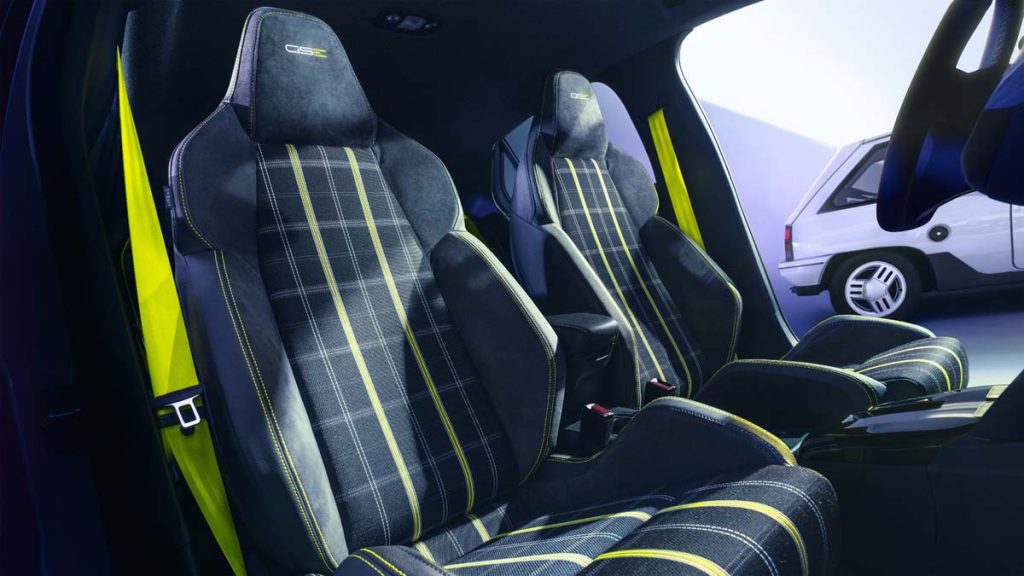
À bord, Opel a soigné les clins d’œil aux Corsa sportives des années 80 et 90. Les sièges Performance, garnis d’Alcantara et floqués du logo GSE, reprennent un revêtement à damier noir, gris et jaune directement inspiré des anciennes GSi, tandis que les ceintures de sécurité jaune vif viennent trancher avec le reste de l’habitacle. Le volant est lui aussi gainé d’Alcantara, les pédales passent à l’aluminium, et la planche de bord arbore fièrement son logo GSE sur fond gris argenté. Niveau technologie, l’écran tactile central de 10 pouces embarque un mode dédié aux données de performance : forces G, valeurs d’accélération et gestion de la batterie s’affichent en direct, avec une instrumentation numérique entièrement personnalisable en face du conducteur.
280 chevaux et trois modes de conduite
Sous le capot, ou plutôt sous le plancher, la Corsa GSE reprend le bloc électrique du Mokka GSE et de son pendant compétition, le Mokka GSE Rally. Le moteur synchrone délivre 207 kW, soit 280 chevaux, et 345 Nm de couple, pour un 0 à 100 km/h abattu en 5,5 secondes et une vitesse de pointe de 180 km/h. De quoi faire de cette Corsa l’Opel de série la plus rapide à l’accélération, tout simplement.
Trois modes de conduite permettent de moduler ces performances. Le mode Sport libère l’intégralité de la puissance avec une calibration pensée pour le circuit, le mode Normal ramène la donne à 170 kW (231 ch) tout en conservant un tempérament sportif, et le mode Eco limite la casse à 140 kW (190 ch) et 300 Nm, avec une vitesse maximale abaissée à 150 km/h pour préserver l’autonomie. Cette dernière est annoncée jusqu’à 336 km en cycle WLTP, pour une batterie lithium-ion de 54 kWh, dont 51 kWh utiles, dotée d’une gestion thermique spécifiquement adaptée aux sollicitations intensives.
Un châssis pensé pour l’exercice
Opel n’a pas fait les choses à moitié côté mécanique. La transmission aux roues avant s’accompagne d’un différentiel autobloquant Torsen, épaulé par un châssis sport surbaissé, avec essieux, barres antiroulis et butées hydrauliques spécifiquement développés pour l’exercice. La direction et les réglages des pédales ont été revus pour l’occasion, et le freinage est confié à des étriers haute performance à quatre pistons.
Dernier détail qui ne manquera pas de faire parler : Opel a développé à Rüsselsheim un son sport actif exclusif à la Corsa GSE, qui adapte sa signature sonore à l’accélération et à la vitesse, façon voiture thermique. Côté équipement, la Corsa GSE ne se prive de rien : sièges et volant chauffants, navigation, caméra de recul à 180 degrés, régulateur de vitesse adaptatif, accès et démarrage sans clé, et même un chargeur bidirectionnel V2L capable d’alimenter un vélo électrique ou un barbecue directement depuis la batterie de la voiture.
Sur circuit et sur route : nos premières impressions
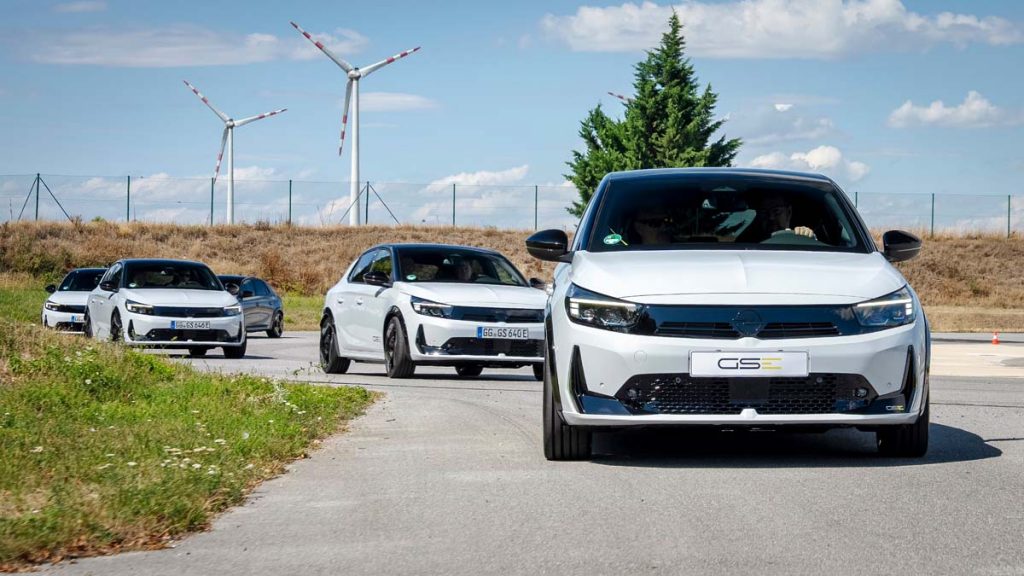
Les premiers essais menés en Autriche, sur un petit circuit fermé puis sur route ouverte, confirment que la Corsa GSE ne se contente pas d’un beau discours marketing. Sur le tracé sinueux, chaussée en Michelin Pilot Sport 4S, l’avant plonge franchement à la corde et se resserre encore lorsqu’on surbraque, tandis que le différentiel autobloquant Torsen fait parfaitement son travail à la réaccélération, à condition de bien débrayer l’angle de braquage pour l’aider. Seul bémol relevé: la direction manque un peu d’informations sur le niveau d’adhérence, même lorsque le mode Sport en réduit l’assistance. Ce mode Sport, seul à libérer l’intégralité des 281 chevaux, retarde également l’intervention de l’ESP, non débrayable, et coupe toute récupération d’énergie au freinage pour offrir une pédale plus cohérente entre la phase de régénération et la phase purement mécanique. En ligne droite, la puissance monte de façon progressive afin d’éviter tout patinage des roues avant, y compris sous la pluie, mais les sensations restent en retrait, et le son artificiel censé recréer une ambiance sportive peine à convaincre.
Sur route ouverte, en usage quotidien, la Corsa GSE ne fait pas semblant : les bruits de roulement se font sentir sur revêtement granuleux, les sièges très enveloppants deviennent fermes sur les dos-d’âne, et la suspension se montre nettement plus remuante que sur une simple Corsa Electric. On est clairement plus proche de l’esprit GTI que d’une GT reposante, dans la droite lignée des anciennes Corsa OPC. Côté consommation, l’autonomie WLTP homologuée plafonne à 354 km grâce à la batterie CATL de 51 kWh utiles, une valeur qu’il faudra confirmer sur un protocole de test plus posé. Car sur un rythme soutenu et une route sinueuse, la consommation relevée lors de cet essai a grimpé jusqu’à 30 kWh/100 km, ramenant l’autonomie réelle à seulement 170 km environ. De quoi rappeler qu’une citadine sportive électrique, aussi joueuse soit-elle, impose encore un vrai compromis entre plaisir de conduite et rayon d’action.
Prix et disponibilité
La nouvelle Corsa GSE s’affiche à 39 990 €, un tarif qui la positionne clairement en dessous de ses rivales directes : la Peugeot e-208 GTi, avec laquelle elle partage l’intégralité de sa fiche technique, réclame 2 910 € de plus, et l’Alpine A290, moins puissante, ne fait pas mieux. Avec le bonus écologique déduit, la facture peut redescendre à 35 290 €. De quoi rappeler qu’une sportive électrique n’est pas forcément réservée aux plus grosses bourses. Les commandes sont ouvertes depuis septembre, en attendant la présentation officielle au public lors du Mondial de l’Automobile de Paris en octobre. Opel confirme au passage que les performances électriques n’ont plus besoin d’un badge premium pour convaincre.
Le 12 mai 2026, Google officialisait une nouvelle catégorie d'ordinateurs portables centrée autour de son IA Gemini : les Googlebooks. Embarquant le nouveau système d'exploitation de la firme, baptisé sobrement Googlebook OS, il a pour vocation de créer une véritable passerelle entre votre smartphon...
There's at least 15 author-driven lawsuits underway against AI companies, while publishers have filed roughly 10 more coordinated suits of their own, notes Publisher's Weekly.
Yet "While the lawsuits play out, some publishers are building bridges."
Google recently announced a partnership with Bloomsbury, De Gruyter Brill, Johns Hopkins University Press, Macmillan, O'Reilly Media, and Penguin Random House to enhance e-books from its Google Play store with AI, allowing readers to interact with the text of the books directly, ask questions and get answers, and develop tools such as quizzes and slideshows... [The CEO of the Author's Guild called the partnership "a positive step forward in the legitimized use of books in the AI ecosystem to the benefit of readers, publishers, and authors alike."]
Of even more significance is the growing number of licensing deals publishers are striking with AI companies. In 2024, HarperCollins became the first of the Big Five to publicly reveal that it had signed a deal to license its content for AI training. The three-year agreement paid $5,000 per participating title, split equally between HarperCollins and the authors. Wiley announced its first AI licensing deal in 2024 and has since made several more. For fiscal year 2026, it reported earning $49 million in revenue from the deals. The company also has a number of strategic collaborations with companies including Amazon Web Services, Microsoft, Anthropic, Perplexity, IQVIA, OpenEvidence, and others.
And publishers are even building in-house AI tools for producing royalty statements, proofreading, and providing customer service:
In its 2025 Salary and Jobs Report, Publisher's Weekly reported that 63% of industry professionals surveyed said their organizations were using AI... Keith Riegert, president of the Stable Book Group and CEO of Perfect Bound, has been a vocal advocate for the use of AI in publishing — despite calling himself a "hardcore techno-pessimist." He tells PW, "I do this because you use AI or you die at this point...." Like many in the industry, he maintains any use of AI must "start with a human and end with a human," and he draws a clear line, avoiding AI for core creative work, such as selecting titles, designing covers, or creating illustrations — reserving it for developmental editing, formatting, and admin instead... What is known is that each of the Big Five is developing proprietary AI systems for internal use, as proven by the numerous AI-related job openings the companies have posted... [And the parent company of Penguin Random House said in 2025 they used AI for marketing and to forecast demand.]
There've been a few high-profile controversies about prominent authors accused of using AI. But Princeton University Press CEO Christie Henry "is less concerned about authors secretly using AI to write than about the time spent policing the situation."
"It pulls us away from having focused time to think," she says. Princeton University Press is currently vetting companies that promise to be able to certify that a given book was written by a human, including Created by Humans, Human Authored, and Verify My Writing. Henry adds that the proliferation of plagiarized, copycat, and pirated books online, now supercharged by AI agents mass producing and reproducing content, is further draining resources, as it demands constant vigilance and takedown requests sent to Amazon, YouTube, and others.
Les prix de la RAM et des SSD sont au plus haut, et à en croire certains comme le PDG d'Acer, ces prix pourraient encore augmenter en cette fin d'année 2026, voire début 2027. Guetter les meilleurs tarifs possibles pour s'équiper et donc plus important que jamais, et nous vous proposons aujourd'hui...
"Australia is considering barring the use of camera-equipped smart glasses in government workplaces..." reports Reuters, "in what it said could be the first ban of its kind."
But meanwhile "more than 70 people who bought, used or were recorded with Meta's smart glasses have sued the social media giant," reports the Los Angeles Times, "claiming their intimate and sensitive images were exposed to workers abroad who are paid to review and label photos and videos."
The contractors in Kenya work for companies that help train Meta's artificial intelligence, according to a proposed class-action lawsuit amended in late August. The smart glasses users, some in California, allege the gadget captured footage of themselves and family members undressing, going to the bathroom, having sex and entering passwords. In some cases, the people said they weren't aware the camera-equipped glasses were recording. One California user, referred to as PL18 in the lawsuit, alleges his glasses were unknowingly recording after he placed the smart glasses on the bathroom counter. "He noticed that at times photos of his family members using the bathroom and bathing began appearing in his gallery — footage no one in his household intended to take," the lawsuit said....
The 230-page lawsuit, filed in a federal court in Northern California, accuses Meta of fraud and false advertising, along with violating other consumer protection laws in various states. Tina Wolfson, one of the lawyers representing the plaintiffs, said the case also centers on Meta's surveillance of people's lives without their consent and the exploitation of their image and likeness. "People who bought these glasses and thought that they were cool gadgets weren't aware that every time they activated AI, video was sent to train Meta's AI," said Wolfson, a principal at law firm Ahdoot & Wolfson in Burbank. Meta disagrees with the allegations and intends to fight them.
"If you use Meta AI, we may review that data to help improve our products and people's experiences — this works the same way as many other companies. We take steps to filter this data to help remove identifying information and to protect people's privacy," a Meta spokesperson said in a statement...
The lawsuit alleges people wearing the smart glasses were unwittingly transmitting data to Meta whenever they used Meta AI by saying "Hey Meta," or sometimes accidentally when adjusting the glasses. "Every activation of the AI features, intentional or accidental, captures video and audio that is transmitted to Meta's servers, routed overseas, and reviewed by low-paid human workers who watch, label, and embed these moments into Meta's AI models," the lawsuit said...
The lawsuit also seeks to block Meta from deploying biometric tools through its glasses. The company has been exploring a controversial feature called "NameTag" that would allow people to identify others... A separate lawsuit, filed in September in a federal court in Illinois, alleges Meta has been using images of people's faces uploaded to their public Facebook and Instagram accounts to train AI that powers NameTag and other AI tools.
Le samedi 19 septembre 2026, les médias taïwanais Economic Daily News (UDN) et Harvard Business Review Taiwan (HBR) ont organisé à Taipei un évènement baptisé "Wangdao 50 : Wangdao Management & AI International Forum". Le principe était de célébrer les 50 ans de la marque Acer, mais aussi de met...
"I would like to verify your technical abilities, so please download the specified file and complete the assigned task..."
Fake job listings aimed at software developers and IT professionals led to 30,000 infected devices in over 100 countries — and 7,000 compromised cryptocurrency wallets, leading to over $10 million (USD) transferred to North Korea. Inc. reports:
The hacks occurred from December 2025 through July 2026, according to a joint cybersecurity advisory issued Friday by Japanese, Australian, German, and U.S. authorities, including the Federal Bureau of Investigation and the Defense Department's Cyber Crime Center... The group reportedly has been active since 2023, carrying out both financially motivated attacks and cyberespionage...
The hackers lure job seekers through social media, online job platforms, gig-work sites and freelance marketplaces. WaterPlum asks responders to take part in virtual technical interviews or complete coding assignments. The attackers then instruct targets to download and run malicious files, sometimes under the guise of completing an assignment or troubleshooting a problem with videoconferencing software. Once the group gains access to a device or network, it uses malware to steal information, including browser passwords, screenshots, files, and cryptocurrency-wallet data. An infected computer can also provide an avenue into the network of the target's employer, opening the door to intellectual-property theft and espionage, authorities said.
The operation overlaps with a separate scheme in which North Korean nationals conceal their identities and locations to obtain remote IT work with companies abroad, officials said.
The malicious files are "hosted on multiple online collaboration software developer platforms and code repositories," the advisory points out, and includes malicious Node Package Manager (NPM) packages.."
Stolen ID images can also be used by North Korean IT workers to impersonate victims to obtain contracts and receive payment in foreign currency, but "The actors can also use stolen sensitive information for extortion." In one case, a North Korean IT worker "extorted a company over payment and published its proprietary source code online. In another case, an IT Worker hired for website maintenance defaced the hiring company's website and rendered the site inaccessible."
The advisory provides clues for employers. It warns these malicious IT workers "tend to favor payment in cryptocurrency, and they may request that remuneration be sent to an account in another person's name." During interviews they'd sometimes used Al face-swapping software, then claimed network issues and disabled their video. And "On holidays celebrated in North Korea, the actors played games and watched soccer videos instead of conducting their usual malicious activities."
Tom's Hardware reports:
Four plaintiffs subscribed to ChatGPT, Claude, Grok, or Gemini filed a proposed class-action lawsuit alleging that the developers of these AI models violated antitrust laws when they agreed to slow AI development. According to the Associated Press, the lawsuit argues that this agreement would "reduce the value consumers get for paid AI subscriptions" and that this coordination started in July 2026 after the leading AI labs signed a statement admitting there is "intense competitive pressure not to unilaterally slow" development.
The plaintiffs recognize the need for AI development to slow for the sake of safety, but they say that Anthropic founder Dario Amodei's cooperation proposal is a "shortcut" that "substitutes collective restraint for individual accountability." Attorney Nick Rowley, the lead counsel for the plaintiffs, says, "AI will quickly spin out of human control and could kill us all if we allow AI safety and protocol ... to be controlled by private self-serving agreements between the world's most powerful 'for profit' technology companies."
"Representatives for Anthropic, OpenAI, Google and SpaceXAI did not immediately respond..."
reports the Associated Press:
The coordination largely took place on Sept. 12, the lawsuit argues, when Anthropic CEO Dario Amodei published an essay urging for industrywide cooperation on decelerating advancements in favor of enhanced safety measures. That same day, OpenAI CEO Sam Altman, SpaceXAI CEO Elon Musk and Google DeepMind's co-founder and chair Demis Hassabis each publicly responded to Amodei's proposals in agreement. But the lawsuit also alleges that the coordination began to take shape months earlier. It points to a statement from July 2026 that high-ranking employees from several of the leading AI labs signed that acknowledged the "intense competitive pressure not to unilaterally slow" development. That statement called on the government to support a global effort to slow automated AI development.
Sam Altman even specificially said "we do not believe we need to wait for an antitrust exemption or legislation to begin the work of providing this confidence," notes Tom's Hardware.
However, the Trump administration shot down this idea... Chinese state media also criticized this announcement, saying that the call to put the brakes on AI development is nothing but a response to Chinese competition, especially as Amodei's essay explicitly mentioned the desire to slow China's progress and widen the U.S.'s gap over Beijing
The Rise and Fall of the Artificial State ultimately asks the question, "How did we cede control of our democracy to the machines, and can we get it back?" according to the Harvard's Arts and Sciences site, FAS Current:
The new title finds Lepore, who used to teach a course at the College titled "The Rise and Fall of the Machine," charting the ascent of what she calls the artificial state: the digital communication infrastructure by which governments and private corporations automate and ultimately control public discourse. Following her Pulitzer Prize win for "We the People: A History of the U.S. Constitution" (2025), "I wanted to think about whether liberal constitutional democracies can survive this moment in time," Lepore shared in a phone interview...
[In the "current ChatGPT moment"] Lepore found herself asking: "Who are the people who are clamoring to be replaced by machines, to have movies made by machines, and novels written by machines?" And who, she continued, is pushing for our government to be determined by these machines? In the book, Lepore notes that technological tools are increasingly influencing elections around the world...
However, she sees the 2026 U.S. midterms as an inflection point. In a recent piece in the Financial Times, Lepore wrote, "This year marks the first AI election. Voters are asking chatbots how they should vote. Campaigns and activists are using AI to analyze the electorate, send micro-targeted messages, produce tailored ads and even deepfakes...."
Lepore stresses in the book that "nobody should trust historians to make predictions," but she believes it's possible for democratic citizens to wrest back control. Referencing proposals such as New York's data center moratorium law, Lepore ends by describing a "growing and increasingly noisy tech backlash."
"It's not foreordained. This isn't inevitable," she said during the interview.
"In the book's epilogue Lepore predicts, as her title suggests, a fall of the Artificial State," writes the California Review of Books. "That argument turns out to be speculative, much more of a hope than a certainty."
[Lepore] does support her prediction by positing that the Artificial State is "poorly designed and badly built," that it has not given people safety and happiness but rather a prison of glowing screens, and that a majority of Americans want more control over AI. To escape the Artificial State we will have to imagine a different future by gaining more knowledge of the past in a search for meaning. Of course, powerful forces want to deny that and turn us into servile automatons.
The Guardian adds that "While Lepore interprets much classic sci-fi, such as Isaac Asimov, as cautionary, she observes that "the architects of the Artificial State seem to have read these stories, unironically, as instruction manuals, guides for how to build robots that would one day rule the world". (The Atlantic writes that "What one gathers from these misreadings is not so much that science fiction itself is nefarious, but that arrested development might be...")
But The Indian Express writes that despite the author's bleak conclusion, "Lepore is not a pessimist. Because the Artificial State is a construct, neither alive, nor truly indestructible, she argues it is still possible to take it apart... [T]his is a clear-eyed reckoning rather than a doomsday tract. It is not an easy read, but an essential one for anyone unsettled by the pace of the AI wave."
"New research led by Stanford Medicine reveals that what we call the brain is two distinct organs that evolved independently over hundreds of millions of years," Stanford Medicine announced this week:
The new research finding shows that the human brain consists of two ancient nervous systems cleverly packaged together — a more primitive part that regulates our hearts' beating, our breathing and other functions, and another that makes us distinctly human, capable of poetry, mathematics and wondering about our own origins. The discovery could help explain why scientists have struggled for decades to grow certain types of brain cells in the laboratory — and it opens new avenues for studying devastating diseases that affect the brain stem...
[S]cientists have struggled for decades to generate human hindbrain neurons in the laboratory. This gap has hampered research into devastating diseases affecting the brain stem, including spinal muscular atrophy and amyotrophic lateral sclerosis... The researchers' breakthrough came from studying the earliest moments of embryonic development... [Study co-authors Carolyn Dundes and Rayyan Jokhai] discovered that the hindbrain follows a separate developmental path, running in parallel to — rather than branching off from — the pathway that creates the forebrain and midbrain... This revelation explained decades of frustration in the field — scientists had been trying to turn one type of progenitor cell into another that it is fundamentally incapable of becoming... Armed with this knowledge, the researchers for the first time successfully coaxed human pluripotent stem cells (a kind of cell that can create any cell in the human body) to become functional hindbrain motor neurons in the laboratory...
Finally, the researchers looked back over 550 million years of evolutionary time. They found the same two-origin brain pattern in chickens; zebrafish; and, remarkably, in acorn worms, tiny creatures living on the ocean floor that share a distant common ancestor with humans. Jellyfish, which diverged from humans about 600 to 700 million years ago, have two nervous systems at different ends of their body. "Our research suggests that evolution took two existing neural systems and pushed them together spatially," Loh said. "Having the brain as one organ would probably be more efficient, but we rely on this primordial way to make the brain as two separate pieces."
Thanks to Slashdot reader Beeftopia for sharing the article.
Bonjour à tous et bienvenue dans ce nouvel épisode de La Semaine Automobile. Au programme : un bras de fer entre la FIA et l’ACO sur l’avenir des 24 Heures du Mans, le calendrier F1 2027, un marché électrique qui explose en France, un Range Rover qui fait la chasse aux écrans, et une Alpine A110 à saisir. C’est parti.
À l’inverse, les VE importés en Chine s’effondrent : seulement 125 unités en juillet. Les marques chinoises ont tout simplement rattrapé, voire dépassé, les occidentales sur leur propre terrain, jusque dans le premium.
Grosse tension en endurance. La FIA envisagerait de se passer de l’ACO et des 24 Heures du Mans pour 2027. Les contrats entre les deux instances ont expiré en juin, la FIA réclame plus de pouvoir et de moyens, et une procédure d’appel d’offres pour un nouveau promoteur serait à l’étude. Mise à jour : la FIA confirme qu’un accord tient bon pour 2027, mais rien n’est réglé au-delà.
The European Commission "proposed on Thursday banning children under 13 from social media, with parent-supervised accounts until 15," reports Reuters.
"Enforcement would rely on a tool Brussels built itself" — a free, open-source age verification smartphone app "that tells a platform whether a user meets an age threshold without revealing their identity..."
If passed, the proposed Kids Act would create the world's largest social media access restriction, covering 450 million people across 27 countries... [The EU-built age-verification app] is being rolled out through member states, with seven pilot countries: Cyprus, Denmark, France, Greece, Ireland, Italy and Spain. The Commission expects EU-wide availability by the end of 2026.
It will also be used to prove users are over 18 when accessing adult sites, a restriction already implemented under the Digital Services Act...
[T]he system itself is decentralised. Member states run it through issuers they designate, and the proofs live on the user's phone. There is no central EU database of ages or of who verified whom... A user proves their age once to a nationally designated issuer — a body vetted by the member state, which can be a digital ID provider, a bank or a post office. At a restricted site, the app certifies that the user is above the required age threshold. The platform receives only a yes-or-no response. Issuance and verification are handled by separate entities. The proof provider is not told which service the proof was used for. Each proof works only once, preventing cross-service tracking. No identity documents or biometric data are retained. The code is open-source, allowing independent scrutiny.
The significance of the EU approach is that it provides a common age-verification mechanism rather than leaving individual platforms to develop and enforce their own systems.
"Online platforms can easily rely on our age verification app. So there are no more excuses," [EU Commission President Ursula] von der Leyen said...
The proposal must be approved by EU member states and the European Parliament before becoming law.
Non-compliance would risk fines of up to 6% of a tech company's global annual sales, plus supervisory fees, Reuters reported earlier.
The EU's plan follows similar initiatives in Australia, Britain, China, India, Turkey and several European Union countries.
Saturday morning President Trump announced he's creating an AI task force and appointing an AI czar, reports Politico.
"I am forming the AI Force, much like I did Space Force, which has been a tremendous SUCCESS," Trump wrote Saturday in what Politico earlier described as "a lengthy Truth Social post on Saturday morning."
TRUMP: Over the years, there have been many Hoaxes, all generated by the Radical Left Dumocrats, for purposes of destroying our Country. RUSSIA, RUSSIA, RUSSIA, UKRAINE, UKRAINE, UKRAINE, Global Warming, Impeachment Hoax #1, Impeachment Hoax #2 [...] and now, the decimation, or destruction, of AI, commonly known as Artificial Intelligence — And I, as President of the United States, will not stand by and let this happen.
It all began with an attack on our Data Centers, until people realized how wealthy and prestigious they were for the Communities in which they were built. Higher Salaries, Lower Taxes, and Safer Streets, was the result, and the crazed Data Center attack has largely failed, so now [...] they are going straight at AI. We will not in any way hinder or stifle the Growth of this incredible Industry. Rather, we will cherish it, help it, and watch over it, as it grows!
However, we will also be looking for BAD, and we can do that, very easily, with our already existing Criminal and Civil Justice System. For this purpose, I am forming the AI Force, much like I did Space Force, which has been a tremendous SUCCESS, in my First Term. To that end, I will be announcing, in the near future, the AI "Czar" — Only High I.Q. individuals need apply!
Trump concluded by saying AI "is the next Industrial Revolution, or Internet, but will be even larger and more impactful... We are leading China, and the rest of the World, and I intend to keep it that way!"
But what exactly is AI Force? "The White House did not immediately respond to a request to clarify whether the agency would be military or civilian," notes the Washington Post. So now "The tech industry is struggling to make sense of President Donald Trump's surprise announcement," Politico reported Saturday afternoon:
Four representatives for the sector, who were granted anonymity because they were not authorized to speak publicly, told POLITICO that the industry was not widely informed of Trump's decision prior to the Truth Social post. "Nobody knows what the idea even is," one of the people said. Another said that feedback on the idea was not widely solicited within the industry. The White House did not immediately respond to a request for comment...
"I think that he clearly feels pressure to say something, but he's torn because he's just spent the last few days saying that the whole thing is a hoax," Adam Kovacevich, CEO of the progressive tech industry coalition Chamber of Progress, said of Trump and his prior dismissal of AI doomsday scenarios. Since the departure of David Sacks, who stepped down as the Trump administration's previous AI czar earlier this year, the White House has been "making up AI policy as it goes," Kovacevich added. "I think it's clear they've really missed the presence of an organized leader like David Sacks was."
One of the tech industry representatives said they were confused about whether the task force would be charged with formulating more AI regulations or recommending policies that would further stimulate the tech's development. Taylor Barkley, director of federal government affairs at the industry-aligned Abundance Institute, is eyeing it as a way to solidify a light-touch government approach to the technology he says will foster innovation. "Any AI Force or AI Czar should have one job: keep the field open so entrepreneurs at every scale can compete, free from onerous regulation," he told POLITICO. "Existing criminal and civil law can handle bad actors. New permission regimes will stifle the very activity America needs most."
It's worth noting that the day before, California's governor made an announcement. "With Donald Trump and Congress asleep at the wheel, Governor Gavin Newsom is once again taking the lead to strengthen AI safety for all Americans," the governor's office announced Friday. Newsom issued a strong executive order convening experts to help California create new AI safety laws and reporting rules, possibly even requiring safety auditors embedded in labs and emergency "kill switches" in frontier models.
Mashable writes:
Flock Safety offered employees voluntary buyouts on Friday, WIRED reported... Without the buyouts, those familiar with the situation suspect the company would have to lay off some of its 1,500 employees.
WIRED writes that people familiar with the program "say they believe that a significant number of the startup's roughly 1,500 employees may try to depart."
Flock is making the severance offers as it continues to lose customers... The company has had many of its contracts either not extended or dropped this year, which could leave it short of revenue goals, according to two of the people. A wave of vandalism targeting its cameras has unexpectedly increased expenses. Without buyouts, Flock almost certainly would have to lay off some staff, one of the people believes... People familiar with Flock's severance plan tell WIRED that some employees may take the offer amid speculation that the company, which has raised about $1.2 billion in venture capital, might resort to selling off parts or all of its business to stay afloat... One advocacy group identified 93 city and county governments that cut ties with Flock in August alone. Overall in 2026, roughly three times as many local governments have dropped Flock compared to the previous five years.
Flock has recently been building products that extend the company beyond its core license plate reader offering. WIRED reported last month that the company has developed AI-powered investigative software to identify drivers, find potential associates based on patterns of movement, and search across police records and other data. A separate WIRED analysis of Flock's software found tools designed to continuously search camera feeds for people matching written descriptions. WIRED's analysis of Flock's code also found potential integrations with drones and other surveillance systems.
Flock's financial scrambles might explain an incident in Syracuse, New York. The nonprofit news site
Central Current discovered the city's contract said its license plate data wouldn't be shared outside the police department, reports Mashable:
But the department had granted access to other agencies, which police said was an accident. Over roughly a year, searches by officers around the country reached Syracuse's data nearly 4.4 million times. And that wasn't the only surprise in the paperwork. Central Current also found that Flock could keep using Syracuse data after the contract ended. When the city approved cameras from Axon to replace Flock's, Flock said Syracuse couldn't simply end its agreement early. It warned that the city might have to pay for both systems; so even as officials moved to replace the cameras, they faced questions about what Flock could do with the data and what the city might still owe.
Meanwhile, the Texas Department of Transportation "has stopped issuing permits allowing Flock cameras and other automated license plate readers to be installed along state roads..." reports the Texas Tribune. "There were an estimated 13,000 Flock cameras across Texas in August, but hundreds of the devices have been shut down after [governor] Abbott's funding freeze."
And in August Florida's Republican Governor "ordered his state's transportation department to remove the cameras from state roads, saying he didn't want 'a surveillance state.'"
"In April this year, we saw Andy Nguyen turning the PS5 into a Linux-powered gaming PC,"
writes the blog It's FOSS.
It ran Steam games and emulators using the PS5's on-board hardware. But this week Andy announced he's "stopping all my work on PS5 Linux" and "stepping away from the PS5 scene."
stopping work on porting the project to the PS5 Pro, which would've shipped sometime in 2027.
Andy Nguyen: After pouring my heart and months of my life into it, including plans to finish PS5 Pro support and release in 2027, it's all down the sink.
The scene used to be a group of highly talented researchers, but now it is just a bunch of noobs using LLMs and writing hacks they don't even understand. Slop kiddies found the only hypervisor bug left, which I had also found a while ago, and decided to report to Sony. I asked them to at least wait for GTA 6 to come out so that people would have the opportunity to legally purchase the game and also enjoy Linux. They agreed to wait, but not a day passed and they decided to waste it instead.
Or, as It's FOSS tells it:
Running Linux on a PlayStation console is possible because the PS5 Linux project was able to find a way past the hypervisor using exploits Sony had already patched, covering firmware 3.00 through 7.61. ..
[The bug's discoverer writes it was] found with what he calls his "trusty ai clanker machine" and no help from anyone else. He had even agreed to Andy's request to not disclose the findings. Unexpectedly, a third person, still unnamed, found the same bug using AI a few hours later. Anticipating that there would be more people finding the same bug, [he] decided to post the flaw on HackerOne.
The project's GitHub page and all the related repositories are still there. Nothing has been archived as of today, and if you wanted to, you could start contributing to the PS5 Linux project by taking over any pending work or cooking up new improvements... The PS5 Pro support Andy was building never reached the repository, so you would have to start from scratch... While Andy's departure is a blow to the plan for supporting newer PS5 firmware and the PS5 Pro, other contributors have shown that they can deliver work on the loader without him, and I am hopeful more will follow.
Fin juillet 2026, nous vous parlions sur H&Co des IA de chez OpenAI qui s'étaient attaquées au site Hugging Face dans ce qui devait être à la base un "simple" exercice de cybersécurité. Un évènement qui avait de quoi interroger sur les dangers de la croissance exponentielle des capacités des int...
U.S. military intelligence received an inaccurate report this spring that a Chinese ship in the Middle East was transporting components of a nuclear weapons program, reports CNN.
"The US military swung into action with plans to intercept the vessel, according to four sources familiar with the episode."
Armed members of the US military were preparing to board the ship [according to two of the sources]. Military planes were in the air, one of those sources and another source familiar with the incident said. It was only just before the planned operation that officials dug deeper into the report put together by a special operations command analyst and found it had been generated with the help of AI — and that a chatbot the analyst had used inaccurately identified the material the ship was carrying.
The report, according to one of the sources, was "entirely false." But it also "almost started a war," the source said. Any US operation against a Chinese vessel could have risked spiraling into an armed conflict between the two nations.
Across the US military and the intelligence community, officials are pushing to weave AI into nearly every facet of their work, from analyzing the huge volumes of raw intelligence the US collects and selecting targets for strikes, to more mundane applications like managing budgeting, logistics and supply chains. But the episode underscores the profound risks of using this powerful, new and relatively poorly understood technology for targeting in the middle of a war...
Officials say the US can't afford to fall behind in integrating AI in case it must one day fight China or another adversary who would potentially be able to stay one step ahead of the US. In January, Defense Secretary Pete Hegseth released his agency's "Artificial Intelligence Acceleration Strategy" in a bid to speed up the military's use of AI. "We will unleash experimentation, eliminate bureaucratic barriers, focus our investments and demonstrate the execution approach needed to ensure we lead in military AI," Hegseth said in a speech announcing the strategy.
Thanks to long-time Slashdot reader stabiesoft for sharing the news.
The F-16 "experienced an incident," the Texas Military Department said in a statement, adding that "The pilot successfully ejected the aircraft and is receiving care at a nearby hospital."
ABC News reports:
A Texas Air National Guard F-16 crashed in Michigan during a training mission on Thursday afternoon, sparking an hourslong evacuation near the crash site, according to officials.
The incident prompted the evacuation of homes and businesses within 1 mile of the crash site due to a "hazardous chemical spill related to the plane crash," Michigan State Police said... All of the Texas Air National Guard aircraft that were in Michigan for the training were immediately grounded, and will likely remain so for the next 24 hours, according to a U.S. official.
America's War Department has said it wanted to see more military flyovers writes The Daily Beast, adding that the F-16 "was due to perform a flyover at a high-school football game on Friday night, the Alpena News reported."
The military said it was still investigating the cause of the crash, but one pilot told air traffic controllers that he believes his wingman hit a bird before the crash....
The accident followed a Pentagon X post on Thursday after widespread criticism of low-altitude flyovers and maneuvers. "The flyovers will continue until morale improves," it said.
Il y a tout juste un mois de cela, nos confrères de Hardware Unboxed mettaient en ligne une vidéo de test de l'AMD Radeon RX 9050 8 Go. Un test vraiment pas favorable à la petite nouvelle en ce qui concerne les performances pures, puisqu'elle avait du mal à lutter face à une "simple" Radeon RX 7600,...

 Connexion




 Le 12 mai 2026, Google officialisait une nouvelle catégorie d'ordinateurs portables centrée autour de son IA Gemini : les Googlebooks. Embarquant le nouveau système d'exploitation de la firme, baptisé sobrement Googlebook OS, il a pour vocation de créer une véritable passerelle entre votre smartphon...
 Les prix de la RAM et des SSD sont au plus haut, et à en croire certains comme le PDG d'Acer, ces prix pourraient encore augmenter en cette fin d'année 2026, voire début 2027. Guetter les meilleurs tarifs possibles pour s'équiper et donc plus important que jamais, et nous vous proposons aujourd'hui...
 Le samedi 19 septembre 2026, les médias taïwanais Economic Daily News (UDN) et Harvard Business Review Taiwan (HBR) ont organisé à Taipei un évènement baptisé "Wangdao 50 : Wangdao Management & AI International Forum". Le principe était de célébrer les 50 ans de la marque Acer, mais aussi de met...

 Fin juillet 2026, nous vous parlions sur H&Co des IA de chez OpenAI qui s'étaient attaquées au site Hugging Face dans ce qui devait être à la base un "simple" exercice de cybersécurité. Un évènement qui avait de quoi interroger sur les dangers de la croissance exponentielle des capacités des int...
 Il y a tout juste un mois de cela, nos confrères de Hardware Unboxed mettaient en ligne une vidéo de test de l'AMD Radeon RX 9050 8 Go. Un test vraiment pas favorable à la petite nouvelle en ce qui concerne les performances pures, puisqu'elle avait du mal à lutter face à une "simple" Radeon RX 7600,...
