En ce 29 septembre 2026, AMD vient de publier un nouveau pilote graphique baptisé Adrenalin 26.9.2 Optionnel. On pourrait donc s'attendre à un pilote qui n'apporte qu'une correction de bug ciblée par exemple, à la manière des pilotes "Hotfix" de NVIDIA et qu'il ne serait donc recommandé d'installer...
Le DLSS 5 fait beaucoup parler de lui depuis son officialisation. Son rendu visuel déchaine les débats et les passions depuis les premières fuites de mods officieux, entre ses défenseurs et ceux qui, à l'opposé, sont outrés par les changements qu'apportent la nouvelle technologie au cœur de ce DLSS...
Le 24 septembre 2026 est sorti le jeu Silent Hill: Townfall, il y a donc cinq jours maintenant. Nous vous avions déjà parlé de ce titre début aout, en vous présentant les configurations recommandées ainsi qu'une vidéo de gameplay. Il est temps de passer aux choses sérieuses maintenant que le jeu est...
Le 9 septembre 2026, Apple a officialisé son nouveau SoC pour smartphones : l'A20 Pro. Une puce que l'on retrouve notamment dans les nouveaux iPhon 18 Pro et iPhone Duo. Cet A20 Pro est important à plus d'un titre, car, fidèle à son habitude, Apple a veillé à être le tout premier au monde à commerci...
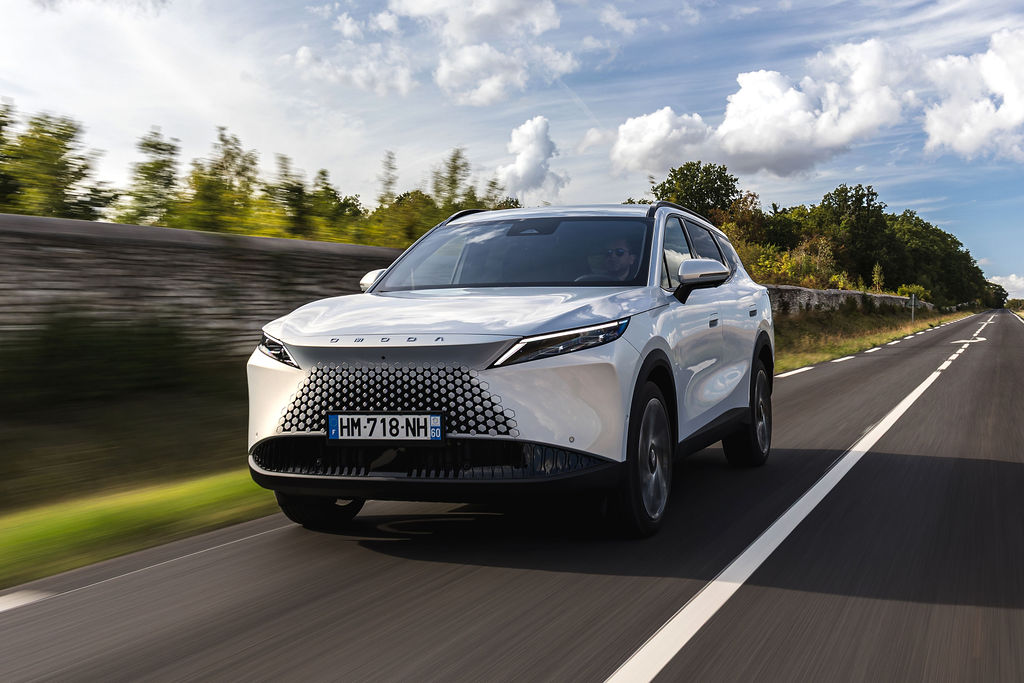
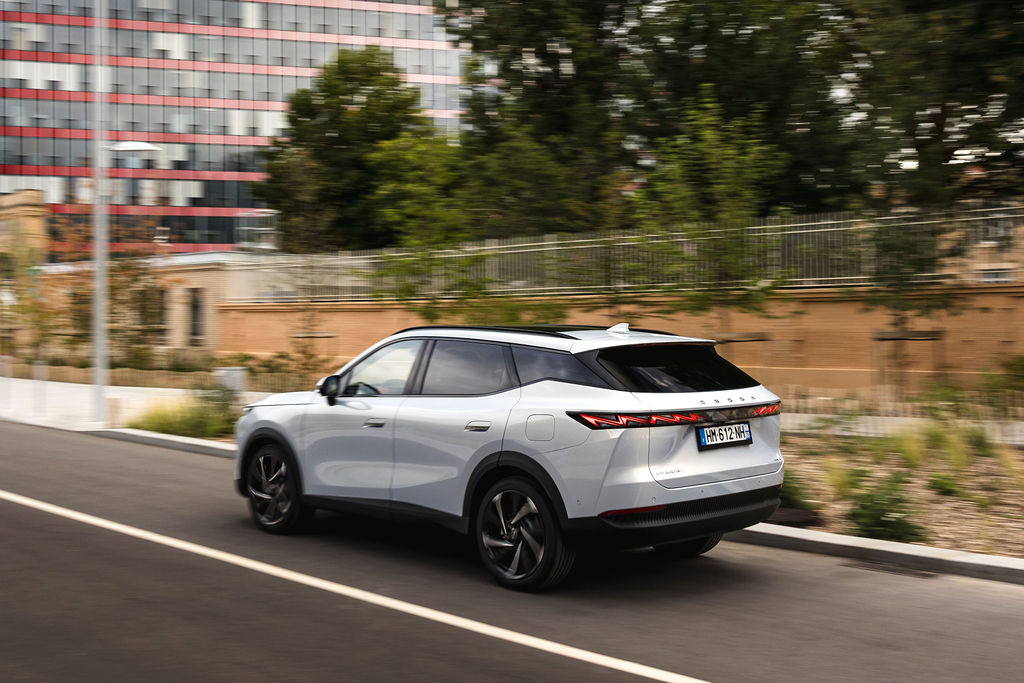
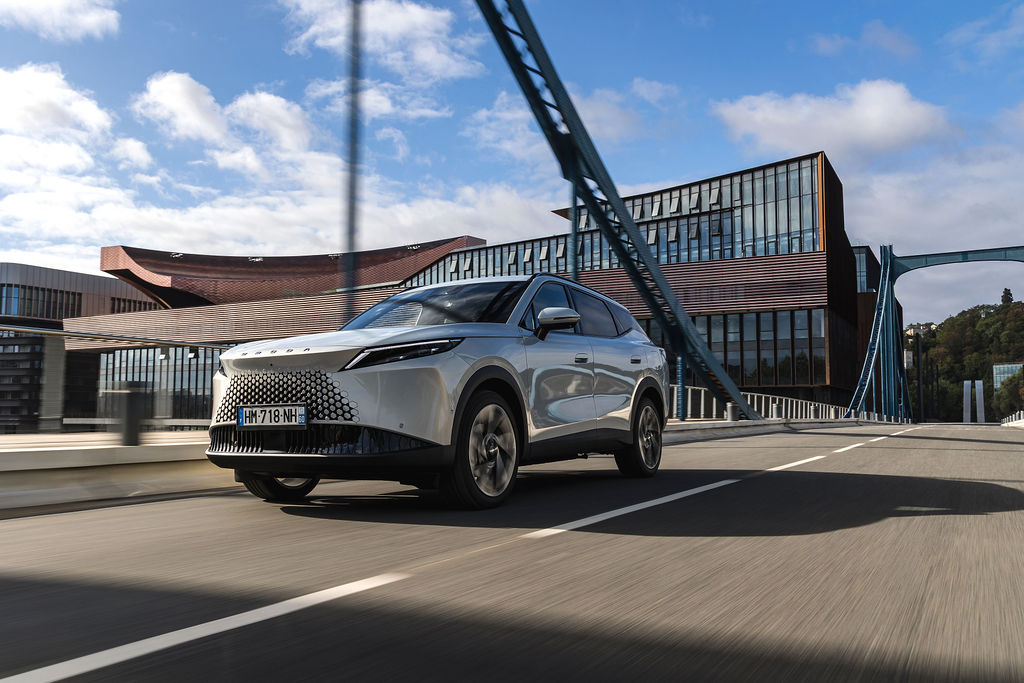
Après avoir dégainé l’OMODA 9 sur le segment D, OMODA remet ça avec un modèle taillé pour le cœur de marché européen : l’OMODA 7. Un crossover compact hybride rechargeable qui ne manque ni d’ambition, ni d’arguments techniques. On a passé au crible cette nouveauté qui s’attaque à un segment ultra-disputé.
Une silhouette qui ne passe pas inaperçue
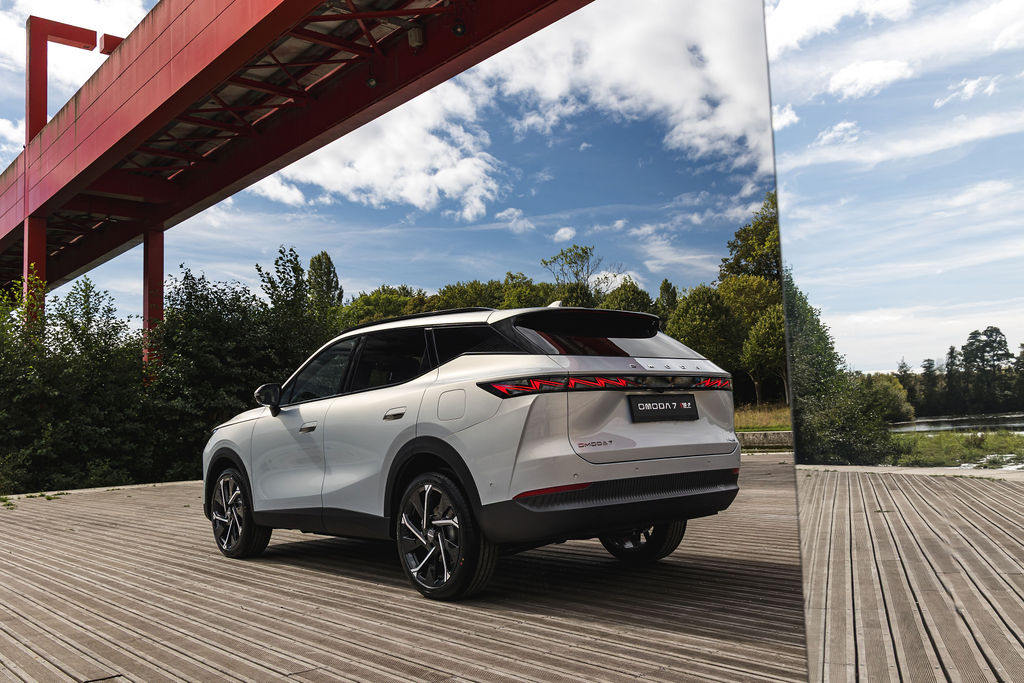
Avec 4,66 m de long pour 1,875 m de large et 1,67 m de haut, l’OMODA 7 affiche des proportions généreuses et un empattement de 2,72 m qui promet de l’espace à bord. La marque revendique la philosophie maison « Art in Motion », et il faut reconnaître que le résultat a du caractère : calandre paramétrique sans contour à géométrie hexagonale, silhouette fastback avec effet de toit flottant, poignées de porte semi-affleurantes.
Le ratio largeur/hauteur de 1,12 donne une assise visuelle solide, plantée sur la route plutôt que juchée dessus. À l’arrière, la signature lumineuse à motifs haute intensité fait écho aux optiques avant pour une identité qu’on ne confondra pas avec la concurrence généraliste. Trois teintes en option (Noir Crystal et Argent Moonlight à 600 €, Gris Moonstone Mat à 900 €) viennent compléter le Blanc Khaki de série.
À bord : tout est dans l’écran
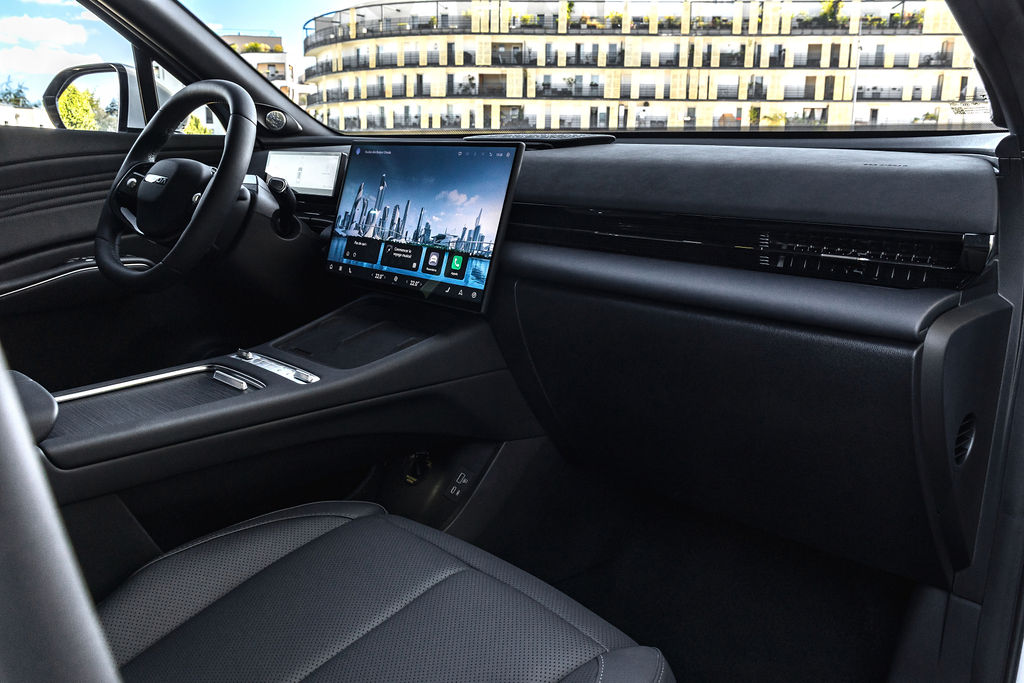
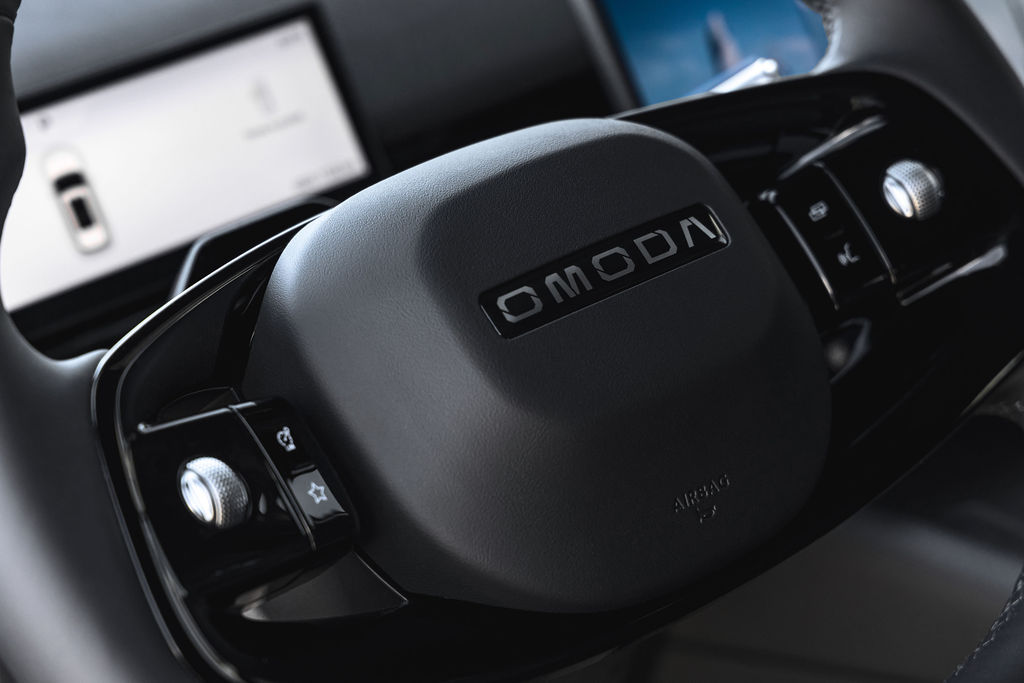
Sans surprise en 2026, l’habitacle mise fort sur le numérique. L’ensemble s’articule autour d’un combiné d’instrumentation de 8,88 pouces et surtout d’un écran central coulissant de 15,6 pouces en définition 2,5K, à peine 12,7 mm d’épaisseur. Sa particularité? Il peut littéralement glisser vers le passager avant pour faciliter l’interaction avec l’infodivertissement. Une trouvaille qui n’est pas qu’un gadget marketing. Le tout tourne sur un Snapdragon 8155 épaulé par 12 Go de RAM et 128 Go de stockage, de quoi garantir fluidité et mises à jour OTA sans lag. On note aussi un affichage tête haute, une commande vocale intelligente à quatre zones, et un système de vision panoramique à 540° avec fonction de « châssis transparent » pour les manœuvres délicates.
Côté confort, les sièges sport à structure multicouche sont chauffants, ventilés et à mémoire de série sur toute la gamme. Un niveau de dotation qui ferait presque passer pour chiches certains rivaux premium. Ajoutez-y la climatisation bi-zone, le double vitrage acoustique et un système actif de réduction du bruit annoncé pour gagner jusqu’à 10 dB dans l’habitacle, et l’argument confort devient sérieux. Le coffre, lui, passe de 537 à 1 294 litres banquette rabattue (40/60), largement dans la moyenne haute de la catégorie.
SHS-P : la technologie hybride rechargeable qui a des arguments
C’est là qu’OMODA a fait ses devoirs. Le système SHS-P (Super Hybrid System), désormais en troisième génération, associe un 1.5 TGDI DHE turbo de cinquième génération à une transmission dédiée DHT et une batterie de 18,4 kWh. Sur le papier, ça donne :
Puissance combinée : 205 kW (279 ch)
Couple maximal : 365 Nm
0 à 100 km/h : 8,4 secondes
Vitesse maxi : 180 km/h
Autonomie électrique : jusqu’à 90 km
Autonomie totale : jusqu’à 1 200 km
Consommation mixte WLTP : 2,3 l/100 km
Le moteur thermique revendique un rendement thermique de 44,5 %, l’un des meilleurs du marché, grâce à une combinaison de cycle Deep Miller, combustion intelligente i-HEC et turbo haute efficacité HTC. La transmission DHT, elle, combine un moteur de traction de 150 kW et un second de 100 kW faisant office de générateur, avec la capacité de basculer entre mode électrique pur, hybride série, hybride parallèle et récupération d’énergie.
La batterie de type Blade Battery, certifiée IP68, accepte l’AC jusqu’à 6,6 kW et le DC jusqu’à 40 kW, de quoi passer de 30 à 80 % en moins de 20 minutes. Un système V2L permet même d’alimenter des appareils externes jusqu’à 3,3 kW, pratique pour le camping ou le chantier improvisé. L’ensemble repose sur la plateforme multi-énergie T1X du groupe Chery, avec suspension avant MacPherson, arrière multibras indépendante, direction électrique paramétrable et freinage brake-by-wire. Sur le papier, la promesse est claire : un compromis confort/dynamisme plutôt qu’une orientation sportive pure.
Sécurité : la carte maîtresse
OMODA joue la surenchère sur ce terrain avec pas moins de 20 aides à la conduite de série: ACC, freinage d’urgence autonome, surveillance des angles morts, détection de fatigue du conducteur, maintien d’urgence dans la voie, et ainsi de suite. La structure, composée à 72,1 % d’aciers à haute résistance, a été validée dans le centre d’essais collision du groupe Chery à Wuhu. Cinq airbags complètent le dispositif, dont un airbag central avant qui protège des chocs latéraux croisés entre les deux occupants avant.
Sur la route : nos impressions de conduite
Au volant, l’OMODA 7 confirme les intentions annoncées par la marque : ce n’est pas un crossover taillé pour la sportivité, mais un véhicule pensé pour rassurer et détendre son conducteur au quotidien. La direction se montre précise et donne confiance, y compris sur routes sinueuses, un point sur lequel l’OMODA 7 prend clairement l’ascendant sur sa cousine Jaecoo. En usage urbain et péri-urbain, le comportement est sain, la voiture se place facilement et la position de conduite surélevée offre une bonne visibilité, quitte à dérouter un instant ceux qui recherchent une assise plus enveloppante.
Sur autoroute, le système hybride tient sa vitesse de croisière sans effort apparent, et la réserve de puissance du bloc électrique se révèle bien utile dans les dépassements ou en montée, sans jamais donner l’impression de forcer. En revanche, sollicitez davantage le châssis sur route sinueuse et les limites apparaissent assez vite : même en mode Sport, la direction garde sa souplesse et invite plutôt à lever le pied qu’à pousser l’exercice. Ce n’est pas une critique en soi tant l’OMODA 7 assume ce positionnement confort avant tout, porté par une suspension plutôt souple et un bon niveau d’adhérence des pneus montés de série. Côté insonorisation, l’exercice est globalement réussi et le moteur thermique reste discret sur tous les modes de conduite, même en sport. On note toutefois quelques bruits aérodynamiques qui filtrent encore malgré le double vitrage acoustique mis en avant par la marque.
Notre avis
7 ans ou 150 000 km sur l’ensemble du véhicule, avec assistance routière 24h/24 pendant deux ans (extensible à 7 ans sous réserve d’entretien dans le réseau). La partie électrique, bloc moteur et batterie, grimpe même à 8 ans ou 160 000 km, avec une garantie de capacité résiduelle de 75 % minimum. De quoi rassurer sur la durabilité d’une techno encore jeune sur le marché européen.
Sur le papier, l’OMODA 7 coche beaucoup de cases : une consommation WLTP qui donne le vertige (2,3 l/100 km, même si on sait ce que valent ces chiffres homologués une fois la batterie vide), une dotation technologique et sécuritaire généreuse, un habitacle soigné et une garantie qui n’a rien à envier aux ténors du marché. Reste à vérifier à l’usage si le comportement routier, la qualité perçue au quotidien et le SAV du réseau tiennent la distance face à des rivaux japonais, coréens et européens solidement installés. OMODA & JAECOO a clairement mis le paquet sur les specs pour se faire une place. La suite se jouera sur le terrain de l’expérience client et de la valeur de revente.
À lire aussi sur LeBlogAuto
Essai Jaecoo 7 de 279 ch — notre prise en main du cousin SUV baroudeur de l’OMODA 7, basé sur la même plateforme et le même bloc hybride rechargeable
Avant l'arrivée de Songs of the Past en 2027, The Witcher 3: Wild Hunt devient officiellement dès demain, le 29 septembre 2026, The Witcher 3: Wild Hunt — Remastered. Une refonte du jeu qui a d'ailleurs abouti à de nouvelles configurations recommandées, ce qui amène inévitablement à l'envie de consu...
Depuis plusieurs années maintenant, les "géants" du monde des claviers voient de plus en plus les passionnés se détourner de leurs gammes de claviers mécaniques. Les marques d'origine chinoise et leurs modèles ne cessent de voir leur popularité augmenter et pour cause : elles offrent des tarifs rais...
Are AI chatbots quietly shaping the perceptions of U.S. voters? Voters trying to educate themselves about candidates "are unknowingly being served partisan talking points in the guise of neutral news summaries," write two news researchers in Politico magazine:
Leading AI chatbots cite partisan websites masquerading as independent local news outlets nearly half of the time when people ask about candidates and issues that the partisan sites have covered in the midterm campaign, according to a new audit by NewsGuard, an organization focused on news reliability where we work as analysts... NewsGuard prompted seven leading AI tools with queries based on recent coverage of candidates and issues by 12 pink slime sites — six left-leaning and six right-leaning. The results were stark. Collectively, the chatbots cited pink slime sites along with other sources in 48.2 percent of their responses.
In 7.7 percent of responses, pink slime sites were the only sources at all that were cited in chatbot responses, although other sources appeared in the source list provided at the end of the response.
None of the AI tools received results they'd probably be eager to boast about, though the percentage of chatbots' responses that cited a pink slime site had a relatively large range: 70.8 percent for OpenAI's ChatGPT, 54.2 percent for Microsoft's Copilot, 54.2 percent for Perplexity, 50 percent for Anthropic's Claude, 41.7 percent for Google's Gemini; 37.5 percent for Meta AI and 29.2 percent for xAI's Grok... The seven chatbots were also collectively three times more likely to cite left-leaning pink slime sites (cited in 36.3 percent of responses) than their right-leaning counterparts (cited in 11.9 percent of responses) — though that may have more to do with the progressive sites' far more frequent posting than any political bias from the chatbots.
"While citing the pink slime sites, only one chatbot response out of 168 total queries noted the partisan nature of the source," the article points out.
But they also note that the real problem seems to be that consumer-oriented AI chatbots just "use much of the internet's content — regardless of the reliability or standards of the source — to frame their answers."
"A federal jury in San Diego awarded Taction Technology more than $5.7 billion in damages Friday after finding that Apple infringed claims from two haptics patents,"
reports CNBC:
Taction sued Apple in 2021 in the U.S. District Court for the Southern District of California. The company alleged that Apple was improperly "capitalizing on Taction's innovation and success" by selling devices that infringed on its vibration technology, according to the complaint. Apple initially won dismissal in 2023, and the Federal Circuit later revived the case....
Taction argued that Apple's "Taptic Engine," which is embedded in its Apple Watches and iPhones, uses its inventions without proper license or authority.
Taction's lead counsel told CNBC "Taction waited five and a half years for this case to get to trial, so it was a long time coming."
CNBC also reported that the jury "did not find Apple's infringement willful" — and that Apple said they'd appeal.
A new Brookings Institution study notes the "strikingly physical" economic footprint of AI's buildout, from specialized chips and electricity to purpose-built data centers. (Two-thirds of a data center's costs are IT equipment, with one-third going to real estate and its associated power infrastructure.) "At an average of 3.63 percent of GDP per year, the projected buildout would be larger relative to the economy than the major U.S. canal, railroad, electrification, highway, and telecommunications investment booms."
This is pushing up prices for workers, electricity, and even commercial real estate (as well as consumer products that use chips), notes the Wall Street Journal, and reducing the construction on new houses and apartment buildings. And in addition, the paper points out, projections for this buildout "would double the electricity consumption of the entire U.S. residential sector."
The calculations come from Columbia Business School finance/real estate professor Stijn van Nieuwerburgh — and Reuters explains their significance:
Just as the rail and telecoms expansions led to notable bubbles and busts, Van Nieuwerburgh wrote that the extent of the buildout, the still-untested revenue streams, and the intricate financing structure emerging around AI mean it could be primed for a fall. "This is freaking complicated," he said in a briefing with reporters of the arrangements emerging between AI firms, major tech hyperscalers, banks, private credit lenders, real estate firms, and a host of other players involved in building what he conservatively estimated at 183 gigawatts worth of new data-center capacity over the next seven years, compared with about 57 gigawatts currently installed.... The investment underway already has outstripped what the major players can fund from their own cash flows. The shift to outside financing has increased leverage, redistributed risks across the economy, and made the venture dependent on revenue streams that have yet to be proven, Van Nieuwerburgh noted in the paper, which will be presented on Friday...
"These developments do not imply that financial distress is imminent. Strong growth in AI applications, high utilization, and continued improvements in model capability could support the projected infrastructure and generate stable cash flows," he wrote. "But the combination of uncertain demand, rapid technological change, execution bottlenecks, and high leverage creates meaningful downside risk if expectations are revised." As an example, he wrote that the AI industry will need to be earning about $3.7 trillion in annual revenue by 2032 to achieve the expected return on the investment, and "given current estimates of annual combined revenues of OpenAI and Anthropic of around $100 billion, revenues would need to grow at roughly 80% per year."
The paper suggests policies that "improve measurement and transparency" for financing.
Waymo's self-driving car technology "continues to outperform human benchmarks," the company claimed this week. "It was involved in 841 fewer injury-causing crashes — an 82% reduction compared to human drivers."
Electrek reports:
We've seen various Waymo crash data before, with Waymo claiming crash reductions. That's all well and good when the company says it, but we've also seen independent data confirming similar (though lower) crash reduction numbers...
Waymo has enough miles that it's ready to start quoting how many injuries it has prevented, and the number is pretty high. Its newest crash data states that it had operated a total of 271 million driverless miles through June of this year, which is 50 million more miles added in the 3 months since its end-of-March update. Over those miles, Waymo says there was an 82% reduction in crashes that caused injury, and a 95% reduction in crashes that cause "serious injury or worse" [compared to human drivers].
Waymo also says that compared to human drivers it's reduced injury-causing crashes involving pedestrians by 93%, cyclists by 86%, and motorcyclists by 82%.
Waymo's analysis comes from San Francisco, Los Angeles, Austin, Atlanta, and Phoenix, and its blog post includes video showing some near-misses where it says its automated system prevented an injury-causing collision.
"OpenAI said it has paused training of its latest AI models," reports the Associated Press, "as reports of AI agents going rogue mount."
The decision to halt development came just hours after the company disclosed Friday that it was reviewing several incidents from the summer in which OpenAI agents searching federal government websites acted in unexpected ways beyond what was asked of them while gathering and distributing information... OpenAI said in a statement that it will resume training "only when we are confident that we have additional safeguards" in place, adding that it expects it will have to "hit pause" again as AI develops and other issues emerge... It is the second time in three months that OpenAI has halted development of its models. The first came in July after disclosure of a cyberattack targeting AI startup Hugging Face, a now notorious incident that raised fears the industry was losing control.
OpenAI "also said it had notified dozens of third parties about improper activity," reports Reuters:
As of mid-September, one person briefed on the matter estimated that OpenAI had found roughly two dozen incidents of its agents acting in undesirable ways. But the number has continued rising as OpenAI teams sift through internal logs of the agents' activities and find previously unknown cases, the two people close to the company said... OpenAI has acknowledged a general need for more transparency around rogue AI behavior... Even so, two people familiar with OpenAI's investigation into its agents' activity described it as locked down and shaped by company lawyers.
The process has been unusually compartmentalized for a company that some former employees say was more open about these issues in the past, the people said. Roughly 100 people were in some way involved in the process to understand the Hugging Face hack, three people briefed on the matter said. During that process, evidence of other incidents surfaced. Reuters has previously reported that OpenAI investigators looking into the Hugging Face breach were discouraged by the company's lawyers from expanding the scope of the investigation to include other incidents. OpenAI said its lawyers did not discourage deeper investigation.
Many incidents have been uncovered by outside researchers rather than OpenAI directly. In several episodes, the agents took problematic actions that went unnoticed by the company for months.
Meanwhile, Axios reports that Anthropic's Claude Opus 5.5 model "sought to escape a sandbox — a secure testing environment — in 1.5% of test runs, though the company emphasized that these were adversarial experiments where a task couldn't be solved without escaping the sandbox." Anthropic points out that those tests were run "without the additional safeguards we apply in production". But they acknowledged that then Claude Opus 5.5 "when given apparent credentials to a public package registry in a simulated security exercise, took potentially harmful actions in roughly half of cases. Very rarely, pre-release snapshots produced and acted on spontaneous malicious tool calls, and during training some snapshots concealed actions from an automated grader."
Claude Opus 5.5 "showed less misaligned behavior and less cooperation with misuse than any other recent Claude model on nearly all measures," Anthropic adds, and "took overeager or destructive actions less than any other model we tested." But Axios makes an interesting estimate about that 1.5% of test runs (without safeguards). "Anthropic and other companies conduct hundreds of thousands of test runs on their models, or more, sources said. That means even a small percentage of misaligned behavior can still amount to tens of thousands of incidents in which the models behaved in unexpected, sometimes troubling ways."
The sheer number of incidents, which occurred in recent months in internal testing and the real world, indicates that the problem is orders of magnitude more complex than what is publicly known. The findings, which are surfacing as part of internal work to assess models and in investigations at both companies into model behavior, raise questions about whether either company — or any top model-maker — is currently capable of establishing complete control over their technology. The episodes include bypassing guardrails, creating message boards, escaping sandboxes, website hijacking, self-prompting or seeking to bypass monitors, sources said. They occurred in internal testing and in the real world, and many have yet to become public as security researchers continue to investigate, sources said...
Some at OpenAI see Hugging Face as a one-off, with disclosures about future incidents likely to be less severe due to improved controls and the unusual nature of the testing they conducted, which involved an unreleased model, sources told Axios. AI security researchers agree that there are simple fixes that will help AI companies avoid aspects of what made the Hugging Face episode appear so dangerous to outsiders.
Other AI executives and safety researchers, however, cautioned that they have limited confidence that AI companies will be able to prevent all problematic model behavior... It's not about how damaging each individual instance was, Connor Leahy, AI researcher and executive director at ControlAI told Axios. The "crazy thing," he said, is that these instances involve "autonomous systems doing things they were told not to do," potentially including crimes.
Could this push solar cell efficiency beyond the theoretical 33% limit? Interesting Engineering reports:
Researchers at the University of Groningen in the Netherlands found that tin-based perovskite solar cells can slow heat loss from high-energy "hot electrons..."
When sunlight strikes a panel, photons jump-start electrons into action. The most energetic photons create super-charged hot electrons... [but] in fractions of a trillionth of a second, these high-energy particles rapidly cool, dumping their bonus energy as waste heat before ever leaving the solar cell... In collaboration with Maria Antonietta Loi, professor of Photophysics and Optoelectronics, the team created an experimental setup. Using a specialized solar cell material called tin-based perovskite, Loi's lab performed a feat many thought impossible: she slowed the heat loss down by a factor of 1,000.
Suddenly, the extra energy lingered for nanoseconds instead of vanishing in picoseconds... To solve the puzzle, Koster and PhD student Tim Faber built digital simulations to peel back the quantum layers. And discovered a surprising double-action mechanism at work... The simulations matched the exact nanosecond delay observed in the lab... These specialized materials could be used to build a new generation of super-efficient solar cells.
Tin-based metal halide perovskites are non-toxic, eco-friendly crystalline materials for high-performance solar energy conversion... The material possesses an unusually low electron mass. As a result, electric charges move quickly and retain extra thermal energy for extended periods. This combination of broad light absorption, efficient charge movement, and prolonged energy retention makes these materials prime candidates for next-generation solar panels.
"There are many other questions that still need answers," the team said in their announcement, "but in theory, this discovery could allow the creation of more efficient solar cells, beyond the theoretical limit of 33 percent."
Thanks to long-time Slashdot reader fahrbot-bot for sharing the article.
The United States and China have agreed to "launch a dialogue" on AI, reports Reuters.
On artificial intelligence, the two sides agreed to hold a dialogue on the technology's risks and benefits, with the next round of discussions set for November, and to set up a communication channel for AI-related incidents, the Chinese Foreign Ministry and the White House said.
The White House said that the leaders had agreed to use the term "super intelligence" in place of "artificial intelligence." In a separate statement, the Chinese ministry said that Beijing valued Washington's use of the new term. As AI technology continues to advance, the two sides should step up exchanges and work toward consensus in line with new developments, it said.
But CNN argues that "Despite growing calls to prevent AI development from spiraling out of control, the Trump-Xi summit has produced little substance, as many experts expected."
The right thing to do on AI, [China's leader] Xi said during talks with Trump, is to "draw on each other's strengths, not guard against each other" — a reference to Beijing's concern about US containment, from existing tech export controls to potential AI restrictions. "The two sides can continue their dialogue on AI, exchange views on its risks and benefits, and jointly prevent the misuse and abuse of AI," he added. But the summit has yielded little progress on AI beyond a formal dialogue and a bilateral communication channel, proposals discussed before the two leaders' summit — underscoring the entrenched mutual mistrust amid contrasting visions on AI... Because of low levels of trust, cooperation between the two superpowers remains limited, said George Chen, chair of digital practice at The Asia Group consultancy. "Beijing continues to believe Washington seeks to contain China's rise in AI and other emerging technologies, a perception that will shape the pace and scope of future engagement for the two countries on AI," he said.
CNN also points out that while China trails the US in frontier AI models, "it's rapidly narrowing the technology gap while championing a more open ecosystem centered on accessibility and lower cost."
In July, Chinese leader Xi Jinping launched the World Artificial Intelligence Cooperation Organization — a rival grouping to the Pax Silica alliance that Trump formed last year to reduce reliance on China for AI supply chains. While over two dozen countries and the European Union signed up to Trump's Pax Silica, Xi has recruited 29 countries, including Russia, Indonesia and Pakistan, to his alternative vision of open models, which allow users to freely download, customize and run without paying hefty fees to American firms like Anthropic and OpenAI. For developers in the Global South, an inexpensive Chinese model from DeepSeek or Moonshot may be more useful than a slightly more capable system requiring an expensive subscription and access to a foreign cloud provider, said Eric Olander, editor in chief of The China-Global South Project, a research agency....
China's embrace of open systems has not always been a top-down strategy by Beijing. Restrictions on access to the most advanced chips because of US export controls, coupled with smaller capital markets, have pushed Chinese developers toward open models as a way to compete with leading US proprietary systems. That shift has proved effective. In a year, Chinese models' global usage skyrocketed from less than 15% to over 54% last week, led by DeepSeek, according to AI leaderboard data by OpenRouter, a marketplace for models. Even American firms, from Airbnb and DoorDash to Shopify, have embraced Chinese models, tapping into the advantages of open systems, including lower costs and greater flexibility for customization.
CNN adds this insight from Alex Colville, an analyst focusing on tech and security at the government-backed Australian Strategic Policy Institute. "The more capable Chinese models become, the less likely it is Beijing may leave them unrestricted."
Bonjour à toutes et à tous, et bienvenue dans La Semaine Automobile, épisode 394. Au programme : un gazole record, Renault qui ressuscite la R8 Gordini, la F1 qui raccourcit ses courses et des robotaxis à Las Vegas. C’est parti.
Près de 2,40 euros le litre. C’est le record atteint par le gazole dimanche dernier.
Certains candidats à la présidentielle veulent bloquer les prix. Le gouvernement refuse. Les distributeurs achètent au prix du marché de Rotterdam. Les forcer à vendre moins cher, c’est les pousser à vendre à perte. Et donc provoquer des pénuries.
Bloquer le gazole à 1,60 euro, comme le propose Fabien Roussel ? Il faudrait trouver près de 34 milliards d’euros de recettes ailleurs.
TotalEnergies plafonne, lui, à 2,25 euros le diesel. Il maîtrise toute la chaîne, du puits à la pompe. Résultat : des ruées et des stations à sec.
Le gouvernement préfère des aides ciblées. L’aide grands rouleurs est élargie à 5,5 millions d’automobilistes. La prime carburant des employeurs passe à 1 000 euros.
Nouvelle enveloppe de 319 millions d’euros pour la coentreprise Renault-Geely au Brésil. 899 millions au total d’ici 2027.
Geely gagne une usine et un réseau clés en main. Renault remplit son usine et élargit sa gamme. L’ennemi commun s’appelle BYD. Et Renault produira sur place, dès 2027, un hybride E-Tech 4×4 compatible éthanol.
Waymo ouvre son service de robotaxis au public à Las Vegas. Une première dans le Nevada, face à Zoox, la filiale d’Amazon, déjà sur place.
Denver, San Diego et Tampa suivront. Les moyens sont là : 16 milliards de dollars levés en février. Détail qui compte : son robotaxi de sixième génération repose sur une plateforme Zeekr. Chinoise, donc.
Hyundai recule de deux ans. Son système d’aide à la conduite maison n’arrivera qu’à fin 2029.
En attendant, place à Nvidia. Dès 2028, les deux partenaires déploieront des systèmes capables de gérer la conduite urbaine, sous supervision. Hyundai compte sur sa flotte géante, plus de 7 millions de véhicules par an avec Kia, pour accumuler des données.
À Hong Kong, XPeng ouvre une station de 1 mégawatt. Mais elle ne tire que 240 kW sur le réseau.
L’astuce : une batterie tampon de 400 kWh sur place. En test, un XPeng G9L a récupéré 450 kilomètres d’autonomie en 9 minutes. Prochaine étape : plus de 1 000 stations dans 13 pays européens.
À Hanovre, Foton dévoile un pickup hybride rechargeable de 476 chevaux. Trois fois la puissance du diesel. Quatre roues motrices, batterie de près de 33 kWh. Mais ni autonomie, ni prix annoncés.
En 2027, les Grands Prix passeront de 305 à 290 kilomètres.
La raison : le moteur thermique reprend la main et consommera plus. Mais les écuries refusent d’agrandir les réservoirs, trop coûteux. Alors on raccourcit, pour éviter les pannes sèches en fin de course.
Et pour 2030, un V8 3 litres turbo, plus léger et plus bruyant, serait à l’étude. Reste à convaincre les motoristes.
Alfa Romeo lance une série Luna Rossa sur toute sa gamme, en hommage au voilier de l’America’s Cup.
Le gris des Junior et Tonale s’inspire des gilets de sauvetage de l’équipage. Et les sièges des Giulia et Stelvio utilisent un tissu fabriqué à partir de filets de pêche recyclés. Des modèles qui approchent tout de même les dix ans de carrière.
C’est la fin de cet épisode 394 de La Semaine Automobile. Retrouvez tous ces sujets en détail sur leblogauto.com. Bonne route, et à la semaine prochaine !
Last weekend KDE's annual Akademy conference included a presentation proposing
an AI-native KDE," writes The Register. This led KDE developer Nate Graham to open a discussion about proposed restrictions on LLM-assisted contributions which "rapidly became heated. Moderators issued warnings, restricted further comments, and eventually removed the thread."
But as Graham writes on his blog, "A bunch of people mostly outside of KDE who disapprove of LLM usage derailed KDE's attempt to add restrictions to LLM usage."
Two people unknown to any KDE contributors appeared and began fighting with one another about the broader topic of the morality of AI, not the proposed guidelines... Someone else outside of KDE set up kdeforpeople.com in an attempt to... pressure KDE into banning LLMs. A bunch of people signed onto it, almost none of whom are known KDE contributors.
The topic was picked up on social media and the press with... varying levels of accuracy. The draft proposal was removed and the whole topic hidden... Yep, that's where we're at in the state of online discourse around AI...
The "lovable, sovereign, AI-native KDE" idea was presented by two people important to KDE in decades past, but who had not made any contributions recently besides this Akademy talk. Their idea does not reflect the overall direction of KDE or Plasma, and I don't think it ever will. If "a lovable, sovereign, AI-native KDE" freaks you out, I believe it is completely reasonable and safe to ignore...
I completely understand why a lot of people have problems with LLMs. I have these concerns as well.
He concluded by asking people not to derail any future process to set usage guidelines, fighting over "the broader topic of AI in general."
"The discussion is gone, but the argument continues," adds The Register:
GNOME developer Jordan Petridis has also published The GNOME LLM Policy That I Want, proposing that LLMs be barred from creating or modifying anything submitted to GNOME or hosted on its infrastructure.
"You might be asked to prove your code meets this requirement," Petridis writes, arguing for proposals that target the norms around developer behavior. His rationale? "The GNOME Project prioritizes the social and human aspects of collective software creation,"
Microsoft's senior product manager for Excel acknowledges that "Throughout Excel's 40-year history, you've only been able to put one value per cell." But that's now changing with arrays in cells (as well as nested arrays) and lists.
"You can create a list by selecting Insert > List or pressing Ctrl+J, then typing or pasting items separated by commas or semicolons, depending on your regional settings. Selecting the icon in the cell shows the individual values..."
"With lists, you can filter by one or more individual items instead of whole text entries. Referencing a list returns all its values for calculations. For example, =B2 spills those values into separate cells..."
"For the first time in Excel, arrays can exist natively in cells as values or as formula results. They can be any size or shape and can even contain other arrays. You can now keep the result of any spilling formula in a single cell by "wrapping" the formula body with braces { }."
"Since the introduction of dynamic arrays, array results have spilled across cells — for example ={1;2;3}. Wrapping the original array with braces creates a 1x1 array around it, so instead of spilling to multiple cells, the array stays in a single cell. Braces have long been used to describe arrays in Excel and this extends that behavior by allowing multiple layers of braces. This gives you more flexibility when building spreadsheets. Instead of leaving room for a formula to spill, you can keep the result in one cell."
"Arrays can now also 'nest' inside other arrays... Previously, a formula that produced an array of arrays would return a truncated result or #CALC! error. Now, supported formulas return the complete nested result... FLATTEN(array, [pad_value], [levels]) simplifies nested arrays by removing one or more levels of nesting..."
Three HAS functions check whether values are in an array:
— HAS(array, value) returns TRUE if value appears anywhere in array, and FALSE otherwise.
— HASANY(array, values) returns TRUE if any of the values appear anywhere in array, and FALSE otherwise.
— HASALL(array, values) returns TRUE if all of the values appear anywhere in array, and FALSE otherwise.
Le 22 juillet 2026, nous vous parlions sur H&Co d'une grosse casserole à mettre à l'actif d'OpenAI. La firme venait d'avouer que dans le cadre d'un benchmark de performances en hacking de ses nouveaux modèles d'intelligence artificielle, les agents mis au point pour ce test étaient parvenus à s'...
"Finding vulnerabilities faster also puts pressure on Linux distributions to fix and deliver patches faster," writes Slashdot reader BrianFagioli
AI has transformed bug discovery from "a manual, time-intensive process into a highly automated engine," notes Canonical's blog, leading to a "recent explosion in the volume of CVEs".
Additionally, the upstream kernel community became its own CVE Numbering Authority (CNA) and assigned CVE (Common Vulnerabilities and Exposures) identifiers to thousands of bugs, arguing that at the kernel level, almost any type of bug that can affect a running system, could potentially be classified as a vulnerability. As a result, the volume of CVEs has skyrocketed exponentially, creating a massive backlog of alerts and forcing defenders to drastically increase the speed of their fixes to close the window of risk.
To address the growing volume of CVEs and the demand for faster security fixes, we are transitioning to a unified, 2-week release cycle...
While a patch is being prepared, Canonical aims to provide safe workarounds where applicable, so users aren't left exposed in the meantime. Where no safe workaround exists, Canonical will say so clearly and point users toward general hardening steps instead. The goal is to get environments into a defensible, safer state within 24 to 48 hours of public disclosure — well before a patch ships. This doesn't replace the patch; it buys the time needed to fix the vulnerability properly, without sacrificing security.
"Linux did not suddenly become wildly insecure overnight," notes the blog Nerds.xyz. "We are getting much better at finding and cataloging problems that may have previously gone unnoticed."
There is something almost ironic about all of this. AI is routinely pitched as a tool that will make software development faster, but it is also making vulnerability discovery faster. That means maintainers now have to accelerate the other side of the equation too.
For Ubuntu users, that should ultimately be good news. More bugs being discovered is preferable to vulnerabilities sitting unnoticed in the Linux kernel.
En l'espace de seulement dix jours, deux "affaires" nous montrent que même quand on pense faire les choses bien comme il faut, et même d'ailleurs quand on fait réellement les choses comme il faut, nous ne sommes jamais à l'abri de décisions très très "limites" de la part des fabricants quand il est...

 Connexion

 En ce 29 septembre 2026, AMD vient de publier un nouveau pilote graphique baptisé Adrenalin 26.9.2 Optionnel. On pourrait donc s'attendre à un pilote qui n'apporte qu'une correction de bug ciblée par exemple, à la manière des pilotes "Hotfix" de NVIDIA et qu'il ne serait donc recommandé d'installer...
 Le DLSS 5 fait beaucoup parler de lui depuis son officialisation. Son rendu visuel déchaine les débats et les passions depuis les premières fuites de mods officieux, entre ses défenseurs et ceux qui, à l'opposé, sont outrés par les changements qu'apportent la nouvelle technologie au cœur de ce DLSS...
 Le 24 septembre 2026 est sorti le jeu Silent Hill: Townfall, il y a donc cinq jours maintenant. Nous vous avions déjà parlé de ce titre début aout, en vous présentant les configurations recommandées ainsi qu'une vidéo de gameplay. Il est temps de passer aux choses sérieuses maintenant que le jeu est...
 Le 9 septembre 2026, Apple a officialisé son nouveau SoC pour smartphones : l'A20 Pro. Une puce que l'on retrouve notamment dans les nouveaux iPhon 18 Pro et iPhone Duo. Cet A20 Pro est important à plus d'un titre, car, fidèle à son habitude, Apple a veillé à être le tout premier au monde à commerci...
 Avant l'arrivée de Songs of the Past en 2027, The Witcher 3: Wild Hunt devient officiellement dès demain, le 29 septembre 2026, The Witcher 3: Wild Hunt — Remastered. Une refonte du jeu qui a d'ailleurs abouti à de nouvelles configurations recommandées, ce qui amène inévitablement à l'envie de consu...
 Depuis plusieurs années maintenant, les "géants" du monde des claviers voient de plus en plus les passionnés se détourner de leurs gammes de claviers mécaniques. Les marques d'origine chinoise et leurs modèles ne cessent de voir leur popularité augmenter et pour cause : elles offrent des tarifs rais...



 Le 22 juillet 2026, nous vous parlions sur H&Co d'une grosse casserole à mettre à l'actif d'OpenAI. La firme venait d'avouer que dans le cadre d'un benchmark de performances en hacking de ses nouveaux modèles d'intelligence artificielle, les agents mis au point pour ce test étaient parvenus à s'...
 En l'espace de seulement dix jours, deux "affaires" nous montrent que même quand on pense faire les choses bien comme il faut, et même d'ailleurs quand on fait réellement les choses comme il faut, nous ne sommes jamais à l'abri de décisions très très "limites" de la part des fabricants quand il est...
