❌

Vue lecture

La GeForce RTX 5080 24 Go arriverait au Q1 2027, les fabricants seraient dans l'attente d'informations à son sujet...

Il y a trois jours seulement, nous vous partagions une rumeur assez fracassante. Face à la conjoncture actuelle autour du hardware informatique, NVIDIA aurait pris la décision de cesser totalement d'allouer des GPU GB202 pour que ses partenaires fabriquent des GeForce RTX 5090 et GeForce RTX 5090 D....

  •  

GTA VI sur PC dès début 2027 ? La rumeur qui va faire plaisir !

Il avait fallu attendre 19 mois entre les lancements de GTA V sur console le 17 septembre 2013 et sur PC le 14 avril 2015, autant dire une éternité. Les bruits de couloirs de ces derniers mois laissent clairement penser que Rockstar Games ne devrait pas reproduire le même schéma avec GTA VI, et un l...

  •  

NVIDIA dévoile l'actualité du DLSS 5 : plus de fps, moins d'usage VRAM et deux nouveaux jeux à l'horizon

Nous l'avions tous bien compris lorsqu'il a été lancé début septembre 2026 pour le seul jeu NBA 2K7 : NVIDIA va prendre son temps avec son DLSS 5 et le fameux DLSS 3D-Guided Neural Rendering (DLSS NR) qui fait tant parler de lui depuis plusieurs mois maintenant. En ce 13 octobre 2026, NVIDIA remet u...

  •  

MSI Afterburner se libère, voilà le mode "out-of-warranty" !

Il ne vous aura pas échappé que MSI Afterburner est un logiciel certes très intéressant, mais que l'on sent bridé dans ses capacités. Pour la communauté, il ne faisait guère de doute depuis longtemps déjà que la raison à cela n'était pas bien difficile à trouver puisqu'elle se trouvait directement d...

  •  

Should We Beware of Other License Plate Surveillance Companies Besides Flock?

NPR reports: Police officers in cities across the U.S. are quick to extol the virtues of real-time crime centers as a game changer that helps them find missing children, monitor large events from the skies and scope out dangerous scenes before putting an officer in harm's way. Hundreds of police departments have one of these central hubs, which have existed for years. But many are now being powered with AI software, such as Fusus, from the public-safety technology giant Axon... synthesizing the data it pulls in and allowing police command centers to watch an entire city from one place. Flock cameras, the automated license plate readers (ALPRs), have faced intense backlash in recent months amid stories of abuse. Yet privacy experts say they're just the tip of the iceberg when it comes to police surveillance. "I have been watching the debate about Flock with a little bit of puzzlement," says Andrew Guthrie Ferguson, a law professor at George Washington University. "Because real-time crime centers have not just ALPR cameras and sensors, but video analytics and drones and essentially a way to create a visual single-pane-of-glass vision of what's going on in a city, with time machine capabilities where you can go back and investigate crime." Tools like Axon Fusus, which is a leader in this type of software, also pull in footage and data from police body cameras, law enforcement dashcams, 911 dispatch, gunshot detectors and surveillance cameras, including sometimes those of private businesses that opt in. Its use is growing fast. In 2024, the technology news site 404 Media reported that just over 100 law enforcement agencies had deployed Fusus, which was then its own company and was acquired by Axon that year. The number of law enforcement agencies using the tool has more than doubled since then, according to Axon. Even the American Civil Liberties Union warned concerned citizens in August that "Flock is far from the only vendor," adding that "it's important to realize that its competitors aren't so great either, and that simply replacing Flock surveillance with another company's surveillance won't necessarily solve any of the privacy and other civil liberties problems posed by this mass surveillance technology." Communities can't simply assume that their residents will be better off from a privacy and civil liberties perspective by dropping Flock and replacing it with another ALPR provider, as some customers have done. They should ask hard questions about whether they really want to create that kind of a system, and if they do, ensure it doesn't function as a mass surveillance system... One of Flock's most significant competitors is Motorola. This company, which has been expanding its police technology offerings through an aggressive acquisition strategy in recent years, offers a nationwide law enforcement data sharing system similar to Flock's called the National Vehicle Location Service, operated by Motorola unit Vigilant Solutions. In addition to collecting data from law enforcement clients' cameras, it also runs a large separate commercial ALPR unit that makes deals for tow trucks and other fleet vehicles to carry cameras and collect data for Motorola as they drive around, amassing billions of plate reads (a claimed 500 million monthly, subject to no apparent data retention policy). Known as the Digital Recognition Network, that unit sells its data for commercial purposes but also makes it available to its law enforcement customers for an extra charge. Motorola tells agencies they can have "access to billions of detections beyond your own." Abandoning Flock for another system doesn't protect privacy, their article argues. "If a jurisdiction decides to allow license scanners to be installed, how that system operates is more important than which vendor provides it..." They recommend strong restrictions like data retention limits — and imposing them by law rather than in the language of contracts with vendors (which could always be renegotiated).

Read more of this story at Slashdot.

  •  

Avez-vous un GPU Blackwell de bonne qualité ? Le SPEEDO devrait vous le dire.

2026 est vraiment une année assez folle dans l'évolution des logiciels de suivi des cartes graphiques. Nous avons eu droit cette année à la lecture du hotspot GPU sur les cartes NVIDIA Blackwell, puis la lecture des températures de chaque puce mémoire sur les GeForce, avant que cela n'arrive égaleme...

  •  

How the US Nuclear Plant Fleet Is Leaning Into AI

"This year, nearly the entire fleet of 94 U.S. nuclear reactors has been offered the chance to integrate AI into its operations, and most have taken it," reports IEEE Spectrum: In August, California-based Atomic Canyon launched NIVA, the Nuclear Industry Virtual Assistant, which was developed in cooperation with nuclear-industry groups. The assistant was pilot-tested in nuclear plants run by Constellation Energy and is now available to the United States' entire fleet of reactors.... Meanwhile, the AI-for-nuclear startup Nuclearn says its products have gone to work with more than 65 U.S. partners, a total that includes many traditional plants but also an integration with NuScale Power Corp. that is working toward advanced small nuclear reactors. Microsoft and Nvidia have collaborated on a project to apply AI toward optimizing "the entire life cycle of a nuclear plant, spanning site permitting, design, construction, and continuous operations." The reason for the rapid adoption, according to Nuclearn CFO and cofounder Jerrold Vincent, is twofold. First, the technology companies banking their futures on AI are also keen on a revival of nuclear power to provide the electricity for all those data centers. Vincent says AI is also ideal for addressing some of the nuclear industry's most pressing problems. Many of the things that make reactors so difficult to operate — intricate regulations, along with complex systems for management and maintenance — are exactly the kinds of tasks that AI is good at. The industry is staggering to deal with aging hardware and an aging workforce. If it is going to survive, and have a real shot at a nuclear revival, it will need help from machine intelligence, Vincent says... Right now, the principal output of a nuclear reactor (aside from electricity) is paperwork. Nuclear plants produce piles of documentation to demonstrate regulatory compliance and to record how they respond to any potential problem, from a crack in the sidewalk to a fault in the reactor... Nuclearn's AI products help plants search through large repositories of data more efficiently to more quickly file paperwork with the federal government or figure out how a particular problem was solved in the past. "If you think of it as ChatGPT for nuclear," he says, "it's actually not a bad place to start." It's especially important because the nuclear power industry "has a remarkably skilled but quickly shrinking workforce tasked with keeping old reactors online and possibly starting up new ones to meet surging demand for electricity," the article points out. It also stresses that "So far, both the Nuclearn and NIVA large language models used in the nuclear world report to humans and don't go anywhere near power plant operations."

Read more of this story at Slashdot.

  •  

Let's Encrypt to Cut SSL Certificate Lifetimes to 64 Days in February 2027

Let's Encrypt "will shorten the default validity period of its TLS certificates from 90 days to 64 days, starting February 10, 2027," reports the blog Linuxiac: All certificates issued or renewed from that date will have a 64-day lifespan unless users explicitly select one of the shorter options already available: 45 or six days. Existing certificates will remain valid until their expiration dates. Let's Encrypt expects the final 90-day certificate to expire on May 11, 2027. The organization also confirmed no valid certificates will be revoked during the transition. To help administrators prepare, Let's Encrypt will introduce 64-day certificates in its staging environment on October 14, 2026, allowing users to test their renewal setups before the change reaches production. The move is part of a broader effort to improve web security by reducing how long compromised or incorrectly issued certificates remain usable... Looking further ahead, the organization plans to reduce the default certificate lifetime again, this time to 45 days in 2028. That makes the upcoming 64-day limit an intermediate step rather than the final destination. "Administrators using cron jobs or scripts with hardcoded renewal intervals should review their configurations," the article suggests. "Another upcoming change concerns domain validation. Let's Encrypt will reduce the period during which a previously completed domain authorization can be reused from 30 days to 10 days. In 2028, that period will shrink further to just seven hours."

Read more of this story at Slashdot.

  •  

Game Console Market Craters: Xbox and PS5 Sales Plummet Over 25%

"Video game console sales in the U.S. have cratered," reports Tom's Hardware, with sales through August far below where they'd been in 2025: Mat Piscatella, the video game industry advisor at research firm Circana, shared the numbers on his Bluesky account — PlayStation 5 sales have dropped by 25%, putting it at its lowest point since 2013, when gamers held off buying PlayStation consoles in anticipation of the arrival of the PS4, while Xbox's retail figures have cratered by 33% YTD, putting its sales numbers at an all-time low since its launch almost 25 years ago. Piscatella said price sensitivity is becoming a real problem among gamers, especially as the chip shortage has pushed console manufacturers to raise prices. Microsoft has raised the price of the Xbox three times in the past two years, with the 512GB versions jumping by $100 and 1TB models becoming $150 more expensive. Worse, the company has killed off the 2TB model. This brought the Xbox Series S to $499.99 (512GB) and $599.99 (1TB), while the Xbox Series X now costs $749.99 for the Digital Edition, and the disc version costs $50 more at $799.99. PlayStation fans haven't escaped these price hikes, as Sony raised prices for that console by $100 to $150. The base Digital Edition PS5 now costs $599.99, while the version with an optical drive is priced at $649.99. If you want the PS5 Pro, you'll have to shell out $899.99, while those who want to stream games from their console via the PlayStation Portal must now pay $249.99 — $50 higher than its $199.99 launch price. Even used consoles didn't escape inflation, with Sony bumping the price of refurbished PS5 Slim consoles by $100, bringing them to $399. "Still, Piscatella says the U.S. hardware market has never been more precarious since the early 1980s."

Read more of this story at Slashdot.

  •  

Research Firm Calls Anthropic's Upcoming IPO 'Unprecedented Test of Investor Gullibity'

CNBC reports: As Anthropic barrels toward a potential $2 trillion market cap on the Nasdaq, one research firm is valuing the artificial intelligence company at a mere $150 billion and says Wall Street is about to face an "unprecedented test of investor gullibility." In a report on Tuesday, independent financial research provider New Constructs called Anthropic's upcoming offering the "most ridiculous IPO of 2026." To reach its desired valuation, the firm estimates Anthropic would need to record double the trailing year of profit for Nvidia, the world's most valuable tech company. Nvidia's net income over the past four quarters topped $190 billion. Meanwhile, Anthropic's revenue in 2025 was $4.6 billion as the company racked up a net loss of $42 billion, according to Reuters, which cited a leaked copy of the company's prospectus. Anthropic's mounting operating losses coupled with emerging competition from a plethora of open-source models led New Constructs to conclude that, "We don't think Anthropic has a viable business...." Anthropic didn't respond to a request for comment... The New Constructs report also notes that Anthropic's assertion that AI could pose "a catastrophic or existential risk to humanity" is another reason why investors should avoid the IPO. Reuters reported that Anthropic's IPO prospectus "highlights risks associated with its AI models, which it said could exhibit 'self-preserving behaviors,' including attempts to 'resist shutdown,' to 'conceal or manipulate information' and behavior 'resembling blackmail.'" Now Bloomberg writes that "investors considering Anthropic's planned mega-IPO are grappling with an unusual, and more than a little scary, conundrum: How to value a company that some fear could help wipe out the human race?" Anthropic's valuation also drew some scrutiny from a senior analyst at PitchBook. "A $2 trillion price is about 435 times 2025 revenue, less than 44 times the annualized second-quarter revenue of more than $46 billion and just under 31 times the July run rate."

Read more of this story at Slashdot.

  •  

Gas Cars Fall Below 50% of Global New Car Sales for the First Time

"Gas cars are now a minority of the world's new car sales," reports Electrek. Gasoline-only vehicles made up 49% of global new-vehicle sales in the first half of 2026, down from 73% in 2021, according to Mobility Global data first reported by Nikkei. It's the first time on record that they've been under half. But there's a catch: most of the cars taking their place still have a gas tank... [The share of gas-only vehicles] fell three points in a single year, from 52% to 49%. Battery-electric vehicles grew 12% to 6.87 million units and took 17% of the market, up three points. Conventional hybrids grew 10% to 7.27 million units, or 18%... [T]he rest is diesel, plug-in hybrids and a few minor fuels. Nikkei ties the acceleration to oil. Fuel prices spiked with the conflict in the Middle East, and buyers went looking for lower running costs. The whole car market shrank about 5% in the first half, according to the IEA, so gas-only sales fell twice as fast as the market. Gas car sales dropped the most in China, down 26%, followed by Europe at 13%... Mobility Global has battery-electric sales up 32% in Europe to 1.81 million, up 81% in Southeast Asia to 350,000, and more than doubling in Oceania to 110,000... Yoshiaki Kawano, an associate director at Mobility Global, told Nikkei that few EV buyers go back to gasoline cars or hybrids. He expects demand based on "genuine consumer needs rather than subsidies" to grow as prices come down... [Hybrids] outsold battery-electric vehicles in the first half, 7.27 million to 6.87 million... Only the 17% that's battery-electric burns no fuel at all. So about 83% of the new vehicles sold in the world this year still came with an engine. The article notes that U.S. hybrid sales were up 23%, reaching a record 16.3% of vehicles sold in the second quarter of 2026, while the share of ICE vehicles went down. Gas-only cars went from 73% to 49% of the market in less than five years, and nothing in the data suggests they're getting that share back. The last time gasoline wasn't on top was the early 1900s, when steam and electric cars outsold it in the US. I hate seeing media headlines claiming that "EV sales are down" and that "EV growth has stalled." The data is clear: that's true in the US, but only in the US. The rest of the world is moving to electric vehicles, and it is not slowing down.

Read more of this story at Slashdot.

  •  

'The Social Reckoning' Bombs with $5.5 Million Opening

Why didn't The Social Reckoning enjoy the box office success of 2010's The Social Network, asks IndieWire/A>: [T]here wasn't the same urgency in the story being told. The Social Reckoning focuses less on Zuckerberg, and more on data engineer Frances Haugen's decision to blow the whistle on how Facebook's algorithms were promoting political content that radicalized users, as well as the company's awareness of how its products were contributing to a rise in bullying and teen suicide... [B]ut The Social Reckoning arrives as a much greater threat has emerged from Silicon Valley. Artificial intelligence is dominating the headlines, as fears mount about the economic disruptions it will unleash when millions of jobs are replaced by machines, and, graver still, its potential to trigger a world-ending event... And it's not like Haugen's testimony led to lasting change at Facebook... As IndieWire's Ryan Lattanzio put it, "'The Social Reckoning' argues that the aftermath of their whistleblowing is still somehow felt today. In actuality, living as we do in 2026, it pretty much feels like... no one cared, and nothing changed?" After the first movie's director bowed out, Sony Pictures shied away from selling it as a sequel — but the problems run deeper, the article adds. "The Social Reckoning isn't just a financial failure, it's a critical one, too. The reviews were blistering..." Although on the bright side, "Sony wisely kept The Social Reckoning's budget at $30 million, meaning it won't face losses on the scale of a Digger... " Variety writes that Digger "cratered in its second weekend with $3.2 million from 3,321 theaters, a 60% decline from its dismal $8 million debut. So far, the Tom Cruise satire has limped to $14 million domestically and $35.3 million globally. Warner Bros. spent above $160 million to produce the film, which is shaping up to be one of the biggest bombs ever..."

Read more of this story at Slashdot.

  •  

Blade Runner, Star Trek, Godzilla, Star Wars + Marvel (and Legos): News From New York Comic-Con

There was some Blade Runner news at New York Comic-Con this weekend — and also some news about Godzilla. Ars Technica reports: We got our first look at Prime Video's new sci-fi series Blade Runner 2099 in July at San Diego Comic-Con. With the show's premiere roughly six weeks away, the streamer unveiled the full trailer this weekend at New York Comic-Con... Prime Video will drop all eight episodes of Blade Runner 2099 on November 25, 2026. [It's already earned 2.1 million views in the last 17 hours]. We also got a new trailer for Godzilla Minus Zero, the sequel to director Takashi Yamazaki's gloriously grounded kaiju epic, Godzilla Minus One, which became a major international hit and snagged an Oscar for best visual effects. [1.2 million views in its first five hours] And StarWars.com brings news from the Star Wars universe: Kevin Smith has already announced his Star Wars/Marvel: Hope Assembles crossover comic, interweaving the Marvel universe and the Star Wars galaxy like never before. Now, you're cordially invited to add your own creative ideas to the mix through a LEGO Ideas challenge celebrating the milestone 50th anniversary of Star Wars: A New Hope. Using physical or virtual LEGO bricks, fans are challenged to build "their own epic mash-ups," according to Lego's web site, "in three categories: Character Fusion, Vehicle Fusion, and Scene Fusion." ("Write an engaging description and upload great images of your creation without using AI tools...") Meanwhile, Star Trek fan site TrekMovie.com covered the major Star Trek announcements: There was an interview with 95-year-old William Shatner by Star Trek super-fan Ben Stiller, which ended "with Stiller surprising Shatner by revealing the original Gorn head from his personal Star Trek memorabilia collection."Also announced was a new documentary about the disastrous fan-organized convention in 1982 that tried reuniting cast members from the original series. (Its title? The Con of Wrath: The Craziest Convention Ever!)Gates McFadden (who played Dr. Beverly Crusher on Star Trek: The Next Generation) will write a new comic book to "bridge the 20 year in-universe gap in Crusher's story between the events of the film Star Trek Nemesis and the television series Star Trek: Picard."Paramount+ offered a panel about their series Star Trek: Starfleet Academy (which returns for a second season in 2027).Nacelle Toys even announced new action figures of Star Trek creator Gene Roddenberry and Lucile Ball, owner of Desilu Productions. Reuters also has photos of costumed attendees. But there was also some excitement when an unruly fan shouted over a panel for the Prime Video animated series Helluva Boss. Entertainment Weekly reports it culminated with series star Brandon Rogers shouting "You need to shut the f--- up right now. I'm going to jump over this fence and end you. It's not cute."

Read more of this story at Slashdot.

  •  

Mondial de l’auto Paris 2026: Concept DS F3VER :

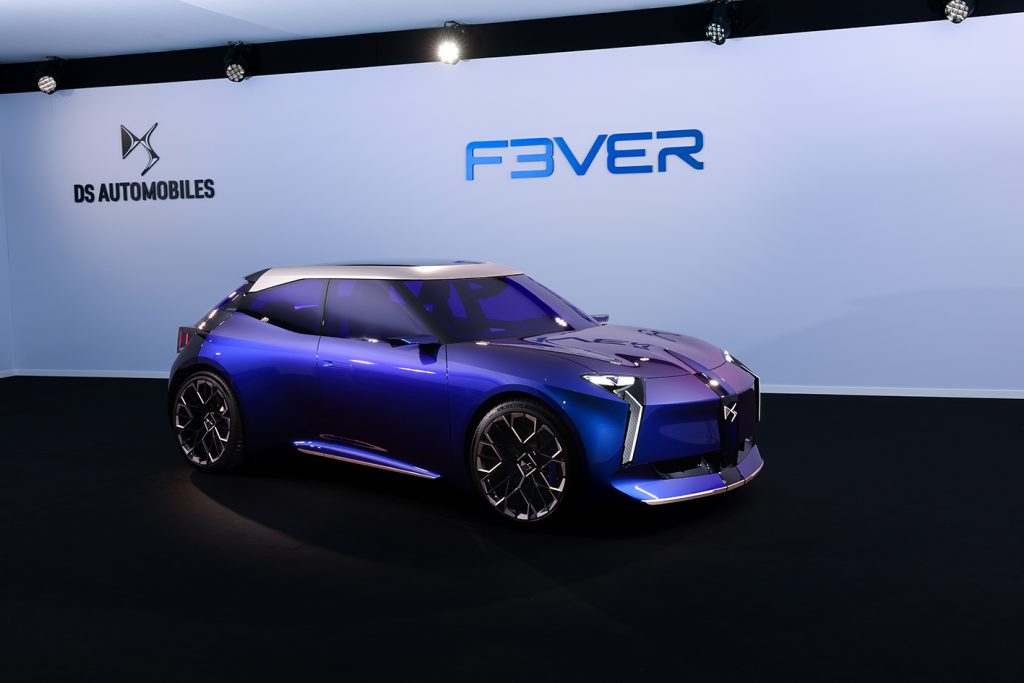
À la veille de l’ouverture du Mondial de l’Automobile, DS Automobiles lève le voile sur DS F3VER, un concept-car compact et électrique pensé comme le manifeste de ses futures créations. Au programme : un design sculptural, une personnalisation poussée et une philosophie baptisée « Design Intelligence ».

DS Automobiles aime les concepts-cars, et la marque le prouve une nouvelle fois. Après l’imposant DS Aero Sport Lounge de 2020, dont la DS N°8 a largement repris l’esprit, voici DS F3VER. Un nom à prononcer « fever » ou « fièvre », selon la langue. La marque assume : il s’agit de provoquer une émotion instantanée, une « fièvre » positive chez ceux qui le découvriront sur son stand parisien.

Contrairement à l’Aero Sport Lounge et ses 5 mètres, F3VER joue la carte de la compacité. Le concept mesure 4,19 m de long, 1,85 m de large et seulement 1,46 m de haut. Pas de SUV cette fois, mais une silhouette basse et ramassée, qui annonce des proportions inédites pour la marque. De quoi laisser imaginer un futur modèle compact, sous la DS N°4 ? DS n’en dit rien, mais le « 3 » glissé dans le nom ne manquera pas d’alimenter les spéculations.

Autre précision mise en avant par la marque : DS F3VER a été entièrement réalisé en interne, par les équipes du DS Design Studio.

Un « totem » à l’avant comme à l’arrière

La face avant s’articule autour d’un élément vertical, que DS nomme « totem », qui porte l’emblème de la marque. Il est encadré par une nouvelle signature lumineuse verticale en forme de Y. On retrouve ici la logique initiée par la N°8 et sa signature verticale, mais poussée plus loin.

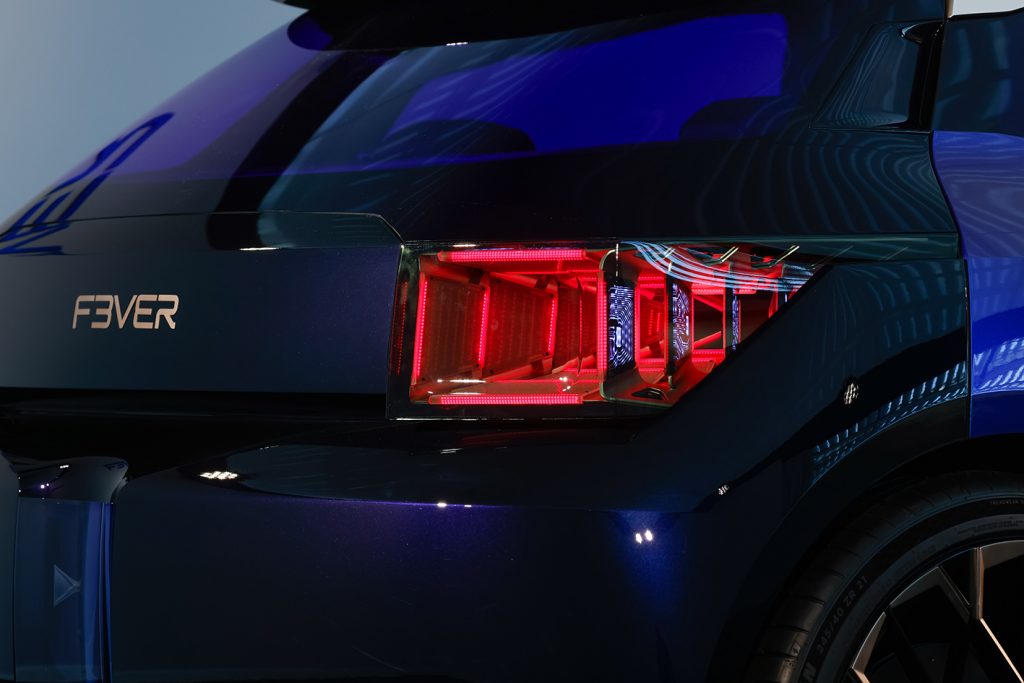
L’arrière reprend le même principe, avec un totem central arborant un logo DS digitalisé. Les feux, eux, jouent l’effet de profondeur : 16 panneaux de LED, empilés comme un tunnel lumineux, maintenus par une structure ultralégère en magnésium. Son dessin s’inspire de la voûte du Grand Palais, clin d’œil appuyé au lieu où la Citroën DS originelle avait été dévoilée en 1955.

La personnalisation au cœur du projet

C’est sans doute le volet le plus intéressant du concept. DS fait de la personnalisation un élément du design à part entière, et non plus une simple liste d’options.

Premier élément : un anneau de pavillon personnalisable, bandeau décoratif qui souligne la ligne de toit et doit permettre à chaque propriétaire de marquer son véhicule. Ensuite, la peinture biton est réinterprétée. La ligne de séparation entre les deux teintes court jusqu’aux feux arrière, puis enveloppe le volet de coffre, les flancs et le bouclier. Une évolution de la logique du biton étendu déjà proposé sur la N°8, qui vise ici à accentuer la compacité perçue.

Le concept étrenne aussi une teinte exclusive, Bleu Cosmique. Cette peinture dichroïque change selon la lumière, d’un bleu vif à des nuances violettes profondes. Un rappel au passage que la marque proposait jadis des teintes plus audacieuses, comme le regretté violet Whisper des débuts.

Enfin, le totem arrière intègre des animations lumineuses dites UX. Selon DS, elles doivent remplir trois rôles : personnaliser l’expression du véhicule via des scénarios dédiés, interagir avec l’environnement et transmettre des informations de manière lisible. La lumière devient ainsi un langage. Reste à voir ce que la réglementation autorisera en série.

Les jantes ne sont pas oubliées, avec un graphisme géométrique, des détails couleur champagne et un discret guillochage « clou de Paris », motif fétiche de la maison.

Compact dehors, généreux dedans ?

DS revendique pour F3VER un empattement généreux, gage d’habitabilité et de confort selon la marque. Le coffre annoncé atteint 400 litres, un volume digne de la catégorie supérieure pour un gabarit de 4,19 m. Pour comparaison, la DS N°4, plus longue, propose 390 litres en version électrique.

Côté technique, en revanche, la fiche reste muette. Le concept est électrique, DS évoque une autonomie « best in class », sans aucun chiffre de batterie, de puissance ou de rayon d’action. L’exercice reste avant tout stylistique.

« Design Intelligence » : faire plus avec moins

Dernier pilier du projet, la « Design Intelligence ». Derrière la formule marketing, une idée assez concrète : réduire le nombre de pièces, alléger les architectures, optimiser l’aérodynamique et améliorer la qualité perçue avec des surfaces plus pures et des assemblages moins visibles.

Sur F3VER, cela se traduit par un bloc lumineux avant unique réunissant projecteur et feu de jour, des boucliers monobloc et la disparition des habillages plastiques rapportés sur les passages de roues et les bas de caisse. Ce dernier point mérite d’être salué, tant les protections noires en plastique sont devenues la norme, y compris sur des modèles premium. Derrière l’argument esthétique, il y a aussi un intérêt industriel évident : moins de pièces, c’est moins de coûts.

DS précise enfin que ses designers s’appuient sur les outils numériques et d’intelligence artificielle développés par Stellantis pour explorer plus vite davantage de pistes. La marque prend soin de préciser que l’IA ne remplace pas la créativité, mais accélère la démarche.

Notre avis

DS F3VER a le mérite d’être un vrai concept, et non un modèle de série maquillé. Il pose des pistes claires : silhouette basse plutôt que SUV, signature lumineuse verticale affirmée, personnalisation intégrée au dessin. Après une DS N°4 qui rentrait un peu dans le rang, avec un nuancier appauvri et des équipements distinctifs supprimés, voir DS remettre la couleur et la singularité au centre du jeu est une bonne nouvelle.

Reste la question qui fâche : quel avenir industriel pour ces idées ? Avec F3VER, DS montre ce qu’elle sait faire. Il lui faudra maintenant prouver qu’elle peut le produire.

L’article Mondial de l’auto Paris 2026: Concept DS F3VER : est apparu en premier sur Le Blog Auto.

  •  

A College Told Flock to Remove Its Cameras. The Company Refused.

The Chicago Sun-Times reports: When Elgin Community College hired Flock Safety to install six surveillance cameras in April 2025, President Peggy Heinrich thought they would "enhance the safety and security of students...." They were supposed to help locate stolen cars and missing people. But Heinrich started to wonder if the cameras were actually making students less safe after seeing news reports that data captured by Flock cameras in Illinois had been shared with U.S. Customs and Border Protection. Then in September 2025, Immigration and Customs Enforcement detained an Elgin Community College student in a campus parking lot. More than half of students at the far west suburban Chicago campus identify as Latino. Heinrich said enrollment dipped. Students were afraid to come to class. College officials decided the cameras had to go... College officials asked Flock to remove the surveillance cameras "out of an abundance of caution for our students," Heinrich said. But getting the cameras taken down was not as simple as it sounds, especially because Flock retains ownership of the company's equipment.... Surveillance experts say the company is financially incentivized to have as many cameras gathering data as possible even in places that no longer want them, because potential clients are looking for the surveillance network with the greatest reach.... Elgin Community College staff notified Flock in October 2025 that they wanted to cancel their contract and have the cameras taken down. Within a day, Heinrich said, Flock rejected the request and refused to uninstall the equipment on the basis that the company had not breached their agreement. College officials reached out again in December 2025 and said they would pay for the remaining five months of the contract — they just wanted the cameras taken down. "We never received a response back from Flock," Heinrich said. That's when things got weird. Heinrich said Elgin Community College staff began to cover the cameras using black trash bags and zip ties so that they would not be able to capture footage. But workers in an unmarked vehicle, which Heinrich assumed belonged to Flock, repeatedly removed the coverings... This strange dance continued, Heinrich said, until Elgin Community College's contract with Flock expired in April this year and the company uninstalled the cameras for good.

Read more of this story at Slashdot.

  •  

Original RFC1149 Packet Up For Auction At Christies

Long-time Slashdot reader badger.foo writes: As some of you may remember, in 2001 RFC1149 (TCP/IP over carrier pigeon) was implemented. Now one of the packets preserved from that event is up for auction at Christies. Direct link to the auction (current bid: USD 2600) is here. This is a unique chance to own a piece of Internet history!

Read more of this story at Slashdot.

  •  

US Agency To Rewrite Rules To Finally Address Vehicle Headlight Glare

America's National Highway Traffic Safety Administration "said on Tuesday that it will rewrite its vehicle lighting standards," reports Reuters, "to address concerns about headlight glare and allow for the latest safety-improving lighting technologies." NHTSA said it plans to improve rules for LEDs, dusk sensors, automatic high beams and replaceable light sources. The agency will also evaluate headlamp height and aim and how they impact driver visibility and address headlight glare and make appropriate changes. Complaints about glare from headlights have increased and some lawmakers have urged the government to set a maximum headlight brightness standard. A growing number of taller trucks and SUVs on roads has also led to more complaints about glare. LEDs, which now account for most headlights in new cars, are much brighter than traditional halogen headlights... The issue still accounts for a small number of nighttime crashes, according to a study last year from the Insurance Institute for Highway Safety (IIHS). The study noted that headlight glare contributes to far fewer crashes than insufficient visibility... Federal headlight standards for minimum and maximum brightness have not changed since 1997, IIHS noted. The study found that drivers older than 70 appear to be most affected by headlight glare. In 2022, NHTSA said it would allow automakers to install adaptive driving beam headlights on new vehicles. The devices adjust the headlight beam pattern to dim portions directed at other vehicles. Thanks to Slashdot reader technology_dude for sharing the news.

Read more of this story at Slashdot.

  •  

NASA Releases Data from Artemis II Moon Mission, Calls It 'Sights and Sounds of Science'

"What did four astronauts see, notice, and document as they traveled around the Moon during NASA's Artemis II mission?" asks a new NASA web page, offering some fascinating pictures and video: Through photographs, spoken observations, drawings, and annotations, the Artemis II crew created a unique scientific record — one that is now available to the science community and the public for further study... As part of the mission science plan, lunar scientists asked the Artemis II crew to watch for tiny flashes sparked by rocky fragments hitting the Moon. Even so, some scientists were astonished when astronauts reported seeing five extremely faint "pinprick" bursts of light from 46,000 miles away. After ruling out other sources — cosmic rays or reflections from the spacecraft — the science team confirmed the sightings... The impact flash observations happened during a planned loss of communications while the Artemis II crew was on the far side of the Moon... Apollo astronauts saw similar flashes from lunar orbit, but the Artemis crew likely caught the faintest ever seen with the unaided eye. From the brightness of the flashes, scientists estimated that incoming rocks were each no more than a couple of inches wide. Despite their size, they were traveling thousands of miles per hour, producing just enough light upon impact to be visible. The nearly hour-long total solar eclipse that the crew experienced while passing by the Moon's far side created ideal dark conditions for spotting such subtle bursts. With no atmosphere to slow or burn up incoming debris, projectiles slam freely into the lunar surface. The crew's direct observations of this process on the Moon's far side provided a rare dataset that will help us understand how often these small impacts occur, which is essential for assessing long-term risks to future lunar habitats and infrastructure... The crew reported seeing subtle hues of gray, black, brown, tan, white, green, and blue across the Moon's surface. This muted rainbow offers clues to the rocks and minerals that make up different lunar regions, helping scientists piece together how the Moon — and, by extension, Earth — evolved over time. "Amazing news," Mission Control responded when they heard about the flashes. Space.com reports that when a Mission Control operator looked over at the Science Evaluation Room, "they were jumping up and down, literally." NASA blogged this week that more than 800 gigabytes of Artemis II lunar science data — some previously unreleased — "have been uploaded to NASA's Planetary Data System, the public archive for NASA's planetary missions." This data release includes more than 11,000 full-resolution images and video of the Moon from the crew's handheld cameras and the Orion spacecraft's cameras, 8.5 hours of audio recordings of the crew's scientific observations of the lunar surface, and crew-annotated images... Along with this data, NASA has released the Artemis II Preliminary Lunar Science Report, the Artemis II Lunar Science Operations Report, and the Artemis II Lunar Science Data User Guide.

Read more of this story at Slashdot.

  •  

Podcast 396: La semaine automobile par Leblogauto.com

Bonjour à toutes et à tous, et bienvenue dans La Semaine Automobile, épisode 396. Au programme : Volvo qui renonce à ses prévisions, Volkswagen qui s’allie au chinois Gotion pour ses batteries, une BMW iX4 à 828 km d’autonomie, et un titre mondial arraché à deux virages de la fin pour Elfyn Evans. C’est parti.

Économie

Volvo Cars renonce à ses prévisions

Volvo abandonne ses objectifs de ventes et de trésorerie pour 2026. Et ne donne aucun nouveau chiffre pour les remplacer. En cause : un marché chinois qui s’enfonce et une reprise américaine plus lente que prévu. Seule l’Europe tient.

Au troisième trimestre, Volvo vend 141 609 voitures, en recul de 11 %. L’action touche un plus bas historique. Elle a perdu la moitié de sa valeur depuis janvier. Le redressement est confié à Klaus Zellmer, l’actuel patron de Skoda, qui prendra la direction d’ici un an.

Tesla rebondit en Europe

En septembre, Tesla progresse presque partout : +62 % en France, +128 % au Portugal, +38 % en Suède. De janvier à août, ses immatriculations européennes grimpent de 43 %. C’est plus que le marché électrique, à +39 %.

Mais l’élan pourrait vite retomber. Tesla vit toujours sur ses Model 3 et Model Y. Depuis janvier, les marques non chinoises ont lancé 27 nouvelles électriques en Europe. Tesla, aucune.

Royaume-Uni : Chery sur le podium

Septembre, c’est le mois de la nouvelle plaque « 76 » outre-Manche. Chery en profite pour devenir le troisième constructeur du pays, avec 32 823 immatriculations et plus de 9 % de part de marché. C’est 171 % de plus qu’il y a un an. Le marché, lui, ne progresse que de 12 %.

La Jaecoo 7 est la voiture la plus vendue du mois au Royaume-Uni. Et déjà la deuxième de l’année.

Stratégie

Volkswagen et Gotion : 3,2 milliards pour des batteries hors de Chine

Volkswagen et le chinois Gotion investissent 3,22 milliards d’euros dans trois usines. À Valence, en Espagne : 29,1 gigawattheures par an. À Šurany, en Slovaquie : 8,4. Et au Maroc, à Kénitra, 100 000 tonnes de matériaux de cathode LFP.

Le paradoxe est assumé : pour s’affranchir de la Chine, Volkswagen s’appuie sur un chinois. Après les échecs de Northvolt et Britishvolt, et un PowerCo revu à la baisse, l’Europe n’a plus vraiment le choix.

Mercedes teste la batterie solide de ProLogium

Mercedes obtient un accès prioritaire aux cellules solides Gen4 du taïwanais ProLogium. La promesse : 400 Wh/kg et un 5 à 80 % en 6,4 minutes.

Prudence toutefois. Il s’agit de tests, pas d’un contrat. Et seuls les 381 Wh/kg de la génération précédente ont été certifiés par le TÜV. Mercedes teste en parallèle les cellules de Factorial. ProLogium, lui, construit une usine à Dunkerque.

Nouveautés

BMW iX4 : 828 km d’autonomie

Troisième modèle de la Neue Klasse, le SUV coupé iX4 arrive en mars 2027. La version 50 xDrive revendique 469 ch et jusqu’à 828 km WLTP. Recharge à 400 kW : 387 km récupérés en dix minutes. La M60, elle, grimpe à 612 ch.

La fiche technique impressionne. Le style beaucoup moins : la face avant, très verticale, divise. Production en Hongrie, à Debrecen.

VW ID. Tiguan : la fin des chiffres

Volkswagen range les numéros. L’ID.4 et l’ID.5 cèdent la place à l’ID. Tiguan début 2027. De 190 à 299 ch, jusqu’à 600 km d’autonomie. Prix en Allemagne : 42 695 euros. Commandes ouvertes dès le 13 octobre.

Bonne nouvelle : les boutons physiques reviennent, sur le volant comme pour la climatisation. Et clin d’œil nostalgique : un mode d’affichage reprend les compteurs bleus et rouges de la Golf IV.

Jaguar Type 01 : 1 030 ch et 166 100 euros

Jaguar dévoile enfin sa GT électrique quatre portes. Trois moteurs, 1 030 ch, 0 à 100 en 3,2 secondes. Jusqu’à 720 km WLTP avec 118 kWh utiles.

Les dimensions sont hors normes : 5,24 m de long, 2,17 m de large, 1,40 m de haut. Prix d’entrée en France : 166 100 euros. Jaguar quitte le premium pour le luxe. Le pari est risqué, mais l’effet de surprise est bien là.

Sport

F1 Sepang : Verstappen gagne dans le chaos

Couru à Sepang à la place de Bahreïn, le Grand Prix tourne à la loterie. Pluie, faux départ, pannes sur la grille, deux voitures de sécurité. Verstappen s’impose devant Antonelli et Hamilton. C’est sa 72e victoire, et la première pour Red Bull-Ford.

Russell abandonne en fin de course. Antonelli compte désormais 84 points d’avance, à sept courses de la fin. Le titre lui tend les bras.

WRC : Evans champion à deux virages de la fin

Au dernier rallye, en Sardaigne, Elfyn Evans voit le titre lui échapper. Oliver Solberg mène et n’a besoin que de quelques points en Power Stage. Puis il commet une erreur dans les derniers virages. Il gagne le rallye, mais perd le championnat.

Evans est sacré avec Scott Martin, à 37 ans, après cinq titres de vice-champion. Il devance Solberg de cinq points et Pajari de six.

Petit Le Mans : enfin pour la Porsche 963

Dix heures de course, 16 neutralisations, et même un drapeau rouge à cause des éclairs. Au bout, la première victoire de la Porsche 963 à Road Atlanta. Kévin Estre, Laurens Vanthoor et Matt Campbell s’imposent avec à peine plus d’une seconde d’avance sur la BMW. Une dernière belle page : l’équipage se sépare l’an prochain.

Insolite

Tesla FSD : le panneau dit 30, la Tesla lit 50

L’association belge Johanna.be a testé le FSD Supervised de Tesla sur 400 km. En zone 30, le système dépasse la limite dans 55 % des cas, à 44 km/h en moyenne. Plus étonnant encore : la voiture reconnaît bien le panneau 30… mais affiche 50 au tableau de bord.

Bon point en revanche : le système se montre prudent avec les piétons et les cyclistes. Le rapport a été transmis aux autorités néerlandaises, à l’approche d’un vote européen sur le FSD.

C’est la fin de cet épisode 396 de La Semaine Automobile. Retrouvez tous ces sujets en détail sur leblogauto.com. Et rendez-vous au Mondial de Paris, qui ouvre ses portes lundi 12 octobre. Bonne route, et à la semaine prochaine !

L’article Podcast 396: La semaine automobile par Leblogauto.com est apparu en premier sur Le Blog Auto.

  •  

FBI Arrests Cybersecurity Executive Over Data Breach After Contractor Fails to Update Oracle HR Platform

CNN reports: The FBI arrested a Canadian cybersecurity executive and ransomware expert as part of the investigation of a damaging hack that exposed the sensitive data of current and former FBI employees, according to court documents and people familiar the investigation. Edward Dubrovsky was arrested in the Philadelphia area in recent days... Dubrovsky is facing charges related to extortion and making threats. He has been transferred to Texas's Eastern District for a scheduled detention hearing, according to court records and a law enforcement official. FBI Director Kash Patel announced the arrest on Friday but did not disclose where it occurred or what role the man is suspected of playing in the hack. Patel also didn't name Dubrovsky, but CNN confirmed the defendant is believed to be tied to the FBI hack through multiple people familiar with the investigation... A LinkedIn profile under Dubrovsky's name lists years of experience in the Canadian cybersecurity industry and describes Dubrovsky as a 'globally recognized cybersecurity expert.' An Ed Dubrovsky is also the author of a book on handling ransomware negotiations with cybercriminals... There has also been an inquest at the FBI over how such a critical security lapse happened. The FBI determined that a contractor managing the bureau's jobs portal failed to update software "explicitly issued to secure the platform," [senior FBI cyber official, Brett Leatherman said last week]. The FBI has "removed the contractor," he said. The software in question is a human-resources platform made by Oracle, ShinyHunters has said. The hackers previously used a flaw in the software to attack targets in the education sector in May and June, according to Google's Threat Intelligence Group. But months later, the FBI contractor apparently still had not applied a security patch that was available for the software. "The inmate locator at the U.S. Bureau of Prisons website reports that a 54-year-old Edward Dubrovsky is currently being held at a federal facility in Philadelphia," reports security researcher Brian Krebs. Thanks to long-time Slashdot reader schwit1 for sharing the news.

Read more of this story at Slashdot.

  •  
❌