
Vue lecture

Mars en croissant : la magnifique et surprenante photo capturée par la sonde Psyché
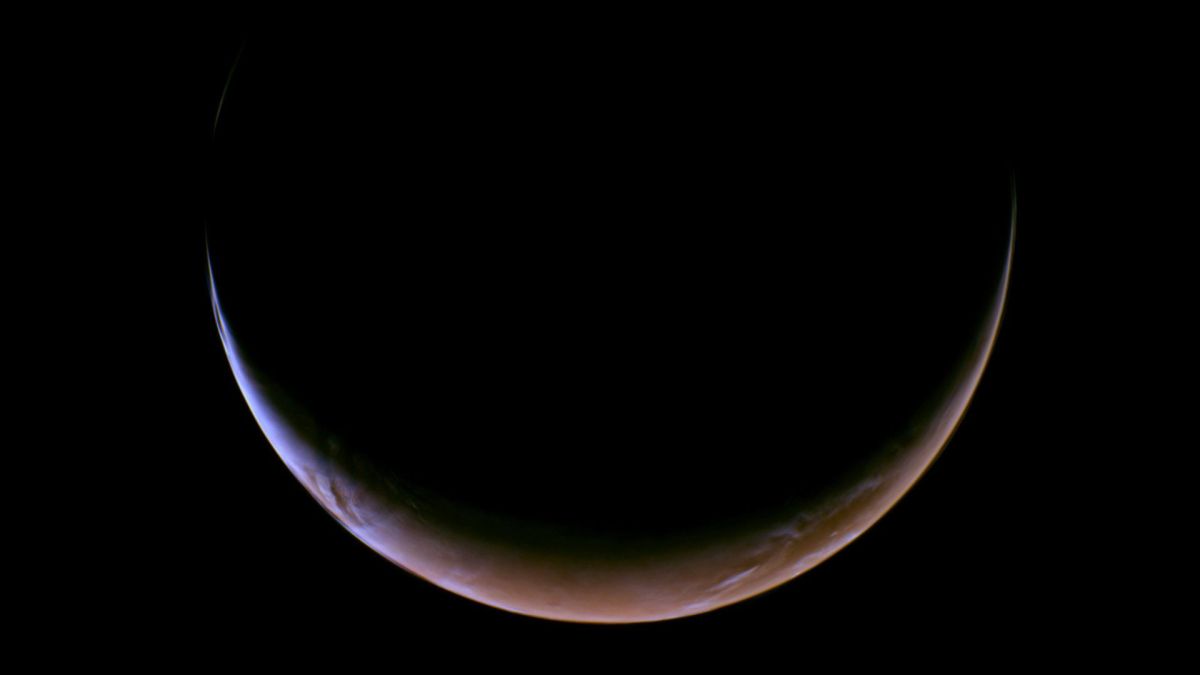
croissant mars

En route vers son mystérieux astéroïde de métal, la sonde Psyché a profité d'un survol de Mars le 15 mai 2026 pour s'offrir un coup d'accélérateur cosmique. Un « vol rase-motte » spectaculaire qui lui a aussi permis d'immortaliser la planète rouge sous un angle rare : un fin croissant lumineux sculpté par les poussières martiennes.

  •  

Course à la Lune : l’ESA tape du poing sur la table face au déclin européen

Ariane 6

Lunar Gateway suspendu, Mars Sample Return sabré... Face aux choix unilatéraux des États-Unis, le directeur général de l’ESA tire la sonnette d’alarme. Pour Josef Aschbacher, l'Europe doit d’urgence s’unir pour financer son autonomie spatiale avant d'être définitivement reléguée au rang de simple passagère de l'Histoire.

  •  

En plein vol rase-motte, la sonde Psyché de la NASA immortalise une vue inédite de Mars

croissant mars

En route vers son mystérieux astéroïde de métal, la sonde Psyché a profité d'un survol de Mars le 15 mai 2026 pour s'offrir un coup d'accélérateur cosmique. Un « vol rase-motte » spectaculaire qui lui a aussi permis d'immortaliser la planète rouge sous un angle rare : un fin croissant lumineux sculpté par les poussières martiennes.

  •  

Webb Discovers One of the Universe's First Galaxies

Astronomers using the James Webb Space Telescope have identified an ultra-faint galaxy seen just 800 million years after the Big Bang. The galaxy contains almost no heavy elements, shows signs of intense early stellar radiation, and could offer a rare glimpse into the first stages of galaxy formation. Phys.org reports: In a paper published in the journal Nature, a team of scientists led by Kimihiko Nakajima, an astronomer at Kanazawa University, Japan, describes how they used the telescope to study a part of the deep universe and discovered a faint galaxy called LAP1-B. "LAP1-B establishes a 'fossil in the making,' a direct high-redshift progenitor of the ancient ultra-faint dwarf galaxies observed in the local universe," they wrote. Because the galaxy is so small and distant, it would normally be impossible to see. However, it was spotted due to a phenomenon known as gravitational lensing, in which a massive cluster of closer galaxies acts like a giant magnifying glass, boosting the light from LAP1-B by 100 times. The scientists realized that most of the light from the galaxy wasn't coming from the stars, but from glowing clouds of gas. They analyzed this light by splitting it into a spectrum and studying the emission lines, which revealed the chemical composition of the gas. They found that the galaxy contains almost no heavy elements, and its oxygen abundance is about 240 times lower than the sun's, making it one of the most primitive star-forming galaxies ever observed. The emission lines also revealed intense ionizing radiation, which is what scientists expect to see from the first generation of stars. The team also measured an elevated carbon-to-oxygen ratio. This matches the predicted chemical signature for the first star explosions in history from Population III stars, the first stars to exist in the universe. The stars we see today are Population I stars, which formed later and contain more heavy elements. Another fascinating finding is that, after measuring the gas's motion and speed, the researchers concluded that the galaxy is held together by a massive cloud of invisible dark matter.

Read more of this story at Slashdot.

  •  

S’unir ou subir : il est urgent que l’Europe cesse d’être à la remorque de la conquête spatiale, prévient l’ESA

Ariane 6

Lunar Gateway suspendu, Mars Sample Return sabré... Face aux choix unilatéraux des États-Unis, le directeur général de l’ESA tire la sonnette d’alarme. Pour Josef Aschbacher, l'Europe doit d’urgence s’unir pour financer son autonomie spatiale avant d'être définitivement reléguée au rang de simple passagère de l'Histoire.

  •  
❌