UK's Members of Parliament (MP) were "looking for proof that smartphones and social media are rotting children's brains," writes The Register — but they got "a less satisfying answer from neuroscientists on Wednesday: nobody can really prove it."
Appearing before the Science, Innovation and Technology Committee this week, three researchers spent much of the session explaining that concern and evidence are not quite the same thing. Asked what evidence exists on the impact of digital devices on infants and young children, Professor Denis Mareschal, director of the Centre for Brain and Cognitive Development at Birkbeck, replied: "There is very little, if any, causal research in the early years. Almost everything is correlational."
MPs kept coming back to the question — and the experts kept coming back to the same answer. When questioned about social media's impact on adolescents, Professor Sarah-Jayne Blakemore of the University of Cambridge was equally cautious. "What evidence do we have of the impact of digital devices or social media on the adolescent brain?" she asked. "Almost nothing. There are a few small studies, but they haven't been replicated, and they're purely correlational...."
MPs also wanted to know whether neuroscience could settle one of the liveliest arguments in the debate: how old a child should be before they're allowed onto social media. "What neuroscience can't do is pinpoint a precise age," Blakemore said. "The individual differences in brain development are vast...." If there was a takeaway from the hearing, it was that concern about digital childhood is running well ahead of the evidence needed to settle the argument.
Steven Spielberg grants that his 1977 UFO film Close Encounters was "speculative," writes the Associated Press, but "Disclosure Day, he insists, is the real deal."
"It's my first film that will be considered science fiction that I do not consider to be science fiction," Spielberg said in a recent interview. "It's much more reflective of the world as it is evolving and discoveries that are being made as we speak." Spielberg, at 79, is trying to revive and reconsider the alien wonder that's long lingered in his mind, from "E.T." to "War of the Worlds." "Disclosure Day," Spielberg's first summer movie in a decade, is already being hailed as one of his best in years. But this time, Spielberg is testing whether he can conjure some of his trademark movie magic less with imagination than with conviction. "I've been a believer since I made 'Close Encounters' 50 years ago," Spielberg says. "But I would always say: Until I've seen a UAP or a UFO with my own eyes, I'm not going to categorically state that life from out there has come here. But I've changed that," he adds. "I'm now willing to change my mind because of the circumstantial evidence which is overwhelming..."
Spielberg, having long followed reports of alleged alien encounters, was inspired by the 2023 House Subcommittee on National Security hearing on UAPs: Unidentified Anomalous Phenomena. Among the witnesses was whistleblower and former Air Force intelligence officer David Grusch, who testified that the government concealed a program investigating UAPs. The Pentagon then denied it... Those 2023 testimonies and others so fueled Spielberg that he produced a 50-page treatment on what would become "Disclosure Day." During the writing process with Koepp, he texted him more notes, he says, "than I've ever sent to anyone in my life."
"There was a period in there where I believe he re-read the script every single day for a year," Koepp says. "We'd be in different time zones and I would wake up to 30 or 35 texts from his most current reading of the script. When the leader of the project has that level of commitment, it tends to bring along everyone. You up your game."
The article calls it "a grand bookend for one of the most cosmically-minded moviemakers of our time." But the man who filmed some of the world's first summer blockbusters also shared his thoughts on the future of movies. "Even though the numbers are still not pre-COVID level numbers for any films being released now, it's more robust than it has been for many years. The audience gives me belief that people still want to congregate in a dark space in the company of strangers to share an experience of a film made by storytellers. And that gives me faith to continue making films."
Rolling Stone wrote that "There's a lot to love in Disclosure Day." Though they also offer this pithy summary of its plot. "Remember when Steven Spielberg digitally replaced the guns in the hands of government agents for the 20th anniversary of E.T., then expressed regret about the decision? Imagine that he not only restored the weapons but crafted an entire two-and-a-half-hour feature around that one sequence as a mea culpa. That's Disclosure Day."
The filmmaker may be staging a pulpy campaign with this sci-fi throwback, but he sincerely seems to believe the truth is out there — and will set us free... [W]hile the quality of his output can vary wildly when you look at the big picture of his career, there's still a baseline of love — for filmmaking, for storytelling through images, for giving people an experience that pushes emotional buttons and taps adrenal glands — that gives his work a sense of vitality and displays the sensibility of an artist at work...
There's also a weird full-circle feel to it, and not just because he's returning to the fertile ground of Close Encounters and his other science fiction spectacles. You can see traces of everything from Duel to Minority Report show up, to the point where this almost doubles as a career retrospective in miniature... Yes, Spielberg does believe that we are not the only game running in the cosmos. But he also believes that our better angels have not left the building, and that movies still have the power to communally blow minds and open hearts.
The Associated Press calls it "a grand bookend for one of the most cosmically-minded moviemakers of our time" and "a distant answer to the final notes of Close Encounters."
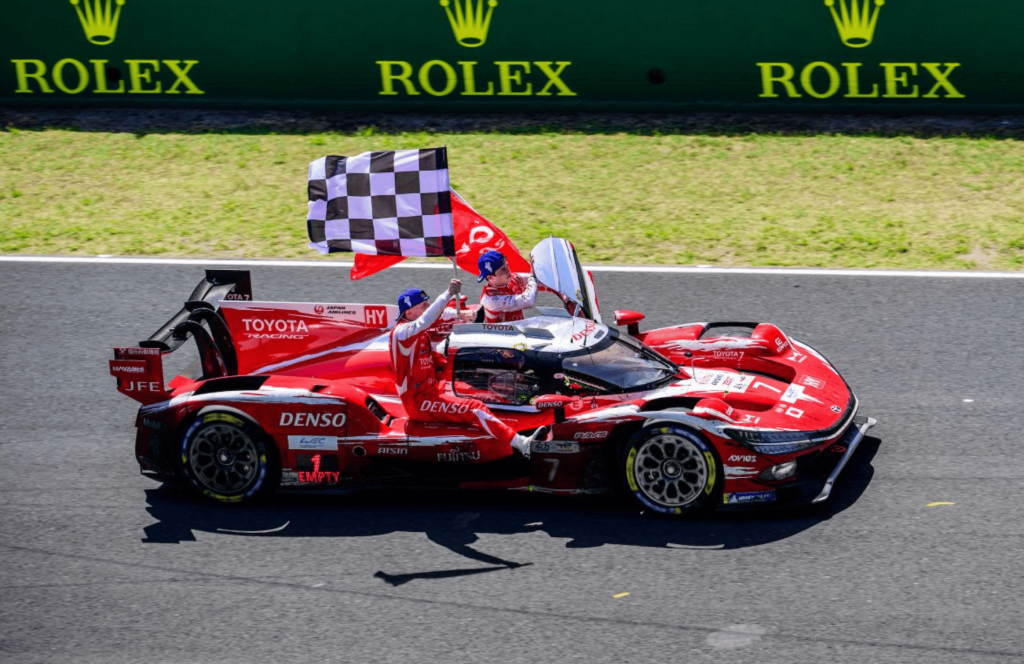
La plus rapide des Toyota TR010 était la n°8. Mais celle qui a gagné les 24 heures du Mans 2026 est la n°7. La voiture dotée près de sa portière d’un autocollant « chihuahua » (référence à la taille de ses pilotes) a pris le dessus sur soeur décorée par un « doberman ». Cette dernière fut retenue une quarantaine de secondes dans son stand peu avant 10 heures du matin. Un élément chargé du refroidissement des freins sortait de son logement et frottait sur la jante.
Préalablement, la n°8 avait déjà reçu une pénalité – passage par la voie des stands – en raison d’une infraction de Ryo Hirakawa lors d’une neutralisation. Dans le sprint final, Sébastien Buemi joua la partition d’équipe en retenant la BMW n°20, principale rivale des Toyota.
Mais cela n’a pas non plus été facile pour la TR010 victorieuse… Une crevaison samedi à l’heure du dîner perturba les efforts de Nyck de Vries. Puis une autre tuile tomba : « Vers 21 heures hier soir, nous avons connu une défaillance de l’un des capteurs FIA », expliquait David Floury, le directeur technique de l’équipe Toyota, évoquant les mesures prises par la fédération pour vérifier la puissance maximale des Hypercar.
« Nous étions contraints de mettre la voiture en mode défaut, limitant notre puissance. Pendant cette période, la voiture perdait 6 à 8 km/h en ligne droite. Heureusement, le capteur s’est remis à fonctionner ».
La dernière victoire de Toyota aux 24 Heures remontait à 2022. Le plus grand constructeur automobile du monde compte désormais 6 succès au Mans.
BMW satisfait
De son côté, la BMW n°20 de René Rast, Sheldon van der Linde et Robin Frijns a été la principale menace pour Toyota dans les dernières heures. Les trois pilotes ont effectué une course d’une grande propreté. Mais ils ont parfois manqué un peu de chance sur le tempo des neutralisations, alors que BMW tentait de boucler 13 tours sur ses relais plutôt que les 12 conventionnels. La voiture termine l’épreuve sur la deuxième marche du podium, à 10 secondes de la Toyota lauréate.
« On s’est rattrapé après la première neutralisation, rappelait Vincent Vosse, patron de l’équipe WRT. Nous sommes repassés en tête après. On a même récupéré une avance confortable. Mais on a de nouveau eu un safety car au mauvais moment ».
Pendant ce temps, on fêtait ce bon résultat aux 24 heures du Mans 2026 avec du Christopher Cross en fond sonore et des sourires sur les visages. « BMW peut être très très fier de tous les efforts consentis ces derniers mois ou même ces dernières années », jugeait le visage du programme.
Tableau d’honneur des 24 heures du Mans 2026
Nous tenons un carnet dans lequel nous notons des « + » et des noms pour retenir quels pilotes nous ont impressionné pendant leurs relais. C’est largement chronométrique et un peu subjectif.
Nous signalerons pour cette 94e édition :
Sébastien Buemi (Toyota n°8), au départ, capable de profiter d’une piste claire pour gagner une dizaine de places après les premiers arrêts.
Norman Nato (Cadillac n°12) et Will Stevens, véloces au lever du soleil, creusant l’écart sur la BMW n°20
René Rast (BMW n°20), force discrète et tranquille, creusant en toute discrétion un matelas d’une dizaine de secondes sur les Cadillac dans la première heure
Yifei Ye (Ferrari n°83), comme toujours excellent dans les ténèbres
Julien Andlauer (Oreca n°30), distançant les voitures de l’écurie Inter Europol avant que des soucis de freins ne mettent fin à l’aventure de l’équipe Duqueine avec Doriane Pin et Richard Verschoor.
Ferdinand Habsbourg (Alpine n°35) et Mathys Jaubert (Genesis n°17), auteurs de maxi-relais de 57 tours pendant l’obscurité. Cela représentait près de 800 km consécutifs au volant. Et le deuxième n’a que 21 ans…
Sébastien Bourdais parce que Sébastien Bourdais.
Bourdais, l’émotion
Il était un peu plus de 4 heures du matin, quelques spectateurs somnolaient dans les tribunes. La Cadillac n°38 de Sébastien Bourdais rugissait aux avant-postes, sur la route d’une très possible victoire. Mais la rupture de la direction assistée de l’Hypercar américaine en décida autrement.
La voiture regagna son stand au ralenti puis fut rentrée dans son box. Les mécaniciens s’affairaient sur l’avant de la V-Series.R. Et le Sarthois voyait une nouvelle fois son espoir de gagner la classique réduit à néant. Il resta de longues minutes assis à l’arrière du box, le casque bleu et jaune serré entre ses deux mains. L’équipe finit par officialiser l’abandon de ces 24 heures du Mans 2026 au lever du jour.
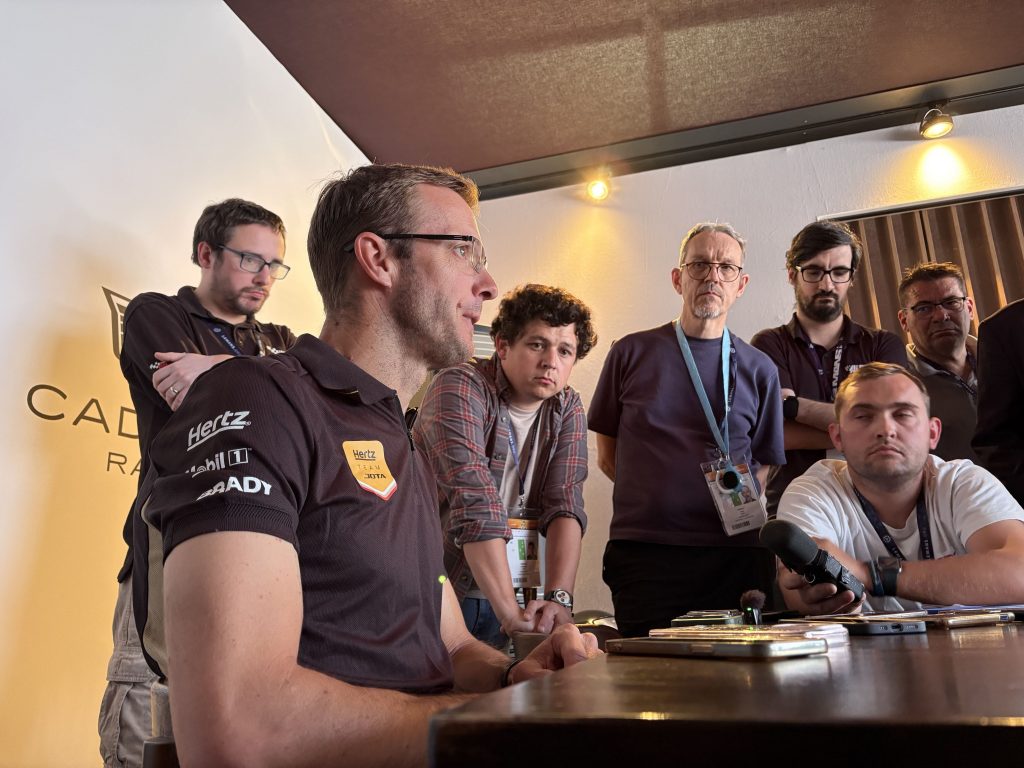
Dimanche à la mi-journée, il accorda un quart d’heure à une poignée de journalistes.
Dans l’hospitalité de Cadillac, silence respectueux. La jambe gauche de Sébastien Bourdais tremblait sous la table. La voix était légèrement étranglée, mais l’attitude digne :
« Cette course a ce don de remettre tout le monde à sa place. Et oui, pour une pièce qui coûte peut-être 2 dollars, ça s’est terminé de façon brutale. Je ne vais pas minimiser : c’est un coup dur. J’ai 47 ans, je n’aurai plus beaucoup d’occasions comme celle-ci. Certaines courses décident de tourner le dos à certains et de sourire à d’autres. C’est comme ça. De toute façon, dans une carrière de pilote, on gagne bien moins qu’on ne perd ».
De son côté, la Cadillac n°12 n’a pour sa part pas réussi à suivre le rythme des Toyota dans les dernières heures de course. La 4e place finale est amère après avoir été la voiture ayant figuré le plus souvent en tête (122 tours sur 344).
Alpine et Peugeot sans faute aux 24 heures du Mans 2026… mais trop loin des leaders
Mauvais cru pour les chances françaises en Hypercar. Le timing des voitures de sécurité sauva la course de l’Alpine n°35 en lui permettant de rester jusqu’au bout dans le tour des leaders. MM. Habsbourg, Milesi et Félix da Costa ont franchi le damier à la 6e place.
Philippe Sinault (team manager) : « On a été de temps en temps capables de jouer à la régulière la cinquième place dans la nuit. Il y a des moments où on n’était pas au niveau, notre voiture était trop compliquée pour nous, le pilote, à emmener à certains moments. Je les remercie. Il n’y a eu qu’un petit passage dans le gravier ».
La voiture sœur s’est classée au 10e rang. C’était la dernière participation sous les couleurs Alpine et l’équipe cherche désormais un avenir avec un autre partenaire ou constructeur. Le nom BYD a beaucoup été cité ce week-end.
Chez Peugeot, les 9X8 ne suivaient pas le rythme, avec les 11e et 12e places à l’arrivée. Le meilleur tour des 24 Heures est le fruit des efforts de Stoffel Vandoorne (Peugeot n°93) en 3’28 »268, à plus de 3 secondes du meilleur chrono d’une Toyota en course.
Emmanuel Esnault, le team principal, préfère souligner les (petits) points arrachés pour le championnat du monde constructeur et la course sans faute de l’équipe : « On peut être satisfait parce que l’équipe, en termes d’exécution, a été remarquable. Il n’y a pas eu d’erreur. La voiture n’a pas fait un seul passage dans le garage. Les pilotes n’ont pas fait d’erreur. On a eu un seul drive-through pour un drapeau jaune. Mais sur une course comme ça, ça reste peu ».
Ferrari discret
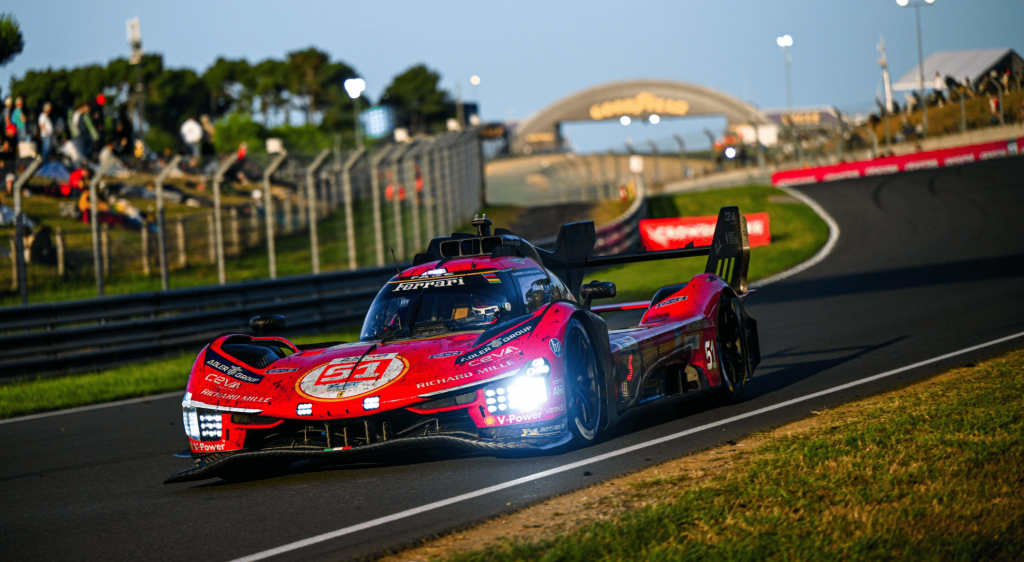
Le cheval cabré a gagné les trois dernières éditions. Difficile de se contenter des 5e (n°51) et 6e places (n°83) finales ce dimanche.
Mauro Barbieri, ingénieur en chef et responsable des relations avec les pouvoirs sportifs faisait le service après-vente dimanche soir : « Nous savions que le niveau était déséquilibré et nous n’avons jamais figuré parmi les meilleurs. Malgré tout, nous avons tout essayé, en testant différentes stratégies pendant la semaine pour tenter de combler l’écart. Malheureusement, nous n’avons rien trouvé de suffisamment significatif pour y parvenir ».
Il pointe évidemment la balance de performance (BoP), désormais confidentielle, chargée d’équilibrer le potentiel des voitures de la catégorie Hypercar.
En piste, ce fut (relativement) calme. La n°51 a été légèrement retardée par une altercation avec une LMP2, samedi soir, lorsqu’Alessandro Pier Guidi se trouvait au volant. Cela ne l’a pas empêchée de finir au 5e rang. La n°83 a bien défendu ses chances après un départ du fond de grille.
La n°50 s’est arrêtée définitivement dimanche matin à l’heure de la messe après un souci électronique. Elle avait déjà été retardée d’une bonne demi-heure après une défaillance de l’extincteur dans le cockpit.
Stratégie gagnante aux 24 Heures du Mans 2026
La course a été un match ininterrompu dans les cervelles des stratèges. Cette année, le jeu était beaucoup plus ouvert que l’an passé. En Hypercar, Michelin mettait à disposition des équipages 14 trains (soit 56 pneus) de Pilot Sport Endurance dans leur version 2026. Trois mélanges étaient disponibles : le soft adapté à la fraîcheur nocturne, le medium polyvalent et le hard ami des grandes chaleurs.
Le mercure estival samedi et dimanche après-midi ont poussé Ferrari ou Peugeot à utiliser plus que d’autres la gomme dure. À l’inverse, dans la fraîcheur de la nuit, les Cadillac semblaient particulièrement à leur aise en softs. Toyota et Genesis ont effectué des quadruples relais, prouvant la faible dégradation des Michelin.
L’an passé, c’était plus simple. La Ferrari n°83 victorieuse avait triplé ses relais en medium avant de les doubler dans le sprint final.
LMP2
Dans la catégorie monopolisée par les Oreca 07, l’équipe polonaise Inter Europol s’impose pour la troisième fois en quatre ans. Cette fois, les jaune et vert signent même un doublé. Le trio Jakub Smiechowski, Tom Dillmann, Nick Yelloly. Ce dernier prendra la poudre d’escampette l’an prochain, puisqu’il vient de signer pour le programme Hypercar de Ford.
L’exploit de Keating
Ce n’était pas gagné, mais elle s’est imposée tout de même. La Corvette n°33 de l’équipe TF Sport partagée par Jonny Edgar, Nicky Catsburg et Ben Keating s’est imposée en catégorie LMGT3.
Ce dernier est un grand concessionnaire auto au Texas et l’un des gentlemen drivers les plus doués du monde. Seulement, il n’avait plus roulé depuis des mois, à cause d’une vilaine chute à vélo. Mercredi, il nous montrait deux impressionnantes cicatrices sur un bras droit très amaigri. « Pour mettre mes bouchons d’oreilles à droite, j’utilise la main gauche », nous confiait-il.
« Je suis allé chez le docteur lundi dernier et il m’a dit : « Waouh, vous savez, votre os est magnifique ». Je pouvais courir. Après, il a continué : « Tu ne vas pas te faire mal à l’os, mais ce ne sera pas très confortable parce que, tu sais, je n’ai pas encore retrouvé toute ma force musculaire. Normalement, on peut tendre le bras et contracter le triceps ici. Je n’y arrive pas. Et plier le bras ici, c’est le maximum que je puisse faire ». Il pliait son bras à 45° en disant cela.
L’Américain poursuivait : « Quand je conduis, ça ne pose aucun problème car on ne plie pas le coude pour faire la course, et le fait de tenir le volant me soutient, donc ça ne me gêne pas du tout. Mais monter et descendre de la voiture, serrer les ceintures et tout le reste, c’est difficile ».
Keating a concentré l’intégralité de ses relais sur le samedi, laissant davantage de temps à ses équipiers « pros » pour le money time du dimanche. Il signe sa troisième victoire de catégorie aux 24 Heures du Mans. Pas mal pour quelqu’un qui a mis le pied dans le milieu via un stage de pilotage offert à Noël par son épouse…
Genesis promet
Une voiture 13e à l’arrivée et l’autre sur le flanc au petit matin en raison d’un bris de suspension. Sur le papier, les débuts de Genesis au Mans ne sont pas très ronflants. Mais le contenu était convaincant. Notamment lorsque Mathieu Jaminet effectua un quadruple relai de nuit avec un rythme fort intéressant, en bagarre avec les Alpine et les Ferrari.
La course de la n°19 n’a pas été de tout repos, avec notamment deux arrêts en bord de piste pour des reset informatiques en fin de nuit. La première fois, Paul-Loup Chatin se trouvait feux éteints dans une position peu enviable entre les virages de Mulsanne et d’Indianapolis. Heureusement, il parvint à résoudre le bug.
Record du tour
Le meilleur chrono des 24 heures du Mans 2026 a été réalisé par Ryo Hirakawa en 3’25 »041. C’est le record depuis l’avènement de la catégorie Hypercar il y a cinq ans. L’ancienne marque de référence appartenait à Sébastien Bourdais, qui avait réalisé 3’26 »063 l’an passé.
"A year after spending over $14 billion to bring in Alexandr Wang and a group of his top Scale AI engineers to revamp its artificial intelligence efforts, Meta is at least back on the map in AI," reports CNBC, "though it's still far behind OpenAI, Anthropic and Google in the market."
Wang's big accomplishment was the delivery of the Muse Spark AI model in April, marking Meta's first jump into proprietary foundation models and away from a strict adherence to open source, or open weight as it's more commonly called in AI... "Meta needs to provide more proof points of both adoption and commercialization," said Ralph Schackart, an analyst at William Blair who recommends buying the stock. "Investors are looking for Meta to monetize a new AI-first product, beyond the substantial positive impact AI is having on enhancing the advertising models." Wall Street, at least so far, is unimpressed. Meta's stock is down 18% over the past 12 months, the worst performer in the megacap group, along with Microsoft, which has its own challenges in AI. That's even after Meta reported 33% revenue growth in the first quarter, the fastest rate of expansion for any period since 2021.
For Meta, the problem started with what some industry experts called, in hindsight at least, a strategic blunder. The company jumped into AI with its Llama family of models, offering an open-source approach that allowed developers to freely tinker, while the other big model makers charged for access. In April of last year, Meta's release of Llama 4 fell flat, failing to captivate developers and leading Zuckerberg to reconsider his company's approach to AI development... Since the release of Muse Spark, Meta has unveiled new AI and business-related subscription plans as part of an effort to expand its business beyond online ads. Historically, it hasn't worked. Meta still counts on ads for 98% of revenue. Schackart said he wants to see "tangible evidence of a growing list of new, AI-first products created by Muse Spark, even if monetization lags." He said that's "what investors are looking for."
No matter how good Wang's model may be, Zuckerberg has a high hill to climb with developers coming off the Llama debacle. "I think the AI community largely ignores Meta at this point," said Rob May, CEO of the startup Neurometric, which works in the realm of token engineering.... Krish Subramanian, the CEO of consulting firm KOI AI and former product head at IBM Consulting, said developers are more excited about Google's AI models than what Meta is offering. The appeal of Llama was that it specifically targeted developers wanting open-weight alternative models, while with Muse Spark, Meta has made little effort in that direction, he said. "The lack of developer trust will come back to hit them if they don't focus on third-party developers," Subramanian said, noting that it took years for Microsoft to regain trust from open-source coders during the early days of Azure. "To just focus on a walled-garden kind of an ecosystem and ad revenue as the main source of income, they probably will never become the big player," he said.
A Meta spokesperson pointed to Wang's recent comments about the company's continued support for the open-source ecosystem, and said Meta still plans to offer outside developers access to Muse Spark's underlying technology via an API, as it previously announced. "We're already testing with some early partners, and look forward to releasing it this month," the spokesperson said.
"That Zuckerberg's metaverse and virtual reality ambitions have generated over $80 billion in total losses since late 2020 makes the AI pitch a tougher sell," the article points out, citing this observation from Howard Yu, business professor at Switzerland's International Institute for Management Development.
"He's running out of the space for his credibility to last," Yu said. "I think the virtual reality foray may have burned up a lot of his goodwill in front of investors."
Phoronix reports:
The AMD R600 Gallium3D driver saw 59 commits [last] Sunday to Mesa 26.2. Making this code restructuring and code cleaning all the more notable is that the improvements to this old AMD Radeon graphics driver was done in part by GitHub Copilot.
Gert Wollny has been among the few open-source developers left working on the AMD R600g driver that covers from the Radeon HD 2000 series through Radeon HD 6000 series graphics cards... [T]he old open-source GPU driver support is being assisted by AI long after the upstream vendor has stopped working on this driver — the Radeon HD 2000 "R600" series launched in 2007.
America's Energy Department "wants to build a single national platform for doing science with AI," reports Communications of the ACM:
It is called the Genesis Mission, and the idea is to connect the country's 17 national laboratories, their supercomputers, scientific datasets, and a growing layer of AI models and agents into one system researchers can access. The DOE has taken to calling it 'a national operating system for science.' That means treating compute, data, and AI models the way the country treats power lines and highways, as shared national plumbing everyone else builds on top of.
If it works, Genesis will change how scientific work gets organized, checked, and scaled, with AI helping run the whole pipeline from hypothesis to simulation to experiment and back. The pitch is that this is better understood as infrastructure policy than as another research program. Genesis is now moving from announcement into execution. President Trump signed the executive order launching it in November 2025. This past February, the DOE published 26 science and technology challenges for the program, and in March it opened a $294-million call for research teams in fields like nuclear energy, quantum information science, semiconductors, and biotechnology.
The program is also beginning to reach beyond U.S. borders. In June 2026, Japan moved to become Genesis's first international partner. The two governments plan to invest a combined $1 billion over five years, with Japan contributing $500 million toward joint work in quantum technology, nuclear fusion, and biotechnology. The stated goal is staying ahead of China in the fields where AI is advancing fastest. The open question is whether a federated platform this big can actually work, or whether it ends up as one more expensive coordination exercise.
"Blizzard Entertainment is continuing its crusade against private World of Warcraft servers," reports the gaming news site Aftermath:
The company filed a new lawsuit on Friday in a California court against the makers of Project Ascension, alleging copyright infringement, Digital Millennium Copyright Act violations, and other claims. Blizzard Entertainment claims that Project Ascension is a "lucrative way to exploit and profit from the popularity of the WoW game experience," according to the complaint, obtained by Aftermath. Blizzard Entertainment's lawyers say in the complaint that Project Ascension purports to have "over a million players." Lawyers write that the developers have "distributed (and are continuing to distribute) millions of pirated copies of Blizzard's copyrighted WoW game software."
They also allege that Project Ascension's servers are hosted on Russian "bulletproof" servers with Aeza Group, a company that was sanctioned in 2025 "for its role in supporting cybercriminal activity targeting victims in the United States and around the world," per a U.S. Department of Treasury press release... Project Ascension lets players combine pieces of World of Warcraft's different classes to build unique characters. It's free-to-play, but players can purchase in-game currency, Donation Points, to buy things in-game, such as cosmetics and experience boosts. Blizzard Entertainment's lawyers assert that Project Ascension has made "millions of dollars from the sale of Donation Points...."
Blizzard Entertainment successfully sued a popular World of Warcraft server called Turtle Wow last year. The project had been running since 2018, taking donations from players for the free-to-play server. Both sides announced in April 2026 that they'd reached a settlement after Blizzard Entertainment was awarded a permanent injunction to shut down Turtle WoW. The details of the settlement were not made public. Turtle WoW was shut down for good shortly after May 15; players gathered online to mourn the end of the server.
The price of bitcoin dropped 13% down to $64,394 just in June — but there's more bad news, reports CNBC." "Bitcoin has lost nearly half its value since reaching a record high above $123,000 in July 2025."
While previous bitcoin selloffs were often followed by large rebounds in price, the latest decline may prompt some investors to revisit why they own bitcoin in the first place, [says Daniel Sotiroff, associate director of ETF and Passive Strategies Research at Morningstar]. Here's what he and other experts have to say about the case for holding crypto, and how much exposure is appropriate for the average investor...
Not all financial professionals agree bitcoin belongs in a portfolio. Bitcoin differs from stocks, bonds and real estate because it doesn't generate earnings, interest payments or rental income that investors can use to estimate its value, says Robert Johnson, a finance professor at Creighton University. Instead, its price is largely determined solely by investor demand. "You cannot invest in Bitcoin, you can only speculate," he says.
Sotiroff agrees that bitcoin is difficult to value using traditional financial metrics. "The best analogy I've heard is that it's more like a collectible, because it's basically worth what other people are going to pay for it," he says.
Sotiroff told CNBC the recent selloff was a reminder that bitcoin's gains can be accompanied by equally dramatic declines — one reason many financial planners recommend limiting exposure to a small portion of a broader portfolio. "You just really can't make a call on what direction it's going to go," says Sotiroff.
Simon Ritter joined Sun Microsystems in 1996 and spent time working in both Java development and consultancy. He's now written an opinion piece for InfoWorld warning that "Between 2029 and 2032, every currently supported long-term support (LTS) version of Java will reach end-of-support within a single three-year window."
That's Java 17 in 2029, Java 8 in 2030, Java 21 in 2031, and Java 11 in 2032...
On paper, this looks like a manageable upgrade cycle. In practice, it creates a collision of timelines that most enterprises have failed to forecast. Organizations attempting to modernize incrementally — moving application by application, version by version — are operating on a model that the calendar has already rendered obsolete... [W]hen every major Java version expires in the same compressed window, sequential planning collapses. By the time this becomes obvious, organizations will be forced into reactive mode, making rushed decisions under extreme pressure.
For organizations planning traditional stepwise upgrades — Java 8 to Java 11 to Java 17 to Java 21 — this convergence elevates a routine maintenance task into a structural crisis. Enterprises with large Java estates will be forced to upgrade multiple applications across multiple versions simultaneously to maintain security compliance and business continuity.
"Parallel modernization requires parallel capacity — something most organizations haven't budgeted for," he points out. "This explains why traditional approaches struggle to scale."
Bonjour à tous. La Semaine Automobile, épisode 385.
Le Mans cette semaine, mais aussi le marché français en recul, Tesla en mode expansion, Ferrari qui va détruire ses propres voitures, et les Allemands sous pression. On y va.
ÉCONOMIE
Le marché français ne repart pas. Sur les cinq premiers mois de 2026, les immatriculations reculent de 0,6 %. L’électrique tient la barre avec 29 % de parts de marché en mai — mais c’est surtout grâce à Tesla, dont les chiffres en yo-yo faussent la lecture d’ensemble.
Ferrari, elle, fait parler avec la Luce. On avait évoqué la première Ferrari électrique — 1 050 chevaux, 530 km, 550 000 euros. Cette semaine, nouveau rebondissement : Ferrari va détruire quatre exemplaires pour les crash-tests Euro NCAP. Deux millions d’euros partis en fumée volontairement. Une démarche rare pour un constructeur de supercars — jamais vu chez Ferrari. Le signal envoyé : la Luce n’est pas une supercar de niche, c’est une voiture familiale de luxe qui joue le jeu de la sécurité grand public.
The Sunday Times reports:
A criminal investigation has begun after a police officer allegedly used AI to create evidential material in a "number of cases". Derbyshire Constabulary said an officer was being investigated over an allegation of suspected perverting the course of justice. The Crown Prosecution Service (CPS) confirmed it was engaging with defence lawyers and the courts over potentially affected cases...
It is the first known allegation of AI misuse by police in a criminal case in the UK, but it follows an incident last year in which West Midlands police relied on AI-generated material that fabricated a match involving Maccabi Tel Aviv. The material was used in intelligence supporting a proposed ban on away fans at the club's match against Aston Villa.
A few weeks ago on a bike ride "inspiration struck" for Dave Eggers, reports SFGate...
Without a pen and paper handy, he was stuck texting the idea to himself. The problem? Eggers doesn't own a smartphone. "It takes 20 minutes to write a sentence," Eggers said... It's a funny predicament for Eggers, given that he's arguably the city's biggest proponent of the written word... Now age 56, Eggers' latest book is called "Contrapposto"...
On writing days, Eggers bikes to his sailboat docked near the Golden Gate Bridge. He writes using a hefty 1998 Mac that has never been connected to the internet. On the boat, he keeps "banker's hours," working 9 to 5 without any meetings or interruptions except for the occasional wildlife visit. "You're there with the cormorants and the occasional porpoise and sea lions and seals, and when you want to take a break, you walk around and you're in the thick of it, one of the most beautiful spots on Earth," he said. "Especially coming from the Midwest, it never gets old."
Given Eggers' decidedly low-tech existence, it's not surprising that the current state of San Francisco gives him pause, but there's a streak of hope that underlies his concerns. He abhors the growing surveillance technology that's gripping the city, refusing to get into Ubers that use recording devices, but he feels a well-written ballot measure about Flock cameras could potentially save our dwindling privacy. ChatGPT's effects on the art of writing are demoralizing, but he welcomes that teachers are re-embracing pencil and paper, with cursive making a big comeback. The wave of artificial intelligence ads blanketing bus stops imploring companies to stop hiring humans are so over the top, they'd sound cliché if he were to include them in one of his dystopian tech industry novels like "The Circle" or "The Every," but tech philanthropy has helped many of his projects flourish.
Case in point, Art + Water, a new art space scheduled to open next year on Pier 29 funded largely by art world donations... Co-founded with the artist JD Beltran, the space is slated to operate as an old-school apprenticeship system, hosting 10 artists in residence mentoring 20 students, all free of charge... The ultimate goal is to break down the financial barriers that keep students from pursuing art.
Thanks to Slashdot reader destinyland for sharing the article.

 Connexion