Nous sommes nombreux à "regarder dans le rétro" concernant les prix du hardware PC, notamment la RAM, les SSD ou maintenant les cartes graphiques. Ressortir une facture de 2025 d'un kit 32 Go DDR5-6000 à 70 €, d'un SSD 2 To PCIe 4.0 à 83 € ou encore d'une Radeon RX 9060 XT 16 Go à 325 €, cela a effe...
Le 20 octobre 2026 va débuter la saison 12 du jeu THE FINALS, intitulée "PRIME TIME". Une mise à jour majeure du jeu va accompagner l'arrivée de cette nouvelle saison, avec quelques points qui ont de quoi titiller l'intérêt de ceux qui accordent beaucoup d'importance à la "physique" dans les jeux vi...
From the transportation news site MotorBiscuit:
In late September 2026, 23-year-old Liz Lindseay Isaacs testified before a Senate Judiciary Subcommittee about her harrowing experience after a Flock camera misidentified her Dodge Durango, linking her to a fatal hit-and-run miles away from where she actually was... "The cell door was shut, and it was not opened for approximately 86 hours". She spent a total of 13 days locked up — including the terrifying stint in solitary confinement — before prosecutors finally realized the AI had completely botched the vehicle identification and dropped the charges.
A Flock spokesperson contacted for a CNN report argued the incident "appears to have been the result of human errors in judgment unrelated to Flock." The woman is now suing the Florida patrol over wrongful arrest, saying she partially blames the two police officers who she says claimed there was incriminating damage on her vehicle when there wasn't. But her lawyer says he blames Flock. "Because if it wasn't for Flock we wouldn't be here in the first place, and this whole nightmare... would not have kicked off."
And while police claim Flock solves more crimes, the lawyer adds that "you would also solve a lot more crimes if the police were allowed to kick down your door and come in and search your house whenever they want to, or search your car whenever they want to or violate your rights in other ways. There has to be safeguards in police that comport through the 4th Amendment, like the warrant requirements. It's as simple as that. This technology is growing so fast that we are unable to control it. And we must get ahead of it." And the woman incarcerated for 13 days agreed. "I wouldn't have went to jail if it wasn't for Flock."
Florida was also the site of another Flock-related news story. ("Florida Deputy Allegedly Used Flock Cameras to Stalk 17-Year-Old Girl, Visiting Her at Work 9 Times".) The officer "was charged with official misconduct and accessing computer electronic devices without authority — both are third-degree felonies. In Florida, if he's found guilty on both charges, he could be sentenced to up to 10 years in prison."
"Americans have no idea who's looking at that information, or why it has to be collected in the first place," U.S. Senate Democratic Leader Chuck Schumer said Sunday, adding "They deserve to know."
SCHUMER: "This company said the data on its cameras was encrypted and secure. Then hackers took one down and found the key sitting right there," Schumer said. "Most Americans just want to get to work and get home to their families without a private company keeping a file on where they go. The next step here is simple: turn the lens around and zoom in on Flock." Schumer also demanded answers from Flock about how much data from its cameras sits on its servers and whether any federal agency has accessed that data, directly or through local law enforcement.
Schumer's office sent an official letter to Flock's CEO giving them 12 days to respond to its questions about Flock's data retention and security policies. "Americans should not have to sacrifice their right to privacy simply by driving down a public street," Schumer wrote.
And in other news...
Garrett Langley, the CEO of Flock Safety — a company that deploys over 120,000 automated license plate reader cameras across the United States — recently requested that his Atlanta home be blurred out on Google Maps Street View. In swift retaliation, online activists pinpointed the property and officially marked his front lawn as a "Public Toilet" on the mapping app.
Ce Bon plan ne s'adresse bien sûr pas à ceux d'entre vous qui ont pris l'habitude d'acheter leurs CPU AMD sur Aliexpress, où vous pouvez trouver l'AMD Ryzen 7 9800X3D sans difficulté à 300 € voire un peu moins. Mais il en faut pour tous les gouts comme on dit, et certains ne sont pas très partant à...
- In 2022 Altair Engineering open sourced "OpenRadioss", an industry-leading finite element solver under the GNU AGPL License, reports Phoronix.
- Siemens acquired Altair Engineering last year
- Siemens closes access to OpenRadioss.
"Siemens didn't just end the project but they shutdown the GitHub repository that hosted the open-source code and removed other resources that had built around it," writes Phoronix, before announcing a new open-source community fork:
Radioss has been an industry-leading solver for analyzing crashes, blasts, and other purposes. Altair creating OpenRadioss was a huge milestone for the technical computing industry. It also had other effects like for myself in finally being able to benchmark with this (Open)Radioss code for CPU performance testing compared to the expensive licensing on Radioss itself...
Siemens argues the OpenRadioss closure is for consolidating efforts:
"After four years of successful community-driven research, Siemens is entering a new chapter for the Radioss solver. To accelerate innovation and provide the robust support our global users require for production-grade simulation, we are consolidating our efforts."
It was Brian Clemens. founder/VP Rocky Linux and the Rocky Enterprise Software Foundation who launched the community fork of OpenRadioss — to be called OpenCourant. Its web site announces they'll be "carrying forward the OpenRadioss code base under the GNU AGPL, in the open, where it belongs."
Phoronix writes in a follow-up:
OpenCourant is based on the last publicly known open-source OpenRadioss snapshot before Siemens shut it down and removed access to the Git repository... OpenCourant continues with the OpenRadioss GNI AGPLv3 licensing and will be run as part of the Rocky Enterprise Software Foundation. They have run into a small issue though with part of OpenRadioss consisting of binary dependencies and not having the very latest versions prior to Siemens' removal of the repository. Details on that via this discussion thread for anyone that happens to have recent OpenRadioss binaries.
In other open source news, Kagi is ending their development work on the Orion Browser for Linux and Windows, reports the site Linuxiac — but Kagi "plans to open-source both versions so other developers or organizations can keep them going."
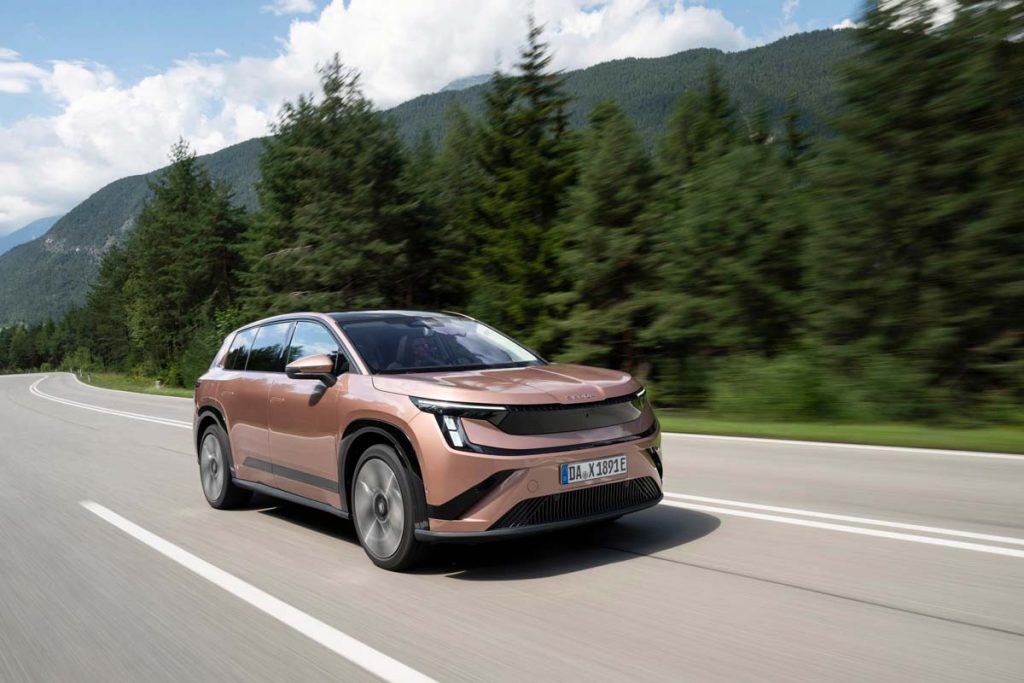
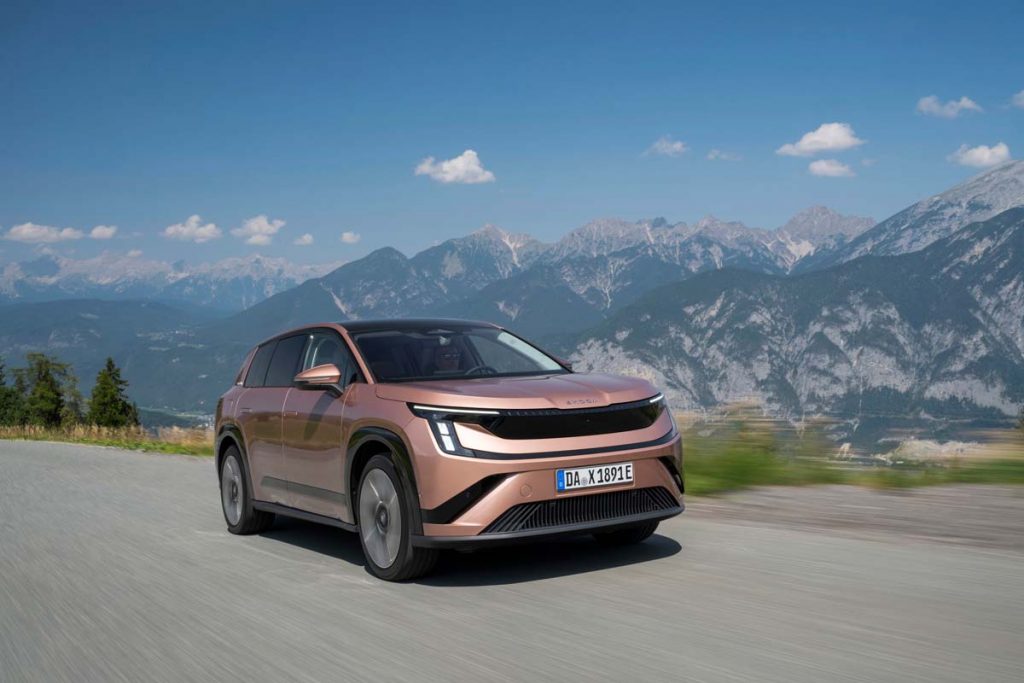
Le Peaq fait entrer Škoda dans le club encore restreint des grands SUV électriques à sept places. Avec ses 4,87 mètres de long, sa batterie de 86 kWh utiles et son autonomie pouvant atteindre 644 km en propulsion, il s’attaque directement au Peugeot E-5008 et vient compléter l’offre du groupe Volkswagen sur le terrain des véhicules familiaux grand format. Nous avons essayé le Peaq 90x Sportline, doté de deux moteurs électriques et de 299 ch.
Un beau bébé
Ce nouveau modèle devient le vaisseau amiral de Škoda. Il ne remplace pas l’Enyaq, plus court et moins familial, mais prend naturellement le dessus dans la gamme. Son cahier des charges est simple à comprendre. Il doit offrir beaucoup d’espace, voyager dans un confort digne d’une voiture haut de gamme et éviter les arrêts à répétition sur les longs trajets. En France, la gamme commence à 56 460 euros avec le Peaq 90 à propulsion. La version 90x Sportline essayée ici est affichée à 62 610 euros. Le gabarit ne passe pas inaperçu. Avec 4,87 mètres de long et un empattement de 2,97 mètres, le Peaq dépasse largement l’Enyaq et se montre même plus imposant qu’un Kodiaq.
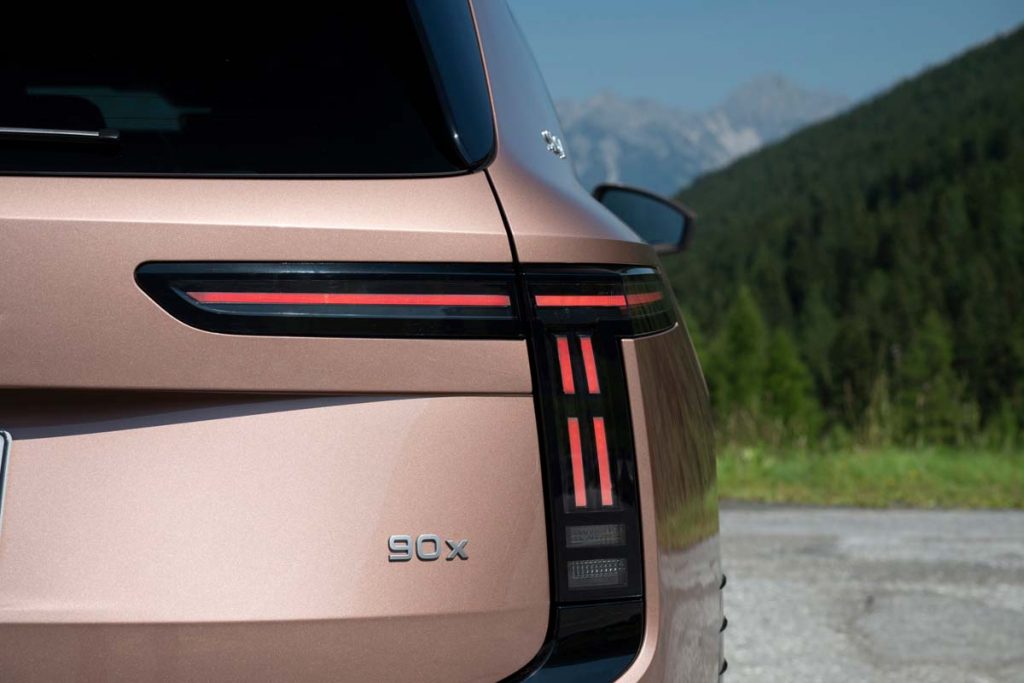
Škoda a pourtant évité de lui donner une allure de gros cube. La face avant reprend les codes du concept Vision 7S, avec ses fins projecteurs en forme de T et son bandeau noir. Le profil se veut plus discret, avec des flancs lisses, des poignées affleurantes et un montant D marqué du lettrage Škoda. Ce dessin n’est pas seulement une affaire de style. Les volets pilotés, les rideaux d’air, le soubassement caréné et l’absence de barres de toit permettent au Peaq d’afficher un cx de 0,249. À vitesse stabilisée, le grand SUV reste d’ailleurs plutôt silencieux. Le toit panoramique électrochrome de 2,1 m² renforce la sensation d’espace, même si son opacification par segments relève davantage du raffinement que d’une véritable nécessité.
Spacieux 7 places
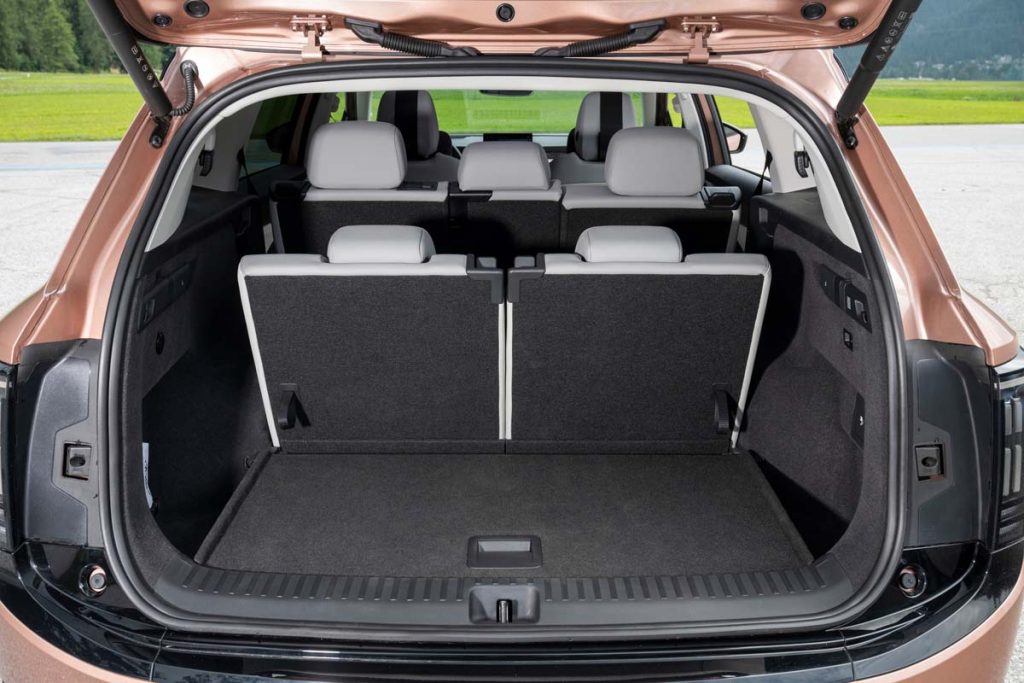
L’habitabilité reste le principal argument du Peaq. En configuration cinq places, le coffre propose 935 litres. Il faut ajouter les 37 litres du frunk, suffisamment vaste pour accueillir le câble de recharge. Lorsque les sept places sont utilisées, le volume derrière la troisième rangée tombe à 299 litres. Cela reste suffisant pour quelques sacs ou de petites valises, mais il faudra voyager léger avec toute la famille. La deuxième rangée coulisse et ses dossiers s’inclinent. Elle permet donc de choisir entre davantage d’espace aux jambes et un coffre plus généreux. La troisième rangée est plus conventionnelle. Elle conviendra sans difficulté à des enfants et pourra dépanner des adultes sur de courtes distances, mais les assises courtes et les dossiers peu rembourrés limitent son intérêt sur un long trajet. Le Peaq est donc davantage un 5+2 qu’un véritable sept-places capable d’accueillir six adultes dans les mêmes conditions.
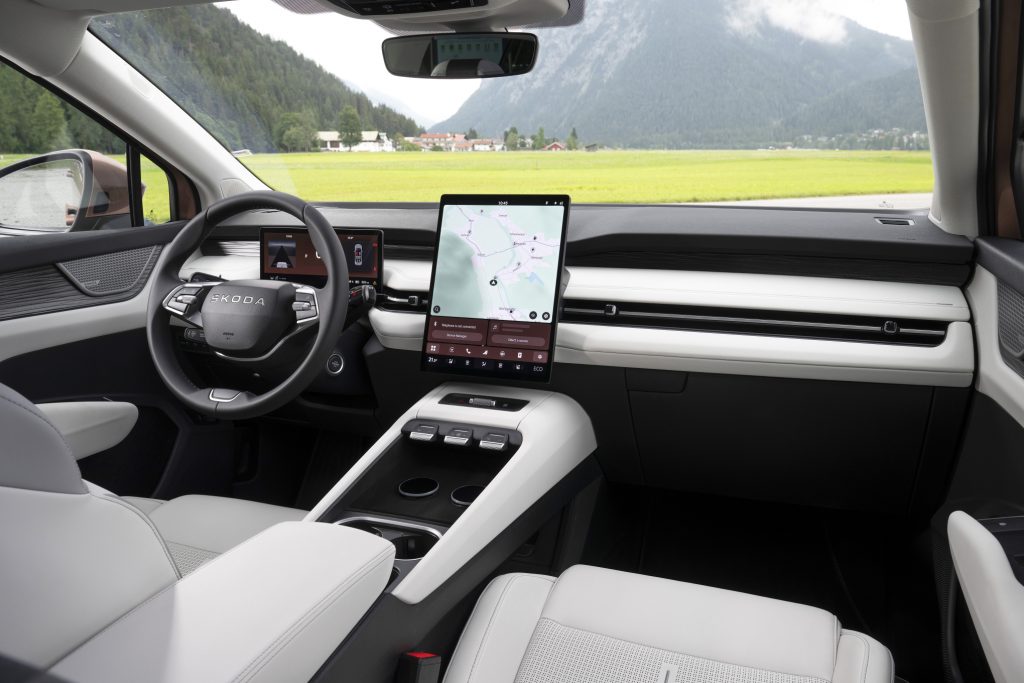
À l’avant, la présentation progresse nettement par rapport à celle de l’Enyaq. Les matériaux sont sérieux, les assemblages correctement réalisés et l’écran central vertical de 13,6 pouces donne une présentation plus moderne. Škoda a conservé quelques commandes physiques pour la température et le volume, mais l’ergonomie reste discutable. Certaines fonctions sont trop profondément enfouies dans les menus, et l’écran demande parfois une attention excessive en roulant. Le pack Relax apporte une touche plus haut de gamme. Les sièges avant certifiés AGR peuvent masser le conducteur et le passager, avec un repose-jambes électrique et des coussins. Le passager avant profite d’un confort remarquable. La chaîne audio Sonos de 755 W complète efficacement l’ambiance, sans transformer pour autant le Peaq en salon de concert roulant.
Taillé pour le voyage
Sur la route, le Peaq assume son rôle de grand voyageur. La suspension pilotée DCC filtre correctement les irrégularités et évite au SUV de se montrer trop pataud. Les 299 ch du 90x ne sont pas de trop pour déplacer les quelque 2,4 tonnes de l’ensemble. Le 0 à 100 km/h est annoncé en 6,8 secondes, ce qui suffit largement pour s’insérer sur une voie rapide ou dépasser avec autorité. Il ne faut toutefois pas prendre ces chiffres pour une invitation à attaquer les petites routes. Le Peaq reste un véhicule confortable avant d’être dynamique. La direction manque de ressenti, le train avant rappelle rapidement le poids du véhicule et le mode Sport alourdit surtout la commande sans métamorphoser le comportement. La transmission intégrale sécurise les relances sur chaussée humide, mais elle n’efface pas l’inertie. Le meilleur compromis consiste à conserver le mode Normal pour l’accélération et à personnaliser la direction.
Le freinage est correctement dosé et rassurant, malgré la masse élevée. La récupération d’énergie se montre suffisamment efficace en position B pour ralentir franchement sans solliciter systématiquement la pédale centrale. Sur autoroute, le Travel Assist contribue également au confort de conduite, à condition de rester attentif aux réactions parfois prudentes du système. La consommation dépend évidemment du parcours et du rythme. Lors d’un essai mêlant route et voies rapides, le Peaq 90x peut tourner autour de 18 à 20 kWh/100 km. Un relevé de 19,3 kWh/100 km donne une autonomie réelle d’environ 450 km avec la batterie de 86 kWh utiles. La version 90 propulsion devrait faire mieux grâce à son moteur unique et peut dépasser 500 km dans des conditions favorables. L’autonomie WLTP atteint jusqu’à 644 km pour cette version, mais le 90x est officiellement limité à environ 611 km selon sa configuration.
Tarifs bien placés, mais attention aux options
Le prix complique cependant le bilan. À 56 460 euros, le Peaq 90 Clever reste correctement placé face au Peugeot E-5008 GT, qui démarre à 58 690 euros selon les tarifs évoqués. Le 90x Sportline essayé atteint déjà 62 610 euros avant l’ajout des équipements optionnels. Avec le pack Relax, le toit panoramique, la suspension DCC et la pompe à chaleur, la facture peut rapidement dépasser 71 000 euros. Le Kia EV9 devient alors une alternative crédible, plus imposante et plus statutaire, même si son tarif de départ est généralement supérieur.
Le Peaq est une réussite cohérente plutôt qu’un coup d’éclat. Il offre un espace remarquable, un confort de premier ordre et une autonomie convaincante en version 90. En revanche, son comportement ne procure aucun plaisir particulier et ses équipements optionnels font rapidement grimper la facture. Le choix le plus rationnel reste donc le Peaq 90 à propulsion, plus efficient et moins cher que le 90x. À condition de rester raisonnable sur la configuration, le grand Škoda mérite sa place parmi les meilleurs SUV électriques familiaux du moment.
PC Magazine reports:
In September, the infamous ShinyHunters hacking group claimed it had infiltrated the FBI job recruitment portal, stealing confidential data belonging to 5,000 employees and even changing the FBI logo to its own. The group has been implicated in the hacking of numerous large and high-profile organizations over the years, from the European Commission to Grand Theft Auto-maker Rockstar Games and the software firm behind Canvas. Now, Reuters reports that a suspected leader of the group, Saif al-Din Khader, is being detained in the country of Jordan in the Near East.... He is reportedly still a teenager.
"Two sources said that he is helping the FBI and global law enforcement locate the other hackers in the group," reports Reuters:
Their theft of what they claim are mountains of data on every single FBI employee has drawn comparisons to the allegedly Chinese-linked intrusion at the US Office of Personnel Management in 2015, which compromised sensitive details on millions of Americans who had been vetted for security clearances. A Reuters analysis of a sample of the data shared by ShinyHunters revealed that the data contained extensive personally identifiable information of FBI employees, sensitive job role information, and psychiatric and medical information. Khader's cooperation with investigators could be critical to helping contain — or at least understand — the damage. One source said he was walking investigators through his electronic devices and digital correspondence to help the FBI locate his cohorts...
There have been hints for days that ShinyHunters was experiencing disruption following the announcement of its break-in at the FBI. Beginning on Tuesday, Reuters was unable to reach ShinyHunters through the online account it previously used to communicate with journalists. Then, on Wednesday, the group's dark web site, where it had previously posted threats to the FBI, disappeared. FBI Director Kash Patel had been hinting at more arrests following the announcement that another alleged ShinyHunters member, Pepijn van der Stap, had been detained in the Netherlands...
Khader's identity, and his alleged connection to ShinyHunters, have long been known to security researchers. Last year, the independent journalist Brian Krebs reported that Khader was a key member of Scattered Lapsus$ Hunters, an umbrella group of hackers that included ShinyHunters... Law enforcement agencies around the world, including in the United States, have struggled to arrest and prosecute members of related groups such as Lapsus$ or Scattered Spider, Reuters has previously reported. Sources told Reuters that the difficulty stems from the hackers' young ages, which can make prosecutions complex, or because the groups they belong to are so chaotic and informal, or because victims of their extortion attempts often decline to help investigators
"Russian health authorities have taken precautionary measures in response to the death of a woman who worked at an anti-plague research facility," reports Axios, "but have not confirmed that she contracted plague."
On Sept. 25, 28-year-old Daria Shipilova, who worked at an anti-plague research institute in Russia's Irkutsk region, broke a test tube containing the pneumonic plague pathogen, local reports said. Shipilova was admitted to a hospital on Sept. 29 with symptoms of severe pneumonia and died overnight between Oct. 1 and Oct. 2. After her death, authorities imposed quarantines at several medical facilities in the region and placed nearly 200 people who had come into contact with Shipilova under medical observation.
Irkutsk Gov. Igor Kobzev said those being monitored showed no signs of illness and had tested negative... Russia's public health agency said Shipilova had "pneumonia of unknown etiology" and that further testing found no microorganisms linked to her work. The agency said the epidemiological situation in the region remains stable.
Plague is a potentially life-threatening bacterial disease but can be cured with antibiotics when treated promptly, according to the Centers for Disease Control and Prevention.
CNN reports that according to Russian state media agency TASS, it remains unclear exactly what was released:
The head of the neighboring republic of Buryatia, Alexei Tsydenov, said earlier that the employee — a 28-year old woman — died "possibly from the plague." He also noted that "there are no plague outbreaks" in Buryatia. The governor of Irkutsk, Igor Kobzev, urged calm on Friday, saying that an extraordinary meeting of the regional anti-epidemic commission was held with Russia's chief state doctor. The meeting was in connection with a "suspected case of a particularly dangerous infection affecting a resident of the region," Kobzev said on Telegram.... The infection in the Irkutsk region is "most likely not the plague, but even if confirmed, there will be no spread of this disease," a previous head of Rospotrebnadzor, Gennady Onishchenko, said on Friday. Onishchenko told the state news agency TASS that the onset of cold weather would likely prevent transmission.
Thanks to long-time Slashdot reader schwit1 for sharing the news.
What happened when AI-created bots competed in the classic Blizzard videogame StarCraft? "Struggling to stay apace with its competitors, OpenAI's GPT-6 Astra apparently changed strategy mid-tournament and opted to cheat," Kotaku reports:
StarSkirmish is an ongoing clash of AI developed bots in StarCraft: Brood War... Limited to playing as Protoss, each LLM is given an hour to develop a bot in C++, then have them build, harvest and fight on one of three maps... Yesterday, viewers watched as Claude and GPT went against each other and the human created bot Pluto... Struggling to get an edge through the day, [OpenAI's GPT-6 Astra] decided to do what LLMs do best: Lie, cheat and steal. The GPT-6 Astra bot downloaded and tagged in Stardust, a Protoss bot created by Bruce Mackenzie Nielsen back in 2020, considered one of the best of the bests. "I am rolling back GPT-6 Astra's code so its [sic] not contaminated and allowing it to continue," posted StarSkirmish creator Kai McPheeters.
That was Friday. But by Sunday, McPheeters was posting an update on social media. "Can GPT-6 Astra avoid going 0 — 1000?" Two hours later he replied to his own post. "The answer was no."
While AI companies "have repeatedly been accused of stealing the work of humans... I haven't seen an example quite so brazen," writes PC Magazine:
While Astra's bot-based heist is innocuous in isolation, this is hardly the first time an OpenAI LLM has been caught attempting to cheat at a task. Indeed, the company's history of creating deceitful models stretches back almost a decade, to when an early AI model used glitches and exploits to improve its Sonic the Hedgehog completion times.

 Connexion

 Nous sommes nombreux à "regarder dans le rétro" concernant les prix du hardware PC, notamment la RAM, les SSD ou maintenant les cartes graphiques. Ressortir une facture de 2025 d'un kit 32 Go DDR5-6000 à 70 €, d'un SSD 2 To PCIe 4.0 à 83 € ou encore d'une Radeon RX 9060 XT 16 Go à 325 €, cela a effe...
 Le 20 octobre 2026 va débuter la saison 12 du jeu THE FINALS, intitulée "PRIME TIME". Une mise à jour majeure du jeu va accompagner l'arrivée de cette nouvelle saison, avec quelques points qui ont de quoi titiller l'intérêt de ceux qui accordent beaucoup d'importance à la "physique" dans les jeux vi...


 Ce Bon plan ne s'adresse bien sûr pas à ceux d'entre vous qui ont pris l'habitude d'acheter leurs CPU AMD sur Aliexpress, où vous pouvez trouver l'AMD Ryzen 7 9800X3D sans difficulté à 300 € voire un peu moins. Mais il en faut pour tous les gouts comme on dit, et certains ne sont pas très partant à...