The new 2026 ON1 Effects is now officially released and available as a standalone application or as a plugin for Lightroom Classic and Photoshop. Version 2026 introduces new 1-click subject and background masks, layer-based masking, improved mask quality, and four new creative filters, all designed to give you speed without sacrificing control. Additional information:
Photo RAW users can already access Effects inside that app; this release adds a standalone option
Subject and Background Masks: AI-powered one-click masking to instantly isolate the main subject or background in an image, enabling precise adjustments without manual brushing.
Depth Lighting Filter: Uses AI depth detection to add cinematic lighting effects, balancing light and shadow for dramatic, three-dimensional results in portraits or landscapes.
Split Field Filter: Simulates a tilt-shift lens to compress perspectives, bringing distant backgrounds closer while keeping the foreground sharp—ideal for creative landscape edits.
Double Exposure Filter: Easily blends two images or exposures into artistic composites without needing multiple layers or in-camera techniques, turning simple shots into surreal artwork.
Motion Filter: Applies realistic motion blur effects like panning, zooming, or twisting to static photos, adding a sense of movement and dynamism.
Effects Starting Points: Kick off edits with pre-selected favorite filters or looks applied instantly, streamlining the creative process for consistent styling across images.
New Add Filter Dialog: An updated interface for quicker access to commonly used filters, with search, favorites, and the ability to hide unused options for a more personalized workflow.
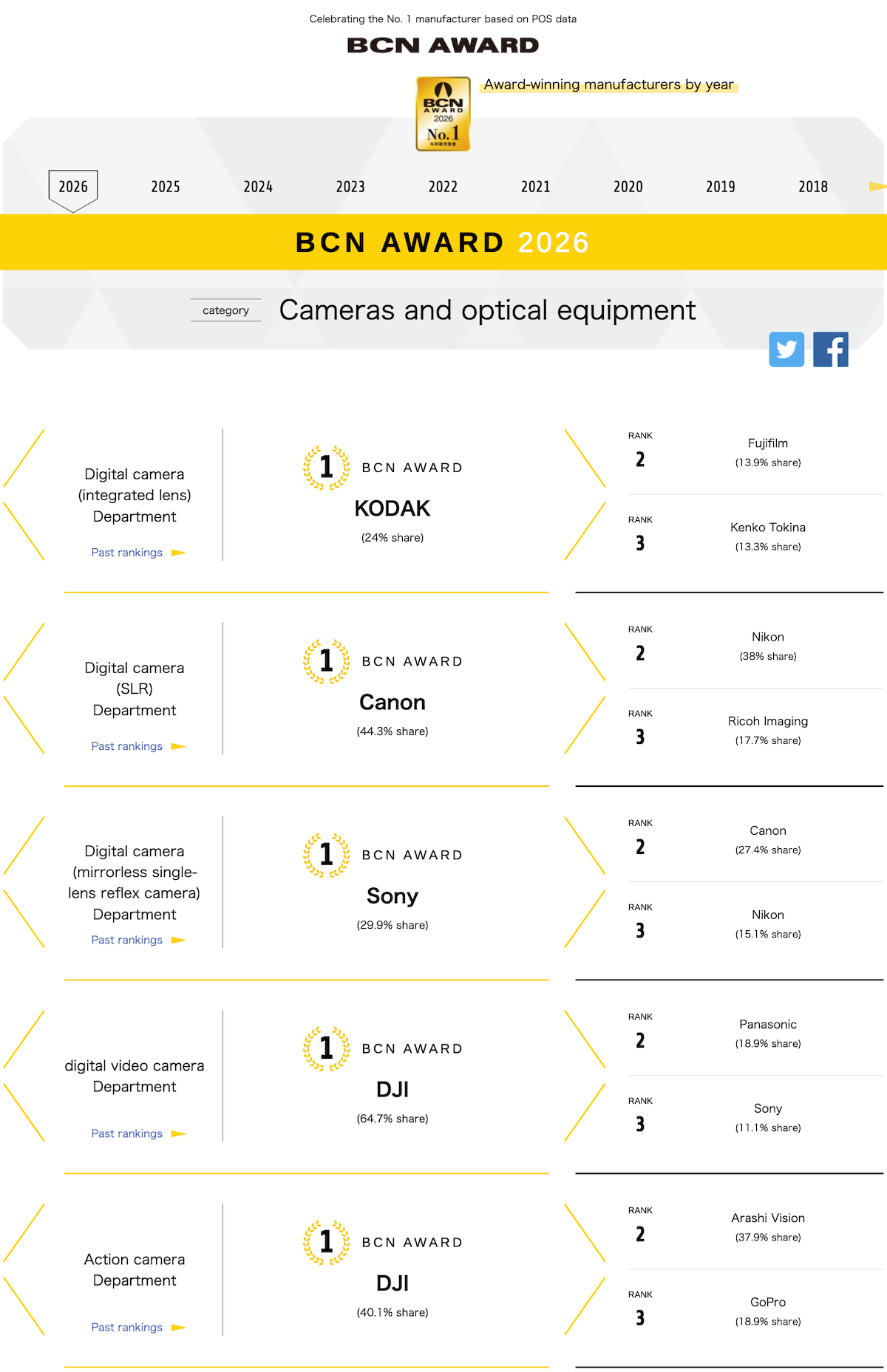
BCN Corporation, headquartered in Tokyo, announced the winners in the camera category for 2026. BCN collects POS sales data from most retail stores in Japan (January to December, 2025). Here is the latest ranking:
Mirrorless cameras:
Sony: 29.9%
Canon: 27.4%
Nikon: 15.1%
DSLR cameras:
Canon: 44.3%
Nikon: 38%
Ricoh/Pentax: 17.7%
Digital compact cameras with an integrated lens:
Kodak: 24%
Fujifilm: 13.9%
Kenko Tokina: 13.3%
Action cameras:
DJI: 40.1%
Arashi Vision: 37.9%
GoPro: 18.9%
Video cameras:
DJI: 64.7%
Panasonic: 18.9%
Sony: 11.1%
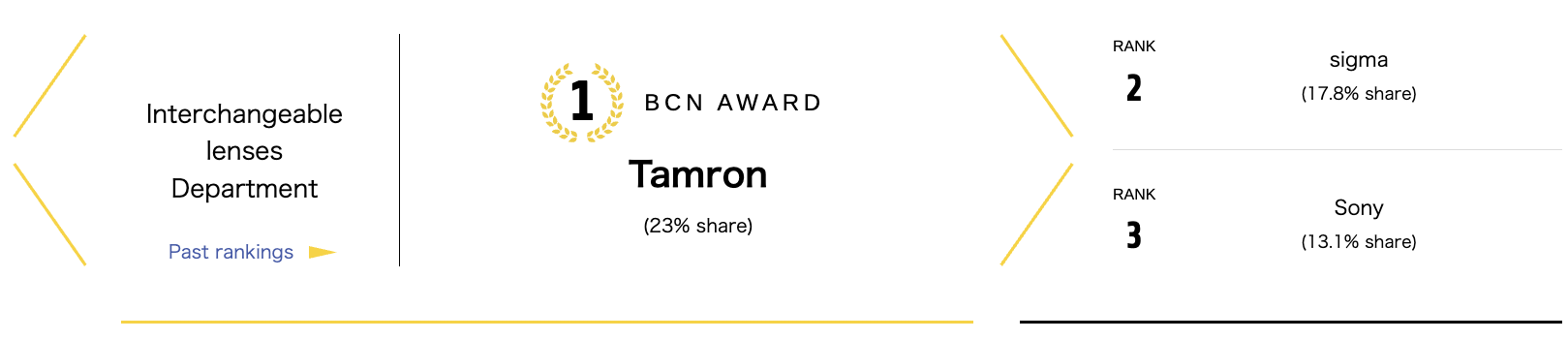
Interchangeable lenses
Tamron: 23%
Sigma: 17.8%
Sony: 13.1%
Overall Trends and Insights
Mirrorless Growth vs. DSLR Decline: Mirrorless rankings show a fragmented but vibrant market, with Sony holding strong. DSLR sales are likely shrinking, as evidenced by lower overall volumes implied in historical data (e.g., Canon’s 2025 DSLR share was 69.4%, but no 2026 figure available). Nikon remains competitive in both but could benefit from more aggressive Z-system marketing.
Non-Traditional Brands Rising: DJI’s double win in video and action categories signals a shift to versatile, tech-integrated devices over pure camera hardware. This could pressure traditional brands like Nikon to innovate in video features.
Lens Market Dynamics: Third-party lenses leading points to price sensitivity in Japan. For Nikon fans, this means opportunities to pair Z-mount bodies with affordable Tamron or Sigma glass, potentially boosting system adoption.
Nikon-Specific Analysis: Nikon appears in three categories (DSLR 2nd, mirrorless 3rd, binoculars 3rd), a respectable showing amid intense competition. Compared to 2025 (where Nikon was 3rd in mirrorless and 2nd in DSLR), there’s consistency, but to climb higher, focusing on entry-level mirrorless or hybrid video capabilities could help. No appearance in lens top three suggests Nikon’s native optics are premium-positioned, not volume leaders.
These awards reflect Japanese retail trends, which may differ globally due to regional preferences (e.g., instant cameras are popular in Asia).
Late last year, Tamron announced that it was bringing its venerable 70-180mm F2.8 Di III VC VXD G2 to Nikon's Z mount. We took the opportunity to shoot a sample gallery with it, to get an idea for how it performs, and how much it asks you to give up compared to a heavier, larger and more expensive 70-200mm F2.8.
That is a bit of a spoiler for what the experience of shooting with the lens was like. Its size makes it much more usable as an everyday walkabout lens than your typical 70-200mm F2.8, and I found myself taking it places I normally wouldn't bring this class of lens, just because it'd be too much of a hassle to do so.
Even extended, the Tamron 70-180mm F2.8 Di III VC VXD G2 isn't particularly long (unlike its name).
The autofocus motors in the lens were snappy enough that I never felt like they were holding the camera back, even when I was shooting fast-moving subjects like horses. I also appreciated the lens's inclusion of optical image stabilization, which, when paired with the Z8's in-body stabilization, let me get sharp handheld shots at shutter speeds that would typically be difficult to manage with a telephoto lens.
Optically, you do give up a bit compared to the more premium options; as evidenced by several photos in our sample gallery, there's some pretty heavy vignetting at F2.8, though it's noticeably better at F4, and pretty much clears up by F5.6. There's also, of course, the 20mm difference at the long end, though in most scenarios, most photographers won't really notice the difference between a photo shot at 180mm and one shot at 200mm. The lens is also reasonably sharp throughout its range, and has relatively pleasing bokeh wide-open.
The vignetting will be most noticeable when shooting relatively bright, featureless surfaces like the sky, and is less distracting in other situations.
Finally, there are the controls. The lens has a single customizable button, which is always a nice inclusion, and Nikon allows you to assign a wide variety of functions to it. I also appreciated the inclusion of a lock switch to keep the lens retracted. It's an extending zoom design (which isn't my favorite, but makes sense given its size), and having the ability to keep it from walking while I was carrying it around was much appreciated. However, it's worth noting that it's quite a strong lock; unlike with some of Sigma's lenses, you can't overpower it if you forget to deactivate it before raising the camera up to your eye.
My biggest complaint with the lens is the focus ring, which is quite sensitive, and is situated exactly where I'd typically rest my hand. This led me to frequently bump the camera into manual focus mode at inopportune times. If I spent long enough with the lens, I'm sure I'd adapt to it (and the focus ring's location will be more familiar to those who only shoot Nikon), but I ended up simply setting it to do nothing in the camera's settings.
The buttons are nice to use, but the focus ring can be quite touchy, and doesn't leave you much room to hold the lens.
Minor complaints and personal preferences aside, I found the Tamron 70-180mm F2.8 Di III VC VXD G2 to be a capable and versatile lens, especially for the price. But be sure to check out the gallery below so you can make your own assessments.