Last week, we asked our readers what photos made them realize their new gear was worth it. Here is what they showed us.
European-Z8
Buying a new camera is an exciting feeling, but so is seeing the great photos you take with it. For last week’s community question, we asked readers to share a favorite photo or story from their new gear. From majestic animals to intense bokeh scenes, and from antique cameras to modern mobile phones, the responses covered a wide range of interesting categories.
As always, there was also a mix of useful tips you’ll want to read about.
Here are some of the photos and stories they shared. Click their names to see more within the forum conversation.
“Two experiences. The first was the first dance concert I shot with the Olympus 40-150mm F2.8 PRO. I was more than happy to do this with ‘smaller’ (relatively speaking) gear than full-frame gear. Second was the first time I did portrait shots for posters, of dancers, in full costume, with two flash units, umbrella reflectors, etc. Those first-time experiences are always sweet, no matter how many times I do it afterward.” – Satyaa
“Last Christmas, I managed a photo which I had waited literally years to take. It’s usually impossible to take a photo of the center of the Octagon at Ely Cathedral from below because there’s normally a modern oak altar in the way. I had gone to the cathedral to try out my new Hasselblad X2D II with a 20-35mm lens. Lo and behold, a team of workmen was preparing the central area for some school carol concerts. The altar had been removed. One nod of approval later and I was in!” – ClaireJRedHat
Nikon Z8 | Nikkor Z 100-400mm F4.5-5.6 VR S | 210mm | F5 | 1/750s | ISO 12800PhillipKukelhan
“Since moving to Cleveland 5 years ago, I’ve spent a lot of time riding my bicycle along the old Ohio & Erie Canal, where I see a lot of wildlife, mostly deer, snakes, bird life, and turtles.” – PhillipKukelhan
“Two years ago, I decided to upgrade a Canon 40D 12mp with the used X-T4. After having the camera a couple of months, I had a vacation to Japan scheduled. My intention was to buy an array of lenses while I was there. I put one of them to use the very night I purchased it. Because of the low-light conditions and fast-moving moments, I realized from those photos what a great purchase my X-T4 and Sigma 10-18mm F2.8 were. Personally, there isn’t a better feeling than successfully capturing these moments.” – ronphoto
“As a second-generation photographer, I grew up using Canon, and most of my gear was handed down from my father. Around 2014/2015, I was tired of using cast-offs and older generation equipment, so I set out to purchase my own gear and explore other systems. I had already picked up an A6000 (or A6300) as a secondary camera to my 1D Mark II, but when Sony released the A7RII, I decided to rent it for a big annual job.” – reflux83
Fujifilm X-S20 | Fujinon XF 56mm F1.2 R WR | 56mm | F1.2 | 1/170 sec | ISO 6400Minolta TC-1
“I decided to get the XF 56mm F1.2 WR because the image quality is so good that it compensates for the fact that it’s just really rather big on my X-E5. Well, when I started using it at the next concert, this is the kind of thing that really convinced me it was money well spent. It was even a bit emotional – taking me back 20+ years to when I finally bit the bullet, bought that Zuiko 90mm F2 and got my first photos back. Just one example says enough.” – Minolta TC-1
“Having introduced Eye Control AF (ECAF) with the second camera in the RF series, Canon made it an upgrade I couldn’t pass up. I always believed ECAF had the potential to significantly improve my photography, and I wasn’t wrong. The feature is particularly valuable with lenses such as the Canon RF 28–70mm F2 L USM, whose large and heavy glass elements require more time to focus. By allowing you to direct the AF system immediately to the intended subject, Eye Control AF reduces unnecessary focus hunting and helps the lens lock focus more efficiently, without wasted tries.” – PhotoKhan
“It wasn’t one image so much as hundreds that assured me my stabilized AF telephoto macro lens was a great investment for the online store.” – Jefenator
Canon EOS R5 Mark II | Canon RF 24-70mm F2.8 L IS USM | 37mm | F3.5 | 1/80 sec | ISO 4000Invisible Man Potography
“I realized I made a great decision in upgrading from a Canon R6 Mark II to a Canon R5 Mark II when I reviewed my files from the June 26, 2026, 20th Anniversary of fashion designer Diego Cerón’s ‘Couture a Table’ in Mérida, México. Standing outside the room, I photographed Pablo Mercader Duch – performing as ElHada Frozen and embodying Marie Antoinette – through the crowd. In that moment, I made the artistic decision to allow the people to form a natural frame around Pablo.” – Invisible Man Photography
So many other stories we couldn’t fit in this article are shared in the forums. Thanks to everyone who took the time to submit a favorite photo from their first new camera purchase.
Feel free to participate in the series at any time. New questions are posted here on the homepage and in the forums every other week We can’t wait to read your stories and see your photography!
About the Author: Mathew Anderson is a proud Community Manager for the technology industry and a past visitor to DPReview.com for all his camera needs. He is currently the lead of DPReview’s community and primary communication link between the community and DPReview’s team.
Want to stay up to date on the latest product news and releases? Add DPReview as a preferred source to ensure our independent journalism makes it to the top of your Google search results.
The Viltrox AF 26mm F2.8 Evo is the smallest offering in the Evo lineup yet.
Viltrox
Viltrox has expanded its mid-tier lineup with the AF 26mm F2.8 Evo, a new pancake prime. As the smallest Evo offering yet, it continues the series’ focus on durable build quality and external controls, positioning itself as an everyday carry option for street and travel photographers.
The AF 26mm F2.8 Evo is made for full-frame E and Z mount cameras. As a pancake lens, it’s highly compact and lightweight, measuring just 24mm (0.9″) thick and weighing only 130 g (4.6 oz). Despite its diminutive size, it still offers useful controls. That includes a clicking aperture ring, though there is no toggle to de-click it. There’s also a separate focus ring for manual focus.
The lens features two narrow control rings: one for aperture and one for focus. Viltrox
The lens uses an optical design of eight elements in six groups, including two aspherical elements and one high-refractive index (HR) element. Viltrox promises good sharpness even with the aperture wide open, and says that in-camera corrections minimize distortion. It uses a seven-blade aperture diaphragm.
The new lens uses an STM autofocus motor. It can focus as close as 0.2m (7.8″), enabling close-up shots in addition to broad views. A machined metal barrel offers greater durability, and it is dust- and splash-resistant around the lens mount. The lens is compatible with 43mm filters, as long as you use the included lens hood, and it uses a magnetic front lens cap. A USB-C port enables firmware updates.
The Viltrox AF 26mm F2.8 Evo is available today for E and Z mounts for $299.
Viltrox Launches Ultra-Compact AF 26mm F2.8 EVO Pancake Lens
Durable, Full-Frame E/Z Mount Lens with Dual Control Rings Designed for the Portability Needs of Everyday Photography
Shenzhen, China, July 15, 2026 — Viltrox today announced the launch of its AF 26mm F2.8 EVO, a compact full-frame autofocus pancake lens designed for everyday carry and photography. Well suited to street photography, architecture, environmental portraits, travel, and visual storytelling, the AF 26mm F2.8 EVO is an ideal companion for creators who value great portability, dependable image quality, and intuitive handling in a lightweight full-frame system.
Durable, Ultra-Compact, With Intuitive Control
The AF 26mm F2.8 EVO is an ultra-compact lens that pairs naturally with today’s lightweight full-frame mirrorless cameras. Available for Sony E and Nikon Z mounts, this pancake lens features both a dedicated aperture ring and a separate focus ring, providing tactile manual control that is rarely found in this category.
Its precision-machined metal construction provides durability and a premium feel, while dust and splash resistance around the lens mount enhances reliability during everyday use, matching its portability to make it an ideal companion for travel and spontaneous photography.
An Excellent Perspective at Any Distance
A gear-type STM autofocus motor delivers precise and reliable autofocus performance. With a minimum focusing distance of just 0.2m, the AF 26mm F2.8 EVO allows photographers to transition seamlessly from expansive landscapes to expressive close-up compositions. With an 81.2° angle of view, the 26mm focal length sits naturally between traditional wide-angle perspectives, delivering an immersive yet natural field of view that adapts effortlessly to a broad range of subjects and shooting scenarios.
Carefully Crafted for Impressive Image Quality
Compact in size yet impressive in performance, the AF 26mm F2.8 EVO features an optical design of 8 elements in 6 groups, including 2 aspherical elements and 1 high-refractive (HR) element. The lens delivers excellent sharpness even at its maximum aperture of F2.8, allowing confident wide-open shooting. In-camera correction further helps produce natural rendering with minimal visible distortion for balanced, high-quality results.
Convenient Functionality
A magnetic front lens cap enables conveniently quick attachment and removal. A standard 43mm filter thread, a built-in USB-C port for firmware updates, and compatibility with the Viltrox Lens App further enhance the user experience, combining everyday convenience with long-term usability.
Pricing and Availability
The Viltrox AF 26mm F2.8 EVO is available for 299USD / 319EUR / 279GBP
About the Author: Abby Ferguson holds an MFA in photography and blends a fine-art background with extensive editorial and commercial experience. She built and led an in-house imaging program for a large vacation rental company and has served as an associate editor at Popular Photography. She also teaches at a local community college and serves on its Photographic Technology Program Advisory Board, sharing her knowledge and enthusiasm for the medium.
Want to stay up to date on the latest product news and releases? Add DPReview as a preferred source to ensure our independent journalism makes it to the top of your Google search results.
Firmware v1.1 for medium format cinema camera arrives today, with further updates over the coming year
Fujifilm / Timur Civan
Fujifilm has released updated firmware for its GFX Eterna 55 medium format cinema camera, and set out a roadmap of additional updates that will follow over the next year.
Firmware v1.1 promises improved stability and usability but future updates include support for desqueezed previews of additional anamorphic lens ratios, improved SDI and HMDI latency, with LANC control and variable electronic ND arriving later.
Press release:
Fujifilm Announces Firmware Roadmap for FUJIFILM GFX ETERNA 55 Filmmaking Camera
Enhanced usability and operability that expands the possibilities of creative work
TOKYO – July 15, 2026 – FUJIFILM Corporation today announces a firmware roadmap designed to further expand the applications of the “FUJIFILM GFX ETERNA 55” (GFX ETERNA 55), Fujifilm’s first dedicated filmmaking camera. The latest update expands the possibilities for creative work and further enhances expressive capabilities.
Ver.1.101 – Available July 15, 2026
The camera’s overall operational stability and usability have been updated to provide a refined shooting experience.
Ver.1.20 or later – Availability later in 2026
Features to include:
Support for in-camera playback of MXF (Material eXchange Format).
Back-up and restore of camera settings via a dedicated App.
Further improvements to the enhancements made by firmware version 1.04 to SDI and HDMI video latency.
Additional anamorphic “desqueeze” options will be made available, which will include Open Gate 4K 4:3.
Ver.1.30 or later – Availability January 2027 or later
Features to include:
Additional preset options for coarse adjustments with the “Electronic Variable ND Filter.”
Automatic, in-camera adjustment of ND filter density, while maintaining constant values for iris, shutter angle, and ISO sensitivity.
LANC (Local Application Control Bus System) support for enhanced operation.
Remote control of “Duvo Series” lenses through the Multi-function dial located on both the camera body and the “handle”.
About the Author: Richard graduated as a scientist but had a lot more fun writing and shooting for his university magazine. A number of years spent variously as a reporter, writer and editor on science and engineering titles combined his knowledge of science with his interest in images and words. But it was spotting the connections between emission spectra, white balance and all the nonsense he’d taught himself playing around in Photoshop that helped kindle an interest in digital photography. Searching for a camera led to him discovering DPReview and Richard was recruited by Phil Askey in 2007. He’s been combining his love of photography, communication and attention to detail (pedantry?) ever since.
He has unusually strong opinions about lenses for the APS-C format.
Want to stay up to date on the latest product news and releases? Add DPReview as a preferred source to ensure our independent journalism makes it to the top of your Google search results.
The Tamron 12-20mm F2.8 is the first to adopt a new design language, along with simpler naming.
Mitchell Clark
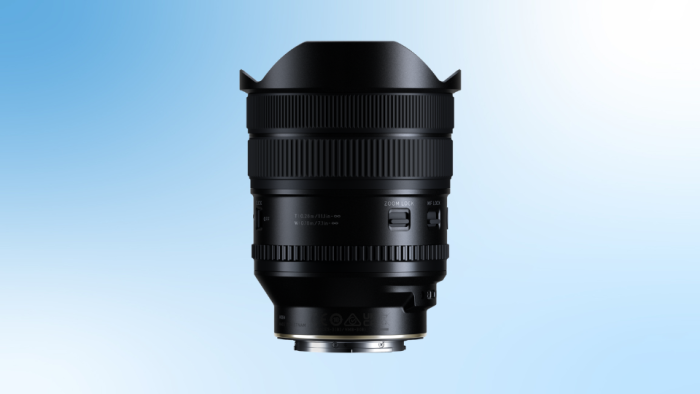
Tamron is introducing a fast, ultra-wide zoom lens for full-frame cameras: the 12-20mm F2.8. It’s being released for Nikon Z-mount and Sony E-mount, and is also ushering in a new look for the company’s lenses.
The 12-20mm F2.8 uses an optical formula with 17 elements in 12 groups, with one expanded glass molded aspherical element, three glass molded aspherical lenses, one extra low dispersion element, and three low dispersion elements. The company says it’s designed to be sharp to the corners, and to minimize and correct for aberrations like color fringing and sagittal coma flare. The latter is especially important for astrophotographers, who may be interested in this lens thanks to its wide focal range.
At 12mm, it can focus on subjects as close as 0.18m (7″), and at 20mm, its minimum focusing distance is 0.28m (11″). It has a 12-blade aperture. Because of its bulbous front element, it can’t accept front filters, but it has a rear filter holder in addition to its integrated lens hood.
Focusing is handled by a linear motor and is internal. While zooming doesn’t make the lens any longer, the front element does physically move back into the body. The lens has both an MF/AF switch and a manual focus lock switch; the latter is again something that will be appreciated by astrophotographers.
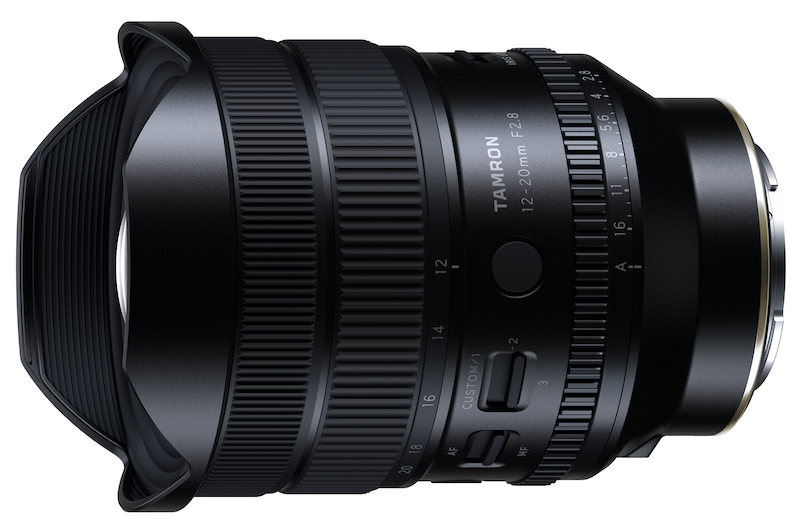
Beyond those switches, the lens is covered in controls. There’s a customizable function button in both portrait and landscape orientations, a zoom lock switch that can be used to keep the lens at either 12mm or 20mm, a lock for the aperture ring (or control ring on Nikon), a switch to click or declick that ring and a custom setting switch, which you can use Tamron’s Link software to configure to switch between focus position, change your rings’ rotation direction, limit focus, etc. There’s also a USB-C port you can use to update the lens’s firmware, or to connect it to your phone via a cable or wireless adapter to use Tamron Link.
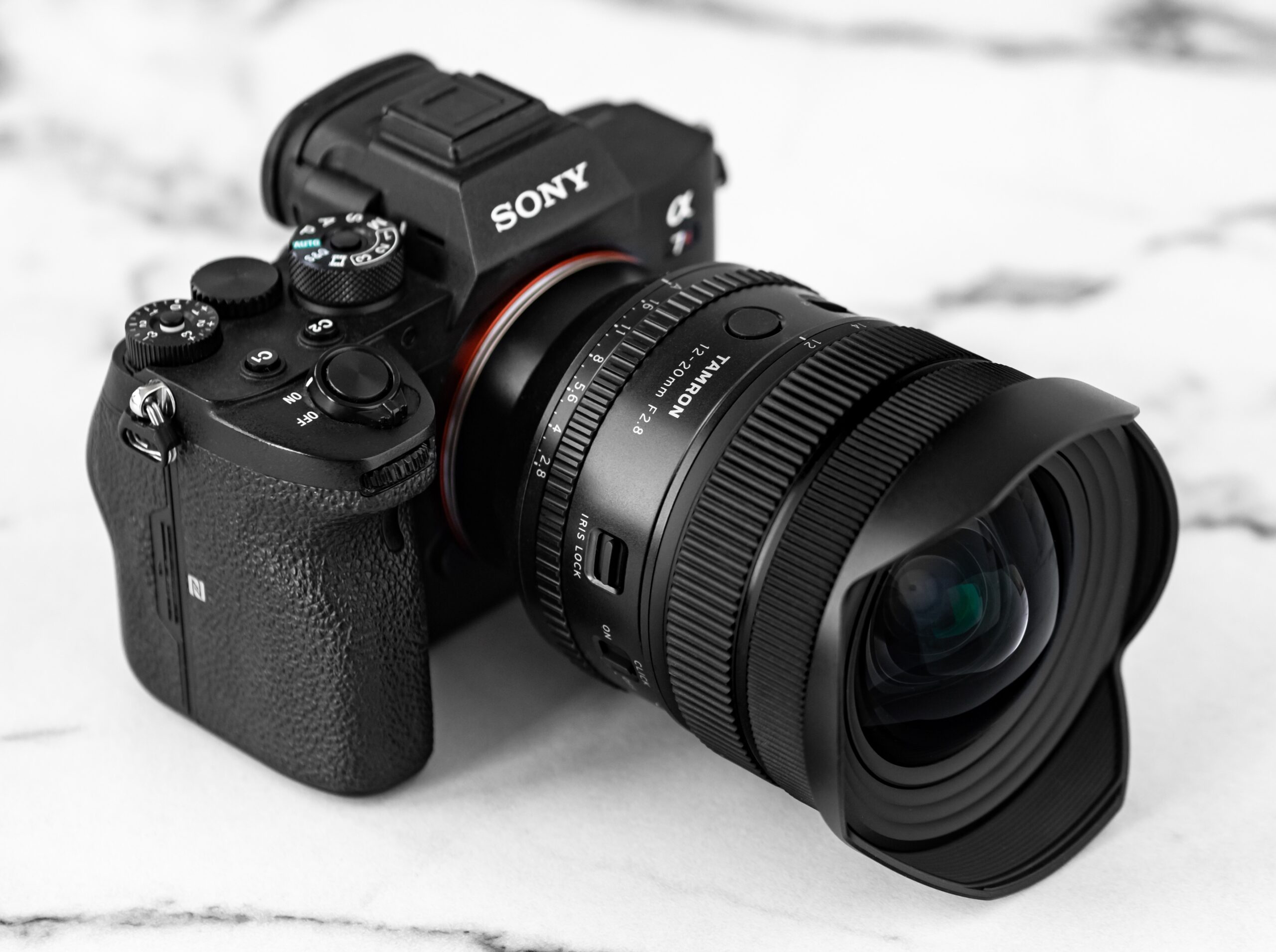
In its briefing, Tamron took a lot of pride in the lens’s size and weight, saying it was comparable to slower lenses, or ones with less range, and substantially lighter than other options. The E-mount version of the lens weighs 570g (20.1oz), with the one for Nikon weighing 15g more. The Sony version is 119mm (4.7″) long, with the Z-mount version adding 2mm.
This isn’t just a new lens for Tamron, though. The company is also introducing its new branding alongside it. Those familiar with the company’s naming conventions may have noticed what’s not there, first: there’s no “Di III” or “VXD” at the end of the name, denoting it as a mirrorless lens that uses a linear motor. Like Sigma , the company has decided that it doesn’t need to distinguish its DSLR lenses from its mirrorless ones directly in the name, and likewise, most of its lenses going forward are likely to use linear motors.
The updated industrial design language that Tamron is launching with the lens is called “Toned Profile Next,” which the company says is made to match how modern cameras are designed, while feeling better in the hand and more recognizably Tamron. Compared to its older lenses, the 12-20mm F2.8 has chunkier rings for zooming, aperture control and focusing, updated textures for its touchpoints, and new placement and print color for its branding. It also narrowed the champagne-colored “brand ring” that borders the lens mount.
I personally quite like the new look, especially since it comes with a clicking aperture ring on E-mount, something Tamron hasn’t been including on its recent lenses. I also appreciate that it’s now quite easy to grip the control rings and to distinguish which one your finger is on just by feel. The switches and buttons are all satisfying to use, and the lens feels solidly built, even if I don’t prefer the finish’s smooth texture.
The Tamron 12-20mm F2.8 will cost $1699 for the E-mount version and $1799 for the Z-mount version; the company says the difference comes down to volume, behind-the-scenes differences in manufacturing, and the competition on the different mounts. The Sony version will be available starting July 30th, while Nikon owners will have to wait until August 27.
Please do not reproduce any of these images on a website or any newsletter/magazine without prior permission (see our copyright page
). We make the originals available for private users to download to their own machines for personal examination or printing; we do so in good faith, so please don’t abuse it.
Loading gallery…
Thanks to Nikon for the loan of a Z8 to shoot this gallery. All images were processed using our standard lens workflow in Capture One, with the manufacturer’s distortion correction applied but no correction of vignetting. The profile corrects a minor amount of distortion – barrel at the wide end and pincushion at the long end – but we wouldn’t consider it an essential part of the lens design.
Press release:
TAMRON 12-20mm F2.8 (Model A084) 12mm Ultra Wide-Angle Zoom, Unbelievably Compact Form for Sony E-mount and Nikon Z mount Full-Frame Mirrorless
July 15, 2026, Commack, NY
– TAMRON announces the launch of the 12-20mm F2.8 (Model A084), a fast-aperture ultra wide-angle zoom lens, compatible with Sony E-mount and Nikon Z mount full-frame mirrorless cameras. The lens will be on sale for Sony E-mount on July 30 at $1699 USD / $2,299 CAD and for Nikon Z mount on August 27 at $1,799 USD / $2,399 CAD.
The defining feature of the 12-20mm F2.8 (Model A084) is its ultra-wide focal range, from 12mm to 20mm. The overwhelming breadth of the 12mm perspective enables dynamic expression that seems to “capture the entire expanse of a scene.” With a bright F2.8 aperture maintained throughout the entire zoom range, this lens is poised to become the “new protagonist” for astrophotography and interior shooting.
The optical system incorporates an XGM (eXpanded Glass Molded Aspherical) lens element, three GM (Glass Molded Aspherical) lens elements, and multiple special lens elements. This design effectively suppresses peripheral blurring and color fringing while correcting sagittal coma flare — a common challenge in astrophotography — ensuring high sharpness from the center to the extreme edges of the frame.
Despite its exceptional imaging performance, the lens achieves a sophisticated balance of size and weight, measuring just 4.7” (119.3mm) in length and weighing only 20.2oz. (570g)1. While compact, it remains a professional-grade tool equipped with various switches and rings for superior operability.
For autofocus, the lens features the VXD (Voice-coil eXtreme-torque Drive), a high-speed, high-precision linear motor focus mechanism. Furthermore, with an MOD (Minimum Object Distance) of 7.1” (0.18m) at the 12mm wide end, the lens offers outstanding close-up performance for creative versatility.
Product Features
Beyond the scope of vision — the overwhelming perspective only 12mm can capture
Stunning corner-to-corner resolution for astrophotography and nightscapes
Enhanced mobility for landscapes — a compact and lightweight design
Comprehensive control features to meet professional demands
High-speed, high-precision, and quiet performance — equipped with VXD linear motor focus mechanism
Stunning close-up performance — unleashing the dynamism of ultra wide-angles
Compatible with TAMRON Lens UtilityTM — seamless support for video and stills
Mastery of light — the artistry of a 12-blade circular diaphragm
Evolution of form — introducing the “Toned Profile Next” lens design
Integrated flower-shaped lens hood and locking front lens cap
Integrated rear filter holder
Included soft wrapping cloth for scratch resistance
Protective features (moisture-resistant construction and fluorine coating)
1. Length and weight are for Sony E-mount.
Tamron 12-20mm F2.8 specifications:
Quick Specs
AF motor type
Linear motor
Aperture actuation
Electronic
Aperture ring
Yes
Autofocus
Yes
Diameter
90 mm
Distance scale
No
DoF scale
No
Filter notes
Rear filter holder
Maximum Focal length (T)
20 mm
Minimum Focal length (W)
12 mm
Focus method
Internal
Max format size
35mm FF
Full time manual
Yes
Hood supplied
Yes
Hood product code
Integrated
About the Author: Mitchell started taking pictures at 10 and hasn’t stopped since. It’s been a wide-ranging adventure, spanning a wide variety of genres and locales, and occasionally dipping into fascinations with video and filmmaking. They honed their technical knowledge doing documentation, programing and QA, writing for The Verge, and just generally messing around on the computer to see what breaks.
Want to stay up to date on the latest product news and releases? Add DPReview as a preferred source to ensure our independent journalism makes it to the top of your Google search results.

 Connexion