The Field Made Summer sale is now live. You can get 25% off all custom indicator labels for cameras, lenses, batteries, and cases with coupon code SUMMER25OFF:
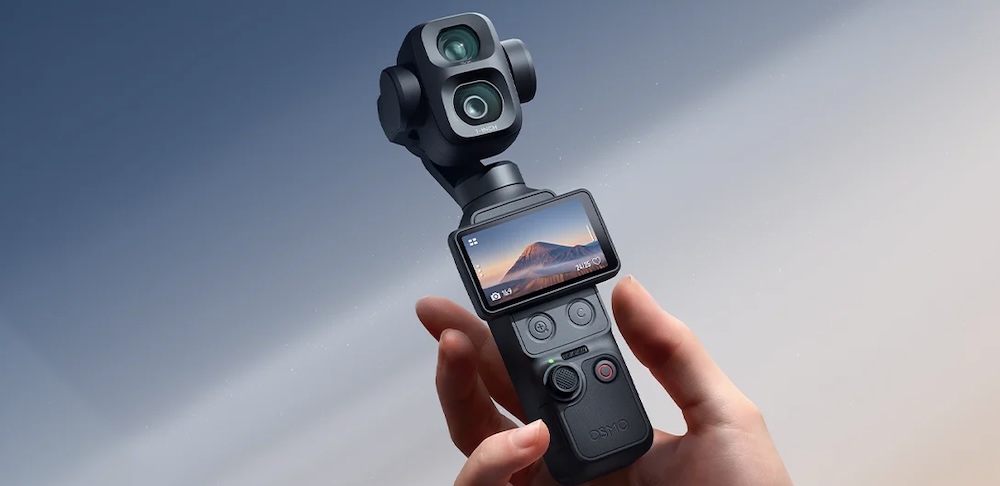
Continuing the weekend with the latest action camera news and rumors – I forgot to report that last week DJI officially announced the previously reported Osmo Pocket 4P camera (WEX Photo | Foto Erhardt). The new model is not officially available in the United States. Regulatory authorization and FCC clearance are still pending, meaning major US retailers do not stock it.
Additional information:
The new DJI Osmo Pocket 4P camera features a Type 1 (116mm²) sensor with a 20mm equivalent lens and, new to the series, a secondary Type 1/1.28 (75mm²) sensor with a 60mm equivalent lens, 3-axis stabilization, ActiveTrack 8.0, and up to 8× ultra HD slow motion, and cinematic 4K:
Photographers are often drawn to crystal-clear scenery in brilliant golden light. Yet some of the most evocative images are created under precisely the opposite conditions.
Ben Hattenbach
Fog strips away distraction. It conceals rather than reveals, simplifying a landscape until only its essential forms remain. Ordinary subjects become mysterious, and scenes that would appear cluttered in clear weather become elegant studies of light, shape, and atmosphere. Fog encourages interpretation rather than documentation. Instead of recording every detail, it invites viewers to imagine what lies beyond the veil.
Many photographers see a bank of fog as a signal to pack away their cameras and wait for the weather to improve. Experienced photographers do the opposite, understanding that fog introduces depth, reduces complexity, and creates an emotional atmosphere impossible to duplicate under clear skies.
Like every artistic tool, however, fog is most effective when applied with restraint. Too little may have insufficient effect; too much can obscure the subject that attracted your attention. The challenge, and the opportunity, is finding the balance where difficult weather can be transformed into extraordinary photographs.
Distilling simplicity
Antarctic WatersBen Hattenbach
Fog’s greatest artistic contribution is its remarkable ability to simplify. Many landscapes are visually overwhelming. Dense forests contain thousands of branches competing for attention. Mountain vistas often include countless ridges, rocks, and textures. Without a clear visual hierarchy, viewers struggle to determine where to look.
Fog solves this problem naturally. As distant detail gradually disappears, stronger forms begin to emerge. A solitary tree becomes the subject rather than merely one tree among hundreds. The graceful curve of a ridgeline replaces a jumble of competing textures. Negative space begins to carry as much visual weight as the objects themselves.
Depth perception
Pack Ice, Northern GreenlandBen Hattenbach
Successful landscape photographs often inspire a viewer’s eye to travel through the scene. Few natural phenomena encourage this more effectively than fog. In fog, distant subjects lose contrast, sharpness, and saturation, while nearby objects retain more of their original character.
Without the need for converging lines or overlapping objects, fog immediately communicates spatial relationships. Trees standing only a few hundred feet apart may suddenly appear separated by enormous distances simply because each successive row fades a little further into the mist. This gradual progression, from crisp foreground to increasingly subdued middle ground to barely visible background, is a signature of successful fog photography.
Scenes containing multiple planes often produce the strongest photographs in fog. Forested hillsides, mountain ridges, and winding rivers all lend themselves naturally to atmospheric layering. In many cases, adding only a single nearby element – a rock, tree, or wildflower – is enough to transform an otherwise flat photograph into one possessing convincing depth.
Negative space
Emperor Penguin, AntarcticaBen Hattenbach
When visibility decreases, the empty portions of one’s image can become as important as the subjects themselves. Fog provides one of the most elegant forms of negative space found in nature.
A lone tree emerging from blank mist. A distant lighthouse suspended in whiteness. Or, as above, the silhouette of a solitary emperor penguin peering out from behind an Antarctic ice storm. The surrounding emptiness isolates the subject, increases its visual importance, and creates an emotional sense of solitude.
Seasoning to taste
Redwood National Park, CaliforniaBen Hattenbach
When photographing in fog, moderation is essential. Finding the ideal balance becomes one of the photographer’s principal creative decisions. Although you cannot directly control the fog itself, you can control how much of it appears in your photograph.
Try changing your distance from the subject. Every additional foot of atmosphere between camera and subject slightly increases the fog’s cumulative effect. Move to another altitude where the fog density will be different. Or just wait for the fog to change.
Working the fog’s edges
Crepuscular rays, IcelandBen Hattenbach
One of the most productive places to photograph is along the boundaries of fog. The transition between clear air and heavy mist often produces precisely the amount of atmosphere needed to simplify a scene without overwhelming it.
The edge of a fog bank is also where light frequently becomes most dramatic. Sunlight filtering across the boundary between clear and foggy air often creates luminous edges, illuminated layers, and glowing shafts that transform otherwise ordinary scenes into cathedrals of light. Exceptional fog photographs are frequently found during the minutes when the atmosphere is actively changing.
Shapes and silhouettes
Yosemite National ParkBen Hattenbach
Fog naturally encourages the eye to focus on form rather than detail. This makes it one of the finest environments for silhouettes. When texture disappears, shape becomes everything. The profile of a mountain ridge. A distant elk. Or as above a mother tree and her child.
Subjects that might appear unremarkable in full daylight suddenly become iconic when reduced to their simplest outlines. Silhouettes depend less on exposure than on recognizable form. The viewer should immediately understand the subject from its outline alone.
Resist the temptation to recover shadow detail during processing. Mystery is part of the photograph’s appeal. Not everything needs to be explained.
Exposure in the digital era
Rhododendron in Del Norte Coast Redwoods, CaliforniaBen Hattenbach
Reflective light meters still assume that the average scene should reproduce as a middle gray. Bright fog violates that assumption, encouraging the camera to underexpose unless compensation is added. Rather than relying on a predetermined exposure adjustment, use your live histogram. For scenes that change rapidly, as foggy landscapes often do, this immediate visual feedback becomes invaluable.
Unless you are seeking a silhouette, you’ll normally want to expose almost as brightly as possible while preserving important highlights. This approach maximizes image quality by recording more tonal information in the brightest portions of the file while avoiding clipped highlights.
Maintaining focus
Frozen Spruce, Northern AlaskaBen Hattenbach
Dense fog presents challenges even for the most sophisticated autofocus systems. Contrast diminishes. Edges disappear. Subjects drift in and out of visibility.
Focus peaking highlights areas the camera detects as sharp, while magnified live view allows precise placement of focus even in remarkably low-contrast conditions. If the composition contains layered subjects, consider focusing slightly closer than instinct suggests. The nearest sharp object frequently serves as the visual anchor that encourages viewers to enter the photograph before exploring its softer, more distant layers.
Remember that absolute sharpness is rarely the defining characteristic of successful fog photography. Atmosphere, not microscopic detail, is usually the subject.
Time and motion
Long Exposure of Geothermal Pool, Icelandic HighlandsBen Hattenbach
Fog is seldom still. It drifts, curls and dissolves with astonishing subtlety. Those movements present creative opportunities every bit as significant as flowing water.
While fast shutter speeds preserve delicate textures within the fog, long exposures transform moving fog into smooth ribbons that emphasize mystery. Neither interpretation is inherently more truthful. Each simply tells a different story.
Lens choice
Redwood National Park, CaliforniaBen Hattenbach
Ask landscape photographers which lens belongs on the camera during fog, and most will recommend a wide-angle. The answer is more nuanced.
Wide-angle lenses excel when the atmosphere itself becomes part of the foreground experience. They immerse viewers within the fog, emphasizing nearby textures while allowing distant features gradually to dissolve into the mist.
Telephoto lenses, however, often reveal fog’s greatest strengths. Distance exaggerates atmospheric perspective. Successive ridgelines merge into delicate tonal bands. Isolated subjects appear suspended within enormous volumes of atmosphere.
Rather than asking what lens covers the scene, consider which lens best expresses the atmosphere. That subtle change in thinking often transforms an ordinary photograph into a memorable one.
Forecasting fog
Yosemite ValleyBen Hattenbach
Until recently, finding photogenic fog depended as much on intuition and luck as on planning. Today, real-time tools such as Windy.com have dramatically improved photographers’ ability to predict when and where fog is likely to form. Such resources forecast fog directly on an interactive map, allowing one to see where fog will develop, drift and dissipate.
Before leaving home, spend a few minutes advancing the forecast hour by hour while studying the map. A valley predicted to fill with fog just before sunrise, or a coastal fog bank forecast to drift inland after dawn, may provide the fleeting conditions necessary for outstanding photography.
Final thoughts
Dalton Highway, AlaskaBen Hattenbach
Many photographers spend their careers searching for incredible landscapes. Fog reminds us that exceptional photographs often require nothing more than extraordinary light falling upon ordinary places. A familiar grove of trees. An empty shoreline. A road leading to the horizon.
Subjects overlooked under blue skies frequently become unforgettable once the atmosphere begins simplifying the world around them. That may be fog’s greatest gift. It teaches us to see less – and in doing so, to see more.
The finest fog photographs are seldom about weather. They are about mood. About suggestion rather than explanation. About allowing mystery to remain mystery.
The next time a forecast calls for dense fog, resist the temptation to postpone your outing until conditions improve. Instead, leave a little earlier. Walk a little farther. Stay a little longer. You may discover that the weather many photographers avoid is the weather that produces your strongest work.
When not photographing remote and foggy landscapes, Ben Hattenbach is a partner at a Los Angeles-based law firm where his practice focuses on the trial of complex intellectual property disputes. More of his images can be seen at www.benhattenbach.com and https://www.instagram.com/benhattenbach/.
Want to stay up to date on the latest product news and releases? Add DPReview as a preferred source to ensure our independent journalism makes it to the top of your Google search results.

 Connexion