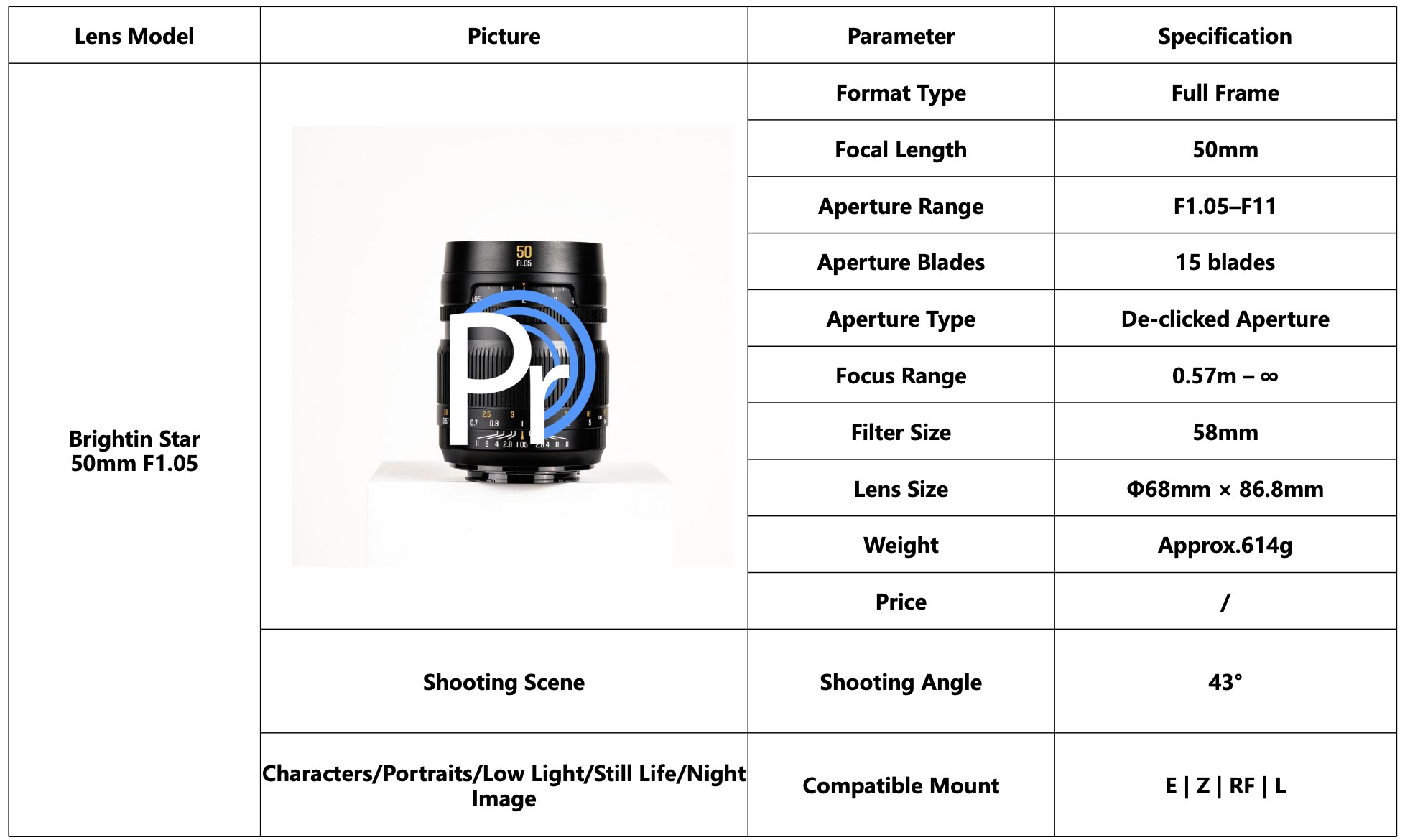
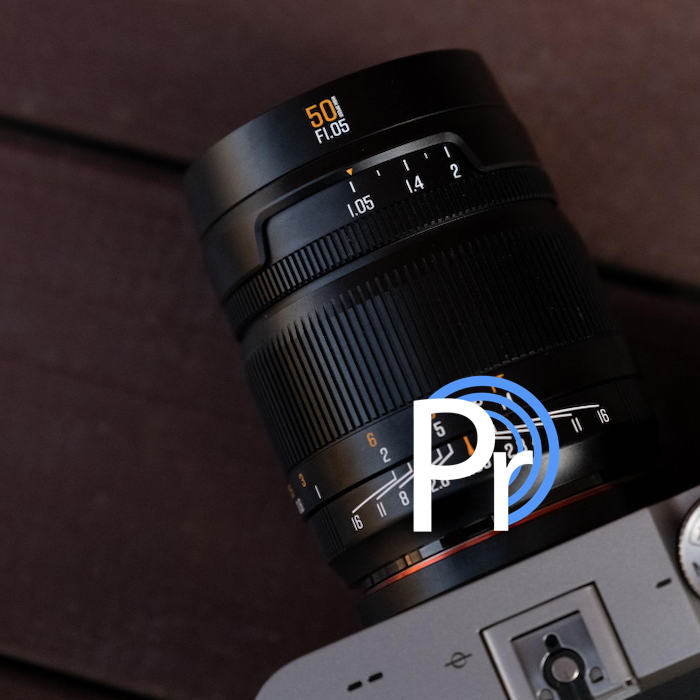
The previously reported Brightin Star MF 50mm f/1.05 full-frame manual focus lens will be officially announced on January 16th. Here are the details (check the Brightin Star website for updates):
For Z/E/RF/L mount
7-group, 10-element optical design with 2 high-refractive index elements
When you use DPReview links to buy products, the site may earn a commission.
Sample gallery
This widget is not optimized for RSS feed readers. Please open this article's permalink in a browser to view this content.
Product photos: Richard Butler
Ricoh has released a monochrome version of its GR IV enthusiast compact camera. The GR IV Monochrome features the same 26MP BSI CMOS sensor and 28mm equiv F2.8 lens as the color version, but is black-and-white only.
Key specifications
26MP BSI CMOS sensor with no color filter array
On-sensor phase detection
ISO 160-409,600
In-lens shutter allows flash sync to 1/4000th sec
E-shutter allows use of F2.8 at up to 1/16,000 sec
Built-in red filter, giving punchier blues.
53GB of internal memory
250 shot-per-charge battery rating
UHS-I Micro SD memory card slot
The GR IV Monochrome will sell for a recommended price of $2199. This is a 46% premium over the list price of the standard GR IV, suggesting Ricoh feels that the mono version will have a smaller audience to foot the development costs. The MSRP in the UK is £1599, which is only a 33% mark-up over the standard version's original list price.
As the name implies, the Ricoh GR IV Monochrome is a black-and-white only variant of the GR IV.
You get all the usual benefits and costs of a mono-only sensor: a higher base ISO, because less light is being lost to a color filter array (a 2/3 of a stop increase, in this instance), and much sharper detail, as there's no demosaicing taking place.
You also get better noise performance at any given ISO: again because there's no color filter sapping any light, but with that advantage disappearing if the color version can use its lower base ISO.
However, with only a single color channel, there's a lot less flexibility to the Raw files: once the image appears to be clipped, there's no way to approximate highlight data from unclipped channels.
The electronic shutter can deliver exposures down as low as 1/16,000 sec, letting you use the maximum aperture even in good light
To prevent overexposure when shooting at F2.8, the GR IV Monochrome lets you switch from its in-lens shutter to an e-shutter. The electronic shutter can deliver exposures down as low as 1/16,000 sec, letting you use the maximum aperture, even in good light, despite the camera not having an built-in ND filter. As with the regular GR IV, the mechanical shutter has an upper limit of 1/2500 sec at F2.8: you need to stop down to F5.6 to achieve the 1/4000 sec maximum.
Interestingly, Ricoh says the GR IV Monochrome's autofocus is the same as that on the GR IV, which means it has on-sensor phase detection. This would mean that, unlike the Leica Q3 Monochrom, it has to do some degree of interpolation during processing, to hide any impact of those phase-detection pixels. We've not seen any negative impact from this in our preliminary shooting, even when trying to induce flare to highlight any issues.
The company also says that the sensor is not the same one used in the K-3 III, though it wasn't specific about how the two differ.
Red Filter
Other than the lack of color filter array, the other difference is that the GR IV Monochrome has a slot-in red filter, rather than the neutral density filter in the color version. This selectively lowers the impact of blue and green light on the sensor, which gives more dramatic skies and higher contrast, generally.
The filter in the GR IV Monochrome reduces the overall light to the camera by around 3 stops, for a neutral subject (it's around a 4 stop cut for blues, 3.5 for greens and closer to a single stop for reds).
Body and handling
As you might expect, the GR IV Monochrome looks and handles exactly like the regular GR IV: it's a tiny camera for one with such a big sensor and yet it manages to put a lot of control at your fingertips without seeming too cramped.
The finish of the camera is also a little different, with a less textured matte black finish. The shutter button is also black and the GR logo on the front is a very dark grey, rather than white. The green LED ring around the power button is also white, to keep with the monochrome theme. Sadly, Ricoh has not borrowed the beautiful 'Monochrome' typography from its Pentax K-3 III Monochrome DSLR.
The control logic is well worked through, as you'd expect for the eighth generation of a design (prior to 2013's GR, with its APS-C sensor, were four iterations of GR Digital, which used a much smaller Type 1/1.7 sensor in a very similar body).
Despite its size, the GR IV's magnesium alloy body makes it feel very solid, without being overly weighty. And, unlike almost all modern cameras, it will sensibly fit in a pocket.
Ricoh says the GR IV's lens was specifically designed to reduce the risk of dust ingress, but that they had to make the choice between the small form factor that a retractable lens makes possible and complete weather sealing, so there are no promises around the level of sealing.
Ricoh was kind enough to lend us a pre-production GR IV Monochrome, to let us get a feel for the handling, but we were asked not to make measurements or publish images from it, as it's not necessarily representative of final production performance.
But, even in the limited time we've spent with the camera, its appeal shines through: it forces on you that same way of looking at light and shade that Leica's monochrome cameras bring. And I maintain that using a camera that can only capture black and white is a completely different experience to using a normal camera in mono mode. Knowing that you can't switch, no matter how appealing the colors are in your scene means you solely focus on light, shadow and contrast.
The inclusion of a built-in, switchable red filter is a brilliant idea, letting you add that punch to your images at the touch of a button, without having to add a filter ring adapter or carry filters round with you. I'm sure there'll be people who would have preferred a different color, but red seems like a sensible option since they had to choose one. And the option to engage electronic shutter, so that you can still shoot wide-open in bright conditions feels like a reasonable work-around.
Even more so than the standard GR IV, the Monochrome version is going to be a niche proposition. Some people will immediately know they want one, while I suspect a great many people will be baffled at the idea that a regular GR IV in mono mode wouldn't be similar enough. And cheaper.
The price of adopting a decidedly niche camera is that there are fewer people to share the development costs with. The Ricoh is just over a quarter of the price of the other dedicated mono compact on the market – though the Leica Q3 mono has a sensor more than twice the size and a maximum aperture that's over a stop brighter, so can capture more than four times as much light – but there's still something inherently counter-intuitive about having to spend more, for less.
All photographers inevitably deal with creative droughts or periods when they feel their skills have plateaued. At the end of last year, I wrote about part of why (and how) that's manifested for me over the past few years. For me, one common tool I fall back on to combat such feelings is tackling a specific project or goal related to photography, which I just wrote about as well.
I've completed multiple 365s (a photo a day for a year) and 52-week projects (one photo each week for a year). Most recently, I've accidentally stumbled into a project with a friend that involves alternating who picks a theme each week, and then each creating a photo around that theme. We don't have a set end date, so it could be less than a year or more than a year, but so far, we're about 12 weeks in.
Those are the projects that have helped me, but there are countless other iterations and other types of projects. No matter what, though, the main goal is to force yourself to pick up your camera either to try to generate some creativity or learn new skills.
With that in mind, I'm curious to hear from you all:
What projects are you undertaking to move your photography forward?
Some of you shared a glimpse into your projects in the comments on my recent article, but we'd love to see more. Maybe it's a project you're working on now, or maybe it's something you've done in the past. It could be a week-long project, or maybe a multi-year undertaking.
No matter what, we're curious what projects have helped, or are helping you bring back inspiration or forward momentum to your photography. Even better, share some of the images you've taken for such projects! Your responses and images may even be featured in next week's front-page update.
The mini Evo Cinema hybrid instant camera features a first for instax cameras – the Gen Dial, which allows users to apply photo effects from 10 different eras to their image – from the grainy, pale tones of the 1930s, to the vibrant colors of the 1980s, to the sharp, rich imagery of the 2020s, each era is designed to capture the look and feel of the imagery of that time.
Degree Control Dial
Content created in each era can be fine-tuned with the Degree Control Dial. By simply rotating the dial to precisely adjust color, contrast, and noise expression, users can create up to 10 creative variations per era.
Frame Switch
Once an era is chosen and the intensity of the era is selected via the Degree Control Dial, users can continue to personalize by adding a frame to every shot or video clip utilizing the Frame Switch. There’s a frame for every era, each paying homage to the characteristics, media, and playback devices that defined that time.
Cine/Still Mode
Users can easily switch between “Cine” and ”Still” modes to capture either a video or photo, respectively, with ease. In Cine mode, users can shoot a series of clips – up to 15 seconds in total – and the camera will stitch them into one smooth video automatically. Via the free, downloadable instax mini Evo smartphone app, users can connect via Bluetooth® and extend video creations to 30 seconds by adding or reordering clips.
Zoom Lever
Mini Evo Cinema features built-in digital zoom. The tactile Zoom Lever lets you dial up the intimacy of the shot or pull back for greater scope and more atmosphere.
“My Gallery”
Within the instax mini Evo app, the My Gallery section provides users a secure place to store the images and videos they create, segmented into categories including Favorites, Printed, Video, Photo, Projects. Through this function, users can also save printed images digitally to their smartphone’s camera roll, finished with the iconic instaxTM mini border.
Video Printing
Users can access videos via a one-of-a-kind instax mini instant photo printed with a QR code ready to be scanned and played back on a smartphone. Video and audio data is securely stored for 24 months.
Timeless Design
With sleek black, glimpses of green, and analog-inspired details, this hybrid instant camera is crafted for those who appreciate tactile functions alongside beauty and elegance. Additional camera features include:
Remote shooting capability (via app)
Integrated Selfie Mirror and Self-Timer
1.54-inch high-resolution LCD Monitor
Print Lever
The camera features an analog-style printing operation lever – lift and twist to print a photo.
Accessories
mini Evo Cinema includes viewfinder and grip attachments, and a premium hand strap.
USB-C & Micro SD Card Slots
Integrated flash/continuous light source
Pricing and Availability
instax mini Evo Cinema hybrid instant camera will be available in early February 2026 at a Manufacturer’s Suggested Retail Price of $409.95 USD and $479.99 CAD.
Last week, Fujifilm Japan launched a surprising and rather controversial new offering in its Instax lineup, the Instax Mini Evo Cinema. The company has now announced the global release of the hybrid camera, providing more details about its features and capabilities.
The Instax Mini Evo Cinema offers a hybrid experience by combining the ability to take digital images, instant film photos, and record video. It is designed to produce retro-looking videos and photos, and the sensor appears to be a throwback as well. It's built around a shockingly small 5MP Type 1/5 (∼2.8 x 2.2mm) CMOS sensor, which is smaller than even the most budget-focused smartphones. It features a 28mm equiv. lens with F2.0 aperture.
The sensor may be far from impressive, but the Instax Mini Evo Cinema includes plenty of features for those wanting a more playful camera experience. The "Gen Dial," which was referred to as the "Eras Dial" in the Fujifilm Japan press release last week, allows users to apply effects from 10 different eras, including grainy, pale tones for the 1930s, vibrant colors for the 1980s and "sharp, rich imagery of the 2020s."
A lever on the side, intended to evoke a film winding lever, triggers a print. Image: Fujifilm
Users can fine-tune the look of each preset with a dial on the lens, which adjusts color, contrast, and noise in 10 variations per era. There's also a Frame Switch, which allows users to add a frame based on each era to images or video clips.
There's a zoom lever that allows for digital zoom during video recording, though Fujifilm doesn't specify the exact capabilities of that feature. A switch on the side of the camera allows you to change between photo ("Still") and video ("Cine") modes. Videos in most modes are limited to a disappointing 800 x 600px resolution, with only the 2020 mode allowing a 1440 x 1080 capture.
Video clips max out at 15 seconds, but you can combine clips to create videos up to 30 seconds long in the Instax Mini Evo smartphone app. If you choose to print a still image from a video, it features a QR code that, when scanned, allows for playback. Fujifilm specifies that clips are only stored for 24 months, though, so you'll want to be sure to download them before that.
Image: Fujifilm
The camera uses a microSDXC card for storage, and images and videos can also be stored in the Instax Mini Evo app. It features a 1.54-inch LCD and an integrated light that can be used as a flash or a continuous light source. It supports remote shooting with the app and offers a self-timer as well. The camera uses Instax Mini instant film.
The price may be as much of a shock as the sensor size: $410. And you'll also have to buy instant film on top of that, too. Fujifilm says it will be available for purchase at the beginning of February.
Press release:
Lights, Evo, Action: Fujifilm Introduces instax mini Evo Cinema™ Hybrid Instant Camera
VALHALLA, N.Y., January 13, 2026 - FUJIFILM North America Corporation, Imaging Division, today announced the introduction of instax mini Evo Cinema™ (mini Evo Cinema) hybrid instant camera. mini Evo Cinema offers multiple ways for users to make highly personalized, one-of-a-kind content through still photos, short-form video (15-second clips), and instax™ mini photo prints via the free, downloadable instax mini Evo™ smartphone app. This 3-in-1 camera is designed to give users one of the most dynamic creative experiences the instax™ brand has offered.
"mini Evo Cinema offers the best of both worlds – the vintage look of an 8mm video camera, with all of the modern functionality of a hybrid image creation tool, integrating photo, video, and print in one unique package," said Bing Liem, division president, FUJIFILM North America Corporation, Imaging Division. "mini Evo Cinema delivers a smooth, unique photographic experience that gives the user a myriad of ways to turn casual moments into unforgettable ones."
Main Features:
Gen Dial™
The mini Evo Cinema hybrid instant camera features a first for instax™ cameras – the Gen Dial™, which allows users to apply photo effects from 10 different eras to their image – from the grainy, pale tones of the 1930s, to the vibrant colors of the 1980s, to the sharp, rich imagery of the 2020s, each era is designed to capture the look and feel of the imagery of that time.
Degree Control Dial
Content created in each era can be fine-tuned with the Degree Control Dial. By simply rotating the dial to precisely adjust color, contrast, and noise expression, users can create up to 10 creative variations per era.
Frame Switch
Once an era is chosen and the intensity of the era is selected via the Degree Control Dial, users can continue to personalize by adding a frame to every shot or video clip utilizing the Frame Switch. There’s a frame for every era, each paying homage to the characteristics, media, and playback devices that defined that time.
Cine/Still Mode
Users can easily switch between "Cine" and "Still" modes to capture either a video or photo, respectively, with ease. In Cine mode, users can shoot a series of clips – up to 15 seconds in total – and the camera will stitch them into one smooth video automatically. Via the free, downloadable instax mini Evo™ smartphone app, users can connect via Bluetooth® and extend video creations to 30 seconds by adding or reordering clips.
Zoom Lever
Mini Evo Cinema features built-in digital zoom. The tactile Zoom Lever lets you dial up the intimacy of the shot or pull back for greater scope and more atmosphere.
"My Gallery"
Within the instax mini Evo™ app, the My Gallery section provides users a secure place to store the images and videos they create, segmented into categories including Favorites, Printed, Video, Photo, Projects. Through this function, users can also save printed images digitally to their smartphone’s camera roll, finished with the iconic instax™ mini border.
Video Printing
Users can access videos via a one-of-a-kind instax™ mini instant photo1 printed with a QR code2 ready to be scanned and played back on a smartphone. Video and audio data is securely stored for 24 months.
Timeless Design
With sleek black, glimpses of green, and analog-inspired details, this hybrid instant camera is crafted for those who appreciate tactile functions alongside beauty and elegance. Additional camera features include:
Remote shooting capability (via app3)
Integrated Selfie Mirror and Self-Timer
1.54-inch high-resolution LCD Monitor
Print Lever
The camera features an analog-style printing operation lever – lift and twist to print a photo.
Accessories
mini Evo Cinema includes viewfinder and grip attachments, and a premium hand strap.
USB-C & Micro SD Card Slots4
Integrated flash/continuous light source
Pricing and Availability
instax mini Evo Cinema™ hybrid instant camera will be available in early February 2026 at a Manufacturer’s Suggested Retail Price of $409.95 USD and $479.99 CAD. For more information, please visit https://www.instaxus.com/cameras/instax-mini-evo-cinema/.
1 instax™ mini instant film required, sold separately.
2 The text QR code itself is a registered trademark and wordmark of Denso Wave Incorporated.
3 Smartphone required (sold separately). Download of free instax (insert correct name of app) smartphone app required
After a successful Kickstarter campaign, the world’s first Sirui Astra 50mm/75mm/100mm 1.33X full-frame autofocus anamorphic cine lenses (E/Z/L) are now available for purchase

 Connexion