Another clickbait story is circulating the Internet:
“Sony is working on a new display technology for its Alpha cameras after 2026/Q3”
“New rumor suggests upcoming Sony cameras could have noticeably better battery life”
Editors are publishing made-up stories without even doing a simple Google search. The article in question is a 2011 research paper by Korean academics and has nothing to do with Sony or any upcoming Sony cameras. Here are the details:
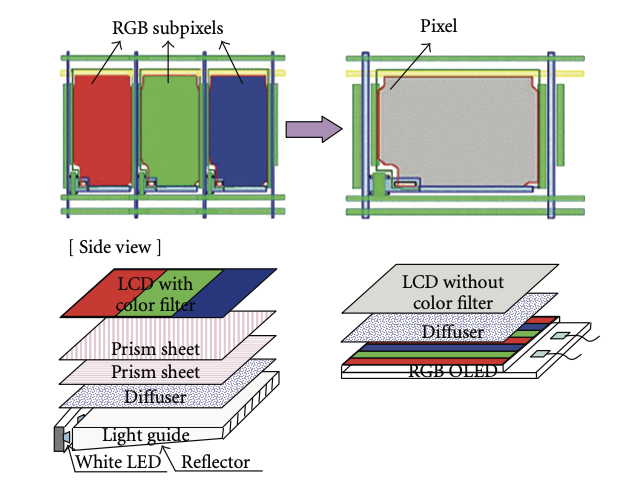
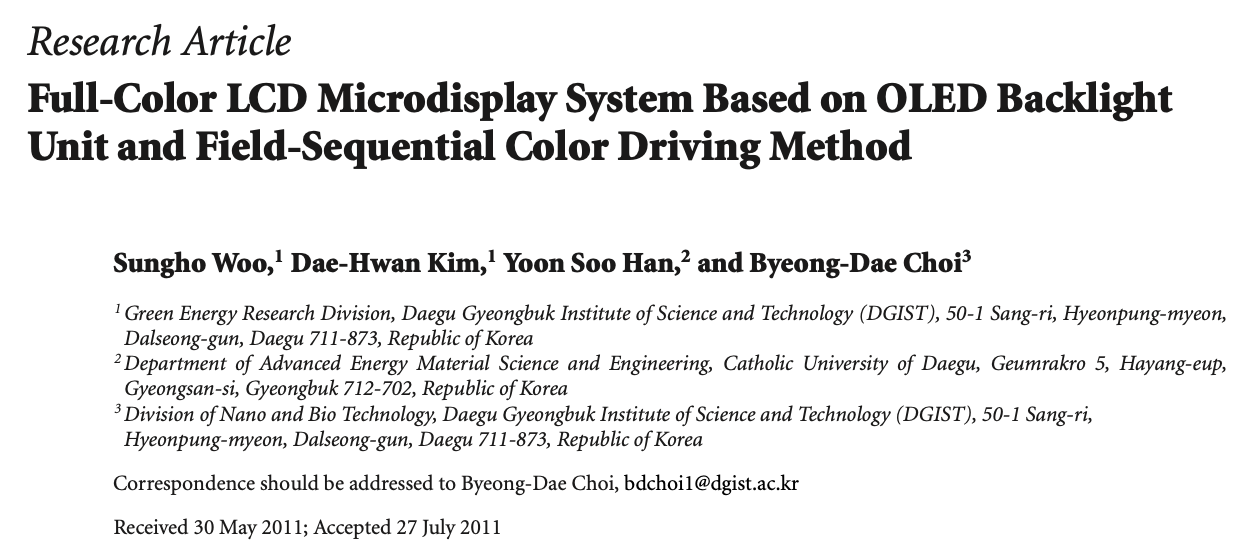
The 2011 paper (“Full-Color LCD Microdisplay System Based on OLED Backlight Unit and Field-Sequential Color Driving Method”) was written by researchers from Daegu Gyeongbuk Institute of Science and Technology (DGIST) and Catholic University of Daegu in South Korea. It describes a prototype 0.7″ FSC (field-sequential color) LCD microdisplay using a custom 0.76″ patterned RGB OLED as the backlight unit (BLU), combined with a high-temperature polysilicon (HTPS) LCD panel supplied by ILJIN Display Co., Ltd. (a Korean company).
There is no mention of Sony anywhere in the paper (including the authors, acknowledgments, references, or experimental details). The work is independent academic/industrial research from Korean institutions focused on low-cost, high-efficiency microdisplays for potential use in viewfinders, projectors, HMDs, etc.
Sony does not appear to be implementing (or planning to implement) this specific technology. Sony’s actual microdisplay approach: Sony Semiconductor Solutions develops and uses direct-emissive OLED microdisplays (OLED-on-silicon/OLEDoS) for electronic viewfinders (EVFs) in its cameras. These are self-emissive panels with high resolution, contrast, and fast response – no separate backlight or color filters in the same way as the paper’s LCD + OLED BLU design. Sony has released multiple generations of these for Alpha cameras and AR/VR applications.
In short, the paper is unrelated to Sony, and while Sony is exploring FSC-based LCD improvements for efficiency in future cameras, there is no indication that it involves the specific OLED-backlit microdisplay approach described in the 2011 paper.
You can download the original PDF research paper from 2011 here.
DPReview's Community Manager, Mathew Anderson, shamelessly presenting an ice cream cone as if it were part of Ikea's product lineup. Ice cream cone courtesy of Ikea's cafeteria. A symbol of his light-hearted but still serious attitude toward community development.
Photo: Mathew Anderson
Greetings, DPReview community!
A lot happens across the community every month: lively discussions, feature articles spotlighting community members and their gear, photo events and more, and much of it naturally won't be seen by everyone. As DPReview's Community Manager, I want to change that as much as possible. In this "What you missed" roundup, I'll highlight some of the best community activity from the past month, including some of the things that didn't make it into articles.
Here's just a sampling of what happened in May.
What's in your bag? A community member spotlight
Every week, we spotlight a community member's unique photographs and gear in our 'What's in your bag?' series. The series tells the story of your trials and tribulations getting that perfect shot, and highlights their favorite camera gear and how they use it. You'll also get tips and tricks on capturing your own photography.
As with many of our other community initiatives, we often don't get a chance to cover every detail of a community member's story, so we're selecting an additional photo from each of the previous month's posts that you haven't seen yet. Check them out below.
Feeling artsy
Photo: Roberto De Micheli (roby17269)
Roberto De Micheli, who goes by the username roby17269 in the forums, switched from wildlife photography to focus on his passion for fashion. He also dabbles in travel and kids' photography (mainly family outings). Roberto submitted a wide range of photography on these subjects to us for this article, but we focused on the fashion segment as it's his most recent work.
"Fashion shoots happen in studios or on location. In my heart, though, I still remember my two safaris in Africa (Kenya and South Africa) most fondly, which can be a magical place. The safaris were during my wildlife 'phase'. I was absolutely floored by how rich, colorful and amazing nature was in those places."
The photographer who never stopped chasing the unique shot
Photo: Josh S. Rose
Josh S. Rose has been capturing visceral reactions since the 1970s, when he wandered around a racetrack park as a kid to explore the event. He found himself hanging out at the photo booth and loved to watch a team develop film after each race, calling up the winners to the announcer upstairs, then hearing the crowd wildly react. His career kept him intrigued by those early moments of capturing scenes on film.
"In the beginning, I tried to minimize mistakes. Because I shoot dance and movement a lot, this is exacting work, especially when you're inside – low light and fast movement is a nightmare for a camera. So, I kind of treated dance as one would sports, reaching first and foremost for clarity, focus and split-second timing. It isn't all that hard, honestly. It just takes a certain number of reps."
This photographer uses an 800mm lens to lock onto nature's special moments
Photo: Alan Randle (AJRimages)
Alan Randle, known as AJR Images in the forums, has been capturing striking images for decades, with a particular passion for fast-paced subjects. Originally from the UK and now based in Southern California, he has built a body of work that spans airshows, surfing, wildlife and more. Over the years, his photography has evolved from early film experiments to high-precision digital work with top-tier equipment, allowing him to get in close and capture subjects with remarkable clarity and detail.
"I've been taking photographs since the early 1960's, but more seriously for the last 15 years. I moved to California from the UK in 2000, and am now lucky to have great subject matter and good light. I've been fortunate enough to acquire some of the best equipment and now like to get in close to my subjects with the use of long telephotos."
"I also enjoy shooting zoo animals. I like to take portraits rather than the whole of the animal, making good use of my telephoto lenses. Carrying big equipment around a zoo can be tiring. I’ve been asked by docents if I want to check my ‘luggage’ to make life easier!"
How this photographer sets up to capture life at the speed of the streets
Photo: Kevin Zhang (fatplanediaries)
Kevin Zhang, known as fatplanediaries in the wider community, began photographing at a young age under his father's influence, a dedicated Leica street photographer. What started as a focus on street photography evolved over time, especially after a chance moment in Shanghai, when he experimented with panoramas using only a prime lens. Since then, his work has developed into a distinctive blend of candid street scenes and highly detailed panoramic images, each discipline informing the other.
"I like to shoot candid street subjects, but I'm often pretty shy about approaching people to get the right shot. The best alternative is to get hired for events instead; everyone's vying to have you shoot them in those kinds of situations. I've had a lot of good practice at my friends' parties before getting to events as a photographer."
This reader mastered a Nikon Z5 to capture diverse European architecture
Photo: Brian Ormerod (ikon44)
Brian Ormerod, who goes by the username ikon44, has a love of architecture of all types and periods across northern Europe. Over the decades, he has traveled extensively, meticulously planning trips to capture selected projects in Vienna, Barcelona, Prague, Paris, Istanbul and beyond. His work has evolved from casual holiday snapshots to carefully composed architectural studies at the School of Architecture in Nottingham, UK.
"I went with an architect friend to Barcelona, which I found to be an architectural wonderland. We photographed works by Antoni Gaudi, but by pre-planning we were also able to visit a number of other projects, including the IMO Eye Hospital by Josep Llinas, The University of Pompeu Fabra Library, which is a spectacular arcaded masonry structure, the Santa Caterina Market, a neo-classical building refurbished by Enrique Miralles and the Fira de Belacaire flea market with a spectacular, fragmented mirrored canopy."
Every other week, we ask the community a question about their photography, usually on a specific topic, with the results spotlighted on DPReview's front page and in the forums the following week. There are often many great photos submitted that we don't get a chance to spotlight them all in a single article.
Here is a newly revealed reader's photo from each of the previous two weeks' questions.
Featured quote: "Different accouterments. A chamois, a laptop, a notebook and a pen (sometimes two; private and business), tissues, paracetamol (just in case ;-)), and some small things I can't remember. A Wuchuan canvas messenger bag with a Billingham insert and lots of useful pockets. It serves me well, carrying a D850 with one prime (24, 35, 58 or 85, depending on mood and plan, if any)." - Michiel953
Featured quote: "The foundation came before I even owned a camera: Total Picture Control by Andreas Feininger. His main message is that the photographer transforms a moving, three-dimensional world of color into a frozen, 2D (and in the late 1950s) monochrome picture. To communicate what you saw, you need to translate the lost dimensions (depth, movement and color) into your photograph."- Klaus dk
Photo threads of the month: new types of challenges
"May we never forget."
Photo: BluesJake
Also every week, new photo thread discussions and mini-photo challenges pop up across the forums, generated by community members. Usually, these start as a discussion about a particular camera brand or type of photography. Our community has hundreds of topics to choose from, so there's no shortage of photography show-and-tell opportunities!
For the month of May, we wanted to highlight BluesJake's Post your Memorial Day photos thread, where community members have been contributing to pay their respects to veterans who lost their lives in conflicts and other events around the world.
Visit our Community photo threads index for all the latest opportunities to share an interesting photo from your collection. To contribute to most of these community initiatives, simply read the OP's (Original Poster) posting guidelines (if there are any) and then reply to the thread with your contribution.
On May 13, 2026, Sony announced the a7R VI full-frame mirrorless camera. The community was so excited about the news that they beat us to the punch and immediately started discussing the camera in the forums. Here is a peek at what they had to say:
PWPhotography: Nice! $4499, $500 'cheaper' than initially rumored, and it's slightly lighter than a7R V.
CanadianLongbowman: So the TL;DR is that it's a high-res version of the a7R V, in essence, with a similar readout speed and a few extra perks.
In response, PWPHotography said, "I hope so. However, the a7R V uses a partially stacked sensor, while the a7R VI uses a fully stacked sensor. Fully-stacked sensors, as in the A9 and A1 series, used to have a little DR penalty. Sony appears to have overcome this issue by combining the readouts of its low and high gain steps as in a7R V."
kbrkr: Sony announced the a7R VI today, and my mind automatically went to Nikon challenging it with a Z7 III. Some of the features of the Sony are quite impressive, such as 68MP, 30 fps Raw, pre-capture, and speed boost. I hate these leapfrog games, but I really wish Nikon had a high-megapixel camera to replace the Z7 II.
I'd like to consider writing an article like this one on a monthly basis. Future editions could include camera use and photo-taking tips and tricks, additional quotes from community members in various discussions and more. If you are interested in seeing community content presented this way, please let me know.
For even more content posted directly by our readers, join the discussion forums and share your camera gear and photography curiosities!
When trying to capture this scene, most phones would probably try to brighten the shadows. The Xiaomi 17T Pro, shooting in the Leica Authentic color mode, didn't.
Photo: Abby Ferguson
One of the big conversations around mobile photography relates to how images are processed, with many bemoaning the unnatural look that some phones produce by dramatically brightening shadows. Apparently, Leica isn't necessarily a huge fan of the look, either. According to Marius Eschweiler, Vice President of the company's mobile business unit, it had "a very tough conversation" with Xiaomi about how photos from its co-branded phones should look.
The comment was part of an interview at the launch event for Xiaomi's latest phones, the 17T and 17T Pro, which feature Leica's "Vibrant" and "Authentic" profiles. Eschweiler, responding to a question about what the company's goal was with the latter color mode, says it was meant to show the real colors and shadows of a scene.
Leica executives participated in a group interview with Xiaomi for the launch of the 17T.
Photo: Abby Ferguson
The last part was apparently what prompted the discussions with Xiaomi. "That was a very tough discussion we had with the Xiaomi engineering team at the very beginning, because coming from the smartphone world, colorful, shiny images were seen as a benchmark," he says. "Then we came into play and said, 'yeah, but if you see it from the serious photographer's point of view, it's okay that some shadows are maybe not perfectly lightened up to let you see every detail.'"
"That computational imaging was getting too much in the picture for our taste"
Pablo Acevedo Noda, Head of Development and Engineering for Leica's mobile division, adds: "Leica Authentic was made more for photographers coming from the photography world," explaining that phones need to do a lot of computational photography to make up for their smaller sensors and lenses. "That computational imaging was getting too much in the picture for our taste."
The solution, he says, was processing the images in a completely different way than the vibrant ones. "In the end, we had to do two different pipelines. The image signal processor (ISP) has two different processing pipelines. One is the authentic, one is the vibrant. They share some common blocks, but the base is different."
A photo taken in the Leica Vibrant mode on the Xiaomi 17T Pro.
Photo: Abby Ferguson
He also says Leica had a hand in tuning the imaging pipeline for the phone's Live Moment feature, which captures a video before and after the shutter is pressed. The feature existed on Xiaomi products before, but now it includes the Leica color profile throughout. According to Noda, the company helped improve the resolution and HDR processing for the feature, as well as the exposure and white balancing for human subjects.
Eschweiler says Leica wants to give photographers a choice: they can go with the Leica Authentic for a more traditional photographic look, or the Vibrant for a more saturated aesthetic that mobile photographers will be familiar with. "It's a different philosophy, and I believe it's good that customers have the choice."
He echoes this sentiment about users having options when discussing the role of AI in mobile photography, after Xiaomi and Google touted the 17T's ability to use generative AI to transform images taken with the phone into videos, or to reimagine them. "Whether you take a serious image or whether you would like to create something with generative AI, I think that's a different use case," he says.
"It's a different philosophy, and I believe it's good that customers have the choice"
"You likely won't see that on a Leica M, but I think on the 17T series it makes sense," he says. Noda also adds that part of the point of features like Content Credentials, which Leica attaches to photos taken with its cameras, is to make it obvious when someone has tampered with a photo, using generative AI tools or otherwise.
The answers offer a look at some of the considerations traditional camera companies face when deciding to co-brand a phone. There are some fundamental differences in how those devices will produce images compared to a traditional camera, as well as different expectations from consumers, but the Leica name and branding come with their own set of expectations. Of course, not everything will come down to decisions around processing and software, but we'll cover the choices around hardware in a separate article.

 Connexion