Vue normale

2026-2027 EISA photography awards

Par : PR admin
24 août 2026 à 23:13


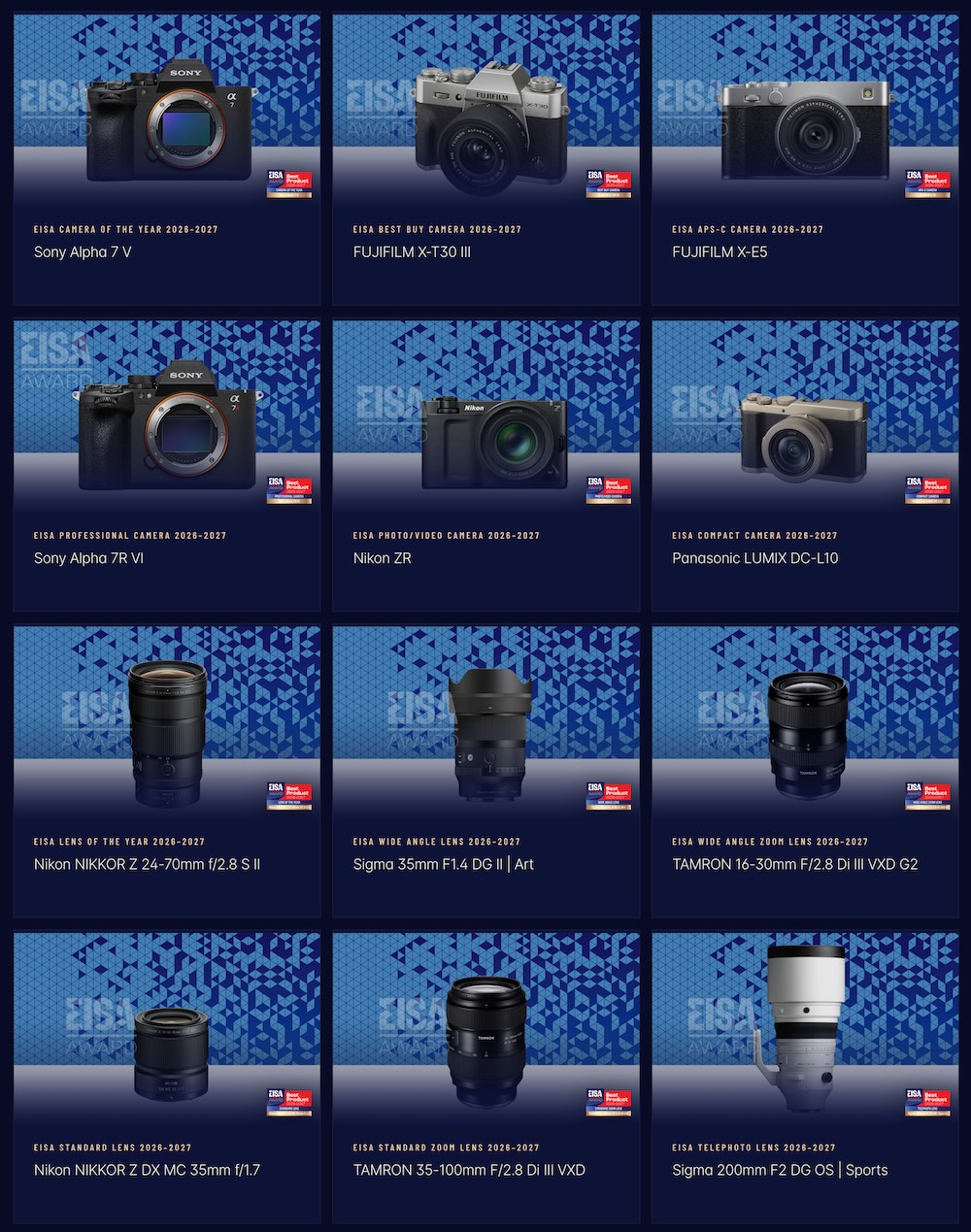
Here are the 2026-2027 EISA photography awards that were just announced today:

Award Category Winner (B&H link)
EISA Camera of the Year Sony Alpha 7 V
EISA Best Buy Camera Fujifilm X-T30 III
EISA APS-C Camera Fujifilm X-E5
EISA Professional Camera Sony Alpha 7R VI
EISA Photo/Video Camera Nikon ZR
EISA Compact Camera Panasonic LUMIX DC-L10
EISA Lens of the Year Nikon Nikkor Z 24-70mm f/2.8 S II
EISA Wide Angle Lens Sigma 35mm F1.4 DG II | Art
EISA Wide Angle Zoom Lens Tamron 16-30mm F/2.8 Di III VXD G2
EISA Standard Lens Nikon Nikkor Z DX MC 35mm f/1.7
EISA Standard Zoom Lens Tamron 35-100mm F/2.8 Di III VXD
EISA Telephoto Lens Sigma 200mm F2 DG OS | Sports
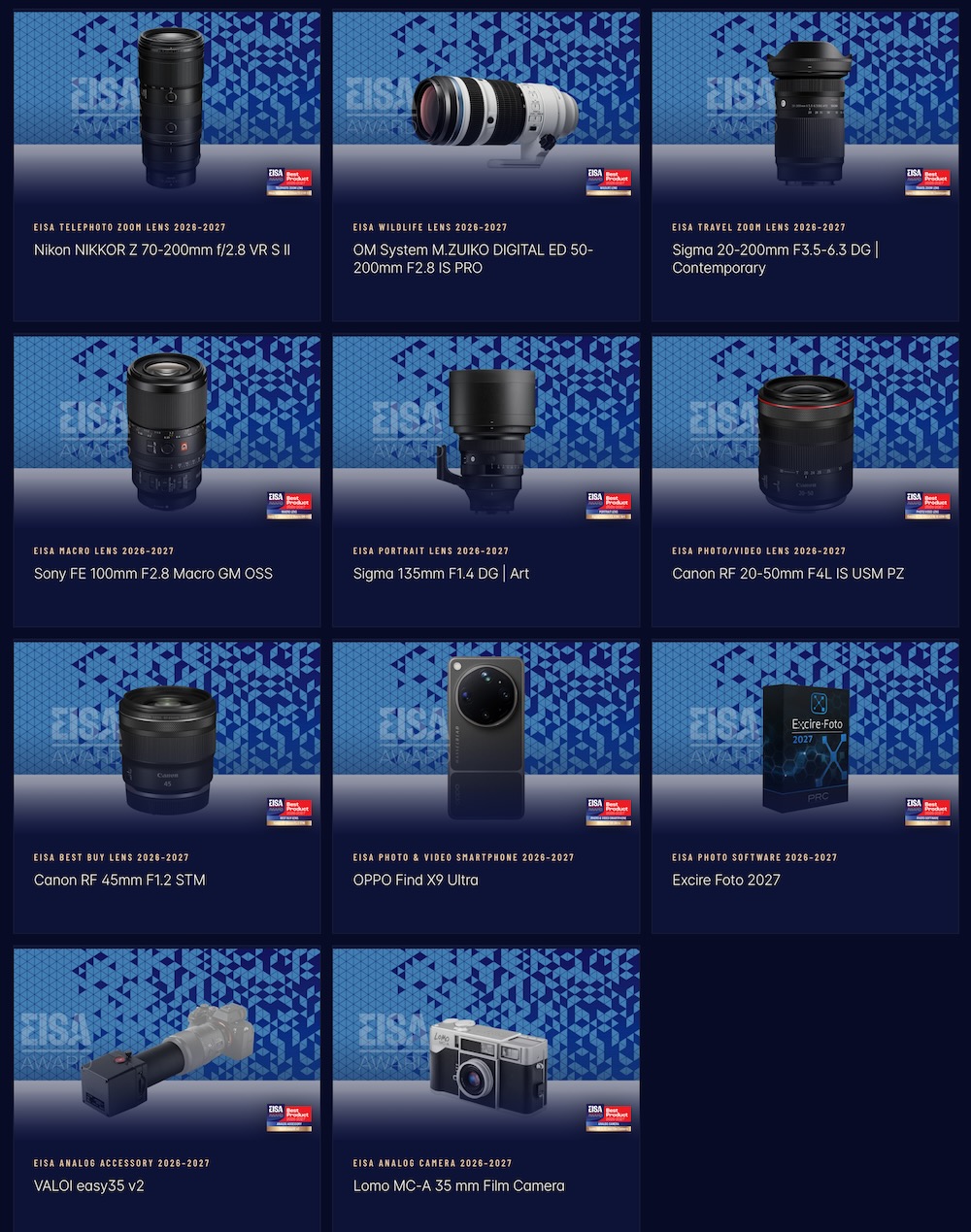
EISA Telephoto Zoom Lens Nikon Nikkor Z 70-200mm f/2.8 VR S II
EISA Wildlife Lens OM System M.ZUIKO ED 50-200mm f2.8 IS PRO
EISA Travel Zoom Lens Sigma 20-200mm F3.5-6.3 DG | Contemporary
EISA Macro Lens Sony FE 100mm F2.8 Macro GM OSS
EISA Portrait Lens Sigma 135mm F1.4 DG | Art
EISA Photo/Video Lens Canon RF 20-50mm F4L IS USM PZ
EISA Best Buy Lens Canon RF 45mm F1.2 STM
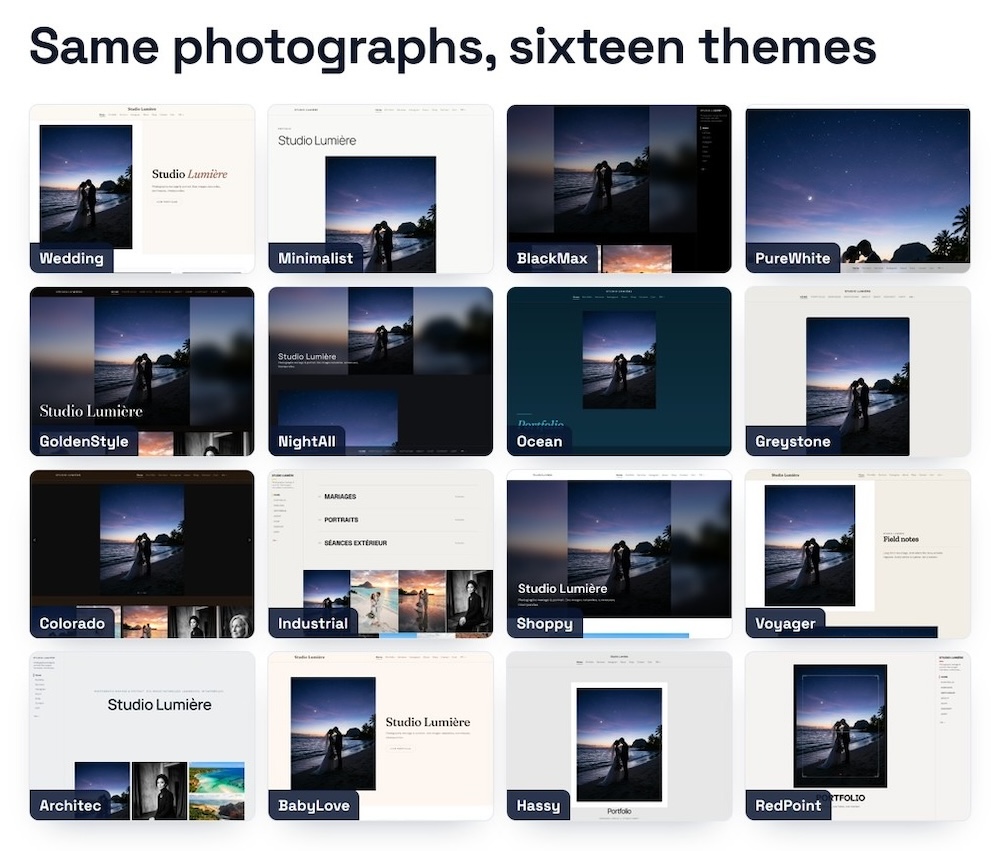
EISA Photo Smartphone OPPO Find X9 Ultra
EISA Photo Software Excire Foto 2027
EISA Analog Accessory VALOI easy35 v2
EISA Analog Camera Lomo MC-A 35 mm Film Camera

Source

The post 2026-2027 EISA photography awards appeared first on Photo Rumors.

Is the digital camera industry really recovering?

Par : PR admin
22 août 2026 à 20:31


A new report from the Japanese Ministry of Economy, Trade, and Industry suggests that digital camera production is showing signs of recovery. Here is a recap of the original report:

  • Digital camera production (and camera lenses) had been under long-term pressure from the rise of smartphones, which caused production to start declining around 2008 (video cameras peaked earlier, in 2005, and fell more sharply).
  • Production dropped sharply in Q2 2020 due to COVID-19 restrictions, then fluctuated afterward.
  • Clear signs of recovery have appeared since 2025, according to the Mineral and Industrial Production Index.
  • Domestic shipments of lens-integrated (compact) cameras have risen for two consecutive years starting in 2024 (CIPA data).
  • For lens-exchangeable cameras: the long decline in DSLRs has leveled off; mirrorless cameras fell in 2025 but are now showing an upward trend, pointing to a generational shift toward mirrorless.
  • The recent pickup is attributed mainly to stronger demand from younger users for sharing and video content.
  • Despite the multi-year structural decline caused by smartphones, digital cameras are finding new life in niches that smartphones do not fully replace (higher image quality, interchangeable lenses, still + video capability).

While overall numbers are improving, the latest CIPA numbers show a slowdown. A good example here is Nikon – they have released only two lenses this year, and it seems that most of their upcoming products are even further delayed.

Also, what the report does not cover is the recent significant increase in prices as a result of the Trump tariffs, memory shortages, and geopolitical instability (Fujifilm is rumored to have another price increase on September 1st; see all recent price increases here):

Update: Sony Japan just increased the prices of several cinema cameras.

Another Fujifilm price increase is coming

Report from Japan: the top 10 used cameras with the biggest price increases

Ricoh GR camera models are getting a 6-11% price increase in Japan on July 1st

LaCie just increased prices in the US by around 9-12%

The post Is the digital camera industry really recovering? appeared first on Photo Rumors.

2025 digital camera shipment market share

Par : PR admin
20 août 2026 à 19:31


Here is the 2025 digital camera shipment market share from the latest Nikkei Industry Report:

2025 Camera Shipment Ranking

  1. Canon: 4.5 million units (45.7%, +2.5%)
  2. Sony: 2.42 million units (24.6%, -3.9%)
  3. Fujifilm: 1.16 million units (11.8%, +2.8%)
  4. Nikon: 880,000 units (8.9%, -2.8%)
  5. Panasonic: 430,000 units (4.4%, +1%)
  6. Ricoh Imaging: 210,000 units (2.1%, +1.3%)
  7. OM Digital: 150,000 units (1.5%, -0.4%)

2024 Camera Shipment Ranking

  1. Canon: 3,53 million units (43.2%)
  2. Sony: 2.33 million units (28.5%)
  3. Nikon: 960,000 units (11.7%)
  4. Fujifilm: 740,000 units (9.0%)
  5. Panasonic: 280,000 units (3.4%)
  6. OM Digital: 160,000 units (1.9%)
  7. Ricoh Imaging: 70,000 units (0.8%)

2023 Camera Shipment Ranking

  1. Canon: 3.34 million units (46.5%)
  2. Sony: 2 million units (27.9%)
  3. Nikon: 810,000 units (11.3%)
  4. Fujifilm: 430,000 units (6.0%)
  5. Panasonic: 260,000 units (3.6%)
  6. OM Digital: 180,000 units (2.5%)
  7. Ricoh Imaging: 60,000 units (0.8%)

Source: Nikkei Industry Report, via dclife

The post 2025 digital camera shipment market share appeared first on Photo Rumors.

MyBoook.com is a new website & gallery builder that automatically syncs with Adobe Lightroom (coupon code included)

Par : PR admin
12 août 2026 à 17:10


MyBoook is a website builder for photographers built around Adobe Lightroom. You connect your Adobe account, choose which albums you want public, and they become live galleries on your own website – no manual upload, no re-export. Edit or add a photo in Lightroom and the site follows. On top of the portfolio, you get a print shop with Stripe payments, private client galleries, an Instagram feed, a custom domain, and multilingual pages. Plans start at $9.90/month.


  
WHY IT IS DIFFERENT

Most portfolio platforms ask you to export, resize, and re-upload your photos, then do it all over again when you re-edit. MyBoook plugs into the Lightroom cloud instead: your catalog stays the single source of truth, and the website is just a view of it. The integration runs on Adobe’s official partner API and went through Adobe’s review process.

WHAT IS INCLUDED

  • Adobe Lightroom sync: albums become galleries automatically
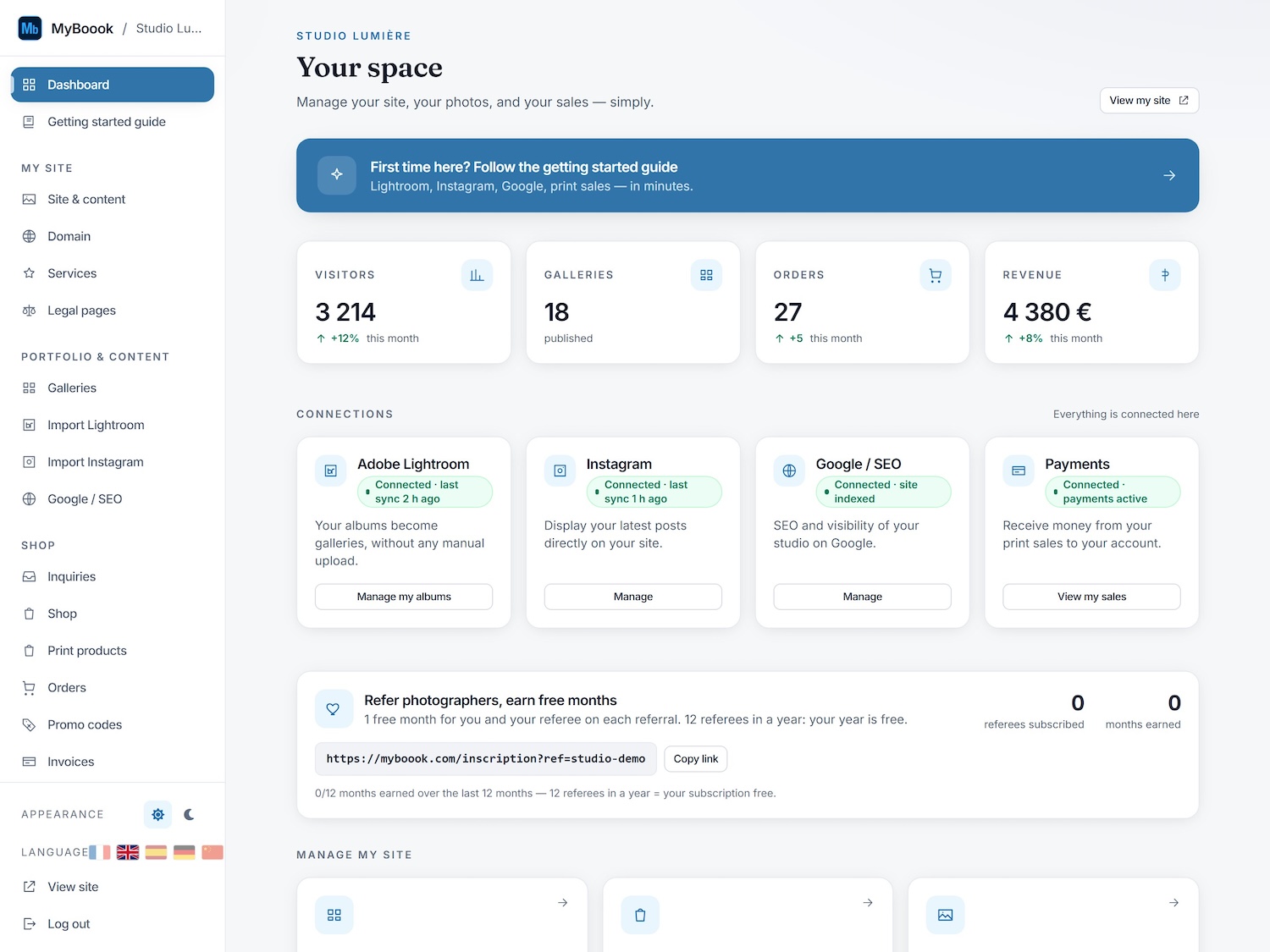
  • 16 themes, customizable fonts and colors
  • Unlimited private client galleries
  • Print shop with secure Stripe payments (the money goes to the photographer’s own Stripe account)
  • Instagram feed pulled into the site
  • Custom domain (or a free name.myboook.com subdomain)
  • Multilingual sites and a full back office
  • Google/SEO settings built in
  • Pro plan adds a free-form page composer, reusable layouts, and the Community where photographers share and sell their own themes

PRICING

  • Casual: $9.90/month or $99/year
  • Pro: $19.90/month or $199/year
  • No commitment, cancel in one click.

COUPON CODE

You can use coupon code PHOTORUMORS for 3 months free, one per person, on either plan – see the details on this page:

  • Monthly: the first 3 months are $0, then the normal rate of the plan they picked.
  • Annual: 3 months free instead of the usual 2, so the first year is $89.10 on Casual and $179.10 on Pro, then the normal annual price.

You can also just type PHOTORUMORS in the promo field at signup.


LINKS



The post MyBoook.com is a new website & gallery builder that automatically syncs with Adobe Lightroom (coupon code included) appeared first on Photo Rumors.

Stow: a free tool to verify your camera memory card backups before you format

Par : PR admin
25 juillet 2026 à 23:15


This is a guest post by Luke Lv, founder of Lumira Studio, a UK video production studio (Website | Instagram | YouTube | LinkedIn).

There is a small moment that I think most photographers and filmmakers will recognise. You are on the next shoot, you reach for a card, and realise it is still full from the last job.

Then the doubt starts.

Did I definitely back this up properly? Is everything on both drives? Is it actually safe to format? You probably did everything correctly. But when that card holds a full day of work, “probably” does not always feel good enough.

I started Lumira Studio in 2014, and this was something that bothered me for years. So we eventually built a small tool for our own team to remove that doubt.

It is called Stow, and we decided to make it free. It works on both Mac and Windows.

What Stow does

The idea is deliberately simple.

You choose the camera card, then choose two destination drives. Stow copies the files to both destinations at the same time. Once the copy is complete, it reads the files back from the destination drives and verifies them before giving you a clear result:

Safe to wipe.

Or, if something is not right:

Not yet.

The important part for us was that Stow should not simply tell you that a copy process has finished. We wanted it to check the files that had actually been written to the destination drives before we trusted the result.

Why the verification matters

Most of the time, copying a card is completely uneventful. The problem is that the footage or photographs on that card may be impossible to replace. A wedding, a commercial, an interview, a wildlife trip or an entire production day might only exist once.

That is why I wanted a very simple answer at the end of an offload. I did not want to look through folders and wonder whether everything had made it across. I wanted to know whether the copy had been completed and verified before the card was reused.

Stow also saves a short report to the destination drives showing what was copied and verified. For us, that report is useful because the question often comes later. You pick up the card on another shoot and cannot quite remember what happened to the footage that was on it. Having a record removes some of that uncertainty.

Why we made it free

We originally built Stow for our own production work. We wanted something simple that could copy to two destinations, verify the files afterwards and give our team a clear answer before a card was formatted. Once we had built it, there did not seem to be much reason to keep it to ourselves.

So Stow is free.

There is no account to create, no subscription and no paid tier behind it. It is not intended to replace a proper backup strategy. It is simply a tool to make one very important part of the workflow clearer: getting the files safely off the card and verifying the copies before that card is reused.

One honest note

Stow is not yet code-signed and certified by Microsoft or Apple. That means the first time you open it, your operating system may display a security warning. Getting the app properly signed is one of the next things we are working on. In the meantime, we have put together a short installation guide for both Mac and Windows, you will find it on the website.

Where to get it

Stow is available free at:

https://www.lumirastudio.com/stow/

There is nothing to sign up for. And if you try it and find something that would make it more useful, I would genuinely like to hear about it. A lot of the improvements we are already planning have come directly from photographers and filmmakers telling us what they would like the app to do next.

The post Stow: a free tool to verify your camera memory card backups before you format appeared first on Photo Rumors.

Here are the top 10 best-selling compact digital cameras for the first half of 2026 in Japan

Par : PR admin
21 juillet 2026 à 00:15


Here are the top 10 best-selling compact digital cameras of the first half of 2026 in Japan:

  1. Kodak Pixpro C1
  2. Kodak Pixpro FZ55
  3. Fujifilm Instax mini Evo
  4. Canon PowerShot SX740 HS
  5. Canon IXY 650
  6. OM System Tough TG-7
  7. Panasonic Lumix TZ99
  8. Kenko KC-AF11
  9. Kodak Pixpro FZ45
  10. Kodak Pixpro WPZ2

You can clearly see how the big Japanese brands are behind on the trend – Kodak has four cheap mediocre cameras in the top 10 list.

The BCN Ranking is a POS database that collects and aggregates daily sales data of digital cameras from major consumer electronics retailers and online shops covering approximately 40% of the Japanese retail market.

Used compact camera prices quadruple in Japan as CCD models make a comeback

Compact fixed-lens cameras are becoming more popular, while interchangeable-lens cameras are starting to lose their popularity

Source: BCNR

The post Here are the top 10 best-selling compact digital cameras for the first half of 2026 in Japan appeared first on Photo Rumors.

The first Russian anamorphic cinema lenses

Par : PR admin
16 juillet 2026 à 15:58


The first 80mm Russian anamorphic cinema lens (previously reported here) was recently presented by Shvabe Holding (part of Rostec State Corporation) at the Innoprom 2026 show. This marks the first time a domestically produced anamorphic film lens has reached the ready-made prototype stage in Russia. The anamorphic series, developed by the Lytkarinsky Optical Glass Plant (LZOS) within the Shvabe holding, includes four focal lengths:

  • 40mm
  • 60mm
  • 80mm (first finished model, now shown)
  • 100mm

All lenses feature a 2x anamorphic squeeze, PL mount as standard (with adapters available for other mounts), and are designed for digital cinema cameras.

Shvabe announced the first Russian anamorphic cinema lenses

Key lens highlights:

  • Ultra-wide field of view without the edge distortion and corner darkening typical of wide-angle spherical lenses.
  • Distinctive cinematic rendering, including characteristic bokeh and flares.
  • High image quality and “unique picture” that sets them apart from many foreign alternatives.
  • The front elements have an unusual concave shape – a hallmark of this optical design that enables the horizontal squeeze while preserving overall image integrity.

“The development of anamorphic lenses is an important step by a domestic manufacturer for the development of the Russian film industry. In addition to the extended horizontal frames and high image quality, they allow you to create unique cinematic effects. We will launch the film lenses into mass production next year. It is planned to produce 4 sets of products as part of the first installation batch. Test copies will appear this year. They will be available for delivery to film studios, and their cost will be lower than their foreign counterparts.” — Lev Borisov, Deputy General Director for Sales of Civilian Products at Shvabe Holding

Development Timeline & Availability

  • July 2026: 80mm ready-made model presented publicly for the first time.
  • Later in 2026: test copies are expected to become available for film studios.
  • 2027: serial/mass production launch, starting with an initial batch of 4 sets.

LZOS & Shvabe Background

Lytkarinsky Optical Glass Plant is one of Russia’s premier optical manufacturers. It is the only facility in the country capable of producing large-scale ground- and space-based mirrors used in major telescopes worldwide. The plant also produces the well-known Rubinar mirror lenses.

Previous coverage of Russian lenses is available here.

The post The first Russian anamorphic cinema lenses appeared first on Photo Rumors.

SanDisk’s first 8TB SDUC memory cards confirmed: massive storage, but new readers required

Par : PR admin
8 juillet 2026 à 18:44


SanDisk’s first 8TB SDUC memory cards are coming soon, here are the latest details (see current SanDisk offerings):

SanDisk is moving forward with its long-awaited high-capacity SDUC memory cards. After an initial 2024 announcement and a delay from the originally planned 2025 launch, new details emerged last month at Computex 2026 confirming that 8TB full-size SDUC and 4TB microSDUC cards are on track to ship shortly.

Coming soon: world’s first SanDisk 4TB microSD and 8TB SD memory cards

What We Know About the Cards

SanDisk plans to launch these under its Ultra lineup (with some Extreme Pro variants also referenced):

  • 8TB SDUC (full-size SD card)
  • 4TB microSDUC

Both are UHS-I cards with a theoretical maximum transfer speed of around 104 MB/s. The Ultra models carry V10 and A1 ratings (minimum sustained write speed of 10 MB/s). An Extreme Pro 4TB SDUC version is also expected with a higher V30 rating.
These cards fall under the SDUC (Secure Digital Ultra Capacity) standard, which covers capacities from just over 2TB up to a theoretical 128TB and uses the exFAT file system (like current SDXC cards).

The Major Compatibility Issue

Here’s the big caveat – these cards are not backward compatible with existing SDXC readers or devices.

  • Current SDXC card readers (even those supporting the highest current capacities up to 2TB) will not work with SDUC cards.
  • Even brand-new SD Express readers cannot handle SDUC at this point.
  • No consumer or professional cameras, computers, or devices currently on the market support SDUC cards.

New multi-standard readers that combine UHS-II, SD Express, and SDUC support are expected and were reportedly shown at Computex, but they are not yet widely available.

SanDisk has not released official pricing, exact launch dates, or full spec sheets yet.

The post SanDisk’s first 8TB SDUC memory cards confirmed: massive storage, but new readers required appeared first on Photo Rumors.

❌