The new 2026 ON1 Effects is now officially released and available as a standalone application or as a plugin for Lightroom Classic and Photoshop. Version 2026 introduces new 1-click subject and background masks, layer-based masking, improved mask quality, and four new creative filters, all designed to give you speed without sacrificing control. Additional information:
Photo RAW users can already access Effects inside that app; this release adds a standalone option
Subject and Background Masks: AI-powered one-click masking to instantly isolate the main subject or background in an image, enabling precise adjustments without manual brushing.
Depth Lighting Filter: Uses AI depth detection to add cinematic lighting effects, balancing light and shadow for dramatic, three-dimensional results in portraits or landscapes.
Split Field Filter: Simulates a tilt-shift lens to compress perspectives, bringing distant backgrounds closer while keeping the foreground sharp—ideal for creative landscape edits.
Double Exposure Filter: Easily blends two images or exposures into artistic composites without needing multiple layers or in-camera techniques, turning simple shots into surreal artwork.
Motion Filter: Applies realistic motion blur effects like panning, zooming, or twisting to static photos, adding a sense of movement and dynamism.
Effects Starting Points: Kick off edits with pre-selected favorite filters or looks applied instantly, streamlining the creative process for consistent styling across images.
New Add Filter Dialog: An updated interface for quicker access to commonly used filters, with search, favorites, and the ability to hide unused options for a more personalized workflow.
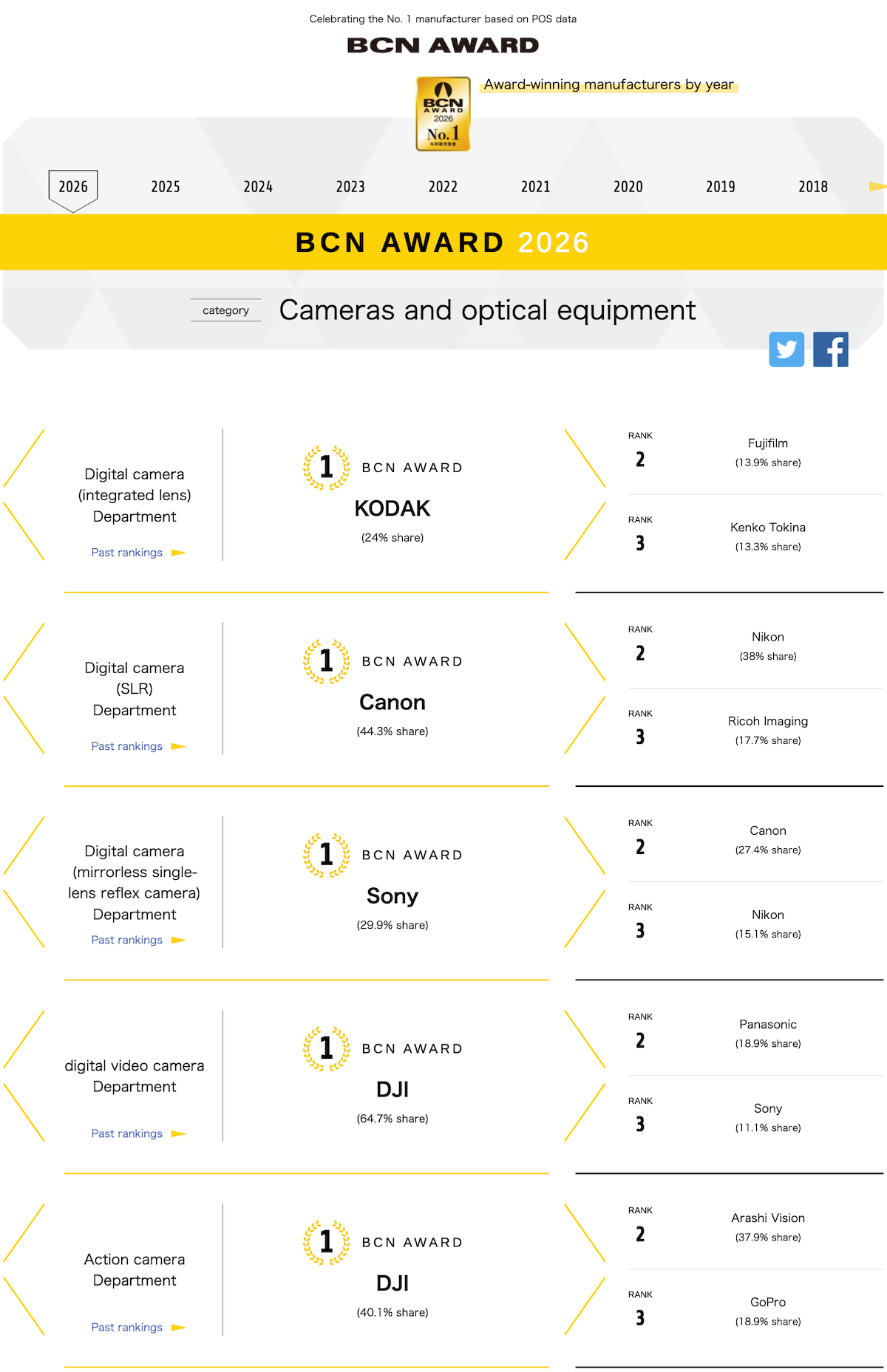
BCN Corporation, headquartered in Tokyo, announced the winners in the camera category for 2026. BCN collects POS sales data from most retail stores in Japan (January to December, 2025). Here is the latest ranking:
Mirrorless cameras:
Sony: 29.9%
Canon: 27.4%
Nikon: 15.1%
DSLR cameras:
Canon: 44.3%
Nikon: 38%
Ricoh/Pentax: 17.7%
Digital compact cameras with an integrated lens:
Kodak: 24%
Fujifilm: 13.9%
Kenko Tokina: 13.3%
Action cameras:
DJI: 40.1%
Arashi Vision: 37.9%
GoPro: 18.9%
Video cameras:
DJI: 64.7%
Panasonic: 18.9%
Sony: 11.1%
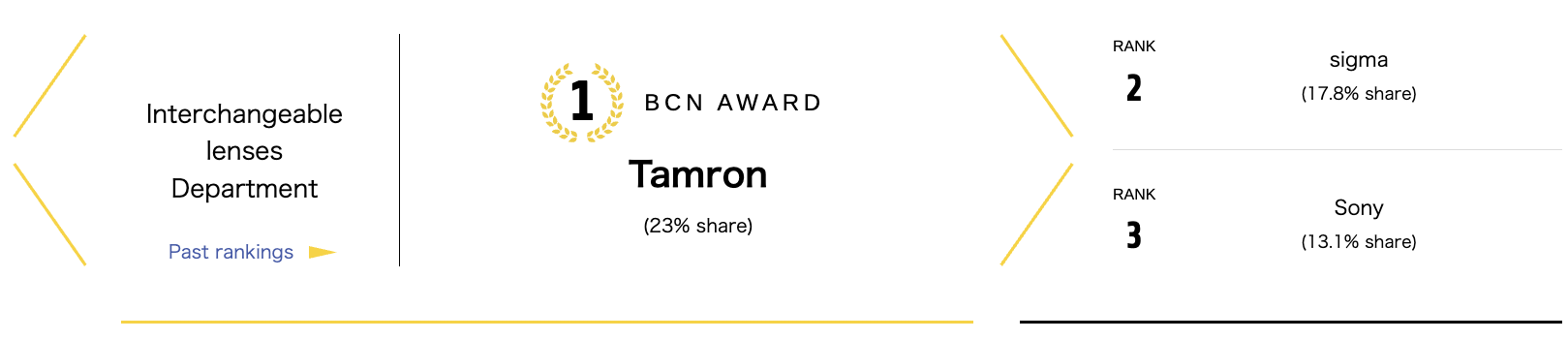
Interchangeable lenses
Tamron: 23%
Sigma: 17.8%
Sony: 13.1%
Overall Trends and Insights
Mirrorless Growth vs. DSLR Decline: Mirrorless rankings show a fragmented but vibrant market, with Sony holding strong. DSLR sales are likely shrinking, as evidenced by lower overall volumes implied in historical data (e.g., Canon’s 2025 DSLR share was 69.4%, but no 2026 figure available). Nikon remains competitive in both but could benefit from more aggressive Z-system marketing.
Non-Traditional Brands Rising: DJI’s double win in video and action categories signals a shift to versatile, tech-integrated devices over pure camera hardware. This could pressure traditional brands like Nikon to innovate in video features.
Lens Market Dynamics: Third-party lenses leading points to price sensitivity in Japan. For Nikon fans, this means opportunities to pair Z-mount bodies with affordable Tamron or Sigma glass, potentially boosting system adoption.
Nikon-Specific Analysis: Nikon appears in three categories (DSLR 2nd, mirrorless 3rd, binoculars 3rd), a respectable showing amid intense competition. Compared to 2025 (where Nikon was 3rd in mirrorless and 2nd in DSLR), there’s consistency, but to climb higher, focusing on entry-level mirrorless or hybrid video capabilities could help. No appearance in lens top three suggests Nikon’s native optics are premium-positioned, not volume leaders.
These awards reflect Japanese retail trends, which may differ globally due to regional preferences (e.g., instant cameras are popular in Asia).
Late last year, Tamron announced that it was bringing its venerable 70-180mm F2.8 Di III VC VXD G2 to Nikon's Z mount. We took the opportunity to shoot a sample gallery with it, to get an idea for how it performs, and how much it asks you to give up compared to a heavier, larger and more expensive 70-200mm F2.8.
That is a bit of a spoiler for what the experience of shooting with the lens was like. Its size makes it much more usable as an everyday walkabout lens than your typical 70-200mm F2.8, and I found myself taking it places I normally wouldn't bring this class of lens, just because it'd be too much of a hassle to do so.
Even extended, the Tamron 70-180mm F2.8 Di III VC VXD G2 isn't particularly long (unlike its name).
The autofocus motors in the lens were snappy enough that I never felt like they were holding the camera back, even when I was shooting fast-moving subjects like horses. I also appreciated the lens's inclusion of optical image stabilization, which, when paired with the Z8's in-body stabilization, let me get sharp handheld shots at shutter speeds that would typically be difficult to manage with a telephoto lens.
Optically, you do give up a bit compared to the more premium options; as evidenced by several photos in our sample gallery, there's some pretty heavy vignetting at F2.8, though it's noticeably better at F4, and pretty much clears up by F5.6. There's also, of course, the 20mm difference at the long end, though in most scenarios, most photographers won't really notice the difference between a photo shot at 180mm and one shot at 200mm. The lens is also reasonably sharp throughout its range, and has relatively pleasing bokeh wide-open.
The vignetting will be most noticeable when shooting relatively bright, featureless surfaces like the sky, and is less distracting in other situations.
Finally, there are the controls. The lens has a single customizable button, which is always a nice inclusion, and Nikon allows you to assign a wide variety of functions to it. I also appreciated the inclusion of a lock switch to keep the lens retracted. It's an extending zoom design (which isn't my favorite, but makes sense given its size), and having the ability to keep it from walking while I was carrying it around was much appreciated. However, it's worth noting that it's quite a strong lock; unlike with some of Sigma's lenses, you can't overpower it if you forget to deactivate it before raising the camera up to your eye.
My biggest complaint with the lens is the focus ring, which is quite sensitive, and is situated exactly where I'd typically rest my hand. This led me to frequently bump the camera into manual focus mode at inopportune times. If I spent long enough with the lens, I'm sure I'd adapt to it (and the focus ring's location will be more familiar to those who only shoot Nikon), but I ended up simply setting it to do nothing in the camera's settings.
The buttons are nice to use, but the focus ring can be quite touchy, and doesn't leave you much room to hold the lens.
Minor complaints and personal preferences aside, I found the Tamron 70-180mm F2.8 Di III VC VXD G2 to be a capable and versatile lens, especially for the price. But be sure to check out the gallery below so you can make your own assessments.
Some random websites are reporting that a new Fujifilm X-Pro4 camera is coming soon. The Fujifilm X-Pro3 camera has been discontinued for a while without any replacement in sight:
Digging deeper with AI, the Fujifilm X-Pro4 camera rumors appear to be just clickbait:
The Fujifilm X-Pro4 remains in the realm of rumors and speculation, with no concrete evidence of an imminent launch (e.g., within the next few months). Most credible sources point to a potential release sometime in the second half of 2026 or even later, possibly tied to Fujifilm’s next-generation X-Trans VI sensor and processor updates, but this is unconfirmed. Here is a break down all references found online:
Official Fujifilm Websites
Searches across Fujifilm’s global and regional sites (e.g., fujifilm-x.com, fujifilm.com, fujifilm.com.cn) yield no official references to the X-Pro4. These sites focus on existing models like the X-Pro3 (released in 2019), X-T5, X-H2S, and others.
Fujifilm’s product pages and news sections discuss updates to current lines but make no mention of an X-Pro4.
In interviews (e.g., with Fujifilm executives like Yuji Igarashi), the company has acknowledged demand for an X-Pro successor but emphasized it won’t be a “boring refresh” and is still in conceptual stages, with no timeline given.
No product listings, teasers, or firmware mentions appear on Fujifilm China (fujifilm.com.cn) or other regional variants. If it were officially coming soon, we’d expect teasers or placeholders on these sites, but there’s nothing.
Retailer References
Major retailers show no active listings or pre-orders for the X-Pro4, indicating it’s not available for sale or even teased commercially. Searches often redirect to the X-Pro3 or unrelated accessories.
Social Media References (X/Twitter)
On X (formerly Twitter), the X-Pro4 is a hot topic among photography enthusiasts. No official Fujifilm accounts mention it. Key themes:
Rumors and Predictions: Many posts cite 2026 as the likely year, often linking to articles speculating on specs like a 40MP APS-C sensor, IBIS (in-body stabilization), improved hybrid viewfinder, and new film simulations.
User Wishes and Debates: Posts express frustration over the delay (X-Pro3 is 7 years old) and debate features, such as keeping the optical viewfinder (OVF) vs. going all-digital with an EVF. Some suggest it might be renamed (e.g., X-Pro5 or X-Pro6) to align with current numbering.
Broader Predictions: Some accounts bundle it with other 2026 cameras (e.g., X-T6).
No leaks from insiders or Fujifilm reps.
Chinese Websites
Chinese e-commerce sites like JD.com and Taobao have indirect references to the X-Pro4, but not as a sellable camera – only in accessory listings (e.g., flashes like EF-X8 or EF-60) that claim compatibility with future models, including “X-Pro4”. This seems precautionary (listing potential compatibilities) rather than evidence of a release. No actual camera pages or pre-orders exist on these platforms.
Summary and Rumored Timeline/Specs
Is it coming soon? Unlikely in the immediate future. Rumors suggest a 2026 release or later if Fujifilm focuses on mass-market models like the X-T6 first.
Rumored Specs: 40MP non-stacked APS-C sensor, faster processor, IBIS, articulating screen, new film simulations (e.g., Reala Ace), and possibly a refreshed hybrid viewfinder. Price estimates: $2,400–$2,600.
Why the Delay? Sources suggest Fujifilm is prioritizing broader-appeal cameras and wants a significant upgrade to justify the X-Pro line’s niche.
I took this photo while touring Astoria, Oregon, solely to explore the sites featured in the 1985 movie The Goonies. The photo depicts the driveway sign leading up to the house where some of the Goonies kids lived.
This month, we're celebrating the silly and strange world of signage that tells an interesting story. Whether you're traveling across the country or just around the corner, capture a photo of a sign with a unique story to tell. It could be a massive billboard along a highway or a quirky notice in your local pub. We can't wait to see what you discover!
Photos can be submitted between Sunday, January 18, and Saturday, January 24 (GMT). The challenge is open to photos captured at any time.
Important: Images MUST include a title and a description of at least 25 words to be eligible. We need to be able to share the story behind your photo. We will consider both photos and captions when selecting our winners, so make sure to tell us that story!
Visit the challenge page to read the full rules and to submit your photos for consideration as soon as the challenge opens.
Getting a new camera is always exciting, even if it's only new to you. So much so that it can be tempting to jump right into using it without much, if any, setup. However, despite the urge to get started right away, it's important to take a few minutes to review some important settings. Doing so can make a significant difference in what your first impressions of the camera are and how the first photos you take turn out.
It's important to note that different genres of photography and video will require their own specific tweaks. However, there are some foundational settings that stay the same no matter what you like to capture, especially when setting up a new camera. This guide focuses on core settings to help beginners navigate a new camera.
Additionally, each specific camera brand will have its own intricacies. We'll touch on some of the more prominent ones in a later article. For now, our focus is on more general settings that apply to most people, no matter their camera brand.
Settings everyone should change
There are a few settings that everyone should check and potentially change when dealing with a new camera. These are relevant to every photographer, no matter your preferred genre or camera brand.
Time and date
When you turn on a new camera for the first time, you'll be prompted to make a few changes right off the bat, including time and date. Some cameras let you skip this step, but it’s best not to. Also, if you bought a used camera, we'd advise looking up how to do a complete reset and then entering the correct information. After all, having the correct date and time will make it easier to organize your photos and videos later on, so it's useful to start here.
Firmware updates
Canon's firmware menu screen will tell you at a glance which version of firmware you have. Screenshot: Mitchell Clark
Your camera may be brand new, but it was likely sitting on a shelf for some time before you brought it home. As a result, there could be new firmware available, which is usually worth installing right away. Some new firmware updates are minor, simply enhancing stability or improving security, but they can also unlock new features and improve performance, so it's important to make sure your camera is up to date. New cameras from many brands will now check for you when you connect them to your phone for the first time, so it's also worth downloading the relevant app, too.
If you bought a used camera, you don't necessarily know if the previous owner kept it updated. As a result, we'd recommend checking whether new firmware is available. To check if there's new firmware, head to the manufacturer's website and see if there's an updated version for your camera's model.
Set the diopter
The dial just to the right of the viewfinder is the diopter dial. Photo: Abby Ferguson
The diopter is an often overlooked and even unknown feature on cameras. The diopter is a tiny optical lens in front of the viewfinder with a small wheel off to the side. It allows you to make small adjustments to the viewfinder so that it matches your eyesight, ensuring that text and details look sharp. It doesn't change the sharpness of your photos, only what you see in the viewfinder. However, with a mirrorless camera, having it set wrong could make you think your shots aren't sharp, so it's critical to dial this in. You can think of it like changing the prescription of your viewfinder. If you have a camera without a viewfinder, this won't be relevant; however, if your camera does have one, be sure to set it up correctly right out of the box.
Image quality and file format
A screenshot of Canon's interface for choosing image type and size. Screenshot: Mitchell Clark
Your new camera will arrive with the file format set to JPEG only. While that works well for photographers who don't need the greater control that Raw files unlock, it's not the preferred option for some. If you're the type of photographer who expects to use Raw files, make sure to change your file format settings right off the bat. Or, you can select to shoot both Raw and JPEG at once, giving you the best of both worlds. If you're unsure or on the fence, we'd suggest shooting in Raw. You can always discard the file if you don't need it, but if you get a shot you really want to edit, you can't acquire the Raw data later.
It's also worth checking the image quality settings while you're at it. Even if you shoot in JPEG only, there are multiple options to choose from that determine how large your files are. We'd recommend shooting in the largest, highest quality your camera offers. Even the largest JPEGs are pretty small, and you can always downsize or recompress a large file, but you can't regain the quality or detail you didn't originally save.
Settings to consider changing
There are settings everyone should definitely check, like the ones above, and others that many people prefer to adjust right away, while others may not. The default settings all have reasons for being there, so they make sense in certain situations and for some people, but many photographers prefer to turn them off or change them immediately.
Beeps, sounds and audio signals
We'd suggest turning the beeps off right away. This is what the menu looks like on a Nikon camera. Screenshot: Mitchell Clark
Most camera manufacturers have lots of beeps turned on by default. These could be beeps for focus confirmation, for starting a recording, menu beeps and so on. For most of us, those constant noises can drive us (as well as the people around us) mad, so we'd suggest you turn them off right away. That's especially true if you're photographing in any situation where quiet is important. The only reason to leave the beeps on is if that added notification is helpful to you when using your camera, but there are also other tools you can employ in most situations that you'd use beeps.
AF-assist light
Another feature that's typically turned on by default is the AF-assist light (it can go by different names depending on the brand). It's a small light on the front of the camera that is intended to lightly illuminate a subject, helping your camera focus in dark conditions.
However, autofocus systems in cameras these days are impressive even in very low light, and that light can be annoying or even disruptive. It's not fun for a subject to have a beam of light in their eyes when you press the shutter. Plus, it's only effective for subjects that are close to the camera. Unless you know you'll need it, we'd recommend turning that off right away.
Autofocus settings
Autofocus options on a Panasonic camera. Screenshot: Mitchell Clark
Modern cameras have a long list of autofocus settings you can tweak, such as focus mode, focus area, subject detection and more. Most of these settings will depend on your specific type of photography or subject. Additionally, some may not be "set it and forget it" settings if you shoot a wide range of subjects. In those situations, we'd suggest getting a feel for the settings and modes you find yourself using, then checking if there's a way to configure your camera to quickly switch between your favorites.
Whether you shoot a variety of genres or stick to one, it's still worth going into the autofocus menu on your new camera. For many, you'll likely end up changing the focus mode and subject detection option to ensure that the settings align with how you most often photograph. If you don't photograph a lot of people, for example, you don't want the subject detection mode to be set to Human.
Don't forget your personal preferences
The above items are likely just a starting point for many photographers. It's also important to remember that you are the one using your camera, and choosing the settings that work best for your workflow and preferences is always the way to go. It may take time to dial in your new camera, but spending the time to figure out the best setup for your needs will help you enjoy using the camera a lot more.
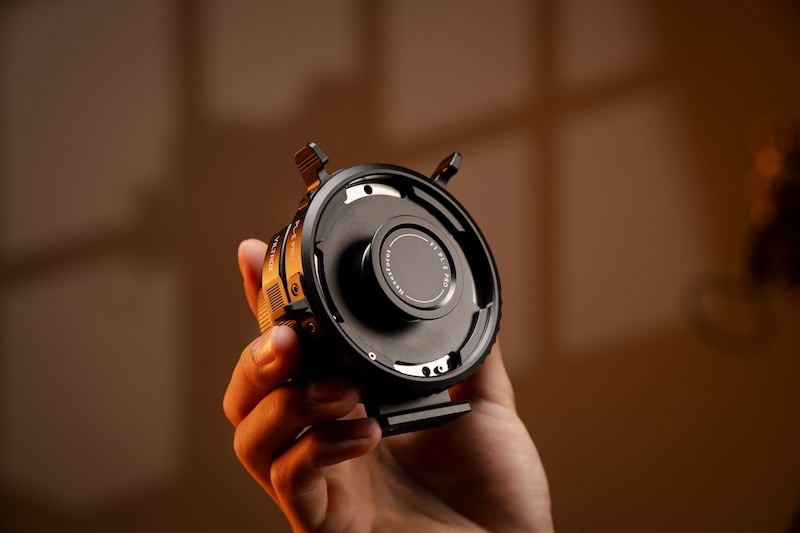
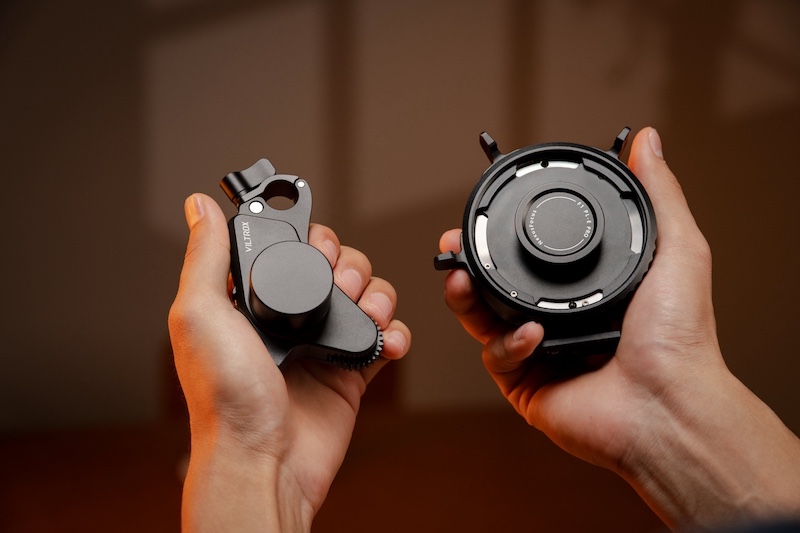
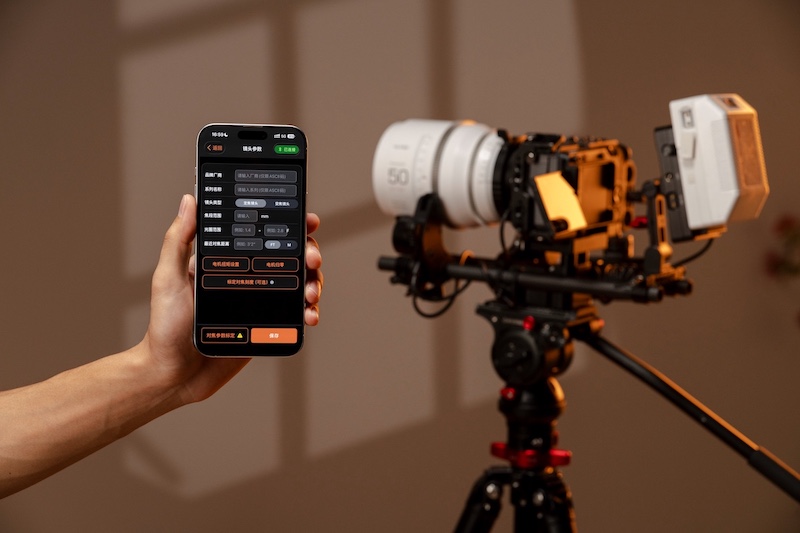
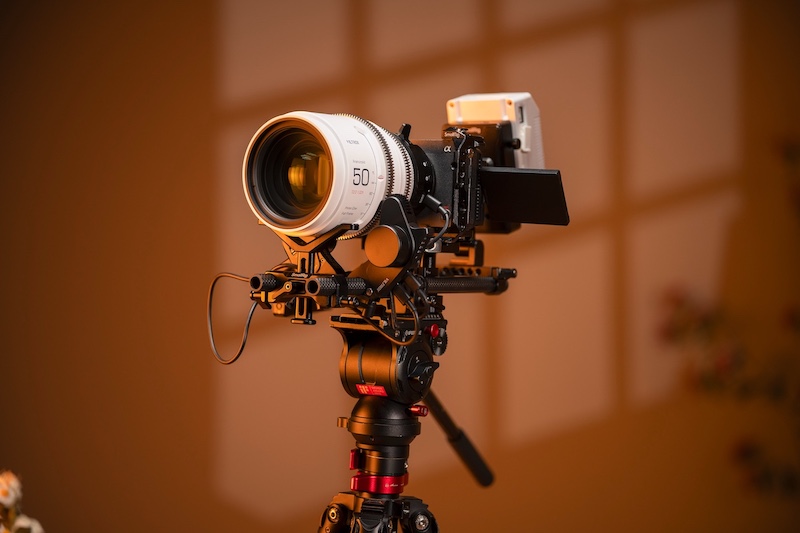
The previously reported Viltrox Nexus F1 Pro cinema with AI-assisted phase-detection autofocus adapter (PL to E) with full AF capabilities and photo/video EXIF support is now available on Kickstarter and already rasised $42k.
The Viltrox NexusFocus PL-E Adapter (also referred to as the Nexus PL to E Pro) is an innovative cinema lens adapter designed to bring full autofocus capabilities to manual PL-mount cine lenses when used on Sony E-mount cameras. Announced as a prototype at IBC 2025 in September, it essentially transforms vintage, anamorphic, or modern manual cinema primes into AI-driven autofocus lenses by leveraging the camera’s native phase-detection AF system.
Key Features
Autofocus Integration: It taps directly into Sony’s autofocus protocols, enabling features like eye AF, face recognition, subject tracking, and tap-to-focus on the camera’s LCD. No additional sensors (like LiDAR) or wireless follow-focus systems are needed—the adapter uses external motors to drive focus based on real-time data from the camera sensor.
Iris and Zoom Control: Beyond focus, it supports camera-controlled aperture (iris) adjustments, and with additional motors, it could handle zoom on compatible lenses.
Lens Profiles: Comes with pre-installed profiles for various PL lenses, allowing quick calibration, saving configurations, and easy swapping without recalibration.
Power and Design: Powered by a small battery that lasts for days of use. The prototype includes refinements planned for housing, cable management, and motor strength.
Compatibility
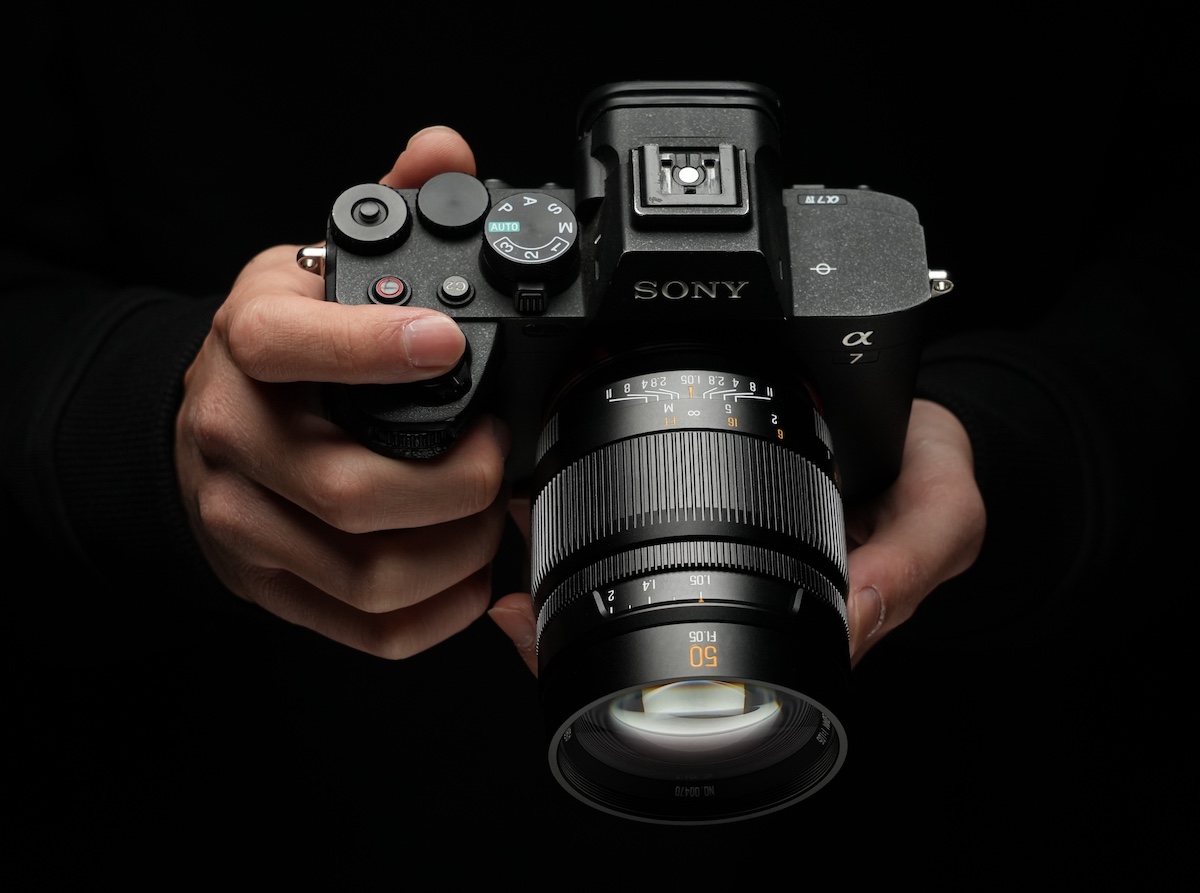
Primarily for Sony E-mount cameras with built-in AF, such as the FX3, FX6, A7 series, and NEX series.
Limited testing has shown partial functionality on other mounts like L-mount, Nikon Z, and Fuji GFX, with potential for expanded support in future versions.
How It Works
The adapter mounts between the PL lens and E-mount body, then connects to external motors on the lens. It receives AF commands from the camera (e.g., when you tap the screen or use subject detection) and translates them into precise motor movements for focus and iris – making manual lenses behave like native Sony AF glass.
We put the USB 3.2 Gen 2 Samsung T7 Shield, USB4 SanDisk Extreme Pro and Thunderbolt 5 OWC Envoy Ultra head-to-head. Photo: Mitchell Clark
These days, there are an overwhelming number of options when it comes to buying an external SSD to expand your computer's storage (an increasingly important ability as Raw sizes and video bitrates balloon). The highest-end options use protocols like Thunderbolt 5 or USB4 to achieve blistering speeds, but this raises the question: do photographers need all that performance?
We tested several SSDs across a range of price points to see if each one had more to offer for photographers, or if the returns quickly diminished.
What we tested and how we tested them
For this article, we used a 1TB Samsung T7 Shield as our sample for USB 3.2 Gen 2, a 2TB SanDisk Extreme Pro to represent USB4 and a Thunderbolt 5 2TB OWC Envoy Ultra. The tests were carried out on a 2024 MacBook Pro with an M4 Pro processor, which supports Thunderbolt 5, and we tested each SSD one at a time, using the cable it came with.
While this isn't meant to act as a review for the specific SSDs we used for our testing, the results can't necessarily be universally applied to each product in their class. For example, the USB4 SanDisk SSD is using the faster 40Gbps version of the spec, but another USB4 SSD may only be able to reach 20Gbps speeds. We may also see faster USB 4 and Thunderbolt 5 drives as the market around those specifications matures, but, as of early 2026, the drives we've tested are some of the best in their respective classes.
How do the drives stack up?
USB 3.2 Gen 2
The magic of USB-C: it can be used for almost anything. The downside of USB-C: it can run at almost any speed.
Starting with our standard-bearer for USB 3.2 Gen 2, the Samsung T7 Shield handled a number of photography-related tasks with aplomb. We didn't notice any hiccups scrolling through a Lightroom Classic library with over 3600 images, and it wasn't meaningfully slower than the competition when we were copying hundreds of Raw/JPEG pairs to it from a CFExpress or SD card. However, it did take noticeably longer to import and build previews for that Lightroom library, and copying files to the drive from the computer (and vice versa) could take several times longer than on our faster drives.
For the photographers who occasionally stumble into the land of video, we also found that the slower SSD struggled a bit more when editing footage off of it. Adobe Premiere would frequently drop frames during playback, and more complex sequences could slow it to a crawl. Final Cut fared a bit better and was surprisingly usable, though there were still occasional hitches.
USB4
Despite the USB 3.2 Gen 2 drive's general competence, there were definitely times when the USB4 drive made it obvious that it was using a next-generation interface capable of real-world read and write speeds anywhere from 2.5 to 6.4 times faster than those of the Samsung model. Moving files back and forth between it and the computer was very quick, and most of the playback issues in our video editing suites disappeared or were substantially less noticeable. And, of course, it handled all our photo editing and organization tasks with the same ease as the lower-end model.
Thunderbolt 5
The point of the Thunderbolt spec is to be an assurance of performance; USB4 may just be Thunderbolt 4 in a trenchcoat, but until you do some digging, you won't know exactly what speeds a piece of USB4 gear can deliver. That's not the case with Thunderbolt.
Unsurprisingly, the Thunderbolt 5 drive easily handled everything we threw at it, and it never felt like it was a performance bottleneck. However, there also weren't any scenarios we ran into where it was noticeably faster than the USB4 drive, outside of our synthetic benchmarks*. While there are probably some users who'd be able to push it to its limits, we suspect most photographers and video editors wouldn't see a ton of benefit over a good USB4 drive.
* - And even there, the gains weren't nearly as large a jump as the one from USB 3.2 Gen 2 to USB4; our Thunderbolt 5 drive ran around 1.2 to 1.8 times faster than our USB4 one, not quite realizing the theoretical 2x improvement that the standard would allow for.
What's in a name?
No discussion of external SSDs would be complete without a rant on just how confusing things have become when it comes to USB ratings and speeds. What was once relatively simple (USB 2 = slow, USB 3 = fast) has become incredibly complex, with the version of USB that your device supports actually telling you very little about what speeds it supports. For example, a device labeled "USB 3.2" may only run at 5Gbps, or it could rival earlier versions of Thunderbolt, supporting up to 20Gbps. USB4 has the same issue, with potential speeds ranging from 10Gbps to 120Gbps.
Wikipedia has an excellent chart showing all the permutations of the USB specification and the speeds they provide. Which explains a bit why the standard is such a nightmare for those who care about performance. Graphic: Wikipedia
While external SSDs usually come with maximum speed ratings that tell you what they should be capable of (even the fastest SSDs won't be capable of fully saturating USB4's top speeds), it's more of a concern when it comes to the port on your computer and the cable you use to connect the two. While the USB Implementers Forum has been leaning on people to label equipment with their speed and power delivery ratings, not everyone will, so you'll want to make sure you're familiar with which ports on your computer are the fastest, and that you're using a high-quality cable that's capable of providing the speeds your SSD needs. If you have a random USB-C to C cable laying around your house that came with some device, assume it runs at USB 2 speeds, and shouldn't be used for transferring data.
The cable that comes with the SanDisk is, thankfully, labeled with the speeds and power delivery that it's capable of, but this is currently far from the norm. Photo: Mitchell Clark
Thankfully, the story is simpler with Thunderbolt, as each generation has only a single speed. If you have a Thunderbolt 4 cable, you know it should run at 40 Gbps. Of course, this is part of the reason why the price floor for Thunderbolt devices and accessories is so much higher than it is for their USB counterparts. It's also worth noting that Thunderbolt is cross-compatible with USB; if you plug a Thunderbolt drive into a 20Gbps USB-C port on your computer, it will still work, albeit at the lower speeds allowed by the connection.
Summary
This isn't a review of the OWC Envoy Ultra, but it's been a very enjoyable drive to use. The attached cable may be a bit of a mixed bag in terms of repairability but means you can never accidentally leave it at home.
For most photography tasks, you can get away with a relatively standard USB 3.2 SSD with a port and cable rated for 10Gbps speeds. If you frequently move around large chunks of data, edit complex videos, or are just generally impatient, though, it may be worth upgrading to a faster USB4 one, with the greatest gains to be had by going with a model that supports a 40Gbps connection. Most photographers and videographers will be able to stop there; unless you just enjoy having the best version of a thing possible, or need a specific feature, capacity or form factor only offered by a Thunderbolt drive,
DivePhotoGuide (DPG) has announced the winners of its Masters Underwater Imaging Competition 2025. The contest consists of nine image categories, including wide angle, macro, over-under, compact and more, along with one video category. It also awards one overall winner, with this year's honor going to Yuka Takahashi for her stunning image of two humpback whales swimming side by side in Mo'orea.
The DPG Masters Underwater Imaging Competition may be smaller than some photo competitions, but it still showcases stunning imagery. This year's edition received more than 2000 entries from underwater photographers and videographers around the world. A panel of six judges – Nicolas Remy, Jennifer Hayes, Álvaro Herrero (Mekan), Jill Heinerth, Aaron Wong, and Kate Jonker – selected the winners and runners-up, awarding a total of $85,000 in prizes. The contest also donates 15% of proceeds to marine conservation efforts.
You can see all of the winning images and learn more about the contest at the DPG website.
Overall Winner, Wide Angle - Gold
Photographer: Yuka Takahashi
Country: Japan
Title: Synchronized Humpback Whales
Shooting location: Mo’orea, French Polynesia
Equipment and settings: Sony a7R Mark IV, Sony FE 16–35mm F2.8, SeaFrogs housing (F4.5, 1/500s, ISO 320)
Photographer's comment: A pair of humpback whales swims in synchronicity off the French Polynesian island of Mo’orea. Every year, migrating humpback whales from the Southern Hemisphere journey to Mo’orea to use its warm waters as a nursery and resting ground. These two humpbacks are always seen together, and I was fortunate to capture this rare moment in which they mirrored each other’s position and movement almost perfectly. Living close to nature has taught me lessons no textbook ever could, including the realization that each animal has a unique personality. To me, this photograph reflects the strong bond between the two whales while also revealing their playful and curious nature. One of the most special moments I have experienced, this encounter truly made me feel a deep connection with wildlife.
Equipment and settings: Canon EOS 5D Mark IV, Canon EF 8–14mm F4 Fisheye, Liquid Eye housing (F10, 1/2000s, ISO 1000)
Photographer's comment: There was a good weather forecast on this particular day of our surf trip to Sumbawa, and I knew I had a great opportunity to try and get some underwater shots with a surfer in a tube, as the water clarity and conditions were perfect. The hardest part was constantly being in the breaking zone of fairly large and powerful waves. You need to understand and read the ocean well to do that. A small mistake can be very costly if you’re in the wrong place. The swell that day was great. The waves were double overhead, and the surfers put on a show. I spent almost two hours in the water and made numerous attempts before I got a really good series. The best waves were taken by local surfers, and one of the Indonesian surfers is in the photo.
Equipment and settings: Canon EOS R5, Canon RF 100mm F2.8 Macro, Seacam housing, Retra strobes (F2.8, 160s, ISO 400)
Photographer's comment: A bluestriped fangblenny repeatedly scoops up sand from its burrow with its mouth and spits it out. At first glance, the behavior appears random, almost playful, but closer observation reveals a precise and purposeful routine. The fish follows a systematic three-step excavation process, carefully clearing its home grain by grain. This image captures the final and most dramatic stage—the moment the fangblenny launches itself upward from the burrow at roughly a 45-degree angle, forcefully ejecting the remaining sand as far away as possible. The brief burst of motion, frozen in time, highlights both the intelligence and determination hidden within this tiny reef dweller.
Equipment and settings: OM System OM-1 Mark II, Olympus M.Zuiko 90mm F3.5 Macro, Nauticam housing, Inon Z-240 strobes, Backscatter MW-4300 video light (F18, F160s, ISO 200)
Photographer's comment: Prior to this dive, our guides had mentioned that there was a possibility of encountering a Denise’s pygmy seahorse, but after entering the water, there wasn’t much to see and I remember thinking our chances were slim. Yet, when we reached this small, pristine fan coral, I was amazed—and overjoyed—to find this tiny, pregnant pygmy living there. I took just three or four shots, trying not to disturb the animal too much. It seemed to pose proudly among the branches of the fan.
Equipment and settings: Nikon Z8, Nikon Z 105mm F2.8 Macro, Nauticam housing, Backscatter HF-1 strobes (F25, 1/25s, ISO 320)
Photographer's comment: On the way back up a deep, sandy muck slope, at 25 feet, I saw my 30th tube anemone of the dive, and I habitually—obsessively—inspect each and every one for symbionts. The prize I was looking for wasn’t just present but perched in the perfect spot, looking like the ruler of its domain. Before beginning to shoot, I knew I wanted a blue background rather than black, so I slowed the shutter speed. Since I had to be quite far back for this composition with my 105mm macro lens, I moved my strobes all the way forward to try to minimize backscatter. Then the challenge was getting a crisp shot at 1/25s (since I’m an ISO noise snob) as the anemone swayed back and forth in the current. So, much to the chagrin of my housing’s already-gritty O-rings, I braced the housing in the sand as a poor excuse for a tripod. I checked this anemone each time I repeated this site over the next few weeks, and the crab was never there again, so I’m glad I dedicated all the time I could when the chance presented itself.
Equipment and settings: Sony a7R Mark IV, Sony FE 90mm F2.8 Macro, Nauticam housing, Nauticam EMWL-1 with 160° Objective Lens, Retra Flash Pro Max strobes (F16, 1/160s, ISO 640)
Photographer's comment: Encountering this sea snake (Hydrophis sp.) during a dive off Anda in the Philippines, I noticed some rather unusual behavior. First, the snake was rubbing itself on the sand in a vertical U-shape, then it was literally tying itself in knots. I could see pieces of skin hanging at the tail—it was shedding! Although sea snakes are known to exhibit such behavior to help slough off their old skin, it has rarely been captured in a photo—so I knew I had captured something special.
Photographer's comment: This composite image was created during a multi-week trip to Lembeh, Indonesia. Our dive guide found a black sand patch with multiple snake eels, but this was the only one that had cleaner shrimp associated with it. With the dive guide assisting by holding my snoot, the shrimp moved along the snake eel and I managed to capture this shot with the crustacean over its eye. The sun ball that forms the background was shot later on the trip.
Equipment and settings: Sony a7S Mark III, Sony FE 28–60mm F4–5.6, Nauticam housing, Nauticam WACP-1, DivePro G18 video light (F5, 1/400, ISO 16000)
Photographer's comment: The skull in this photo was the first human remains we saw after descending into Green Cave Sink (绿窟潭), which is thought to have once served as a site for ritual executions. It was resting quietly on a rock ledge, just 15 feet below the surface. Over time, minerals in the water had begun to coat its surface, leaving behind distinct signs of calcification—like a silent rust left by the passing of centuries. In that moment, I didn’t feel fear, or even fascination. What I felt was heavier: This wasn’t a movie prop, or a prank planted by some thrill-seeking explorer. It was real. Someone once lived here. And now, they remained here.
Shooting location: Sierra Nevada mountains, CA, USA
Equipment and settings: Nikon D810, Nikon AF-S 8–15mm F3.5–4.5 Fisheye, Nauticam, Seacam strobes (F16, 1/60s, ISO 400)
Photographer's comment: In the spring, in California’s Sierra Nevada mountains, streams fed by snowmelt flow cold and clear. Remarkably resistant to the cold temperatures, Sierra newts (Taricha sierrae) take to the water to breed, spending weeks in the stream. During this time, they will find a mate and lay their eggs on the underside of boulders underwater in deeper pools. From above the water’s surface, a newt appears as a golden-orange shimmer on the bottom of the fast-flowing stream; one has to wonder how often during California’s gold rush prospectors mistook the amphibians for precious metals!
Equipment and settings: Nikon D850, Nikon AF-S 8–15mm F3.5–4.5 Fisheye, Nauticam housing (F10, 1/125s, ISO 100)
Photographer's comment: This split shot, captured with a close-focus wide-angle technique, aims to emphasize the key features of the brown booby (Sula leucogaster), a sleek, agile seabird perfectly adapted to the open ocean. The brown booby is commonly encountered resting on the water’s surface, its water-repellent feathers preventing it from becoming too heavy for takeoff and also helping insulate its body to maintain heat. Webbed feet allow it to efficiently paddle through the water while diving for food and give it the ability to launch itself from the water’s surface. Meanwhile, the dagger-like shape of its beak helps keep it streamlined when diving to minimize drag, while the sharp tip aids in piercing its slippery prey, such as fish and squid. Finally, its forward-positioned eyes provide binocular overlap, which aids in depth perception when judging plunge-dives.
Equipment and settings: Sony a7R Mark V, Sigma 15mm F1.4 Fisheye, Nauticam housing (F11, 1/800s, ISO 320)
Photographer's comment: While on an expedition in Sri Lanka, we encountered an olive ridley turtle ensnared in ghost fishing nets, drifting amid the active gear of a nearby fishing boat. After speaking with the fishermen and receiving their permission, my wife and I, along with our boat captain, entered the water to help free the animal. As we worked, we discovered the turtle was already missing a front flipper, likely the result of a previous entanglement. Carefully cutting away the ropes, we released its trapped back flipper and watched as it swam free—now relying on only two flippers on one side of its body. The turtle disappeared into the blue, its ultimate fate remaining unknown. What stayed with me was its resilience and undeniable will to survive. I hope this image resonates with the wider public, serving as a quiet but powerful reminder of the lasting impact human activities have on these remarkable marine creatures.
Equipment and settings: Canon EOS R, Canon RF 15–35mm F2.8, Nauticam housing (F10, 1/500s, ISO 800)
Photographer's comment: On August 2nd, 2025—less than 48 hours after Baja California’s annual three-month shark fishing ban was lifted—I was exploring the ocean with friends when something caught my eye through binoculars in the distance. At first, it looked like drifting trash. But as we approached, two small fin tips barely breaking the surface beside an empty plastic soda bottle revealed the truth: This male silky shark had mistaken a meal for survival, and lost.
Here, shark fishing often exists within complex and sometimes illegal networks, where intervening can place one’s own life at risk. Before getting closer, we scanned the horizon for nearby boats that might have set the line. Knowing what I would find, our captain stood watch as I entered the water. In that moment, our paths were bound by the same line, but with very different outcomes. The shark’s fate was sealed; mine was a choice. Unable to free it without putting myself in danger, I used the only tool I could safely employ: my camera. I hope the images I took will help to give a voice to those entangled in a system they cannot escape or fight against.
Equipment and settings: Nikon Z8, Nikon AF-S 8–15mm F3.5–4.5 Fisheye, Isotta housing, Isotta RED64 strobes (F16, 1/25s, ISO 800)
Photographer's comment: This freshwater crayfish (Austropotamobius pallipes italicus) displays an extraordinary blue coloration caused by a rare genetic mutation. While the species is normally camouflaged in hazel or olive tones to blend with the riverbed, a disrupted bond between carotenoid pigments and specific proteins reveals this striking blue hue, an exceptionally uncommon phenomenon in nature. Beyond its unusual appearance, this species is a sensitive indicator of ecosystem health, surviving only in pristine freshwater environments with stable temperatures, high oxygen levels, and minimal human disturbance. Today, its populations are in severe decline due to habitat fragmentation and degradation, the spread of pathogenic agents such as crayfish plague, and increasing pressure from invasive alien predators, including raccoons.
Equipment and settings: Sony a7R Mark V, Sigma 15mm F1.4 Fisheye, Nauticam housing (F4, 1/250s, ISO 800)
Photographer's comment: I set out to photograph orcas in the frigid fjords of Norway, where conditions can be unpredictable and often unforgiving. During my time there, however, the weather was nothing short of extraordinary. On this particular day, the sun shone brightly beneath a clear blue sky—an uncommon gift for this time of year. A pod of roughly 10 orcas was actively feeding on herring when one individual broke away from the group and moved toward the light. I followed at a distance as the orca swam calmly into the sunlit water, then suddenly turned and headed directly toward me. At the last possible moment, it veered aside, offering a perfectly framed, full-body view illuminated by cascading rays. Opportunities for a composition like this are rare, requiring timing, trust, and a great deal of luck. I feel incredibly fortunate to have witnessed—and captured—this fleeting, unforgettable moment in the wild.
Equipment and settings: Sony RX100 Mark VII, Nauticam housing, Nauticam WWL-C, three X-Adventurer M8000 video lights (F2.8, 1/50s, ISO 1600)
Photographer's comment: In Mexico’s Cenote Dos Pisos, earth, water, and time merge into a single, breathing organism. Roots break through the ceiling of the cave and reach deep into the water. Light filters through the earth, bathing the scene in a mysterious glow. Millennia have shaped these formations, and yet everything feels alive. When I dove there, it was the silence that struck me. It was as if nature whispered its story—of rain seeping through limestone, of roots searching for life, and of light offering hope. It was a moment that reminded me how deeply everything is connected.
Equipment and settings: Canon G7X Mark III, Nauticam housing (F2.2, 1/1600s, ISO 800)
Photographer's comment: This is my favorite snorkeling spot in Tahiti, a place I return to again and again, never expecting the same encounter twice. That day, the ocean offered me this turtle, which was unusually calm and serene. When she rose to the surface, she didn’t simply take a breath and drift back down to rest on the reef. She stayed there, suspended between the marine world and the air above. Floating effortlessly, she slowly changed her position, adjusting her body as if searching for perfect alignment with her surroundings. Watching her, I had the strange and powerful feeling of being in the presence an animal in meditation. It reminded me why I keep coming back. You can enter the same water dozens of times, yet every immersion is a rediscovery of the marine world and its inhabitants, always offering something new to those willing to pause and observe.
Shooting location: Gulf of Aqaba, Red Sea, Eilat, Israel
Equipment and settings: Sony a1, Sony FE 12–24mm F2.8, Nauticam housing, Retra Flash Pro Max strobes (F16, 1/60s, ISO 400)
Photographer's comment: In a breathtaking spectacle, thousands of corals spanning vast reef expanses release their reproductive material simultaneously—a fleeting moment that unfolds within minutes, once a year. A vibrant, upside-down snowstorm ensues as billions of colorful eggs and sperm disperse through the currents, converging to create new life. This photographic project, part of an ongoing scientific journey, chronicles the unique reproductive phenomena of corals, shedding light on the intricacies of their underwater world and the challenges they face in an ever-changing environment.
Title: Orange, Black and Green: The Colors of Diving in Flooded Slate Mines
Shooting location: Nuttlar, Germany
Equipment and settings: Sony a7C, Sony FE 28mm F2, Nauticam housing, Nauticam WWL-1, Bigblue VL65000P and other video lights (F8, 1/30s, ISO 2500)
Photographer's comment: Orange rusty remains create a pleasing contrast to the greenish/black walls of the flooded slate mines in northern Germany. My goal in this portfolio is to show this color contrast by using powerful video lights. The orange main subjects are in the foreground of the image, near the camera, so that the color is not absorbed by the water. The greenish/black slate walls form the background, thereby underlining the orange color, which sometimes appears golden. The beams of light and shadows create a certain depth in the image while the illuminated diver provides an important sense of scale.
The winners of the 2026 World Sports Photography Awards have been announced, highlighting impeccable timing, dramatic lighting and memorable moments. The contest showcases work from sports photographers across 24 categories, spanning more than 50 sports, including American Football, Baseball, Football, Formula 1, and more. In addition to Gold, Silver, Bronze and Special Merit awards in each category, the jury selects a Gold, Silver and Bronze Grand Prix award for the three top images.
This year's edition drew a record number of submissions. 23,130 images were submitted by 4120 photographers from 123 countries. "The images recognised this year showcase photographers at their creative best, pushing boundaries, seeing differently and capturing sport in ways we’ve not experienced before," said Richard Shepherd, Product Marketing Senior Manager, Imaging at Canon Europe.
Description: Tennis - Australian Open - Melbourne Park, Melbourne, Australia - January 19, 2025 Spain's Carlos Alcaraz in action during his fourth round match against Britain's Jack Draper
Grand Prix - Silver
Photographer: Beatriz Ryder da Costa
Image Title: The Underworld
Award(s): Grand Prix - Silver, Aquatic - Gold
Description: We were deep in the Solomon Islands, on an island where we were the first white people anyone had ever seen, and yes, we were worried about saltwater crocs. I snapped the photo not knowing if it had worked, and when I saw it had, the stoke exploded. The waves were not great but that didn't matter, it was that raw, chaotic moment of adventure and disbelief that made it unforgettable.
Grand Prix - Bronze
Photographer: Richard Heathcote
Image Title: India v England layers
Award(s): Grand Prix - Bronze, Cricket - Gold
Description: Not provided
American Football - Silver
Photographer: Kyle Zedaker
Image Title: POV
Award(s): American Football - Silver
Description: The Tampa Bay Buccaneers take the field during team introductions prior to a regular season game. Shot on a rig with an authentic facemask attached, this photo is intended to simulate a players point of view, giving the viewer a true behind the scenes feel at what it's like to be an NFL player.
Aquatic - Silver
Photographer: Petr Slavik
Image Title: Razor
Award(s): Aquatic - Silver
Description: ICF and U23 Wildwater Canoeing World Championships Solkan 2025
Athletics - Gold
Photographer: Kenjiro Matsuo
Image Title: Tokyo Rocket
Award(s): Athletics - Gold
Description: Not provided
Baseball - Gold
Photographer: Steph Chambers
Image Title: Bubble
Award(s): Baseball - Gold
Description: Eugenio Suárez #28 of the Seattle Mariners takes batting practice prior to game five of the American League Division Series against the Detroit Tigers at T-Mobile Park on October 10, 2025 in Seattle, Washington.
Basketball - Gold
Photographer: Bob Donnan
Image Title: Breakaway for the Lead
Award(s): Basketball - Gold
Description: Florida guard Alijah Martin gives the Gators the lead for good on a breakaway score in the semifinals of the NCAA tournament.
Boxing - Gold
Photographer: Alexis Goudeau
Image Title: Uppercut
Award(s): Boxing - Gold
Description: Not provided
Cricket - Silver
Photographer: Santanu Banik
Image Title: Pant’s audacious pull electrifies the SCG
Award(s): Cricket - Silver
Description: Rishabh Pant of India unleashes one of his trademark, 360-degree pull shots during day two of the fifth NRMA Insurance Test of the Border–Gavaskar Trophy between Australia and India at the Sydney Cricket Ground. Known for his fearless, unconventional stroke-play, Pant once again chooses attack over caution at a time when his team needs inspiration. Having soaked up pressure and tight bowling, he responds by taking on the short ball and swinging through the line with complete abandon. The full house at the SCG is treated to the kind of audacious batting that has become his calling card. This frame freezes that moment of risk and imagination, with Pant’s body contorted and the bat carving an improbable arc across the sky.
Cycling - Special Merit
Photographer: Ashley & Jered Gruber
Image Title: Pauline Ferrand-Prévot Wins the Tour de France
Award(s): Cycling - Special Merit
Description: Pauline Ferrand-Prévot collapses after winning the Tour de France Femmes avec Zwift.
Equestrian - Gold
Photographer: Morgan Treacy
Image Title: Equine Reflection
Award(s): Equestrian - Gold
Description: Runners and riders reflected in the sand on the beach in Laytown, Ireland's only horse racing event run on a beach under the Rules of Racing.
Football - Gold
Photographer: Luis Amaral
Image Title: Black & White Passion
Award(s): Football - Gold
Description: Emotion that bursts in the moment and finds itself in someone else — the kind of feeling football turns into its own language, especially in the father-and-child bond.
Formula 1 - Bronze
Photographer: Florent Gooden
Image Title: Eau Rouge F1 Train
Award(s): Formula 1 - Bronze
Description: All the F1 cars racing on lap 1 at the famous Eau Rouge & Raidillon corners during the 2025 Belgian Grand Prix
Golf - Silver
Photographer: K.C. Alfred
Image Title: Fore
Award(s): Golf - Silver
Description: Scottie Scheffler chips on the 8th hole of Torrey Pines south during the second round of the Genesis Invitational as a large promotional golf ball is displayed.
Gymnastics - Silver
Photographer: Arnab Sarkar
Image Title: Poise in motion
Award(s): Gymnastics - Silver
Description: In the midst of a flawless leap, she holds the ball gently, her form a symphony of strength and poise. The composition is striking – her hands holding the ball, as if she's holding her head in hand, even as she defies gravity. This fleeting moment, frozen in time, is the essence of artistic gymnastics. This image is taken in skygrace event.
Ice Hockey - Gold
Photographer: Sophia Sandurskaya
Image Title: Last Line of Defense
Award(s): Ice Hockey - Gold
Description: "Moscow, Russian Federation, Megasport Stadium. Kontinental Hockey League. "Spartak" (Moscow) vs "Shanghai Dragons" (Shanghai). Players of "Shanghai Dragons" (in white) and "Spartak" (in red) during the match."
Martial Arts - Gold
Photographer: Tom Jenkins
Image Title: Unusual sumo attack
Award(s): Martial Arts - Gold
Description: Tobizaru sticks a finger up the nose of Takayasu as they fight during the final day of the five day Grand Sumo Tournament at the Royal Albert Hall on October 19th 2025 in London, England.
Motor Sports - Special Merit
Photographer: Yana Stancheva
Image Title: Through the rocks
Award(s): Motor Sports - Special Merit
Description: A tricky crossing of a rocky mountain pass during Dakar Rally 2025
Other - Gold
Photographer: Anna Zinovieva
Image Title: Bout
Award(s): Other - Gold
Description: Not provided
Racket Sports - Gold
Photographer: Abelardo Mendes Jr
Image Title: Kim Nayeong - WTT Foz do Iguaçu
Award(s): Racket Sports - Gold
Description: Kim Nayeong (South Korea) - Table Tennis - WTT Star Contender Foz do Iguaçu (Brazil), 01 August 2025
Rugby - Gold
Photographer: Andrew Dowling
Image Title: New Zealand Haka
Award(s): Rugby - Gold
Description: The Haka at the principality stadium in cardiff
Swimming & Diving - Gold
Photographer: Carel du Plessis
Image Title: Catching a breath
Award(s): Swimming & Diving - Gold
Description: Image taken at the XTERRA World Championship in Molveno, Italy. Photo features Henry Bramwell-Reeks, a Triathlete from the United Kingdom. This was taken during the swim leg of the full-distance triathlon on September 27th 2025
Tennis - Silver
Photographer: Joel Marklund
Image Title: All Light on Djokovic
Award(s): Tennis - Silver
Description: Novak Djokovic of Serbia during his match against Flavio Cobolli of Italy in the quarterfinals of men's singles on centre court during day ten of Wimbledon on July 9, 2025 in London, England.
Urban & Extreme - Gold
Photographer: Martin Bissig
Image Title: Klickflippin' India
Award(s): Urban & Extreme - Gold
Description: An athlete finds an improbable line, launching across the void of an ancient Jaipur stepwell.
Venues & Views - Gold
Photographer: Andrew Hancock
Image Title: Championship View
Award(s): Venues & Views - Gold
Description: A circular fisheye lens from above shows the scene as confetti falls from the circular video board atop Mercedes-Benz Stadium as the Ohio State Buckeyes rush the field to celebrate winning the 2025 College Football Playoff National Championship over the Notre Dame Fighting Irish.
Winter Sports - Silver
Photographer: Claudia Greco
Image Title: FIS Freestyle World Championships - Women's Aerials in St Moritz
Award(s): Winter Sports - Silver
Description: Freestyle Skiing - FIS Freestyle World Championships - Women's Aerials - St Moritz, Switzerland - March 30, 2025 Australia's Danielle Scott during the warm up before the event REUTERS/Claudia Greco
When you use DPReview links to buy products, the site may earn a commission.
Photo: Mitchell Clark
We've taken a look at how the Sony a7 V performs when it comes to stills, now it's time to turn our attention to video. The company's latest hybrid is once again in front of our studio scene, and we aim to see how the 4K footage it delivers stacks up compared to its predecessor and competitors.
Image Comparison
This widget is not optimized for RSS feed readers. Click here to open it in a new browser window / tab.
The a7 V's 4K/24 video is oversampled from 7K capture by default, with no option (or real need) to drop down to a subsampled or line-skipped mode. Thankfully, the footage from that mode has good levels of detail and is competitive with the oversampled modes from cameras like the Canon EOS R6 III and Panasonic S1II. However, both those cameras have higher-resolution recording options (7K for Canon, 6K for Panasonic) that allow you to capture a good deal more detail, something the a7 V lacks, but that could be helpful when you're shooting subjects with very fine detail, or want some room to crop in post.
Moving up to 4K/60, the story is slightly more complicated, as the a7 V has an "Angle of View Priority" mode that you have to turn on if you want to get full-width recording at higher framerates; leaving it off will incur a 1.17x crop. While Sony says that enabling the mode turns off noise reduction, we didn't see a major difference at base ISO. With Angle of View Priority on, the a7 V's 4K/60 footage is a touch more detailed than that from the Canon or Panasonic.
Rolling shutter
4K/24
14.5ms
4K/60, Angle of View Priority on
13.3ms
4K/60, Angle of View Priority off
14.7ms
4K/120
6.9ms
The a7 V requires a 1.52x crop to record 4K/120, thus using less of its sensor (and changing the framing more) than the S1II with its 1.24x crop, and the EOS R6 III with its subsampled but full-width 4K/120 recording. As with 4K/60, with Angle of View Priority off, there's a further crop, adding up to 1.79x.
All that said, the a7 V's 4K/120 footage is substantially more detailed than the EOS R6 III's, and is competitive with the S1II's. We also don't see an observable reduction in detail going from the 4K/24 APS-C mode to the 4K/120 mode.
The 'missing' pieces
There's been a lot of discussion about the features the a7 V is 'missing,' compared with its rivals. But it's worth considering whether these are relevant to you or are just people point-scoring about brands.
Whereas Panasonic and Canon allow open-gate shooting, capturing the whole sensor output, the Sony only shoots in 16:9, UHD 4K. If your workflow requires higher resolution capture, the use of anamorphic lenses or you're trying to compose for both vertical and horizontal delivery, simultaneously (which is an aesthetic challenge, even when it's technologically possible), then those other cameras will be a better choice.
Likewise, if your shooting benefits sufficiently from the increased workflow complexity and storage challenges of shooting raw video (the advantages of which are much less pronounced than in stills shooting), then this isn't the camera for you. But a great many people find that shooting high quality 4K footage is more than sufficient for their needs, and the a7 V appears competitive in this regard.

 Connexion