Vue normale

Fuji and Canon registered new cameras

Par : PR admin
16 juillet 2026 à 19:24


Both Fujifilm and Canon registered new cameras in Asia. Canon registered a new DS126965 camera on July 1st. It features dual-band Wi-Fi. This brings Canon’s total registrations for fiscal year 2026 to three new devices: DS126947, DS126973, and DS126965, none of which have corresponding existing models:


Fujifilm now has two registered and not yet announced cameras:


  • Fujifilm FF260001: registered on April 7, 2026, featuring the X-Processor 6 APS-C interface, tri-band Wi-Fi 6, NP-W255 battery, and CMOS Image Sensor.
  • Fujifilm FF260002: registered on July 3, 2026, featuring the X-Processor 6 interface, tri-band Wi-Fi 6, and CMOS Image Sensor – this will probably be the rumored Fujifilm X-T6:

Fujifilm F260001 Found: Likely Fujifilm X-T6

Updated list of upcoming/rumored Fujifilm cameras and lenses

Source: E8M_8888

The post Fuji and Canon registered new cameras appeared first on Photo Rumors.

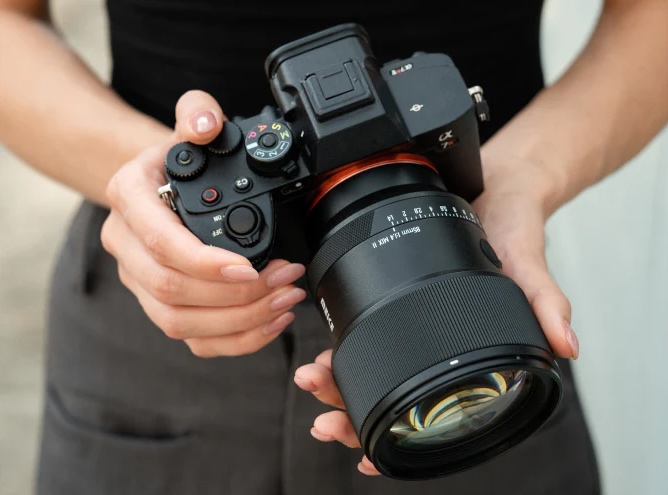
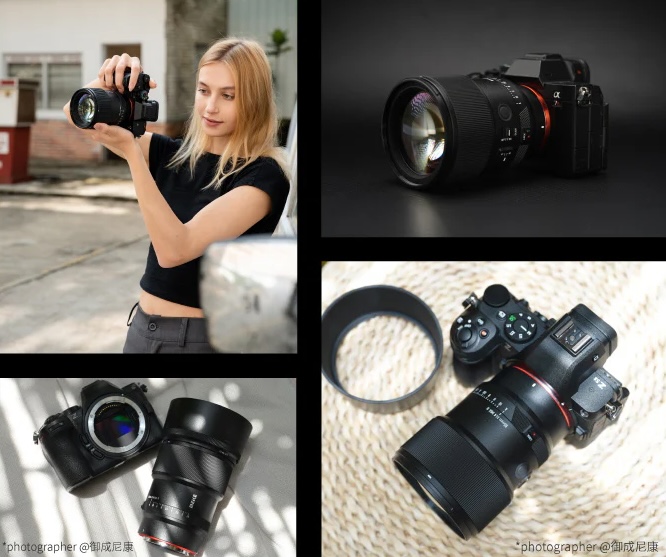
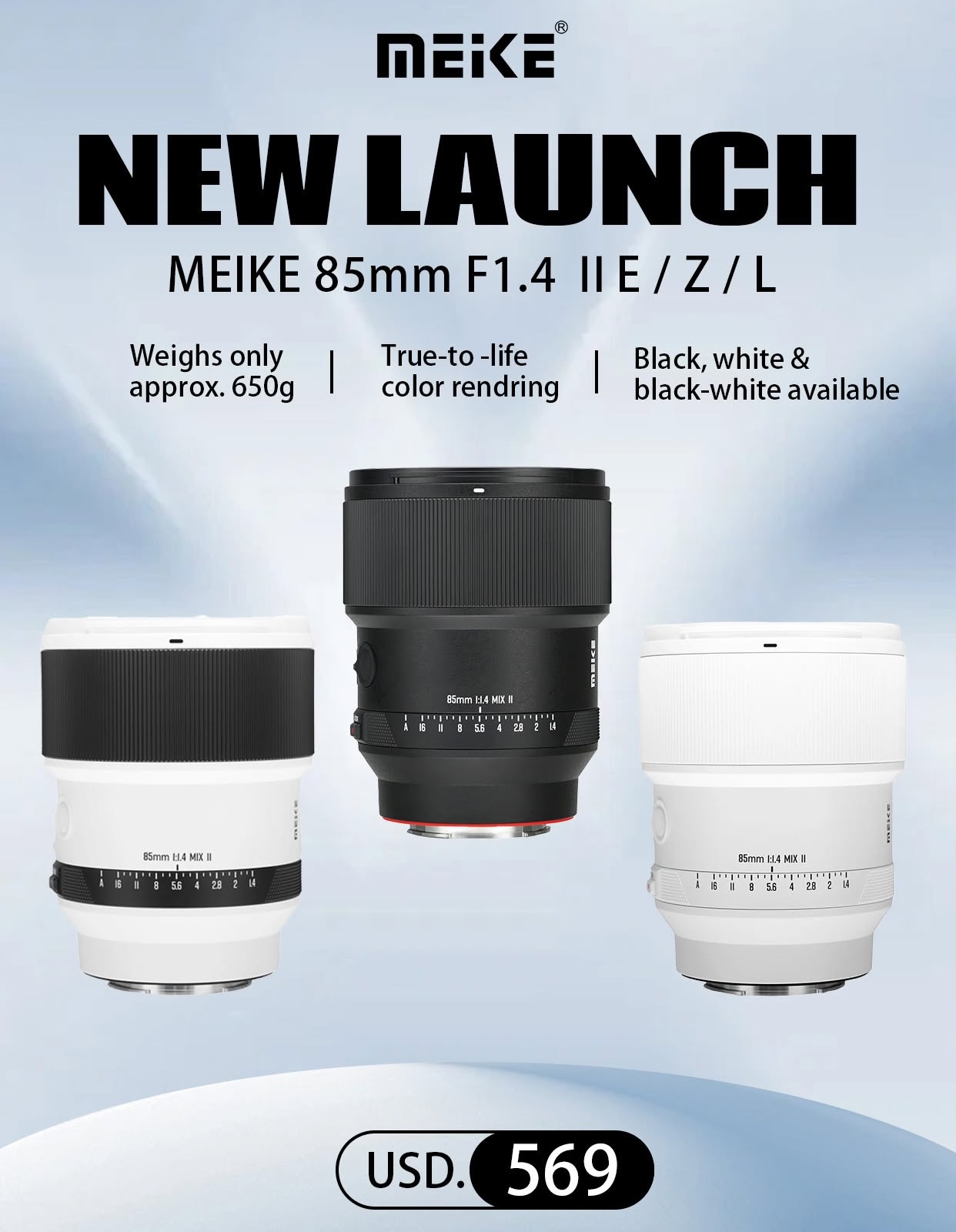
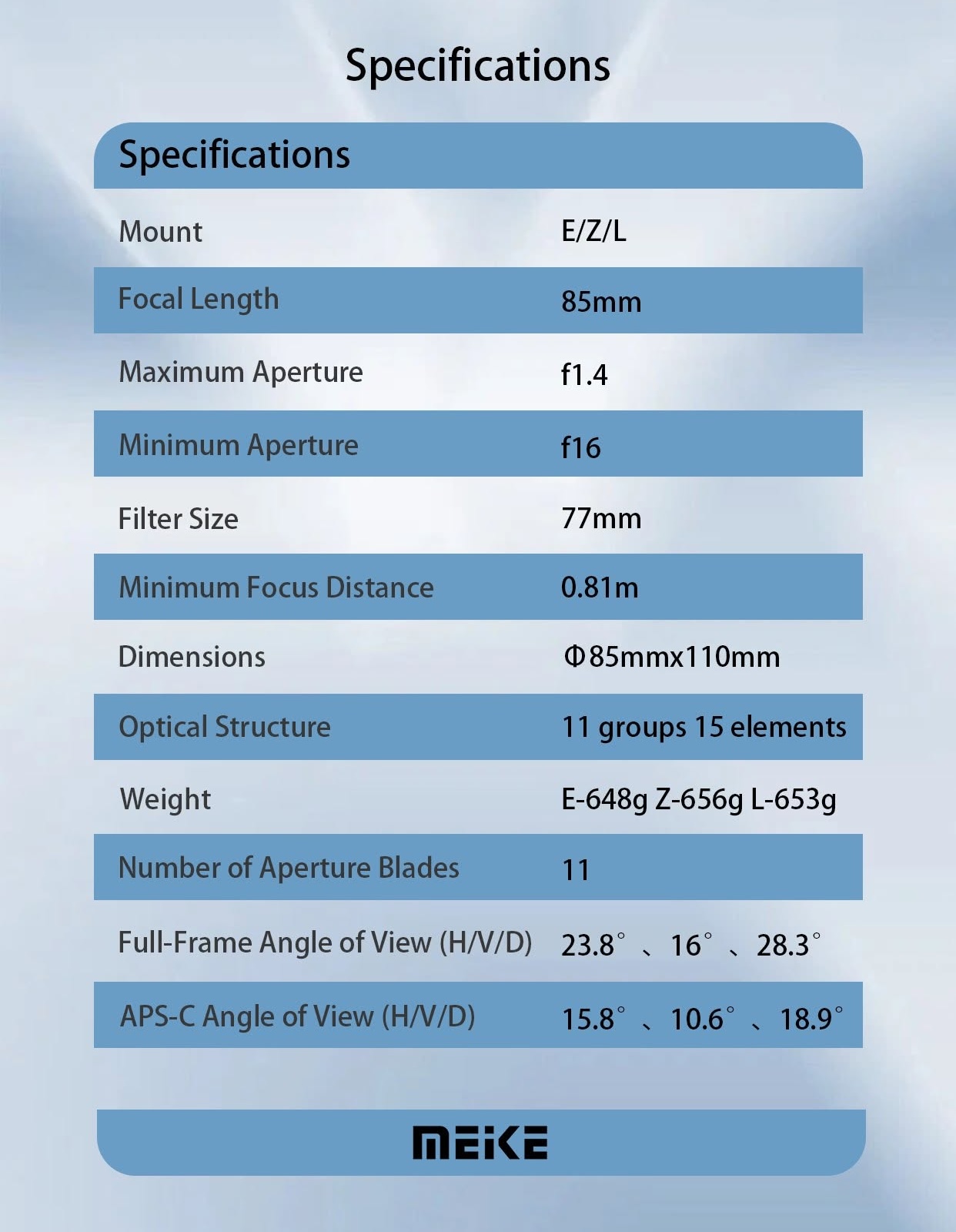
Officially launched: Meike AF 85mm f/1.4 MIX Ⅱ full-frame lens (L/E/Z)

Par : PR admin
16 juillet 2026 à 16:55


Meike officially launched the AF 85mm f/1.4 MIX Ⅱ full-frame lens for L/E/Z mount:

 
Here is the list of lens updates:

  • Sharper. Faster. Lighter.
  • 67MP Ready – Image quality capable of 10K resolution
  • APO Optics – Minimized chromatic aberration for cleaner color
  • Three Colors Available – Black, Panda, and White
  • Edge-to-Edge Sharpness – Exceptional detail across the frame
  • Hyperb STM AF – Fast, precise, and whisper-quiet autofocus
  • Lightweight Design – Only around 650g
  • Click/De-click Aperture Ring, Aperture Lock & Fn Button

The new Meike AF 85mm f/1.8 lens for GFX mount will be announced on July 20th:


The post Officially launched: Meike AF 85mm f/1.4 MIX Ⅱ full-frame lens (L/E/Z) appeared first on Photo Rumors.

The first Russian anamorphic cinema lenses

Par : PR admin
16 juillet 2026 à 15:58


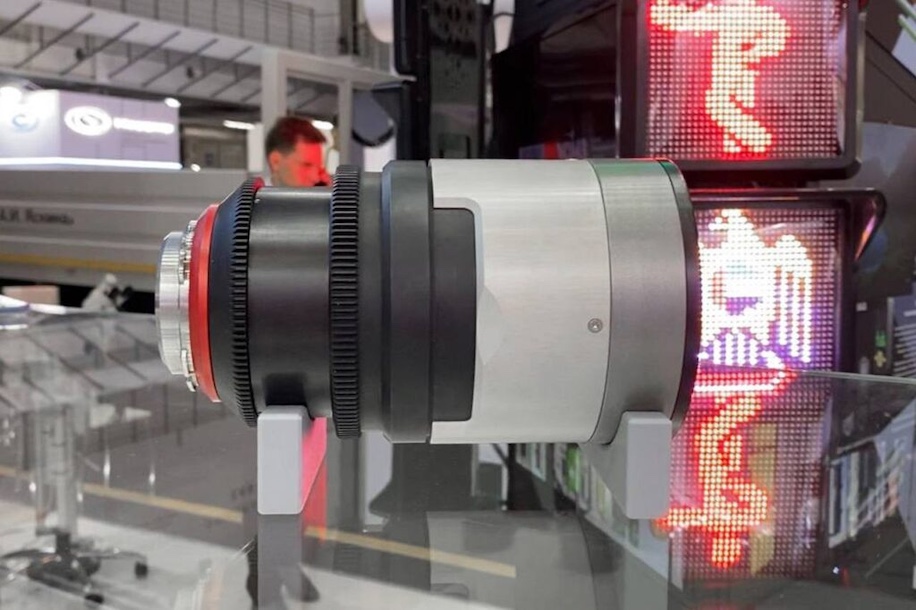
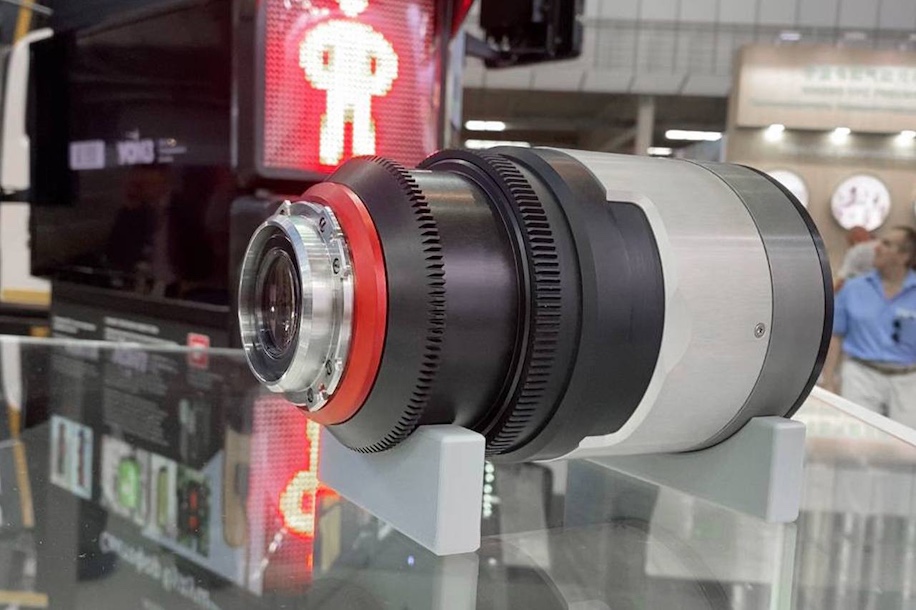
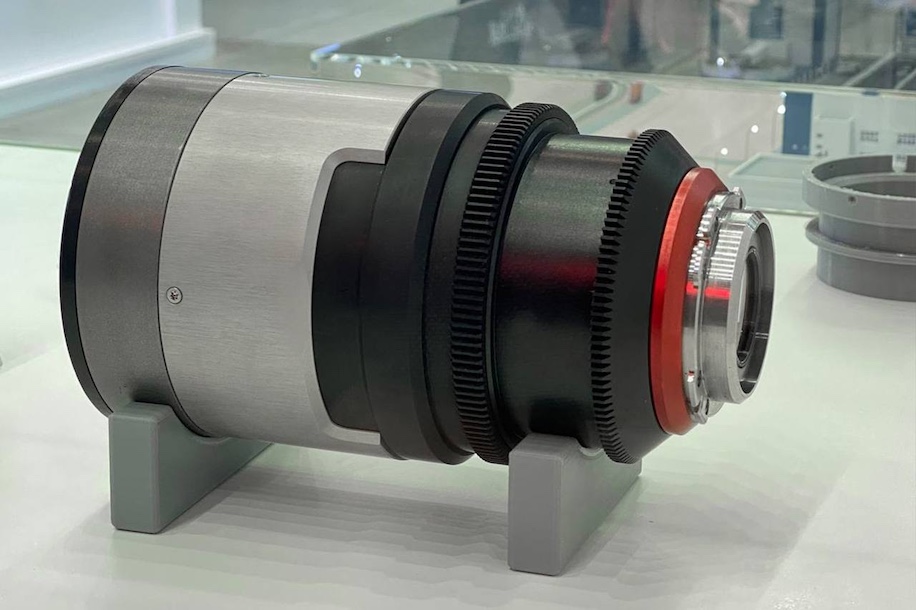
The first 80mm Russian anamorphic cinema lens (previously reported here) was recently presented by Shvabe Holding (part of Rostec State Corporation) at the Innoprom 2026 show. This marks the first time a domestically produced anamorphic film lens has reached the ready-made prototype stage in Russia. The anamorphic series, developed by the Lytkarinsky Optical Glass Plant (LZOS) within the Shvabe holding, includes four focal lengths:

  • 40mm
  • 60mm
  • 80mm (first finished model, now shown)
  • 100mm

All lenses feature a 2x anamorphic squeeze, PL mount as standard (with adapters available for other mounts), and are designed for digital cinema cameras.

Shvabe announced the first Russian anamorphic cinema lenses

Key lens highlights:

  • Ultra-wide field of view without the edge distortion and corner darkening typical of wide-angle spherical lenses.
  • Distinctive cinematic rendering, including characteristic bokeh and flares.
  • High image quality and “unique picture” that sets them apart from many foreign alternatives.
  • The front elements have an unusual concave shape – a hallmark of this optical design that enables the horizontal squeeze while preserving overall image integrity.

“The development of anamorphic lenses is an important step by a domestic manufacturer for the development of the Russian film industry. In addition to the extended horizontal frames and high image quality, they allow you to create unique cinematic effects. We will launch the film lenses into mass production next year. It is planned to produce 4 sets of products as part of the first installation batch. Test copies will appear this year. They will be available for delivery to film studios, and their cost will be lower than their foreign counterparts.” — Lev Borisov, Deputy General Director for Sales of Civilian Products at Shvabe Holding

Development Timeline & Availability

  • July 2026: 80mm ready-made model presented publicly for the first time.
  • Later in 2026: test copies are expected to become available for film studios.
  • 2027: serial/mass production launch, starting with an initial batch of 4 sets.

LZOS & Shvabe Background

Lytkarinsky Optical Glass Plant is one of Russia’s premier optical manufacturers. It is the only facility in the country capable of producing large-scale ground- and space-based mirrors used in major telescopes worldwide. The plant also produces the well-known Rubinar mirror lenses.

Previous coverage of Russian lenses is available here.

The post The first Russian anamorphic cinema lenses appeared first on Photo Rumors.

Hasselblad’s Phocus Mobile app finally arrives on Android

Since Hasselblad launched Phocus Mobile 2 in 2019, its mobile Raw editing workflow has been confined to iOS – until now.

Three smartphone screens, each showing a photo editing app interface with options for exposure, contrast, brightness, and HDR settings; all display a nighttime landscape photo being adjusted.Hasselblad / Albrecht Voss

Hasselblad launched Phocus Mobile 2 in 2019, as an iOS-only app for editing Raw files from its medium format cameras on phones and tablets. Now, the company has announced Phocus Mobile v1.0.0 for Android, finally bringing the mobile workflow to Android users with the X2D II 100C, X2D 100C and 907X + CFV 100C.

Like the iOS version, Phocus Mobile for Android includes a robust set of editing tools, including exposure, curves, white balance, sharpening, cropping, lens correction and more. It also supports batch adjustments and basic asset management with the ability to add ratings and mark favorites. Images can be imported over Wi‑Fi or, for those using the X2D II 100C (with firmware version 1.3.16.1 or later), via USB‑C. Files can then be exported as Ultra HDR JPEG, HDR TIFF, as well as standard JPEG, TIFF, HEIF or 3FR Raw.

Hasselblad says that the Android app brings its end-to-end Natural Color Solution (HNCS) to mobile, allowing for a consistent look whether editing on desktop or mobile. The app supports HDR viewing and editing for X2D II 100C files on compatible HDR devices. It also features the company’s AI-powered Raw noise reduction, which it says is tuned for its 100MP sensors. The noise reduction tool offers two modes, allowing users to prioritize either cleaner files or better micro-contrast.

There are some hardware caveats, though. The app requires an Android device with at least 12 GB of RAM and Android 12 or later. That said, Hasselblad recommends Android 16 or later and devices powered by Snapdragon 8 Gen 3 or newer for the best experience. Given that the phone needs to handle 100MB files, that shouldn’t come as much of a surprise.

Hasselblad’s Phocus Mobile for Android is now available on the Google Play Store for free.

Press release:

HASSELBLAD BRINGS PHOCUS MOBILE TO ANDROID

Phocus Mobile for Android extends the Hasselblad mobile workflow with Hasselblad Natural Colour Solution (HNCS), Hasselblad Natural Noise Reduction (HNNR), a comprehensive editing toolkit, and streamlined photo management.

GOTHENBURG, Sweden — Hasselblad is pleased to announce that Phocus Mobile V1.0.0 for Android is now available¹ for the X2D II 100C, X2D 100C and 907X & CFV 100C. Long requested by the Hasselblad community, the Android release brings the Hasselblad mobile imaging workflow to a broader community of photographers.

Phocus Mobile, the official companion app for Hasselblad medium format digital cameras, delivers the end-to-end Hasselblad Natural Colour Solution (HNCS) experience on mobile. It combines AI-powered noise reduction, a comprehensive editing toolkit, and streamlined photo preview and management into a complete mobile workflow. Android users can now review, edit, organise, and export images directly from their mobile device, allowing them to continue working wherever they are.

THE END-TO-END HNCS MOBILE EXPERIENCE

Phocus Mobile for Android brings the end-to-end Hasselblad Natural Colour Solution (HNCS) experience to Android. True-to-life colours, smooth tonal gradation, and rich highlight detail are preserved from preview through final export. Photographers can review and edit images away from the desktop, knowing the natural colour and tonal precision of their images are preserved throughout the mobile workflow.

On HDR-supported Android devices², HDR images captured with the X2D II 100C reveal the full spectrum of HNCS HDR, with intricate shadow detail, luminous highlights, and colour gradations that closely match what the eye sees. In addition to standard editing tools, the app supports precise HDR highlight adjustment, giving photographers greater control when refining high-contrast images.

HDR images captured with the X2D II 100C, as well as RAW images from the X2D II 100C, X2D 100C, and 907X & CFV 100C, can be previewed, edited, and exported in the app. HDR images can be exported as Ultra HDR JPG, while RAW images can be exported as Ultra HDR JPG or HDR TIFF.

HASSELBLAD NATURAL NOISE REDUCTION FOR HIGH ISO PHOTOGRAPHY

Hasselblad Natural Noise Reduction (HNNR) is now available in Phocus Mobile for Android.³ When shooting at high ISO settings for low-light or night photography, the AI-powered RAW noise reduction solution produces cleaner, more natural-looking images while preserving fine image detail. Calibrated and optimised for Hasselblad medium format sensors and trained on hundreds of thousands of Hasselblad images, HNNR reduces noise in 100MP RAW images in approximately 15 to 20 seconds.

Two processing modes are available. Purity Mode prioritises noise suppression for the cleanest possible result, making it ideal for most scenes. Detail Mode preserves luminance noise to better retain micro-textures and fine image detail. Both modes work seamlessly with Hasselblad Natural Colour Solution (HNCS) to preserve the signature natural colours, colour fidelity, and smooth tonal gradation in every image.

HNNR is especially beneficial for the 907X & CFV 100C, which does not feature in-body image stabilisation, expanding handheld shooting possibilities in low-light conditions.

PROFESSIONAL MOBILE EDITING AND PHOTO MANAGEMENT

Phocus Mobile for Android combines a comprehensive editing toolkit with streamlined photo preview and management. A full suite of editing tools—including exposure adjustment, curves, white balance, monochrome correction, lens correction, noise reduction, sharpening, cropping, rotation, and keystone correction—provides precise control directly from an Android device. Edit settings can also be copied and applied in batches to speed up high-volume editing workflows.

Images can be quickly imported via Wi-Fi or, for supported cameras, a wired USB-C connection.⁴ Once imported, images can be organised using star ratings and favourites for faster image selection and review before being exported in JPG, TIFF, HEIF, or 3FR RAW formats.

¹ Phocus Mobile for Android supports Android devices with at least 12 GB of RAM running Android 12 or later. For the best colour display and editing experience, Hasselblad recommends Android 16 or later and devices powered by Snapdragon 8 Gen 3 or newer. Refer to the official Hasselblad website for compatibility information

² HDR viewing and editing features require a compatible HDR-capable Android device. Refer to the official Hasselblad website for a list of recommended devices.

³ Hasselblad Natural Noise Reduction (HNNR) currently supports only devices powered by Snapdragon 8 Gen 3 or later. Refer to official website for more details.

⁴ Wired USB-C connection is only supported on X2D II 100C with firmware version 1.3.16.1 or later when using Phocus Mobile for Android.

About the Author: Abby Ferguson holds an MFA in photography and blends a fine-art background with extensive editorial and commercial experience. She built and led an in-house imaging program for a large vacation rental company and has served as an associate editor at Popular Photography. She also teaches at a local community college and serves on its Photographic Technology Program Advisory Board, sharing her knowledge and enthusiasm for the medium.

Want to stay up to date on the latest product news and releases? Add DPReview as a preferred source to ensure our independent journalism makes it to the top of your Google search results.

add as a preferred source on google

Inside Getty Images’ 2026 World Cup coverage: 10-hour days and wild fans

Getty Images staff photographer Maddie Meyer shares her touchline gear setup, rapid-fire workflow and what it’s like shooting from the middle of a celebrating crowd.

A photographer kneels beside a soccer goal on a stadium field, adjusting a camera. Other media crew members and equipment are present, with a large FIFA World Cup 2026 sign displaying "New York New Jersey" in the background.Getty Images

Getty Images photographer Maddie Meyer sets up a camera behind the goal.

After more than a month of drama, the 2026 FIFA World Cup is finally heading into its finale, with the last games set for this weekend. Over the course of the tournament, a small army of photographers has been crisscrossing stadiums to keep pace with the matches and the stories unfolding around them.

One of them is Maddie Meyer, a Getty Images staff photographer who has spent this World Cup on the touchline and in the stands, documenting everything from tunnel nerves to wild celebrations. Meyer took the time to speak with me between matches, sharing insights into what it’s like to cover such an event and how she stays on top of her game.

Finding her way

Camera held by a person standing on a metal platform overlooking a stadium; large stadium lights and a soccer field crowded with spectators are visible below.Getty Images

While Meyer was always interested in photography, she didn’t start out wanting to be a sports photographer. She grew up in Washington, D.C., playing soccer and thinking she would follow the path of Doug Mills, a prominent New York Times photographer she’d known since childhood. “I’ve known him since I was 8, and I looked up to him so much,” she said. “I remember his pictures from the Torino Olympics and thinking this might be the coolest thing I’ve ever seen.”

Meyer recognizes that having Mills to look up to early on was quite important for her path. “It was so cool to have somebody in my life so early to show me this is a job you can have,” she told me. “He was super encouraging; he said the only difference between me and you is I’ve worked hard at this for 40 more years.” Meyer kept shooting through middle and high school and went on to study photojournalism at Ohio University.

She still thought she wanted to be a White House photographer until she started working with her college athletics department and realized how much she loved traveling with teams and being outside. That led her to apply for a Getty Sport internship in New York City, which quickly felt like the right fit. “I loved the pace and the scale and the intensity of it. After I graduated from college, I got hired in Boston in 2015. I have been here ever since, and I still love it,” she said.

Managing the chaos

Two soccer players embrace; one wears a white jersey labeled BELLINGHAM with the number 5, and the other is in dark green. A trophy appears blurred in the background.
Jude Bellingham #10 of England and Erling Haaland #9 of Norway embrace in the tunnel before the FIFA World Cup 2026 Quarter Final match between Norway and England at Miami Stadium on July 11, 2026 in Miami Gardens, Florida.

Canon EOS R1 | RF 85mm F1.2 L USM | F1.2 | 1/3200 sec | ISO 4000
Maddie Meyer – FIFA/FIFA via Getty Images

At this point in her career, Meyer is no stranger to long days and constant travel, but this World Cup has been especially demanding, with matches held in 16 cities across 3 countries. Group play was the most intense stretch, with 50 Getty editorial photographers bouncing between host cities to cover 72 group‑stage matches. “We were traveling the day of sometimes, so it was like, wake up, take a flight, check into the hotel, head to the stadium,” said Meyer.

Once she’s at the venue, the workday around a single match stretches to roughly 10 hours. Meyer said that the Getty team at a game (generally two to three photographers during group play) typically arrives about five hours before kickoff. They start by setting up remote cameras behind the goals and photographing the dressing rooms. When the teams arrive, the atmosphere shifts quickly. “Some of the African teams come and actually sing down the tunnels and the hallways with drums, which is really cool,” she described. “So I love that right off the bat, sometimes you get a really interesting cultural taste right away.”

Those are some of the more genuine moments that we see of these athletes before they step out and see these tens of thousands of people

Maddie Meyer

From there, Meyer follows the team as they walk the pitch and go through their warmups, then moves into one of her favorite moments: the tunnel. “What I really like is getting access into the tunnel, where there aren’t other photographers, so to me, those are some of the more genuine moments that we see of these athletes before they step out and see these tens of thousands of people,” she said.

After the final whistle, one member of the crew typically goes out on the pitch with a steadicam. “I really love getting closer to those players, whether it’s the celebration, the dejection, it feels a little bit more intimate than using those really long lenses to photograph the action,” she said. They wrap up the day by capturing the press conferences and packing up before heading to the next city.

The long hours and frequent travel can wear anyone down, so Meyer leans on small rituals to keep herself steady. including bringing small things from home and making time for movement. She likes to bring a few comforts from home and find regularity where she can. “I love having my good-smelling soaps in the shower, little things that make me feel like I’m not just sitting in the rain in my raincoat all the time,” she explained. “I also always try to get some sort of exercise in, either walking or in the gym, just kind of moving my body, because most of the time, we’re kind of curled up in these weird positions.”

She also explained that sleep is non-negotiable. “I really believe I can do anything in the world if I have 8 hours of sleep,” she said. “I tell my colleagues, too, listen, if we’re not sleeping and we’re running between places, let’s be really gentle with each other the best we can, because we’re running on fumes sometimes.”

What goes on behind-the-scenes

Soccer player in white uniform sliding to tackle the ball from opponent in red uniform on grass field, with a crowd in the background.
Desire Doue #20 of France competes for the ball against Marcus Holmgren Pedersen #16 of Norway during the FIFA World Cup 2026 Group I match between Norway and France at Boston Stadium on June 26, 2026 in Foxborough, Massachusetts.

Canon EOS R1 | RF 400mm F2.8 L IS USM | F2.8 | 1/3800 sec | ISO 640
Maddie Meyer – FIFA/FIFA via Getty Images

Meyer and her teammates certainly have their hands full during an event. She told me that she typically has four cameras in action during World Cup matches: one remote camera behind the goal, and three on her. She usually fits those handheld cameras with a 400mm lens, a 70-200mm, and, depending on her placement, something wide-angle to catch close action. Across the team, there are multiple remotes behind each net, all positioned to cover key moments around the goals.

Before kickoff, Meyer sets up the remote camera’s exposure and focus, making sure it’s ready for action near the net. She explained that the remote cameras behind the goals are hardwired, as there’s far too much interference to rely on wireless connections during matches. It is still manually triggered, either by remote editors or by someone nearby using a foot pedal.

From the opening match on June 11 to the final on July 19, the Getty Images team will have shot more than 2.6 million images. Thankfully, the photographers aren’t working alone. The Getty Images FIFA World Cup team consists of 115 people, including 20 editors in New York who help oversee operations and are ready to receive images as they come in.

They can have photos ready within 30 seconds of capture, often before television replays are available.

“They have a diagram of where everybody is. So after a goal is scored, they’ll say, ‘Oh, that’s in Maddie’s corner, take a look at what she’s sending us.’ So they’re able to prioritize whose work they want to look at to get those pictures out quickest,” Meyer explained. She works under a “tag and send workflow,” meaning she looks through and sends pictures that she wants the editors to see, often within seconds of something happening.

The remote cameras are handled differently. Those are set to send all of the images to New York as soon as the cameras fire. Once the editors have the photos, they crop, tone, caption and send the pictures out for use. A Getty Images representative told me that they can have photos ready within 30 seconds of capture, often before television replays are available.

Meyer explained that the current process is vastly improved from when she first started. “In 2015, I photographed the Women’s World Cup, and it was self-edit, so I had my laptop out on the sideline, and it was super challenging,” she explained. “Versus now, it’s just such a win for everybody. The editing team does a way better job than me out in the sun, squinting into my laptop. And also, I’m able to shoot more and really focus on the game.”

Staying prepared

Soccer player in a white jersey labeled KANE 9 kneeling on grass with head lowered and hands on the ground during a match.
Harry Kane #9 of England celebrates after the 2-1 victory during the FIFA World Cup 2026 Quarter Final match between Norway and England at Miami Stadium on July 11, 2026 in Miami Gardens, Florida.

Canon EOS R1 | RF 400mm F2.8 L IS USM | F2.8 | 1/2000 sec | ISO 2500
Maddie Meyer – FIFA/FIFA via Getty Images

With so much happening around each match, Meyer tries to go in as prepared as possible. “I think it’s always great to understand the key players and some of the storylines,” she said, noting that her European colleagues have been especially helpful since they see many of these players regularly and can flag people to keep an eye on.

More than scouting, though, Meyer focuses on her particular location for the match. “We’re assigned where we’re shooting, and so I really think about the backgrounds, how the game is gonna kinda flow,” she said. She went on to explain that she’s also very intentional about which moments are hers to photograph, versus ones that are better for her colleagues to capture. “I really think this is my little piece of the pie, this portion of the field,” Meyer said. “I’m gonna really think about what lenses show off what’s going on here.”

I always think, what would I tell her about today? What makes this different? What makes this interesting?

Maddie Meyer

Meyer said she also thinks about her mom a lot when photographing. “She’s a big Maddie fan, but not a big sports fan,” she said. “And I always think, what would I tell her about today? What makes this different? What makes this interesting? What makes this special?” She uses that mindset to make sure she’s telling the bigger story, making it interesting for more than just die-hard soccer fans.

Another challenge Meyer faces is making her pictures feel distinctive. “Sometimes the photos do end up looking the same as the person sitting next to you,” she explained. “I try to think about lens choices – can I shoot really wide to show atmosphere? Tight to show details or faces? A very shallow depth of field to highlight the action? That can be where the difference comes into play when our position can’t be unique.”

A favorite moment on the world stage

Crowded stadium with fans cheering and waving flags during a soccer match, many in Argentina jerseys showing visible excitement and celebration.
Argentina fans celebrate after the 3-2 victory during the FIFA World Cup 2026 Round of 16 match between Argentina and Egypt at Atlanta Stadium on July 07, 2026 in Atlanta, Georgia.

Canon EOS R1 | RF 15-35mm F2.8 L IS USM | 19mm | F2.8 | 1/1600 sec | ISO 3200
Maddie Meyer – FIFA/FIFA via Getty Images

As the 2026 World Cup nears its end, Meyer doesn’t hesitate when asked about a favorite moment from the tournament: the Egypt–Argentina match. She was roaming rather than in an assigned spot on the touchline, which she said presents a fun challenge, since she can go anywhere and doesn’t have set compositions and backgrounds in mind as she does otherwise.

There had been lots of back and forth, but Egypt was up towards the end. She got a message saying they would have access to the Egypt locker room, asking whether she would go in with them if they won. “I was like, okay, do I leave before the match is over to wait outside their locker room, or do I stay up a little bit longer?” she recalled. Then, Argentina scored, and she decided to go with the Argentina fans and figure out how to get to the locker room later if she had to.

“The Argentina fans are incredible,” she said. “These people are so passionate. They travel so well. They have the instruments. They’re just out of their minds in the best way that you want to see.” She also told me that she loves how much they want everyone involved, and they are not shy about having a photographer in their midst.

What I think is so fun about the World Cup is just how passionate these people are.

Maddie Meyer

“They ended up winning, crying, shirts off, screaming, and I have all these pictures with a 15mm, and all these people, it’s like, babies, old men, young people, and that was super memorable to me, of just kind of being in that chaos,” she said. “Being on the pitch, it feels pretty high pressure as a photographer, but up there, I was like, I’m in this. And they’re like, ‘Get in here, sister!’ I’m like, okay, I’m not celebrating. I’m gonna photograph you celebrating. One of the guys took my phone and was like, ‘I’m taking pictures of you!’ It was just, like, the rails have come off up here.”

For Meyer, that moment captures a lot of what makes the World Cup special. “What I think is so fun about the World Cup is just how passionate these people are, and getting to be maybe a little bit too close to them even was great,” she told me.

Beyond the World Cup: why the small games matter

Soccer match underway on a green field inside a packed stadium, surrounded by fans. Large overhead screens show live footage, and bright lights illuminate the pitch beneath a partially transparent dome roof.
A general view of kick off during the FIFA World Cup 2026 Round of 16 match between Argentina and Egypt at Atlanta Stadium on July 07, 2026 in Atlanta, Georgia.

Canon EOS R1 | RF 15-35mm F2.8 L IS USM | 16mm | F4.5 | 1/1250 sec | ISO 2500
Maddie Meyer – FIFA/FIFA via Getty Images

While Meyer is photographing on the big stage these days, she is quick to stress that professional events aren’t the end-all, be-all. “Even though I love being at the World Cup, it’s not all about the World Cup,” she said. “There’s so much joy, and sometimes, frankly, better pictures in the smaller events, in the high school, in the college, in the MLS, NWSL, all those types of things.”

It’s a good reminder that although big events like this get most of the spotlight, smaller events are important, too. “As much as I love it, and I love talking about it, I never want people to leave talking with me, thinking it’s this or nothing, because there’s a picture to be made at every single level,” Meyer said.

You can see more of Meyer’s work on her Instagram or through Getty Images.

About the Author: Abby Ferguson holds an MFA in photography and blends a fine-art background with extensive editorial and commercial experience. She built and led an in-house imaging program for a large vacation rental company and has served as an associate editor at Popular Photography. She also teaches at a local community college and serves on its Photographic Technology Program Advisory Board, sharing her knowledge and enthusiasm for the medium.

Want to stay up to date on the latest product news and releases? Add DPReview as a preferred source to ensure our independent journalism makes it to the top of your Google search results.

add as a preferred source on google

Max Lowe shares the experiences that shaped his adventure photography and filmmaking

Max Lowe is a filmmaker, photographer and storyteller. Recipient of a National Geographic Young Explorer’s grant, Max’s work ranges from wildlife filmmaking to personal, human-centered stories.

Person in winter clothing holding a camera, standing in a bright, snowy landscape with clear sky; their shadow is cast on the ground.Max Lowe

This is the story of Max Lowe, a filmmaker, photographer and storyteller based in Bozeman, Montana. Recipient of a National Geographic Young Explorer’s grant early in his career, Max’s work ranges from wildlife filmmaking to deeply personal, human-centered stories. In our conversation, he spoke about learning photography through trial and error, discovering magical places around the world and finding serendipity and inspiration in his own backyard.

Our ‘What’s in your bag?’ community spotlight series features readers sharing their favorite gear and photography, including from past DPReview collaborators such as Max.

Meet Max Lowe

Outdoor gear-clad figure views a monitor showing a landscape scene, with camera equipment positioned in front inside a camouflaged tent or hide.
Nikon Z6 | AF-S Nikkor 35mm F1.4G | F3.5 | 1/500s | ISO 1250
Max Lowe

Photography became a way for Max to engage more deeply at home in Bozeman, Montana, eventually leading to a career spanning National Geographic Expeditions, documentary filmmaking and editorial photography. While he has photographed hundreds of places around the world, he says one of his biggest creative challenges remains capturing the essence of his hometown.

“I’ve never been able to truly capture the essence of the way I love Montana. It’s a place where people put their own interpretations. It’s a place I want to keep finding new ways to illustrate to the world, because it holds that depth and importance to me as my home.”

Max’s parents were a major influence in starting his photography career. “I grew up with a mountaineer for a father, and my mom was an artist. At some point, my mom gave me one of her old cameras. Both my mom and dad made it in the world in different artistic ways. Because of that, I felt I needed to find an artistic path for myself, and photography became that for me. Photography has this magical way of making you feel like you belong somewhere you otherwise might not.”

Career and projects

Two hikers on a rocky mountain slope with jagged peaks in the background and a hazy valley below, beneath a bright sky.
Nikon D750 | AF-S Nikkor 24-70mm F2.8G ED @ 36mm | F2.8 | 1/4000s | ISO 200
Max Lowe

One of the most significant turning points in Max’s career came in 2012, when he received a National Geographic’s Young Explorers Grant. That opportunity led to trips with National Geographic Expeditions that continue to this day, and the grant community introduced Max to many of the photographers, filmmakers and storytellers who helped shape the work you see in this article.

“In the earlier years of my work as a full-time photographer and filmmaker, I had more personal ambition to just go places for the sake of going, in the selfish sense. At this point, I’m more compelled to travel because I can get a unique lens on the world – pun intended. There are really cool photography-focused trips that many companies put on, but National Geographic Expeditions goes to some rather remarkable places. I’ve been lucky to make many friends within the National Geographic scene, fellow photographers I look up to and reach out to for collaboration. That camaraderie is what really makes it special.”

Max’s documentary work

Two people sit closely together on a couch, facing the camera with relaxed expressions. The background is softly lit and features several indistinct objects out of focus.
Max Lowe and his wife, Lia
Jack Fox

One of Max’s current projects is The Kind Ones, a documentary he’s producing with his wife, Lia. They spent eight weeks at a rural hospital on the North Carolina coast, where Lia worked as a travel nurse while Max documented patients, nurses and moments of care. He described the careful balance between telling meaningful stories and respecting the people involved.

“During the pandemic, everyone rallied around healthcare workers, but in the years since, these tremendous workers just fell back to where they’d been before. After the pandemic, Lia was at a low point in her career. She wanted to talk about the fact that the humans within the healthcare system are often disregarded as a major component of how we function as a healthy society.”

A person in black scrubs stands by a hospital bed with a stethoscope and badge, surrounded by medical equipment and posters in a clinical room.
Max Lowe’s wife, Lia Lowe, while shooting his documentary The Kind Ones in North Carolina.
Max Lowe

“We were filming with her every day, capturing beautiful and often difficult moments with patients. Her portrayal of the value nurses bring, not only in the medical care they render, but in the human care and appreciation for life in its most complicated moments. The project is a challenge: working together in a nuanced way to think about what to photograph, and especially what not to.”

Kind Ones is scheduled for release in late 2026. If you’re interested in Max’s other film works, including the acclaimed feature doc detailing his own family story, “Torn” (2021), the Oscar Shortlisted “Camp Courage” (2023) and more.

What’s in Max’s bag

Black backpack with camera equipment—cameras, lenses, lens filters, a tripod, cables, and a microphone—neatly organized on a tiled floor.
Max Lowe’s camera bag
Max Lowe

Max’s approach to equipment depends heavily on the project, though when it’s a personal endeavor, he has some go-to favorites.

Max’s go-to gear:

Lenses:

Favorite camera: When traveling on his own, Max prefers simplicity. One of his favorites is a Rolleiflex 4×4 medium-format film camera, which he uses regularly for personal projects. “I still shoot quite a bit of film, mostly for my own interests. The Rolleiflex is a bit complicated to use. I’ve failed to properly expose images plenty of times. Unlike modern digital cameras, it offers little immediate feedback. Sometimes you shoot a frame you think will be great, only to blow the exposure or end up with a blurry image.”

Small cabin on a green hill, surrounded by trees, overlooking a valley and distant mountains with sunlight shining through a partly cloudy sky.
Montana mountains
Max Lowe

Max has found hidden benefits in the challenges of shooting film. “There’s something cool about photography being this format in which we can learn to fail and do better in small, incremental ways. You’re really forced to learn about ISO, shutter speed, aperture and all the other functions of a camera.”

Still, the camera Max uses most often is the one already in his pocket, an iPhone 16 Pro Max. “Probably the camera I use most is my phone, honestly.” Rather than focusing on gear for its own sake, he emphasized carrying equipment that lets him remain present with people and stories while staying ready when meaningful moments arise.

Photography ethics

Person in traditional clothing with a red cap walks along a narrow woodland path beside a shallow stream on Croatia’s Dalmatian coast.
Croatia Dalmatian Coast forest path

Canon EOS 5D Mark IV | Canon EF 35mm F1.4L II USM | F1.4 | 1/400s | ISO 320
Max Lowe

Throughout our conversation, Max returned to the idea that storytelling requires trust, context and respect. He believes photographers should continually ask themselves why they’re taking an image and who ultimately benefits from it.

“Trust is paramount in our work, especially when we’re working with other people. If it’s someone sitting alone on a subway platform crying, I probably wouldn’t shoot a photo of that, because it would feel exploitative. But if you go up to the person, ask them what’s wrong, hear their story and get a little more insight into what they’re experiencing, and then ask if you can shoot a photo of them in that moment. You’re going to get a more compelling image that way.”

Person standing on a narrow stone pier above choppy blue water below a cliffside fortress and seaside buildings on Croatia’s Dalmatian coast.
Dalmatian Coast

Canon EOS 5D Mark IV | Canon EF 16-35mm F4L IS USM @ 16mm | F5 | 1/125s | ISO 100
Max Lowe

Max also stressed the importance of building relationships and understanding stories before documenting them. “If I’m going to, say, Egypt as a storyteller, I want to find an in – someone who knows the place in a unique way, and within that, a unique story that defines the place and my experience there. When you’re invited by someone who calls a place home, the experience is much richer. Finding someone like that is a tremendous gift that deepens a photographer’s interpretation and understanding of the world.”

Some of Max’s film projects have required him to revisit a scene, and he found that the assumptions he made on a first pass often missed its real context, whether because he was distracted or because his own priorities got in the way.

“Understanding the context of the scene is a major necessity for an artist. Ask yourself: why are you taking that photo? Is it for the benefit of those people? If you’re a photojournalist capturing the story of refugees fleeing the war in Ukraine so that the world can understand that pain, does your work have the power to change things for the better?”

Curiosity and flexibility

A white cat naps curled over the wheel well of a parked white truck, resting on the tire in a sunlit Italian street.
Cat in Italy sleeping on a tire.
Max Lowe

Max’s work is also heavily tied together by curiosity and a willingness to adapt to whatever story unfolds before him. Opportunities will come up to take that perfect shot, and one mustn’t hesitate for long to take it. One such image that surprised him in its success came from an ordinary moment in Italy. “It was just a photo of a cat sleeping on the tire of a Land Cruiser. I snapped it in passing – it was something I saw and was like, ‘Oh, that’s cute.'”

The image was made with a simple point-and-shoot 35mm film camera, and the reaction wildly exceeded his expectations. “It got this massive response on social media and ended up winning an honorable mention in a photo contest called ‘Flow.'”

White owl in flight over a grassy tundra while another white owl shelters its chicks on the ground under a gray sky.
Snowy Owls photographed for Frozen Planet 2 documentary.

Nikon D850 | Nikon AF-S NIKKOR 200-500mm F5.6E ED VR @ 500mm | F5.6 | 1/1250 sec | ISO 640
Max Lowe

Max’s wildlife filmmaking has presented very different challenges. While working on a Frozen Planet II segment about snowy owls near Utqiagvik, Alaska, he ran into an unexpected obstacle. “It gets surprisingly hot because the sun is up around the clock in summer, and that heat rising off the tundra creates these distortions,” Max told us. “Atmospheric distortion made long-lens footage unusable. We ended up having to switch our whole approach on the spot, because the conditions meant the gear we’d brought just didn’t work. Camera traps certainly would have helped, but we didn’t think we’d need them when we planned the trip.”

The experience reinforced one of his recurring lessons: adaptation and flexible expectations matter more than rigid planning.

Max’s advice for photographers

Red bush plane flies over a sprawling glacier winding through rugged snow-covered mountains under a bright blue sky.Max Lowe

As I was listening to Max’s stories and adventures, there were countless gems of advice sprinkled throughout. To close out this story about Max, I wanted to list a couple of final pieces of advice that didn’t fit in the stories he told above. I hope they help you improve your photography as much as they got me thinking about mine.

The moment dictates the shot

“Many visual artists approach their work by thinking about a specific shot they want, such as a bear emerging from its den, or whatever it might be. But I approach all my work in a more freeform, creative way, whether that’s photography or filmmaking. You want to allow leeway for the experience to give you the story, instead of putting pressure on yourself to seek something out and setting yourself up for failure.”

You want to allow leeway for the experience to give you the story, instead of putting pressure on yourself to seek something out and setting yourself up for failure.

“It can be scary to step out of your comfort zone and into someone else’s world, but it leads to much richer experiences for both you and your audience. It’s not that you should never go anywhere without a plan, just make sure you stay open to that depth when it presents itself.”

mall bird with a bright yellow body and orange-red head perched on a weathered wooden branch against a dark, softly blurred background.
Nikon D750 | AF-S Nikkor 24-70mm F2.8G ED | 36mm | F2.8 | 1/4000s | ISO 200
Max Lowe

Don’t ignore what’s in front of you

“It’s a mistake a lot of artists make – not seeing the value in what exists right in front of them. I’m constantly looking at the world around me, at how unique little moments occur without anyone conjuring them up. One day, I was in my office when a Western Tanager landed on a branch outside the window. Tanagers are these beautiful yellow-red birds that migrate through Montana every spring. It was such a cool moment, and I wanted to hold it forever. Find those moments and hold them forever through your photography.”

You can check out Max’s other work at maxlowemedia.com.


Editor’s note: This article continues a series, ‘What’s in your bag?’, highlighting DPReview community members, their photography and the gear they depend on. Would you like your photography to be featured? Tell us about it by filling out this form . If you’re selected for a feature, we’ll be in touch with next steps.

About the Author: Mathew Anderson is a proud Community Manager for the technology industry and a past visitor to DPReview.com for all his camera needs. He is currently the lead of DPReview’s community and primary communication link between the community and DPReview’s team.

Want to stay up to date on the latest product news and releases? Add DPReview as a preferred source to ensure our independent journalism makes it to the top of your Google search results.

add as a preferred source on google

The photos that made photographers fall in love with their new camera

Last week, we asked our readers what photos made them realize their new gear was worth it. Here is what they showed us.

Lion staring at ants across a pane of glassEuropean-Z8

Buying a new camera is an exciting feeling, but so is seeing the great photos you take with it. For last week’s community question, we asked readers to share a favorite photo or story from their new gear. From majestic animals to intense bokeh scenes, and from antique cameras to modern mobile phones, the responses covered a wide range of interesting categories.

As always, there was also a mix of useful tips you’ll want to read about.

Here are some of the photos and stories they shared. Click their names to see more within the forum conversation.

“Two experiences. The first was the first dance concert I shot with the Olympus 40-150mm F2.8 PRO. I was more than happy to do this with ‘smaller’ (relatively speaking) gear than full-frame gear. Second was the first time I did portrait shots for posters, of dancers, in full costume, with two flash units, umbrella reflectors, etc. Those first-time experiences are always sweet, no matter how many times I do it afterward.” – Satyaa

“Last Christmas, I managed a photo which I had waited literally years to take. It’s usually impossible to take a photo of the center of the Octagon at Ely Cathedral from below because there’s normally a modern oak altar in the way. I had gone to the cathedral to try out my new Hasselblad X2D II with a 20-35mm lens. Lo and behold, a team of workmen was preparing the central area for some school carol concerts. The altar had been removed. One nod of approval later and I was in!” – ClaireJRedHat

Large snapping turtle with a rough, dark shell and thick limbs resting on a textured log beside a pond, surrounded by green leaves in sunlight.
Nikon Z8 | Nikkor Z 100-400mm F4.5-5.6 VR S | 210mm | F5 | 1/750s | ISO 12800
PhillipKukelhan

“Since moving to Cleveland 5 years ago, I’ve spent a lot of time riding my bicycle along the old Ohio & Erie Canal, where I see a lot of wildlife, mostly deer, snakes, bird life, and turtles.” – PhillipKukelhan

“Two years ago, I decided to upgrade a Canon 40D 12mp with the used X-T4. After having the camera a couple of months, I had a vacation to Japan scheduled. My intention was to buy an array of lenses while I was there. I put one of them to use the very night I purchased it. Because of the low-light conditions and fast-moving moments, I realized from those photos what a great purchase my X-T4 and Sigma 10-18mm F2.8 were. Personally, there isn’t a better feeling than successfully capturing these moments.” – ronphoto

“As a second-generation photographer, I grew up using Canon, and most of my gear was handed down from my father. Around 2014/2015, I was tired of using cast-offs and older generation equipment, so I set out to purchase my own gear and explore other systems. I had already picked up an A6000 (or A6300) as a secondary camera to my 1D Mark II, but when Sony released the A7RII, I decided to rent it for a big annual job.” – reflux83

Individual in a yellow shirt adjusts electronic equipment with visible wires and a small microphone, under blue and purple lighting; “Peter Leyssens photography” text appears in the corner.
Fujifilm X-S20 | Fujinon XF 56mm F1.2 R WR | 56mm | F1.2 | 1/170 sec | ISO 6400
Minolta TC-1

“I decided to get the XF 56mm F1.2 WR because the image quality is so good that it compensates for the fact that it’s just really rather big on my X-E5. Well, when I started using it at the next concert, this is the kind of thing that really convinced me it was money well spent. It was even a bit emotional – taking me back 20+ years to when I finally bit the bullet, bought that Zuiko 90mm F2 and got my first photos back. Just one example says enough.” – Minolta TC-1

“Having introduced Eye Control AF (ECAF) with the second camera in the RF series, Canon made it an upgrade I couldn’t pass up. I always believed ECAF had the potential to significantly improve my photography, and I wasn’t wrong. The feature is particularly valuable with lenses such as the Canon RF 28–70mm F2 L USM, whose large and heavy glass elements require more time to focus. By allowing you to direct the AF system immediately to the intended subject, Eye Control AF reduces unnecessary focus hunting and helps the lens lock focus more efficiently, without wasted tries.” – PhotoKhan

“It wasn’t one image so much as hundreds that assured me my stabilized AF telephoto macro lens was a great investment for the online store.” – Jefenator

A figure in ornate, vintage-inspired clothing holds a red fan beside a table displaying flowers, cakes, and snacks; the setting features warm lighting and large paper decorations for a celebratory ambiance.
Canon EOS R5 Mark II | Canon RF 24-70mm F2.8 L IS USM | 37mm | F3.5 | 1/80 sec | ISO 4000
Invisible Man Potography

“I realized I made a great decision in upgrading from a Canon R6 Mark II to a Canon R5 Mark II when I reviewed my files from the June 26, 2026, 20th Anniversary of fashion designer Diego Cerón’s ‘Couture a Table’ in Mérida, México. Standing outside the room, I photographed Pablo Mercader Duch – performing as ElHada Frozen and embodying Marie Antoinette – through the crowd. In that moment, I made the artistic decision to allow the people to form a natural frame around Pablo.” – Invisible Man Photography

So many other stories we couldn’t fit in this article are shared in the forums. Thanks to everyone who took the time to submit a favorite photo from their first new camera purchase.

Feel free to participate in the series at any time. New questions are posted here on the homepage and in the forums every other week We can’t wait to read your stories and see your photography!

About the Author: Mathew Anderson is a proud Community Manager for the technology industry and a past visitor to DPReview.com for all his camera needs. He is currently the lead of DPReview’s community and primary communication link between the community and DPReview’s team.

Want to stay up to date on the latest product news and releases? Add DPReview as a preferred source to ensure our independent journalism makes it to the top of your Google search results.

add as a preferred source on google

Viltrox adds a pocketable wide-angle lens to its Evo series

The Viltrox AF 26mm F2.8 Evo is the smallest offering in the Evo lineup yet.

Nikon mirrorless camera and lens held in both hands, blue top visible in background, close-up detail on camera body and lens.Viltrox

Viltrox has expanded its mid-tier lineup with the AF 26mm F2.8 Evo, a new pancake prime. As the smallest Evo offering yet, it continues the series’ focus on durable build quality and external controls, positioning itself as an everyday carry option for street and travel photographers.

The AF 26mm F2.8 Evo is made for full-frame E and Z mount cameras. As a pancake lens, it’s highly compact and lightweight, measuring just 24mm (0.9″) thick and weighing only 130 g (4.6 oz). Despite its diminutive size, it still offers useful controls. That includes a clicking aperture ring, though there is no toggle to de-click it. There’s also a separate focus ring for manual focus.

Viltrox AF 26mm F2.8 Z camera lens in close-up, featuring a black metal finish, visible aperture ring with marked f-stops, and a red Evo label; set against a dark background.
The lens features two narrow control rings: one for aperture and one for focus.
Viltrox

The lens uses an optical design of eight elements in six groups, including two aspherical elements and one high-refractive index (HR) element. Viltrox promises good sharpness even with the aperture wide open, and says that in-camera corrections minimize distortion. It uses a seven-blade aperture diaphragm.

The new lens uses an STM autofocus motor. It can focus as close as 0.2m (7.8″), enabling close-up shots in addition to broad views. A machined metal barrel offers greater durability, and it is dust- and splash-resistant around the lens mount. The lens is compatible with 43mm filters, as long as you use the included lens hood, and it uses a magnetic front lens cap. A USB-C port enables firmware updates.

The Viltrox AF 26mm F2.8 Evo is available today for E and Z mounts for $299.

Press release:

Viltrox Launches Ultra-Compact AF 26mm F2.8 EVO Pancake Lens

Durable, Full-Frame E/Z Mount Lens with Dual Control Rings Designed for the Portability Needs of Everyday Photography

Shenzhen, China, July 15, 2026 — Viltrox today announced the launch of its AF 26mm F2.8 EVO, a compact full-frame autofocus pancake lens designed for everyday carry and photography. Well suited to street photography, architecture, environmental portraits, travel, and visual storytelling, the AF 26mm F2.8 EVO is an ideal companion for creators who value great portability, dependable image quality, and intuitive handling in a lightweight full-frame system.

Durable, Ultra-Compact, With Intuitive Control

The AF 26mm F2.8 EVO is an ultra-compact lens that pairs naturally with today’s lightweight full-frame mirrorless cameras. Available for Sony E and Nikon Z mounts, this pancake lens features both a dedicated aperture ring and a separate focus ring, providing tactile manual control that is rarely found in this category.

Its precision-machined metal construction provides durability and a premium feel, while dust and splash resistance around the lens mount enhances reliability during everyday use, matching its portability to make it an ideal companion for travel and spontaneous photography.

An Excellent Perspective at Any Distance

A gear-type STM autofocus motor delivers precise and reliable autofocus performance. With a minimum focusing distance of just 0.2m, the AF 26mm F2.8 EVO allows photographers to transition seamlessly from expansive landscapes to expressive close-up compositions. With an 81.2° angle of view, the 26mm focal length sits naturally between traditional wide-angle perspectives, delivering an immersive yet natural field of view that adapts effortlessly to a broad range of subjects and shooting scenarios.

Carefully Crafted for Impressive Image Quality

Compact in size yet impressive in performance, the AF 26mm F2.8 EVO features an optical design of 8 elements in 6 groups, including 2 aspherical elements and 1 high-refractive (HR) element. The lens delivers excellent sharpness even at its maximum aperture of F2.8, allowing confident wide-open shooting. In-camera correction further helps produce natural rendering with minimal visible distortion for balanced, high-quality results.

Convenient Functionality

A magnetic front lens cap enables conveniently quick attachment and removal. A standard 43mm filter thread, a built-in USB-C port for firmware updates, and compatibility with the Viltrox Lens App further enhance the user experience, combining everyday convenience with long-term usability.

Pricing and Availability

The Viltrox AF 26mm F2.8 EVO is available for 299USD / 319EUR / 279GBP

The lens will be available from these global stores:
Viltrox Official: https://bit.ly/4vljl0i
Amazon Store US:https://www.amazon.com/dp/B0H334F7XG
Amazon Store Europe:https://www.amazon.de/dp/B0H334F7XG

About the Author: Abby Ferguson holds an MFA in photography and blends a fine-art background with extensive editorial and commercial experience. She built and led an in-house imaging program for a large vacation rental company and has served as an associate editor at Popular Photography. She also teaches at a local community college and serves on its Photographic Technology Program Advisory Board, sharing her knowledge and enthusiasm for the medium.

Want to stay up to date on the latest product news and releases? Add DPReview as a preferred source to ensure our independent journalism makes it to the top of your Google search results.

add as a preferred source on google

Fujifilm announces firmware roadmap for GFX Eterna

Firmware v1.1 for medium format cinema camera arrives today, with further updates over the coming year

FUJIFILM Eterna 55 with its sensor showingFujifilm / Timur Civan

Fujifilm has released updated firmware for its GFX Eterna 55 medium format cinema camera, and set out a roadmap of additional updates that will follow over the next year.

Firmware v1.1 promises improved stability and usability but future updates include support for desqueezed previews of additional anamorphic lens ratios, improved SDI and HMDI latency, with LANC control and variable electronic ND arriving later.

Press release:

Fujifilm Announces Firmware Roadmap for FUJIFILM GFX ETERNA 55 Filmmaking Camera

Enhanced usability and operability that expands the possibilities of creative work

TOKYO – July 15, 2026 – FUJIFILM Corporation today announces a firmware roadmap designed to further expand the applications of the “FUJIFILM GFX ETERNA 55” (GFX ETERNA 55), Fujifilm’s first dedicated filmmaking camera. The latest update expands the possibilities for creative work and further enhances expressive capabilities.

Ver.1.101 – Available July 15, 2026

The camera’s overall operational stability and usability have been updated to provide a refined
shooting experience.

Ver.1.20 or later – Availability later in 2026

Features to include:

  • Support for in-camera playback of MXF (Material eXchange Format).
  • Back-up and restore of camera settings via a dedicated App.
  • Further improvements to the enhancements made by firmware version 1.04 to SDI and HDMI video latency.
  • Additional anamorphic “desqueeze” options will be made available, which will include Open Gate 4K 4:3.
Ver.1.30 or later – Availability January 2027 or later

Features to include:

  • Additional preset options for coarse adjustments with the “Electronic Variable ND Filter.”
  • Automatic, in-camera adjustment of ND filter density, while maintaining constant values for iris,
    shutter angle, and ISO sensitivity.
  • LANC (Local Application Control Bus System) support for enhanced operation.
  • Remote control of “Duvo Series” lenses through the Multi-function dial located on both the camera body and the “handle”.

For more information, or to download the latest firmware, please visit:
https://www.fujifilm-x.com/global/support/download/firmware/cameras/gfx-eterna-55/

1 Please note GFX ETERNA 55 Recording Media Compatibility Chart for this and future updates – https://www.fujifilm-x.com/global/support/compatibility/cameras/gfx-eterna-55-recording-media/

About the Author: Richard graduated as a scientist but had a lot more fun writing and shooting for his university magazine. A number of years spent variously as a reporter, writer and editor on science and engineering titles combined his knowledge of science with his interest in images and words. But it was spotting the connections between emission spectra, white balance and all the nonsense he’d taught himself playing around in Photoshop that helped kindle an interest in digital photography. Searching for a camera led to him discovering DPReview and Richard was recruited by Phil Askey in 2007. He’s been combining his love of photography, communication and attention to detail (pedantry?) ever since. He has unusually strong opinions about lenses for the APS-C format.

Want to stay up to date on the latest product news and releases? Add DPReview as a preferred source to ensure our independent journalism makes it to the top of your Google search results.

add as a preferred source on google

Tamron goes wide (and gets a new look, too)

The Tamron 12-20mm F2.8 is the first to adopt a new design language, along with simpler naming.

tamron 12-20mm f2p8 front elementMitchell Clark

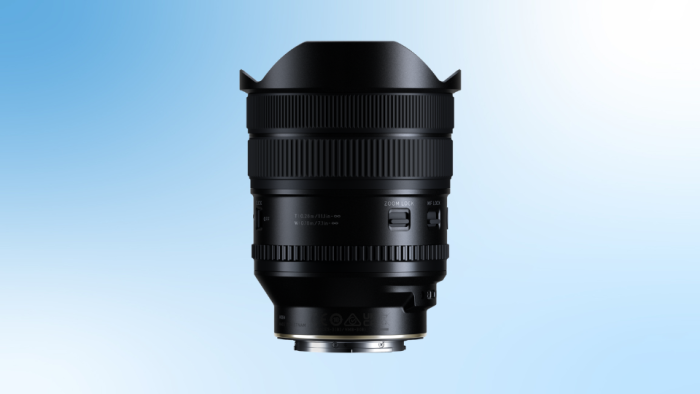
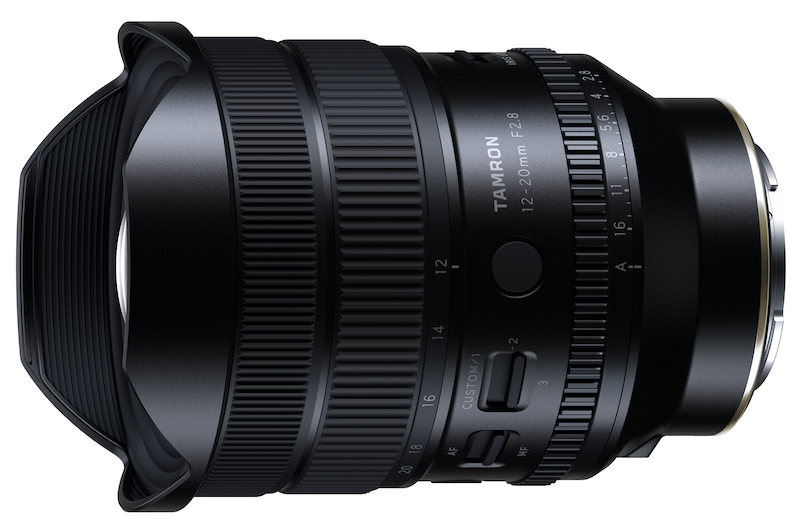
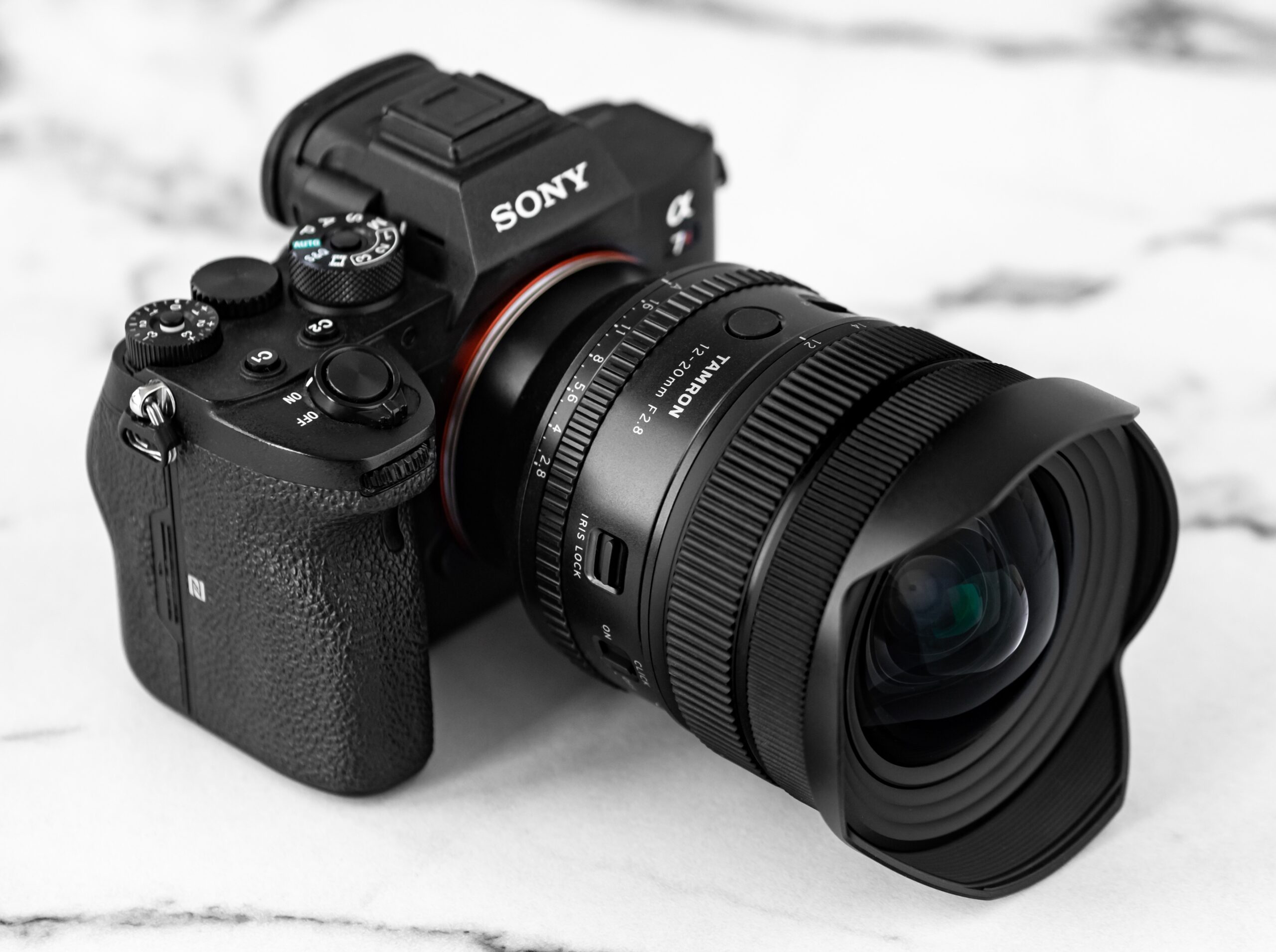
Tamron is introducing a fast, ultra-wide zoom lens for full-frame cameras: the 12-20mm F2.8. It’s being released for Nikon Z-mount and Sony E-mount, and is also ushering in a new look for the company’s lenses.

The 12-20mm F2.8 uses an optical formula with 17 elements in 12 groups, with one expanded glass molded aspherical element, three glass molded aspherical lenses, one extra low dispersion element, and three low dispersion elements. The company says it’s designed to be sharp to the corners, and to minimize and correct for aberrations like color fringing and sagittal coma flare. The latter is especially important for astrophotographers, who may be interested in this lens thanks to its wide focal range.

At 12mm, it can focus on subjects as close as 0.18m (7″), and at 20mm, its minimum focusing distance is 0.28m (11″). It has a 12-blade aperture. Because of its bulbous front element, it can’t accept front filters, but it has a rear filter holder in addition to its integrated lens hood.

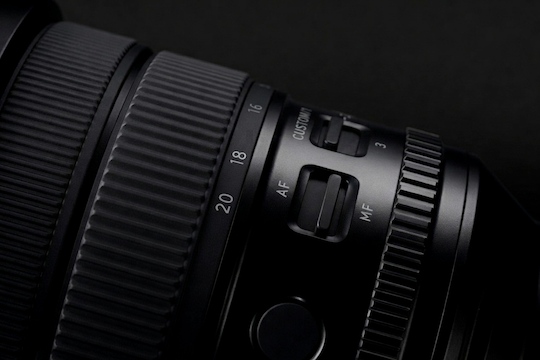
tamron 12-20mm f2p8 lock switches

Focusing is handled by a linear motor and is internal. While zooming doesn’t make the lens any longer, the front element does physically move back into the body. The lens has both an MF/AF switch and a manual focus lock switch; the latter is again something that will be appreciated by astrophotographers.

Beyond those switches, the lens is covered in controls. There’s a customizable function button in both portrait and landscape orientations, a zoom lock switch that can be used to keep the lens at either 12mm or 20mm, a lock for the aperture ring (or control ring on Nikon), a switch to click or declick that ring and a custom setting switch, which you can use Tamron’s Link software to configure to switch between focus position, change your rings’ rotation direction, limit focus, etc. There’s also a USB-C port you can use to update the lens’s firmware, or to connect it to your phone via a cable or wireless adapter to use Tamron Link.

In its briefing, Tamron took a lot of pride in the lens’s size and weight, saying it was comparable to slower lenses, or ones with less range, and substantially lighter than other options. The E-mount version of the lens weighs 570g (20.1oz), with the one for Nikon weighing 15g more. The Sony version is 119mm (4.7″) long, with the Z-mount version adding 2mm.

This isn’t just a new lens for Tamron, though. The company is also introducing its new branding alongside it. Those familiar with the company’s naming conventions may have noticed what’s not there, first: there’s no “Di III” or “VXD” at the end of the name, denoting it as a mirrorless lens that uses a linear motor. Like Sigma , the company has decided that it doesn’t need to distinguish its DSLR lenses from its mirrorless ones directly in the name, and likewise, most of its lenses going forward are likely to use linear motors.

The updated industrial design language that Tamron is launching with the lens is called “Toned Profile Next,” which the company says is made to match how modern cameras are designed, while feeling better in the hand and more recognizably Tamron. Compared to its older lenses, the 12-20mm F2.8 has chunkier rings for zooming, aperture control and focusing, updated textures for its touchpoints, and new placement and print color for its branding. It also narrowed the champagne-colored “brand ring” that borders the lens mount.

I personally quite like the new look, especially since it comes with a clicking aperture ring on E-mount, something Tamron hasn’t been including on its recent lenses. I also appreciate that it’s now quite easy to grip the control rings and to distinguish which one your finger is on just by feel. The switches and buttons are all satisfying to use, and the lens feels solidly built, even if I don’t prefer the finish’s smooth texture.

The Tamron 12-20mm F2.8 will cost $1699 for the E-mount version and $1799 for the Z-mount version; the company says the difference comes down to volume, behind-the-scenes differences in manufacturing, and the competition on the different mounts. The Sony version will be available starting July 30th, while Nikon owners will have to wait until August 27.

Sample Gallery

Please do not reproduce any of these images on a website or any newsletter/magazine without prior permission (see our copyright page ). We make the originals available for private users to download to their own machines for personal examination or printing; we do so in good faith, so please don’t abuse it.

Loading gallery…

Thanks to Nikon for the loan of a Z8 to shoot this gallery. All images were processed using our standard lens workflow in Capture One, with the manufacturer’s distortion correction applied but no correction of vignetting. The profile corrects a minor amount of distortion – barrel at the wide end and pincushion at the long end – but we wouldn’t consider it an essential part of the lens design.

Press release:

TAMRON 12-20mm F2.8 (Model A084) 12mm Ultra Wide-Angle Zoom, Unbelievably Compact Form for Sony E-mount and Nikon Z mount Full-Frame Mirrorless

July 15, 2026, Commack, NY – TAMRON announces the launch of the 12-20mm F2.8 (Model A084), a fast-aperture ultra wide-angle zoom lens, compatible with Sony E-mount and Nikon Z mount full-frame mirrorless cameras. The lens will be on sale for Sony E-mount on July 30 at $1699 USD / $2,299 CAD and for Nikon Z mount on August 27 at $1,799 USD / $2,399 CAD.

The defining feature of the 12-20mm F2.8 (Model A084) is its ultra-wide focal range, from 12mm to 20mm. The overwhelming breadth of the 12mm perspective enables dynamic expression that seems to “capture the entire expanse of a scene.” With a bright F2.8 aperture maintained throughout the entire zoom range, this lens is poised to become the “new protagonist” for astrophotography and interior shooting.

The optical system incorporates an XGM (eXpanded Glass Molded Aspherical) lens element, three GM (Glass Molded Aspherical) lens elements, and multiple special lens elements. This design effectively suppresses peripheral blurring and color fringing while correcting sagittal coma flare — a common challenge in astrophotography — ensuring high sharpness from the center to the extreme edges of the frame.

Despite its exceptional imaging performance, the lens achieves a sophisticated balance of size and weight, measuring just 4.7” (119.3mm) in length and weighing only 20.2oz. (570g)1 . While compact, it remains a professional-grade tool equipped with various switches and rings for superior operability.

For autofocus, the lens features the VXD (Voice-coil eXtreme-torque Drive), a high-speed, high-precision linear motor focus mechanism. Furthermore, with an MOD (Minimum Object Distance) of 7.1” (0.18m) at the 12mm wide end, the lens offers outstanding close-up performance for creative versatility.

Product Features

  1. Beyond the scope of vision — the overwhelming perspective only 12mm can capture
  2. Stunning corner-to-corner resolution for astrophotography and nightscapes
  3. Enhanced mobility for landscapes — a compact and lightweight design
  4. Comprehensive control features to meet professional demands
  5. High-speed, high-precision, and quiet performance — equipped with VXD linear motor focus mechanism
  6. Stunning close-up performance — unleashing the dynamism of ultra wide-angles
  7. Compatible with TAMRON Lens UtilityTM — seamless support for video and stills
  8. Mastery of light — the artistry of a 12-blade circular diaphragm
  9. Evolution of form — introducing the “Toned Profile Next” lens design
  10. Integrated flower-shaped lens hood and locking front lens cap
  11. Integrated rear filter holder
  12. Included soft wrapping cloth for scratch resistance
  13. Protective features (moisture-resistant construction and fluorine coating)

1. Length and weight are for Sony E-mount.

Tamron 12-20mm F2.8 specifications:

Quick Specs

AF motor type
Linear motor
Aperture actuation
Electronic
Aperture ring
Yes
Autofocus
Yes
Diameter
90 mm
Distance scale
No
DoF scale
No
Filter notes
Rear filter holder
Maximum Focal length (T)
20 mm
Minimum Focal length (W)
12 mm
Focus method
Internal
Max format size
35mm FF
Full time manual
Yes
Hood supplied
Yes
Hood product code
Integrated
About the Author: Mitchell started taking pictures at 10 and hasn’t stopped since. It’s been a wide-ranging adventure, spanning a wide variety of genres and locales, and occasionally dipping into fascinations with video and filmmaking. They honed their technical knowledge doing documentation, programing and QA, writing for The Verge, and just generally messing around on the computer to see what breaks.

Want to stay up to date on the latest product news and releases? Add DPReview as a preferred source to ensure our independent journalism makes it to the top of your Google search results.

add as a preferred source on google

FieldMade introduced new custom lens hood & Pelican case indicator labels

Par : PR admin
14 juillet 2026 à 18:02


FieldMade introduced new custom lens hood & Pelican case indicator labels.

  • Get 10% off your FieldMade order with code “Rumors10“ (minimum purchase of $20 CAD, cannot be combined with other discounts)
  • Previous coverage of FieldMade can be found here
  • Additional information on the new labels:

Customizable Lens Hood & ID Labels
Engineered to stop the frustration of mixing up identical-looking lens hoods on busy sets. This system allows shooters to easily differentiate similar hoods while adding their custom studio or business name directly to lens bodies and camera setups for durable, clean ownership tracking.

Customizable ID Labels for Pelican Cases
Heavy-duty, weatherproof labels designed to replace messy gaffer tape on rugged hard cases. These IDs allow creators to identify exactly what gear is inside each case at a glance, giving the entire production kit a sleek, cohesive, and professional look during client sessions.

New FieldMade stealth blackout decals kits for Sony, Canon, Nikon, and Leica cameras (coupon code included)

Field Made unveiled a complete customizable battery indicator/labels ecosystem for Canon, Nikon, and Sony cameras (coupon code included)

The post FieldMade introduced new custom lens hood & Pelican case indicator labels appeared first on Photo Rumors.

Jimmy Chin says bringing less gear makes you a better photographer

Adventure photographer and filmmaker Jimmy Chin recently sat down for a Q&A with Canon, sharing tips for finding your creative voice.

Person in a blue shirt and cap sitting and smiling in a modern room with shelves and books; on-image text reads: Q&A with Canon Explorer of Light Jimmy Chin.Canon

Jimmy Chin is an Academy Award-winning filmmaker, National Geographic photographer, author and elite mountain athlete. Known for telling epic adventure stories from remote corners of the world, Chin is also a Canon Explorer of Light. He recently sat down for a Q&A session on Canon’s YouTube channel, sharing his insight on his gear considerations and general approach to photography.

One thing I found particularly interesting was that he’s reduced the amount of gear he brings on shoots. Instead of hauling a huge kit, he’ll only take a couple of lenses, or sometimes just a single lens. “I’ve found that when you are working within certain constraints, it actually pushes you creatively,” he says. “It makes you find creative solutions to the different problems and challenges that you face on a shoot.” Of course, for the type of photography and videography he does, having less gear is also helpful logistically and physically, but I appreciate his mindset of using less to grow creatively.

Adaptability is also a key trait according to Chin, both in terms of gear and overall mindset. “Adaptability is a huge part of being a great photographer and being able to roll with the punches on shoots,” he says. “Sometimes you get really focused on the single shot that you really want, and you’re missing all kinds of other shots. So you have to keep your eyes open and your mind open.”

Chin also recommends looking at a lot of photography and, specifically, paying attention to many genres, even beyond what you’re personally interested in. “Look at all the greats. Understand kind of the approach that all these different artists have come to their craft,” he says. “I think that understanding and the thought processes of creating images is a really good place to make photography fun for you, because all of a sudden you are looking at the world in these different ways and then you kind of find your own language and your own ideas for how you think about photograph, and that’s what makes your photography special.”

The video has plenty of other great advice, too. It’s well worth a watch, especially for newer photographers trying to figure out how to move forward.

About the Author: Abby Ferguson holds an MFA in photography and blends a fine-art background with extensive editorial and commercial experience. She built and led an in-house imaging program for a large vacation rental company and has served as an associate editor at Popular Photography. She also teaches at a local community college and serves on its Photographic Technology Program Advisory Board, sharing her knowledge and enthusiasm for the medium.

Want to stay up to date on the latest product news and releases? Add DPReview as a preferred source to ensure our independent journalism makes it to the top of your Google search results.

add as a preferred source on google

The FCC is coming for Xtra and other DJI clone brands in the US

The U.S. Federal Communications Commission has fined multiple companies over alleged imports of DJI technology into the United States.

Compact action camera with XTRA EDGE label, featuring a display that shows someone skateboarding outdoors near a city skyline.Xtra

Xtra is one of the eight companies facing potential penalties.

The U.S. Federal Communications Commission (FCC) is proposing $25,000 fines against eight companies after they allegedly failed to respond to questions about DJI‑related products sold in the United States. The agency is examining whether these firms played a role in bringing cameras, drones and other wireless devices based on DJI technology into the country under different brand names.

The companies named in the action are Cogito Tech, Fixaxo Technology, Lyno Dynamics, Skyhigh Tech, Spatial Hover, SZ Knowact, WaveGo Tech and Xtra Technology. According to the FCC, the proposed penalties stem from the companies’ refusal to answer formal letters of inquiry, rather than from a final determination that specific products violated U.S. equipment rules. Each firm has until July 20 to respond before the Commission decides whether to proceed with the fines or take further enforcement steps.

This latest action builds on a series of moves that have steadily tightened U.S. scrutiny of DJI. In late 2025, the FCC added DJI to its “Covered List,” a designation that prevents new DJI radio‑based products from receiving equipment authorization, effectively blocking future models from entering the U.S. market. Existing, previously approved drones can, however, continue to be sold and flown. As DPReview reported at the time, that shift marked a turning point in the long‑running debate over a possible “DJI ban” and pushed creators toward stockpiling current models or looking at alternative brands.

Handheld gimbal camera with built-in display, displaying a person in an orange jacket raising an arm, set against mountains and a blue sky outside.
Xtra’s products have drawn comparison to DJI’s Osmo Action and Osmo Pocket lineups.
Xtra

Xtra’s inclusion in the new enforcement action is particularly notable for photographers and filmmakers. The brand has been selling cameras and gimbal systems in the U.S. that closely resemble DJI’s Osmo Pocket and Osmo Action lines, effectively providing a path for DJI‑style hardware to reach U.S. buyers despite the Covered List restricting new DJI‑branded products.

What this could mean for DJI’s U.S. prospects

In the short term, the FCC’s move does not mean that existing DJI or Xtra products are suddenly banned or pulled from shelves. Equipment that already holds valid FCC authorizations remains legal to own and operate. However, if enforcement pressure causes these lesser‑known brands to scale back or exit the U.S. market, the supply of DJI‑adjacent “clone” or rebadged devices could become more limited.

Longer term, the enforcement push could complicate DJI’s efforts to return to the U.S. under its own name rather than help it. By formally targeting companies suspected of funneling DJI‑linked technology into the country, the FCC is reinforcing the idea that this hardware poses enough concern to warrant ongoing scrutiny. That may strengthen the case for strict controls and keep political and regulatory pressure on DJI high, even as the company continues to challenge its inclusion on the Covered List and push for a path to get new products approved again.

We’ll have to wait and see what the outcome will be, but the direction from regulators is clear: companies tied to DJI‑linked technology are expected to fully cooperate with FCC investigations, and a lack of cooperation could result in additional enforcement action beyond the currently proposed fines.

About the Author: Abby Ferguson holds an MFA in photography and blends a fine-art background with extensive editorial and commercial experience. She built and led an in-house imaging program for a large vacation rental company and has served as an associate editor at Popular Photography. She also teaches at a local community college and serves on its Photographic Technology Program Advisory Board, sharing her knowledge and enthusiasm for the medium.

Want to stay up to date on the latest product news and releases? Add DPReview as a preferred source to ensure our independent journalism makes it to the top of your Google search results.

add as a preferred source on google

The $100 Godox kit that finally killed my excuse to not use flash

The Godox iT32 flash and wireless controller make off-board flash more accessible than ever.

A Godox iT32 flash, mounted on an X5 controller, with the flash head angled upwardsMitchell Clark

The Godox iT32 is a pocketable, $80 flash. And it essentially sweeps away all the hurdles that stood in the way of me using flash.

I suspect I’m not alone in having found the cost of flash systems off-putting, when I first started photography. I’d scrabbled together enough money for a camera body with a nice kit zoom and immediately turned my attention to additional lenses. Flash was always the next thing on my list. And, two decades later, it still is.

You learn early on that flashes are most effective, creatively when they’re positioned away from the camera, but this invokes all the costs of remote triggers and off-board flashes, or being limited by the length of cables, because I’d bought an entry-level DSLR that couldn’t act as a flash commander, and I didn’t feel confident enough to start with manual, rather than TTL-controlled flash.

A Godox X5 flash trigger, mounted in a camera's hotshoeMitchell Clark

The iT32 solves that off-camera problem because it connects to your camera via a small, hotshoe-mounted radio-frequency controller. The cost of this controller? between $20 and $34, depending on which brand of camera you use.

The X5 controller slots into your camera’s hotshoe and the iT32 attaches magnetically to the controller. Or you can disconnect the flash and fire it remotely. The flash itself communicates using Godox’s own communication protocol and can pair with any X5 controller, providing TTL compatibility whatever brand camera you own. It also means that you can buy a single iT32 and make it work even if you have cameras from more than one brand.

A Godox iT32 still behind a trio of different X5 controllers
Additional X5 controllers are available for most popular systems, meaning it’ll cost around $20 to add compatibility to any system you happen to use.
Richard Butler
Godox TransmitterMSRP
CanonX5 C* $20
FujifilmX5 F$20
Leica (limited models)X5 L$34
NikonX5 N$20
Olympus
/Panasonic
X5 O$20
SonyX5 S$25

*Godox says Canon cameras with multi-interface hotshoes should use an adapter to mount the X5 C. It makes a “X5 Cm” version for these newer cameras but has limited its sales to China.

The X5 can only control flashes operating in a single group, so you can’t use it as the basis of a complex multi-group setup, but the iT32 itself can operate in different groups, so will still be usable, if you decide to expand your setup, later.

So far, I’ve just been using the X5 and iT32 combination and have found it to be a really low-risk place to start experimenting with flash. It’s a genuinely small unit, that makes it easy to keep with me. It has a guide number of 18m, so it’s not especially powerful, but it’s enough of a step up from any camera’s built-in flash that, especially combined with the ability to use off-camera, is enough to make it worth carrying around.

In-use

A Godox iT32 flash with X5 controller and their accessories
The iT32 comes with a diffuser, two warming gels that attach magnetically and a small stand (which has a tripod thread on its base), to which it can attach magnetically or via the hotshoe mount of an X5.
Mitchel Clark

For such a small unit, the iT32 has a surprising number of control points. There’s a power/flash test button, a Set button and a Menu button, along with a dial on the side, used for quick control. But the iT32’s small rear screen is also touch-sensitive, so it’s really quick to operate, rather than requiring odd combinations of button pressing and dial turns.

To turn the unit on you hold the power/test button for two seconds then scroll the control dial upwards to confirm that it’s not just pressed against something in your bag.

You can access the menu by pressing the Menu button or swiping down on the screen. In the menu you’ll find options for controlling the modelling lamp on the front of the flash, a control for switching between TTL, Manual and multi-flash (strobe) modes, as well as deciding whether the flash is in on-camera mode, sender or receiver.

The rear screen of a Godox iT32 flash
The rear screen of the iT32. It’s (very) touch sensitive, to the point that I found it easier to lock the screen (swipe down and tap the lock button), then control everything from the X5
Mitchel Clark

The iT32 automatically switches to receiver mode when you detach it from the on-camera X5, so you don’t need to give most of this much thought.

In use you can set exposure compensation by turning the dial on the side of the flash, by swiping left or right on the touchscreen or, when the iT32 is working remotely away from the base, by pressing the small + and – buttons on the back of the X5 controller.

If you have a pair of iT32s you can your their controls to set them to different manual flash values (or flash exposure comp values if in TTL mode). You can still use the X5 to increase and decrease these values remotely, but any increase or decrease will be applied to both flashes, so you can’t remotely adjust them independently, as you would in a proper system of grouped flashes.

The USB port and sync terminal of a Godox iT32 flash
The iT32 has a built-in battery that can be recharged over its USB-C socket.
Mitchel Clark

When working handheld, I found the touchscreen to be very sensitive and the control dial very easy to jog, so tended to make use of the ‘Lock’ function in the menu, to stop myself accidentally changing the flash settings. Once lock is engaged, you need to hold ‘Set’ for two seconds to re-activate the controls.

The iT32 has its own, built-in battery, so you don’t need to hunt around for a fresh set of AAs all the time. It recharges over its USB-C socket, which is also used for updating firmware for both the flash and the X5. The X5 unit has its own battery, which charges up when connected to the iT32. You can check the battery level on the menu of the flash, when it’s connected, or long-press the – button, where it will communicate its charge level with between zero and four flashes of its tiny red LED.

A man with flowing hair and a beard holds a dart and looks intently off to the side of the image
A little bit of flash, fired from off the left of the shot, helps to balance the daylight streaming in from the right.

Panasonic L10 | 50mm equiv. | F2.7 | 1/60 sec | ISO 1250
Richard Butler

Generally, getting started with the iT32 is simplicity itself. The two units pair with one another when physically connected, switching the flash to the correct camera brand’s protocol, and then auto switches between on- and off-camera operation. It’s only two swipes on the touchscreen to manually engage receiver mode, if you power the flash on again later and don’t want to have to physically re-connect them each time.

This simple, sub-$100 set overcame pretty much all of my previous concerns about cost, compatibility or batteries

As you use the setup more, it’s worth scanning through the manual, as there are some differences between camera brands about how to access modes such as high-speed sync and rear curtain flash sync, but there’s nothing that a complete novice should find off-putting at all.

Overall, though, I found the X5 / iT32 pairing to be a remarkably cost-effective way to access the world of flash photography. And, significantly, the realm of off-board flash. This simple, sub-$100 set overcame pretty much all of my previous concerns about cost, about compatibility and around batteries, leaving me with no excuse.

About the Author: Richard graduated as a scientist but had a lot more fun writing and shooting for his university magazine. A number of years spent variously as a reporter, writer and editor on science and engineering titles combined his knowledge of science with his interest in images and words. But it was spotting the connections between emission spectra, white balance and all the nonsense he’d taught himself playing around in Photoshop that helped kindle an interest in digital photography. Searching for a camera led to him discovering DPReview and Richard was recruited by Phil Askey in 2007. He’s been combining his love of photography, communication and attention to detail (pedantry?) ever since. He has unusually strong opinions about lenses for the APS-C format.

Want to stay up to date on the latest product news and releases? Add DPReview as a preferred source to ensure our independent journalism makes it to the top of your Google search results.

add as a preferred source on google

❌